
2027 Is Data Science Hard? Guide to Overcoming Challenges

Co-Founder and Chief Data Scientist
Many students view data science as an intimidating career path due to its steep learning curve. It requires mastering mathematics, statistics, and programming while also developing strong analytical and problem-solving skills.
Yet, despite its challenges, data science remains one of the most rewarding and future-proof careers. In 2024, data scientists held about 245,900 jobs, with computer systems design and related services employing the largest share at 11% (Bureau of Labor Statistics [BLS], 2024). These numbers underscore the growing importance of data scientists across various industries.
As a career planning and education expert, I’ve seen how this field transforms careers. In this guide, my team and I will discuss its challenges, growth trends, and practical tips for success.
What are the benefits of pursuing a career in data science?
- The median annual wage for data scientists was $112,590 in May 2024, with top earners making up to $194,410 per year (BLS, 2024).
- Data scientists are needed in multiple sectors beyond tech, with the highest employment in computer systems design (23,150 positions) and strong demand in consulting, insurance, and research services (BLS, 2023).
- Professionals can advance into leadership roles such as data science managers or chief data officers, or specialize in high-demand areas like machine learning, AI, or cloud engineering for even greater impact and pay.
- What makes data science a challenging career? Challenges
- What do data scientists do? Career Overview
- How difficult is it to learn data science? Learning Difficulty
- Which subfield of data science is the most mathematically challenging? Subfields
- How difficult is data science compared to cybersecurity? How difficult is data science compared to cybersecurity?
- Which emerging technologies will impact data science careers the most? Which emerging technologies will impact data science careers the most?
- How competitive is the data science job market? Job Market
- What technical skills are essential to succeed in data science? Skills
- How can a graduate of data science build a strong portfolio? Career Tips
- What strategies can help data scientists move into leadership roles? What strategies can help data scientists move into leadership roles?
Is data science hard? What makes the career challenging in 2026
Data science is hard because it sits at the intersection of programming, statistics, business judgment, and communication. A successful data scientist is not only expected to write code or build models; they must understand messy real-world data, choose the right analytical method, explain uncertainty, and turn results into decisions that teams can actually use.
This guide is for students, career changers, analysts, engineers, and working professionals who are trying to decide whether data science is the right path. It explains why the field is difficult, what data scientists do, which skills matter most, how data science compares with cybersecurity, how competitive the job market is, and how graduates can build portfolios that show real ability.
The difficulty is real, but it is manageable. People who enjoy solving ambiguous problems, learning technical tools, and explaining complex ideas can build a strong data science career with the right foundation, projects, and career strategy.
Quick answer: How hard is data science?
Data science is challenging but learnable. The hardest parts are usually statistics, machine learning, programming, data cleaning, and communicating results to non-technical decision-makers. Learners with experience in mathematics, computer science, engineering, economics, analytics, or research may have a faster start, while those without a technical background often need more time to build foundational skills.
| Challenge area | Why it is difficult | How to prepare |
| Mathematics and statistics | Data scientists need to understand probability, inference, regression, linear algebra, and model evaluation. | Build fundamentals before jumping into advanced machine learning. |
| Programming | Most work requires writing code, debugging workflows, and using libraries for analysis and modeling. | Start with Python or R, then add SQL and version control. |
| Messy data | Real datasets are incomplete, inconsistent, duplicated, biased, or stored across systems. | Practice data cleaning, data validation, and exploratory analysis on real datasets. |
| Business problem-solving | A technically accurate model is not useful unless it answers the right question. | Learn to define project goals, success metrics, and stakeholder needs. |
| Communication | Findings must be explained clearly to people who may not understand code or statistical assumptions. | Use dashboards, plain-language summaries, and visual storytelling. |
One reason data science feels difficult is that many adults wish they had stronger quantitative preparation. According to Gallup (2025), 4 in 10 adults (43%) wish they had learned more math skills in middle or high school. Among the most desired skills are financial math (29%), data science (21%), software (20%), and programming (20%). For aspiring data scientists, this reinforces the value of building math and technical foundations deliberately rather than trying to skip straight to advanced tools.
Experienced professionals who want to move beyond applied analytics into research, senior technical leadership, or advanced modeling may consider the best online doctorate in data science. Doctoral programs are most appropriate for people who need advanced research training, not for beginners who are still learning core programming and statistics.
What do data scientists actually do?
Data scientists use data to answer complex questions, support decisions, and build predictive or automated systems. Their work often changes by company and industry, but most roles include a mix of data preparation, analysis, modeling, communication, and collaboration.
- Gather and prepare data. Data scientists pull information from databases, APIs, spreadsheets, product systems, surveys, logs, and third-party sources. They check quality, remove errors, handle missing values, and reshape data for analysis.
- Explore patterns and relationships. They use statistics, visualizations, and exploratory data analysis to identify trends, outliers, correlations, and possible causes worth investigating further.
- Build and test models. Many roles involve machine learning models that predict outcomes, classify records, recommend products, detect anomalies, or estimate risk.
- Evaluate results carefully. Data scientists test whether a model performs well, whether assumptions are reasonable, and whether the findings are reliable enough to guide action.
- Translate technical findings into business insight. A major part of the job is explaining what the data means, what the limitations are, and what decision-makers should do next.
- Create reports, dashboards, and visualizations. Data scientists use charts, interactive dashboards, and written summaries to make complex analysis easier to understand.
- Work across teams. They often collaborate with data engineers, software engineers, product managers, analysts, executives, compliance teams, and cybersecurity professionals.
| Project stage | Typical tasks | Skills used |
| Problem definition | Clarify the business question, define success metrics, and identify available data. | Business analysis, stakeholder communication, domain knowledge |
| Data preparation | Collect, clean, join, validate, and transform data. | SQL, Python or R, data quality checks, database knowledge |
| Analysis and modeling | Run statistical analysis, build models, tune algorithms, and compare results. | Statistics, machine learning, experimentation, programming |
| Interpretation | Explain findings, uncertainty, limitations, and recommended actions. | Critical thinking, visualization, written and verbal communication |
| Deployment or reporting | Deliver dashboards, reports, model outputs, or production-ready workflows. | Cloud platforms, dashboards, MLOps, collaboration with engineering teams |
Because many data projects involve sensitive information, data scientists increasingly work with IT and security teams. Professionals who want to combine analytics with system protection may benefit from an online network security master's, especially if they plan to work with regulated data, fraud detection, security analytics, or privacy-focused machine learning.
How difficult is it to learn data science?
Learning data science is difficult because it is not one subject. It combines programming, statistics, databases, machine learning, visualization, and business reasoning. The learning curve depends heavily on what you already know and how much time you can spend practicing with real data.
Students who have completed a bachelor’s degree in computer science, statistics, engineering, mathematics, economics, or a related quantitative field often find the technical material more familiar. Learners who pursue the fastest online master's degree in mathematics may strengthen the quantitative base needed for advanced modeling, probability, optimization, and statistical reasoning.
Other learners prefer a structured graduate program in data science, analytics, engineering, or applied computing. A fast track industrial engineering online master’s, for example, can be useful for professionals interested in operations, optimization, systems modeling, supply chains, and process improvement.
Hands-on work is where many learners discover the real difficulty of the field. Classroom examples are usually cleaner than workplace data. In practical projects, students may build customer churn models, recommendation systems, Tableau or Power BI dashboards, or large-scale analyses using Hadoop and Spark. These projects require more than choosing an algorithm; learners must clean data, engineer useful features, validate assumptions, and judge whether a model is useful in context.
Doctoral-level data science is significantly more demanding. PhD students are expected to contribute original research, design new methods, publish peer-reviewed work, and engage deeply with theory. A doctoral project might involve improving deep learning architectures, optimizing natural language processing models for sentiment analysis, or applying causal inference methods to public health data.
People without a STEM background can still enter data science, but they should expect a longer ramp-up period. A realistic path usually starts with statistics, Python or R, SQL, and basic data visualization before moving into machine learning and advanced modeling.
Estimated learning path by background
| Learner background | Likely advantages | Likely challenges | Best starting point |
| Computer science or software engineering | Programming, algorithms, systems thinking | Statistics, inference, experiment design, business interpretation | Statistics, machine learning, data analysis projects |
| Mathematics or statistics | Probability, modeling, quantitative reasoning | Software tools, databases, production workflows | Python, SQL, data engineering basics |
| Business, finance, or economics | Domain knowledge, decision-making context, quantitative exposure | Programming depth, machine learning implementation | Python or R, SQL, applied analytics projects |
| Non-technical background | Communication, domain expertise, user perspective | Math, coding, technical vocabulary, model evaluation | Foundational statistics, beginner programming, guided projects |
Which areas of data science require the most math?
All data science roles require some quantitative skill, but not every role requires advanced theory. A business intelligence analyst may use descriptive statistics and SQL every day, while a machine learning researcher may need deep knowledge of calculus, probability, optimization, and linear algebra. Learners with strong software preparation, including those who complete a fast track software engineering degree online, may be better prepared for algorithm-heavy work because they have stronger coding, abstraction, and systems-design experience.
The most mathematically demanding areas usually include the following:
- Machine learning and deep learning. These fields rely on calculus, linear algebra, probability, optimization, and statistical learning theory. Advanced practitioners may design new architectures, improve training methods, or evaluate complex model behavior.
- Bayesian statistics and probabilistic modeling. This specialization focuses on uncertainty, prior distributions, inference, and probabilistic reasoning. It is common in advanced statistics, research, forecasting, and high-stakes decision modeling.
- Computer vision and natural language processing. These areas require strong understanding of vectors, matrices, embeddings, optimization, neural networks, and model evaluation for image, video, speech, or text data.
- Causal inference and experimentation. This work requires careful reasoning about cause and effect, confounding variables, randomized experiments, quasi-experimental methods, and the limits of observational data.
- Optimization and operations research. These methods are important in logistics, scheduling, pricing, supply chains, transportation, and resource allocation.
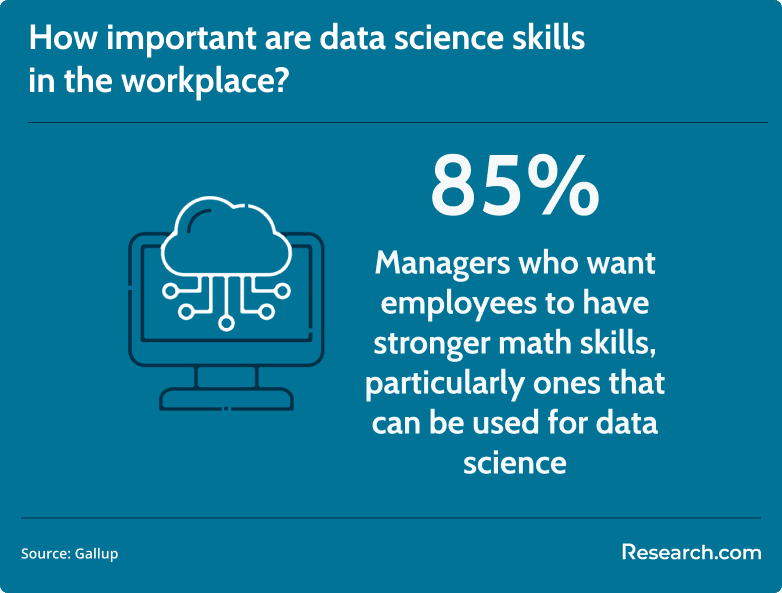
Mathematical readiness matters not only for individual learners but also for employers. According to Gallup (2025), 85% of managers wish their team members had stronger math skills in at least one area, with data science ranking among the most desired skills (37%), along with financial and foundational math (41%, respectively).
How difficult is data science compared with cybersecurity?
Data science and cybersecurity are both demanding technology careers, but they are hard in different ways. Data science is usually more math-heavy and model-focused. Cybersecurity is often more systems-focused, risk-focused, and incident-driven.
| Comparison point | Data science | Cybersecurity |
| Main challenge | Turning complex, messy data into reliable insights, predictions, or models. | Protecting systems, detecting threats, managing risk, and responding to incidents. |
| Core skills | Statistics, programming, machine learning, SQL, visualization, business analysis. | Networking, operating systems, security tools, threat analysis, compliance, incident response. |
| Typical pressure | Ambiguous problems, uncertain data quality, model performance, stakeholder expectations. | Urgent security events, evolving threats, system vulnerabilities, response time. |
| Best fit for | People who enjoy quantitative reasoning, modeling, experimentation, and explaining patterns. | People who enjoy defense, investigation, systems thinking, risk management, and technical troubleshooting. |
| Common credentials | Degrees in data science, statistics, computer science, analytics, or related fields. | Cybersecurity or IT degrees plus credentials such as fastest online CompTIA cloud+ training bootcamps, Certified Information Systems Security Professional (CISSP), and Certified Ethical Hacker (CEH). |
Some learners find data science harder because abstract mathematics and statistical assumptions can be difficult to master. Others find cybersecurity harder because security work may involve constant vigilance, high-pressure incidents, and the need to keep up with new attack methods. The better choice depends on your strengths: choose data science if you like modeling and evidence-based decision-making; consider cybersecurity if you prefer system protection, digital forensics, and real-time technical defense.
Which technologies are changing data science careers?
Data science is changing quickly. The most important trend is not that tools will replace data scientists, but that employers increasingly expect data professionals to work with automation, cloud platforms, privacy requirements, and AI-assisted workflows. The value of a data scientist is shifting toward problem framing, model judgment, governance, communication, and responsible deployment.
- Generative AI and large language models. GPT-based systems and related tools can assist with code generation, text analysis, documentation, data exploration, and natural language interfaces. Data scientists still need to validate outputs and understand limitations.
- Automated machine learning. AutoML can speed up model selection, hyperparameter tuning, and baseline model development. This makes it more important for professionals to understand when automation is appropriate and how to interpret results.
- Cloud-native AI platforms. Services such as AWS SageMaker, Azure ML, and Google Vertex AI are central to many modern workflows because they support collaboration, scalable training, deployment, monitoring, and integration with production systems.
- Edge computing. More organizations want analytics near the point where data is generated, including IoT devices, sensors, manufacturing equipment, and connected products. This creates demand for real-time and low-latency data skills.
- Data privacy and security technologies. Federated learning, differential privacy, secure data sharing, and privacy-aware analytics are becoming more important as organizations manage sensitive data and regulatory obligations.
- Quantum computing. Quantum computing remains an early-stage area, but it may eventually affect optimization, cryptography, simulation, and other large-scale computational problems.
For readers exploring how to get into tech, data science can be one route into the field, but it is not the only one. Entry-level analytics, business intelligence, data operations, and cloud support roles can provide practical experience before moving into more advanced machine learning or data science positions.
How competitive is the data science job market?
The data science job market has strong demand, but it is also more competitive than it was when the field was newer. Many applicants now have degrees, certificates, bootcamp projects, or analytics experience, so employers often look for evidence that candidates can solve real business problems rather than simply list tools on a resume.
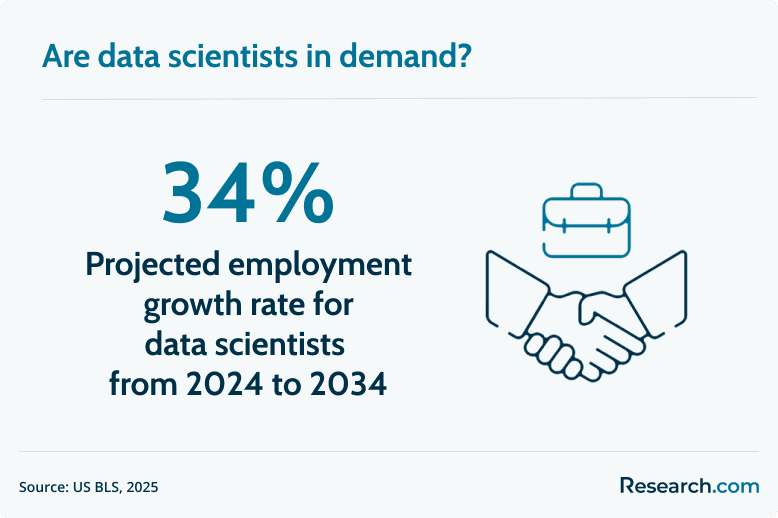
Employment of data scientists is projected to grow 34% from 2024 to 2034, much faster than the average for all occupations, with about 23,400 job openings per year over the next decade (BLS, 2024). Demand appears across healthcare, finance, e-commerce, technology, logistics, government, education, and other sectors that use data to improve decisions and operations.
Competition varies by location, industry, and seniority. Major technology hubs may offer more roles but also attract more qualified applicants. Smaller markets and specialized industries may have fewer openings, but candidates with domain knowledge can stand out. Globally, the data science platform market was valued at $96.25 billion in 2023 and is projected to grow at a 26.0% CAGR from 2024 to 2030, signaling continued investment in data science platforms and related skills (Grand View Research, 2023).
How to stand out in a competitive data science market
- Show complete projects, not isolated notebooks. Employers want to see how you define a problem, clean data, build models, evaluate results, and communicate recommendations.
- Develop domain knowledge. A candidate who understands healthcare operations, finance, supply chains, marketing, cybersecurity, or public policy can often apply data science more effectively.
- Learn SQL deeply. Many entry-level candidates focus on machine learning but struggle to retrieve, join, and validate data from databases.
- Explain trade-offs. Hiring teams value candidates who can discuss model limitations, bias, leakage, interpretability, and business impact.
- Build communication artifacts. Add dashboards, executive summaries, and clear visualizations to your portfolio, not just code.
What technical skills are essential for data science?
Data scientists need a layered skill set. Some skills help you get and prepare data, some help you model it, and others help you communicate the result. Beginners often make the mistake of jumping straight to neural networks before learning SQL, statistics, and data cleaning, but employers frequently need people who can handle the full workflow.
| Skill | Why it matters | Examples of what to practice |
| Python or R | These languages are widely used for data manipulation, analysis, automation, and machine learning. | Pandas, NumPy, Scikit-learn, tidyverse, scripting, reusable functions |
| SQL and databases | Most business data lives in structured databases, so data scientists must retrieve and combine it correctly. | Joins, aggregations, subqueries, window functions, data validation |
| Statistics and probability | Statistical thinking helps professionals avoid false conclusions and evaluate uncertainty. | Regression, hypothesis testing, confidence intervals, distributions, sampling |
| Machine learning | Models are used for prediction, classification, recommendations, anomaly detection, and automation. | Train-test splits, cross-validation, feature engineering, model selection, evaluation metrics |
| Data cleaning and manipulation | Real data is often incomplete, inconsistent, or poorly structured. | Missing values, duplicates, outliers, formatting issues, feature transformation |
| Visualization and dashboards | Stakeholders need clear evidence, not raw model output. | Tableau, Power BI, Matplotlib, Seaborn, dashboard design, chart selection |
| Big data tools | Some organizations work with datasets too large for traditional local analysis. | Hadoop, Spark, distributed processing concepts |
| Cloud computing | Cloud platforms are commonly used for scalable storage, model training, deployment, and monitoring. | AWS, Azure, Google Cloud, cloud storage, managed ML platforms |
| Machine learning frameworks | Frameworks support model development, experimentation, and deployment. | TensorFlow, PyTorch, Scikit-learn |
According to the Data Skills Gap (2025) report, employers report a mismatch between the technical skills they need and the skills available in the workforce. The chart below identifies statistical analysis and modeling (58%) as the most lacking skill.
The report also identifies knowledge of programming languages (46%) and data manipulation and cleaning (44%) as major gaps. Other reported gaps include data visualization (31%) and experience with data warehouse and cloud computing platforms (28%).
These gaps explain why the field can be difficult for job seekers: employers need people who can combine theory, tools, and applied judgment. Readers asking is health information technology hard will notice overlap with data science, especially in data management, privacy, analytical thinking, and attention to detail.
How can a data science graduate build a strong portfolio?
A strong portfolio is one of the clearest ways to prove that you can apply data science beyond coursework. The best portfolios show complete thinking: the problem, the data source, the cleaning process, the analysis, the model, the limitations, and the recommendation.
- Use capstone projects strategically. A strong bachelor’s or master’s capstone can become a portfolio centerpiece if it solves a realistic problem and includes documentation, code, visuals, and interpretation.
- Compete in Kaggle challenges thoughtfully. Kaggle can help you practice modeling on real datasets, but do not rely only on leaderboard scores. Explain your process, what you tried, and what you learned.
- Publish clean GitHub repositories. Employers may review public code, so repositories should include readable notebooks or scripts, a clear README, requirements, data notes, and project summaries.
- Create end-to-end projects. Strong projects include data collection, cleaning, exploratory analysis, feature engineering, modeling, evaluation, and visualization.
- Write project explanations or tutorials. Blog posts and tutorials show that you can explain technical work to other people, a skill that matters in stakeholder-facing roles.
- Build a simple portfolio website. A personal site can organize project summaries, dashboards, GitHub links, visualizations, and contact information in one place.
- Include business recommendations. Do not stop at accuracy scores. Explain what action an organization could take based on the analysis and what risks or limits remain.
| Portfolio item | What it proves | Common weakness to avoid |
| Predictive modeling project | You can train, compare, and evaluate models. | Reporting only accuracy without explaining data leakage, bias, or business relevance. |
| Dashboard project | You can communicate trends and metrics visually. | Using attractive charts that do not answer a clear question. |
| Data cleaning project | You can handle messy real-world data. | Hiding the cleaning process instead of documenting decisions. |
| Domain-specific analysis | You understand how data applies to an industry or function. | Choosing a topic without explaining why the results matter. |
| Technical blog post | You can explain methods clearly. | Writing a tutorial that repeats code without interpretation. |
Employers consistently emphasize practical experience as a strong indicator of readiness for data science roles. The chart below shows that real-world projects and internships (73%) are the most valued forms of hands-on learning because they demonstrate that candidates can apply theory to business problems. Case studies (55%) and capstone projects (45%) are also valued forms of applied learning.
How can data scientists move into leadership roles?
Moving from data scientist to data science leader requires more than stronger modeling skills. Leaders must connect analytics to strategy, manage people and priorities, communicate with executives, guide responsible AI use, and make decisions when data is incomplete.
- Pursue advanced education when it matches your goal. A master’s degree or PhD in data science, analytics, statistics, computer science, or business can support research-intensive, strategic, or executive-facing roles.
- Build business judgment. Leaders need to understand how data projects affect revenue, cost, risk, customer experience, operations, or policy outcomes.
- Improve executive communication. Senior data professionals must explain technical trade-offs, uncertainty, and recommendations in language that non-technical leaders can act on.
- Lead projects before managing people. Owning roadmaps, mentoring junior colleagues, coordinating stakeholders, and delivering cross-functional projects can demonstrate leadership readiness.
- Learn project management and agile methods. Data science leaders often manage timelines, backlogs, experiments, dependencies, and changing business priorities.
- Understand model deployment and operations. Leaders should know how models move from notebooks into production, how they are monitored, and how performance changes over time.
- Expand cloud and engineering knowledge. Programs such as accelerated cloud engineering courses online can help professionals understand AWS, Azure, Google Cloud, deployment workflows, and production-oriented machine learning environments.
- Develop internal and external networks. Relationships with product, engineering, compliance, finance, and executive teams create more opportunities to influence decisions and earn leadership responsibilities.
Common mistakes that make data science harder than it needs to be
| Mistake | Why it hurts | Better approach |
| Learning tools without learning statistics | You may build models without understanding whether the results are valid. | Study probability, regression, sampling, uncertainty, and evaluation metrics alongside tools. |
| Skipping SQL | Many jobs require retrieving and joining data before any modeling begins. | Practice SQL until you can query, aggregate, and validate data confidently. |
| Only doing guided tutorials | Tutorials may hide the messy decisions that occur in real projects. | Work on open-ended datasets where you must define the question and process. |
| Overemphasizing complex models | A simpler model may be more interpretable, reliable, and useful for the business. | Compare simple baselines with advanced models and explain trade-offs. |
| Ignoring communication | Good analysis has limited value if stakeholders do not understand it. | Create summaries, visualizations, and recommendations for non-technical audiences. |
| Assuming a certificate or degree guarantees a job | Hiring depends on skills, projects, experience, market conditions, and fit. | Pair education with internships, portfolio work, networking, and interview preparation. |
Questions to ask before choosing a data science path
- Do I enjoy math and uncertainty? Data science often involves incomplete data, imperfect models, and probabilistic answers rather than clear yes-or-no solutions.
- Am I willing to code regularly? Even analytics-focused roles usually require Python, R, SQL, or similar tools.
- Do I want to build models, explain data, or manage data systems? Your answer may point you toward data science, analytics, machine learning engineering, business intelligence, or data engineering.
- What industries interest me? Domain knowledge can make you more employable and help you ask better questions.
- Can I show practical work? A portfolio, internship, capstone, or work project can matter as much as coursework.
- Do I need a degree, a bootcamp, or self-study? The right path depends on your background, budget, timeline, and career target.
- Will the program teach the full workflow? Look for data cleaning, SQL, statistics, machine learning, visualization, cloud tools, communication, and applied projects.
Key Insights
- Data science is difficult because it combines technical depth with business problem-solving and communication. The challenge is broader than learning one programming language or tool.
- The steepest learning areas are usually statistics, machine learning, SQL, programming, and real-world data cleaning.
- Advanced subfields such as deep learning, Bayesian modeling, NLP, computer vision, causal inference, and optimization require stronger mathematical preparation.
- Compared with cybersecurity, data science is generally more quantitative and model-driven, while cybersecurity is more focused on systems, threats, risk, and rapid response.
- The job market is growing, with employment of data scientists projected to grow 34% from 2024 to 2034 and about 23,400 job openings per year over the next decade, but candidates still need strong portfolios and practical experience to compete.
- Employers value applied proof. Real-world projects, internships, case studies, capstones, dashboards, and well-documented GitHub repositories can help graduates stand out.
- Generative AI, AutoML, cloud-native AI platforms, privacy technologies, and edge computing are changing the field. Data scientists who can validate, govern, explain, and deploy AI responsibly will be better positioned.
- The best way to make data science less intimidating is to build skills in sequence: statistics, Python or R, SQL, data cleaning, visualization, machine learning, domain knowledge, and communication.
References:
- Data Skills Gap. (2025). Data skills gap — 2025 report. HubSpot. https://2227229.fs1.hubspotusercontent-na1.net/hubfs/2227229/Data-skills-gap%20-2025.pdf
- Gallup. (2025). Math Matters Research. https://www.gallup.com/analytics/658517/math-matters-research.aspx
- Grand View Research. (2023). Data Science Platform Market. https://www.grandviewresearch.com/industry-analysis/data-science-platform-market
- U.S. Bureau of Labor Statistics. (2023, May). Occupational Employment and Wages, May 2023: Data Scientists. https://www.bls.gov/oes/2023/may/oes152051.htm
- U.S. Bureau of Labor Statistics. (2024). Data Scientists. In Occupational Outlook Handbook. Retrieved from https://www.bls.gov/ooh/math/data-scientists.htm
Other Things You Should Know About Challenges in the Field of Data Science
Data scientists in 2027 can remain current by engaging in continuous learning through online courses, attending relevant conferences like Strata Data, and joining professional communities such as Kaggle or DataScienceGO. These avenues offer exposure to emerging trends and networking opportunities with experts, helping them keep pace with rapid technological advancements.
Data scientists can overcome complex challenges in 2027 by adopting interdisciplinary approaches, leveraging automated tools for data preprocessing, and continuously enhancing their skills in machine learning. Additionally, collaborating with peers and engaging in ongoing learning through courses and industry events can significantly aid problem-solving.
Data scientists in 2027 face challenges like integrating AI advancements, managing and securing vast data volumes, and addressing ethical data usage issues. Additionally, they must stay updated on emerging tools and techniques to address evolving industry demands efficiently.


