
2027 Best Online Master's in Network Security Programs

Co-Founder and Chief Data Scientist
You have the technical skills and the hands-on experience, but the path to a true leadership role feels blocked. With the cybersecurity field projected to grow by 29%, the biggest opportunities are for strategic thinkers, not just skilled practitioners. This is the exact gap a specialized graduate degree is designed to fill.
An online masters in network security is the credential that validates your experience and proves you can translate technical knowledge into high-level strategy. To help you make the best choice, our career planning experts, with over 10 years of experience, have developed this comprehensive guide. We'll cover everything you need to know to make a confident decision.
What are the benefits of getting an online master's in network security?
- It qualifies you for senior leadership and architect roles, allowing you to design the secure systems that protect critical infrastructure in fields like healthcare and finance.
- You can unlock a significant salary premium, with specialized cybersecurity roles earning a median of $124,910 compared to $105,990 for other computer occupations.
- The online format provides the flexibility to earn a career-transforming credential without having to pause your career or step away from your current job.
What can I expect from an online master's in network security?
You should expect a program that is just as rigorous and academically demanding as its on-campus equivalent. Let’s be clear: the quality of the university is what matters, not the delivery format.
The curriculum in a reputable online masters in network security program is advanced. It’s designed for experienced professionals, so it moves beyond teaching you how to perform a technical task. Instead, it focuses on why that task is part of a larger enterprise security strategy. You will be challenged to think like an architect and a leader.
The flexibility you get is in the scheduling, not the academic standards. This means you’ll need significant self-discipline and excellent time management to balance the coursework with your current job. It’s a serious commitment, but it’s one that’s designed to fit into a professional's life.
Where can I work with an online master's in network security?
This degree prepares you for senior leadership and strategic roles across every major industry, not just in traditional tech companies. Any organization that depends on data and technology needs high-level security expertise.
You can find top-tier positions in environments like:
- Large Corporations: Step into roles like Security Architect or Information Security Manager in sectors such as finance, healthcare, and manufacturing.
- Specialized Consulting Firms: Work as a Principal Security Consultant, advising a diverse range of clients on their security posture and strategy.
- Government and Defense: Pursue critical roles within federal agencies, intelligence communities, and defense contractors that protect national security.
The reality is that the modern economy has made every company a tech company. This has created a universal and urgent demand for leaders who can build and manage robust security programs, giving you a wide map of potential career destinations.
How much can I make with an online master's in network security?
With this degree, you can expect to command a top-tier salary. The average pay for a professional holding a master's in cybersecurity is approximately $132,962.
Now, it's important to understand what that number means. This isn't a guaranteed starting salary for a new graduate. It reflects the earning power of an experienced professional who uses this specific degree to move into those senior-level and strategic roles.
Think of it this way: your experience gets you in the door, but the master's degree is the key that unlocks the rooms where the highest salaries are found. It validates your expertise in a way that allows you to compete for the most lucrative positions in the field.
List of the Best Online Master's in Network Security Programs for 2027
How do we rank schools?
Recognizing that paying for a degree is a significant investment, our ranking methodology ensures that students can make informed decisions based on comprehensive and transparent information. The ranking draws upon reliable sources such as the IPEDS database, Peterson's database, the College Scorecard database, and The National Center for Education Statistics.
These sources provide a robust foundation of data to evaluate and rank DEGREE programs. For more details on our methodology, please visit Research.com’s methodology page.
1. University of Southern California - Master of Science in Cyber Security Engineering
The University of Southern California's Viterbi School of Engineering offers a program focused on the core engineering principles behind securing computer systems. Students learn to design, implement, and manage robust security solutions for complex and large-scale digital environments.
- Program Length: 1.5–2 years
- Required Credits to Graduate: 32 units
- Cost per Unit: $2,427
- Accreditation: Western Association of Schools and Colleges (WASC)
2. Johns Hopkins University - Master of Science in Cybersecurity
Johns Hopkins University provides a technical, hands-on curriculum that prepares students to analyze, design, and build trusted computing systems. The program emphasizes practical skills in areas like forensics, intrusion detection, and secure software development.
- Program Length: As little as 16 months
- Focus Areas: Analysis; Networks; and Systems
- Required Credits to Graduate: 30 credits
- Cost per Course: $5,280
- Accreditation: Middle States Commission on Higher Education (MSCHE)
3. New York University - Master of Science in Cybersecurity
New York University's Tandon School of Engineering delivers a program that balances foundational theory with practical application in a flexible online format. The curriculum is designed to equip professionals with advanced skills in digital forensics, network security, and secure software development.
- Program Length: As few as 24 months
- Required Credits to Graduate: 30 credits
- Total Tuition: $22,500 (for NYU Cyber Fellows)
- Accreditation: Middle States Commission on Higher Education (MSCHE)
4. Drexel University - Master of Science in Cybersecurity
Drexel University offers a program that provides a comprehensive understanding of cybersecurity, from technical foundations to policy and management. Students are prepared to protect critical information systems and infrastructures within both public and private sectors.
- Program Length: Approximately 2 years
- Required Quarter Credits to Graduate: 45
- Cost per Credit: $1,429
- Accreditation: Middle States Commission on Higher Education (MSCHE)
5. Robert Morris University - Master of Science in Cyber Security and Information Assurance
Robert Morris University provides a program designated as a Center of Academic Excellence, focusing on the practical skills needed to lead in cybersecurity. The curriculum emphasizes hands-on learning in areas like enterprise security and data privacy management.
- Program Length: Varies
- Required Credits to Graduate: 30
- Cost per Credit: $1,030
- Accreditation: Middle States Commission on Higher Education (MSCHE)
6. DePaul University - Master of Science in Network Engineering and Management
DePaul University's program focuses on the design, implementation, and management of complex enterprise networks. The curriculum equips students with advanced skills in network security, performance analysis, and strategic network planning.
- Program Length: Approximately 2 years
- Concentrations: Network Engineering; Network Management; and Security
- Required Credits to Graduate: 52
- Cost per Credit: $955
- Accreditation: Higher Learning Commission (HLC)
7. Saint Leo University - Master of Science in Cybersecurity
Saint Leo University offers a program that blends advanced technical skills with critical management principles for a holistic approach to cybersecurity. The curriculum is designed to prepare graduates for leadership roles in protecting an organization's critical information assets.
- Program Length: 1-2 years
- Required Credits to Graduate: 36
- Cost per Credit: $850
- Accreditation: Southern Association of Colleges and Schools Commission on Colleges (SACSCOC)
8. Western Governors University - Master of Science in Cybersecurity and Information Assurance
Western Governors University provides a competency-based program that allows professionals to accelerate their degree by leveraging existing knowledge. The curriculum includes preparation for key industry certifications, such as the Certified Ethical Hacker (CEH).
- Program Length: 12-24 months on average
- Required Competency Units to Graduate: 30
- Cost per 6-Month Term: $4,860
- Accreditation: Northwest Commission on Colleges and Universities (NWCCU)
9. University of Detroit Mercy - Master of Science in Information Assurance with a Major in Cybersecurity
The University of Detroit Mercy offers a program designated as a Center of Academic Excellence by the NSA and DHS. The curriculum is designed to provide a deep understanding of information assurance principles, with a strong focus on cybersecurity applications.
- Program Length: Varies
- Required Credits to Graduate: 30
- Cost per Credit: $1,618
- Accreditation: Higher Learning Commission (HLC)
10. Sam Houston State University - Master of Science in Information Assurance and Cybersecurity
Sam Houston State University provides a fully online program that prepares students for leadership roles in securing and managing information systems. The curriculum is designed by industry experts to address the most current threats and defensive strategies.
- Program Length: As little as 18 months
- Required Credits to Graduate: 30
- Total Program Cost: $14,262 (for Texas residents)
- Accreditation: Southern Association of Colleges and Schools Commission on Colleges (SACSCOC)
How long does it take to complete an online master's in network security program?
Most programs will take you between 18 and 24 months to complete if you're studying full-time. As a working professional, a part-time track is more common, and that typically extends the timeline to between 24 and 36 months.
The exact duration really depends on the specific program's structure. Key factors include the total number of credit hours required—usually between 30 and 36—and whether the university offers an accelerated path. Some programs also have generous transfer credit policies that can shorten your time to completion.
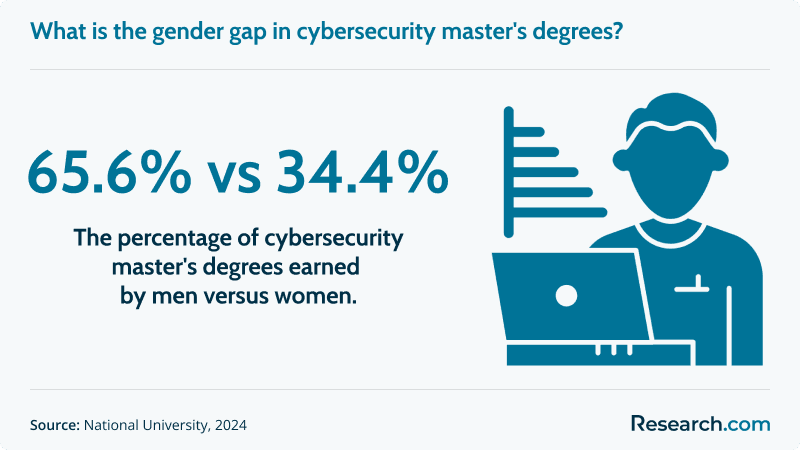
When you enroll, you’ll be joining a diverse group of fellow professionals. It’s interesting to note that, across all fields, men have been consistently earning the majority of master's degrees for years, as the data below illustrates.
How does an online master's in network security program compare to an on-campus program?
When it comes to the degree you earn, there is no difference. A master's degree from an accredited university holds the same weight whether you earned it online or on campus. The curriculum, the faculty, and the academic standards are identical.
The real difference is in the delivery and your peer group. Some people assume on-campus networking is better, but I'd encourage you to see it from another perspective. An online program connects you with a national cohort of experienced professionals who are currently working in the field. This can be a far more powerful strategic network than a local, campus-based one.
Choosing the Right Credential for Your Goal: Degree vs. Certification
This brings up a more fundamental question: choosing the right credential for your specific career objective. A master's degree is designed to prepare you for strategic leadership. It teaches you to synthesize information, manage risk, and align security with business goals.
A certification, on the other hand, is designed to validate a specific, tactical skill. For instance, if your immediate goal is to master a particular cloud platform, exploring the best online Microsoft Azure dual certification bootcamps could be a targeted and effective move. But if your ambition is to design the entire cloud security strategy or lead the team, the master's degree is the credential that gets you there.
What is the average cost of an online master's in network security program?
You'll find that the total tuition for an online masters in network security can range anywhere from around $20,000 to over $70,000. This depends heavily on the institution—whether it's a public or private university and its overall reputation.
But it's a mistake to only focus on the sticker price. The most important way to think about this is as a strategic investment in your future earnings. The real question isn't just "What does it cost?" but "What is the return on that investment?"
The Spectrum of Earning Potential
This is where looking at the potential salary outcomes becomes critical. While we've talked about the average pay, the top end of the spectrum is where this investment truly pays off. Experienced professionals in top roles can command salaries ranging from $111,000 to over $172,500.
A higher-cost program from a top-tier university can often be the fastest path to a role like a Security Architect or CISO, where those highest salaries are found. The chart below details some of the most lucrative career paths this degree opens up, helping you calculate the real return on your investment.
For students seeking both affordability and strong job placement support, exploring historically Black colleges and universities can also be worthwhile. If diversity, community support, and mentorship are priorities, researching the best HBCU for cyber security programs may help identify options that balance cost, culture, and career outcomes effectively.
What are the financial aid options for students enrolling in an online master's in network security program?
You have several good options for funding your degree. The most common are federal and private loans, along with scholarships specifically for graduate students in STEM or cybersecurity fields.
However, for a working professional like you, the single most powerful financial aid option is often employer tuition reimbursement. Many people mistakenly think this kind of support is only for undergraduates, but companies are more willing than ever to invest in developing senior-level technical talent. This should be the very first avenue you explore.
Maximizing Employer Tuition Reimbursement
The key is to frame your request as a direct benefit to the company. You aren't just asking for a handout; you're presenting a business case. Explain to your manager how this degree will equip you with the strategic skills to solve their most complex security challenges. You're offering them a way to fill a high-level talent gap internally, which is a massive win for them.
This is a standard practice for retaining top talent. Companies are already used to investing in their future leaders, which is why so many support employees pursuing the best online MBA in general business programs. You are simply making the case that cybersecurity leadership is just as critical to the business's future success.
Many students considering funding options also ask whether is cybersecurity a hard major to complete. While the field is rigorous and involves analytical thinking and problem-solving, the structured coursework and hands-on training provided in network security programs are designed to support students of varying experience levels. Strong motivation and consistent study habits often matter more than prior technical expertise.
What are the prerequisites for enrolling in an online master's in network security program?
The main requirements are straightforward: an accredited bachelor's degree and relevant professional experience.
The key thing to understand, especially if you're pivoting from an adjacent tech field, is that graduate programs weigh your hands-on experience very heavily. They are often more interested in your years of technical work and problem-solving than your specific undergraduate major. A strong technical foundation is what matters most.
For students looking to strengthen their application or position themselves for higher-level security roles after graduation, pursuing security engineer certifications—such as the CISSP, CEH, or CompTIA Security+—can provide a competitive advantage. These credentials demonstrate both technical capability and commitment to the field, which can help open doors to more advanced positions.
Your background is your biggest asset. Don't just take my word for it; the data from industry professionals backs this up completely. The chart below shows that 99% of cybersecurity experts agree that having worked in an IT position is the most valuable experience for career growth—far more than any other single factor.
What courses are typically in an online master's in network security program?
The curriculum is designed to build on your existing technical knowledge and elevate it to a strategic level. You won't be just learning skills; you'll be learning how to synthesize them into a comprehensive security program.
Core courses will cover the essential pillars of the field: cryptography, secure network design, risk management, and security policy. The real goal here is to teach you how all these components work together. You'll learn to see the entire security landscape from a leadership perspective, which is what separates a senior practitioner from a true architect.
The Role of Data in Modern Security Strategy
Modern security is fundamentally about data. It's about analyzing threat intelligence, correlating logs from thousands of systems, and using data to make informed decisions about risk. Building strong walls isn't enough anymore; you have to be able to analyze the information flowing through them.
This is why having a strong foundation in data analysis is becoming such a critical advantage. Many top professionals even supplement their skills with training from the best online data analytics bootcamps to stay ahead of the curve. Just as you use data to track threats, you can use market data to guide your career. The graphic below, for instance, shows where the highest demand for your skills is geographically concentrated.
For students planning to move into analyst or monitoring-focused roles, adding certifications for security analyst positions—such as CompTIA CySA+, SSCP, or GIAC Security Essentials—can help reinforce what you're learning in the program. These credentials validate your ability to translate classroom theory into hands-on threat detection and response, making you more competitive in both entry-level and senior analyst roles.
What types of specializations are available in an online master's in network security program?
You'll find common specializations like Cloud Security, Digital Forensics, and Governance, Risk, and Compliance—often called GRC. It's critical to understand that this is not just a minor academic choice. A specialization is how you aim the degree at a specific, high-demand career outcome.
Think of it as choosing your leadership track. If you're drawn to business strategy and policy, the GRC path is designed for an aspiring CISO. If you want to design the next generation of secure cloud infrastructure, the Cloud Security specialization is for you. This choice directly shapes your future role.
Aligning Your Specialization with Top-Paying Industries
A smart approach is to align your specialization with the most lucrative industries. Sectors like finance, information, and management consistently pay a premium for security leaders who understand their unique challenges.
How to Choose the Best Online Master's in Network Security Program
These four points are essential for making a sound decision:
- Accreditation: First and foremost, ensure the university is regionally accredited, as this is the gold standard for academic credibility and quality.
- Practitioner Faculty: Look closely at who is teaching the courses; you want to learn from current or former CISOs and security architects who bring real-world experience, not just theory.
- Applied Capstone Project: Examine the final project required for graduation; it should be a practical, hands-on challenge that solves a real-world security problem, not a purely academic thesis.
- Federal Recognition: Check if the university is designated as a National Center of Academic Excellence (CAE) in Cyber Defense by the NSA and DHS, as this is a powerful external validation.
These are the markers that distinguish a truly career-transforming online masters in network security program from the rest. You're investing in your future leadership, so choose a program taught by the leaders you want to become.
What career paths are available for graduates of an online master's in network security program?
This degree prepares you for the most senior and strategic roles in the security field. You'll be qualified to move beyond implementation and into positions where you design security strategy, lead teams, and manage risk for the entire organization.
- Security Architect: You design the security blueprint for the entire enterprise.
- Principal Security Consultant: You act as a top-level advisor, solving the most complex security challenges for clients.
- Information Security Manager: You lead the teams and programs that protect the organization's assets.
- Chief Information Security Officer (CISO): You are the senior executive responsible for the company's overall security posture.
The demand for these roles is driven by a massive global talent shortage. The chart below breaks down this workforce gap by region, showing a clear and urgent need for qualified leaders everywhere.
The Path to CISO: Blending Technical Expertise with Business Leadership
The most significant career evolution in this field has been the role of the CISO. This position has transformed from a senior technical manager into a key business executive who sits at the leadership table. The job is no longer just about technology; it's about aligning security with business risk and strategy.
This degree provides the essential foundation for that leap. It teaches you to speak the language of business and make a case for security in terms of ROI and risk management. This shift is why the career trajectory from a technical master's now has so much in common with the paths people explore when they ask what can you do with a technology management degree. It's a direct path to the C-suite.
What is the job market for graduates of an online master's in network security program?
The job market for graduates is exceptionally strong. The U.S. Bureau of Labor Statistics projects that roles for information security analysts will grow by 29% over the next decade. That's a staggering figure, far outpacing the 9% growth for other computer occupations and the 3% average for all jobs.
Let's be clear about what this means for you. This degree doesn't just get you a job; it makes you a top-tier candidate for the best jobs. It's the combination of your existing professional experience with the strategic knowledge from an online masters in network security that puts you at the top of the hiring list in a market that is desperate for talent.
The Economics of a Talent Shortage
The reason for this incredible demand is simple economics. There is a massive, persistent global talent shortage in cybersecurity. Recent estimates show a global workforce gap of nearly 4.7 million professionals, with the U.S. workforce only able to supply about 74% of the current demand.
This creates a classic seller's market. When you graduate, you won't just be looking for a job; companies will be actively competing for you. This gives you significant leverage, not just in salary negotiations, but in choosing a role that truly aligns with your career ambitions. It’s the strongest possible position to be in as you take the next step in your professional life.

Is This Program Accredited and Cost-Effective?
When evaluating an online master's in network security, verifying institutional accreditation and assessing overall cost-efficiency are essential. Ensure the program is backed by recognized accrediting bodies and meets industry standards for curriculum quality and academic rigor. Compare tuition fees, additional charges, and available financial aid, including scholarships and employer reimbursement programs, to determine its true value. Furthermore, investigate whether the program has established partnerships with industry leaders to enhance networking and practical learning opportunities, and consider options like the cheapest cyber security degree online for a more budget-friendly pathway.
Here’s What Graduates Have to Say about Their Online Master's in Network Security Program
- Damon: "I had been a senior engineer for years and knew my tech inside and out, but I couldn't make the leap to an architect role. This program was the bridge. It taught me to stop thinking about individual boxes and start seeing the entire security ecosystem from a business-risk perspective. Six months after graduating, I got the promotion I’d been chasing for three years."
- Laura: "My biggest fear was leaving a senior role in network operations to start over at the bottom in security. The master's program validated my decade of tech experience and layered the strategic security knowledge on top. I was able to pivot directly into a senior security consultant position, completely bypassing the entry-level grind. It was incredibly validating."
- Cecile: "I looked at the tuition as a business decision, and the return on investment has been faster than I expected. The program gave me the specific credentials and vocabulary I needed to move into management. My new role came with a 30% salary increase, so the degree paid for itself in less than 18 months."
Key Findings
- The job market for security leaders is expanding rapidly, with a projected growth of 29%, creating a significant opportunity for experienced professionals to advance into strategic roles.
- This degree provides a clear financial return, unlocking access to roles with a median salary of $124,910, which is substantially higher than the $105,990 median for other computer occupations.
- Your existing background is your most valuable asset for admission, with 99% of cybersecurity professionals agreeing that prior experience in an IT position is the most critical factor for career growth.
- The demand for your skills is a global phenomenon, driven by a worldwide cybersecurity workforce gap of nearly 4.7 million, ensuring long-term job security for qualified leaders.
- Graduates are positioned for the most senior and lucrative roles in the industry, with top positions like Chief Information Security Officer (CISO) commanding salaries as high as $239,750.
- While program costs can range from $20,000 to over $70,000, the investment has a strong and rapid payback period due to the high earning potential the degree unlocks.
References:
- CyberSeek. (n.d.). Cybersecurity supply/demand heat map. Retrieved September 29, 2025, from https://www.cyberseek.org/heatmap.html
- IBM. (n.d.). Cost of a data breach report. Retrieved September 29, 2025, from https://www.ibm.com/reports/data-breach
- ISC2. (2024, October). ISC2 2024 Cybersecurity workforce study. Retrieved September 29, 2025, from https://www.isc2.org/Insights/2024/10/ISC2-2024-Cybersecurity-Workforce-Study
- National University. (n.d.). Cybersecurity statistics. Retrieved September 29, 2025, from https://www.nu.edu/blog/cybersecurity-statistics/
- Readynez. (n.d.). GIAC exam passing rates: What you need to know before taking the test. Retrieved September 29, 2025, from https://www.readynez.com/en/blog/giac-exam-passing-rates-what-you-need-to-know-before-taking-the-test/
- U.S. Bureau of Labor Statistics. (n.d.). Computer and information technology occupations. Occupational Outlook Handbook. Retrieved September 29, 2025, from https://www.bls.gov/ooh/computer-and-information-technology/
- U.S. Bureau of Labor Statistics. (n.d.). Information security analysts. Occupational Outlook Handbook. Retrieved September 29, 2025, from https://www.bls.gov/ooh/computer-and-information-technology/information-security-analysts.htm
- U.S. Government Accountability Office. (n.d.). Cybersecurity. Retrieved September 29, 2025, from https://www.gao.gov/cybersecurity
- ZipRecruiter. (n.d.). Master’s cyber security salary. Retrieved September 29, 2025, from https://www.ziprecruiter.com/Salaries/Masters-Cyber-Security-Salary
Other Things You Should Know About Online Master's in Network Security Programs
Admission requirements for top online master's programs in network security can vary, but generally include a bachelor's degree, a minimum GPA, and professional experience in the field. Some programs may require letters of recommendation, a statement of purpose, or an interview. The GRE may or may not be required.
Many reputable online master's programs for experienced professionals have waived the Graduate Record Examinations (GRE) requirement. Universities often consider your professional work experience and a strong undergraduate GPA as sufficient evidence of your academic capability. Check with each university, but do not assume the GRE is mandatory, especially if you have several years of relevant work history.
The best online master's programs in network security for 2027 typically offer curricula that cover advanced topics such as cryptography, ethical hacking, network infrastructure security, and risk management. Programs often include hands-on labs and projects to provide practical experience, along with electives that allow specialization in areas like cloud security or cybersecurity policy.


