
2027 Best Healthcare Administration Certifications to Consider

Co-Founder and Chief Data Scientist
High staff turnover is often the most visible sign of a system under stress. With front-desk turnover in healthcare hitting 25.9%, it's clear that operational chaos isn't just a concept—it's a daily reality causing burnout and inefficiency. For professionals working within these systems, this frustration can lead to feeling powerless to fix the real problems.
This is where you can gain control. Earning one of the top healthcare administration certifications equips you to become a "System Guardian," someone with the formal skills to create order and drive meaningful change. To help you find the right path, our career planning experts, with over 10 years of experience, developed this guide to give you the clear, direct advice you need.
What are the benefits of getting a healthcare administration certification?
- You can qualify for specialized supervisory roles, like Patient Access Supervisor, where you can directly improve system efficiency and patient care.
- You can increase your earning potential, with roles like Patient Access Supervisor offering an average salary of around $78,225.
- You can complete your studies in a flexible online format, allowing you to advance your career without leaving your current job.
What can I expect from a healthcare administration certification?
You should expect a focused, graduate-level program that typically includes four to six courses and can be completed online in under a year. The curriculum is designed for working professionals, so the coursework is practical and immediately applicable to real-world administrative challenges.
It's also important to understand exactly what this credential is. People often confuse three different things, so let's clarify them.
A university graduate certificate, which is what this guide focuses on, is designed to teach you the specific skills for a job. A professional certification, on the other hand, is an exam you take to prove you already have the knowledge. Finally, a Master of Health Administration (MHA) is a full degree that prepares you for executive leadership. For most people starting out, the graduate certificate is the most direct path to a new or better role.
Where can I work with a healthcare administration certification?
According to the U.S. Bureau of Labor Statistics, the largest employers of medical and health services managers in 2023 included:
- Hospitals: Employing 30% of the workforce in roles like department supervisor or patient access manager.
- Offices of Physicians: Making up 12% of employers, with positions such as practice manager or administrative coordinator.
- Nursing and Residential Care Facilities: Accounting for 9% of jobs, including roles like facility administrator.
- Outpatient Care Centers: Representing 7% of the job market, a high-growth area for clinic administrators.
- Government: Also employing 7% of managers in public health agencies and federal healthcare systems.
How much can I make with a healthcare administration certification?
While salaries vary based on your experience, location, and specific employer, this credential provides a clear and direct pathway to higher pay. Based on recent data, roles accessible to certificate holders show strong financial promise:
- Patient Access Supervisor: Average salary of $78,225 per year.
- Medical and Health Services Managers: Median pay of $56.71 per hour; $117,960 per year.
- List of the Best Healthcare Administration Certification Programs for 2027 List of Programs
- How long does it take to complete a healthcare administration certification program? Completion Time
- What is the average cost of a healthcare administration certification program? Program Cost
- What are the financial aid options for students enrolling in a healthcare administration certification program? Financial Aid
- What are the prerequisites for enrolling in a healthcare administration certification program? What are the prerequisites for enrolling in a healthcare administration certification program?
- What courses are typically in a healthcare administration certification program? What courses are typically in a healthcare administration certification program?
- What types of specializations are available in a healthcare administration certification program? Specializations
- How to Choose the Best Healthcare Administration Certifications Program How to Choose the Best Healthcare Administration Certifications Program
- What career paths are available for graduates of a healthcare administration certification program? Career Paths
- Is Accreditation Critical for a Healthcare Administration Certification Program? Is Accreditation Critical for a Healthcare Administration Certification Program?
- What is the job market for graduates of a healthcare administration certification program? Job Market
Best Healthcare Administration Certification Programs for 2027
A healthcare administration certificate can help nurses, clinicians, insurance professionals, public health workers, and business professionals move into management roles without committing immediately to a full graduate degree. The key is choosing the right type of credential. Many programs called “healthcare administration certifications” are actually university graduate certificates, while professional certifications are usually awarded by industry associations after exams or experience requirements.
This guide focuses on university-based healthcare administration certificate programs that build skills in healthcare finance, operations, policy, compliance, leadership, and quality improvement. It also explains how to compare cost, accreditation, transfer options, career value, and program format so you can decide whether this credential fits your next career move. If you are comparing this path with broader certification for healthcare management, use the sections below to understand which option is more useful for your goals.
Quick answer: Which healthcare administration certificate is best?
The best healthcare administration certificate is the one that matches your current experience, career target, budget, and future degree plans. If you may later pursue an MHA, MPH, MBA, or MPA, prioritize programs that allow certificate credits to transfer into the master’s degree. If you need the lowest tuition, compare cost per credit and required credits together. If you want employer recognition, verify institutional or programmatic accreditation before enrolling.
| Program | Best fit | Credits | Cost per credit | Program length |
| University of North Dakota - Health Administration Certificate | Professionals considering an MPA pathway | 9 | $528.36 | 1–2 years |
| Rutgers University–Newark - Healthcare Administration Certificate | Public and nonprofit sector professionals | 9 | $929 | Approximately 2 years |
| East Carolina University - Health Care Administration Certificate | Students seeking a broader operations, law, and finance foundation | 15 | $289.55 | Approximately 1 year |
| Loma Linda University - Health-Care Administration Certificate | Professionals interested in whole-person care and MHA preparation | 13 | $815 | 1 year |
| Wilmington University - Graduate Certificate in Health Care Administration | Working professionals who want dual-credit graduate coursework | 18 | $551 | 12 months |
| Caldwell University - Healthcare Administration Certificate | Students seeking leadership, budgeting, and compliance training | 18 | $1,327 | Approximately 1 year |
| Western Oregon University - Healthcare Administration Certificate | Students interested in organizational leadership, ethics, and health disparities | 15 | $1,062.60 | Approximately 1 year |
| Valdosta State University - Graduate Certificate in Health Care Administration | Online learners who may later pursue the MBA | 12 | $395 | Approximately 1 year |
| University of Arizona - Graduate Certificate in Health Administration | Healthcare professionals focused on public health or government settings | 15 | $820 | 1–2 years |
| Seton Hall University - Graduate Certificate in Healthcare Administration | Students who may transfer into a CAHME-accredited MHA | 15 | $1,530 | 21 months |
How these healthcare administration certificate programs were ranked
Because a graduate certificate requires both time and money, Research.com evaluates programs using transparent education data and school-level information. Our ranking process draws from sources such as the IPEDS database, Peterson's database, the College Scorecard database, and The National Center for Education Statistics.
These sources help compare healthcare administration certificate options using factors such as institutional profile, affordability, student outcomes, and program details. You can review the broader ranking approach on Research.com’s methodology page.
1. University of North Dakota - Health Administration Certificate
The University of North Dakota offers a compact graduate certificate for professionals who want to strengthen their management skills in healthcare organizations. The curriculum covers health policy, law, and organizational challenges, and the credits may be applied directly toward a Master of Public Administration.
- Program Length: 1–2 years
- Required Credits to Graduate: 9
- Cost per Credit: $528.36
- Accreditation: Higher Learning Commission (HLC)
2. Rutgers University–Newark - Healthcare Administration Certificate
Rutgers University–Newark’s graduate certificate is designed for professionals working in or moving toward healthcare leadership in public and nonprofit environments. Students study healthcare systems, finance, and administration through real-time case studies, and the credits can transfer into the Master of Public Administration program.
- Program Length: Approximately 2 years
- Required Credits to Graduate: 9
- Cost per Credit: $929
- Accreditation: Network of Schools of Public Policy, Affairs, and Administration (NASPAA)
3. East Carolina University - Health Care Administration Certificate
East Carolina University’s certificate is built for professionals who want a practical foundation in healthcare management. Coursework addresses health law, finance, and operations, giving students skills that can apply across hospitals, clinics, payer organizations, and other healthcare settings.
- Program Length: Approximately 1 year
- Required Credits to Graduate: 15
- Cost per Credit: $289.55
- Accreditation: Southern Association of Colleges and Schools (SACS)
4. Loma Linda University - Health-Care Administration Certificate
Loma Linda University offers a health-care administration certificate shaped by its whole-person care philosophy. The program emphasizes management, quality improvement, and health law, and graduates may use completed coursework toward a Master of Healthcare Administration.
- Program Length: 1 year
- Required Credits to Graduate: 13
- Cost per Credit: $815
- Accreditation: WASC Senior College and University Commission (WSCUC)
5. Wilmington University - Graduate Certificate in Health Care Administration
Wilmington University’s graduate certificate focuses on the administrative realities of healthcare work, including policy, economics, and legal issues. The program is structured for professionals who want immediately applicable coursework, and the credits can transfer toward a degree with a Health Care Administration concentration.
- Program Length: 12 months
- Required Credits to Graduate: 18
- Cost per Credit: $551
- Accreditation: Middle States Commission on Higher Education (MSCHE)
6. Caldwell University - Healthcare Administration Certificate
Caldwell University’s certificate prepares students for administrative, operational, and oversight responsibilities in healthcare organizations. The curriculum develops leadership, budgeting, and compliance skills that can be useful in hospitals, clinics, insurers, and related organizations.
- Program Length: Approximately 1 year
- Required Credits to Graduate: 18
- Cost per Credit: $1,327
- Accreditation: Middle States Commission on Higher Education (MSCHE)
7. Western Oregon University - Healthcare Administration Certificate
Western Oregon University’s certificate is intended for students who want to understand healthcare administration through the lens of policy, ethics, leadership, and health disparities. The program can support movement into management roles or further study through a Master of Arts in Organizational Leadership.
- Program Length: Approximately 1 year
- Required Credits to Graduate: 15
- Cost per Credit: $1,062.60
- Accreditation: Northwest Commission on Colleges and Universities (NWCCU)
8. Valdosta State University - Graduate Certificate in Health Care Administration
Valdosta State University offers a fully online graduate certificate for working professionals and students entering the field. The curriculum covers healthcare systems, economics, and legal issues, and students who maintain a 3.5 GPA can waive GMAT/GRE requirements for the MBA program.
- Program Length: Approximately 1 year
- Required Credits to Graduate: 12
- Cost per Credit: $395
- Accreditation: Association to Advance Collegiate Schools of Business (AACSB)
9. University of Arizona - Graduate Certificate in Health Administration
The University of Arizona’s graduate certificate supports healthcare professionals who want to build leadership capacity in public health, government, or related healthcare organizations. Courses emphasize strategic planning, finance, and quality improvement, and all courses may transfer into the Master of Public Health program.
- Program Length: 1–2 years
- Required Credits to Graduate: 15
- Cost per Credit: $820
- Accreditation: Council on Education for Public Health (CEPH)
10. Seton Hall University - Graduate Certificate in Healthcare Administration
Seton Hall University’s graduate certificate draws from its CAHME-accredited Master of Healthcare Administration program. It is designed for students who want focused training in healthcare leadership and management, with credits that can transfer toward the full MHA degree.
- Program Length: 21 months
- Required Credits to Graduate: 15
- Cost per Credit: $1,530
- Accreditation: Commission on Accreditation of Healthcare Management Education (CAHME)
How long does it take to complete a healthcare administration certification program?
Most healthcare administration certificate programs can be completed in about 9 to 12 months by part-time students, although some programs take longer depending on credit load, course sequencing, and whether the school uses a cohort model. The programs in this ranking range from 12 months to 21 months, with several listed as approximately 1 year or 1–2 years.
Program pacing matters. Cohort-based certificates usually provide a fixed schedule, set deadlines, and a clear completion plan. Self-paced or more flexible online options can be easier to fit around work shifts, family obligations, and clinical schedules, but they require stronger time management.
Who typically enrolls in these programs?
Healthcare administration certificates are usually aimed at working adults rather than first-time college students. Many classmates may already have experience in nursing, claims processing, patient access, billing, public health, logistics, human resources, IT, or operations.
That professional mix can be valuable because healthcare management work is highly cross-functional. Data USA reports that the average age for medical and health services managers is 45.9 years old, which reflects how often people move into these roles after building experience in another area of healthcare or business. Learners who need a faster academic format may also compare certificate pacing with 6-week online college courses, although short courses are not always equivalent to graduate certificate credits.
| Format | When it works best | Trade-off to consider |
| Cohort-based program | You want structure, deadlines, and classmates moving through the same courses | Less flexibility if your work schedule changes |
| Part-time online program | You are balancing work, family, and school | Completion may take longer than a full-time schedule |
| Stackable graduate certificate | You may later enter an MHA, MPH, MBA, or MPA | You must confirm transfer rules before enrolling |

What is the average cost of a healthcare administration certification program?
Based on the programs analyzed, total tuition for healthcare administration certificates commonly falls between $11,700 and $14,100. Actual cost depends on required credits, cost per credit, residency rules, fees, textbooks, technology charges, and whether the certificate is billed at graduate tuition rates.
Do not compare schools by cost per credit alone. A lower per-credit rate may still lead to a higher total cost if the program requires more credits, and a higher-priced certificate may be more useful if it transfers cleanly into a master’s degree you already plan to complete.
How to think about return on investment
A healthcare administration certificate should be evaluated as a career investment, not only as an academic expense. The practical question is whether the credential helps you qualify for a role, promotion, department transfer, or graduate degree pathway that you could not access as easily before.
Be cautious about assuming the certificate will automatically produce a salary increase. Outcomes depend on your experience, employer, region, role, and ability to demonstrate skills in budgeting, operations, compliance, analytics, and leadership. Some healthcare workers compare certificate costs with compensation patterns in adjacent roles, such as salary for acute care nurse practitioner, to understand how education, licensure, and specialization can affect healthcare earnings.
| Cost factor | Why it matters | Question to ask |
| Required credits | More credits can increase total tuition, even when the per-credit price is lower | How many credits are required to complete the certificate? |
| Transferability | Stackable credits can reduce duplicated coursework if you pursue a master’s degree | Which degree programs will accept these credits? |
| Fees | Online, technology, application, and graduation fees can change the final cost | What is the full estimated cost beyond tuition? |
| Employer support | Tuition reimbursement can significantly reduce out-of-pocket cost | Does my employer cover graduate certificate coursework? |
What are the financial aid options for students enrolling in a healthcare administration certification program?
Students often use more than one funding source to pay for a healthcare administration certificate. The most common options include federal student loans, employer tuition assistance, payment plans, and private loans. Eligibility varies by school and program, so confirm details before you apply.
Federal student loans
Some graduate certificate programs at accredited universities may qualify for federal aid, including Stafford Loans. Do not assume eligibility based only on the university’s accreditation. Ask the financial aid office: “Is this specific certificate eligible for federal financial aid?”
Employer tuition reimbursement
If you already work for a hospital, health system, insurer, public agency, or healthcare vendor, employer assistance may be your strongest funding option. Many organizations support education that prepares employees for leadership, compliance, patient access, quality improvement, or revenue cycle responsibilities.
Private loans and payment plans
Private loans from banks and credit unions can help cover remaining costs, but they should usually be considered after federal aid and employer support because terms vary. Some schools also offer payment plans that spread tuition across the term.
Total compensation matters when evaluating career value. For example, 85% of Patient Access Supervisors have medical coverage, 82% have dental, and 78% have vision benefits. Benefits can meaningfully affect the value of a role beyond base salary. Students who need a lower-cost starting point before graduate study may also explore cheapest online community colleges for transferable foundational coursework, although community college courses generally do not replace graduate certificate requirements.
What are the prerequisites for enrolling in a healthcare administration certification program?
Admission requirements differ by school, but most graduate healthcare administration certificate programs expect applicants to have a bachelor’s degree and a clear reason for pursuing administrative training. Many programs welcome applicants from non-healthcare majors if they can show relevant professional experience or a strong career plan.
- Bachelor’s degree: Most programs require a completed bachelor’s degree, often in any field.
- Minimum GPA: Many universities look for a 3.0 undergraduate GPA, though some may consider professional experience or offer waiver options.
- Resume: A resume helps admissions teams understand your healthcare, business, clinical, military, nonprofit, or administrative background.
- Personal statement: This essay usually explains your career goals, why healthcare administration fits your plans, and how the certificate supports your next step.
Your prior background can be an advantage. A nurse may bring clinical workflow knowledge, an IT professional may understand health systems infrastructure, and a logistics or military professional may already have leadership and operations experience. This “build on prior experience” model is common in healthcare education, including advanced options such as the shortest WHNP post-master's certificate online.
What courses are typically in a healthcare administration certification program?
A strong healthcare administration certificate should teach you how healthcare organizations actually operate. The best curricula connect theory with case studies, regulations, budgets, staffing constraints, patient flow, and performance metrics.
- Healthcare finance: Students learn how budgets, reimbursement, revenue cycles, and financial decisions affect departments and organizations.
- Healthcare operations: Courses may cover process improvement, supply chains, staffing, scheduling, patient flow, and service delivery.
- Health informatics: Students study the systems used to manage patient information and operational data. Those who want deeper technical training may later compare certificate options with a fast track master's in health informatics online.
- Healthcare policy and ethics: Coursework may examine regulation, compliance, HIPAA-related responsibilities, ethical decision-making, and organizational accountability.
Technology is becoming a central part of administrative leadership. With the market for AI-driven patient access solutions projected to grow at 39.2% annually, healthcare managers increasingly need to understand data tools, digital workflows, automation, and patient-facing systems. That does not mean every administrator must become a technologist, but it does mean leaders must be able to evaluate systems, ask informed questions, and manage change responsibly.
What types of specializations are available in a healthcare administration certification program?
Specialization determines how you position yourself in the healthcare job market. Some students use a certificate to become stronger generalist managers, while others focus on a specific administrative function such as compliance, revenue cycle management, patient access, healthcare operations, informatics, quality improvement, or public health administration.
The demand backdrop is strong: an average of 61,400 job openings for medical and health services managers is projected every year. Students interested in health informatics and information management programs can also review the Commission on Accreditation for Health Informatics and Information Management Education (CAHIIM) program directory.
Risk, compliance, and revenue-focused specializations
This route fits detail-oriented professionals who want to manage financial, legal, and regulatory exposure. Revenue Cycle Management and Healthcare Compliance specializations can prepare students to work with reimbursement, documentation, audits, privacy requirements, payer rules, and organizational risk.
Operations, patient access, and quality-focused specializations
This path is better for professionals who want to improve front-line systems. Patient Access and Healthcare Operations specializations focus on scheduling, registration, patient flow, staffing coordination, workflow redesign, and service quality. This can be a good fit if you enjoy fixing bottlenecks and improving the experience of both patients and staff.
| Specialization direction | Best for | Possible roles |
| Compliance and risk | Professionals who like regulation, documentation, policy, and audits | Compliance analyst, privacy coordinator, risk management specialist |
| Revenue cycle | Professionals interested in billing, reimbursement, claims, and payer processes | Revenue cycle manager, patient financial services supervisor |
| Healthcare operations | Professionals who want to improve staffing, workflows, patient flow, and efficiency | Operations coordinator, clinic manager, department administrator |
| Patient access | Professionals focused on scheduling, registration, eligibility, and front-end service | Patient access supervisor, access services manager |
| Health informatics | Professionals who want to connect administrative decisions with data systems | Health information supervisor, informatics coordinator |

How to choose the best healthcare administration certification program
The right healthcare administration certificate depends on what you need the credential to do. A program that is ideal for a nurse moving into department leadership may not be the best choice for an insurance professional pivoting into provider operations or a public health worker preparing for government administration.
- Clarify your target role. Decide whether you are aiming for operations, compliance, revenue cycle, patient access, public health administration, or preparation for a master’s degree.
- Verify accreditation. Check institutional accreditation and any relevant programmatic accreditation. Accreditation can affect financial aid, credit transfer, and employer confidence.
- Ask about credit transfer. If you might later pursue an MHA, MPH, MBA, or MPA, request written confirmation of which certificate credits transfer.
- Compare total cost, not just tuition per credit. Include required credits, fees, textbooks, technology charges, and travel or campus requirements.
- Evaluate faculty experience. Look for instructors with real healthcare leadership, finance, policy, compliance, informatics, or operations experience.
- Check the online format. Ask whether courses are synchronous, asynchronous, cohort-based, self-paced, or offered in short terms.
- Review career support. Strong programs may offer advising, alumni connections, resume help, interview preparation, and employer relationships.
Use career outcomes carefully
Salary information can help you evaluate potential ROI, but it should not be treated as a guarantee. For a Patient Access Supervisor, salaries can range from around $50,500 to over $77,500 for the 75th percentile. Where you fall in that range depends on experience, employer type, location, responsibilities, and performance.
The same decision logic applies to other healthcare education paths. Before enrolling in an accelerated online bachelor's degree in public health or a graduate certificate, compare cost, transfer value, accreditation, and the roles you realistically plan to pursue.
Common mistakes to avoid
| Mistake | Why it can hurt you | Better approach |
| Choosing only by ranking | A highly ranked program may not match your career goal, schedule, or budget | Use rankings as a shortlist, then compare fit |
| Ignoring accreditation | Unaccredited or poorly recognized credentials may limit aid, transfer, or employer value | Verify accreditation before applying |
| Looking only at cost per credit | Required credits and fees can change total cost substantially | Ask for a full program cost estimate |
| Assuming online means flexible | Some online courses still require live attendance or fixed deadlines | Confirm weekly schedule expectations |
| Assuming credits will transfer | Transfer rules vary by school and degree program | Get transfer policies in writing |
| Choosing a certificate without a role target | The credential may not help if it is not tied to a specific career move | Map the program to job postings you want |
What career paths are available for graduates of a healthcare administration certification program?
A healthcare administration certificate can support several career directions. It may help you move from clinical or technical work into supervision, shift from payer-side experience to provider operations, strengthen your qualifications for a promotion, or test graduate-level study before committing to a full master’s degree.
Path 1: Become a specialized administrative expert
This path fits professionals who want depth in a high-value function. Roles such as Senior Compliance Analyst, Revenue Cycle Manager, Patient Access Supervisor, or operations specialist can allow you to become the person an organization relies on for complex systems, rules, workflows, or financial processes.
This route can be especially attractive if you enjoy solving detailed problems, working across departments, and improving processes without necessarily pursuing executive leadership immediately.
Path 2: Use the certificate as a bridge to graduate leadership education
Many students use a certificate as a lower-commitment entry point into graduate study. If the credits are stackable, the certificate may reduce time or repeated coursework when you move into an MHA, MPH, MBA, or MPA.
This path is better for professionals who want broader strategic responsibility. For medical and health services managers, the median pay is $117,960 per year. Students who want to move quickly from certificate study into a graduate leadership degree may compare options such as the shortest MHA online programs.
| Career goal | Certificate strategy | Next step |
| Move into supervision | Choose courses in leadership, operations, and finance | Apply for coordinator, supervisor, or assistant manager roles |
| Enter compliance or revenue cycle | Prioritize law, policy, reimbursement, and documentation coursework | Build experience with audits, claims, billing, or payer rules |
| Advance in patient access | Focus on operations, informatics, patient flow, and service quality | Target patient access supervisor or access services manager roles |
| Prepare for executive leadership | Pick a stackable certificate tied to an MHA, MPH, MBA, or MPA | Transfer credits into a full graduate degree if appropriate |
Is accreditation critical for a healthcare administration certification program?
Yes. Accreditation is one of the most important quality checks when comparing healthcare administration certificate programs. It signals that an institution or program has been reviewed against recognized academic standards, and it may affect financial aid eligibility, employer recognition, and the ability to transfer credits into another graduate program.
Students should distinguish between institutional accreditation and programmatic accreditation. Institutional accreditation applies to the college or university. Programmatic accreditation applies to a specific school, department, or degree area, such as CAHME, CEPH, NASPAA, or AACSB in certain contexts. Not every certificate will have its own programmatic accreditation, so ask the school exactly what the listed accreditation covers.
Accredited programs may also provide stronger technical, financial, and compliance training, which can complement more focused administrative credentials such as cheap medical billing and coding courses.
What is the job market for graduates of a healthcare administration certification program?
The labor market for healthcare administrators is strong, but employers still evaluate candidates based on experience, leadership ability, technical skills, and evidence of results. A certificate can strengthen your profile, especially when it fills a clear skills gap in finance, compliance, operations, informatics, or healthcare policy.
Graduates should be ready to explain the business value of their training. Instead of saying only that you completed a certificate, describe what you can do: improve patient flow, interpret regulations, support revenue cycle performance, manage budgets, coordinate teams, or use data to identify operational problems. These skills can also connect to adjacent healthcare fields, including areas served by fast track online behavioral health science degrees.
Job outlook for medical and health services managers
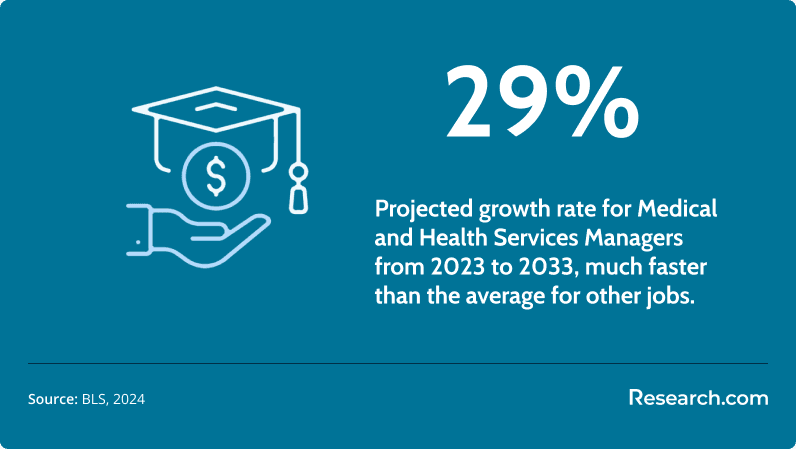
The U.S. Bureau of Labor Statistics projects that employment for medical and health services managers will grow by 29% between 2023 and 2033. Demand is influenced by the healthcare needs of an aging population, expanding care systems, technology adoption, and the complexity of healthcare regulation and payment models.
That outlook makes healthcare administration a promising field, but it does not remove competition. The strongest candidates pair credentials with relevant experience, measurable accomplishments, communication skills, and familiarity with healthcare data systems.
What graduates say about healthcare administration certificate programs
- Kaelen: "I knew how to handle pressure in the ER, but I did not understand why the administrative systems around us kept breaking down. The certificate helped me connect process improvement, staffing, and finance in a way I could use at work. The online lectures made it possible to study after late shifts, and now I contribute to workflow redesign instead of only working around the problems."
- Rhys: "My background was in claims processing, so I understood reimbursement and payer rules. What I needed was a clearer picture of provider operations and patient-facing systems. The program helped me translate my insurance experience into a provider-side career plan, and the online format let me keep working while preparing for the transition."
- Jarek: "My military experience gave me leadership, logistics, and accountability, but civilian healthcare employers did not always know how to read it. The certificate helped put my background into healthcare administration language. The structured online courses also fit the way I work: clear objectives, deadlines, and steady progress."
References
- CCD Care. (n.d.). Healthcare management trends. Retrieved September 3, 2025, from https://ccdcare.com/resource-center/healthcare-management-trends
- Data USA. (n.d.). Health Care & Social Assistance. Retrieved September 3, 2025, from https://datausa.io/profile/naics/health-care-social-assistance
- Data USA. (n.d.). Medical & health services managers. Retrieved September 3, 2025, from https://datausa.io/profile/soc/medical-health-services-managers
- Edgar Index. (2025, January 21). Trends and growth insights in AI and digital operations for patient access strategizing. Retrieved September 3, 2025, from https://www.edgarindex.com/2025/01/21/trends-and-growth-insights-in-ai-and-digital-operations-for-patient-access-strategizing
- Grand View Research. (n.d.). Patient Administration System Market Size, Share & Trends Analysis Report. Retrieved September 3, 2025, from https://www.grandviewresearch.com/industry-analysis/patient-administration-system-market-report
- MedCity News. (2023, November). Long-term impact: How the healthcare industry can survive staffing shortages. Retrieved September 3, 2025, from https://medcitynews.com/2023/11/long-term-impact-how-the-healthcare-industry-can-survive-staffing-shortages
- Mordor Intelligence. (n.d.). Patient Access Solutions Market Size & Share Analysis - Growth Trends & Forecasts (2024 - 2029). Retrieved September 3, 2025, from https://www.mordorintelligence.com/industry-reports/patient-access-solutions-market
- O*NET OnLine. (n.d.). 11-9111.00 - Medical and Health Services Managers. Retrieved September 3, 2025, from https://www.onetonline.org/link/summary/11-9111.00
- Payscale. (n.d.). Average Patient Access Supervisor Salary. Retrieved September 3, 2025, from https://www.payscale.com/research/US/Job=Patient_Access_Supervisor/Salary
- Simbo.ai. (n.d.). The importance of employee retention strategies in front desk administration to enhance patient care and operational efficiency. Retrieved September 3, 2025, from https://www.simbo.ai/blog/the-importance-of-employee-retention-strategies-in-front-desk-administration-to-enhance-patient-care-and-operational-efficiency
- U.S. Bureau of Labor Statistics. (2024, April 17). Occupational Employment and Wages, May 2023: 11-9111 Medical and Health Services Managers. Retrieved September 3, 2025, from https://www.bls.gov/oes/2023/may/oes119111.htm
- U.S. Bureau of Labor Statistics. (2024, September 4). Occupational Outlook Handbook: Medical and Health Services Managers. Retrieved September 3, 2025, from https://www.bls.gov/ooh/management/medical-and-health-services-managers.htm
- ZipRecruiter. (n.d.). Patient Access Supervisor Salary. Retrieved September 3, 2025, from https://www.ziprecruiter.com/Salaries/Patient-Access-Supervisor-Salary
Key Insights
- Most programs in this guide are graduate certificates, not exam-based professional certifications. That distinction matters for admissions, cost, credit transfer, and employer interpretation.
- The best program depends on your next move. Choose a stackable certificate if you may pursue an MHA, MPH, MBA, or MPA; choose a specialized curriculum if you want to move into compliance, revenue cycle, patient access, or operations.
- Accreditation should be verified before applying. Confirm both institutional accreditation and any programmatic accreditation, and ask what the accreditation actually covers.
- Cost comparisons require more than per-credit tuition. Look at required credits, fees, transfer value, financial aid eligibility, and employer reimbursement.
- Healthcare administration has a strong outlook, but credentials do not guarantee outcomes. The BLS projects 29% growth for medical and health services managers between 2023 and 2033, yet hiring still depends on experience, skills, location, and role fit.
- Technology and data skills are increasingly important. Administrative leaders do not need to become software engineers, but they do need to understand informatics, digital workflows, AI-supported tools, and operational data.
- Before enrolling, ask one practical question: “What job, promotion, or degree pathway will this certificate help me reach, and can the school show how the curriculum supports that goal?”
Other Things You Should Know About Healthcare Administration Certification Programs
To obtain a healthcare administration certification in 2027, you typically need a bachelor's degree in healthcare administration or a related field. Some certifications may require prior work experience in the healthcare sector, evidenced by professional references or documented accomplishments.
In 2026, a healthcare administration certification can significantly enhance salary potential by validating specialized knowledge and skills. Certified professionals may earn higher salaries compared to non-certified peers, particularly in roles like healthcare manager or administrator, where certifications showcase expertise in managing complex healthcare systems.


