2027 Communication Disorders Degree Popularity by Gender, Region, and Degree Level
Audited and Verified:
Our Editorial and Data Verification Process
Research.com uses government datasets, official education statistics and primary institutional information to support its career and degree guides. Our review process checks factual accuracy, occupational definitions, source dates and the requirements associated with the credentials discussed.
How This Article Was Fact-Checked
Our editorial team verifies salary estimates, employment projections, education requirements and program information against original data providers and official organizations. Salary figures are checked against the relevant occupational definitions and reporting periods. Information about licensure, accreditation and required in-person training is reviewed separately.
Fact-checked and verified on:

Co-Founder and Chief Data Scientist

Reviewed by Rhea Paul, PhD
SLP Education & Research Expert
A communication disorders degree can lead toward speech-language pathology, audiology, or an assistant role, but the most common degree level is not necessarily the right one for your goal. This guide explains how to compare U.S. degree popularity by gender, region, and award level without mistaking degrees awarded for current enrollment. It also shows what the available measures cannot establish, so prospective students can use popularity as context - not as a substitute for checking professional requirements, costs, and clinical training.
Key Things You Should Know
- Enrollment and degrees awarded are different measures. Federal field-of-study data can support comparisons of degrees awarded, but those counts should not be presented as the number of students currently enrolled in communication disorders programs.
- The program definition changes the result. A comparison limited to speech-language pathology will differ from one that also includes general communication sciences, audiology, and assistant programs; compare the same field codes and award levels throughout.
- Popularity is not a career requirement. Speech-language pathologists typically need a master's degree, while assistant and audiology pathways differ. The BLS projects 17% growth in speech-language pathologist employment from 2025 to 2035, but that projection does not measure degree enrollment.
- How popular are communication disorders degrees by gender, region, and degree level? Gender and Regional Popularity
- Which communication disorders degree levels enroll the most students? Degree Level Enrollment
- How does communication disorders degree popularity differ by gender? Gender Distribution
- Which U.S. regions have the highest communication disorders degree enrollment? Regional Enrollment
- What limitations affect comparisons of communication disorders degree popularity? Data Limitations
How popular are communication disorders degrees by gender, region, and degree level?
There is no single, comparable count that answers all three parts of this question without first defining communication disorders and popularity. The most practical national measure for a gender-by-region-by-degree-level comparison is degrees awarded by U.S. institutions in a specified academic year. It measures completed awards, not everyone studying in the field.
A defensible numeric ranking requires the same federal data release, program-code selection, geographic rule, and award-level categories for every group. Because no such tabulation is established here, assigning a leading gender, region, or degree level a count or share would create false precision. Readers comparing published rankings should first check whether they count students, applications, or awards.
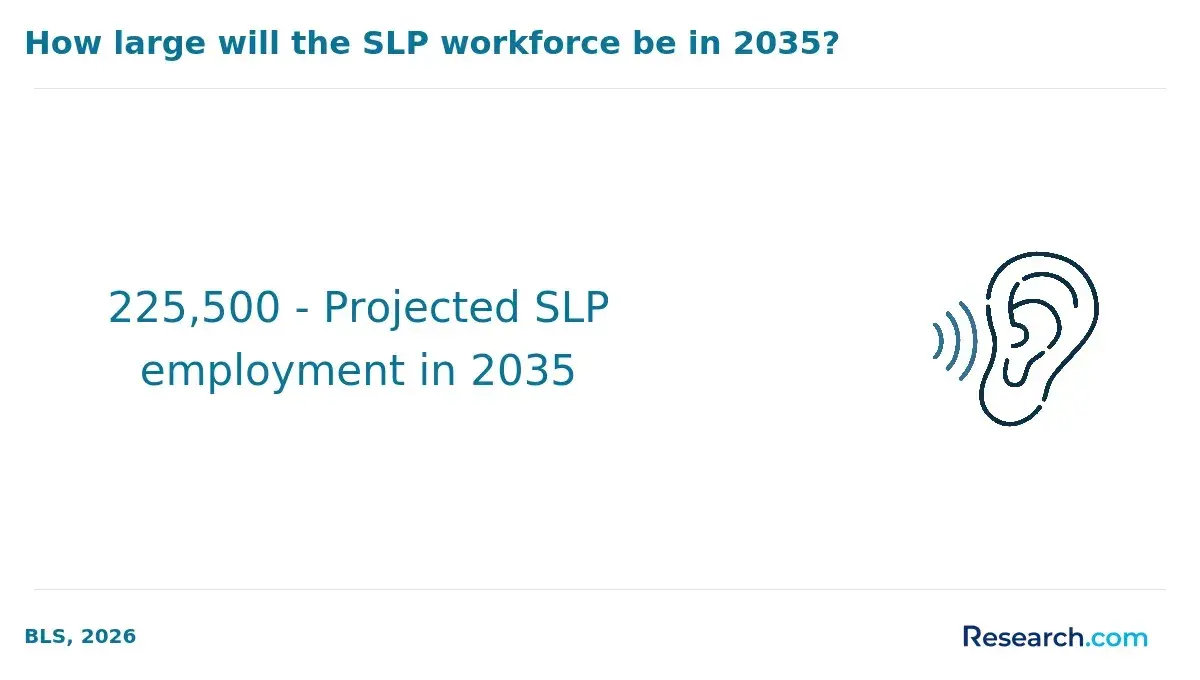
Career demand provides a separate reason to investigate the field: the U.S. Bureau of Labor Statistics projects approximately 12,500 speech-language pathologist openings annually, on average, over 2025-2035. Openings are not seats in graduate programs or a forecast of graduates' job offers. Use them as labor-market context alongside program costs and speech pathology career earnings, not as a popularity measure.
Which communication disorders degree levels enroll the most students?
Award-level data cannot establish which level enrolls the most students. A bachelor's program, for example, may have more students in progress than degrees awarded in any one year. To rank actual enrollment, a source would need field-specific headcounts reported consistently across institutions and degree levels.
The table distinguishes the four degree levels readers commonly compare. It also shows why their relative popularity should be interpreted in light of different career goals rather than treated as a program-quality ranking.
| Degree level | What an award count would show | Typical decision it informs |
| Associate | Completed associate degrees in the selected program codes | Whether a program supports an assistant pathway or transfer toward a bachelor's degree |
| Bachelor's | Completed undergraduate degrees, not all current majors | Preparation for graduate study or related work; generally not sufficient by itself for SLP licensure |
| Master's | Completed graduate degrees in the selected codes | Preparation for the educational requirement typically associated with becoming a speech-language pathologist |
| Doctoral | Completed doctorates, which may represent different professional or research paths | Audiology practice, research, or advanced academic goals, depending on the program |
If you already hold an unrelated bachelor's degree, do not assume you need another full undergraduate degree merely because bachelor's programs appear prominent in a chart. Compare prerequisite routes, including SLP bridge programs versus second bachelor's degrees, against the admission requirements of the master's programs you intend to pursue.
How does communication disorders degree popularity differ by gender?
Gender comparisons are meaningful only when they use the same degree level, field definition, year, and counting method. A national total can conceal different patterns in undergraduate, graduate, audiology, and assistant awards. Without a verified tabulation, this article cannot assign a reliable gender share to communication disorders students or graduates.
Many institutional and federal reporting systems publish gender data in categories that do not fully describe every student's identity. A chart limited to reported female and male categories should say so rather than implying it captures every person. For program selection, a gender breakdown may help describe a student population, but it cannot tell you whether a particular school offers supportive advising, accessible placements, or a good fit.
Which U.S. regions have the highest communication disorders degree enrollment?
No region can be named the enrollment leader from degree-award totals alone. An institution's location can identify where an award was conferred, but an online student may live elsewhere, and a graduate may take a job in another state. Comparisons also depend on whether "region" means the four U.S. Census regions, individual states, or another grouping.
Regional totals can still be useful when clearly labeled as awards by institution location. A larger total may partly reflect a larger population or more institutions; a regional share of all comparable degrees answers a different question. Neither measure confirms that a school can arrange training near your home. If location matters to your decision, examine clinical placement considerations in SLP program selection and ask each program where its students have actually completed placements.
How are communication disorders degrees defined and counted in the data?
The federal Integrated Postsecondary Education Data System, or IPEDS, records awards using Classification of Instructional Programs (CIP) codes. A broad communication disorders analysis can include multiple codes under the communication disorders sciences and services family; a speech-language-pathology-only analysis is narrower. Those choices materially change any ranking.
The table shows program categories a researcher may need to distinguish before counting awards. Institutions report awards under specific codes, so the scope should be published alongside any total.
| 2020 CIP code | Program category | Why inclusion matters |
| 51.0201 | Communication Sciences and Disorders, General | May include broad undergraduate preparation |
| 51.0202 | Audiology/Audiologist and Speech-Language Pathology/Pathologist | Combines disciplines within one classification |
| 51.0203 | Speech-Language Pathology/Pathologist | More closely targets the SLP pathway |
| 51.0204 | Audiology/Audiologist | Adds an audiology pathway with different professional requirements |
| 51.0205 | Speech-Language Pathology Assistant | Adds assistant preparation, which should not be confused with SLP preparation |
| 51.0299 | Communication Disorders Sciences and Services, Other | Captures programs not classified in the named categories |
To reproduce a comparison, identify the academic year and CIP version, select codes, retain the same institutions and award levels, and group awards by institution location and reported gender. Count awards as awards: one person could receive more than one, and some certificates are reported separately from associate, bachelor's, master's, and doctoral degrees.
What share of communication disorders students pursue associate, bachelor's, master's, or doctoral degrees?
A share of students pursuing each degree cannot be calculated from completions. An award share is calculable: divide awards at one level by all awards at the included levels, using the same academic year and CIP codes. If the comparison excludes certificates, its denominator must exclude them at every institution. No verified counts are established here from which to report those shares.
Even a correctly calculated award share does not show which degree is the best investment. A prospective SLP should compare the full cost of prerequisite coursework and a qualifying master's program, rather than choose a level because it accounts for a larger share of awards. When evaluating graduate options, comparing online speech pathology program costs should include required fees, travel, and clinical-placement expenses - not tuition alone.
How do gender patterns vary across communication disorders degree levels?
The appropriate comparison is the gender distribution within each award level, not each level's contribution to the national total. Otherwise, a large bachelor's category could dominate the overall result even if smaller graduate categories have different distributions. Verified level-by-gender award counts are needed before describing the size or direction of any difference.
Readers should also separate discipline from level. A doctoral category that includes audiology and research doctorates should not automatically be compared with an SLP-focused master's category as though both represent the same career route. When reviewing a school's demographic figures, ask whether they describe applicants, enrolled students, or graduates, and whether they cover the specific program you would enter.
Which regions show the largest gender differences in communication disorders enrollment?
Identifying the largest regional enrollment gap requires field-specific enrollment counts by gender and region; degree-award counts cannot answer it directly. If awards are used as a clearly labeled substitute, compare gender shares within each region using identical program codes and award levels. Comparing raw differences alone would tend to emphasize places with more awards.
Small regional or degree-level groups also need caution: a modest change in awards can noticeably shift a share. Before treating a regional contrast as evidence about student experience, check the underlying counts and whether the region is assigned by institution rather than student residence. For an applicant, program-level information about clinical sites and student support is more actionable than a broad regional gender gap.
How has communication disorders degree popularity changed over time?
A trustworthy trend compares the same measure across academic years. Charting annual awards can show how completed degrees change, but it cannot establish when enrollment rose or fell: students entering a program generally complete it later. Changes in CIP classifications, included institutions, and award categories can also create an apparent shift that is partly methodological.
Labor-market projections are relevant context, not proof of an enrollment trend. The BLS projects 17% employment growth for speech-language pathologists from 2025 to 2035; applicants should not assume graduate seats, clinical placements, or licensing capacity will grow at the same rate. If a shorter route is appealing, compare the actual course and placement schedule with the workload in accelerated online SLP programs before interpreting "fast" as an easier path.
What limitations affect comparisons of communication disorders degree popularity?
The biggest limitation is treating different measures as interchangeable. IPEDS awards count credentials conferred; institutional enrollment may count students at a particular point or across a year; applications can include people who never enroll. Broad CIP categories can mix career paths, while institution-based regional figures do not establish where students live or practice.
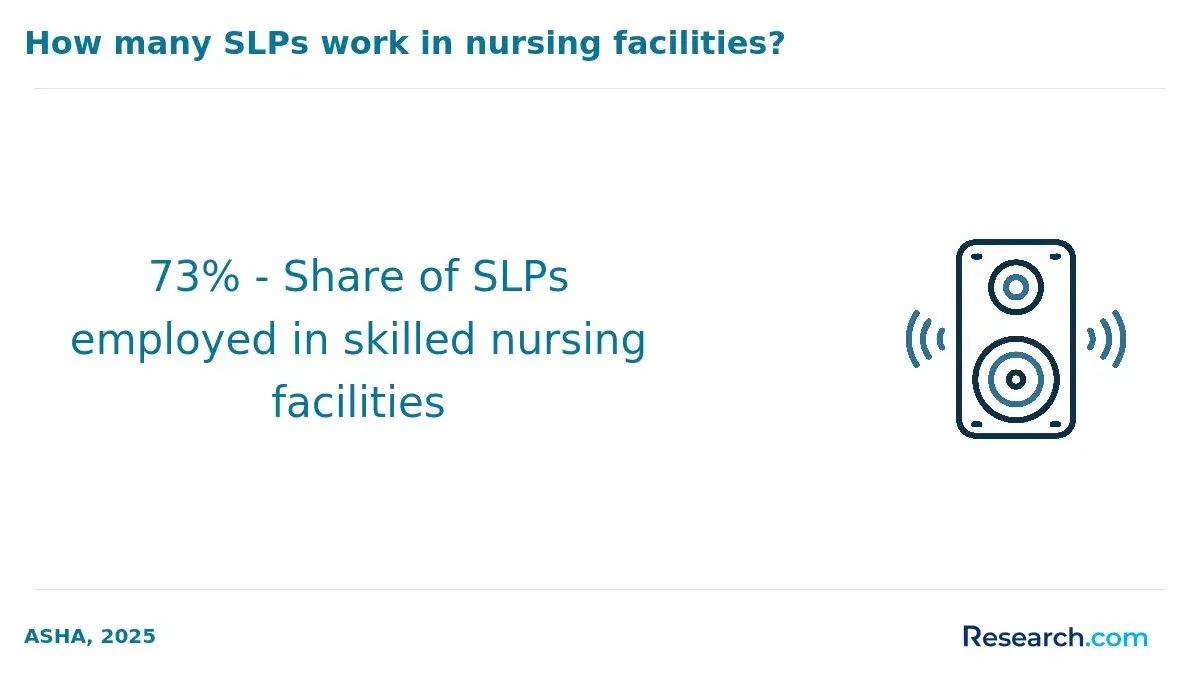
Popularity also cannot establish affordability, accreditation, licensure eligibility, or a reliable graduation timeline. The BLS reports a May 2025 median annual wage of $97,870 for speech-language pathologists, but that occupational figure is not an expected salary for every communication disorders graduate. Before committing to a program, verify its current accreditation status, your state's professional requirements, total estimated cost, and who secures clinical sites. For online options, examine how clinical placements and online SLP graduation timelines interact rather than relying on an advertised minimum duration.
References:
- U.S. Bureau of Labor Statistics - Speech-Language Pathologists https://www.bls.gov/ooh/healthcare/speech-language-pathologists.htm
- ASHA EdFind - Accredited Speech-Language Pathology Programs https://find.asha.org/ed/
- ETS Praxis - Speech-Language Pathology (5331) https://praxis.ets.org/test/speech-language-pathology-5331.html
- University of North Carolina at Greensboro - Speech-Language Pathology, M.A. (Online) https://csd.uncg.edu/graduate/masters-of-arts-online/
- West Virginia University - Speech-Language Pathology, M.S. - Online https://medicine.hsc.wvu.edu/communications-sciences-and-disorders/speech-language-pathology-ms/future-students/curriculum/online-slp-program/
- Pennsylvania Western University - Master of Science in Speech-Language Pathology https://online.pennwest.edu/programs/speech-language-pathology-grad/index.php
- New England Institute of Technology - Master of Science in Speech Language Pathology https://www.neit.edu/academics/graduate-degrees/speech-language-pathology-ms
- California State University-East Bay - Online Master of Science in Speech-Language Pathology https://ce.csueastbay.edu/programs/speech-language-pathology/
Other Things You Should Know About Speech Pathology
A bachelor's degree can prepare you for graduate admission, but speech-language pathologists typically need a master's degree. Check the intended program's accreditation and the licensing rules in the state where you plan to practice.
Many communication disorders graduate programs no longer require the GRE, but some still ask for it or make it optional. When required, schools often set minimum section scores, and admissions offices usually list the exact cutoff in the program requirements for 2027.
Not necessarily. Awards are generally assigned to the institution's location, while jobs and graduates can move across regions. Research employers and licensing requirements in the area where you intend to work.
Ask whether you can enroll from your state, how the program addresses its licensure requirements, who arranges clinical placements, whether travel is required, and what tuition, fees, and placement-related costs you should expect.