
12 Free Plagiarism Checker Tools for Students and Teachers for 2027

Co-Founder and Chief Data Scientist
12 Free Plagiarism Checker Tools for Students and Teachers for 2027 Table of Contents
List of Plagiarism Checker Tools
Statistics For 12 Free Plagiarism Checker Tools For Students and Teachers For 2027
With thousands of papers and articles published each day and millions more already in existence, it’s easy to see how untenable it is to manually check each paper submission for plagiarized content. But with sophisticated web crawlers and search-optimized plagiarism checker tools, the lives of publishers, writers, editors, students, teachers, and many more have become so much easier and manageable.
Plagiarism tools come in various flavors, from free plagiarism checker tools for students and teachers, editors, etc., to premium applications with more powerful algorithms, capabilities, and features. They do more than check for suspiciously familiar content: they can also enhance your writing style, use of grammar, and so much more. Your access to these applications, however, is often limited by how much you can or are willing to pay. You will find that premium plagiarism checker applications are often priced steeply. If you’re only checking a single output, subscribing to one simply does not make sense. The alternative is to use free plagiarism checkers that come with many bonus features.
This article presents the top plagiarism checkers, their key features, and how well they perform. To check their performance, we employed a simple test of copying and pasting content from the PDF copy of an academic journal. The free plagiarism checker tools were then ranked primarily based on their level of accuracy in detecting the unattributed content. Secondary considerations include additional features like character or word count limits, file formats supported, reporting features, and citation generation. Keep on reading to know which is the best free online plagiarism checker on the market and other worthwhile options.
Statistics on Plagiarism
Academic institutions often have clear-cut zero-tolerance policies for students caught plagiarizing their research and essays. This is because of the widespread incidence of plagiarism among higher education students, which presents an increasing concern for school administrators and faculty who are serious in defending academic integrity (MacLennan, 2018). However, it is a bit different for research professionals submitting their work to journals for publication where even self-plagiarism is not allowed. Self-plagiarism is when the author reuses previously published content and passes it off as new without telling the reader where the work previously appeared (Roig, 2011).
In a plagiarism study by Enders et al. (2004), they found that only 19% of journal editors had formal plagiarism policies within their organizations. As such, journal editors can respond to instances of plagiarism in a number of ways. In the survey, 70.9% said that notifying the original author as soon as possible is definitely an appropriate response to a clear case of plagiarism (Enders, Walter & Hoover, Gary, 2004). However, 42% said informing the plagiarists’ dean and other superiors is not likely an appropriate response. Moreover, 51% said that informing the public about the incident is also not likely an appropriate response.
Another plagiarism study by Karabag & Berggren (2012) tried to relate the issue to papers that were retracted due to intellectual dishonesty. They observed that science journals are more active in retracting papers than business and economic journals. For instance, they found more than 700 papers retracted from ScienceDirect, a database of scientific journals from 1985 to 2012. In contrast, they only found seven retraction notices from Emerald Management Journals. This led them to conclude that “the leading business and economics journals’ response to academic dishonesty and plagiarism has been slow (Karabag and Berggren, 2012)."
One prominent case of plagiarism involved Harvard Law professor Charles Ogletree. He admitted to copying word for word six paragraphs from the work of another law professor to his book (Pacia, 2004). Ogletree issued a public apology, after which an internal investigation found he committed an honest mistake (Torres, 2004). This decision was criticized by The Harvard Crimson as imposing double standards on students and professors caught plagiarizing (The Crimson Staff, 2004).
In another case, Bindu Ganga, the director of training at Argosy University-Chicago was found to have plagiarized her doctoral research project about lying (Newbart, 2006). Ganga was fired from her job and stripped of her Doctor of Psychology degree (Newbart, 2007). This was after allegations of plagiarism from a student were confirmed by Turnitin, which showed her work was roughly 45% similar to other published works.
These unfortunate cases illustrate the importance of ensuring one’s research is plagiarism-free, no matter the type of degree or profession, to avoid damage to one’s professional reputation and career. Having a free plagiarism checker like Turnitin enables editors to easily spot plagiarized content and recommend revisions or apply adjustments to documents.
Top 12 Free Plagiarism Checkers
1. Pangram
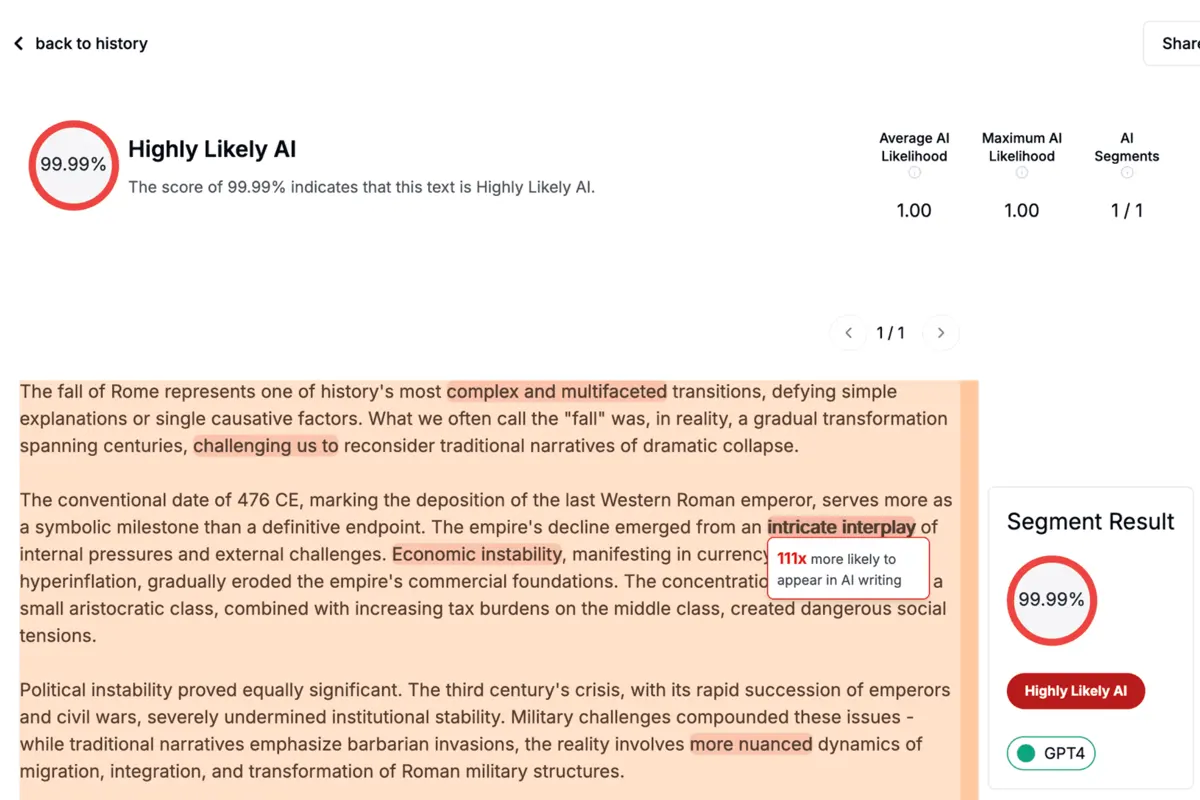
Pangram positions itself as a dual-purpose platform that integrates neural network-based AI detection with standard plagiarism scanning. By leveraging a technique known as "hard negative mining," the software identifies patterns typical of Large Language Models (LLMs) like Gemini and GPT-5, even when the text has been obfuscated by paraphrasing tools (Pangram, n.d.). Its methodology has undergone external validation by academic teams at the University of Maryland and the University of Chicago, lending credibility to its claims of accuracy regarding "humanized" text.
The platform offers a robust free tier that lets users run 4 scans per day. Unlike many "freemium" alternatives that lock essential utilities behind a paywall, Pangram includes Optical Character Recognition (OCR) in its no-cost version. This allows analysis of non-selectable text within images or scanned PDFs without a subscription.
Users benefit from "Segment Analysis," a granular reporting feature that color-codes the document to distinguish between human writing, AI-generated content, and potential plagiarism. The tool supports over 20 languages and integrates directly into workflows via a Chrome extension. Consequently, Pangram serves as a comprehensive, free plagiarism checker for users who require nuanced verification in the age of generative AI.

2. Quetext
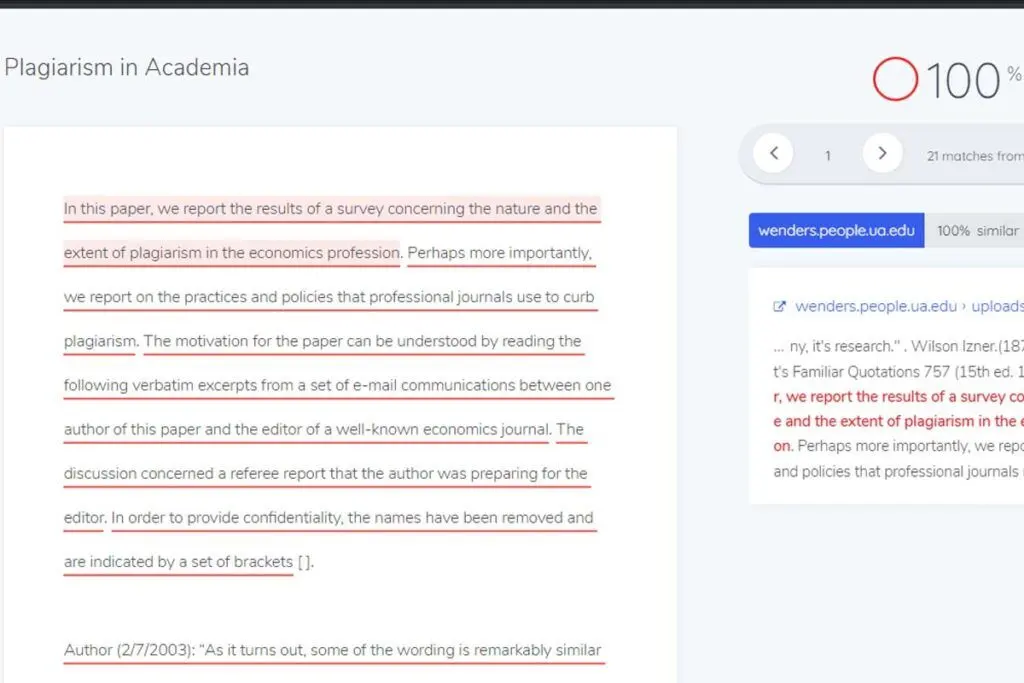
Considered by some as the best online plagiarism checker, Quetext quickly spots plagiarized sections and also serves as a citation assistant. It has a free Instant Search feature that lets you review your work lightning-fast. Their patented DeepSearch technology provides you with contextual analysis, fuzzy matching, and conditional scoring (Quetext, n.d.). With this, Quetext correctly detected 100% of content copied and pasted from an academic journal.
Quetext has a free plan that allows you to get five free plagiarism checks every month. First-time users can get 500 words analyzed for free. More searches require you to register for free.
The free plan includes a decent amount of features for helping you steer clear of improperly attributing your sources. Contextual analysis does not only look at how closely the words match between different sources, but also considers the context of the phrases. It likewise detects synonyms in rewritten phrases through fuzzy matching. Meanwhile, conditional scoring gives weight to each match found in your work in addition to its total DeepSearch score. Once the software is done analyzing your work, its patented ColorGrade feedback gives you a visual guide for which parts of your work need to be corrected. Even with the free version, you get a citation assistant where you can manually input the details of your source material. As such, Quetext is one of the best free plagiarism checker online tools you can use for your research.

3. Plagiarisma
Plagiarisma brands itself as a Copyscape or Turnitin alternative free platform with comparable capabilities (Plagiarisma, n.d.). Prior to its widespread use, scholars (see, for instance, Collberg & Kobourov, 2005) had suggested the use of a 1:1 comparison approach for plagiarism checking, Plagiarisma had since been utilized in its program.
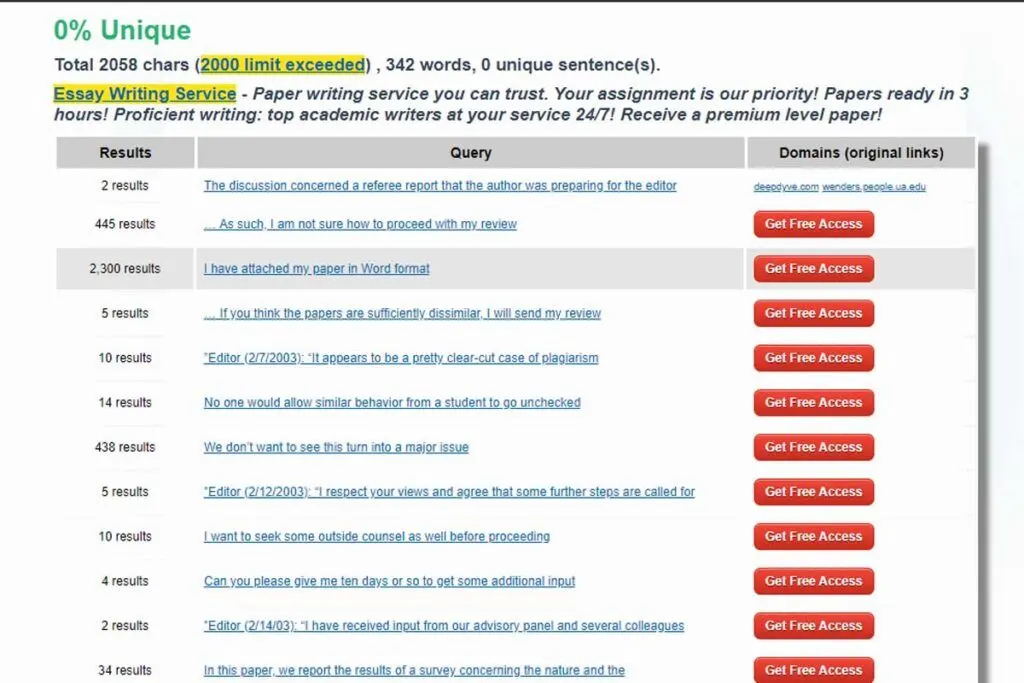
The basic tool helps you check your work against duplicate sentences online. Though the site looks dated, a simple test of copy and pasting exact content from an academic journal accurately yielded a 0% unique result. This makes it one of the best plagiarism checker free options online.
The webpage is straightforward to use. Simply paste the text you want to check in the text box and click the Check for Duplicate Button. Instead of using the text box, you can also upload a file to the site. You can check your work against a specific URL. File types supported include TXT, HTML, RTF, and more. The online tool supports searches for over 190 languages. It’s also possible to search for content using Google Scholar and Google Books.
However, the plagiarism checker free version supports search results for Bing only. Access to Google search results is reserved for registered users only. You can sign up as a registered user for free to get more features like faster results and fuzzy logic search.
4. Originality.ai
Originality.ai is an advanced AI-driven tool that helps content creators, marketers, and businesses maintain high standards for originality in their written work. By leveraging AI-powered technology, Originality.ai can effectively detect instances of both plagiarism and AI-generated content, ensuring that written materials are truly unique. With a focus on delivering precise and accurate detection, it’s designed to support creators and companies that prioritize integrity in their content.
The platform’s functionality is user-friendly and efficient, offering seamless integration for individuals and teams. Users can access Originality.ai’s scanning capabilities directly or through its Chrome extension, allowing for quick checks across various writing and publishing workflows. Its intuitive dashboard provides real-time feedback on content originality scores, which makes it an ideal tool for editors, writers, and marketing teams who need to validate authenticity before publishing.
In addition to plagiarism and AI detection, Originality.ai provides a suite of features that enhance overall content quality. The platform offers customizable scanning options, allowing users to choose the type and depth of analysis suited to their needs. With competitive pricing and dedicated support for SEO and content marketing professionals, Originality.ai caters to a wide range of industries, making it a valuable asset for anyone committed to producing authentic, high-quality content.
5. Search Engine Reports
A free plagiarism checker that both content writers and researchers can use is Search Engine Reports. The online search analyzer has a rather generous limit of 2,000 words for running its plagiarism check. You can upload a file from your computer or from Dropbox. In addition, its URL exclusion feature is not only free but is capable of running up to five URLs at the same time. It’s also available in 17 languages.
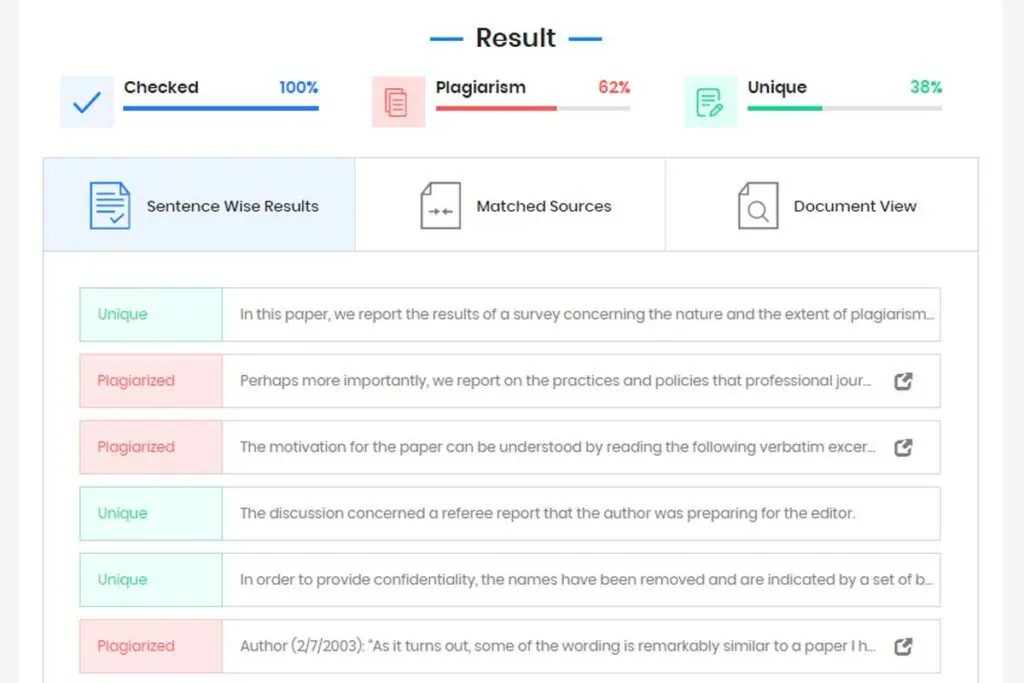
It also offers three different ways to view your plagiarism search results: sentence-wise results, matched sources, or document view (Search Engine Reports, n.d.). The interface and ranking system looks very similar to that of Small SEO Tools but is more accurate. Once the plagiarism check is done, you can view the report from another webpage and share it. You can also download it as a PDF file. If it detects plagiarized content, it will give you a link to similar content. There will also be an option for you to rewrite the plagiarized content through their paraphrasing tool. Though not as accurate as Quetext or Plagiarisma, its user-friendly, visual presentation of its plagiarism check is helpful in addressing problematic parts of one’s work.
6. Plagium
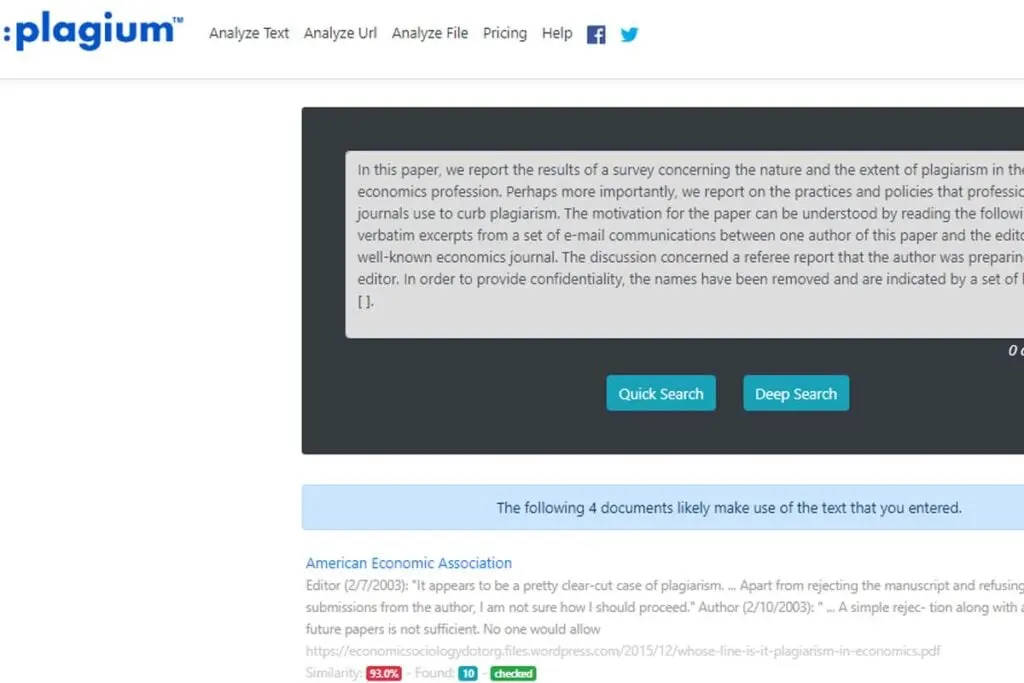
As a free plagiarism checker similar to Turnitin, Plagium is an easy-to-use tool that allows you to detect plagiarized content in text and URLs. It does this by dividing the text into snippets and comparing them to online sources. Plagium claims that this method gives users cleaner, less noisy search results compared to other search engines (Plagium, n.d.). Moreover, Plagium correctly identified the source URL of a sample plagiarized text.
As is standard with free online plagiarism checkers, the Plagium website features a text box where you can put in text for analyzing. You can put a maximum of 1,000 characters in the text box. It gives you options to do a Quick Search or a Deep Search, but only the Quick Search option can be used without creating an account. Quick Search shows you links to matched documents the software found online. However, it does not give you a percentage of how much content was plagiarized.
Plagium also has plans which bill you for every page you search. An alternative to these is their free Google Docs add-on which has no limits on how much text you can select. It is convenient in that it highlights parts of the document where the software has detected duplicate content online. It also provides you with the links to the online source. However, its shortcoming is that it does not give you a side-by-side comparison of your work and the matched result. Still, the accuracy of its plagiarism search results makes it one of the best free plagiarism checkers available online.
7. Small SEO Tools
A plagiarism checker is one out of a hundred tools that you can find for free in the Small SEO Tools site. The tool caters mostly to the needs of content writers and freelancers who want to make sure their work is plagiarism-free for better SEO ranking. Not only is it a candidate for the best online free plagiarism checker; it can serve as a handy research tool, too.
Small SEO Tools’ plagiarism checker allows you to paste text onto the text box or upload a document in various file formats. These include .tex, .txt, .doc, and more. Uploading a document from Google Drive or Dropbox is also possible. With the free tool, you can scan up to 1,000 words per search. Like most free services, you can put in a webpage URL to run a plagiarism check. You can also exclude a specific URL from your search, a feature that you would have to pay for with other providers.
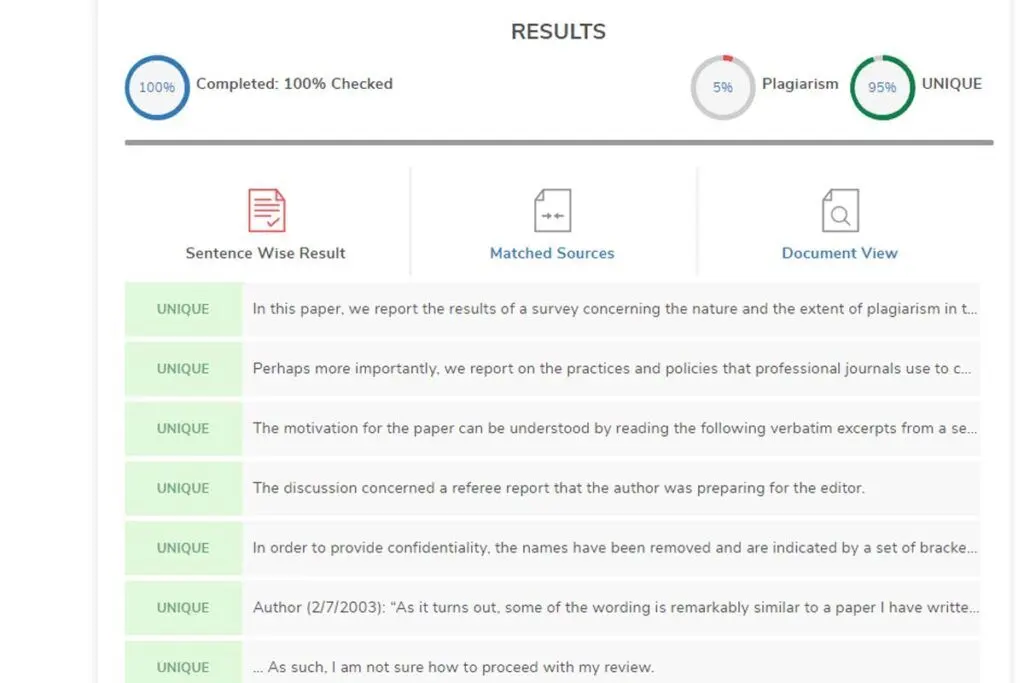
Other useful features include percentage gauges, which give you objective data about how much plagiarized content is present. Its list-based, sentence-wise results show you unique versus plagiarized sentences in an easy-to-follow color-coded format, which is akin to how word cloud generator tools show related words or concepts. You can view a side-by-side comparison with your work versus matched results with the Document View feature. It even has a built-in automatic rewriting feature which allows you to change the wording of plagiarized content with just one click. They also have a mobile Plagiarism Checker app for iOS and Android (Small SEO Tools, n.d.). Though it is feature-rich, it only detected a small fraction of plagiarized content.
8. Editpad
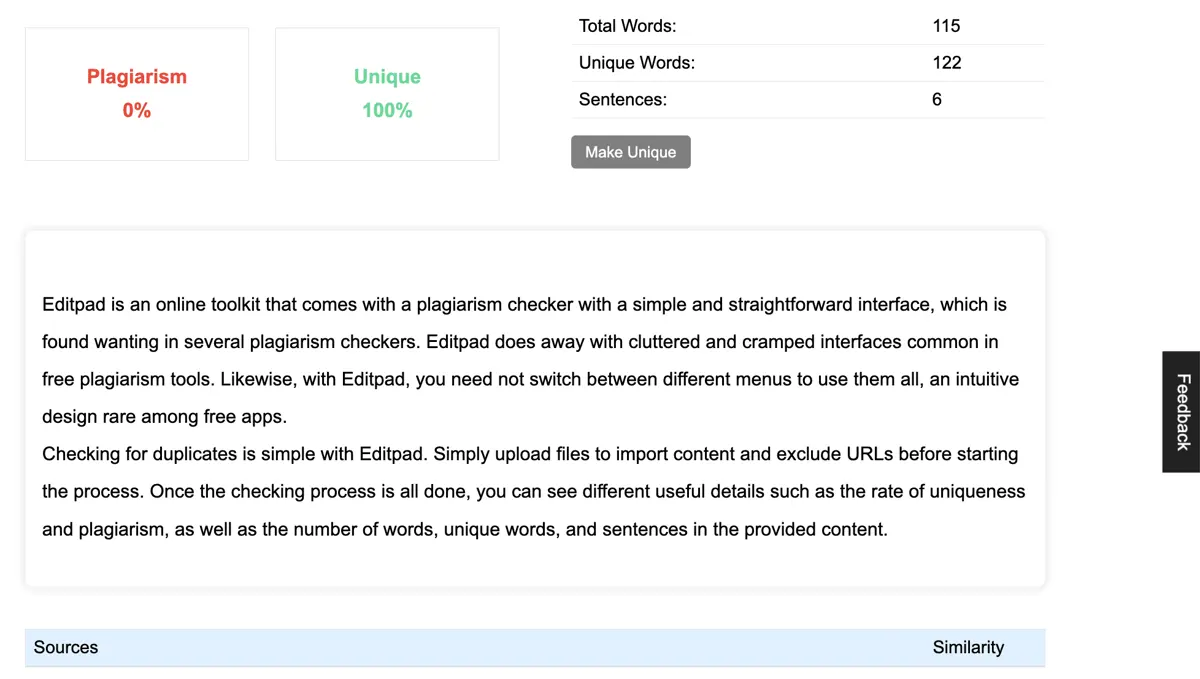
Editpad is an online toolkit that comes with a plagiarism checker with a simple and straightforward interface, which is found wanting in several plagiarism checkers. Editpad does away with cluttered and cramped interfaces common in free plagiarism tools. Likewise, with Editpad, you need not switch between different menus to use them all, an intuitive design rare among free apps.
Checking for duplicates is simple with Editpad. Just upload files to import content and exclude URLs before starting the process. Once the checking process is all done, you can see different useful details such as the rate of uniqueness and plagiarism, as well as the number of words, unique words, and sentences in the provided content.
9. HIX.AI
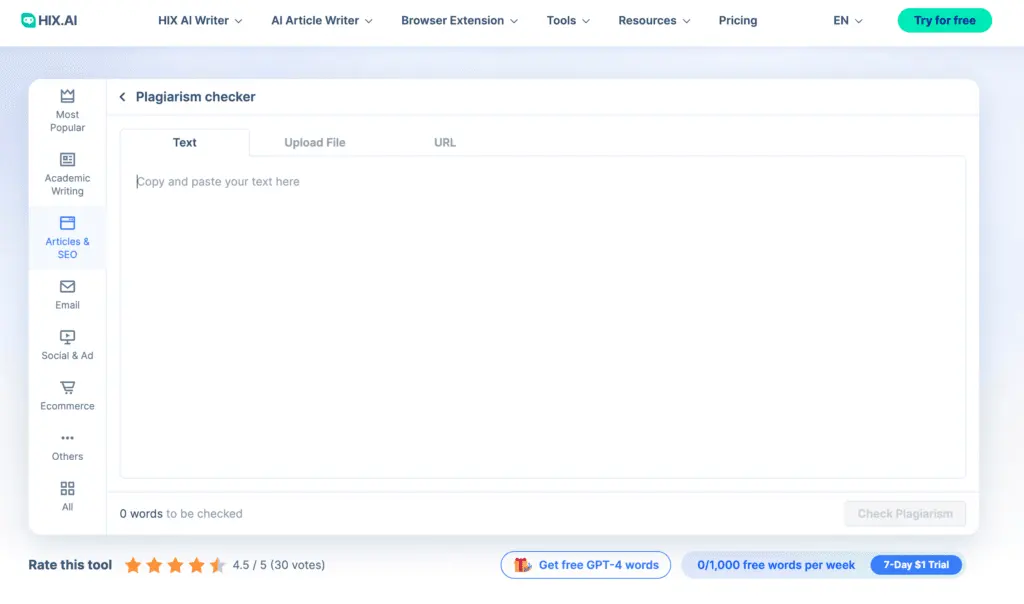
HIX.AI is an all-in-one AI writing copilot that provides a wide range of useful writing tools to cater to all your writing needs. One such tool is the Plagiarism Checker, which is designed to help users identify any instances of plagiarism effortlessly.
This tool allows you to check plagiarism in different ways. You can either paste the text into the text box or upload any files, including .txt, .doc, .pdf, .docx, and other file types, for analysis. Alternatively, if you want to perform a plagiarism check on a published document, you can also paste the URL to that work to run a check.
This tool provides more than a simple plagiarism score. Instead, it uses a color-coding system to effectively highlight sentences and paragraphs with a high and low likelihood of plagiarism, helping the user to identify areas where further paraphrasing is required. In addition, it provides links to plagiarized sources for easy reference.
HIX.AI not only detects plagiarism but also generates plagiarism-free content. With HIX AI Writer, you can create compelling short-form content while ArticleGPT helps you generate long-form, fact-based, and SEO-friendly articles. All content generated by these tools is 100% unique.
10. ZeroGPT
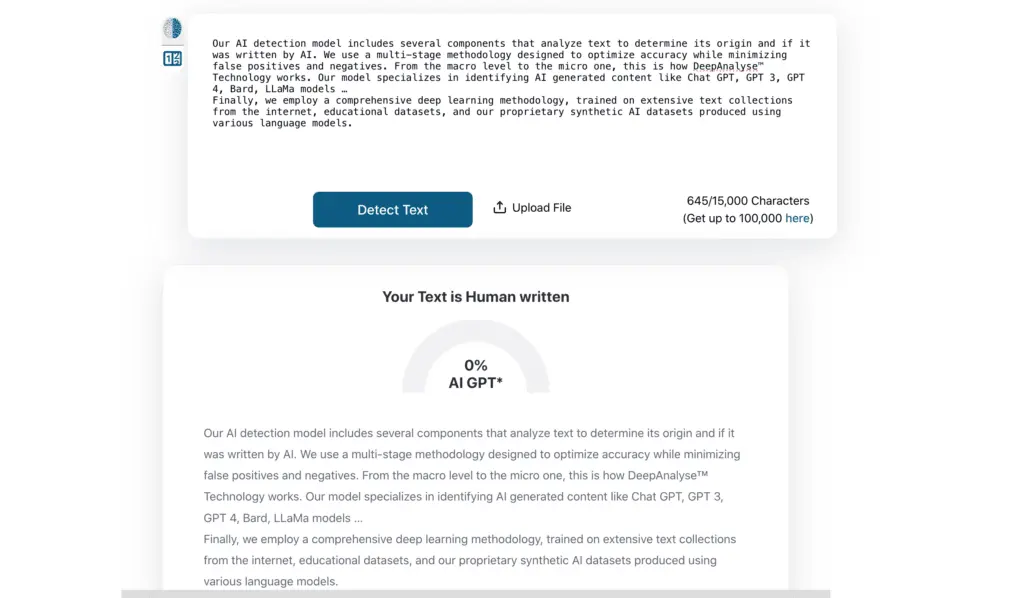
ZeroGPT is a language-agnostic tool used for detecting AI-generated content, specifically from models like Chat GPT, GPT 3, GPT 4, Bard, and LLaMa. It utilizes a comprehensive deep learning approach, drawing from a diverse range of textual sources, including internet content, educational datasets, and proprietary synthetic AI datasets. Spotting suspicious text is easy, with this tool highlighting suspected AI-generated sentences. It also provides scoring of how much AI content is potentially generated within the text. Users can conveniently upload multiple files for automated checks on the dashboard, with automatic generation of .pdf reports for every detection, serving as evidence of AI-free plagiarism.
11. Plagiarismchecker.ai
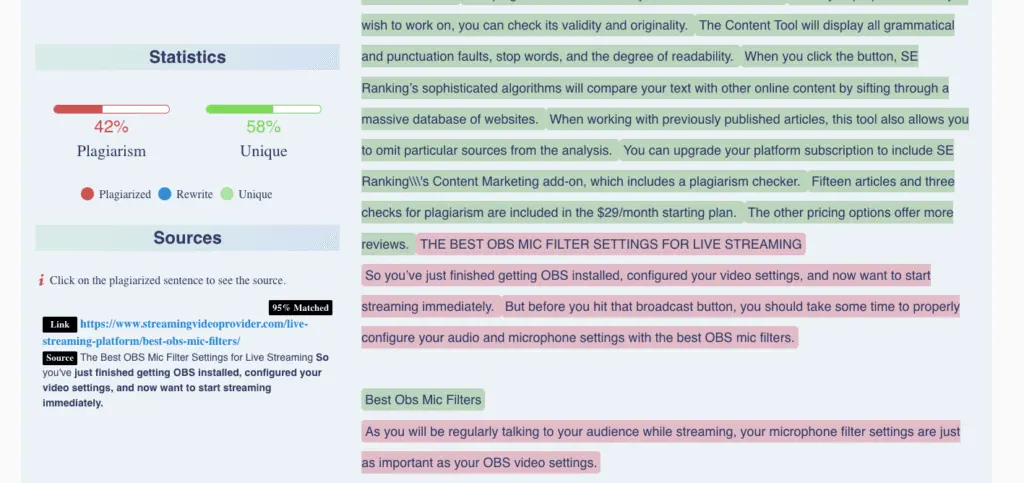
Plagiarismchecker.ai not only detects plagiarism detection but also spots AI content and duplication. It allows you to upload the file or copy and paste the content for checking. It also supports up to 25,000 words for checking and scanning for any traces of copied content within the text. For easier reference, the plagiarized content will be highlighted in red while unique text will be highlighted in green The tool also provides links to the sources of the plagiarized content, and it also offers an option for downloading the plagiarism report in HTML format.
The premium version only costs $5, making it an affordable option for students and writers on a budget. You can also buy a professional package that allows you to check 100,000 words for just $10.
12. PlagiarismSearch.com
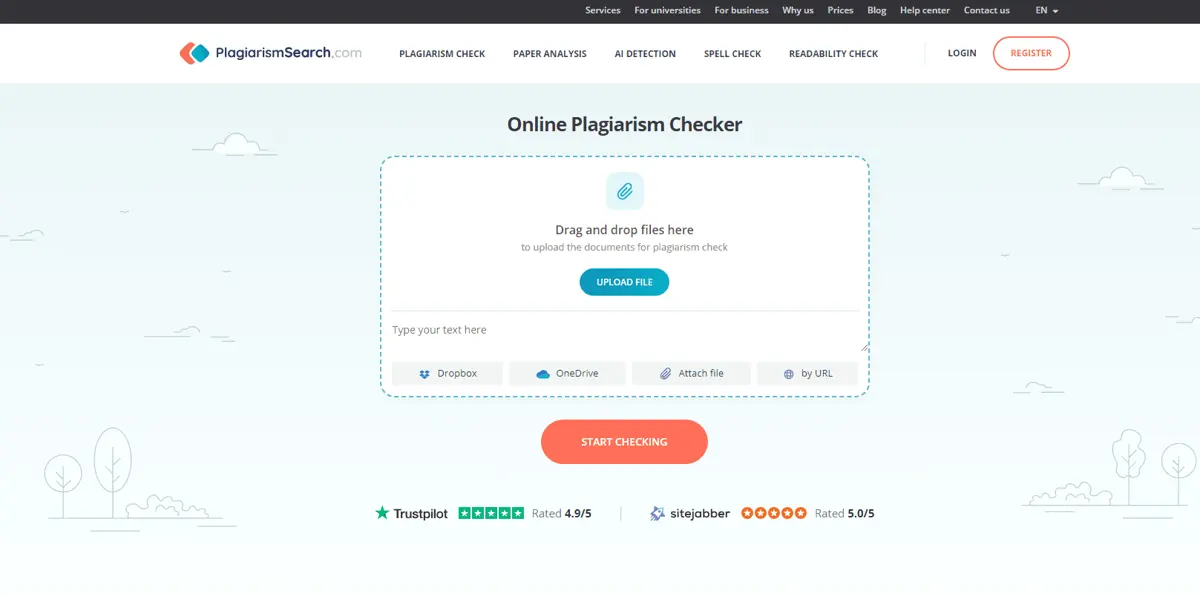
PlagiarismSearch.com is a leading online platform dedicated to preserving academic integrity by providing robust plagiarism detection and prevention solutions. Trusted by educators, researchers, and students worldwide, PlagiarismSearch.com offers advanced algorithms and a user-friendly interface to effectively identify instances of plagiarism in academic work. With features like verbatim copying, paraphrasing, and mosaic plagiarism detection, the platform ensures comprehensive scans of documents against an extensive database of academic and online sources.
PlagiarismSearch.com also offers supplementary tools such as citation and reference checkers, grammar and spelling checks, and writing guides to support users in maintaining originality and excellence in their work. With its commitment to innovation and continuous improvement, PlagiarismSearch.com is dedicated to upholding academic integrity and fostering a culture of honesty and accountability in education.
Beyond Plagiarism: Elevating Your Research Workflow
While plagiarism checkers are critical tools for ensuring the originality of your work, a comprehensive research workflow goes beyond avoiding duplicate content. As researchers and professionals strive for excellence, adopting integrated tools that optimize the entire research lifecycle—such as data collection, analysis, and reporting—is equally important. For instance, streamlining survey-based research is now made easier with intelligent platforms, enabling better participant engagement and data quality.
In addition to securing plagiarism-free academic or professional content, leveraging specialized digital solutions like online survey tools examples can support your efforts in designing, deploying, and analyzing impactful surveys. These tools play a crucial role in compiling user insights, reinforcing the empirical foundation of your work, and enhancing the credibility of your findings. Incorporating them into your research process allows you to achieve a higher level of accuracy and professional rigor.
Ultimately, integrating various technologies along with plagiarism checkers fosters an ecosystem where originality, reliability, and efficiency thrive. By choosing the right blend of tools, you can not only safeguard your research integrity but also produce outputs that leave a lasting impact on your audience.
Tips on Choosing and Using a Free Plagiarism Checker Tool
How Can You Ensure Data Privacy and Security When Using Free Plagiarism Checkers?
When using free plagiarism checkers, it is essential to evaluate the data privacy and security measures offered by each tool. Look for clear policies on data retention, encryption standards, and ownership rights of submitted content. Opt for platforms that specify secure file handling practices and do not store your work longer than necessary. Institutions and professionals should also consider integrating robust security frameworks, such as an advanced HR system, to maintain compliance and safeguard sensitive academic or proprietary material. This approach not only strengthens user trust but also ensures that the verification process does not expose confidential research or business information to potential misuse.
What’s the Best Free Plagiarism Checker to Use?
Based on the simple copy-and-paste test we employed, the answer to the question “What is the best free plagiarism checker to use?" is Pangram and Quetext. Out of all the tools in the list, these were the only ones that correctly detected that the content was 100% plagiarized. Close runner-ups were Search Engine Reports, which reported the lifted copy at 62% plagiarized and Plagium which did not give a percentage but correctly gave the link to the plagiarized content.
On the other hand, Small SEO Tools, Pre Post SEO, and Duplichecker only picked up 5% of the plagiarized content. However, the extra features and mobile version of Small SEO Tools gave it a slight edge among the other two. Meanwhile, Edubirdie, PaperRater, and Plagramme picked up 0% of the plagiarized content. Still, Edubirdie does deserve recognition for its free citation generation feature, which is helpful in avoiding non-attribution.
Ensuring your research acknowledges others’ work correctly is meticulous work. Even so, checking your paper for plagiarism is a must not only to ensure the quality of your research but also to protect your reputation. With free plagiarism checker tools, the process is much easier for students and research professionals alike. In the same manner, for entrepreneurs, if you want to know how to check if a business name is available for free, there are also online tools that you can use for this purpose. If your favorite ones are taken, you might also want to check out some AI business name generator apps to spark your creativity.
Key Insights
- Wide Range of Tools: There are numerous free plagiarism checkers available, each offering different features such as contextual analysis, citation assistance, and support for multiple file formats.
- Accuracy Varies: The accuracy of plagiarism detection varies significantly among tools. Pangram and Quetext were the most accurate, detecting 100% of plagiarized content in the test.
- Additional Features: Many tools offer additional features beyond plagiarism detection, such as grammar checks, SEO analysis, and rewriting tools. These can enhance the overall quality of the writing.
- User-Friendly Interfaces: Tools like Editpad and ZeroGPT offer user-friendly interfaces that make it easy for users to navigate and use the tools effectively.
- Cost Considerations: While many tools offer free versions, the premium versions often provide more comprehensive features and better accuracy. It is important to balance cost and functionality based on your specific needs.
- Importance for Academic Integrity: Using plagiarism checkers is crucial for maintaining academic integrity and avoiding the severe consequences associated with plagiarism, including damage to professional reputation and career.
References:
- Collberg, C., & Kobourov, S. (2005). Self-plagiarism in computer science. https://doi.org/10.1145/1053291.1053293
- Enders, Walter & Hoover, Gary. (2004). Whose line is it? Plagiarism in economics. https://doi.org/10.1257/0022051041409066
- Karabag, S.F., & Berggren, C. (2012). Retraction, dishonesty and plagiarism: analysis of a crucial issue for academic publishing, and the inadequate responses from leading journals in economics and management disciplines. https://ssrn.com/abstract=2190694
- Lahiry, S., & Sinha, R. (2019). Creativity is intelligence having fun, originality an undetected plagiarism! https://doi.org/10.4103/ijdvl.IJDVL_71_18
- MacLennan, H. (2018). Student perceptions of plagiarism avoidance competencies: An action research case study. https://doi.org/10.14434/josotl.v18i1.22350
- Newbart, D. (2006, February 19.) Student scolded by Argosy after accusing school official of plagiarizing project. Chicago Sun-Times.
- Newbart, D. (2007, December 31). Argosy plagiarism was ‘unintentional’ Academic says Poshard got off easier. Chicago Sun-Times.
- Pacia, R. (2004, September 14). Harvard Law prof admits to plagiarism. Yale Daily News.
- PaperRater (n.d.). Paperrater: Features powered by artificial intelligence. PaperRater.com.
- Plagiarisma (n.d.). Free online plagiarism checker for teachers and students. Copyscape and Turnitin alternative. Plagiarisma.com.
- Plagium (n.d.). Plagium by Septet Systems Doc Add-on: Overview. G Suite Marketplace
- Plagramme (n.d.). Free plagiarism check. Plagramme.com.
- Pre Post SEO (n.d.). Why Prepostseo Plagiarism Checker? PrePostSEO.com.
- Quetext (n.d.). DeepSearch™ Technology. Quetext.com.
- Roig, M. (2011). Avoiding Plagiarism, Self-plagiarism, and Other Questionable Writing Practices: A Guide to Ethical Writing. Tuscaloosa, AL: Department of Biological Sciences, College of Arts & Sciences, The University of Alabama.
- Search Engine Reports (n.d.) Plagiarism checker. SearchEngineReports.com.
- Small SEO Tools (n.d.). Features of our plagiarism checker. Small SEO Tools.com.
- The Crimson Staff (2004, September 13). What academia is hiding. The Harvard Crimson.
- Torres, H. (2004, September 25.). Ogletree admits to plagiarism. The Harvard Law Record.
- Editpad (n.d.). Free plagiarism checker. Editpad.org
Other Things You Should Know About Free Plagiarism Checker Tools for Students and Teachers
In 2026, notable new entries include "PlagScan Pro Lite" and "CheckMate" which offer enhanced AI-driven detection capabilities. They provide educators and students with more streamlined ways to check for plagiarism across diverse file types, emphasizing quick and accurate results. 2. Provide four relevant questions and answers from Google’s PAA related to the topic:
Free plagiarism checkers in 2026 often have limitations, such as word-count caps, fewer database sources, and less frequent updates than paid versions. They might miss subtle plagiarism or not recognize every citation style. Users should cross-verify results to ensure comprehensive analysis.
Most plagiarism checkers support multiple file formats, allowing you to upload documents in formats such as .txt, .doc, .pdf, .docx, and more. This flexibility makes it easier to check various types of documents for plagiarism.
In 2026, new additions to free plagiarism checker tools include "PlagiarismScanX" and "EduCheckNow." Both offer unique features like real-time checking and integration with popular educational platforms, helping students and teachers identify and address plagiarism effectively. These tools are equipped with updated algorithms to ensure comprehensive scanning.
Free plagiarism checkers often have limitations such as word count restrictions, lower accuracy, fewer features, and longer processing times. For comprehensive and professional needs, it may be necessary to invest in a premium plagiarism checker.
In 2026, Quetext and Grammarly continue to be highly accurate free plagiarism checkers for students and teachers. They offer comprehensive scans, detecting even nuanced similarities in texts. Many users appreciate their reliability, but it's always wise to cross-reference results for complete assurance.
Additional features to look for in a plagiarism checker include grammar and spell checks, contextual analysis, citation assistance, rewriting tools, and support for multiple file formats. These features can greatly enhance the functionality and usefulness of the tool.
It is advisable to use a plagiarism checker for every significant piece of writing, especially before submitting academic papers, articles, or professional documents. Regular use helps ensure that your work is original and free from unintentional plagiarism.


