
2027 Online MS in Psychology - Forensic Psychology Admissions with Withdrawals During a Family Caregiving Period: What to Ask Before Applying
Audited and Verified:
Our Editorial and Data Verification Process
Research.com uses government datasets, official education statistics and primary institutional information to support its career and degree guides. Our review process checks factual accuracy, occupational definitions, source dates and the requirements associated with the credentials discussed.
How This Article Was Fact-Checked
Our editorial team verifies salary estimates, employment projections, education requirements and program information against original data providers and official organizations. Salary figures are checked against the relevant occupational definitions and reporting periods. Information about licensure, accreditation and required in-person training is reviewed separately.
Fact-checked and verified on:

Co-Founder and Chief Data Scientist
A transcript showing withdrawals during a family caregiving period can make graduate applications feel uncertain, especially when you still need a schedule that works at home. This guide is for prospective online forensic psychology master's students deciding whether to apply now and where. It explains how schools may review withdrawals, what evidence to prepare, and which questions reveal whether a program is academically, financially, and practically workable. The aim is to help you seek a clear answer from each admissions office before spending money on an application.
Key Things You Should Know
- Withdrawals do not automatically bar admission; ask whether the program counts them in its GPA calculation and how it reviews an interrupted academic record.
- Prepare official transcripts and a brief explanation of the caregiving period, then show readiness through subsequent coursework, relevant experience, or both.
- Before applying, confirm live session, placement, leave, and cost policies. An online forensic psychology MS is not, by itself, a license to practice psychology.
What Is an Online Master's in Forensic Psychology?
An online master's in forensic psychology is graduate study of psychological science in legal and justice-related settings. Programs may emphasize research, behavior in legal contexts, victim services, corrections, or organizational applications. The degree title alone does not tell you whether a program has a thesis, an applied project, or any in-person requirement.
For a caregiver returning to school, the useful first comparison is not which program has the most compelling course titles. It is whether the program accepts your academic record, fits your available hours, and supports your intended work. A comparison of tuition and eligibility for forensic psychology programs can help you build a shortlist, but confirm each policy directly for your intended entry term.
Can You Apply After Withdrawing During Family Caregiving?
Yes, you can apply after withdrawing during family caregiving. Admission depends on the school's rules and its assessment of your complete record, not on a universal rule about withdrawals. A withdrawal recorded as a "W" may be treated differently from a failing grade, an incomplete, or a withdrawal from an entire institution. The registrar's transcript, not your recollection of the term, establishes what an admissions committee will see.
The distinction below helps you identify what needs clarification before you pay an application fee. It describes possible review issues, not a promise about how a school will decide.
| Transcript situation | Issue to verify with the program |
| One or more courses marked "W" | Whether withdrawals affect GPA calculation or prompt additional review |
| Failed or incomplete coursework in the same period | Whether grades meet the minimum GPA rule and whether an explanation or later coursework is considered |
| A long enrollment gap | Whether prerequisites must be recent and what evidence shows readiness to return |
| Previous graduate enrollment | Whether transcripts from that institution are required and whether any prior graduate standing matters |
Contact graduate admissions and the program coordinator if the published policy does not address your situation. Ask, "How are my withdrawals treated for admission and GPA purposes? Is there an optional explanation? Would recent coursework or a conditional admission option be relevant?" Give the term and transcript notation, without disclosing more family or medical information than necessary. In your statement, briefly explain the interruption, identify what has changed or how you will manage study now, and point to specific evidence of readiness. Do not frame caregiving as a character flaw or assume an explanation substitutes for a stated minimum requirement.
If you must strengthen your record before applying, compare the cost of a targeted prerequisite with another full degree. Resources on psychology degree affordability for returning adults are most useful when additional undergraduate study is genuinely required, rather than simply reassuring.
What Are the Admission Requirements for Online Forensic Psychology Programs?
Online forensic psychology programs set their own requirements. Common application materials include transcripts, a statement of purpose, and recommendations, but acceptable majors, GPA rules, prerequisite courses, tests, and deadlines vary. A non-psychology bachelor's degree does not necessarily disqualify you; your statistics, research methods, psychology, writing, or justice-related preparation may matter more to a particular program.
Separate a required prerequisite from a course that merely makes an applicant more competitive. Ask whether missing coursework can be completed before enrollment, whether professional experience can support an exception, and who authorizes any waiver. For example, experience in victim services can demonstrate relevant judgment and communication, but it does not automatically replace a required statistics course. Applicants considering a different service-oriented path can compare online addiction counseling coursework and admissions rather than assuming the two fields have interchangeable prerequisites or credentials.
Before requesting recommendations, obtain every required transcript and check the program's written GPA policy. Then prepare a concise explanation of the caregiving period and select recommenders who can speak to your current analytical work, academic performance, or reliability. Ask admissions whether an initial eligibility review is available; only the school can determine how its rules apply to your record.
Check the institution's accreditation through the accreditor it names and a recognized US accreditation directory. Then check what that accreditation actually covers. Institutional accreditation is an important school-level consideration; it does not establish that a nonclinical forensic psychology MS is professionally accredited or meets a licensing board's educational requirements.
Do not reject a general forensic psychology MS merely because it lacks American Psychological Association program accreditation: APA accreditation applies to specified professional psychology training programs, not every psychology master's degree. Conversely, do not accept a vague claim of "accreditation" as proof of clinical eligibility.
If you are comparing a counseling route, examine the recognition and licensing relevance of that specific program; accredited clinical mental health counseling completion pathways involve different professional questions from a nonclinical forensic MS.
A forensic psychology master's does not automatically lead to licensure. Studying assessment, mental disorders, or court-related behavior does not authorize diagnosis, psychotherapy, independent forensic evaluation, or use of a protected professional title. Requirements depend on the occupation and state; licensed psychologist roles generally require a qualifying doctoral pathway and additional supervised training and examination requirements.
If your goal is therapy, seek a program designed to meet the educational requirements for the specific counseling, social work, or other license you intend to pursue, and verify that it fits with the relevant state board. Accelerated online master's preparation in mental health counseling may be worth comparing, but speed cannot replace required supervised training or state eligibility checks. If your goal is research or nonclinical justice-system support, a forensic MS may fit without being a licensure route.
Coursework may cover psychology and law, research methods, statistics, ethics, violence-related research, victimization, or behavior in correctional settings. Examine the actual catalog: similarly named degrees can differ substantially in method depth, elective availability, and whether students complete a thesis, capstone, or supervised nonclinical experience.
For an applicant with withdrawals, course sequencing matters as much as course content. Ask whether a methods course is offered every term and whether missing a term delays the capstone. If earlier undergraduate study focused on substance-use services, recognize that academic preparation and financing for that route—for example, online substance use counseling bachelor's aid resources—address a different degree level and goal. Do not choose forensic graduate electives as a substitute for a credential required in your target occupation.
Program length depends on required credits, course availability, enrollment pace, and the time allowed for any thesis or project. A faster advertised schedule may assume continuous enrollment or a heavier course load than a caregiver can sustain. Comparisons of faster forensic psychology master's study for working professionals are a starting point, not a personal completion forecast.
Request a term-by-term plan for your realistic course load, along with a written estimate covering tuition, mandatory fees, books or software, and any travel or placement expense. Ask what happens financially if caregiving requires another withdrawal: refund deadlines, leave rules, course repeat charges, and satisfactory academic progress requirements can affect both the bill and financial aid. A lower per-credit price is not necessarily the lower-cost choice if a required course is hard to schedule or a stop-out adds fees.
Online study removes routine commuting, but it does not necessarily remove fixed-time obligations. Some programs use live classes, group meetings, proctored assessments, campus visits, or locally arranged experiences. Campus programs may offer easier access to faculty and on-site research activity, while imposing travel and attendance demands that are impractical during caregiving.
Ask for a sample weekly schedule, not just an "asynchronous" label. Confirm whether attendance is required at set times, whether project teammates choose their own meeting hours, and whether approved leave preserves your place in the course sequence. If pace is your main reason for choosing online study, compare accelerated MA psychology study pathways against the forensic content you actually need; a quicker general degree may not serve the same goal.
Depending on prior experience and employer requirements, graduates may pursue nonclinical work involving victim-service coordination, justice-program support, research assistance, policy support, or program evaluation. Such roles involve tasks such as referrals, documentation, literature review, or analysis - not independent clinical assessment or expert testimony. A degree alone does not secure a position or override an employer's experience, background-check, or credential requirements.
Start with job postings in your intended location and compare their stated qualifications with your existing experience. Someone already working in an agency may benefit more from targeted research-methods training or an employer-supported project than from a full MS. Someone whose target job requires a counseling license needs to compare the qualifying route and its full expense, including mental health counseling program charges beyond tuition, rather than relying on forensic coursework to satisfy clinical requirements.
What Are Forensic Psychology Salaries and Job Outlook?
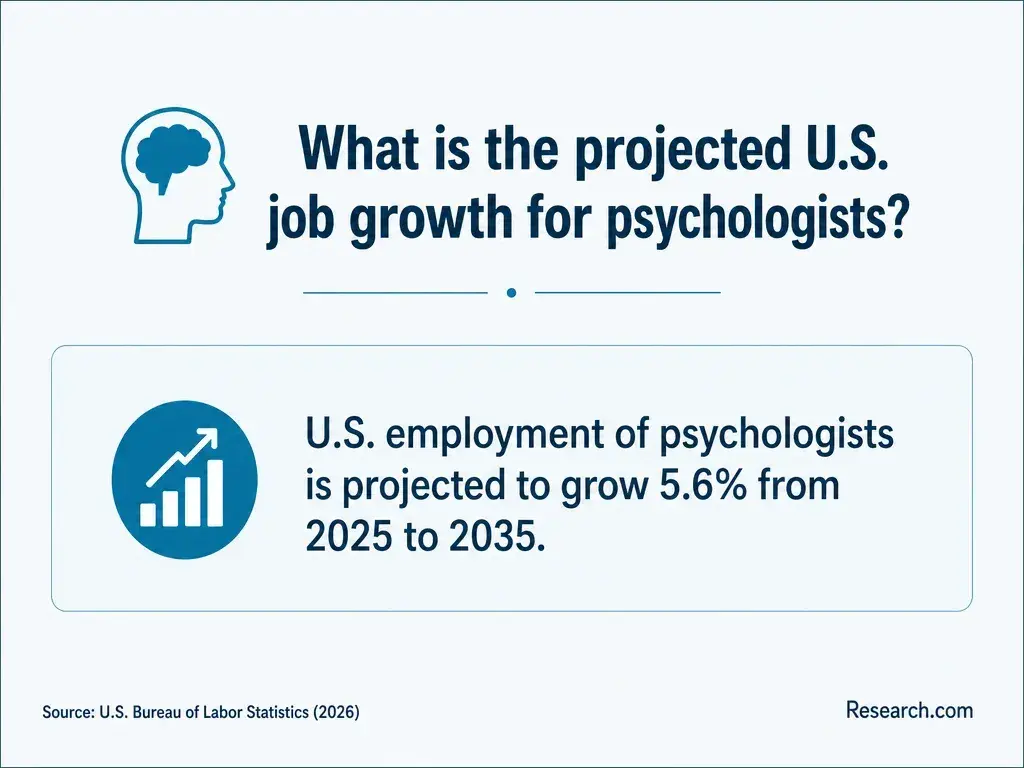
There is no single reliable "forensic psychology master's salary." The US Bureau of Labor Statistics reports wages and employment projections by occupation, not by this degree title. Its psychologist figures should not be presented as expected earnings for a graduate of a nonclinical MS, because psychologist positions have distinct qualification and licensure requirements.
For a useful outlook check, identify a specific job title, review its duties and entry requirements in current postings, and then consult the closest matching Bureau of Labor Statistics occupation. Compare that evidence with the total cost and time of your proposed program. A guide to planning the cost of a psychology master's can help frame the education expense; local hiring requirements and your existing experience determine whether the investment is likely to advance your particular goal.
Other Things You Should Know About Psychology
Usually, a brief description of the caregiving interruption is enough unless a school requests information for a specific process. Ask what documentation is required before sharing private details.
Yes, if the professor can give a specific, positive account of your academic work. A more recent supervisor may better document your present readiness if the program accepts professional recommenders.
Possibly. Ask whether education assistance covers this degree, what grades or continued employment it requires, and whether your work schedule can accommodate fixed class meetings.
Ask admissions which single improvement would matter most for your record. Completing a needed prerequisite or building a manageable study routine may be more useful than submitting an application before your caregiving schedule is stable.
- Your financial path to graduation | consumerfinance.gov https://www.consumerfinance.gov/paying-for-college/your-financial-path-to-graduation/
- Frequently Asked Questions - California Board of Psychology https://www.psychology.ca.gov/licensees/faq.shtml
- Medical Withdrawal Policy | Methodist College https://www.methodistcol.edu/current-students/registrar-office/current-student-policies
- Episode 19. What will professional programs think if I withdraw from a course? | Academic Advising https://advising.stanford.edu/beyond-undergrad/graduate-considerations/pre-prof-podcast/episode-19-what-will-professional
- Online MS in Forensic Psychology | Walden University https://www.waldenu.edu/online-masters-programs/ms-in-forensic-psychology
- Leave of Absence Policy | The New School Catalog https://catalog.newschool.edu/academic-progress-standing/withdrawal-and-leaves/leave-of-absence-policy
- How to Become a Forensic Psychologist in California (2026) | Touro University Worldwide https://www.tuw.edu/psychology/how-to-become-a-forensic-psychologist-in-california/
- When and How To Write an Addendum to Your Law School Application | Seton Hall University https://blog.law.shu.edu/off-the-record/when-and-how-to-write-an-addendum-to-your-law-school-application
- Field Experience Requirements - SOC-OFE Masters Students | Academics at Walden University https://academicguides.waldenu.edu/fieldexperience/soc/mastersFEM/section4/requirements
- Graduate Academic Requirements | John Jay College of Criminal Justice https://www.jjay.cuny.edu/admissions/graduate-admissions/apply/graduate-academic-requirements


