
2027 Cognitive vs. Behavioral Therapy: Explaining the Difference

Co-Founder and Chief Data Scientist
One in five adults in the U.S. lives with a mental health condition, yet nearly half never receive treatment. For those seeking help, the choice between cognitive and behavioral therapy can be confusing—they sound similar but work in very different ways.
This article breaks down what sets the two apart, who each therapy helps best, and how they’re practiced today. By the end, you’ll understand which approach fits specific needs, what results to expect, and how modern therapy integrates both to improve lasting recovery outcomes.
Key Things You Should Know About Cognitive Therapy and Behavioral Therapy
- Cognitive therapy focuses on identifying and changing unhelpful thought patterns that drive emotional distress. It teaches clients to recognize distorted thinking, challenge false beliefs, and replace them with balanced, realistic thoughts that improve mood and daily functioning.
- Behavioral therapy targets visible actions instead of thoughts. It uses conditioning and reinforcement to reshape unhealthy habits or fears through gradual exposure, skills training, or reward systems—helping clients unlearn harmful behaviors and build healthier responses.
- Both approaches are widely used today, often combined into Cognitive Behavioral Therapy (CBT). This integrated model tackles how thoughts influence behavior and vice versa, offering a structured, evidence-based method proven effective for anxiety, depression, trauma, and addiction.
- What is the difference between cognitive therapy and behavioral therapy? Cognitive vs Behavioral
- Who provides cognitive therapy vs. behavioral therapy? Who Provides Therapy
- When is each (cognitive vs behavioral) therapy most appropriate? When Each Therapy Works
- What techniques are used in cognitive therapy vs. behavioral therapy? Techniques Used
- What does a typical session look like in cognitive therapy vs.behavioral therapy? Session Overview
- How long do cognitive therapy and behavioral therapy usually take? Typical Duration
- Who can benefit from cognitive therapy or behavioral therapy? Who Benefits
- What are the limitations or challenges of cognitive therapy vs. behavioral therapy? What are the limitations or challenges of cognitive therapy vs. behavioral therapy?
- How have cognitive and behavioral therapies evolved recently? How have cognitive and behavioral therapies evolved recently?
- What Are the Best Certification and Training Options for Cognitive and Behavioral Therapists? What Are the Best Certification and Training Options for Cognitive and Behavioral Therapists?
What is the difference between cognitive therapy and behavioral therapy?
Cognitive therapy (CT) aims to change unhelpful thinking, while behavioral therapy (BT) focuses on altering observable actions—and that is the core difference. Cognitive therapy works by helping clients identify, challenge, and replace distorted or negative thoughts (e.g. catastrophizing, overgeneralizing). Behavioral therapy instead addresses learned behavior patterns directly, using techniques like exposure, reinforcement, and skills training to shape or extinguish responses. In practice, many practitioners blend both approaches (as in CBT).
CT assumes that feelings and behaviors stem from internal beliefs and judgments. So by adjusting those beliefs, the cascade of negative emotions and maladaptive actions can be altered. BT, by contrast, presumes that behavior itself is modifiable without necessarily needing deep cognitive change first. For phobias or habits, behavior change may proceed even before full insight is attained. Critics argue that CT can be slower initially, while BT may produce faster behavioral shifts but might leave underlying beliefs unchallenged.
That said, CT and BT are not mutually exclusive. In modern therapy practice, they frequently co-occur: you’ll often see behavioral experiments, exposure tasks, homework, cognitive reframing, and activity planning all in one protocol. For those considering therapeutic training, knowing how they differ—and where they overlap—is essential for choosing a specialization or technique. (Curious how you can enter this field? The article on the fastest way to become a therapist discusses educational and licensure pathways.)
| ASPECT | COGNITIVE THERAPY (CT) | BEHAVIORAL THERAPY (BT) |
| Primary Target | Thought patterns, beliefs | Observable behavior, responses |
| Key Techniques | Cognitive restructuring, journaling, Socratic questioning | Exposure, reinforcement, habit reversal |
| Speed of Change | Usually slower when beliefs deeply rooted | Often faster for behavior change |
| Role of Insight | Central | Optional or secondary |
| Disorders Suited | Depression, maladaptive beliefs, rumination | Phobias, habits, compulsions, some anxiety |
Who provides cognitive therapy vs. behavioral therapy?
A growing number of professions deliver cognitive and behavioral therapies across settings like clinics, schools, hospitals, and telehealth. Below are eight roles you’ll commonly see in the U.S. mental health system, along with what they do and how they contribute to providing CT, BT, or both.
Clinical Psychologist
Clinical psychologists hold doctorates (PhD or PsyD) and are among the most common providers of both cognitive and behavioral therapies. They assess, diagnose, and treat complex mental health disorders using evidence-based protocols. They often integrate cognitive restructuring and behavioral interventions into long-term treatment plans.
Licensed Professional Counselor / Mental Health Counselor
These master’s-level clinicians specialize in talk therapy and often provide both cognitive and behavioral approaches. They treat anxiety, depression, trauma, and other concerns in outpatient settings. Many also teach clients coping skills and assign behavioral experiments as homework.
Licensed Clinical Social Worker (LCSW)
LCSWs combine social systems awareness with clinical skill. In addition to connecting clients with resources, they deliver psychotherapy using cognitive and behavioral techniques, especially for clients facing socioeconomic stress, family issues, or trauma.
Marriage & Family Therapist (MFT)
MFTs specialize in relational and systemic interventions, tackling patterns of interaction. They often use behavioral change methods (e.g. communication training) and, when needed, cognitive reframing to shift partner or family members’ belief systems. (On a side note, if you’re curious, the pathway includes knowing how long does it take to become an MFT.)
Addiction / Substance Use Counselor
These providers work in rehab, outpatient programs, or integrated settings. They focus strongly on behavioral techniques—relapse prevention, reinforcement, habit reversal—but often incorporate cognitive elements such as challenging denial or negative thinking patterns.
Psychiatrist (MD / DO)
Though primarily medical, psychiatrists may integrate brief psychotherapeutic approaches. Their main role is diagnosis, medication management, and overseeing treatment. Some use cognitive or behavioral methods to augment pharmacotherapy in mood or anxiety disorders.
Psychiatric Nurse Practitioner / Advanced Practice Psychiatric Nurses
These advanced nurses prescribe and manage psychiatric medications. In many settings, they also deliver brief behavioral or cognitive interventions—especially in integrated care teams—bridging nursing and therapy roles.
School-based / Clinical Counselor or School Psychologist
These clinicians work in K–12 environments, supporting student mental health. They often provide short-term CBT/behavioral interventions for anxiety, ADHD, behavioral conduct issues, or stress management in school settings.
When is each (cognitive vs. behavioral) therapy most appropriate?
Cognitive therapy is most appropriate when a person’s emotional distress stems mainly from unhelpful or distorted thinking patterns, while behavioral therapy is better suited for issues driven by learned actions or avoidance behaviors. Cognitive therapy works best for clients who constantly overthink, catastrophize, or hold negative self-beliefs. It helps reframe thought patterns that feed anxiety, depression, or low self-esteem. Behavioral therapy, by contrast, targets visible habits and reactions—particularly when fear, compulsion, or impulsive actions dominate daily life.
Cognitive therapy is typically used for:
- Depression and persistent negative thoughts
- Generalized anxiety and overthinking
- PTSD-related guilt or self-blame
- Perfectionism and low self-worth
- Eating disorders linked to body image distortions
Behavioral therapy is typically used for:
- Phobias and panic responses
- Obsessive-compulsive behaviors
- Addictions and impulse control issues
- ADHD and behavioral regulation problems
- Autism spectrum or developmental behavior training
By matching the therapy to the root cause—thoughts for cognitive, actions for behavioral—clinicians can tailor interventions that produce faster, longer-lasting results. For practitioners in psychology or education, pursuing a special education MDS degree can also deepen understanding of behavioral approaches, particularly when addressing developmental or learning-related disorders.
How effective is cognitive therapy vs. behavioral therapy?
Both cognitive and behavioral therapies are highly effective for a wide range of mental health conditions, with evidence consistently supporting their use as first-line treatments. According to the American Psychological Association, cognitive therapy (CT) is especially effective for depression and anxiety, helping around 60–80% of patients experience significant improvement. Behavioral therapy (BT), meanwhile, shows comparable success for phobias, obsessive-compulsive behaviors, and substance use disorders—conditions where changing behavior patterns is central to recovery. Meta-analyses indicate that combining both methods in Cognitive Behavioral Therapy (CBT) produces the most consistent and long-lasting results, particularly for anxiety and mood disorders.
Research from the National Institute of Mental Health and other studies confirms that CBT’s dual focus—correcting distorted thoughts and reinforcing new behaviors—yields greater symptom reduction than medication alone for many patients. However, access and retention remain issues. HRSA (2024) reports that workforce burnout, cost barriers, and limited insurance coverage continue to restrict the reach of both therapies. Expanding telehealth and training programs may help bridge this gap.
The chart below highlights national data showing how workforce burnout, cost, and access continue to affect the availability and delivery of cognitive and behavioral therapy in 2024, shaping how effective these interventions can be in real-world settings. Those pursuing mental health careers often weigh HR certifications vs degree paths when considering professional development or administrative advancement in behavioral health organizations.
What techniques are used in cognitive therapy vs. behavioral therapy?
Cognitive therapy and behavioral therapy differ mainly in their techniques and focus. Cognitive therapy (CT) works by changing unhelpful or distorted thought patterns, while behavioral therapy (BT) uses structured methods to modify actions and habits. Both approaches are evidence-based and can be applied separately or combined in Cognitive Behavioral Therapy (CBT).
Common Cognitive Therapy Techniques:
- Cognitive restructuring: Identifying and replacing irrational thoughts with realistic ones.
- Thought records: Tracking daily thoughts, emotions, and triggers to recognize patterns.
- Socratic questioning: Encouraging clients to examine the logic behind their assumptions.
- Decatastrophizing: Reducing exaggerated fears or “worst-case” thinking.
- Core belief work: Exploring and correcting deep-seated beliefs that fuel emotional distress.
Common Behavioral Therapy Techniques:
- Exposure therapy: Gradual confrontation of feared situations to reduce anxiety.
- Systematic desensitization: Pairing relaxation with exposure to anxiety triggers.
- Behavioral activation: Scheduling rewarding activities to combat depression.
- Reinforcement training: Using rewards or consequences to encourage behavior change.
- Modeling and skills training: Teaching adaptive behaviors through demonstration and practice.
Each of these techniques requires specialized training and supervision. If you’re exploring this profession, the behavior therapist career guide provides insight into qualifications, skills, and certification paths.
The chart below shows how different professionals contribute to delivering cognitive and behavioral therapy across the U.S., illustrating which roles dominate the workforce in 2024.
What does a typical session look like in cognitive therapy vs. behavioral therapy?
In cognitive therapy, a typical session begins with reviewing the client’s “homework”—thought records or journal entries—and then the therapist and client work together to identify distorted thoughts and challenge them. For example, if a client thought “I always fail,” the therapist might ask questions to test that belief and guide the client to more balanced alternatives. The rest of the session might include role-plays or planning how to test the new thinking in real life before the next meeting.
In behavioral therapy, the session is more action-oriented. The therapist and client may work through an exposure exercise, practice a relaxation or coping skill, or review how a reward system is going. For instance, a client with a phobia might progressively face feared stimuli in session, while a depressed client might plan a small goal for the week and use reinforcement. Therapists often assign concrete tasks to be performed between sessions to reinforce the behaviors being built.
Because therapy models are blending, many sessions may start with cognitive work and end with behavioral experiments. If you’ve ever wondered about other therapy types or how some therapists combine modalities, approaches like art therapy also integrate mental health techniques—see more on how to become an art therapist for related career paths.
How long do cognitive therapy and behavioral therapy usually take?
Cognitive and behavioral therapies are both considered short- to medium-term interventions, typically lasting between 6 and 20 weeks. On average, most structured programs—especially Cognitive Behavioral Therapy (CBT)—run for about 12 to 16 weekly sessions. The duration depends on the client’s diagnosis, treatment goals, symptom severity, and level of engagement. Cognitive therapy may take slightly longer since it involves identifying deep-rooted belief systems and replacing distorted thought patterns. Behavioral therapy, on the other hand, can yield faster results because it focuses on concrete actions, exposure, and habit modification.
A typical course of therapy includes assessment, goal-setting, skills training, regular progress reviews, and relapse-prevention planning. Clients are often assigned “homework” like journaling, exposure tasks, or daily behavioral tracking. In many cases, combining both approaches helps accelerate progress while addressing both thought and behavior patterns. The duration also depends on therapist availability and systemic barriers—issues explored in discussions of the social worker vs. therapist distinction, which explains how roles differ in managing caseloads and access.
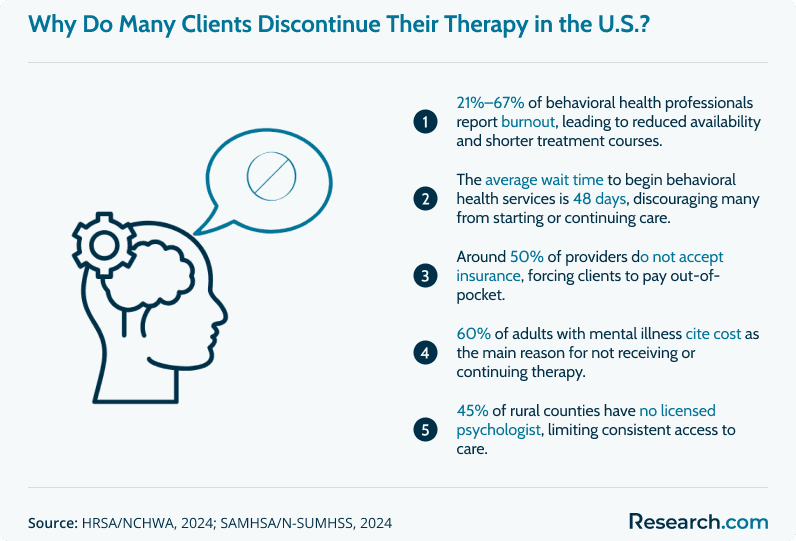
The infographic below highlights why many clients discontinue therapy before completion—factors like cost, insurance gaps, and provider burnout often determine how long people stay in treatment, regardless of their progress.
Who can benefit from cognitive therapy or behavioral therapy?
Cognitive and behavioral therapies are effective for a wide range of mental health conditions, but they serve slightly different purposes depending on whether a person’s problems are rooted in thoughts or behaviors. Cognitive therapy is most beneficial for people whose emotional struggles stem from negative self-talk, irrational beliefs, or chronic overthinking. It helps them challenge automatic thoughts and replace them with rational, balanced perspectives that improve emotional control and self-awareness.
People who benefit most from cognitive therapy include:
- Individuals with depression, anxiety, or panic disorders
- Those experiencing PTSD, guilt, or shame after trauma
- People with low self-esteem, perfectionism, or body image issues
- Clients with obsessive or intrusive thinking patterns
- Those with chronic stress or mood instability
People who benefit most from behavioral therapy include:
- Clients with phobias or avoidance-based anxiety
- Individuals managing OCD, tics, or compulsive habits
- Those with substance use or impulse control disorders
- Children and adults with ADHD or autism spectrum disorders
- Patients needing skills training or structured habit formation
For individuals pursuing counseling licensure, understanding what is the difference between NCE and NCMHCE helps clarify which credential aligns with their therapeutic focus—whether it’s broader counseling competence or clinical mental health specialization.
What are the limitations or challenges of cognitive therapy vs. behavioral therapy?
Cognitive and behavioral therapies both face limitations that affect how well clients respond to treatment. While they are highly effective in research settings, real-world challenges—such as client readiness, therapist availability, and systemic barriers—often determine success or dropout rates.
Limitations of Cognitive Therapy:
- Requires strong self-reflection and verbal communication skills, which not all clients possess.
- May not be suitable for severe mental illnesses or clients in acute crisis who struggle with concentration.
- Progress can take time, as it focuses on identifying and restructuring deep-seated thought patterns.
- Relies heavily on “homework” between sessions; lack of follow-through can slow results.
- Effectiveness depends on the therapist’s skill in guiding cognitive restructuring.
Limitations of Behavioral Therapy:
- Focuses mainly on external behaviors, sometimes overlooking deeper emotional or cognitive roots.
- Exposure-based methods can be stressful or overwhelming without careful supervision.
- Relapse is possible if new behaviors aren’t maintained long-term.
- Requires frequent practice and consistency, which can be hard for clients with low motivation.
- Limited access to trained behavioral therapists in some regions restricts care availability.
The chart below illustrates the population-to-provider ratio for key mental health professions. It shows that even where therapies are effective, accessibility remains uneven—especially for psychiatrists and psychologists, who each serve thousands of people nationwide. These access gaps mirror broader educational disparities, similar to what’s observed when comparing difference between for profit and nonprofit colleges, where institutional resources and outcomes can vary dramatically depending on structure and funding.
How have cognitive and behavioral therapies evolved recently?
Cognitive and behavioral therapies have evolved significantly over the past decade, adapting to new technologies, diverse populations, and emerging mental health challenges. Modern approaches now emphasize accessibility, personalization, and integration with digital tools. For example, recent studies show that telehealth-based Cognitive Behavioral Therapy (CBT) produces outcomes comparable to in-person treatment for anxiety, depression, and PTSD. This shift has made therapy more reachable, particularly for people in rural or underserved communities. Digital tools, such as mobile CBT apps and AI-assisted journaling platforms, are now used to reinforce therapeutic exercises between sessions.
Another key evolution is the blending of cognitive and behavioral frameworks with mindfulness, trauma-informed care, and neurobiological insights. Therapists increasingly focus on whole-person treatment, recognizing the connection between thoughts, emotions, and physiology. Training standards have also evolved to include competencies for online practice—outlined in updated requirements to be an online therapist—reflecting the growing normalization of remote mental health care.
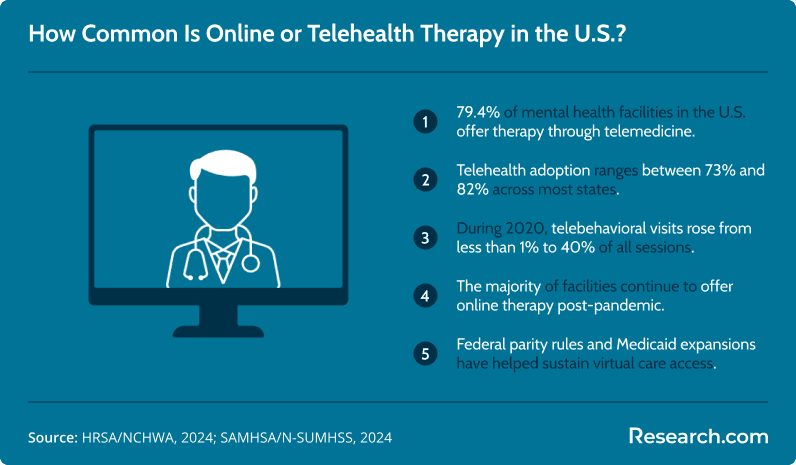
The infographic below illustrates how telehealth now dominates therapy delivery in the U.S., showing how virtual and hybrid models have become essential to sustaining nationwide access to cognitive and behavioral treatment.
What Are the Best Certification and Training Options for Cognitive and Behavioral Therapists?
Comprehensive education and specialized certification play pivotal roles in shaping effective therapeutic practice. Prospective professionals should assess programs that offer a balanced mix of academic rigor, supervised clinical experience, and continuous professional development. Evaluating factors such as accreditation standards, course content relevance, and cost-efficiency is crucial before committing to a program. For instance, comparing options like the cheapest online BCBA masters programs can help ensure that both theoretical knowledge and practical skills are adequately addressed.
Here's What Graduates Have to Say About Their Cognitive Therapy and Behavioral Therapy Practice
- Marielle: "Transitioning my cognitive therapy sessions online was easier than expected. The digital tools actually made it simpler to track clients’ progress and share worksheets instantly. It’s rewarding to see clients challenge their thoughts and gain confidence, even through a screen. The flexibility has allowed me to serve more people nationwide. "
- Ronan: "Working as a behavioral therapist online taught me how structured interventions still thrive in virtual settings. I guide exposure sessions, habit tracking, and reinforcement programs all remotely. Watching clients conquer phobias or break destructive habits without leaving their homes proves therapy doesn’t lose impact when it goes digital. "
- Selene: "What I love most about online therapy is how accessible it’s made mental health care. Clients who once couldn’t attend due to distance or stigma now log in weekly. Whether applying CBT or behavior modification, I’m part of something that’s reshaping how people heal. "
Key Findings
- Cognitive therapy focuses on changing distorted thoughts, while behavioral therapy targets observable actions and habits.
- 79.4% of U.S. mental health facilities now offer teletherapy services, making both approaches more accessible.
- Up to 67% of behavioral health professionals report burnout, affecting therapy availability.
- The average wait time to start therapy is 48 days, and 60% of adults cite cost as a key barrier.
- Behavioral therapy shows faster results for phobias and addictions; cognitive therapy is more effective for depression and anxiety.
- Psychologists, social workers, and counselors form the largest share of the behavioral health workforce, totaling over 770,000 professionals nationwide.
References:
- American Psychological Association (APA). Cognitive Behavioral Therapy: Treatments for PTSD.
- American Psychological Association (APA). Telehealth Evolution: How Virtual Care Reshaped Psychology (2024).
- Association of State and Provincial Psychology Boards (ASPPB). Doctoral Report Publication (2025).
- Association of State and Provincial Psychology Boards (ASPPB). Doctoral Report (2024).
- Health Resources and Services Administration (HRSA). State of the Behavioral Health Workforce Report (2024).
- Health Resources and Services Administration (HRSA). State of the Health Workforce Report (2024).
- Health Resources and Services Administration (HRSA). State of the Maternal Health Workforce Report (2024).
- Health Resources and Services Administration (HRSA). State of the Primary Care Workforce Report (2024).
- National Center for Biotechnology Information (NCBI). Digital Delivery of Cognitive Behavioral Therapy: Outcomes and Effectiveness.
- National Institute of Mental Health (NIMH). Psychotherapies: An Overview.
- Substance Abuse and Mental Health Services Administration (SAMHSA). 2024 N-SUMHSS Annual Detailed Tables.
- Substance Abuse and Mental Health Services Administration (SAMHSA). 2024 N-SUMHSS Annual Report.
- Substance Abuse and Mental Health Services Administration (SAMHSA). 2024 N-SUMHSS Companion Report.
- Substance Abuse and Mental Health Services Administration (SAMHSA). 2024 N-SUMHSS State Profiles.
Other Things You Should Know About the Differences Between Cognitive Therapy vs. Behavioral Therapy
In 2027, cognitive therapy emphasizes modifying dysfunctional thoughts to influence emotions and behaviors. Behavioral therapy focuses more on changing specific behaviors through conditioning techniques. Both aim to improve mental health but use different techniques to achieve this.
Yes, cognitive therapy and behavioral therapy can be effectively combined into Cognitive Behavioral Therapy (CBT) in 2027. This approach uses cognitive techniques to challenge thoughts and behavioral strategies to reinforce positive actions, offering a comprehensive treatment addressing both thoughts and behaviors.
In 2027, it's common for therapists to specialize in both cognitive and behavioral therapies. Many graduate programs offer integrated training in CBT (Cognitive Behavioral Therapy) as the field values a combined approach for addressing various mental health issues effectively.


