
World Online Ranking of Best Chemistry Scientists – 2024 Report

Co-Founder and Chief Data Scientist
Research.com published its third annual ranking of leading chemistry scientists on April 19, 2024. This guide explains what the ranking measures, which countries and institutions are most represented, who leads the field by D-index, and how readers can use the report to identify influential researchers, research hubs, and emerging chemistry priorities.
The article is designed for researchers, graduate students, university leaders, science policymakers, industry partners, and prospective students who want a clearer view of where high-impact chemistry research is concentrated. It also explains how education access, research collaboration, online learning, financial aid, and industry partnerships can shape the next generation of chemistry scientists.
Quick answer: What does the 2024 chemistry scientists ranking show?
The 2024 Research.com chemistry scientist ranking highlights researchers with strong publication records, citation impact, field-specific contributions, and recognized achievements. The United States has the largest representation, with 443 scientists, equal to 44.3% of the full report. The Chinese Academy of Sciences is the most represented institution, with 31 scientists. Michael Gratzel of École Polytechnique Fédérale de Lausanne, Switzerland, ranks first globally with a D-index of 281.
The ranking was built from more than 15,700 scientist profiles reviewed through Google Scholar and Microsoft Academic Graph. To be considered, researchers needed a D-index of at least 40, and most of their scholarly output had to be in chemistry.
How to use this chemistry ranking
This ranking is most useful when treated as a research-discovery tool rather than a simple leaderboard. A high position can indicate sustained influence, but readers should also consider a scientist’s specialization, institutional environment, collaboration network, and relevance to a specific research question.
| Reader goal | How the ranking can help | What to check before making a decision |
| Find potential collaborators | Identify researchers with strong chemistry publication and citation records. | Review recent papers, active grants, laboratory focus, and openness to collaboration. |
| Choose a graduate research direction | See which chemistry subfields and institutions are associated with highly cited scholars. | Compare advisor fit, funding availability, lab culture, and publication expectations. |
| Benchmark institutional research strength | Compare countries and institutions by the number of leading chemistry scientists included. | Look beyond counts and evaluate research facilities, doctoral outcomes, and field-specific strengths. |
| Understand global chemistry leadership | Track where leading chemistry researchers are affiliated across regions. | Remember that country assignment reflects institutional affiliation in MAG, not nationality. |
Latest discoveries in chemistry research
Chemistry research continues to move in two important directions: deeper theoretical understanding and more practical solutions for materials, energy, sustainability, and manufacturing. In 2023, researchers reported the first synthesis of a hexazine molecule, a nitrogen-based structure that could open new questions in materials chemistry. Other work showed that liquid metals such as gallium can act as lower-temperature catalysts, which may reduce the energy and cost demands of catalyst production.
Sustainability-focused chemistry also advanced. Researchers developed catalysts intended to reduce the environmental burden of fertilizer production, while other work examined how waste from the pulp and paper industry could be used to sequester carbon emissions. These examples show why chemistry remains central to climate, materials, food production, and industrial innovation.
The key findings for the 3rd edition of the best chemistry scientists ranking
- Scientists affiliated with institutions in the United States account for the largest share of the 2024 ranking. The U.S. has 443 scientists in the report, representing 44.3% of all listed researchers.
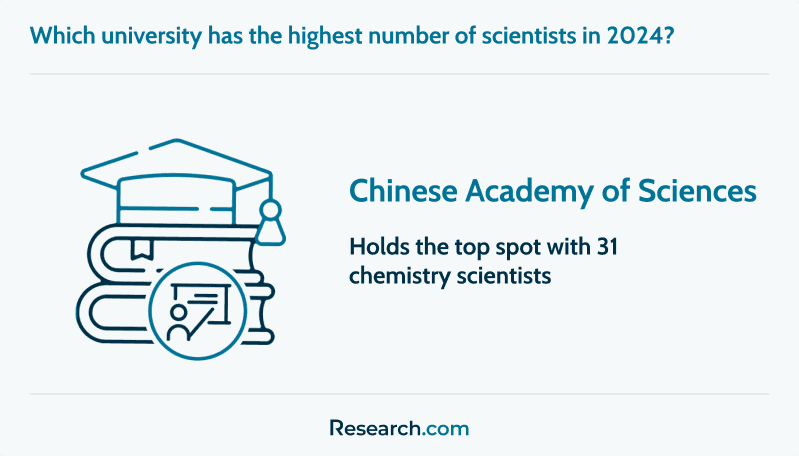
- The Chinese Academy of Sciences ranks as the leading institution by representation, with 31 scientists included in the 2024 report.
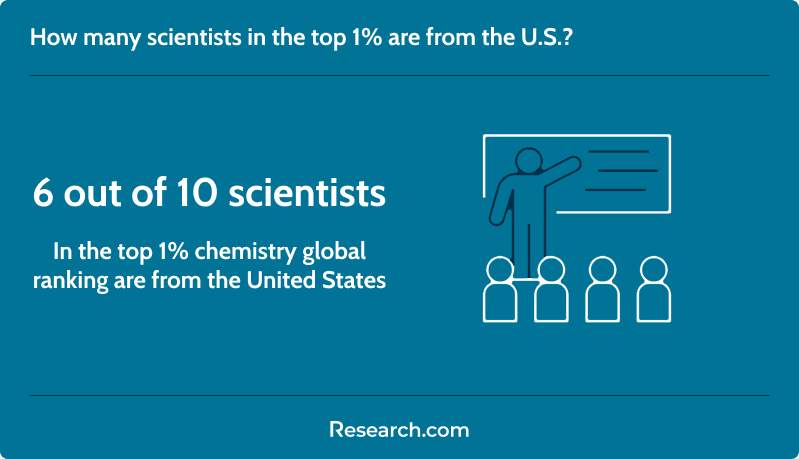
- Among the top 1% of scientists, 7 out of 10 are affiliated with institutions in the United States. Germany, Switzerland, and Denmark are also represented in the top 10.
- Michael Gratzel from École Polytechnique Fédérale de Lausanne, Switzerland, holds the top global position in 2024 with a D-index of 281.
- The top 1% of scientists have an average D-index of 214, compared with an average of 116 across all scientists included in the ranking.
The complete 2024 chemistry scientist list is available here:
Best Chemistry Scientists Ranking
What the ranking measures
The 2024 ranking evaluates chemistry researchers using indicators that reflect scholarly influence and field contribution. Research.com reviewed more than 15,700 scientist profiles in Google Scholar and Microsoft Academic Graph. The analysis considered D-index, publication volume, awards, achievements, and related indicators. Scientists were eligible if they had a D-index of at least 40 and if most of their publications were in chemistry.
The D-index is especially useful because it focuses on disciplinary impact rather than general academic visibility. However, no ranking can capture every important dimension of scientific work. Early-career influence, mentoring quality, open-science contributions, teaching, and emerging interdisciplinary work may not always be fully reflected in citation-based measures.
| Ranking element | What it helps indicate | Important limitation |
| D-index | Field-specific research influence within chemistry. | Citation patterns differ across chemistry subfields and career stages. |
| Publications | Research productivity and scholarly output. | More publications do not automatically mean stronger quality or broader impact. |
| Awards and achievements | Recognition from scientific communities and institutions. | Awards may favor established researchers and highly visible institutions. |
| Institutional affiliation | Where leading chemistry researchers are currently connected. | Affiliation does not indicate nationality and may change over time. |
How Can Accessible Online Degree Programs Empower Future Chemistry Scientists?
Online degree options can support future chemistry researchers when they provide rigorous coursework, qualified faculty, research exposure, and credible institutional recognition. For students who cannot relocate or pause work, flexible programs may help them build foundations in data analysis, laboratory theory, scientific communication, and specialized chemistry topics.
Online study is not a substitute for all laboratory-intensive training, so students should examine whether a program includes in-person labs, research placements, simulation tools, or partnerships with local institutions. Readers comparing flexible graduate options can also review the easiest online masters degree guide, while keeping in mind that “easiest” should never be the only selection factor for a research-focused career.
How Can Remote Work Opportunities Drive Innovation in Chemistry Research?
Remote and hybrid research practices are changing how chemistry teams collaborate. Computational chemistry, literature review, data modeling, manuscript preparation, instrument-data analysis, and international project coordination can often be completed away from a physical laboratory. This can widen participation and help researchers work across time zones and institutions.
At the same time, wet-lab chemistry still requires controlled facilities, safety protocols, specialized equipment, and hands-on technical skill. Professionals preparing for remote-friendly scientific work should build strengths in digital collaboration, research data management, scientific software, and reproducible documentation. Readers interested in broader remote-oriented education paths can compare the best degrees for remote work.
How Can Affordable Advanced Degrees Propel Chemistry Research Careers?
Graduate education can be important for chemistry research careers, but cost affects who can enter and persist in advanced study. Affordable programs may reduce the financial pressure on students who need specialized training in analytical chemistry, materials chemistry, organic chemistry, physical chemistry, environmental chemistry, or interdisciplinary research methods.
Before choosing a lower-cost option, students should verify accreditation, faculty expertise, research access, laboratory requirements, transfer policies, and career support. A cheaper program is only a good value if it supports the student’s actual goal. Prospective graduate students can compare cost-conscious options through this guide to a cheap master degree online.
How Can Financial Aid Enhance Access to Quality Chemistry Education?
Financial aid can make chemistry education more accessible by helping students cover tuition, fees, materials, living costs, and required academic expenses. Scholarships, grants, institutional aid, assistantships, and federal aid can be especially important for students pursuing research-heavy programs that may limit full-time employment.
Students should compare the total cost of attendance, not only advertised tuition. They should also ask whether aid is renewable, whether assistantships include tuition remission, and whether online students qualify for the same support as campus students. Those exploring aid-eligible online options can review online colleges that accept FAFSA in California as part of a broader affordability search.
What Is the Impact of Accelerated Doctoral Programs on Chemistry Research?
Accelerated doctoral formats can appeal to students who already have a clear research agenda, strong academic preparation, and the time to handle an intensive schedule. In chemistry, however, doctoral quality depends heavily on mentorship, lab access, research depth, publication opportunities, and safety training. Speed should not come at the expense of research rigor.
Students considering faster doctoral routes should ask how dissertation supervision works, whether the program supports experimental or computational chemistry, and what research infrastructure is available. Flexible options such as a PhD program online may be useful for some fields and professional goals, but chemistry students should confirm whether the format matches their research specialization.
Countries with the highest number of leading chemistry scientists
The United States leads the 2024 chemistry ranking by country affiliation, with 443 scientists. It also held the top position in the prior report.
China ranks second in this year’s report, with 130 scientists affiliated with Chinese universities and research institutions, compared with 117 scientists in 2023.
Germany, Japan, and the United Kingdom follow with 74 scientists, 52 scientists, and 49 scientists, respectively.
Other countries with notable representation include Australia with 27 scientists, the Netherlands with 23 scientists, Canada with 21 scientists, Italy with 19 scientists, and South Korea with 17 scientists.
The country shown for each scientist is based on the affiliated research institution listed in MAG. It should not be interpreted as the scientist’s nationality.
| Country | Number of leading chemistry scientists |
| United States | 443 |
| China | 130 |
| Germany | 74 |
| Japan | 52 |
| United Kingdom | 49 |
| Australia | 27 |
| Netherlands | 23 |
| Canada | 21 |
| Italy | 19 |
| South Korea | 17 |
Institutions with the highest number of leading scientists
The Chinese Academy of Sciences has the strongest institutional representation in the 2024 chemistry report, with 31 ranked scientists.
The University of California, Berkeley is second with 27 scientists, which is two fewer than in the prior year. Stanford University follows with 20 scientists in 2024.
Northwestern University places fourth with 18 scientists. The Max Planck Society, a major research organization rather than a university, ranks fifth with 16 scientists.
Additional highly represented institutions include The University of Texas at Austin with 13 scientists, the University of Tokyo with 13 scientists, Harvard University with 12 scientists, California Institute of Technology with 12 scientists, and MIT with 12 scientists.
| Institution | Number of scientists in the 2024 ranking |
| Chinese Academy of Sciences | 31 |
| University of California, Berkeley | 27 |
| Stanford University | 20 |
| Northwestern University | 18 |
| Max Planck Society | 16 |
| The University of Texas at Austin | 13 |
| University of Tokyo | 13 |
| Harvard University | 12 |
| California Institute of Technology | 12 |
| MIT | 12 |
How Can Interdisciplinary Collaboration Between Chemistry and Pharmacy Drive Innovation?
Chemistry and pharmacy often overlap in drug discovery, formulation science, toxicology, molecular design, analytical testing, and biomedical materials. When chemists and pharmacy researchers work together, they can connect molecular-level understanding with patient-centered applications and therapeutic development.
Interdisciplinary training can help researchers move between laboratory discovery and applied health challenges. Students interested in this intersection should compare curriculum depth, clinical or biomedical research exposure, faculty expertise, and laboratory access. Flexible pharmacy-related pathways, including pharmacy school online, may be relevant for some learners, but students should verify whether a program supports their intended licensure, research, or professional goal.
Strengthening research in online universities
Online universities can contribute to chemistry research when they build serious partnerships with research institutions, industry laboratories, and universities that have appropriate facilities. Their strengths may include flexible participation, geographically diverse student populations, digital collaboration systems, and scalable data-based research activities.
One model for broad collaboration is reflected by work connected with the University of Oxford, where online universities and research organizations participate across different research themes. Such arrangements can help students engage with authentic scientific projects while learning from experienced chemists. The strongest models combine access with research quality, rather than treating online delivery as a shortcut.
How Do Industry Partnerships Drive Chemistry Innovation?
Industry partnerships can help chemistry research move from laboratory insight to applied products, manufacturing processes, materials, diagnostics, sustainability tools, and commercial technologies. Companies may provide equipment, datasets, scale-up experience, regulatory insight, funding, and real-world problem definitions that academic labs may not have on their own.
For students and early-career researchers, industry-linked projects can build practical experience and improve understanding of how chemistry is used outside academia. Still, researchers should pay attention to publication rights, intellectual property terms, conflict-of-interest policies, and whether the partnership supports open scientific inquiry. Students comparing broad career preparation options can also review Research.com’s guide to the most useful degrees.
D-index ranking leaders, averages, and distribution
Professor Michael Gratzel of École Polytechnique Fédérale de Lausanne, Switzerland, is the highest-ranked chemistry scientist in Europe and also ranks first globally with a D-index of 281.
Professor George M. Whitesides of Harvard University, United States, leads North America. He is ranked 2nd in the report and has a D-index of 259.
Professor Ben Zhong Tang of the Chinese University of Hong Kong, Shenzhen, China, is the leading chemistry scientist in Asia. His D-index is 179, and he ranks 18th overall.
Professor Shaobin Wang of the University of Adelaide, Australia, is the top-ranked chemistry scientist in Oceania. His D-index is 155, and he ranks 62nd in the top 1000 list.
Professor Mika Sillanpää of the University of Johannesburg, South Africa, leads Africa in chemistry, with a D-index of 112.
The top 1% of scientists have an average D-index of 214, while the full group of ranked scientists has an average D-index of 116.
The lowest D-index among scholars included in the 2024 ranking is 97.
The top 1% of scientists in the ranking have an average of 1379.6 published articles, compared with 694.75 across all ranked scholars.
The top 1% have an average citation count of 205,404.1, compared with 57,402.47 for all scholars in the ranking.
| Region or group | Leading scientist or metric | D-index or value |
| Europe | Michael Gratzel | 281 |
| North America | George M. Whitesides | 259 |
| Asia | Ben Zhong Tang | 179 |
| Oceania | Shaobin Wang | 155 |
| Africa | Mika Sillanpää | 112 |
| Average D-index for the top 1% | Ranking metric | 214 |
| Average D-index for all ranked scientists | Ranking metric | 116 |
| Lowest D-index included in 2024 | Ranking threshold within the published list | 97 |
Common mistakes when interpreting scientist rankings
- Using rank alone to choose an advisor or collaborator. A scientist’s position is useful, but research fit, mentoring style, availability, and current projects matter just as much.
- Assuming institutional counts equal program quality in every chemistry subfield. An institution may be strong overall while another school is better for a specific niche.
- Confusing affiliation with nationality. The report assigns country based on the affiliated research institution in MAG, not personal citizenship.
- Overlooking early-career researchers. Citation-based indicators often favor established scholars, so newer researchers may be doing influential work that has not yet accumulated long-term citation impact.
- Ignoring research infrastructure. Chemistry is equipment- and lab-intensive; facilities, funding, safety systems, and technical staff can shape research outcomes.
- Choosing an online or accelerated program without checking research requirements. Students should confirm accreditation, laboratory access, dissertation support, and whether the format fits their intended chemistry specialization.
Questions to ask before choosing a chemistry research path
- Which chemistry subfield best matches your research interests: organic, inorganic, analytical, physical, materials, computational, environmental, or interdisciplinary chemistry?
- Does the institution have faculty actively publishing in that area?
- Will you have access to the laboratory equipment, datasets, software, or fieldwork needed for your work?
- How are graduate students funded, mentored, and supported through publication?
- Does the program support collaboration with other departments, research centers, hospitals, companies, or government laboratories?
- If the program is online or hybrid, how are laboratory and research components handled?
- What are the program’s expectations for publications, teaching, comprehensive exams, and dissertation milestones?
- How does the total cost compare with available aid, assistantships, grants, and career outcomes?
Practical steps for aspiring chemistry scientists
- Start with a research question, not only a school name. Identify the problems, methods, and chemistry subfields that genuinely interest you.
- Map leading researchers and labs. Use rankings, recent journal articles, conference programs, and institutional profiles to identify active scholars.
- Read recent publications before contacting faculty. A strong inquiry should reference current work and explain how your interests fit.
- Compare funding and facilities. In chemistry, access to instruments, reagents, safety systems, and technical support can be decisive.
- Evaluate degree format carefully. Online and hybrid programs can be valuable, but research-intensive chemistry often requires hands-on components.
- Build quantitative and digital skills. Data analysis, modeling, coding, laboratory informatics, and research documentation are increasingly useful across chemistry fields.
- Look for interdisciplinary opportunities. Chemistry increasingly intersects with energy, climate science, pharmacy, materials science, engineering, biotechnology, and data science.
You can learn more about the methodology used to create this report here.
All research was coordinated by Imed Bouchrika, Ph.D., a computer scientist with an established record of collaboration on international research projects across the academic community. His role was to ensure that the data remained unbiased, accurate, and up-to-date.
Research.com is a research portal for science and educational rankings. Its mission is to help professors, research fellows, and students advance their work and identify leading experts across scientific disciplines. Research.com also helps students compare colleges, academic pathways, and career options.
Key Insights
- The 2024 chemistry ranking is led by Michael Gratzel of École Polytechnique Fédérale de Lausanne, Switzerland, with a D-index of 281.
- The United States has the largest national representation, with 443 scientists, or 44.3% of the full report.
- The Chinese Academy of Sciences is the most represented institution, with 31 chemistry scientists included.
- The top 1% of ranked chemistry scientists have an average D-index of 214, far above the average of 116 for all scientists in the ranking.
- Rankings are useful for discovering influential researchers and institutions, but they should be combined with field fit, recent publications, facilities, mentorship quality, and funding information.
- Future chemistry researchers should evaluate online, affordable, accelerated, and interdisciplinary programs carefully, especially when laboratory access and research supervision are essential.


