
World Online Ranking of Best Biology and Biochemistry Scientists – 2025 Report

Co-Founder and Chief Data Scientist
On May 29, 2025, Research.com released its fourth annual report, celebrating the top scientists in these fields. Our goal is to boost the online visibility of these researchers and academics by highlighting their latest scientific breakthroughs.
This report also helps students, businesses, government agencies, and other organizations find and collaborate with scientists on their projects. The list of highly-ranked scientists provides crucial insights into ongoing research, fostering partnerships and significant advancements in biology and biochemistry.
For our 2025 report, our research team analyzed nearly 18,000 scientist profiles using cutting-edge tools. We gathered data from OpenAlex, CrossRef, and other reliable databases. We also established rigorous inclusion criteria, evaluating each scientist's published work, awards, and career milestones in biology and biochemistry.
Latest Discoveries in Biology and Biochemistry Research
The fields of biology and biochemistry have seen remarkable progress from 2024 to 2025, driven by breakthroughs in gene editing, artificial intelligence, and our understanding of fundamental biological processes. A major highlight is the rapid expansion of the CRISPR therapeutics pipeline, which is successfully translating gene editing technologies from laboratories into clinical applications. The FDA approval of Casgevy, the first CRISPR-Cas9-based therapy, marked a significant milestone, with new CRISPR variations like base editing, prime editing, and epigenetic modulation now in trials for a range of conditions, including cancer, genetic disorders, viral infections, and autoimmune diseases. These advancements represent a pivotal shift towards potentially curative treatments rather than just symptom management.
Significant strides have also been made in protein science, heavily influenced by artificial intelligence (AI). The 2024 Nobel Prize in Chemistry recognized pioneering work in computational protein design by David Baker and AI-driven protein structure prediction by Demis Hassabis and John Jumper (Google DeepMind). Their development of AlphaFold, culminating in AlphaFold3 in 2024, has revolutionized structural biology by accurately predicting protein structures, including their complexes with DNA, RNA, and small molecules, and accounting for post-translational modifications.
These tools are now enabling the design of novel pharmaceuticals, vaccines, and nanomaterials, and providing researchers with accurate models for millions of proteins. Complementing this, a new deep learning method can automatically identify transition states in protein conformational changes, enhancing our understanding of protein function and drug interactions crucial for drug discovery and cellular processes.
The Key Findings for the 4th Edition of the Best Biology and Biochemistry Scientists Ranking
- Scholars from the United States lead our list of top scientists. Out of the 1,000 most prominent scientists, 620 have affiliations with institutions in the U.S..
- The United States is home to 8 of the top 10 scientists, with the remaining two being from France and Germany.
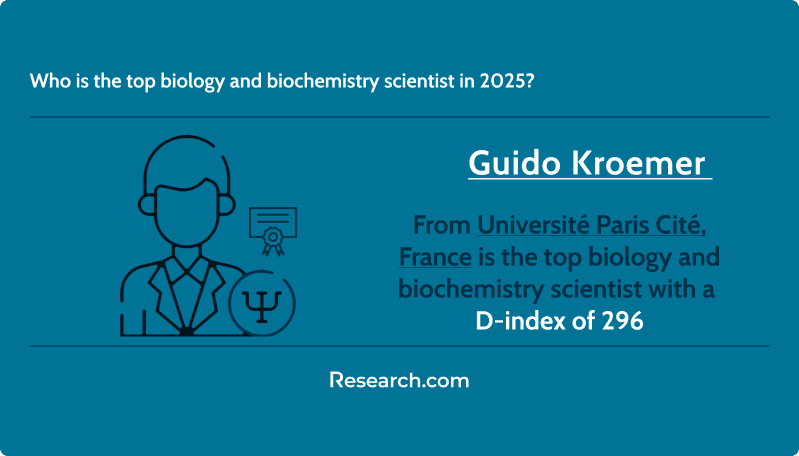
- Guido Kroemer from Université Paris Cité, France, retains his number one position from last year's report with a D-index of 296.
- Harvard University continues to hold the highest position in the 2025 list of institutions with the greatest concentration of ranked scientists. The university has a total of 60 scholars among the top 1,000 list.
- The average D-index for the top 1% of scientists is 255.3, against an average of 131.87 for all 1,000 scientists included in the ranking.
The full ranking for the 2025 list of the best biology and biochemistry scientists can be found here:
BEST BIOLOGY & BIOCHEMISTRY SCIENTISTS RANKING
Countries With the Highest Number of Leading Biology and Biochemistry Scientists
The United States continues to dominate in the number of top biology and biochemistry scientists, with 620 scientists featured in our 2025 report. While still the clear leader, this represents a slight decline from 2024, when 629 U.S.-based scientists were included. Despite the decrease, the U.S. maintains its unmatched influence, and it still accounts for 8 of the top 1% of global scientists—unchanged from last year.
Germany remains in second place, although its total dropped from 70 scientists in 2024 to 65 in 2025. Similarly, Japan and the United Kingdom saw marginal changes—Japan decreased by one (from 54 to 53), while the U.K. increased slightly, from 55 to 56 scientists. Australia held steady at 24 scientists, maintaining its position in the top five for the third consecutive year.
Canada continues to build momentum. After moving into sixth place last year, it holds that spot again with 22 scientists—stable from 2024. Switzerland (20), Sweden (19), and France (18) also maintain their ranks with no changes in headcount.
China, which saw a notable drop from sixth to tenth in 2024, holds its tenth-place position in 2025 with 18 scientists—up by one from last year but still behind its earlier standing. The stability in its rank suggests a pause in the downward trend but not yet a reversal.
Notably, the top 1% of scientists remains largely unchanged, with 8 still based in the U.S., and one each in France and Germany.
Please note that the country associated with a scientist is based on their affiliated research institution according to MAG, not on their actual nationality.
Institutions With the Highest Number of Leading Scientists
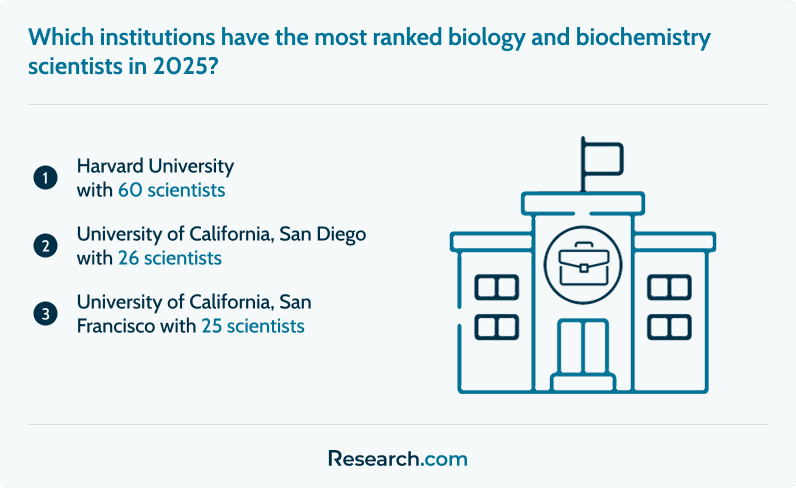
Harvard University leads the way with the most top-ranked biologists and biochemists. Our 2025 index includes 60 scientists affiliated with the university. However, there's a notable decrease in its number of ranked scientists from 66 in 2024 to 60 in 2025. This is a considerable drop of 6 scientists.
Following Harvard, the University of California, San Diego, ranks second with 26 scientists. The University of California, San Francisco, has 25 scientists, which is a significant drop from 30 scientists in 2024.
The National Institutes of Health boasts 23. Stanford University includes 22 scientists, and the University of Texas Southwestern Medical Center has 19.
Other institutions making the top 10 are Scripps Research Institute (19 scientists), Max Planck Society (18), the University of Washington (16), and the University of Pennsylvania (15).
American universities and institutions dominate the top 20 list, making up 85% of the leading institutions. The remaining 15% include institutions from Germany (Max Planck Society), Belgium (KU Leuven), and Japan (University of Tokyo). These non-U.S. institutions largely maintained their presence in the top list, with only a slight dip for Max Planck from 7th place last year to 8th in 2025.
Strengthening Research Through Online Universities
Online universities strengthen research by providing flexible, accessible education that enables a broader and more diverse group of students and professionals to participate in scientific inquiry and innovation. These programs foster critical thinking, problem-solving, and technical skills while offering opportunities for collaboration and virtual networking across geographic boundaries.
Research-intensive online environments also prepare students for graduate studies and professional advancement by teaching research methods, data analysis, and scientific communication, ultimately contributing to a more skilled and innovative scientific workforce.
D-Index Ranking - Leaders, Averages, and Distribution
For Europe, Professor Guido Kroemer from Université Paris Cité, France, is ranked first in the region. He is also the top scientist in the world, with a D-index of 296.
For North America, Professor Solomon H. Snyder from Johns Hopkins University School of Medicine, United States, ranks 1st in the region and 2nd in our report. Professor Snyder has a D-index of 279.
For Oceania, Professor Robert G. Parton from the University of Queensland Australia is the leading scientist. He ranks 109 in our global ranking, with a D-index of 157.
Professor Barry Halliwell from the National University of Singapore, Singapore, leads the top scholars in Asia and ranks 48th, with a D-index of 186.
The average D-index for the top 1% of the first 1,000 scientists in the ranking is 255.3, against an average of 131.87.
The average number of published articles for the top 1% of the first 1,000 scientists in the ranking is 1007.1, against an average of 539.68.
The average number of citations for the top 1% of the first 1,000 scientists is 296995.5, against an average of 76499.04.
You can learn more about the methodology used to create this report here.
About Research.com
All research was coordinated by Imed Bouchrika, Ph.D., a computer scientist with a well-established record of collaboration on a number of international research projects with different partners from the academic community. His role was to make sure all data remained unbiased, accurate, and up-to-date.
Research.com is the number one research portal for science and educational rankings. Our mission is to make it easier for professors, research fellows, and students to progress with their research and find the top experts in a wide range of scientific disciplines. Research.com is also a leading educational platform that helps students find the best colleges, academic opportunities.


