
2027 Best Online Bachelor's Degree in Organizational Leadership

Co-Founder and Chief Data Scientist
In 2023 alone, over 15,000 degrees in organizational leadership were awarded—highlighting the rising demand for professionals who can guide teams and manage change. For individuals looking to complete a bachelor’s degree while balancing work or personal responsibilities, an online program in organizational leadership offers a flexible path to a versatile career.
This article helps future leaders find the best online degree options and understand the opportunities that come with earning this credential.
What are the benefits of getting an online organizational leadership degree?
- Graduates can pursue leadership roles in human resources, operations, project management, consulting, and nonprofit administration.
- Professionals in organizational leadership-related roles earn an average annual salary of around $109,800, reflecting high demand across sectors.
- Online programs allow working adults and nontraditional students to complete coursework on their schedule while gaining practical skills in leadership, communication, and strategy.
What can I expect from an online organizational leadership degree?
An online bachelor’s degree in organizational leadership is designed to develop the strategic thinking and interpersonal skills needed to lead teams, manage organizational change, and align business goals with human performance. These programs often blend coursework in leadership theory, business ethics, communication, and organizational behavior. Students may also gain hands-on experience through internships or capstone projects, even in online formats.
Many programs cater to adult learners or working professionals, offering asynchronous classes that support flexible scheduling. Whether you’re aiming to move into a management role or transition into a new field, this degree offers a strong foundation in leadership principles applicable across industries.
Where can I work with an organizational leadership degree?
Graduates with an organizational leadership degree are found across a wide range of sectors. Many work in corporate environments such as business services, finance, healthcare, and technology—where skilled managers and team leaders are essential to daily operations. Others thrive in government agencies, education institutions, or nonprofit organizations where they coordinate teams, manage programs, and guide organizational growth.
This degree is particularly valuable in companies that emphasize change management, strategic planning, and employee development. Roles can range from HR management and training coordination to operations leadership and project supervision. Regardless of industry, employers value professionals who understand how to motivate teams, implement policies, and align people with organizational goals.
How much can I make with an organizational leadership degree?
Earning potential for organizational leadership graduates varies by industry, experience, and job title, but overall, the outlook is strong. According to labor market data, the average salary for roles related to this degree is approximately $109,800 per year. Entry-level positions such as HR specialists or training coordinators may start around $50,000–$60,000 annually, while more advanced roles in operations, consulting, or executive leadership can exceed $120,000.
Management-level positions like human resources managers, operations directors, and organizational development consultants often command six-figure salaries. Professionals in top-performing industries—such as tech, healthcare administration, and financial services—tend to earn higher wages, especially with experience or graduate credentials. An online degree equips graduates with marketable leadership skills, making them strong candidates for promotions and salary growth.
- List of the Best Online Bachelor's Degrees in Organizational Leadership for 2027 List of Programs
- How long does it take to complete an online organizational leadership degree? Completion Time
- How does an online organizational leadership degree compare to an on-campus program? Online vs. Traditional
- What is the average cost of an online organizational leadership degree? Cost
- What are the financial aid options for students enrolling in an online organizational leadership degree? Financial Aid
- What are the prerequisites for enrolling in an online organizational leadership degree? Prerequisites
- What courses are typically in an online organizational leadership degree? What courses are typically in an online organizational leadership degree?
- What types of specializations are available in an online organizational leadership degree? What types of specializations are available in an online organizational leadership degree?
- How do you choose the best online bachelor’s degree in organizational leadership? How do you choose the best online bachelor’s degree in organizational leadership?
- What career paths are available for graduates of online organizational leadership degree programs? Career Paths
- What is the job market like for graduates of an online organizational leadership degree? Job Outlook
- How can I build a strong professional network through an online organizational leadership degree? How can I build a strong professional network through an online organizational leadership degree?
- What challenges might I encounter during my online organizational leadership degree program? What challenges might I encounter during my online organizational leadership degree program?
Best Online Bachelor’s Degrees in Organizational Leadership for 2027
Choosing an online bachelor’s degree in organizational leadership is usually a career decision, not just an academic one. Many students considering this major already work, supervise others, serve in the military, manage projects, or want to move from individual contributor roles into management. The right program should help you build practical leadership skills, earn a recognized credential, and keep school manageable alongside work and family responsibilities.
This guide explains how online organizational leadership bachelor’s programs work, what they cost, how long they take, which schools stand out, and how to compare your options. It also covers admissions requirements, common courses, specializations, career paths, labor market outlook, financial aid, and mistakes to avoid before enrolling.
If you are still comparing business-related undergraduate paths, you may also want to review adjacent fields such as online sports management bachelor’s programs, especially if you want leadership roles in athletics, recreation, or sports business.
Quick Answer: Is an Online Bachelor’s in Organizational Leadership Worth Considering?
An online bachelor’s degree in organizational leadership can be a strong fit for students who want a flexible management-focused degree that applies across industries. It is especially useful for working adults, transfer students, military learners, and professionals who want to qualify for supervisory, human resources, training, operations, nonprofit, or administrative roles.
The degree is not the best choice for every student. If your target career requires a specialized credential, such as accounting licensure, engineering preparation, clinical practice, or a highly technical IT role, a more specialized major may be a better fit. But for students seeking broad leadership, communication, decision-making, and organizational change skills, this degree can provide a practical route into management-oriented work.
How We Evaluated Online Organizational Leadership Bachelor’s Programs
A bachelor’s degree requires a major investment of time and money, so rankings should be used as a starting point rather than the only deciding factor. Research.com reviewed programs with attention to academic quality, affordability, online flexibility, program structure, student support, and available outcomes data.
To support a data-informed review, we considered information from the IPEDS database, Peterson’s database and its Distance Learning Licensed Data Set, College Scorecard, and the National Center for Education Statistics. Readers can learn more about Research.com’s evaluation process in the full methodology section.
Best Online Bachelor’s Degrees in Organizational Leadership: Program Snapshot
| School | Online Program | Credits Required | Cost per Credit | Accreditation |
| University of Arizona | Bachelor of Applied Science in Organizational Leadership and Regional Commerce | 120 | $500–$600 (In-State and Out-of-State) | Higher Learning Commission (HLC) |
| Trine University | BS in Organizational Leadership | 120 | $299 (In-State and Out-of-State) | HLC |
| National University | BS in Organizational Leadership | 180 quarter units | $370 per quarter unit (In-State and Out-of-State) | International Accreditation Council for Business Education (IACBE) |
| Arizona State University Digital Immersion | BA in Organizational Leadership | 120 | $634 (In-State and Out-of-State) | HLC |
| University of Massachusetts Global | BA in Organizational Leadership | 120 | $500 (In-State and Out-of-State) | WASC Senior College and University Commission |
| Western Kentucky University | BS in Organizational Leadership | 120 | $551 (In-State and Out-of-State) | Southern Association of Colleges and Schools Commission on Colleges (SACSCOC) |
| Charter Oak State College | Bachelor’s degree in Organizational Leadership | 120 | $329 (In-State and Out-of-State) | New England Commission of Higher Education (NECHE) |
| John Brown University | BS in Organizational Leadership | 120 | $315 (In-State and Out-of-State) | Accreditation Council for Business Schools and Programs (ACBSP) |
| Bellevue University | BS in Leadership | 127 | $449 (In-State and Out-of-State) | HLC |
| Samford University | BA in Organizational Leadership | 128 | $382 + $100 fee per online course (In-State and Out-of-State) | SACSCOC |
1. University of Arizona
The University of Arizona offers an online Bachelor of Applied Science in Organizational Leadership and Regional Commerce through the College of Applied Science and Technology. The program is built for students who want applied leadership training connected to areas such as HR, logistics, regional commerce, and corporate training. Coursework emphasizes entrepreneurship, leadership psychology, decision-making, and management practice. Students also complete a senior capstone and a mentoring workshop before graduation, making the degree especially relevant for learners who want to connect classroom concepts with workplace leadership challenges.
- Typical completion time: Four years
- Available focus: Emphasis in Organizational Leadership
- Cost per credit: $500–$600 (In-State and Out-of-State)
- Credits required: 120
- Accreditation: Higher Learning Commission (HLC)
2. Trine University
Trine University offers an online BS in Organizational Leadership for students seeking stronger skills in team leadership, problem-solving, operations, and strategic thinking. The curriculum is applicable to corporate and nonprofit environments, with coursework that may support roles involving project management, employee supervision, and facility oversight. Students can choose an industrial leadership concentration or pursue a fast-track option that combines the bachelor’s degree with a master’s in organizational leadership. The dual-degree pathway can be completed in just four years and saves more than $8,000 in tuition.
- Typical completion time: Four years or less with dual-degree pathway
- Available focus: Industrial Leadership
- Cost per credit: $299 (In-State and Out-of-State)
- Credits required: 120
- Accreditation: HLC
3. National University
National University delivers an online BS in Organizational Leadership with a flexible course structure designed for adults who want to move through classes efficiently. Students study leadership style, ethics, team behavior, workplace law, human resources, conflict resolution, and decision-making. The program ends with a leadership capstone, giving students the opportunity to apply what they have learned to a practical organizational issue. NU’s four-week classes may appeal to learners who prefer shorter course blocks and a faster academic rhythm.
- Typical completion time: Varies based on pace; accelerated format available
- Available focus: None specified
- Cost per credit: $370 per quarter unit (In-State and Out-of-State)
- Credits required: 180 quarter units
- Accreditation: International Accreditation Council for Business Education (IACBE)
4. Arizona State University Digital Immersion
Arizona State University offers its BA in Organizational Leadership through ASU Online. The program focuses on ethics, team behavior, behavioral leadership, resource allocation, and organizational effectiveness. Students learn from faculty with backgrounds in education, psychology, and leadership research, and they may choose an optional internship to gain professional experience. This program may fit students who want a broad leadership degree that can apply in public, private, nonprofit, and community-based organizations.
- Typical completion time: Four years
- Available focus: None specified
- Cost per credit: $634 (In-State and Out-of-State)
- Credits required: 120
- Accreditation: HLC
5. University of Massachusetts Global
The online BA in Organizational Leadership at UMass Global is designed for professionals who want to improve leadership, communication, business strategy, and organizational problem-solving skills. Students study areas such as marketing, finance, multicultural leadership, and team dynamics. The program offers options in Organizational Administration and Supply Chain Systems, allowing learners to align their degree with administrative or operations-oriented career goals. A senior capstone project helps students bring leadership theory into a practical setting.
- Typical completion time: Four years
- Available focuses: Organizational Administration, Supply Chain Systems
- Cost per credit: $500 (In-State and Out-of-State)
- Credits required: 120
- Accreditation: WASC Senior College and University Commission
6. Western Kentucky University
Western Kentucky University offers an online BS in Organizational Leadership through the School of Leadership and Professional Studies. The curriculum covers global leadership, ethics, coaching, and change management, with elective options that can include project management and healthcare systems leadership. Full-time students can complete the degree in four years, while part-time enrollment gives working adults more control over pacing. The program is broad enough to support leadership goals in business, government, nonprofit work, and healthcare-related settings.
- Typical completion time: Four years
- Available focus: None specified
- Cost per credit: $551 (In-State and Out-of-State)
- Credits required: 120
- Accreditation: Southern Association of Colleges and Schools Commission on Colleges (SACSCOC)
7. Charter Oak State College
Charter Oak State College offers a fully online bachelor’s degree in Organizational Leadership for adult students who want a career-oriented curriculum and flexible enrollment options. Courses cover workplace motivation, team management, diversity, and applied leadership. The school offers multiple start dates and allows credit for prior learning, which may help experienced students reduce time to completion. Learners interested in healthcare leadership may add an optional healthcare administration concentration.
- Typical completion time: Flexible; accelerated options available
- Available focus: Healthcare Administration (optional)
- Cost per credit: $329 (In-State and Out-of-State)
- Credits required: 120
- Accreditation: New England Commission of Higher Education (NECHE)
8. John Brown University
John Brown University offers an online BS in Organizational Leadership that combines leadership development, business ethics, critical thinking, and a Christian worldview. Students take courses in strategic management, research, coalition building, and organizational change. Those planning to continue into graduate business study can pursue an accelerated MBA pathway at JBU and complete both degrees in just five years. The program may appeal to students who want leadership preparation for business, nonprofit, or mission-driven organizations.
- Typical completion time: Four years (or five years with accelerated MBA)
- Available focus: None specified
- Cost per credit: $315 (In-State and Out-of-State)
- Credits required: 120
- Accreditation: Accreditation Council for Business Schools and Programs (ACBSP)
9. Bellevue University
Bellevue University offers a fully online BS in Leadership with coursework in interpersonal communication, ethics, leadership psychology, and applied problem-solving. The program does not require standardized test scores and may be attractive to adult learners because of its transfer policies, including the possibility of credit for military experience. Students can work with the university to build a learning plan that reflects prior education and career background. A leadership capstone gives learners a structured way to demonstrate applied leadership skills.
- Typical completion time: Varies based on transfer credit
- Available focus: None specified
- Cost per credit: $449 (In-State and Out-of-State)
- Credits required: 127
- Accreditation: HLC
10. Samford University
Samford University offers an online BA in Organizational Leadership through the Office of Professional Studies. The program is designed for adult learners and includes two enrollment pathways: one for students who already hold an associate degree and another for students beginning without prior college credit. Coursework blends ethics, human resources, technology, public administration, nonprofit leadership, and business foundations with a Christian liberal arts framework. Students also complete two Bible courses and dual senior capstones.
- Typical completion time: Varies depending on entry path
- Available tracks: Associate-degree transfer track; full degree path
- Cost per credit: $382 + $100 fee per online course (In-State and Out-of-State)
- Credits required: 128
- Accreditation: SACSCOC
How Long Does an Online Bachelor’s in Organizational Leadership Take?
Most full-time students can complete an online bachelor’s degree in organizational leadership in about three to four years. The exact timeline depends on course load, transfer credits, prior learning credit, military credit, program calendar, and whether the school offers accelerated terms.
Students who already have substantial college credit may finish faster. Some may consider an accelerated online bachelor’s degree in organizational leadership, which can often be completed in as little as 18 to 24 months. These programs are usually best for students who can handle a heavier academic pace and have strong time-management habits.
| Student Situation | Likely Timeline | Best Fit |
| First-time full-time student | Three to four years | Students who can take a steady course load each term |
| Transfer student with prior credits | Varies by accepted credits | Adults returning to college or students with an associate degree |
| Accelerated online learner | As little as 18 to 24 months | Motivated students who can manage intensive coursework |
| Part-time working student | Longer than four years | Students balancing school with full-time work, caregiving, or military service |
Online vs. Campus Organizational Leadership Programs: Which Format Fits You?
Online and campus-based organizational leadership programs often cover similar academic content, but the student experience can be very different. The better option depends on your schedule, learning style, need for in-person networking, and access to local campus resources.
| Factor | Online Program | Campus Program |
| Schedule | Often more flexible, especially when courses are asynchronous | Usually follows fixed class meeting times |
| Best for | Working adults, caregivers, military students, and learners outside commuting distance | Students who prefer in-person discussion, campus events, and face-to-face support |
| Curriculum | Often similar or identical to the campus curriculum at the same school | May include more in-person activities, presentations, or campus-based projects |
| Networking | Requires more intentional outreach through online discussions, group projects, alumni tools, and virtual events | Can make informal networking easier through campus activities and in-person faculty access |
| Career continuity | Often easier to maintain full-time employment while enrolled | May require commuting or schedule changes that are harder for working adults |
Flexibility and Convenience
Online programs are usually the more practical choice for students who cannot relocate, commute, or attend classes at set times. Asynchronous courses are especially useful because students can complete weekly work around job and family obligations. However, flexibility does not mean less work. Online students still need regular study time, reliable technology, and self-discipline.
Academic Quality
At many universities, online and campus students complete comparable coursework and may learn from the same faculty. Before enrolling, check whether the online program is housed within the same academic department as the campus version, whether faculty credentials are available, and whether online learners receive equal access to advising, tutoring, library resources, and career services.
Graduate Study Options
Students who plan to continue into advanced leadership or management roles may later consider a fast-track online master’s in organizational leadership. Choosing a bachelor’s program with strong transferability, regional accreditation, and graduate advising can make that transition smoother.
How Much Does an Online Organizational Leadership Bachelor’s Degree Cost?
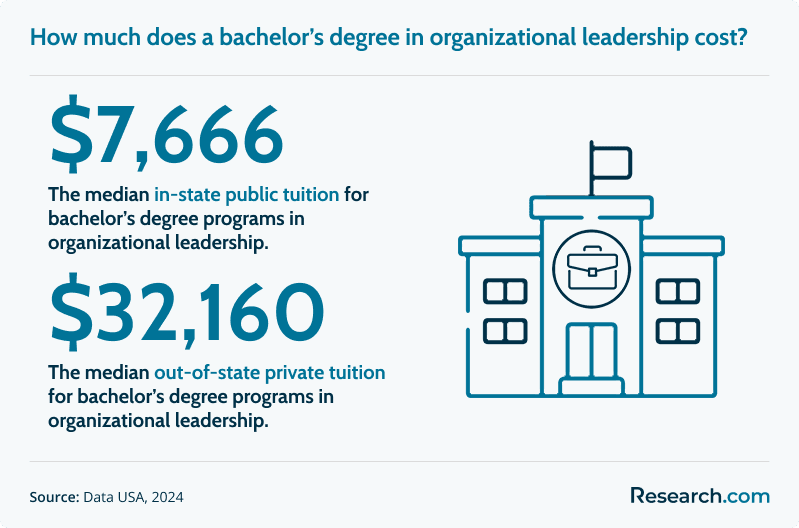
Tuition varies by school, student residency, transfer credits, fees, and whether the institution is public or private. According to Data USA, the median in-state tuition for public colleges is around $7,666 annually, while private out-of-state institutions charge a median of approximately $32,160.
Online students should look beyond the listed tuition rate. Technology fees, online course fees, books, digital learning materials, graduation fees, prior learning assessment fees, and transcript costs can affect the total price. Some online programs charge one flat rate for both in-state and out-of-state students, which can make private or out-of-state options more competitive than they appear at first glance.
The financial value of the degree depends on your current role, employer tuition support, transfer credits, and whether the program helps you move toward a specific management pathway. Students exploring the management value of this field can read more about the role of organizational leadership degrees in management careers.
Financial Aid Options for Online Organizational Leadership Students
Online bachelor’s students may qualify for many of the same financial aid options as campus students if they enroll in an eligible accredited institution. The most important first step is usually completing the FAFSA, because schools use it to determine eligibility for federal, state, and institutional aid.
- Federal and state grants: Need-based funds that generally do not need to be repaid.
- Scholarships: Awards based on merit, financial need, background, employer affiliation, military status, academic program, or professional goals.
- Work-study: Part-time employment opportunities for eligible students, depending on school participation and funding availability.
- Federal student loans: Borrowed funds that must be repaid; students should compare interest rates, repayment options, and total debt before accepting loans.
- Private loans: A possible option after federal aid, though terms vary by lender and may be less flexible.
- Employer tuition reimbursement: Some employers help pay for job-related degrees, especially for employees preparing for supervisory or management roles.
- Military and veteran education benefits: Eligible service members and veterans should ask schools how benefits apply to online programs.
If your leadership goals are more technical, compare degree-based financial aid with shorter credential options, such as online CompTIA Network+ training programs, before committing to a full bachelor’s degree.
Admissions Requirements for an Online Bachelor’s in Organizational Leadership
Admissions requirements differ by institution, but most online organizational leadership bachelor’s programs ask for basic undergraduate application materials. Transfer-friendly programs may also request college transcripts, military training records, or documentation for prior learning assessment.
- High school diploma or GED: Most bachelor’s programs require proof of secondary school completion.
- Official transcripts: Schools typically request high school transcripts and transcripts from any colleges previously attended.
- Minimum GPA: Many programs look for a GPA around 2.5 to 3.0, though some offer conditional admission.
- Standardized test scores: Some schools make ACT or SAT scores optional or waive them for adult and transfer students.
- Transfer credit evaluation: Students with prior college coursework should ask how many credits can apply toward the major, general education, and electives.
- Application materials: Some programs may require a personal statement, resume, or short essay explaining career goals.
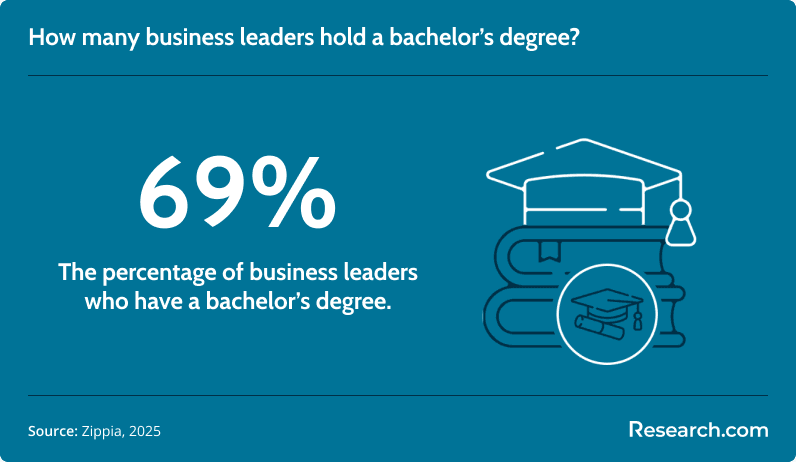
According to Zippia, 69% of business leaders hold a bachelor’s degree, making it the most common educational credential in the field. Master’s degrees and associate degrees follow at 19% and 7% respectively.
Students interested in mission-driven management may later consider an accelerated master’s degree in nonprofit management after completing a bachelor’s program.
Common Courses in an Online Organizational Leadership Degree
Organizational leadership programs combine management theory with practical skills in communication, decision-making, conflict resolution, ethics, and organizational change. Exact course titles vary, but most programs include a mix of leadership, business, and applied electives.
Leadership and Organizational Behavior
- Organizational Behavior
- Leadership Theory and Practice
- Conflict Resolution and Negotiation
- Strategic Planning and Change Management
- Team Dynamics
- Ethical Leadership
Business and Management Foundations
- Financial Accounting
- Marketing Principles
- Human Resource Management
- Business Ethics and Law
- Operations Management
- Decision-Making and Organizational Strategy
Applied and Career-Focused Coursework
- Nonprofit Leadership
- Diversity in the Workplace
- Project Management
- Training and Development
- Healthcare Systems Leadership
- Capstone Project or Senior Seminar
Students who want to lead projects should look for programs with coursework connected to planning, budgeting, stakeholder communication, and execution. For a closer look at that path, review what a project management specialist does.
Specializations in Online Organizational Leadership Programs
Some online organizational leadership degrees are generalist programs, while others let students add a concentration. A specialization can be helpful if you already know the kind of leadership role you want after graduation. In 2027, common employer-valued skills for business leaders include analytics, project management, customer engagement, strategic development, and operational improvement.
| Specialization | What It Emphasizes | Good Fit For |
| Project Management | Planning, scheduling, resource coordination, risk management, and cross-functional teamwork | Students who want to manage initiatives across departments |
| Business Analytics | Using data to evaluate performance, identify problems, and support decisions | Students interested in evidence-based leadership and operational reporting |
| Human Resource Leadership | Talent development, workplace culture, employee relations, and organizational policy | Students targeting HR, training, or people operations roles |
| Strategic Leadership and Business Development | Growth planning, innovation, competitive strategy, and long-term organizational direction | Students aiming for management, entrepreneurship, or executive-track roles |
| Operations and Continuous Improvement | Process improvement, performance metrics, efficiency, and systems thinking | Students interested in logistics, operations, quality improvement, or supply chain settings |
Students comparing career outcomes can explore common organizational leadership degree jobs and career paths before choosing a concentration.
How to Choose the Best Online Bachelor’s in Organizational Leadership
The best program is the one that fits your career goal, budget, schedule, and academic background. A highly ranked school may not be the right choice if it accepts few transfer credits, lacks your preferred concentration, or charges fees that push the total cost beyond your budget.
1. Confirm Accreditation First
Accreditation affects credit transfer, financial aid eligibility, employer recognition, and graduate school options. Start by checking whether the institution is accredited by an agency recognized through resources such as the Council for Higher Education Accreditation’s regional accrediting organizations.
2. Compare Total Cost, Not Just Tuition
Ask each school for an estimated total program cost based on your transfer credits. Include tuition, online course fees, technology fees, books, graduation fees, and any prior learning assessment charges.
3. Review Transfer and Prior Learning Policies
For adult learners, transfer credit can make the biggest difference in cost and completion time. Ask whether the school accepts community college credit, military training, professional certifications, workplace learning, or portfolio-based credit.
4. Match the Curriculum to Your Career Goal
If you want HR roles, look for human resources, training, employment law, and organizational culture courses. If you want operations roles, prioritize project management, supply chain, process improvement, and analytics. If you want nonprofit work, look for governance, fundraising, public administration, and community leadership coursework.
5. Evaluate Online Student Support
Strong online programs provide academic advising, library access, tutoring, writing support, career coaching, disability services, technical support, and faculty access. Do not assume online students receive the same services as campus students; ask directly.
6. Consider Whether You Need a Broader Business Credential
Some students may be better served by a business administration program, an MBA pathway, or a technical leadership credential. For example, students aiming for cybersecurity management may want to compare leadership degrees with online CCSP training options before deciding.
| Question to Ask | Why It Matters |
| How many of my prior credits will transfer? | Transfer credit can reduce both cost and time to graduation. |
| Is the program asynchronous, synchronous, or mixed? | The format determines how well classes fit your work schedule. |
| Are online students eligible for the same scholarships and services? | Support and aid access can affect persistence and affordability. |
| Does the curriculum include a capstone, internship, or applied project? | Applied work can help you demonstrate leadership skills to employers. |
| What career outcomes do graduates pursue? | Program alignment matters more than the degree title alone. |
Career Paths for Online Organizational Leadership Graduates
Organizational leadership is a flexible degree because it focuses on skills used across many workplaces: communication, decision-making, personnel management, change leadership, conflict resolution, and strategic planning. Graduates may pursue roles in business, government, healthcare, education administration, nonprofit organizations, startups, and corporate operations.
| Career Path | Typical Responsibilities | Helpful Program Preparation |
| Top Executives | Set organizational goals, guide operations, make strategic decisions, and oversee senior teams | Strategy, ethics, organizational change, finance, and decision-making |
| Human Resources Managers | Manage hiring, employee relations, benefits policies, compliance, and workforce planning | HR management, employment law, conflict resolution, diversity, and organizational culture |
| Training and Development Managers | Design learning programs, assess employee skill needs, and improve workforce performance | Adult learning, coaching, communication, assessment, and leadership development |
| Operations or Administrative Manager | Coordinate teams, improve processes, monitor performance, and support daily organizational functions | Operations management, project management, analytics, and continuous improvement |
| Nonprofit or Community Program Leader | Lead programs, coordinate staff and volunteers, manage stakeholder relationships, and support mission goals | Nonprofit leadership, public administration, ethics, budgeting, and communication |
Leadership training is also valuable in fast-growing niche sectors. Students interested in business roles within competitive gaming, for example, may compare this degree with online esports business degree programs.
Job Market Outlook for Organizational Leadership Graduates
The labor market for graduates depends on industry, location, experience, and the specific role pursued. Organizational leadership graduates are not limited to one occupation, which can be an advantage, but it also means students should build a focused resume through internships, projects, certifications, or relevant work experience.
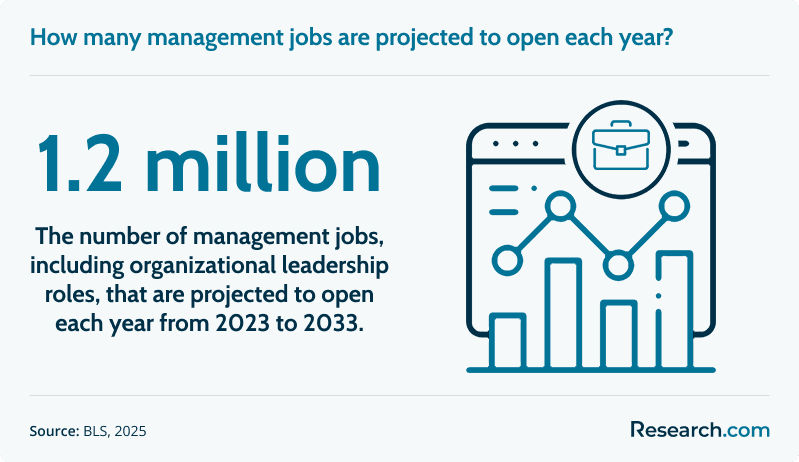
According to recent projections, employment in management occupations is expected to grow faster than the average for all job types between 2023 and 2033. An average of 1.2 million management job openings are projected each year during this decade. These openings are tied to business growth, replacement needs, retirements, and demand for managers who can guide teams through change.
Students should avoid assuming that a degree alone guarantees a management job. Employers often look for a combination of education, work history, communication skills, measurable results, and the ability to lead people through real workplace challenges.
How Online Students Can Build a Professional Network
Networking in an online program takes more effort than walking into a campus event, but it can still be effective. Online students should treat every discussion board, group project, faculty meeting, and virtual event as a professional connection point.
- Participate actively in live sessions and discussion boards: Thoughtful participation helps classmates and instructors remember your expertise.
- Use group projects strategically: Exchange contact information with reliable teammates and stay connected after the course ends.
- Attend virtual career fairs and alumni events: These events can connect you with employers and graduates already working in management roles.
- Ask faculty for career guidance: Instructors with leadership experience may help you identify relevant roles, certifications, or graduate pathways.
- Join professional communities: Look for associations or online groups connected to HR, project management, operations, nonprofit leadership, or your target industry.
Students who want broader business networks after earning the bachelor’s degree may also compare affordable online MBA programs as a next step.
Challenges Online Organizational Leadership Students Should Expect
Online learning can be convenient, but it is not effortless. Many students struggle most with time management, isolation, inconsistent motivation, and balancing coursework with work or caregiving responsibilities.
| Common Challenge | Why It Happens | Better Strategy |
| Falling behind in asynchronous classes | No fixed class time can make deadlines easier to overlook | Block weekly study hours on your calendar before the term begins |
| Feeling disconnected | Online students may have fewer informal conversations with peers | Join virtual office hours, group chats, alumni events, and class discussion threads |
| Underestimating technology needs | Leadership programs may require presentations, collaboration tools, or proctored exams | Confirm software, internet, webcam, and technical support requirements before classes start |
| Choosing too many credits while working full time | Accelerated pacing can become difficult during busy work periods | Start with a manageable course load and increase only if your schedule allows |
| Not connecting coursework to career goals | A broad degree can feel unfocused without a target role | Use electives, projects, and internships to build evidence for a specific career path |
For students who want advanced business training after graduation, accredited online MBA programs may provide a more comprehensive graduate-level path in management, finance, strategy, and leadership.
Common Mistakes to Avoid Before Enrolling
- Choosing a program without checking accreditation: Accreditation can affect financial aid, credit transfer, employer acceptance, and graduate school admission.
- Comparing only tuition rates: Fees, transfer policies, books, and course load can change the true cost of a degree.
- Assuming all online programs are self-paced: Many online courses still have weekly deadlines, group projects, live sessions, or scheduled exams.
- Ignoring transfer credit limits: A low tuition rate may not save money if the school accepts fewer credits from prior coursework.
- Choosing a broad degree without a career plan: Organizational leadership is versatile, but students should use electives and projects to target a specific field.
- Expecting a degree to replace experience: Management hiring often depends on both education and demonstrated workplace results.
- Overlooking student support: Advising, tutoring, writing support, career coaching, and technical help can make a major difference in online success.
What Graduates Say About Online Organizational Leadership Programs
- Janelle: "Earning my organizational leadership degree online made it possible to keep my full-time job while finishing school. The flexible schedule was the biggest advantage, but the coursework also changed how I approached communication, team motivation, and workplace problem-solving. I was able to use several assignments directly in my job, which made the program feel practical rather than theoretical."
- Russell: "I was balancing parenting, work, and college, so an online format was the only realistic option for me. The program helped me practice strategic planning and decision-making, and the group projects introduced me to classmates working in very different industries. I started the degree unsure whether online learning would fit me, but it ended up giving me more confidence as a leader."
- Elena: "The program worked well for me because it was designed with adult learners in mind. Case studies, leadership simulations, and applied projects pushed me to think differently about managing people and processes. I also appreciated having instructors with industry experience who were accessible online. Studying from home helped me finish in less than three years, and I now manage cross-functional teams at a Fortune 500 company."
References
- BLS. (2025, August 28). Human resources managers. bls.gov.
- BLS. (2025, April 18). Management occupations. bls.gov.
- BLS. (2025, April 18). Top executives. bls.gov.
- BLS. (2025, April 18). Training and development managers. bls.gov.
- Data USA. (2024). Organizational Leadership. datausa.io.
- Zippia. (2025, January 8). Best Colleges and Degrees for Business Leaders. zippia.com.
- Zippia. (2025, January 8). Business Leader skills for your resume and career. zippia.com.
Key Insights
- An online bachelor’s in organizational leadership is best for students who want broad, practical preparation for management, HR, training, operations, nonprofit, or administrative roles.
- Program fit matters more than rank alone. Compare accreditation, total cost, transfer credit, online format, concentrations, capstone options, and career services before enrolling.
- Most full-time students finish in three to four years, but transfer credits and accelerated formats can shorten the timeline. Part-time students should expect a longer path.
- Costs vary widely. Use the school’s full cost estimate, not just cost per credit, and include online fees, books, technology costs, and accepted transfer credits.
- Organizational leadership is versatile, but students should avoid being too general. Use electives, projects, internships, or certifications to build a clear career direction.
- Management occupations are projected to grow faster than the average for all job types between 2023 and 2033, with an average of 1.2 million management job openings projected each year during this decade.
- The degree can support advancement, but outcomes are not automatic. Employers usually value a mix of education, experience, measurable accomplishments, communication skills, and evidence of leadership potential.
Other Things You Should Know About the Best Online Bachelor's Degree in Organizational Leadership
Yes, many employers recognize and respect online organizational leadership degrees, especially those from accredited institutions. These programs often cover the same curriculum as their on-campus counterparts and are taught by the same faculty. What matters most to employers is the quality and reputation of the school and whether the graduate demonstrates strong leadership, communication, and problem-solving skills.
In fact, online degrees show a candidate’s ability to manage time effectively and be self-motivated—qualities valued in leadership roles. Always verify accreditation to ensure the degree holds value in the job market.
In 2027, top online Organizational Leadership programs are characterized by flexibility, accreditation, experienced faculty, and a comprehensive curriculum covering communication, management strategies, and ethical leadership. They often offer internship opportunities and networking resources to enhance career prospects.
In 2027, top universities offering the best online Bachelor's degree in Organizational Leadership include Penn State World Campus, Arizona State University, and Purdue University Global. These programs are recognized for their comprehensive curricula, flexible learning formats, and strong focus on leadership skill development tailored to modern organizational needs.
Universities, such as Arizona State University, Pennsylvania State University, and Purdue University Global, offer highly respected online Bachelor's degrees in Organizational Leadership in 2027. These programs are recognized for their robust curricula and effective preparation for leadership roles across various industries.


