
2027 Best Online Liberal Arts Degree Programs

Co-Founder and Chief Data Scientist
Choosing an online liberal arts degree is usually a decision about flexibility, career mobility, and whether a broad undergraduate education can still pay off in a skills-focused job market. For many adults, transfer students, career changers, and first-generation college students, an online program can make a bachelor’s degree possible without relocating or leaving work.
This guide explains what an online liberal arts degree includes, how much it may cost, how long it can take, what careers it can support, and how to compare programs without relying only on rankings. You will also find a ranked program list, admissions and financial aid guidance, online-versus-campus comparisons, common mistakes to avoid, and practical questions to ask before enrolling.
Quick answer: Is an online liberal arts degree worth considering?
An online liberal arts degree can be a strong option if you want a flexible bachelor’s program that builds communication, writing, analysis, research, and problem-solving skills across several disciplines. It is especially useful for students who have transfer credits, need a degree-completion path, or want a broad foundation for careers in education, communications, human resources, public service, business, or graduate study.
The degree is less ideal if you need highly technical preparation for a licensed or specialized occupation unless the program includes the required prerequisites, fieldwork, or certification pathway. Before enrolling, confirm accreditation, transfer credit policies, total cost, course format, career services, and whether the curriculum fits your target career.
What are the benefits of getting an online liberal arts degree?
- Transferable career skills: Liberal arts programs focus on critical thinking, writing, research, communication, ethical reasoning, and problem-solving—skills that can apply in education, public administration, communication, technology, nonprofit work, and business.
- Higher earnings than a high school credential alone: Bachelor’s degree holders earn an average of $1,334 weekly, whereas those with a high school diploma earn $808 weekly.
- Flexible learning: Online courses can make it easier to study while working, parenting, serving in the military, or managing other responsibilities. Many programs also reduce relocation and commuting costs.
- Career pivot potential: Because the curriculum is broad, students can combine liberal arts coursework with certificates, internships, minors, or graduate programs to move into more specialized roles.
What is an online liberal arts degree?
An online liberal arts degree is an undergraduate program that blends coursework from the humanities, social sciences, communication, history, literature, philosophy, culture, quantitative reasoning, and sometimes professional studies. Unlike a highly specialized major, liberal arts education is designed to help students connect ideas across fields and apply broad analytical skills to complex problems.
Most bachelor’s programs require about 120 credits, although some degree-completion programs require fewer credits after transfer coursework. Students typically complete general education courses first, then move into upper-division liberal arts courses, electives, and a concentration or capstone project. Some programs are designed for future teachers, while others are built for working adults who want to finish a bachelor’s degree.
Who should choose an online liberal arts degree?
| Student goal | Why a liberal arts degree may fit | What to verify first |
| Finish a bachelor’s degree with prior credits | Many online liberal arts programs are designed as transfer-friendly degree-completion pathways. | Ask how many credits transfer and whether old credits expire. |
| Prepare for education or public service | Some liberal studies programs align with teacher preparation or community-focused careers. | Confirm state credential, student teaching, or licensure requirements. |
| Build writing, research, and communication skills | The curriculum often includes writing-intensive and discussion-based courses. | Review sample assignments, capstone requirements, and faculty feedback policies. |
| Change careers without starting from zero | The degree can support broad entry into HR, communications, nonprofit, business, or administrative roles. | Look for internships, career coaching, certificates, and applied projects. |
| Prepare for graduate school | Liberal arts training can strengthen analytical writing and research ability. | Make sure the program includes prerequisites for the graduate field you want. |
Who may want a different degree?
A liberal arts degree is not the best match for every student. If your goal is nursing, engineering, accounting licensure, cybersecurity engineering, architecture, or another tightly regulated or technical field, a specialized degree may offer a clearer route. A liberal arts program can still be useful, but you may need additional prerequisites, certifications, a second major, or graduate study.
Students who want a more career-specific undergraduate pathway may compare liberal arts with options such as an online writing degree, a project management bachelor degree, or other focused online programs.
Where can I work with an online liberal arts degree program?
Online liberal arts graduates may pursue roles in human resources, editing, public relations, nonprofit administration, business operations, training, real estate, marketing, public service, and education-related settings. Specific job titles can include human resources specialist, editor, management analyst, substance abuse counselor, property appraiser, real estate agent, director of public relations, training and development specialist, advertising/promotions/marketing manager, and graphic designer.
The best career fit depends on the student’s concentration, work experience, internships, portfolio, technical skills, and any additional credentials. For example, a student focused on communication may target public relations or content strategy, while a student who adds data or project management coursework may be better positioned for operations or analyst roles.
How much can I make with an online liberal arts degree program?
Earnings for liberal arts graduates vary widely because the degree can lead to many different fields. The median annual wage for liberal arts degree holders is around $55,000, but outcomes depend on industry, location, experience, graduate education, and specialized skills.
Examples of possible salary ranges include art directors at about $105,000, project management specialists at approximately $95,000 annually, editors and human resource specialists in the $73,000 range, legal assistants closer to $55,000 per year, social media strategists around $63,000 annually, and technical writers about $80,000 each year.
Students should treat these figures as occupation-level benchmarks, not guarantees. A liberal arts degree can open doors, but salary growth usually depends on the student’s ability to pair broad skills with evidence of applied experience, such as writing samples, projects, internships, software skills, certifications, or leadership experience.
- List of Best Online Liberal Arts Degree Programs for 2027
- How long does it take to complete an online liberal arts degree program for 2027?
- How does an online liberal arts degree program compare to an on-campus program?
- What is the average cost of an online liberal arts degree program for 2027?
- What are the financial aid options for students enrolling in an online liberal arts degree program?
- What are the prerequisites for enrolling in an online liberal arts degree program?
- What courses are typically in an online liberal arts degree program?
- What types of specializations are available in an online liberal arts degree program?
- Should I supplement my online liberal arts degree with professional certifications?
- What are the potential challenges of pursuing an online liberal arts degree?
- Can advanced credentials amplify the value of an online liberal arts degree?
- What student support resources are available in online liberal arts programs?
- Does an online liberal arts degree offer a competitive return on investment?
- How to choose the best online liberal arts degree program?
- What career paths are available for graduates of an online liberal arts degree program?
- What is the job market for graduates with an online liberal arts degree program?
- Should I pursue a doctoral degree after earning my online liberal arts degree?
- How can pursuing an advanced degree enhance your career prospects?
- Do Top Employers Value Online Liberal Arts Degrees Equally?
- What are the emerging trends shaping online liberal arts education?
List of Best Online Liberal Arts Degree Programs for 2027
The best online liberal arts program is not automatically the most famous or the cheapest. A strong choice should match your transfer credits, schedule, budget, academic interests, and career direction. Some programs emphasize teacher preparation, some are degree-completion options for adults, and others allow broad interdisciplinary customization.
Use the list below as a starting point, then verify current tuition, admissions rules, residency requirements, and course availability directly with each school before applying.
How do we rank schools?
Program evaluation should consider accreditation, curriculum design, affordability, student support, transfer policies, degree-completion structure, and career relevance. Reliable education data sources used in program research include:
- Integrated Postsecondary Education Data System (IPEDS database)
- Peterson’s database, including their Distance Learning Licensed Data Set
- College Scorecard database
- National Center for Education Statistics
Online liberal arts program comparison
| Rank | School and program | Program length | Required credits | Estimated cost detail |
| 1 | California State University-Northridge Liberal Studies major | 4 years | 135 | $270 per credit |
| 2 | California State University-Long Beach Bachelor of Arts in Liberal Arts | 4 years | 66 | $426 per credit |
| 3 | Arizona State University Digital Immersion Bachelor of Arts in Liberal Studies | 4 years | 120 | $663 per credit |
| 4 | California State University-Chico Bachelor of Arts in Liberal Studies | 4 years | 120 | $493 per credit |
| 5 | University of Illinois Springfield Bachelor of Arts in Liberal Studies | 3 years | 48 | $293 per credit |
| 6 | Clayton State University Bachelor of Science in Interdisciplinary Studies | 4 years | 120 | $174 per credit |
| 7 | University of Iowa Bachelor of Liberal Studies | 4 years | 120 | $387 per credit |
| 8 | Rutgers University-Camden Liberal Studies program | 4 years | 120 | $441 per credit |
| 9 | Northeastern University Bachelor of Science in Interdisciplinary Studies | 4 years | 120 | $541 per credit |
| 10 | Harvard University Bachelor of Science in Interdisciplinary Studies | 4 years | 120 | $2,100 per course |
1. California State University-Northridge Liberal Studies major
The online Liberal Studies major at California State University-Northridge (CSUN) serves students who want a broad liberal arts education and those preparing for K-8 teaching in California. The Interdisciplinary Studies and Liberal Studies Department emphasizes socially responsible learning across multiple subject areas. Coursework is aligned with California State Academic Content Standards for grades K-8, which can support preparation for elementary and special education classrooms. The ITEP-Freshman Option includes the requirements for a preliminary teaching credential, including two student teaching experiences.
- Program Length: 4 years
- Tracks/concentrations: Liberal Studies
- Estimated Cost per Credit: $270
- Required Credits to Graduate: 135
- Accreditation: Western Association of Schools and Colleges Senior Colleges and University Commission
2. California State University-Long Beach Bachelor of Arts in Liberal Arts
The online Bachelor of Arts in Liberal Arts at California State University-Long Beach (CSULB) is a degree-completion program for working adults who already have college credit. The format is designed to help students continue toward graduation while managing job and personal responsibilities. Through interdisciplinary study, students build communication, critical thinking, and collaborative learning skills while connecting with peers who often bring professional experience to the classroom.
- Program Length: 4 years
- Tracks/concentrations: Liberal Studies
- Estimated Cost per Credit: $426
- Required Credits to Graduate: 66
- Accreditation: Western Association of Schools and Colleges Senior Colleges and University Commission
3. Arizona State University Digital Immersion Bachelor of Arts in Liberal Studies
The online Bachelor of Arts in Liberal Studies from Arizona State University gives students an interdisciplinary curriculum with room for customization. Students select two concentrations from areas such as business, communication, social sciences, and humanities. The program is designed to strengthen problem-solving, written and oral communication, and the ability to analyze issues from more than one disciplinary perspective. Graduates may apply these skills in areas such as project management, human resources, and marketing.
- Program Length: 4 years
- Tracks/concentrations: Liberal Studies
- Estimated Cost per Credit: $663
- Required Credits to Graduate: 120
- Accreditation: The Higher Learning Commission
4. California State University-Chico Bachelor of Arts in Liberal Studies
The online Bachelor of Arts in Liberal Studies at California State University, Chico is structured as a degree-completion option and is especially relevant for students interested in Multiple Subjects credential programs. The curriculum can support preparation for elementary classrooms, self-contained classroom settings, and special education K-12 school settings. Online learners can access student services and learn more through recorded information sessions or upcoming live online sessions.
- Program Length: 4 years
- Tracks/concentrations: Liberal Studies
- Estimated Cost per Credit: $493
- Required Credits to Graduate: 120
- Accreditation: WASC Senior College and University Commission (WSCUC)
5. University of Illinois Springfield Bachelor of Arts in Liberal Studies
The online Bachelor of Arts in Liberal Studies at the University of Illinois Springfield (UIS) offers a personalized liberal arts pathway built around broad knowledge, critical thinking, problem-solving, communication, and civic engagement. The program may appeal to students who want a flexible degree that connects academic exploration with practical workplace skills.
- Program Length: 3 years
- Tracks/concentrations: Liberal Studies
- Estimated Cost per Credit: $293
- Required Credits to Graduate: 48
- Accreditation: The Higher Learning Commission
6. Clayton State University Bachelor of Science in Interdisciplinary Studies
The Bachelor of Science in Interdisciplinary Studies at Clayton State University is built for students who want a customizable academic plan. Students work with an advisor to design a curriculum connected to their educational and career goals. The program emphasizes integrative thinking, helping learners identify relationships across disciplines and use multiple perspectives to address complicated issues.
- Program Length: 4 years
- Tracks/concentrations: Liberal Studies
- Estimated Cost per Credit: $174
- Required Credits to Graduate: 120
- Accreditation: Southern Association of Colleges and Schools Commission on Colleges (SACSCOC)
7. University of Iowa Bachelor of Liberal Studies
The online Bachelor of Liberal Studies from the University of Iowa is designed for adult learners with previous college credit who want to complete a bachelor’s degree. The program emphasizes workplace and leadership skills and allows students to choose a specialized track that aligns more closely with their interests and career plans.
- Program Length: 4 years
- Tracks/concentrations: Liberal Studies
- Estimated Cost per Credit: $387
- Required Credits to Graduate: 120
- Accreditation: The Higher Learning Commission
8. Rutgers University-Camden Liberal Studies program
The Rutgers University-Camden Liberal Studies program offers interdisciplinary coursework in literature, history, philosophy, religion, social sciences, and the arts. Students develop analytical, communication, and problem-solving abilities while benefiting from smaller class sizes that can support more interaction with faculty.
- Program Length: 4 years
- Tracks/concentrations: Liberal Studies
- Estimated Cost per Credit: $441
- Required Credits to Graduate: 120
- Accreditation: Middle States Commission on Higher Education
9. Northeastern University Bachelor of Science in Interdisciplinary Studies
The online Bachelor of Science in Interdisciplinary Studies at Northeastern University is a flexible program for students seeking professional advancement. It allows learners to shape their studies around career goals and includes multiple entry points throughout the year. The curriculum emphasizes practical application through critical thinking, communication, and problem-solving. Northeastern’s experience-powered learning model may include co-ops, internships, project-based learning, and research opportunities that help students connect coursework to professional settings.
- Program Length: 4 years
- Tracks/concentrations: Liberal Studies
- Estimated Cost per Credit: $541
- Required Credits to Graduate: 120
- Accreditation: New England Commission on Higher Education
10. Harvard University Bachelor of Science in Interdisciplinary Studies
The Bachelor of Science in Interdisciplinary Studies through Harvard Extension School offers working adults a part-time pathway that combines online coursework with a required on-campus component. Students complete a liberal arts foundation and select a concentration and field of study, with options such as Business Administration, Computer Science, and Psychology. The program uses an “Earn Your Way In” admissions process that requires students to complete three courses with a B or higher before applying formally. Students may also access career advising, Harvard resources, and the alumni network.
- Program Length: 4 years
- Tracks/concentrations: Liberal Studies
- Estimated Cost per Credit: $2,100 per course
- Required Credits to Graduate: 120
- Accreditation: New England Commission on Higher Education
How long does it take to complete an online liberal arts degree program for 2027?
Completion time depends on transfer credits, course load, term length, and whether the program is a full bachelor’s pathway or a degree-completion option. Students with previous college coursework may finish in two to four years, while students starting with no credits usually need closer to the traditional four-year timeline if studying full time.
Examples show how much timelines can vary. Programs such as those at Georgetown University indicate a completion range of approximately two to four years depending on full-time or part-time enrollment. Montana State University notes that a student with 60 credits remaining who takes six credits per semester could finish in about 3.5 years. Fresno Pacific University offers a completion pathway within 18 to 24 months for students who meet specific criteria.
| Enrollment situation | Possible timeline | Best for |
| Starting with few or no credits | Often around 4 years | First-time bachelor’s students who can follow a standard course sequence |
| Degree-completion student | Often two to four years | Adults with prior college credit |
| Part-time student | May take longer than full-time study | Working adults, caregivers, and military learners |
| Accelerated eligible student | May finish within 18 to 24 months in some programs | Students with substantial transfer credits and strong time availability |
How does an online liberal arts degree program compare to an on-campus program?
Online and on-campus liberal arts programs may cover similar academic content, but the learning experience differs. Online programs usually provide more scheduling flexibility and reduce the need to commute or relocate. Campus programs may offer more in-person discussion, immediate access to physical facilities, and face-to-face networking.
The better option depends on your schedule, learning style, support needs, and career goals. An online program can be a better fit for adults balancing school with work or family. A campus program may be preferable for students who want a traditional residential experience, frequent in-person interaction, or access to local campus activities.
| Factor | Online liberal arts degree | On-campus liberal arts degree |
| Schedule | Often more flexible, especially if courses are asynchronous | Usually follows set meeting times and campus schedules |
| Location | Can be completed from anywhere with reliable internet | Requires regular travel to campus or relocation |
| Cost considerations | May reduce commuting, housing, and campus-related expenses | May include higher living or transportation costs |
| Interaction | Uses discussion boards, video meetings, email, and virtual advising | Offers face-to-face class discussion and campus community |
| Best fit | Working adults, transfer students, remote learners, and self-directed students | Students who want a traditional college environment and in-person services |
What is the average cost of an online liberal arts degree program for 2027?
The cost of an online liberal arts degree varies by school type, residency status, credit requirements, and transfer credit acceptance. Students can expect to pay between $19,000 and $87,000 for the entire degree program, with many programs averaging around $48,300 for a four-year track, or just over $12,000 per year.
Per-credit costs typically range from $160 to $680, though individual programs may fall outside that range. Public universities may be less expensive for in-state students; California State University campuses have annual tuition rates of around $5,742 for in-state students. Private institutions can cost more, with some programs exceeding $54,000. Related online programs, including library science degree options, also vary widely by tuition model and institutional fees.
Cost factors to compare before applying
- Transfer credits: The more credits accepted, the fewer credits you may need to pay for.
- Tuition model: Compare per-credit tuition, flat-rate terms, cohort pricing, and extra online fees.
- Residency status: Some public universities charge different rates for in-state and out-of-state students.
- Books and materials: Ask whether courses use open educational resources or paid textbooks.
- Technology costs: Confirm hardware, software, webcam, exam proctoring, and internet requirements.
- Time to completion: Taking longer may increase fees and delay earnings from degree completion.
What are the financial aid options for students enrolling in an online liberal arts degree program?
Online liberal arts students may qualify for many of the same financial aid options as campus students, provided the school and program meet eligibility rules. Always contact each school’s financial aid office because aid availability, deadlines, enrollment requirements, and scholarship rules vary.
- Federal Student Aid: Eligible students may qualify for federal grants and loans after completing the required federal aid application.
- State-Based Financial Aid: Many states fund grants, scholarships, or tuition programs for residents attending eligible institutions.
- Institutional Aid: Colleges may offer scholarships, grants, tuition discounts, or adult learner awards based on need, merit, transfer status, or other criteria.
- Scholarships: Professional associations, foundations, community groups, and private donors may support students in liberal arts, education, communication, humanities, or public service fields.
- Grants: Grants are usually need-based and generally do not require repayment when eligibility conditions are met.
- Loans: Federal loans often have borrower protections and repayment options that private loans may not offer. Borrow only what you can reasonably repay.
- Employer Tuition Assistance: Some employers reimburse tuition or pay a portion of education costs when the degree supports professional development.
How to reduce the cost of an online liberal arts degree
- Request an official transfer credit evaluation before committing to a program.
- Compare total program cost, not only the per-credit price.
- Ask whether prior learning, military training, exams, or professional certifications can count for credit.
- Apply early for institutional scholarships and state aid.
- Use employer tuition benefits if available.
- Avoid taking unnecessary electives that do not apply to graduation requirements.
What are the prerequisites for enrolling in an online liberal arts degree program?
Admissions requirements depend on the school and whether the program is designed for first-year students or degree-completion students. Some programs admit students directly from high school, while others require substantial previous college credit.
- Previous College Credits: Many degree-completion programs require transferable credits. Colorado State University’s online Interdisciplinary Liberal Arts program requires at least 40 transferable credit hours, while the University of Cincinnati requires applicants to have earned at least 61 semester hours.
- Minimum GPA: Some schools set a minimum college GPA. The University of Massachusetts Dartmouth specifies a cumulative GPA of at least 2.0.
- High School Diploma or Equivalent: Most bachelor’s programs require a high school diploma or GED. Arizona State University lists specific high school course and academic standards for first-year applicants.
- Placement Testing: Some institutions use placement tests to determine appropriate math or English course levels. Leeward Community College notes that placement tests may be required before registration in certain courses.
- Foundational Courses: Some programs use prerequisite courses as part of admission. Harvard Extension School requires prospective students to complete three-degree courses with a minimum grade of B before formal admission into its Bachelor of Liberal Arts program.
- Application Materials: Applicants typically submit an application and official transcripts. Some schools recommend speaking with an academic advisor before applying.
Questions to ask an admissions advisor
- How many of my credits will transfer into the major, general education, or electives?
- Is this a full bachelor’s program or a degree-completion program?
- Are there required live class meetings?
- Does the program include a capstone, internship, practicum, or field placement?
- If I plan to teach, does this program meet the credential requirements in my state?
- What happens if I need to stop out for a term?
What courses are typically in an online liberal arts degree?
Coursework varies, but online liberal arts programs usually combine broad general education with upper-division interdisciplinary study. Students may take classes that strengthen writing, interpretation, research, historical analysis, ethical reasoning, quantitative thinking, and cultural understanding.
- Introduction to the Humanities: Students study literature, philosophy, art, and cultural expression while practicing interpretation and analysis.
- Academic Writing: This course develops college-level research, argumentation, drafting, revision, and citation skills.
- History of Science and Art: Students examine how scientific ideas and artistic movements have developed within social and cultural contexts.
- Contemporary Society and Culture: Coursework explores modern institutions, social change, globalization, diversity, and current issues.
- Mathematical and Quantitative Reasoning: Students build practical analytical skills for interpreting information and solving problems.
- World Revolutions: This course studies major revolutions, their causes, central figures, and long-term effects.
- Ethics: Students compare moral theories and apply ethical reasoning to personal, professional, and social dilemmas.
What types of specializations are available in an online liberal arts degree program?
Many liberal arts degree programs allow students to focus their electives or concentrations around a subject area. Common options include:
- English and Literature: Builds close reading, writing, editing, and textual analysis skills for writing, publishing, education, and communications roles.
- History: Develops research, source analysis, and historical interpretation skills for education, museums, public history, policy, or research support.
- Psychology: Introduces human behavior and mental processes, which can support roles in human services, HR, social work support, or preparation for graduate study.
- Communication: Focuses on messaging, media, persuasion, public relations, and organizational communication.
- Philosophy: Strengthens logic, ethics, argumentation, and abstract reasoning, which can be useful for law, policy, academia, and leadership.
- Sociology: Examines social systems, inequality, organizations, and communities, supporting work in social services, advocacy, research, and community programs.
Should I supplement my online liberal arts degree with professional certifications?
Professional certifications can make a liberal arts degree more career-specific. The degree provides broad thinking and communication skills, while a certificate can document job-ready ability in areas such as project management, digital marketing, human resources, data analysis, grant writing, user experience, nonprofit management, or technical communication.
This approach is especially useful if your target job postings mention specific software tools, compliance knowledge, analytics platforms, or industry practices. Students comparing short-term credentials can review the best online certificate programs to identify options that may complement a liberal arts background.
What are the potential challenges of pursuing an online liberal arts degree?
Online study offers flexibility, but it also requires planning and self-management. Students may need to create their own weekly structure, participate actively in online discussions, and seek help before falling behind. The absence of regular in-person contact can also make networking harder unless the program intentionally builds community.
- Time management pressure: Flexible deadlines can become a problem if students do not maintain a study schedule.
- Limited face-to-face networking: Students may need to be proactive in virtual office hours, alumni events, and career fairs.
- Technology requirements: Reliable internet, compatible software, and online testing tools are essential.
- Less immediate feedback: Online learners should ask instructors about response times and grading turnaround.
- Career translation: Students must learn how to explain liberal arts skills in employer-friendly language.
Some students later add graduate credentials, including options such as a quickest cheapest masters degree, but that decision should be based on career requirements rather than the assumption that more education is always necessary.
Can advanced credentials amplify the value of an online liberal arts degree?
Advanced credentials can increase the value of a liberal arts degree when they add specialized expertise that employers recognize. A graduate certificate or master’s program may be useful for students moving into education, counseling, public administration, communications leadership, library science, analytics, law-adjacent roles, or management.
Efficient graduate formats, including one year online masters degree programs, can help students specialize more quickly, but they should still compare accreditation, workload, admissions standards, cost, and employer relevance.
What student support resources are available in online liberal arts programs?
Strong online programs do more than post lectures. They provide advising, tutoring, technology support, library access, writing help, disability services, career counseling, and opportunities to interact with faculty and classmates. These services matter because online learners often have less informal access to campus staff.
- Academic advising: Helps students choose courses, stay on track, and understand transfer credits.
- Writing and tutoring support: Useful in writing-heavy liberal arts curricula.
- Career services: May include resume reviews, interview practice, virtual job fairs, and internship support.
- Online library access: Essential for research papers and capstone projects.
- Technical help desk: Important for learning management systems, video tools, and online exams.
- Peer community: Discussion boards, student groups, and cohort models can reduce isolation.
Students trying to limit upfront costs may also compare options such as no application fee online colleges.
Does an online liberal arts degree offer a competitive return on investment?
The return on investment of an online liberal arts degree depends on how much you pay, how many credits transfer, whether you graduate, and how well the program supports your target career. A lower-cost accredited program with generous transfer credit may provide better ROI than a prestigious program that requires many additional credits and higher borrowing.
To evaluate ROI, compare total net cost, expected time to graduation, career services, alumni outcomes, and the skills employers request in your target roles. Students exploring broader degree-value comparisons can review resources on the best online degrees.
How to choose the best online liberal arts degree program?
Choosing well requires more than scanning a ranking. The right program should fit your academic record, schedule, budget, and career direction. Use the following process before you enroll.
- Confirm accreditation: Make sure the institution is accredited by a recognized accrediting body. Accreditation affects transfer credit, employer recognition, graduate school eligibility, and financial aid access.
- Request a transfer review: Ask for a written estimate showing which credits apply to general education, major requirements, and electives.
- Compare total cost: Include tuition, fees, books, technology, proctoring, and the number of credits still required.
- Check course format: Determine whether classes are asynchronous, synchronous, accelerated, or cohort-based.
- Review curriculum fit: Look for concentrations, electives, capstones, internships, or applied projects connected to your goals.
- Evaluate student support: Prioritize programs with advising, writing support, tutoring, library access, and career services for online students.
- Ask about outcomes: Request available information on graduation rates, alumni careers, graduate school placement, or employer partnerships.
- Consider alternatives: If your goal is more specialized, compare liberal arts with programs such as a cheap online master's degree in communications or other career-specific options.
Common mistakes to avoid
| Mistake | Why it can hurt you | Better approach |
| Choosing a program without checking accreditation | Your degree may not transfer well or be recognized by employers or graduate schools. | Verify institutional accreditation before applying. |
| Looking only at tuition per credit | A low per-credit price can still be expensive if few transfer credits apply. | Compare the total cost to graduation. |
| Assuming online means self-paced | Many online courses still have weekly deadlines or live sessions. | Ask for the course schedule format in writing. |
| Ignoring career alignment | A broad degree may feel unfocused without a plan. | Pair electives with internships, certificates, portfolios, or a concentration. |
| Assuming teaching programs transfer across states | Teacher credential requirements vary by location. | Confirm licensure or credential rules in the state where you plan to work. |
| Relying only on rankings | A highly ranked school may not be the best fit for your credits, budget, or schedule. | Use rankings as one input, not the final decision. |
What career paths are available for graduates of an online liberal arts degree program?
Liberal arts graduates can pursue a wide range of roles because the degree develops adaptable skills rather than training for only one occupation. Career options may include human resources, editing, management analysis, public relations, training and development, marketing, nonprofit work, real estate, social services, and education-related positions.
Students interested in writing-focused graduate study may also compare pathways such as what can I do with a master's in creative writing. The strongest candidates often combine academic work with a portfolio, internships, writing samples, leadership roles, or technical tools relevant to their chosen field.
| Career area | Relevant liberal arts strengths | Helpful add-ons |
| Human resources | Communication, ethics, conflict analysis, writing | HR coursework, internship, employment law basics |
| Editing and content | Writing, research, close reading, audience awareness | Portfolio, publishing tools, SEO knowledge |
| Public relations and marketing | Messaging, persuasion, cultural awareness, media analysis | Digital marketing certificate, campaign samples |
| Management analysis and operations | Problem-solving, systems thinking, research | Project management, data analysis, spreadsheet skills |
| Education and training | Communication, curriculum thinking, presentation skills | Teacher credential, instructional design tools |
| Social services and nonprofit work | Empathy, sociology, ethics, community analysis | Volunteer work, case management exposure, grant writing |
What is the job market for graduates with an online liberal arts degree program?
The job market for liberal arts graduates is broad rather than tied to one occupation. Graduates may work in business, education, healthcare, communications, public relations, nonprofit organizations, and public service. Those asking What jobs can you get with an mfa in creative writing may find that writing-intensive liberal arts skills can also support content, publishing, communications, and education-related roles.
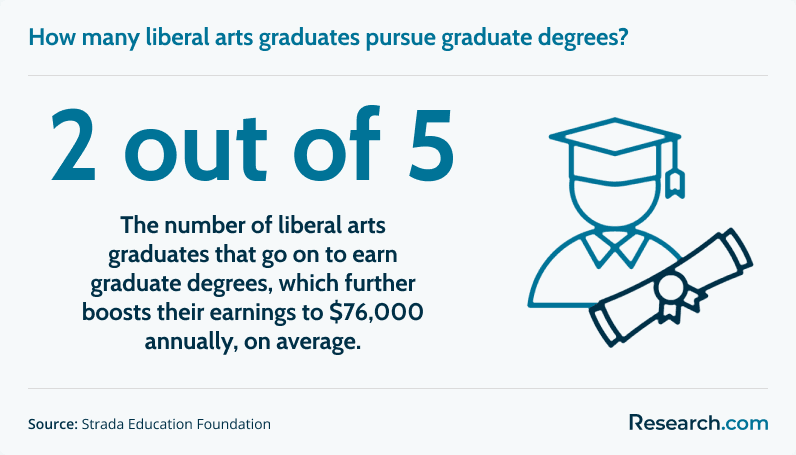
For example, those working in health specialties or post-secondary education has a projected growth of 8% from 2023-2033. Approximately 35% of job openings require at least a bachelor's degree, and graduates with bachelor’s-level preparation generally have more access to roles that require written communication, research, coordination, and analytical judgment.
Technology is also changing employer expectations. Liberal arts graduates may need to demonstrate comfort with digital collaboration tools, data interpretation, content platforms, AI-assisted workflows, and responsible information evaluation. The degree can provide the critical thinking foundation, but students should add evidence of technical and applied skills where possible.
Should I pursue a doctoral degree after earning my online liberal arts degree?
A doctoral degree can be worthwhile if your goals require advanced research training, university teaching, senior policy research, or deep specialization. It is not usually necessary for many entry-level or mid-career roles that liberal arts graduates pursue. Before applying, compare program cost, funding, dissertation expectations, career outcomes, and the opportunity cost of additional years in school.
Students seeking accelerated doctoral options can research 2-year PhD programs online, but they should carefully verify accreditation, academic rigor, faculty fit, and whether the credential is accepted in their target field.
How can pursuing an advanced degree enhance your career prospects?
An advanced degree can help liberal arts graduates move from broad preparation into specialized professional tracks. Graduate study may support advancement in education, public administration, counseling, communications, law-related fields, research, management, or technical writing, depending on the program selected.
The key is alignment. A graduate credential should connect directly to job requirements or promotion criteria. Students comparing graduate ROI can explore masters degrees that pay well and then evaluate whether the cost, admissions requirements, and career outcomes match their goals.
Do Top Employers Value Online Liberal Arts Degrees Equally?
Employers generally care most about whether the institution is accredited, whether the candidate can do the work, and whether the applicant can demonstrate relevant skills. The online format itself is less important when the program is credible and the graduate can show strong writing, communication, collaboration, research, and digital workplace abilities.
That said, students should be ready to translate their degree into employer language. Instead of saying only “I studied liberal arts,” explain the projects you completed, the problems you analyzed, the audiences you wrote for, and the tools you used. The broader trend toward flexible and accelerated education, including pathways such as the fastest way to get associate's degree, also reflects growing interest in alternative routes to recognized credentials.
What are the emerging trends shaping online liberal arts education?
Online liberal arts education is becoming more skills-conscious and technology-enabled. Programs increasingly use learning platforms, virtual collaboration tools, online tutoring, digital libraries, live discussions, and applied projects. Many schools are also adding certificates, micro-credentials, or concentration pathways so students can pair broad liberal arts learning with career-specific skills.
AI is another important trend. Students need to learn how to evaluate sources, write clearly, use AI tools ethically, check accuracy, and apply human judgment to ambiguous problems. These abilities fit naturally with liberal arts learning, but programs vary in how directly they teach them. Students comparing flexible academic formats may also review easiest online degrees, while remembering that “easy” should never replace accredited, career-relevant, and academically credible.
Final checklist before enrolling
- Is the institution accredited by a recognized accrediting body?
- Will your transfer credits reduce both time and cost?
- Does the curriculum include a concentration that supports your career goal?
- Are courses asynchronous, live, accelerated, or cohort-based?
- What is the full cost from enrollment to graduation?
- Does the program offer online advising, tutoring, writing help, library access, and career support?
- If you plan to teach or pursue licensure, does the program meet your state’s requirements?
- Can you graduate with a portfolio, capstone, internship, certificate, or other proof of applied skills?
Key Insights
- An online liberal arts degree is best for students who want flexible bachelor’s-level study that builds communication, analysis, writing, research, and problem-solving skills across disciplines.
- Completion time can range from 18 to 24 months in some accelerated degree-completion pathways to two to four years for many transfer students, with traditional timelines closer to 4 years for students starting with few credits.
- Students can expect to pay between $19,000 and $87,000 for the entire liberal arts degree program, so transfer credit acceptance and total cost matter more than sticker tuition alone.
- Bachelor’s degree holders earn an average of $1,334 weekly, whereas those with a high school diploma earn $808 weekly, but individual salaries depend heavily on occupation, experience, location, and specialized skills.
- Approximately 35% of job openings require at least a bachelor's degree, and liberal arts graduates can compete more effectively when they pair the degree with internships, portfolios, certificates, or technical competencies.
- Those working in health specialties or post-secondary education has a projected growth of 8% from 2023-2033, but students should research the specific occupation they want rather than assuming all liberal arts outcomes are the same.
- The safest way to choose a program is to verify accreditation, request a transfer evaluation, compare total cost to graduation, review support services, and confirm that the curriculum supports your career or graduate school plans.
References:
- ACE (2020). NACE salary survey: Starting salary projections for class of 2020 new college graduates. Bethlehem, PA: National Association of Colleges and Employers.
- Bureau of Labor and Statistics. (2024). Field of Degree: Liberal Arts. Field of degree: liberal arts: Occupational Outlook Handbook: U.S. Bureau of Labor Statistics
- NCES (2020, May). The condition of education: Undergraduate degree fields. Washington, DC: National Center for Education Statistics.
- All Business Schools. (2020, June 24). Read about business administration degrees. All Business Schools.
- Sigurdson, R. (N.D.). Why study liberal arts? University of Northern Iowa.com.
Other Things You Should Know About the Best Online Liberal Arts Degree Programs
Admission requirements for online liberal arts degree programs in 2027 often include a high school diploma or equivalent, transcripts, a personal statement, and sometimes standardized test scores. Specific prerequisites may vary by institution, so it's crucial to check each program's criteria.
In 2027, top accredited online liberal arts degree programs include those from Arizona State University, University of Massachusetts, and Penn State World Campus. These programs stand out for their diverse course offerings, strong faculty, and flexible learning formats, allowing students to tailor their education to fit their personal and professional goals.


