
2027 MA vs MFA: Explaining the Difference

Co-Founder and Chief Data Scientist
The distinction between a Master of Arts (MA) and a Master of Fine Arts (MFA) has become more consequential for aspiring creative and academic professionals. However, the real challenge in these programs is the skill gaps among graduates. In a special educational report, 65% of arts and design alumni highlighted a discrepancy between the technical, business, or entrepreneurial skills they acquired in graduate school and what the job market demanded.
As prospective students weigh an MA degree vs an MFA degree, they must understand not only pedagogical differences but also market pressures, institutional constraints, and the uncertain return on investment in creative fields. Read on to dive into the MA vs MFA debate and find the path that suits you best.
Key things you should know about an MA and an MFA
- An MA degree emphasizes academic study, theory, and research, while an MFA is practice-oriented.
- An MA can lead to further academic study or roles in education, publishing, and cultural institutions, while an MFA degree is often required for university-level teaching in the arts.
- MA programs typically involve coursework, exams, and a thesis, while MFA programs require intensive studio practice or creative projects culminating in a final portfolio or performance.
- What is the difference between an MA and an MFA degree? MA vs. MFA
- How competitive is admission to MFA programs compared to MA programs? How competitive is admission to MFA programs compared to MA programs?
- How does MFA coursework differ from MA coursework? Coursework Differences
- How long does it take to complete coursework for MA vs MFA degrees? Completion Time
- Does an MA or MFA lead to better job prospects in creative industries? Does an MA or MFA lead to better job prospects in creative industries?
- What are the tuition costs for MA vs MFA degrees? Program Costs
- Which degree prepares you better for research-based doctoral studies? Which degree prepares you better for research-based doctoral studies?
- What skills does an MA program emphasize compared to an MFA? Emphasized Skills
- Which degree is better for students planning to work internationally? International Work
- How do you decide whether to pursue an MA or MFA? How do you decide whether to pursue an MA or MFA?
- What are the pros and cons of an MA vs an MFA degree? What are the pros and cons of an MA vs an MFA degree?
What is the difference between an MA and an MFA degree?
An MA degree is a graduate degree fundamentally rooted in the humanities, social sciences, or liberal arts disciplines. It's oriented toward research, theory, and critical inquiry. The curriculum encompasses courses in history, theory, methodology, and interdisciplinary scholarship. Its teachings are complemented by seminars, reading-intensive study, and perhaps a written thesis or capstone research project.
In many institutions, an MA is viewed as a stepping stone toward a doctoral program (PhD) because of its emphasis on scholarly skills and academic research.
An MFA degree is designed for practitioners in creative and performing arts, such as visual arts, creative writing, theater, film, dance, or design. It focuses on hands-on workshop practice, portfolio development, studio time, mentoring by practicing artists, and a culminating project or exhibition/performance rather than a formal research thesis.
Because of an MFA's orientation toward artistic creation, it's considered a terminal degree in the arts in many academic settings.
The relationship between these degrees is somewhat similar to the difference between BA and BS, where both are undergraduate pathways but vary in academic focus—one emphasizing theory and research, the other practical or creative application.
How competitive is admission to MFA programs compared to MA programs?
MFA programs, especially at prestigious institutions or in highly reputable creative disciplines, tend to be much more competitive than MA programs. Yet, the competitiveness depends heavily on school prestige, funding, discipline, and program size. Not all MFAs are equally selective, nor are all MAs equally open.
How competitive are MFA programs?
MFA programs are known for being highly competitive, especially at top universities. Many of the best creative writing MFAs in 2025 have acceptance rates as low as 1% to 5%, making admission extremely selective.
For instance, the University of Washington’s MFA in the arts receives more than 200 applications each year but admits only around 12 students, resulting in an acceptance rate of about 5% to 6%.
Some of the most prestigious programs are even more competitive for specific specialties, where applicant pools are larger and spots are fewer.
Why MFA admissions are more competitive than many MA admissions
- Smaller cohort sizes and limited seats: MFA programs usually cap enrollment tightly to ensure quality of studio/mentor oversight, etc., so despite many applicants, only a few spots are open.
- Portfolio/work sample requirements: MFAs in art, design, writing, etc., need strong evidence of creative work. This raises the bar for applicants beyond grades and test scores.
- Prestige & demand: A higher demand for acclaimed MFA programs from both domestic and international applicants increases competitiveness. Top schools, like Yale and NYU, have far more applicants per seat.
If you're eyeing a writing-related program, many top online journalism degree options are available.
How MFA admissions compare to MA admissions
MA degree programs basically have higher acceptance rates than top-tier MFA programs, though there’s a variation depending on some factors. For example, many master’s specialist programs (non-MFA) in business or social science have acceptance rates higher than 20% to 30%, depending on the institution.
The AACSB master’s programs report that acceptance rates remain stable, with fewer admitted students declining offers, but do not show the single-digit rates common in elite MFAs.
The most common major of professionals in this field is visual & performing arts.
How does MFA coursework differ from MA coursework?
An MFA and an MA share many features but diverge in structure, emphasis, and outcome. This is how they differ in terms of coursework:
- Focus on Creation & Practice vs. Theory & Analysis: MFA programs devote much of their coursework to workshops, studio practice, craft development, produce-oriented assignments, and mentoring from practicing artists.
- Quantity of Hands-On/Studio/Workshop Work: An MFA almost always includes intensive, practice-based coursework such as workshops, labs, studios, or performance projects. For instance, students in creative fields or even those enrolled in the shortest online game art and design programs often follow MFA-style curricula focused on producing tangible, portfolio-ready work.
- Thesis/Final Project Differences: MFA programs require a substantial creative project as the culminating work. This can be a manuscript, portfolio, performance, exhibition, or other artistic artefact of publishable or publicly presentable quality.
- Structure, Credit Load, & Duration: MFA programs demand more credits or residency time due to the intensive workshop and creative output components. For instance, some MFA programs are structured for 2 to 3 years of full-time study, with 48 to 54 units or more and regular creative practice.
- Mentorship, Peer Feedback, & Cross-Genre Learning: MFA coursework comes with more frequent mentorship by faculty/practicing artists, peer workshopping, critique sessions, and opportunities to cross genres or join mixed media/experiments.
How long does it take to complete coursework for MA vs MFA degrees?
An MA degree can take about 1 to 2 years of full-time study. This timeline varies by credit requirements, a thesis or capstone requirement, and electives or bridge courses.
Meanwhile, an MFA degree mandates 2 to 3 years of full-time study. It requires more time due to its concentration on studio or creative work and thesis, or performance/exhibition. It also requires more credit hours, or otherwise more work per semester.
Several factors affect the overall duration:
- Full-time vs Part-time enrollment: Part-time study extends the duration. Students juggling work or other responsibilities may need 3 years or more for MFA programs.
- Residency/in-person requirements: Programs that require full-time residency or a certain number of on-campus studio hours can stretch out the schedule.
- Credit load & course availability: Some programs have heavier credit loads, requirements of courses in summer sessions, or limited elective offerings, all of which can affect pacing.
If you're looking for an arts-related program with a quick completion time, consider the fastest online fashion merchandising degree programs.
Does an MA or MFA lead to better job prospects in creative industries?
The evidence suggests that MFAs may give somewhat better job prospects in creative industries when the goal is to work as a practicing artist, creative leader, or academic. Still, this advantage is not universal. For people whose goals are more theoretical, policy-oriented, or a blend of creative plus critical work, an MA may be sufficient.
What the data shows
A master’s degree in creative writing or arts gives access to roles seeking more creative skill, craftsmanship, portfolio work, or teaching credentials. MFA jobs include positions like art director, graphic designer, film & video editor, UX/UI designer, or university teaching. Those with MFAs are well-positioned for creative leadership or institution-based work.
MFA graduates have robust employment outcomes in creative/artistic fields. For example, the University of Waterloo reports that its MFA alumni go into roles like art instructor, fine arts professor, curator, or self-employed artist. Roughly 43.5% are in educational services, and 43.5% are self-employed/artists/curators.
Comparisons & considerations
- Teaching in Higher Education/Academia: For certain faculty or instructor roles in creative arts, an MFA may be required or preferred. An MA might suffice for some adjunct or non-practice-based teaching roles, but for many full-time teaching jobs in creative practice, having an MFA can serve as a superior credential.
- Versatility vs. Specificity: MA degrees are more flexible in humanities, theory, cultural studies, or more research/criticism-oriented work. If someone’s creative interest also leans toward criticism, curatorial work, arts policy, or cultural institutions, an MA might be more apt. Meanwhile, MFAs are more directly connected to the making or public presentation of art: exhibitions, performances, and portfolios.
- Self-Employment/Portfolio Dependency: A large share of creative work is freelance, contract, self-driven, or based on one’s creative output. Even with an MFA, breaking into stable, well-paid creative roles depends as much on one’s portfolio, network, visibility, and experience as on the degree itself. The degree helps open doors, but it's not a guarantee of high income.
What are the tuition costs for MA vs MFA degrees?
An MA can cost $11,090 for tuition alone, and about $29,080 when other costs are included. TuitionHero's 2025 report also estimates that a full MA degree can reach $60,000 to $70,000 at a public institution, and higher at private ones.
Which degree prepares you better for research-based doctoral studies?
For the most part, an MA is the more compelling preparation for research-focused doctoral work because it centers on scholarly research, theoretical frameworks, and academic writing. MAs are crafted with a balance of coursework, critical analysis, and a thesis component, all of which cater to the demands of a PhD or other research-intensive doctorate.
The training you receive in literature reviews, research methodologies, and critical argumentation directly translates into the skill set needed for advanced scholarly inquiry.
By contrast, the MFA is viewed as a terminal professional degree in fields like creative writing, visual arts, or theater. It's outlined primarily to hone advanced creative practice rather than academic research. MFAs often traverse creative projects and may include critical reflection, but they focus on artistic output and craft rather than formal research methods.
This makes the MFA an excellent choice for those aiming to advance their professional or creative careers, or to teach studio or creative practice at the university level. Nonetheless, it's less directly suited for those intending to pursue doctoral studies leaning toward original academic research.
That said, the distinction isn’t absolute. Some MFA graduates do go on to PhD programs, but may need to supplement their creative training with additional research experience, coursework, or publications to prove preparedness for a research-intensive environment. Conversely, an MA is almost always acknowledged as a traditional stepping stone toward a PhD because of its orientation toward scholarship and theory.
In short, if your goal is to enter research-based doctoral studies, an MA is a more direct and rigorous preparation. An MFA is more appropriate if your focus is on professional creative practice with the possibility—though less direct—of doctoral study afterward.
For perspective, this academic hierarchy can be compared to the difference between MD and PhD, where both are terminal degrees but differ fundamentally in purpose—one professional, the other research-focused.
The table below shows that graduate studies actually pay.
What skills does an MA program emphasize compared to an MFA?
An MA program strengthens skills tied to academic research, theoretical engagement, and critical analysis. MA students are trained to conduct literature reviews, apply research methodologies, and write scholarly essays.
The curriculum builds skills in argumentation, analytical thinking, and the ability to situate one’s work within larger intellectual debates. An MA also places importance on developing professional academic skills such as presenting at conferences, preparing articles for publication, and producing a thesis.
An MFA program underscores advanced creative and professional practice. Its focus is on craft, artistic technique, and sustained creative output. Students are trained to refine their personal artistic voice, produce a substantial creative project, and participate in peer critique.
Some MFAs incorporate theoretical or critical studies, but the central skill set revolves around creativity, discipline in producing work, and the ability to present and contextualize one’s artistic output for professional audiences.
For musically inclined individuals, here are your accelerated audio and music degrees online options.
Which degree is better for students planning to work internationally?
Overall, an MA carries a more extensive international recognition, particularly in academic and research contexts. Its concentration on research, theory, and critical inquiry makes it correspond more closely with global standards for graduate-level education and is used for pursuing doctoral programs later on.
This also makes it transferable across countries where academic hierarchies and qualifications are linked to research-based degrees. Graduates with an MA may find it easier to enter PhD programs, apply for research or policy positions, or compete for academic jobs abroad.
An MFA is more specialized and context-dependent. While it's accepted as a terminal professional degree in the United States, its status can vary internationally. Some countries may not consider it equivalent to a research master’s degree, particularly in regions where academic systems prioritize research and theory over practical applications.
An MFA may bring more esteem in creative industries, especially in settings that prefer creative practice over formal research credentials.
Students pursuing international careers may also explore interdisciplinary options like an associate of arts and sciences degree before graduate study, as these programs often provide the general education foundation recognized globally across both research and creative fields.
How do you decide whether to pursue an MA or MFA?
Deciding between an MA and an MFA comes down to clarifying your career goals, the type of work you want to produce, and how you see yourself growing professionally. Each degree has its own purpose, so reflecting on what you hope to achieve is the most reliable way to choose.
If you aim to engage in academic research, teaching, or doctoral studies
Get an MA. MAs are structured to give a foundation in theory, critical analysis, and scholarly writing. They prepare you for PhD-level research, as well as careers in academia, policy, publishing, or cultural institutions where analytical and research skills are critical.
Choosing an MA makes sense if you are drawn to debates in your field, enjoy working with secondary sources and methodologies, or want the option of continuing in higher education at the doctoral level.
If your goal is to advance as a creative practitioner
Go with an MFA. MFAs intensify creative output, craft refinement, and the development of a professional artistic identity. They are beneficial if you want to teach creative practice at the university level, establish a professional portfolio, or position yourself within creative industries. An MFA makes sense if your passion lies in producing original work, finding your artistic voice, and working with a community of practitioners.
For film enthusiasts, try the fast-track cinematography programs online.
Where the decision rests
The decision rests on whether you see yourself more as a researcher-scholar (MA) or as a creative practitioner (MFA). Some people choose both, an MFA for creative development and an MA for research grounding, but most find that adjusting the degree to their career trajectory comes with favorable results.
What are the pros and cons of an MA vs an MFA degree?
MA degree
Pros
- Stronger academic foundation: Ideal for those planning to earn doctoral studies
- International recognition: More understood across academic systems worldwide, especially in Europe and Asia.
- Versatile career options: Prepares students for research, teaching, publishing, policy work, and cultural organizations
- Shorter duration (in many cases): Often 1 to 2 years, making it a quicker route to the next step
Cons
- Less focus on creative practice: If you want to produce art, writing, or performance as your career, an MA may feel overly theoretical.
- Not typically terminal: In academia, it’s a preparation for a PhD rather than a stand-alone professional credential.
- May be less competitive for creative teaching roles: Universities that want creative faculty often prefer the MFA.
MFA degree
Pros
- Terminal professional degree: In fields like creative writing, studio art, and theater, an MFA qualifies graduates to teach at the university level.
- Prioritize creative output: Provides time, mentorship, and resources to produce a significant body of artistic work.
- Professional credibility in creative industries: Hailed as a marker of advanced creative training, especially in the U.S.
- Strong peer and mentor networks: Cohort-based programs often foster long-lasting professional connections in the arts.
Cons
- Recognition varies internationally: Outside the U.S., an MFA may not always be understood as a terminal degree.
- Less emphasis on research skills: This can be a disadvantage if you later obtain a research-based PhD.
- Intensive time commitment: Often 2 to 3 years, with heavy creative workload.
- Narrower career focus: Best suited for creative practice and teaching, less adaptable to non-arts fields.
Here’s What Graduates Have to Say About Their MA & MFA Jobs
- Anna: "Studying for my MA taught me how to think critically and conduct research that really challenged existing ideas in my field. The experience strengthened my writing and analytical skills, and it gave me the confidence to pursue a PhD."
- Dwayne: "My MFA allowed me to focus deeply on my creative practice while receiving invaluable mentorship from professionals in my discipline. Producing a major project during the program not only honed my craft but also opened doors to teaching and exhibiting my work internationally."
- Amelie: "Completing an MA first gave me a strong foundation in theory, while the MFA helped me bring that knowledge into my creative work. Together, the two degrees shaped me into both a reflective scholar and an artist with a distinct voice."
Key Findings
- MA programs have higher acceptance rates than MFAs.
- An MA can take about 1 to 2 years of full-time study, while an MFA can be completed in 2 to 3 yeas.
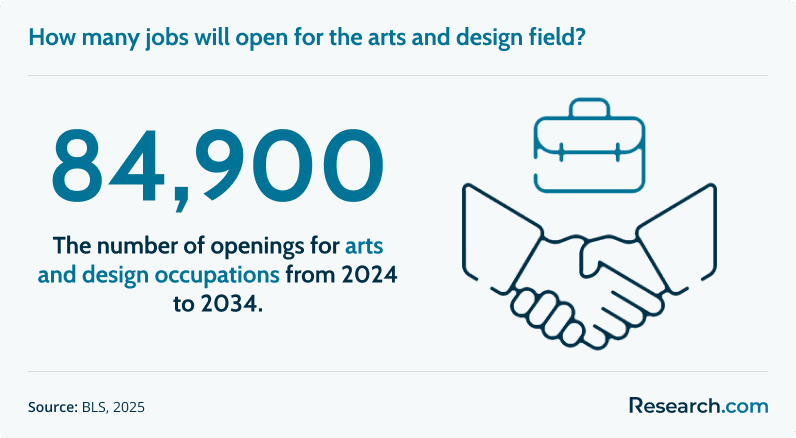
- There will be 84,900 vacancies for arts and design jobs for the next 10 years.
- An MA can cost $11,090 for tuition only, but an MFA can even cost more.
- If you see yourself more as a researcher-scholar, get an MA. If you want to become a creative practitioner, go with an MFA.
References:
- Flaherty, B. (n.d.) Average Cost of a Master's Degree. Retrieved October 3, 2025, from TuitionHero.
- Indeed. (2025, July 25). M.A. vs. M.F.A. Studies: What's the Difference? Retrieved October 3, 2025, from Indeed.
- Novak-Leonard, J. (2024, April). Arts and design alumni employment and perspective on their work and careers. Retrieved October 3, 2025, from Strategic National Arts Alumni Project.
- The Admit Lab. (2025). Best MFA Creative Writing Programs in 2025 - What Admissions Committees Really Want. Retrieved October 3, 2025, from The Admit Lab.
- The University of Waterloo. (n.d.). Career outcomes for MFA graduates. Retrieved October 3, 2025, from The University of Waterloo.
Other Things You Should Know About an MA and an MFA
In 2027, the MFA typically offers more practical experience than the MA, focusing heavily on studio work, internships, and creative projects. In contrast, the MA often emphasizes theoretical study and research. This practical approach in the MFA is beneficial for students pursuing careers in creative arts fields.
In 2027, MA graduates often pursue careers in art history, theory, or teaching, while MFA graduates typically aim for professional careers as artists, designers, or performers. The choice between an MA and MFA may depend on your desired career trajectory and style of work.


