
2027 What Can You Do With a Master’s in Environmental Science?

Co-Founder and Chief Data Scientist
A master’s in environmental science is a graduate degree for people who want to move beyond entry-level environmental work and into more specialized roles in research, consulting, policy, sustainability, conservation, compliance, or resource management. The decision is not simple: recent data shows that only 12% of environmental scientists hold a master’s degree, while 81% have a bachelor’s degree, so prospective students need to know whether the extra time, cost, and academic effort will create a meaningful career advantage.
This guide is for working environmental professionals, recent science graduates, career changers, and students comparing graduate programs. It explains what master’s in environmental science programs include, how long they take, what they cost, which specializations matter, where graduates work, and how to judge whether a program is worth the investment.
Quick Answer: Is a Master’s in Environmental Science Worth Considering?
A master’s in environmental science can be worthwhile if you want deeper technical expertise, access to research or policy-focused roles, stronger qualifications for leadership, or a clearer path into consulting, environmental health, climate work, sustainability management, or doctoral study. It is less useful if your target job only requires a bachelor’s degree, if the program is not accredited, or if the total cost would outweigh your realistic salary growth.
- Time to completion. Full-time students commonly finish in two years. Part-time students may need three to five years, depending on course load and institutional rules.
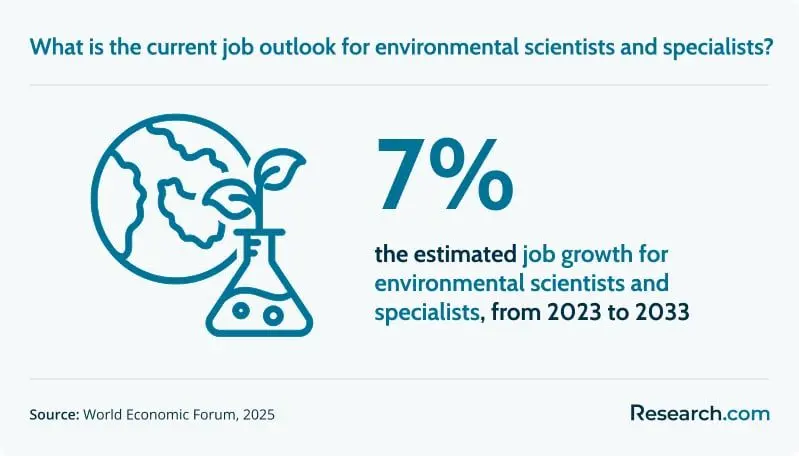
- Labor market outlook. The US Bureau of Labor Statistics projects employment for environmental scientists to grow 7% from 2023 to 2033, with approximately 6,100 new jobs added during that period.
- Cost planning. The average cost of a master’s degree in the US is $65,134 across all disciplines, but environmental science tuition varies by school type, residency status, delivery format, and required field or research components.
- Career settings. Graduates may work for government agencies, environmental consulting firms, corporations, conservation nonprofits, urban planning organizations, renewable energy companies, and environmental health programs.
- Academic focus. Most programs combine natural science, environmental policy, data analysis, GIS, fieldwork, and applied research, with options in climate change, environmental health, renewable energy, conservation, and water resources.
What are the benefits of enrolling in master’s in environmental science programs?
The main benefit of a master’s in environmental science is specialization. A bachelor’s degree may qualify graduates for many environmental science roles, but graduate study can help students build advanced skills in research design, environmental modeling, policy analysis, compliance, GIS, sustainability planning, field methods, and technical communication.
The degree can also strengthen a candidate’s credibility for roles that involve independent analysis, project leadership, regulatory interpretation, or cross-functional decision-making. For example, an environmental consultant may use graduate training to evaluate impact data, while a sustainability manager may use it to connect science-based goals with business operations and reporting requirements.
| Potential benefit | Why it matters | Best fit for |
| Specialized technical training | Graduate coursework can go deeper into ecology, toxicology, GIS, climate systems, hydrology, and environmental modeling. | Students targeting analytical, research, or technical consulting roles |
| Stronger policy and management skills | Many programs connect science with regulation, public administration, land use, and sustainability strategy. | Future policy analysts, compliance professionals, and sustainability managers |
| Research preparation | Thesis and capstone options can help students build evidence-based problem-solving skills. | Students considering doctoral study or research-intensive careers |
| Career mobility | A graduate credential may support movement into supervisory, specialist, or interdisciplinary roles. | Professionals seeking advancement beyond entry-level responsibilities |
What can I expect from master’s in environmental science programs?
Master’s in environmental science programs usually combine classroom learning, applied projects, quantitative analysis, fieldwork, and either a thesis, capstone, practicum, or internship. Students often study how ecosystems function, how pollution affects human and environmental health, how environmental regulations are applied, and how data can guide decisions about land, water, climate, and natural resources.
Programs differ significantly. Some are research-heavy and best suited for students preparing for a PhD or technical science role. Others are professionally oriented and focus on environmental management, policy, consulting, sustainability, or public administration. Before applying, students should check whether the curriculum emphasizes laboratory research, field methods, data analytics, environmental law, management, or community-based work.
Where can I work after graduating from a master’s in environmental science program?
Graduates can pursue work across public, private, and nonprofit sectors. Government roles may involve environmental regulation, land management, permitting, public health, or policy implementation. Consulting firms often hire environmental professionals to conduct environmental impact assessments, compliance reviews, site evaluations, remediation planning, and sustainability analysis.
Other common employers include renewable energy companies, water utilities, conservation organizations, engineering firms, corporate sustainability teams, urban planning agencies, research institutes, and advocacy groups. The best sector depends on the student’s specialization: water resources can lead toward hydrology and resource management, while environmental policy may fit government or nonprofit work, and environmental analytics may align with consulting or corporate sustainability.
How much can I make with a master’s in environmental science program?
Earnings depend on location, experience, employer type, specialization, and job responsibility. According to the US Bureau of Labor Statistics, the median annual wage for environmental scientists and specialists was $78,980 in May 2023. Other reported averages range from $58,963 to $97,161, with top earners making over $108,000.
A master’s degree does not guarantee a specific salary. However, graduate training may help candidates qualify for roles involving senior analysis, project management, regulatory strategy, environmental consulting, sustainability leadership, or applied research—positions that can carry higher responsibility and, in some sectors, stronger compensation.
- Best master’s in environmental science programs for 2027
- How long does a master’s in environmental science take?
- Online vs. on-campus master’s in environmental science programs
- Average cost of a master’s in environmental science program
- Financial aid options for environmental science graduate students
- Admission prerequisites for master’s in environmental science programs
- Common courses in environmental science master’s programs
- Environmental science specializations to compare
- Return on investment for a master’s in environmental science
- Why accreditation matters for environmental science programs
- Student support and career development resources
- Options for nontraditional and working learners
- Using a master’s in environmental science to prepare for doctoral study
- Certifications that may strengthen environmental careers
- How environmental science costs compare with other online degree options
- Academic rigor of environmental science master’s programs
- International collaborations and accelerated tracks
- How to choose the right master’s in environmental science program
- Career paths for environmental science master’s graduates
Best Master's in Environmental Science Programs for 2027
1. Stanford University - E-IPER Joint or Dual Master of Science (MS) in Environment and Resources
Stanford University offers the E-IPER Joint or Dual MS in Environment and Resources for Stanford students who want to connect environmental problem-solving with another graduate field. The program is built for interdisciplinary study, allowing students to examine topics such as climate change, sustainable energy systems, food and water systems, and human and planetary health through multiple academic lenses.
Students can shape coursework and research around their professional goals, whether they are interested in the sustainable built environment, global environmental systems, or cross-sector sustainability work. Because the program draws on Stanford’s faculty, research infrastructure, and collaborative academic culture, it is best suited for students who already have access to Stanford graduate study and want environmental expertise to complement another discipline.
- Program Length: 1-3 years
- Tracks/Concentrations: Climate Change, Food and Water Systems, Global Environmental Systems, Human and Planetary Health, Sustainable Built Environment, Sustainable Energy Systems
- Cost per Credit: $12,720.00 quarterly tuition for 8-10 units; $19,582 quarterly tuition for 11-18 units
- Required Credits to Graduate: 45 units
- Accreditation: Western Association of Schools and Colleges Senior College and University Commission (WSCUC)
2. Yale University - Master of Environmental Management (MEM)
Yale University’s Master of Environmental Management is a professional graduate program for students preparing to lead environmental work across government, nonprofit, and private-sector settings. The curriculum combines science, policy, management, and systems thinking, making it appropriate for students who want to translate environmental knowledge into strategy and action.
Students can choose from several areas of focus, including ecosystem management, energy and the environment, environmental policy analysis, urban sustainability, and a self-designed path. Field learning, applied projects, and interdisciplinary collaboration help students connect classroom study with real environmental decisions involving conservation, equity, industrial ecology, and resource management.
- Program Length: 2 years
- Tracks/Concentrations: Business and the Environment, Climate Change Science and Solutions, Ecosystem Management and Conservation. Energy and the Environment, Environmental Policy Analysis, Industrial Ecology and Green Chemistry, People, Equity, and the Environment, Urban, Water Resource Science and Management, Self-Designed
- Cost per Credit: $51,250.00 full tuition
- Required Credits to Graduate: 48 credits
- Accreditation: Society of American Foresters (SAF)
3. University of Michigan - Master of Science in Ecosystem Science and Management
The University of Michigan offers a Master of Science in Ecosystem Science and Management for students focused on ecology, conservation, and the stewardship of natural systems. The program emphasizes ecosystem relationships and prepares students to address habitat restoration, biodiversity protection, and sustainable resource use.
Fieldwork and research are central to the learning experience. Students interested in conservation ecology can use the program to build practical and analytical skills for work in public agencies, conservation organizations, research settings, or environmental management roles that require a strong ecological foundation.
- Program Length: 2 years
- Tracks/Concentrations: Conservation Ecology
- Cost per Credit: $1,924.00 in-state; $3,448.00 out-of-state
- Required Credits to Graduate: 42 credit hours
- Accreditation: Higher Learning Commission (HLC)
4. Duke University - Master of Environmental Management
Duke University’s Master of Environmental Management is designed for students who want a mix of environmental science, policy, analytics, economics, management, and community engagement. The program offers concentrations across natural systems and management-oriented fields, making it useful for students with different career goals.
Students may focus on coastal and marine systems, ecotoxicology and environmental health, energy and environment, terrestrial and freshwater environments, business and environment, environmental analytics and modeling, or environmental economics and policy. The program’s applied structure, internships, and project-based work can help graduates prepare for environmental leadership roles in consulting, public agencies, nonprofits, and sustainability-focused organizations.
- Program Length: 2 years
- Tracks/Concentrations:
- Environment: Coastal and Marine Systems, Ecotoxicology and Environmental Health, Energy and Environment, Terrestrial and Freshwater Environments
- Management: Business and Environment, Community Engagement and Environmental Justice, Environmental Analytics and Modeling, Environmental Economics and Policy
- Cost per Credit: $46,238.00 flat-fee tuition structure
- Required Credits to Graduate: 48 credits
- Accreditation: Commission on Colleges of the Southern Association of Colleges and Schools
5. Columbia University - MPA in Environmental Science and Policy
Columbia University’s MPA in Environmental Science and Policy is an accelerated graduate option that connects scientific analysis with public policy and administration. It is a strong fit for students who want to work at the intersection of environmental evidence, governance, and implementation.
The program is offered through Columbia’s School of International and Public Affairs and includes intensive coursework, experiential learning, fieldwork, and capstone-style projects. Its one-year format can appeal to students who want to complete graduate study quickly while building skills for policy, urban sustainability, resource management, and environmental decision-making.
- Program Length: 12 months
- Tracks/Concentrations: N/A
- Cost per Credit: $31,390.00 flat-fee tuition
- Required Credits to Graduate: 54 points
- Accreditation: Middle States Commission on Higher Education (MSCHE)
How long does it take to complete a master's in environmental science program?
Most full-time master’s in environmental science programs take about two years. Many require 30 to 60 credit hours, often including a thesis, capstone, internship, practicum, field project, or research requirement. Some programs require 72 credit hours, which can extend completion to three or more years.
Part-time enrollment is common for working professionals and can stretch the timeline to three or four years. Accelerated options may allow motivated students to finish in as little as one year. As with other graduate degrees, the length of a master’s program depends on credit requirements, course availability, research expectations, and whether the student attends full time or part time.
| Enrollment path | Typical timeline | Who it may suit |
| Full-time | About two years | Students who can prioritize school and want a traditional graduate experience |
| Part-time | Three or four years | Working professionals or students with caregiving or financial responsibilities |
| Accelerated | As little as one year | Students who can handle an intensive schedule and want to return to the workforce quickly |
| High-credit program | Three or more years when 72 credit hours are required | Students in research-heavy or specialized programs with extensive academic requirements |
How does an online master's in environmental science program compare to an on-campus program?
Online and campus-based environmental science master’s programs can both be rigorous, but they serve different learners. The right format depends on whether you need schedule flexibility, in-person field access, lab facilities, local networking, or the ability to keep working while studying.
| Factor | Online program | On-campus program |
| Flexibility | Often better for employed students because lectures, assignments, and discussions may be scheduled around work. | Usually follows a more fixed academic schedule with in-person attendance expectations. |
| Networking | May include virtual events, discussion boards, remote group projects, and online advising. | Often provides more informal access to faculty, labs, research groups, and campus organizations. |
| Fieldwork and labs | May use local field assignments, virtual tools, simulations, or short residencies. | Typically offers direct access to laboratories, field sites, and campus research facilities. |
| Best fit | Working professionals, rural students, military learners, and students who cannot relocate. | Students who want immersive research, campus engagement, or lab-centered study. |
Online environmental science programs have become more practical for students who need flexibility, similar to how the best online nutrition degree programs have adapted academic and professional training for remote learners. Still, applicants should verify how an online program handles fieldwork, lab requirements, internships, and access to faculty mentoring.
What is the average cost of a master's in environmental science program?
The cost of a master’s in environmental science varies by public or private status, residency, online or campus format, credit load, fieldwork costs, and fees. Recent data places the average cost of a master’s degree in the United States at approximately $39,600, while environmental science programs may range from $20,000 to over $70,000. Other estimates place tuition for a master's in environmental science from $30,000 to over $120,000, depending on program type, institution, and residency status.
Public universities may be more affordable for in-state students, while private universities often charge higher tuition. Online programs can reduce commuting, relocation, and housing expenses, though tuition may still be similar to campus-based study. As with an online masters in public policy, the real cost depends on more than tuition; students should calculate fees, books, technology, field travel, lost income, and financing costs.
What are the financial aid options for students enrolling in a master's in environmental science program?
Graduate students can use several funding sources to reduce the net cost of an environmental science master’s degree. The best strategy is to combine aid types instead of relying on one source.
- Federal student loans. Students who complete the FAFSA may qualify for federal graduate loans, which often have borrower protections that private loans may not provide.
- Scholarships and grants. Universities, private foundations, professional associations, government programs, and environmental organizations may offer merit- or need-based awards that do not require repayment.
- Assistantships and fellowships. Research, teaching, and administrative assistantships can reduce tuition or provide stipends while giving students relevant academic or professional experience.
- Employer tuition assistance. Professionals already working in environmental science, compliance, sustainability, utilities, engineering, or public agencies should ask whether their employer reimburses graduate coursework.
- Private loans or personal fundraising. These may fill gaps, but borrowers should compare interest rates, repayment terms, and long-term affordability carefully.
Students should ask each program for a full cost-of-attendance estimate, not just tuition. They should also ask whether assistantships are guaranteed, competitive, or limited to on-campus students.
What are the prerequisites for enrolling in a master’s in environmental science program?
Admission requirements vary, but most programs look for evidence that applicants can handle graduate-level science, analysis, writing, and research. Students from environmental science, biology, chemistry, geology, ecology, public health, engineering, geography, and related fields may have the smoothest path, but some programs accept career changers who complete prerequisite coursework.
- Bachelor’s degree. Most programs require an undergraduate degree from an accredited institution, often in environmental science or a related natural or physical science.
- Science foundation. Applicants may need prior coursework in biology, chemistry, physics, ecology, statistics, geology, or environmental systems.
- Research or work experience. Some programs prefer candidates who have completed fieldwork, laboratory work, internships, environmental employment, or undergraduate research.
- GRE policy. Some schools still request GRE scores, while many programs have adopted test-optional admissions.
- Recommendations and goals statement. Letters of recommendation and a statement of purpose help admissions committees evaluate preparation, motivation, and fit.
Career changers should contact admissions advisors early. A program may allow conditional admission, but students without science prerequisites may need additional courses before starting advanced environmental science classes.
What courses are typically in a master’s in environmental science program?
Coursework usually blends environmental science fundamentals with applied tools and policy context. The specific curriculum depends on the program’s concentration and whether it is research-based or professionally oriented.
- Environmental systems and ecology. Students examine ecosystems, biodiversity, population dynamics, land-use change, and relationships among organisms and their environments.
- Environmental policy and law. Courses may cover regulatory systems, environmental governance, compliance, permitting, and major domestic or international policy frameworks.
- Geospatial analysis and GIS. Students learn to interpret spatial data for conservation, planning, resource management, risk mapping, and environmental assessment.
- Sustainability and resource management. Coursework may address renewable energy, sustainable development, natural resource use, circular systems, and organizational sustainability strategy.
- Environmental toxicology. Students study how contaminants affect ecosystems and human health, which is especially relevant for environmental health and remediation careers.
Like genetics masters programs, environmental science master’s programs rely on specialized scientific training. The difference is that environmental science usually adds policy, fieldwork, spatial analysis, and systems-level problem-solving.
What types of specializations are available in a master’s in environmental science program?
Specialization is one of the most important program-selection factors. Students should choose a concentration that matches the employers, problems, and tools they want to work with after graduation.
- Climate science and adaptation. Focuses on climate impacts, mitigation, adaptation planning, renewable energy, and environmental resilience.
- Environmental policy and management. Prepares students to analyze regulations, design programs, evaluate environmental decisions, and manage sustainability initiatives. Sustainability is also relevant in fields such as a hospitality and tourism degree, where environmental practices increasingly affect operations and planning.
- Conservation biology and wildlife management. Emphasizes biodiversity, habitat protection, wildlife management, restoration ecology, and endangered species protection.
- Environmental health and toxicology. Examines pollutant exposure, human health risks, ecosystem impacts, environmental monitoring, and remediation.
- Water resources management. Covers hydrology, water quality, freshwater systems, watershed planning, and sustainable water use.
Students who are unsure about a concentration can compare their interests with major long-term global risks that relate to environmental science, resource planning, public trust, and technology.
| Rank | Global Risk |
| 1st | Extreme weather events |
| 2nd | Biodiversity loss and ecosystem collapse |
| 3rd | Critical change to Earth systems |
| 4th | Natural resource shortages |
| 5th | Misinformation and disinformation |
| 6th | Adverse outcomes of AI technologies |
| 7th | Inequality |
| 8th | Social polarization |
| 9th | Cyber espionage and warfare |
| 10th | Pollution |
What is the return on investment for a master’s in environmental science program?
The ROI of a master’s in environmental science depends on total cost, debt, time away from work, employer demand, specialization, and realistic salary outcomes. Students should compare the program’s net cost with the roles they expect to pursue—not with broad salary averages alone.
A practical ROI review should include tuition, fees, field expenses, books, technology, relocation, commuting, and opportunity cost. Online options, including pathways available through the least expensive online college, may lower some living and transportation expenses, but students still need to examine academic quality, career outcomes, and support services.
| ROI question | Why it matters |
| What jobs do recent graduates actually get? | Career outcomes are more useful than general promises about advancement. |
| How much debt will I take on? | Loan repayment can reduce the value of higher earnings. |
| Does the specialization match local or target employers? | A strong program fit can matter more than name recognition alone. |
| Can I keep working while enrolled? | Maintaining income can improve ROI, especially for part-time or online students. |
| Are assistantships or fellowships available? | Funding can significantly change the affordability equation. |
Is accreditation an essential criterion for environmental science programs?
Accreditation is one of the first items students should verify. Institutional accreditation helps confirm that a school meets recognized academic standards and can affect financial aid eligibility, transferability, employer recognition, and admission to further study.
Applicants should confirm accreditation through the school and the accrediting body, especially when evaluating online or lesser-known institutions. Comparing reputable options, including non profit colleges, can help students avoid programs that lack recognized oversight or transparent outcomes.
How do student support and professional development resources enhance career success?
Environmental science graduate students benefit from more than coursework. Career counseling, faculty mentoring, internship placement, research advising, GIS or data support, writing help, alumni networks, and employer events can influence whether students turn a degree into a stronger job outcome.
Online learners should pay special attention to support access. Programs offered through online schools with financial aid may provide flexible scheduling and remote services, but students should ask whether online students receive the same career advising, internship support, and faculty access as campus students.
Can master's in environmental science programs accommodate nontraditional learners?
Many environmental science programs now serve adults who are working full time, changing careers, returning after a long academic break, or balancing family responsibilities. Online, hybrid, evening, and part-time options can make graduate study more realistic for these learners.
Nontraditional students should look for flexible pacing, clear technology support, asynchronous course options, accessible faculty advising, and policies for transfer credits or prerequisite completion. Resources like online degree programs for seniors show how higher education options are expanding for learners who do not follow a traditional residential path.
How can a master's in environmental science pave the way to doctoral studies?
A master’s in environmental science can prepare students for doctoral study by building research skills, methodological knowledge, faculty relationships, and a clearer academic focus. Thesis-based programs are often especially useful because they require students to design research questions, collect or analyze data, and communicate findings.
Students considering a PhD should prioritize programs with active faculty research, funding opportunities, publication potential, strong quantitative training, and a thesis option. Those comparing future academic pathways may also review low-cost doctoral programs when planning the next stage of graduate education.
What additional certifications can enhance your career prospects?
Professional certifications can complement a master’s degree by demonstrating applied expertise in sustainability, compliance, auditing, project management, or green building. Credentials such as Certified Environmental Professional (CEP) or LEED Green Associate may be useful in certain roles, depending on employer expectations and job duties.
Students should not collect certifications randomly. A better approach is to review job postings for target roles, identify repeated credential requirements, and choose certifications that match the desired specialization. For broader degree-planning context, students can also compare environmental science with other good degrees to get.
How do program costs compare with other online degree options?
A master’s in environmental science generally requires a larger investment than shorter or lower-level credentials because it involves graduate coursework, research expectations, and specialized environmental training. Students comparing costs should separate degree level from delivery format: an online master’s may be flexible, but it is still a graduate degree.
For perspective, students may compare graduate tuition with the cost of online associate's degree, but they should not treat the credentials as substitutes. An associate degree may support entry-level education or career exploration, while a master’s is designed for advanced specialization and professional development.
How does the academic rigor of a master's in environmental science compare to other master’s programs?
A master’s in environmental science can be demanding because it often combines science, statistics, fieldwork, policy analysis, writing, and applied problem-solving. Students may be expected to interpret environmental data, evaluate regulations, conduct research, collaborate across disciplines, and explain technical findings to nontechnical audiences.
The workload depends on the program’s design. Research-heavy tracks can be more intensive than professional programs, while accelerated formats compress the same academic expectations into a shorter timeline. Students comparing difficulty across graduate fields can review What is the easiest masters degree to get?, but they should judge rigor by curriculum, prerequisites, thesis requirements, and weekly workload rather than by reputation alone.
Are international collaborations and accelerated academic tracks available?
Some environmental science master’s programs include international research partnerships, global field experiences, cross-border sustainability projects, or collaborations with international institutions. These opportunities can be valuable because environmental problems often cross political and geographic boundaries.
Accelerated tracks may also be available for students who want a faster route through graduate study or a smoother transition into doctoral work. Students interested in fast academic progression can compare integrated or expedited pathways with options such as 2 year doctorate programs, while carefully checking whether accelerated study leaves enough time for research, internships, and professional networking.
How to choose the best master's in environmental science program?
The best master’s in environmental science program is the one that fits your career target, academic background, budget, schedule, and preferred learning format. Rankings can be helpful, but they should not replace program-specific due diligence.
- Define your career goal first. Decide whether you want consulting, conservation, policy, sustainability, environmental health, water resources, climate work, research, or doctoral study.
- Match the specialization to the job market. Review job postings in your target region or sector to see which skills and credentials employers request.
- Check accreditation and institutional reputation. Confirm that the school has recognized accreditation and that employers or doctoral programs will respect the credential.
- Compare curriculum details. Look for GIS, statistics, field methods, policy, toxicology, hydrology, research, or management courses that match your goals.
- Ask about fieldwork and internships. Environmental science is applied; practical experience can matter as much as classroom learning.
- Calculate the full cost. Include tuition, fees, travel, supplies, housing, lost income, and loan repayment.
- Review student outcomes. Ask where graduates work, what roles they obtain, and whether the school publishes placement information.
Format matters, too. Online programs may help working professionals continue earning while studying, much like the top online MBA programs that are built for career-focused learners. However, students should confirm how online programs handle labs, fieldwork, advising, and employer connections.
Common mistakes to avoid when choosing a program
- Choosing only by school name. A prestigious university is not automatically the best fit if its specialization does not match your career path.
- Ignoring accreditation. An unrecognized credential can create problems for financial aid, employment, and future graduate study.
- Focusing only on tuition. Fees, field travel, relocation, equipment, and lost income can change the real price.
- Assuming online means easier. Online graduate programs can require the same research, writing, and technical work as campus programs.
- Skipping career-outcome questions. Ask for employer connections, internship support, and graduate placement information before enrolling.
- Assuming salary gains are guaranteed. A degree may improve qualifications, but compensation still depends on sector, experience, location, and role.
What career paths are available for graduates of master’s in environmental science programs?
Graduates can pursue roles that involve scientific analysis, policy interpretation, compliance, sustainability planning, conservation, resource management, and environmental risk assessment. The most suitable path depends on specialization, prior experience, location, and the amount of field, lab, or data training completed during the program.
- Environmental consultant. Consultants assess environmental risks, prepare impact reports, support permitting, evaluate compliance, and advise organizations on sustainability or remediation strategies.
- Conservation scientist. Conservation professionals manage land, protect natural resources, support habitat restoration, and work with agencies, nonprofits, landowners, or research teams.
- Environmental policy analyst. Policy analysts study regulations, evaluate environmental programs, prepare reports, and advise governments, nonprofits, or corporations on policy decisions.
- Corporate sustainability manager. Sustainability managers help organizations reduce environmental impact, measure progress, improve operations, and align practices with environmental standards.
- Environmental auditor. Similar to the internal auditor career path, environmental auditors review compliance, identify risks, and recommend improvements to environmental management systems.
| Career path | Useful graduate focus | Typical work setting |
| Environmental consultant | Impact assessment, GIS, compliance, remediation, environmental data analysis | Consulting firms, engineering firms, private companies |
| Policy analyst | Environmental law, public administration, climate policy, economics | Government agencies, nonprofits, think tanks, advocacy organizations |
| Conservation scientist | Ecology, biodiversity, wildlife management, restoration | Public lands agencies, conservation nonprofits, research organizations |
| Sustainability manager | Resource management, climate strategy, reporting, organizational change | Corporations, universities, healthcare systems, municipalities |
| Environmental health specialist | Toxicology, exposure science, pollution, environmental monitoring | Public health agencies, industry, laboratories, regulatory bodies |
What is the job market for graduates with a master's in environmental science program?
The environmental science job market is growing steadily. According to the U.S. Bureau of Labor Statistics, employment of environmental scientists and specialists is projected to grow 7 percent from 2023 to 2033, faster than the average for all occupations. The same outlook points to about 8,500 job openings annually, largely because workers transfer to other occupations or retire.
Employer expectations are also changing. Environmental work increasingly involves data systems, remote sensing, GIS, environmental monitoring technologies, sustainability reporting, climate risk analysis, and cross-disciplinary communication. Artificial intelligence is also being used in environmental monitoring and data analysis, which may increase demand for professionals who can interpret results responsibly rather than simply collect data.
Other developments, including bioremediation techniques and sustainable materials such as biodegradable plastics and recycled building materials, are shaping specialized opportunities in remediation, product development, consulting, and sustainability. A master’s degree can help students build the technical, policy, and analytical skills needed for these evolving roles, but hands-on experience and targeted specialization remain important.
What Graduates Have to Say About Their Master's in Environmental Science Programs
"I lived far from a campus, so an online master’s program was the only option that fit my life. I expected it to feel disconnected, but the virtual labs, team assignments, and faculty discussions kept me engaged. I now work in environmental impact assessment, where I help evaluate ecological risks before development projects move forward. The program gave me both technical confidence and professional contacts I still use." - Priya
"Graduate school seemed financially out of reach at first, but scholarships and aid changed the equation. My employer valued the degree enough to promote me before I finished. Today, I manage environmental compliance for a large manufacturing company. For me, the degree paid off because it aligned directly with the work I wanted to do." - Nathan
"Coming from finance, I worried that I would be behind everyone else academically. The online format helped me complete foundational courses before moving into advanced environmental topics. My thesis on sustainable resource management led to a consulting role where I help companies adopt greener practices. The experience proved that a career shift can work when the program provides the right support." - Corbyn
Key Insights About Master's in Environmental Science Programs
- A master’s degree is most valuable when it supports a specific goal. It can help with consulting, policy, sustainability, conservation, environmental health, technical analysis, leadership, or doctoral preparation, but it should be matched to a clear career path.
- Cost varies widely, so net price matters more than sticker price. Tuition for a master's in environmental science ranges from $30,000 to over $120,000, and students should also account for fees, fieldwork, relocation, lost income, and debt.
- Labor market demand is positive but not automatic. The US Bureau of Labor Statistics projects 7% growth for environmental scientists and specialists from 2023 to 2033, but job outcomes depend on specialization, experience, location, and employer needs.
- Salary outcomes differ by sector and role. As of 2025, the median annual wage for environmental scientists is $78,980, while professionals in engineering and government roles can earn over $100,000 and nonprofit roles may be closer to $60,000.
- Online programs can work well for adults and working professionals. Many students continue working while earning the degree, but they should verify fieldwork, lab access, advising, and internship support before enrolling.
- Accreditation is nonnegotiable. Students should confirm institutional accreditation and understand how it affects financial aid, employer recognition, transfer credit, and future doctoral study.
- The strongest applicants and graduates build more than academic knowledge. GIS, data analysis, writing, communication, policy interpretation, field experience, and professional networking can make the degree more useful in the job market.
References:
- Data USA. (2023). Environmental science. datausa.io
- LSU Online. (2025). 5 reasons to study environmental sciences with LSU online. lsu.edu
- US Bureau of Labor Statistics. (30 Sept 2024). Environmental scientists and specialists. bls.gov
- World Economic Forum. (2025). The global risks report 2025. weforum.org
- Zippia. (2025). Environmental scientists demographics and statistics [2025]. degree-level data and zippia.com
Other Things You Should Know About Master's in Environmental Science Programs
Master’s programs in Environmental Science typically offer research opportunities in areas like climate change, sustainable agriculture, and urban ecology. Students can engage in fieldwork and lab research, addressing pressing environmental issues and collaborating with faculty on funded projects.
In 2027, it's crucial to have skills in data analysis, project management, and sustainability practices. Proficiency in GIS and remote sensing, along with strong communication abilities, are essential for effectively addressing environmental challenges and opportunities.


