
2027 Best Online Emergency Management Degree Programs

Co-Founder and Chief Data Scientist
Choosing an online emergency management degree is a practical decision for people who want to work in disaster planning, public safety, homeland security, healthcare preparedness, business continuity, or community resilience. The field matters because emergencies are becoming more complex: natural disasters, cyber incidents, infrastructure failures, public health events, and security threats often require coordinated planning before a crisis happens. In 2024 alone, over 18,000 people lost their lives due to natural disasters, underscoring why trained emergency management professionals are essential.
This guide explains what to expect from an online emergency management degree, how programs compare, what they cost, which careers they can support, and how to choose a program that fits your goals. It also highlights the best online emergency management degree programs for 2027 and gives you a practical framework for comparing schools beyond tuition and rankings.
Quick answer: Is an online emergency management degree worth considering?
An online emergency management degree can be worth considering if you want a career focused on disaster preparedness, crisis coordination, risk reduction, public safety, or organizational resilience. The strongest programs combine accredited coursework, applied projects, incident command training, crisis communication, and opportunities to connect with agencies or employers. The degree is especially useful for working adults, first responders, military personnel, public-sector employees, and students who need flexibility while preparing for roles in government, healthcare, education, nonprofits, consulting, or private industry.
What are the benefits of getting an online emergency management degree?
- Career preparation: Graduates can pursue roles such as emergency management director, disaster response coordinator, risk assessment specialist, business continuity planner, and public safety administrator in government agencies, hospitals, colleges, nonprofits, and private organizations.
- Applied crisis training: Online programs typically teach emergency planning, hazard mitigation, incident command, disaster recovery, crisis communication, and risk analysis, helping students connect classroom concepts to real emergency scenarios.
- Flexible access: Online delivery allows working professionals and first responders to study without relocating or leaving their current jobs, which can be important for students already employed in public safety or healthcare.
- Salary potential: Emergency management directors earn a median annual wage of $83,960, while emergency management coordinators earn around $61,574 annually and emergency management specialists may start at about $32,000 annually.
- Transferable leadership skills: The degree builds skills in planning, coordination, communication, policy interpretation, budgeting, and decision-making under pressure, all of which can apply across public and private sectors.
What can I expect from an online emergency management degree?
An online emergency management degree teaches students how communities and organizations prepare for, respond to, recover from, and reduce the effects of disasters. Coursework usually covers homeland security, emergency planning, incident management, public policy, ethics, communication, and leadership. Depending on the school, students may also choose a concentration in homeland security, fire administration, public health emergencies, cybersecurity, or business continuity.
Most programs are designed around practical problem-solving rather than theory alone. Students may write emergency operations plans, evaluate past disasters, complete tabletop exercises, analyze risk data, or participate in virtual simulations. Some degrees also include internships, practicum experiences, or capstone projects where students apply emergency management frameworks to a realistic crisis or organizational need.
Online students should expect substantial reading, writing, group coordination, and scenario-based assignments. The best programs help students understand both the technical side of emergency planning and the human side of crisis leadership, including how to communicate with the public, coordinate agencies, and make decisions with limited information.
The cost per credit hour varies by institution. Many programs range from $300 to $600 per credit for in-state students, while private or out-of-state tuition can be higher. Some schools offer tuition discounts for military personnel, veterans, first responders, or public safety employees. Students should compare total program cost, not just per-credit tuition, because fees, transfer credit policies, course load, and residency rules can affect the final price.
| Program feature | What it means for students | Why it matters |
| Core emergency management courses | Disaster response, mitigation, recovery, planning, and incident command | Builds the foundation for public safety and crisis coordination roles |
| Applied projects | Emergency plans, simulations, case studies, and capstones | Helps students show employers they can apply concepts in realistic situations |
| Specializations | Options such as homeland security, fire services, public health, or business continuity | Allows students to align the degree with a specific career path |
| Online format | Asynchronous or live courses delivered through a learning platform | Supports working adults, first responders, and students with family obligations |
| Internship or field experience | Structured experience with an agency, hospital, nonprofit, or employer | Can strengthen résumés and professional networks before graduation |
Where can I work with an online emergency management degree?
Graduates with an online emergency management degree can work in public agencies, healthcare systems, schools, universities, nonprofit organizations, consulting firms, insurance companies, utilities, transportation, technology, and other industries that need emergency planning or continuity operations. The career path you choose will depend on your specialization, experience, location, and whether you want to work in government, healthcare, or the private sector.
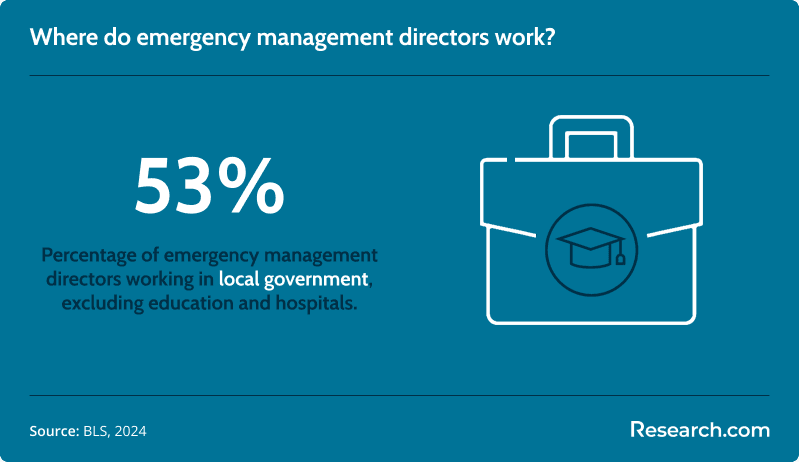
According to the 2024 data from the BLS, local government is the largest employer of emergency management directors, accounting for 53% of jobs. State government accounts for 16%. These positions often focus on emergency operations planning, disaster preparedness, interagency coordination, public warning systems, grant management, and community recovery.
Hospitals employ 5% of emergency management professionals. In healthcare, these workers may prepare emergency operations plans, coordinate drills, support patient safety during disasters, and help organizations meet federal preparedness requirements. Professional, scientific, and technical services employ 4% of workers in this occupation, often in consulting, risk analysis, security planning, or organizational resilience. Colleges and universities employ 2%, commonly in campus safety, emergency communications, and continuity planning.
| Work setting | Common responsibilities | Who it may suit |
| Local and state government | Community preparedness, emergency operations plans, public safety coordination | Students who want public service roles and agency-based work |
| Healthcare | Hospital emergency planning, compliance, mass casualty preparation, continuity plans | Students interested in patient safety and healthcare operations |
| Private industry | Business continuity, risk management, cyber incident planning, disaster recovery | Students who want corporate or consulting opportunities |
| Higher education | Campus emergency plans, drills, threat response, communication systems | Students interested in safety planning for colleges and universities |
| Nonprofits and relief organizations | Disaster recovery, community assistance, logistics, volunteer coordination | Students who want mission-driven recovery and response work |
How much can I make with an online emergency management degree?
Salary depends on job title, employer, experience, location, certifications, and whether the role is in the public or private sector. According to recent data, emergency management directors earn a median salary of $83,960 per year. These professionals typically lead emergency planning, coordinate response resources, supervise preparedness programs, and work with public officials, first responders, or organizational leaders.
Emergency management coordinators, who often support planning, training, exercises, and response logistics, earn around $61,574 annually. Entry-level roles such as emergency management specialist may start at about $32,000 annually, with pay increasing as workers gain experience, complete certifications, or move into supervisory positions.
Private-sector positions in risk management, business continuity, consulting, cybersecurity preparedness, or corporate emergency planning may offer higher salaries in some organizations, particularly when the role requires specialized technical knowledge or supports high-risk operations. However, salary outcomes are never guaranteed. Students should compare program cost with realistic job options in their region and preferred industry.
- Best Online Emergency Management Degree Programs for 2027
- How long does it take to complete an emergency management degree?
- How does an online emergency management degree program compare to an on-campus program?
- What is the average cost of an online emergency management degree?
- What are the financial aid options for students enrolling in an online emergency management program?
- What are the prerequisites for enrolling in an online emergency management degree program?
- Is accreditation a key factor in online emergency management degree programs?
- How do online emergency management degrees stand out compared to other advanced online degree programs?
- What courses are typically in an online emergency management degree program?
- What are the emerging trends in online emergency management degree programs?
- How can business skills enhance an emergency management career?
- What is the return on investment for an online emergency management degree?
- What types of specializations are available in an online emergency management degree program?
- How to choose the best online emergency management program?
- What career paths are available for graduates of an online emergency management degree program?
- What challenges might students face in online emergency management degree programs?
- How do online emergency management programs strengthen industry connections and career support?
- How can entrepreneurial skills enhance crisis management leadership?
- How can financial expertise impact crisis management outcomes?
- What is the job market for graduates with an online emergency management degree?
Best Online Emergency Management Degree Programs for 2027
How do we rank schools?
Research.com evaluates schools using data from established education sources, including the IPEDS database, Peterson’s database, the College Scorecard, and the National Center for Education Statistics. These sources help us compare institutions using measurable factors rather than promotional claims. To understand how Research.com evaluates colleges and programs, review our methodology page.
Rankings should be a starting point, not the only deciding factor. Before enrolling, compare accreditation, transfer credit rules, tuition, emergency management coursework, field experience options, faculty background, and career support. A highly ranked program may still be the wrong fit if it lacks the specialization, schedule, or support services you need.
Pennsylvania College of Technology
Pennsylvania College of Technology offers an online Emergency Management & Homeland Security degree for students interested in crisis planning across government, healthcare, nonprofit, and organizational settings. The curriculum develops skills in disaster response planning, emergency coordination, research, psychology, sociology, and applied problem-solving. Students complete practical assignments that help them connect leadership concepts with real emergency management challenges.
- Required Credits to Graduate: 120
- Cost: $608 per credit hour
- Accreditation: Middle States Commission on Higher Education (MSCHE)
Bethel University
Bethel University provides an Emergency Services Management degree designed for students preparing to supervise emergency response and public safety operations. Coursework includes natural disaster planning, homeland security law, risk analysis, strategic planning, and financial management for emergency organizations. The fully online format supports students who need schedule flexibility while building applied leadership skills.
- Required Credits to Graduate: 120
- Cost: $350 per credit hour
- Accreditation: Higher Learning Commission (HLC)
Columbia College
Columbia College offers a Bachelor of Arts in Disaster & Emergency Management that combines emergency management theory with practical planning and response skills. Students study crisis communication, community recovery, ethical leadership, disaster planning, and emergency response strategy. The program is designed to prepare graduates for work in homeland security, mitigation, emergency response, and disaster recovery.
- Required Credits to Graduate: 120
- Cost: $407 per credit hour
- Accreditation: Southern Association of Colleges and Schools Commission on Colleges (SACSCOC)
Jacksonville State University
Jacksonville State University offers an Emergency Management degree with a strong applied focus. Students complete 30 credit hours in emergency management coursework and may pursue options in Homeland Security or Public Safety Telecommunications. The interdisciplinary curriculum covers disaster response, crisis leadership, emergency policy, and public safety operations. As one of the first accredited programs in this field, Jacksonville State University gives students a structured foundation for emergency services careers.
- Required Credits to Graduate: 120
- Cost: $348 per credit hour
- Accreditation: SACSCOC
State University of New York (SUNY)
State University of New York Canton offers an online Emergency Management degree focused on preparedness, response, mitigation, and recovery for natural and human-caused disasters. Coursework includes mitigation planning, disaster recovery, and virtual incident command training. Students can complete research projects or internships with emergency response organizations, giving them opportunities to connect classroom learning with field practice.
- Required Credits to Graduate: 123
- Cost: $295 per credit hour for resident, $708 per credit hour for non-residents
- Accreditation: MSCHE
Saint Louis University
Saint Louis University takes a multidisciplinary approach to emergency management education. Students study crisis coordination, risk assessment, disaster recovery, and preparedness across the emergency management cycle. The curriculum follows Federal Emergency Management Agency (FEMA) guidelines, and faculty with professional experience help students understand how emergency management principles apply in real settings.
- Required Credits to Graduate: 120
- Cost: $650 per credit hour
- Accreditation: HLC
Bellevue University
Bellevue University offers an Emergency Management degree centered on preparedness, response, terrorism, risk assessment, and emergency planning. Students move through courses in a cohort model, which can help build peer relationships and professional connections. The curriculum balances academic foundations with practical problem-solving for students planning to work in crisis management or public safety leadership.
- Required Credits to Graduate: 123
- Cost: $449 per credit hour
- Accreditation: HLC
University of Alaska
The University of Alaska offers a Bachelor of Security and Emergency Management with online flexibility and several specialized tracks. Students may focus on cybersecurity, emergency medical management, homeland security, or law enforcement. The program emphasizes decision-making during crises and blends online coursework with applied training relevant to security and emergency management leadership.
- Required Credits to Graduate: 120
- Cost: $289 per credit hour for residents
- Accreditation: Northwest Commission on Colleges and Universities (NWCCU)
Saint Leo University
Saint Leo University provides an online Emergency Management degree for students interested in disaster planning, crisis leadership, and global threats. The program includes emergency response, disaster management, and planning coursework. Students may specialize in Fire Science, with classes related to fire prevention and risk reduction. The online format is built for flexibility, while faculty experience helps connect course material to public and private emergency management roles.
- Required Credits to Graduate: 120
- Cost: $13,940 per semester
- Accreditation: SACSCOC
Drury University
Drury University offers an Emergency Management degree that develops planning, coordination, legal, and leadership skills for crisis settings. Students study emergency response operations, disaster planning, and the legal dimensions of emergency management. Internships in public, private, or nonprofit settings provide applied experience, and the curriculum aligns with FEMA guidelines to support practical preparation.
- Required Credits to Graduate: 120
- Cost: $325 to $330 per credit hour
- Accreditation: HLC
How long does it take to complete an emergency management degree?
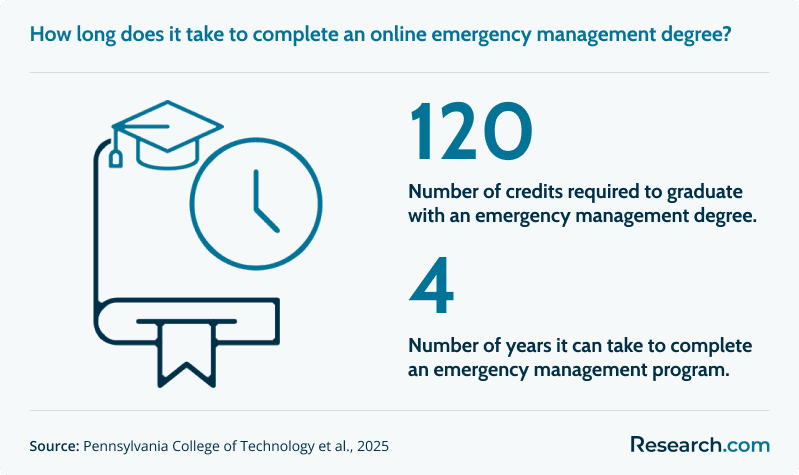
A traditional online bachelor’s degree in emergency management usually takes about four years of full-time study. Most programs require 120 credit hours, which students commonly complete by taking around 15 credits per semester across eight semesters.
Some schools offer accelerated formats that allow motivated students to finish sooner. Accelerated online bachelor degree programs may use shorter terms, year-round enrollment, or intensive course schedules, allowing completion in 2.5 to 3 years. Part-time students often take longer, especially if they enroll in only one or two courses per term, and may need five to six years to graduate.
Transfer credits can significantly change the timeline. Students with previous college coursework, military training, emergency services credentials, or relevant professional experience should ask each school how credits are evaluated. A generous transfer policy can reduce both time and cost, while a restrictive policy may require students to repeat courses they have already completed elsewhere.
| Enrollment path | Typical timeline | Best for |
| Full-time study | About four years | Students who can take a standard course load each semester |
| Accelerated study | 2.5 to 3 years | Students who can handle intensive courses or year-round enrollment |
| Part-time study | Five to six years | Working adults, first responders, caregivers, or military students |
| Transfer-friendly route | Varies by accepted credits | Students with prior college credits, training, or relevant experience |
How does an online emergency management degree program compare to an on-campus program?
Online and on-campus emergency management degrees often cover similar academic content, but the experience is different. The right choice depends on your schedule, preferred learning style, access to local fieldwork, and need for in-person networking.
| Factor | Online emergency management degree | On-campus emergency management degree |
| Schedule | Often offers asynchronous or flexible coursework | Usually follows fixed class meeting times |
| Learning environment | Uses online lectures, discussion boards, virtual simulations, and digital assignments | Uses in-person classes, campus labs, and face-to-face discussions |
| Hands-on experience | May include local internships, virtual exercises, or capstones | May offer more direct access to campus-based drills, labs, or agency visits |
| Networking | Requires proactive participation in virtual events, internships, and professional groups | Can make faculty, peer, and local agency connections easier |
| Cost considerations | May reduce commuting, housing, and relocation expenses | May include more campus-related costs, depending on the institution |
| Employer perception | Generally respected when the school is properly accredited and the curriculum is relevant | Generally respected when the school is properly accredited and the curriculum is relevant |
Online learning is often the better option for working adults, first responders, military students, and students who cannot relocate. Campus-based learning may be a better fit for students who want regular in-person interaction, local agency access, or a structured classroom routine. In both cases, accreditation, curriculum quality, and applied experience matter more than delivery format alone.
What is the average cost of an online emergency management degree?
The average cost of an online emergency management degree depends on whether the school is public or private, whether you qualify for in-state tuition, how many credits transfer, and whether the program charges online fees. Public universities charge about $9,750 annually for in-state students, while out-of-state students pay around $28,297. Private universities cost about $35,248 per year. Online students may save on housing, relocation, parking, and commuting, but they should still check technology fees, course fees, and residency rules.
Some of the cheapest online college options list tuition as low as $300 per credit hour, which can bring the total degree cost to around $36,000 for an entire four-year program. However, the final cost can change if you transfer credits, take extra courses, repeat classes, switch majors, or pay out-of-state tuition. Military benefits, employer tuition assistance, grants, and scholarships can reduce the out-of-pocket cost.
| Cost factor | What to check before enrolling |
| Tuition rate | Confirm whether the posted rate is per credit, per semester, in-state, out-of-state, or online-specific |
| Fees | Ask about technology, graduation, course, proctoring, and student service fees |
| Transfer credits | Request a formal transfer evaluation before committing to a program |
| Course load | Determine whether part-time enrollment changes aid eligibility or total completion time |
| Discounts | Ask about military, veteran, first responder, employer, or public service tuition discounts |
| Financial aid | Compare grants, scholarships, loans, and payment plans before using private loans |
The chart below lists the most common degree levels for emergency management coordinators, as reported by Zippia in 2025.
What are the financial aid options for students enrolling in an online emergency management program?
Online emergency management students may qualify for several types of financial aid. Eligibility depends on the school, enrollment status, citizenship or residency requirements, academic progress, and whether the program is offered by an accredited institution.
- Federal Student Aid (FAFSA): Students should complete the FAFSA to be considered for federal grants, loans, and work-study. Federal aid is often the first place to start because it may offer better protections than private loans.
- Scholarships: Emergency management, public safety, fire service, and homeland security organizations may offer awards. The International Association of Emergency Managers (IAEM) and the National Fire Protection Association (NFPA) are examples of organizations students may research.
- Employer tuition assistance: Government agencies, hospitals, emergency services departments, and private employers sometimes help employees pay for job-related education.
- Military and first responder discounts: Many colleges offer reduced tuition for active-duty service members, veterans, firefighters, paramedics, law enforcement personnel, and other public safety professionals. Students moving across healthcare and emergency response careers may also compare options such as a paramedic to RN bridge program online.
- State grants and tuition programs: Some states provide grants, waivers, or workforce-focused aid for students preparing for public safety, emergency response, or related careers.
How to reduce the cost of an online emergency management degree
- Complete the FAFSA before school and state deadlines.
- Ask for a written transfer credit evaluation from every school you are considering.
- Compare total program cost, not only the advertised tuition rate.
- Check whether your employer reimburses tuition for public safety, security, healthcare, or management-related coursework.
- Look for scholarships from emergency management, homeland security, fire service, and public administration organizations.
- Avoid borrowing more than needed for tuition, books, and required fees.
What are the prerequisites for enrolling in an online emergency management degree program?
Admission requirements vary by institution, but most bachelor’s programs in emergency management expect applicants to show readiness for college-level coursework. Transfer students may need to submit transcripts from every college previously attended.
- High School Diploma or GED: Most schools require proof of high school completion or an equivalent credential.
- Minimum GPA: Some programs use a minimum GPA, often around 2.5, although requirements differ by institution.
- Standardized Test Scores (Optional): Some colleges may request SAT or ACT scores, but many online programs have test-optional or test-waiver policies.
- Letters of Recommendation: Certain programs ask for recommendations from teachers, supervisors, public safety leaders, or community members.
- Personal Statement: Applicants may need to explain their interest in emergency management, public safety, homeland security, or disaster response.
- Prerequisite Courses: Some schools prefer or require prior coursework in public safety, government, management, writing, or social science.
Students with fire service, EMS, military, law enforcement, public health, or security experience should ask whether the program grants credit for training, certifications, or prior learning. Policies vary widely, and the answer can affect both cost and graduation timeline.
Is accreditation a key factor in online emergency management degree programs?
Yes. Accreditation is one of the most important factors to verify before enrolling in an online emergency management degree. Institutional accreditation indicates that a college has been reviewed for academic quality, faculty qualifications, student support, and operational standards. It can also affect credit transfer, graduate school admission, employer recognition, and access to federal financial aid.
Students should confirm accreditation directly through recognized sources rather than relying only on marketing language. For broader education comparisons and cost-focused graduate options in related management fields, students may also review the cheapest MBA online options, but emergency management students should first make sure their selected bachelor’s program has appropriate institutional accreditation.
| Accreditation question | Why it matters |
| Is the institution accredited by a recognized accreditor? | Helps protect credit transfer, financial aid eligibility, and employer acceptance |
| Does the program align with emergency management standards or FEMA-related frameworks? | Can strengthen the practical relevance of the curriculum |
| Will credits transfer to graduate programs? | Important for students considering future master’s or leadership training |
| Does the school publish student support and career services information? | Helps online learners evaluate whether they will receive meaningful guidance |
How do online emergency management degrees stand out compared to other advanced online degree programs?
Emergency management degrees are more specialized than broad business or management degrees. They focus on disaster preparedness, incident command, crisis communication, hazard mitigation, continuity planning, and recovery operations. Students often learn through scenarios, simulations, case studies, and planning exercises tied to real emergency management problems.
By contrast, programs such as MBA programs online usually emphasize finance, marketing, organizational strategy, operations, and executive decision-making. An MBA may be useful for students who want broader business mobility, while an emergency management degree is better aligned with public safety, homeland security, disaster planning, or resilience roles. Students who want to lead crisis operations in agencies or organizations may benefit from emergency management training first, then consider business or graduate leadership education later.
What courses are typically in an online emergency management degree program?
Online emergency management programs usually combine public safety, policy, leadership, communication, and risk management coursework. The goal is to prepare students to plan before disasters, coordinate during crises, and support recovery afterward.
- Introduction to Emergency Management: Explains the emergency management cycle, including preparedness, response, recovery, and mitigation.
- Risk Assessment and Mitigation: Teaches students to identify hazards, evaluate vulnerabilities, and recommend strategies that reduce risk before an event occurs.
- Incident Command Systems (ICS): Covers the structure used by many emergency response agencies to organize people, resources, and responsibilities during incidents.
- Public Health and Emergency Management: Examines the connection between disasters and healthcare systems, including pandemics, mass casualty events, and hospital preparedness. Students interested in healthcare leadership may also compare an accelerated healthcare management degree online.
- Homeland Security and Terrorism: Reviews security threats, terrorism, cyberattacks, infrastructure protection, and the role of public agencies in prevention and response.
- Crisis Communication: Develops skills for communicating with the public, media, agencies, and internal stakeholders during high-pressure events.
- Disaster Recovery: Focuses on restoring services, supporting communities, coordinating resources, and planning long-term recovery after a disaster.
- Emergency Planning and Exercises: Teaches students how to design plans, conduct drills, evaluate performance, and improve preparedness.
What are the emerging trends in online emergency management degree programs?
Online emergency management programs are increasingly emphasizing technology, data-informed planning, and interdisciplinary crisis leadership. Simulation tools, virtual tabletop exercises, real-time data analysis, and scenario-based learning help students practice decision-making without needing to be physically present on campus. These tools are especially useful for online learners who need applied training in a remote format.
Programs are also paying more attention to cybersecurity incidents, climate-related hazards, public health emergencies, infrastructure disruption, and organizational resilience. Many schools are blending emergency management with communication, public administration, healthcare, homeland security, and business continuity. Leadership development is also becoming more important, and some approaches overlap with advanced management training found in DBA online programs, especially when programs address strategy, organizational risk, and executive decision-making.
How can business skills enhance an emergency management career?
Business skills can make emergency management professionals more effective because crisis leadership often involves budgets, staffing, procurement, logistics, stakeholder management, and operational continuity. A professional who understands finance, project management, negotiation, and organizational strategy may be better prepared to coordinate resources under pressure.
Emergency management students do not always need a business degree, but they should understand how organizations function. Skills from accelerated online business degree programs can complement emergency management training by improving planning, resource allocation, communication with executives, and evaluation of continuity strategies.
What is the return on investment for an online emergency management degree?
The return on investment for an online emergency management degree depends on total cost, transfer credits, financial aid, career goals, and the jobs available in your region. Students should compare tuition and fees with realistic salary expectations, not the highest possible salary advertised by a school. The median salary for emergency management directors is $83,960 per year, but entry-level and coordinator roles may pay less.
Online formats can improve ROI when they allow students to keep working, avoid relocation, transfer credits, or finish faster. However, a low-cost program is not automatically the best choice if it lacks accreditation, career support, relevant coursework, or applied experience. Students comparing accelerated graduate business options, such as fast track MBA 6 months programs, should remember that emergency management degrees serve a different career purpose and should be evaluated against public safety and resilience career goals.
| ROI factor | Positive sign | Warning sign |
| Total cost | Clear tuition, fees, and transfer credit estimate | Unclear fees or no written transfer evaluation |
| Career alignment | Courses match your target role or specialization | Curriculum is too general for your goals |
| Flexibility | Format allows you to continue working | Schedule conflicts with job or family responsibilities |
| Applied learning | Capstone, internship, simulations, or agency partnerships | No practical planning or field-based assignments |
| Credential value | Accredited institution with relevant career support | Accreditation is unclear or difficult to verify |
What types of specializations are available in an online emergency management degree program?
Specializations help students tailor an emergency management degree toward a specific job market. The best concentration depends on whether you want to work in government, healthcare, homeland security, fire services, corporate risk, or environmental resilience.
- Disaster Response and Recovery: Focuses on coordinating relief, logistics, sheltering, damage assessment, and rebuilding after hurricanes, earthquakes, floods, and other disasters.
- Homeland Security: Examines terrorism, cyber threats, border security, infrastructure protection, and national preparedness. Graduates may pursue roles with agencies connected to FEMA or the Department of Homeland Security.
- Public Health Emergency Management: Prepares students for emergencies involving hospitals, pandemics, bioterrorism, mass casualty events, and public health coordination.
- Business Continuity and Risk Management: Teaches organizations how to maintain operations, protect assets, reduce downtime, and recover after disruption.
- Fire Science and Emergency Services: Supports firefighters and emergency responders who want to move into planning, prevention, supervision, or emergency services leadership.
- Environmental Hazards and Climate Resilience: Focuses on wildfires, industrial accidents, climate-related hazards, and long-term community risk reduction.
| Specialization | Best fit for students interested in |
| Disaster Response and Recovery | Relief operations, logistics, community rebuilding, and nonprofit response |
| Homeland Security | Security threats, terrorism, cyber incidents, and federal or state agencies |
| Public Health Emergency Management | Hospitals, pandemics, patient safety, and healthcare preparedness |
| Business Continuity and Risk Management | Corporate resilience, insurance, consulting, technology, and operational continuity |
| Fire Science and Emergency Services | Fire departments, EMS, rescue operations, prevention, and command roles |
| Environmental Hazards and Climate Resilience | Wildfires, floods, climate adaptation, industrial risk, and community mitigation |
The chart below lists the top-paying industries for emergency management directors, as reported by the BLS in 2024.
How to choose the best online emergency management program?
The best online emergency management program is the one that is accredited, affordable for your situation, aligned with your career goal, and realistic for your schedule. Do not choose based only on ranking position or the lowest advertised tuition. Instead, compare the details that will affect your learning, cost, and employability.
- Accreditation: Verify that the institution is accredited by a recognized agency. The Council for Higher Education Accreditation (CHEA) search tool can help students review institutional accreditation information.
- Curriculum and Specializations: Look for courses in incident command, disaster planning, risk assessment, crisis communication, mitigation, and recovery. Choose a specialization that matches your target role.
- Flexibility and Format: Determine whether courses are asynchronous, synchronous, accelerated, cohort-based, or self-paced. The format should fit your work schedule and learning preferences.
- Cost and Financial Aid: Compare tuition, fees, transfer credits, scholarships, grants, military benefits, and employer assistance. Calculate total estimated cost before enrolling.
- Internship or Field Experience: Prioritize programs with capstones, simulations, practicums, internships, or partnerships with agencies, hospitals, emergency services, or employers.
- Career Support: Ask about résumé help, job boards, alumni networks, virtual career fairs, internship placement, and employer partnerships.
- Faculty Experience: Review whether instructors have backgrounds in emergency management, homeland security, public safety, healthcare preparedness, or crisis leadership.
Questions to ask before enrolling
- Is the institution properly accredited, and how can I verify it?
- How many of my prior credits will transfer into the program?
- Are courses fully online, or are there required campus visits?
- Does the program include simulations, capstones, internships, or fieldwork?
- Which specializations are available, and which careers do they support?
- What is the full cost after tuition, fees, books, and technology charges?
- Does the school offer military, veteran, first responder, or employer tuition discounts?
- What career services are available specifically for online students?
- Can graduates pursue certifications or graduate study after completing the degree?
- What agencies, hospitals, nonprofits, or companies does the program work with?
What career paths are available for graduates of an online emergency management degree program?
An online emergency management degree can lead to several career paths, but job titles and requirements vary by employer. Some roles require prior experience in public safety, military service, healthcare, security, planning, or administration. Students should review job postings in their target region before choosing a specialization.
- Emergency Management Director: Oversees disaster planning, coordinates emergency response resources, works with public officials and first responders, and leads preparedness programs for agencies or organizations.
- Disaster Recovery Specialist: Supports communities, businesses, nonprofits, or agencies after disasters by coordinating recovery resources, documentation, assistance programs, and rebuilding efforts.
- Hospital Emergency Preparedness Coordinator: Helps hospitals and clinics prepare for pandemics, natural disasters, mass casualty events, utility failures, and regulatory preparedness requirements. Some employers may value medical certifications such as Basic Life Support (BLS) or Certified Emergency Manager (CEM), depending on the role.
- Homeland Security Specialist: Works on threats related to terrorism, cyber incidents, transportation security, border security, or critical infrastructure in public agencies or private security organizations.
- Fire or Police Department Emergency Planner: Develops response plans for fires, active shooter events, hazardous materials incidents, severe weather, and other public safety threats.
- Business Continuity Manager: Helps companies reduce downtime, protect operations, manage crisis communications, and recover from cyberattacks, natural disasters, or supply chain disruptions.
| Career path | Typical employers | Helpful preparation |
| Emergency Management Director | Local government, state government, agencies, large organizations | Leadership experience, planning skills, incident command knowledge |
| Disaster Recovery Specialist | FEMA-related organizations, nonprofits, insurance, consulting | Recovery planning, documentation, logistics, community coordination |
| Hospital Emergency Preparedness Coordinator | Hospitals, clinics, health systems | Public health emergency management, compliance, healthcare operations |
| Homeland Security Specialist | DHS-related agencies, TSA, security firms, infrastructure organizations | Security policy, cyber threat awareness, risk assessment |
| Fire or Police Department Emergency Planner | Fire departments, police departments, public safety agencies | First responder knowledge, emergency exercises, hazard planning |
| Business Continuity Manager | Corporations, finance, technology, utilities, consulting | Risk management, continuity planning, communication, operations |
What challenges might students face in online emergency management degree programs?
Online emergency management degrees can be flexible, but they are not effortless. Students may need to manage demanding reading and writing assignments, group projects across time zones, virtual simulations, and deadlines while working full time or serving in public safety roles. Because emergency management is collaborative by nature, online students must be intentional about building relationships with faculty, classmates, and professionals.
Common challenges include limited face-to-face networking, uneven access to local internships, technology issues during simulations, and difficulty staying motivated in self-paced courses. Students can reduce these problems by attending virtual office hours, joining professional associations, participating in discussion boards, asking about local field placement support, and setting a weekly study schedule. Those seeking broader leadership training may also compare the fastest MBA program online, but emergency management students should prioritize applied crisis planning experience.
| Common mistake | Better approach |
| Choosing a school without verifying accreditation | Confirm institutional accreditation before applying or paying deposits |
| Looking only at tuition | Compare full cost, fees, transfer credits, aid, and completion time |
| Assuming online means easier | Plan for weekly deadlines, projects, simulations, and significant writing |
| Ignoring field experience | Choose a program with internships, capstones, exercises, or agency partnerships |
| Relying only on rankings | Use rankings as one input and evaluate fit, cost, curriculum, and support |
| Assuming salary outcomes are guaranteed | Research local job postings, experience requirements, and typical entry-level roles |
How do online emergency management programs strengthen industry connections and career support?
Strong online emergency management programs help students build professional connections even without a traditional campus experience. They may offer virtual career fairs, alumni networks, guest speakers, mentorship, internship referrals, agency partnerships, and applied projects tied to real emergency planning needs. These supports can be especially valuable for students who are changing careers and do not yet have public safety experience.
Students should ask whether career services are available to online learners, not just campus students. They should also ask whether the program has relationships with emergency management agencies, hospitals, fire departments, nonprofits, security organizations, or private-sector continuity teams. For students interested in executive-level leadership development, cheap online EMBA programs may provide a useful comparison point, but they do not replace emergency management-specific field connections.
How can entrepreneurial skills enhance crisis management leadership?
Entrepreneurial thinking can strengthen crisis leadership because emergencies often require creative problem-solving, rapid prioritization, and the ability to act when resources are limited. Emergency managers may need to redesign processes, coordinate unconventional partnerships, locate supplies, use data quickly, and adapt plans when conditions change.
Students who develop entrepreneurial skills may be better prepared to lead resilience projects, launch consulting services, improve community preparedness programs, or create new approaches to continuity planning. Those exploring business creation or innovation-focused careers can also read What jobs can you get if you study entrepreneurship? to compare how entrepreneurship training supports different career paths.
How can financial expertise impact crisis management outcomes?
Financial knowledge matters in emergency management because disaster readiness depends on budgets, grants, procurement, staffing, contracts, insurance, and long-term recovery funding. A strong plan may fail if an organization cannot pay for equipment, training, backup systems, communication tools, or recovery operations.
Emergency management professionals who understand budgeting and financial risk can make stronger arguments for preparedness investments, manage limited resources during response, and support continuity planning after a disruption. Students who want deeper finance preparation may compare the fastest finance online programs as a complement to emergency management training.
What is the job market for graduates with an online emergency management degree?
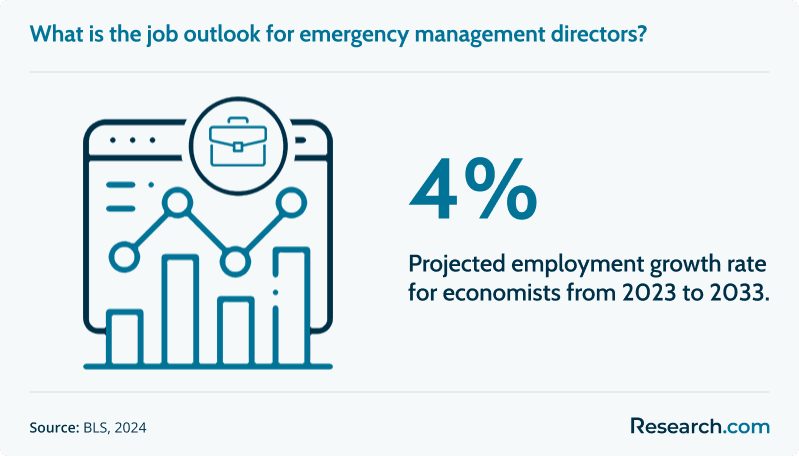
The job market for emergency management graduates is steady rather than explosive. Emergency management directors are projected to see a 4% growth rate from 2023 to 2033, which matches the average for all occupations. Roughly 1,000 job openings appear annually, largely because of retirements and worker turnover.
Protective service occupations overall may grow more slowly, but over 419,000 openings per year still exist in roles related to emergency response. Demand is influenced by natural disasters, public health emergencies, cybersecurity threats, infrastructure risk, and the need for organizations to maintain operations during disruption. Graduates with practical experience, strong communication skills, incident command knowledge, and a relevant specialization may be more competitive.
State and local governments remain the primary employers, but hospitals, corporations, universities, nonprofits, consulting firms, and security organizations also need professionals who can plan for crises and coordinate recovery. Students should expect entry-level competition in some markets and should use internships, volunteer work, certifications, and professional networking to strengthen their résumés before graduation.
Key Insights
- An online emergency management degree is best suited for students who want practical training in disaster planning, crisis coordination, public safety, homeland security, healthcare preparedness, or business continuity.
- Accreditation should be verified before anything else. It affects financial aid, credit transfer, employer recognition, and future graduate study options.
- Most bachelor’s programs require 120 credit hours and take about four years full time, but accelerated formats, part-time study, and transfer credits can change the timeline.
- Cost varies widely. Public universities charge about $9,750 annually for in-state students, out-of-state students pay around $28,297, and private universities cost about $35,248 per year.
- Emergency management directors earn a median salary of $83,960 per year, but students should plan for realistic entry-level roles and should not assume that a degree alone guarantees a specific salary.
- The strongest programs include applied projects, simulations, incident command training, internships, capstones, or agency partnerships—not only online lectures.
- Specializations matter. Homeland security, public health emergency management, fire science, business continuity, and environmental hazards can lead to different employers and responsibilities.
- Online programs can be excellent for working adults and first responders, but students must be proactive about networking, field experience, and career support.
- Use rankings as a starting point, then compare curriculum, total cost, transfer credits, faculty experience, flexibility, and graduate support before choosing a school.
References:
- Bureau of Labor Statistics (BLS). (2024a). Emergency Management Directors. Occupational Outlook Handbook. BLS.
- Bureau of Labor Statistics (BLS). (2024b). Protective Service Occupations. Occupational Outlook Handbook. BLS.
- National Center for Education Statistics (NCES). (2024). Average undergraduate tuition, fees, room, and board charges for full-time students in degree-granting postsecondary institutions, by control and level of institution and state: Academic years 2021-22 and 2022-23. Digest of Education Statistics. NCES.
- Salas, E. (2025). Number of deaths from natural disaster events worldwide from 2000 to 2024. Climate & Weather. Statista.
- Zippia. (2025a). Emergency Management Coordinator Education Requirements. Zippia.
- Zippia. (2025b). Emergency Management Specialist Salary. Zippia.
Other Things You Should Know About Online Emergency Management Degree Programs
Applicants typically need a high school diploma or GED for undergraduate programs in 2027. Some programs might require background coursework in public safety or related fields, while graduate programs often demand a bachelor's degree and relevant professional experience.
In 2027, consider program accreditation, faculty expertise, curriculum relevance to current industry practices, internship opportunities, and alumni success. A strong program will balance theoretical knowledge and practical skills, ensuring that graduates are well-prepared for the demands of the field.
In 2027, leading online emergency management degree programs can be found at universities like the University of Florida, Arkansas State University, and Columbia Southern University. These programs offer comprehensive curricula tailored to equip students with the necessary skills for effective disaster management and recovery.


