
2027 Most Affordable Online Physics Degree Programs

Co-Founder and Chief Data Scientist
An online physics degree can be a practical route into research, engineering-adjacent roles, data analysis, education, radiation safety, and graduate study—but it is not the right choice for every student. Physics is math-intensive, lab-based, and demanding even when the coursework is delivered online. Before enrolling, you need to know whether the program has credible accreditation, how labs are handled remotely, what the total cost will be, and whether the degree supports your target career or graduate-school plan.
This guide is designed for students comparing online physics degree programs, working adults who need scheduling flexibility, military learners using education benefits, and STEM students deciding whether physics offers a strong return on investment. You will learn what online physics programs include, how long they take, how online labs work, what careers may be available, which costs to compare, and how to choose a program without relying only on rankings.
Quick answer: Is an online physics degree worth considering?
An online physics degree can be worth considering if you need flexibility and want a broad STEM foundation in mathematics, experimentation, modeling, and analytical problem-solving. It is best suited for students who are comfortable learning independently, can handle advanced math, and have a clear plan for using the degree in teaching, data analysis, engineering support, radiation health physics, graduate study, or research preparation.
The strongest online physics programs are accredited, transparent about lab requirements, realistic about career outcomes, and clear about whether the degree is fully online or only partially online. Students who want intensive in-person laboratory research, direct faculty mentorship, or a traditional campus science experience may prefer an on-campus program.
| Decision factor | What to look for | Why it matters |
| Accreditation | Institutional accreditation from a recognized accreditor | Accreditation affects credit transfer, graduate-school eligibility, employer recognition, and federal financial aid access. |
| Lab delivery | At-home kits, virtual labs, simulations, remote experiments, or required campus sessions | Physics is experimental; weak lab design can limit preparation for research and technical work. |
| Curriculum depth | Calculus, differential equations, electromagnetism, quantum mechanics, thermodynamics, and lab methods | A credible physics degree should build both mathematical and experimental competence. |
| Career alignment | Tracks in physics education, radiation protection, applied physics, computational physics, or related areas | The best program depends on whether you want teaching licensure, graduate study, technical employment, or a specialized physics career. |
| Total cost | Tuition, fees, lab kits, software, books, residency requirements, and time to completion | The cheapest tuition rate is not always the lowest total cost. |
What can I expect from an online physics degree?
An online physics degree covers the same central ideas that define physics study: motion, forces, energy, electricity, magnetism, heat, waves, quantum behavior, and the mathematical laws used to describe physical systems. Students should expect a curriculum that combines physics lectures, intensive mathematics, laboratory assignments, computational tools, and problem sets that require careful quantitative reasoning.
Because physics depends heavily on experimentation, the quality of the online lab model is one of the most important differences between programs. Some schools use mailed lab kits, remote instrumentation, simulation platforms, or project-based data analysis. Others may offer online lecture courses but require certain lab experiences on campus. Before enrolling, confirm exactly how upper-level labs are completed and whether the format supports your career goals.
Online physics programs can be flexible, but they are rarely easy. Students often need to watch lectures, complete weekly calculations, participate in discussion boards, submit lab reports, use specialized software, and prepare for proctored exams. The format can work well for organized learners, but students who need constant in-person structure should evaluate whether online science study fits their learning style.
Where can I work with an online physics degree?
A physics degree can lead to work in education, technology, healthcare, energy, aerospace, defense, manufacturing, government agencies, research support, and data-focused roles. The exact job options depend on degree level, specialization, technical skills, and whether the graduate has additional credentials such as teacher licensure, engineering experience, programming ability, or graduate training.
At the bachelor’s level, many graduates pursue roles that use physics-adjacent skills rather than the title “physicist.” Examples include data analyst, laboratory technician, technical specialist, high school physics teacher with proper licensure, quality-control analyst, research assistant, or engineering support role. Advanced research roles in physics usually require graduate study.
Students interested in radiation safety, nuclear energy, healthcare physics, or national defense should look closely at radiation health physics and radiation protection programs. Students interested in artificial intelligence, modeling, analytics, or software-heavy scientific work should prioritize computational physics, programming, statistics, and data analysis electives.
How much can I make with an online degree in physics?
Earnings depend on the job title, employer, location, experience level, education level, and technical skills attached to the degree. Entry-level roles such as lab technicians or high school teachers typically fall between $50,000 and $65,000 annually, while roles such as data analyst, engineer, or health physicist can range from $70,000 to $100,000 or more. Graduates who complete advanced study and enter physicist or research roles can earn well over $150,000 per year.
The highest salary figure in this guide is for physicists, with a reported salary of $166,290. However, students should not assume that a bachelor’s degree alone leads directly to physicist-level pay. Many physicist and astronomer positions require a master’s degree or doctorate, especially in research-intensive settings.
- Best online physics degree programs for 2027
- How long does an online physics degree take?
- Online physics degree vs. on-campus physics degree
- Average cost of an online physics degree
- Financial aid for online physics students
- Admission requirements and prerequisites
- Common online physics courses
- Online physics degree specializations
- Challenges of earning physics online
- How technology courses can strengthen a physics degree
- Is an online physics degree a good investment?
- Certificates that can improve career options
- How to choose the right online physics program
- Job market for online physics graduates
List of the Best Physics Degree Programs for 2027
The programs below can help students compare different online and partially online physics-related options, including bachelor’s programs, applied physics master’s degrees, radiation health physics programs, and physics education pathways. Use this list as a starting point, not as the only basis for your decision. A program that is excellent for future teachers may not be the best fit for a student planning to pursue a PhD in theoretical physics, and a radiation health physics program may be more specialized than a general physics degree.
How do we rank schools?
Research.com evaluates schools using our methodology and reviews institutional data to help readers compare programs more efficiently. For school-ranking and program-information research, we reference established education databases and public sources, including:
- IPEDS database
- Peterson's database, including the Distance Learning Licensed Data Set
- College Scorecard database
- National Center for Education Statistics
Rankings should be read alongside your own priorities: accreditation, lab format, total cost, transfer-credit policy, career services, graduate-school preparation, and whether the program meets licensing requirements if you plan to teach.
| Program | Best fit | Key cost figure | Accreditation listed |
| Arizona State University Bachelor of Science in Physics | Students seeking a fully online physics bachelor’s degree with advanced online lab coursework | $692 per credit | Higher Learning Commission (HLC) |
| Liberty University Bachelor of Science in Physics | Students wanting a fully online BS with virtual labs, at-home lab kits, and MATLAB experience | $390 (full-time), $455 (part-time), and $250 (with military discount) | Southern Association of Colleges and Schools Commission on Colleges (SACSCOC) |
| Johns Hopkins University Master of Science in Applied Physics | Working professionals seeking part-time graduate study in applied physics | $5,455 for three credits | Middle States Commission on Higher Education (MSCHE) |
| Oregon State University Master of Radiation Health Physics | Professionals focused on radiation protection and health physics | $726 | Northwest Commission on Colleges and Universities |
| Western Governors University Bachelor of Science in Science Education (Secondary Physics) | Future high school physics teachers who need a licensure-oriented pathway | $3,825 (per six months) | Northwest Commission on Colleges and Universities (NWCCU) |
1. Arizona State University Bachelor of Science in Physics
Arizona State University offers a fully online Bachelor of Science in Physics for students who want preparation for research, teaching-related pathways, graduate study, or technical STEM roles. The program is built around a strong mathematics foundation and broad physics training across major areas of the field. A notable feature is ASU’s online delivery of advanced laboratory coursework, which uses at-home electronic kits and online simulations so students can practice experimental analysis, equipment alignment, and data interpretation outside a traditional campus lab.
- Program Length: Four years
- Tracks/concentrations: N/A
- Cost per Credit/Tuition: $692 per credit
- Accreditation: Higher Learning Commission (HLC)
2. Liberty University Bachelor of Science in Physics
Liberty University provides a fully online Bachelor of Science in Physics that emphasizes core physics concepts such as mechanics, electromagnetism, thermodynamics, and quantum mechanics. The program is designed to strengthen logical reasoning, quantitative analysis, and problem-solving skills that can apply to fields such as mechanical engineering, research support, and data analysis. Students complete virtual lab activities using at-home lab kits and MATLAB software, giving the online curriculum a practical component beyond lectures and readings.
- Program Length: Four years
- Tracks/concentrations: N/A
- Cost per Credit/Tuition: $390 (full-time), $455 (part-time), and $250 (with military discount).
- Accreditation: Southern Association of Colleges and Schools Commission on Colleges (SACSCOC)
3. Johns Hopkins University Master of Science in Applied Physics
Johns Hopkins University offers a part-time, online Master of Science in Applied Physics through its Engineering for Professionals (EP) program. The program is intended for working professionals who want deeper applied physics training without stepping away from full-time employment. Coursework covers areas such as optics, quantum mechanics, solid-state physics, and ocean science. Students learn from faculty and practitioners connected to organizations such as the Johns Hopkins Applied Physics Laboratory, NASA, and the Naval Research Laboratory.
- Program Length: Self-paced up to five years
- Tracks/concentrations: Photonics and materials, and condensed matter
- Cost per Credit/Tuition: $5,455 for three credits
- Accreditation: Middle States Commission on Higher Education (MSCHE)
4. Oregon State University Master of Radiation Health Physics
Oregon State University offers an online Master of Radiation Health Physics (MHP) through Ecampus for students and professionals interested in radiation protection. The non-thesis curriculum focuses on the safe use and management of radiation in fields such as energy, healthcare, national defense, and research. Students study the intersection of physics, biology, and engineering so they can understand ionizing radiation, radioactive materials, measurement practices, and safety standards.
- Program Length: Two to three years
- Tracks/concentrations: Radiation health
- Cost per Credit/Tuition: $726
- Accreditation: Northwest Commission on Colleges and Universities
5. Western Governors University Bachelor of Science in Science Education (Secondary Physics)
Western Governors University (WGU) offers an online Bachelor of Science in Science Education (Secondary Physics) for students pursuing high school physics teaching licensure. The program uses a competency-based model, which allows students to move through material as they demonstrate mastery. The curriculum includes 40 courses in areas such as mechanics, waves and optics, space, time and motion, conceptual physics, and educational psychology. Because the program is built for teacher preparation, it also includes in-classroom observation and a full-time student-teaching term.
- Program Length: Three to four years
- Tracks/concentrations: N/A
- Cost per Credit/Tuition: $3,825 (per six months)
- Accreditation: Northwest Commission on Colleges and Universities (NWCCU)
6. Oneida University Bachelor of Science in Physics
Oneida University offers an online Bachelor of Science in Physics for independent learners seeking a flexible science degree. The curriculum introduces classical mechanics, electromagnetism, thermodynamics, quantum mechanics, mathematical methods, and computer-based modeling. Students may complete learning activities through simulations, data analysis, and possible hybrid lab formats or mailed lab kits. The program emphasizes analytical thinking and technical problem-solving for students interested in engineering-related work, education, data science, or consulting.
- Program Length: Self-paced
- Tracks/concentrations: N/A
- Cost per Credit/Tuition: $13,312 per year
- Accreditation: Accrediting Committee of International Universities (ACICU)
7. Michigan Technological University Bachelor of Science in Physics
Michigan Technological University offers a Bachelor of Science in Physics with rigorous coursework and research-oriented learning. Students study areas such as classical mechanics, electromagnetism, quantum mechanics, and thermodynamics while preparing for STEM careers or future graduate education. The program is primarily campus-based, but some courses are available online, which may help students who need limited flexibility. Students can also pursue research experiences with faculty, an important consideration for those considering graduate school.
- Program Length: Four years
- Tracks/concentrations: Astrophysics, atmospheric physics, computational physics, and experimental physics.
- Cost per Credit/Tuition: $18,796 per year (in-state), $42,662 per year (out-of-state).
- Accreditation: HLC
8. Stony Brook University Physics Online Program
Stony Brook University offers online introductory physics coursework through its Physics Online program. The main lecture sequence includes PHY 131 (Classical Physics I) and PHY 132 (Classical Physics II), which cover mechanics, wave motion, electromagnetism, and optics. Corresponding online lab courses, PHY 133 and PHY 134, are also available. Lectures and recitations are delivered through recordings of live classes, allowing students to review material on their own schedule. During the fall and spring semesters, courses are available to admitted Stony Brook students, while summer session offerings are open to all students, including visiting and transfer students.
- Program Length: Four years
- Tracks/concentrations: N/A
- Cost per Credit/Tuition: $295 per credit
- Accreditation: Middle States Commission on Higher Education (MSCHE)
9. Thomas Edison State University Bachelor of Science (B.S.) in Radiation Protection/Health Physics
Thomas Edison State University (TESU) offers an online Bachelor of Science (B.S.) in Radiation Protection/Health Physics for students preparing for radiation safety roles in nuclear energy, healthcare, research, and related sectors. The 120-credit curriculum includes radiation protection fundamentals, personnel dosimetry, shielding and activation, measurement and instrumentation, and biological effects of radiation. Students also complete supporting coursework in computer concepts, statistics, college algebra, higher-level mathematics, physics, chemistry, and biology.
- Program Length: Four years
- Tracks/concentrations: Radiation protection and health physics
- Cost per Credit/Tuition: $427 per credit (in-state), $556 per credit (out-of-state).
- Accreditation: Middle States Commission on Higher Education (MSCHE)
10. Maharishi International University Master of Science in Physics
Maharishi International University offers a graduate physics program with coursework in theoretical and experimental physics. Students examine quantum mechanics, quantum field theory, string theory, general relativity, and cosmology, including topics such as black holes, dark matter, and dark energy.
The program also incorporates consciousness studies into its physics framework. This includes discussion of quantum nonlocality, entanglement, and quantum measurement through a consciousness-based perspective.
- Program Length: Four years
- Tracks/concentrations: N/A
- Cost per Credit/Tuition: $9,790 per year
- Accreditation: Higher Learning Commission
How long does it take to complete an online physics degree program?
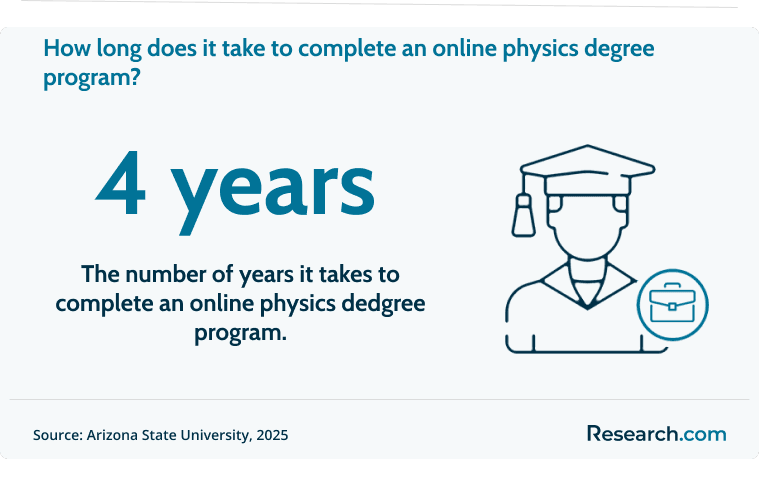
A typical online bachelor’s degree in physics requires 120 credit hours. Full-time students usually complete that amount of coursework in about four years, which is the standard timeline for a Bachelor of Science (BS) degree at many U.S. institutions. Part-time students commonly need five to six years, depending on how many courses they take each term and whether they pause enrollment.
Some programs provide faster routes through year-round enrollment, shorter academic terms, transfer credits, or credit for prior learning and professional experience. These options can reduce time to graduation for students who enter with previous college credits or who can sustain a heavier course load. However, physics courses often build sequentially, so students should be cautious about accelerating too aggressively through calculus, laboratory methods, and upper-division theory courses.
| Enrollment path | Typical timeline | Best for | Risk to consider |
| Full-time bachelor’s student | Four years | Students who can prioritize school and complete a standard 120-credit plan | Heavy math and lab workload can be difficult alongside full-time work. |
| Part-time bachelor’s student | Five to six years | Working adults, caregivers, and students who need a slower pace | Longer enrollment can increase total cost and delay career transition. |
| Accelerated or transfer student | Varies by accepted credits and course availability | Students with prior college credit or strong academic preparation | Physics course sequences may limit how quickly upper-level courses can be completed. |
| Online master’s student | Two to three years or self-paced up to five years, depending on the program | Professionals pursuing applied physics or radiation health physics while working | Advanced coursework may require strong prior preparation in math and physics. |
How does an online physics degree program compare to an on-campus program?
Online and campus-based physics programs may cover similar academic material, but the learning experience can differ substantially. The biggest differences involve laboratory access, faculty interaction, peer collaboration, scheduling structure, and the amount of self-direction required.
| Category | Online physics degree | On-campus physics degree | How to decide |
| Flexibility | Often offers asynchronous lectures, remote assignments, and scheduling options for working students | Usually follows fixed class, lab, and campus schedules | Choose online if schedule control is essential; choose campus if structure helps you stay engaged. |
| Labs | May use virtual labs, at-home kits, simulations, or remote experiments | Provides direct access to lab equipment, faculty supervision, and research spaces | Ask whether online labs meet your goals for graduate school, technical work, or research preparation. |
| Faculty access | Usually through email, video meetings, discussion boards, and digital office hours | Includes in-person office hours, informal conversations, and campus events | Students who need close mentorship may prefer programs with strong advising and research access. |
| Peer interaction | Often occurs through forums, group projects, and virtual study sessions | Includes classroom discussion, lab groups, clubs, and campus study networks | Online students should intentionally build study groups and professional networks. |
| Cost | May reduce commuting, relocation, and housing expenses | May involve additional campus living and transportation costs | Compare total cost, not only tuition. |
The online learning model is also common in other disciplines, including online MLIS programs, where students rely on digital coursework, remote collaboration, and structured advising. Physics students, however, should pay extra attention to lab design because hands-on experimentation is more central to the discipline.
What is the average cost of an online physics degree program?
San Francisco Physisc Degree College Degree ROI Calculator
Average age when ROI becomes positive
0
Total cost of attendance:
$0
Median alumni salary:
$0
ROI after 5 Years:
$0
ROI after 10 Years:
$0
Lifetime ROI:
$0
The cost of an online physics degree depends on tuition structure, enrollment pace, residency status, military discounts, transfer credits, technology fees, lab-kit costs, books, and whether the program is undergraduate or graduate level. Students should calculate the full cost of attendance rather than comparing only the advertised per-credit tuition.
Based on the cost examples provided, online undergraduate physics costs can differ by enrollment type and discount eligibility:
| Cost scenario | Estimated total or listed cost | What it means for planning |
| Full-time | $46,800 | This reflects an average total cost for full-time students completing a standard online undergraduate physics pathway over four years. |
| Part-time | $54,600 | A longer completion timeline can increase total cost, especially when tuition is charged by credit and fees repeat across terms. |
| With military discount | $30,000 | Military tuition rates can significantly reduce the cost for eligible active-duty service members, veterans, and related learners. |
| Master’s with specialization | $32,670 | Graduate programs may charge more per credit but often require fewer credits than a bachelor’s degree, commonly 30–45. |
Students comparing price across fields may find it useful to review how other online programs structure tuition and acceleration. For example, some healthcare-focused pathways, such as the shortest PMHNP program options, illustrate how accelerated schedules can affect both timeline and cost. Budget-conscious students may also compare tuition models in unrelated liberal arts programs, such as the most affordable online philosophy degree programs, to understand how credit-hour pricing and institutional fees differ across online degrees.
When estimating affordability, include these items in your calculation:
- Tuition: Confirm whether tuition is charged per credit, per term, per six months, or per academic year.
- Fees: Online programs may still charge technology, registration, proctoring, graduation, or student-service fees.
- Lab expenses: At-home lab kits, software, calculators, or equipment may add cost.
- Transfer credits: Accepted credits can reduce both time and tuition.
- Residency or campus requirements: Any required travel can change the real cost of an online program.
- Opportunity cost: Consider whether the program allows you to keep working while studying.
The chart below shows how the cost examples vary by enrollment type and eligibility for discounts, which can help you compare whether a full-time, part-time, military-discounted, or specialized graduate route is financially realistic.
What are the financial aid options for students enrolling in an online physics degree program?
Online physics students may qualify for many of the same financial aid options available to campus-based students, as long as the institution and program meet aid eligibility requirements. The most important first step is verifying accreditation and confirming that the school participates in federal student aid programs.
- Federal Financial Aid: Students can complete the Free Application for Federal Student Aid (FAFSA) to determine eligibility for federal grants, loans, and work-study programs. Aid eligibility depends on factors such as school participation, enrollment status, financial need, and program type.
- State Aid Programs: Some states provide grants, scholarships, or tuition assistance for eligible residents. Online students should check whether attending an out-of-state online program affects state aid eligibility.
- Scholarships: Physics and STEM students may find scholarships through colleges, science organizations, private foundations, professional associations, and local community groups.
- Employer Tuition Assistance: Working adults should ask whether their employer offers tuition reimbursement or education benefits for degrees related to data, engineering, energy, healthcare, research, or technology.
- Military and Veteran Benefits: Eligible military-affiliated students may use benefits such as the GI Bill, Tuition Assistance (TA), or the Yellow Ribbon Program to reduce education expenses.
Students in shorter workforce-focused programs, including the cheapest online sterile processing technician certificate programs, often compare federal aid, institutional discounts, and employer support before enrolling. Physics students should do the same, but they should also account for higher-level math prerequisites, lab costs, and the possibility of graduate study.
What are the prerequisites for enrolling in an online physics degree program?
Admission requirements vary by school and degree level, but online physics applicants should expect both academic and technical expectations. A strong background in mathematics is especially important because physics courses quickly move into calculus-based problem-solving.
- High school diploma or equivalent: Undergraduate applicants generally need a high school diploma or GED before beginning college-level physics coursework.
- Strong math and science background: Students benefit from prior coursework in algebra, geometry, trigonometry, and ideally calculus, along with physics and chemistry. Similar preparation matters in other science careers as well, including pathways tied to environmental scientist education requirements.
- Minimum GPA requirements: Many programs look for a cumulative GPA of at least 2.5 to 3.0, though competitive programs may prefer stronger academic records.
- Standardized test scores, if required: Some institutions remain test-optional, while others may request SAT or ACT scores to evaluate college readiness, particularly in math-heavy programs.
- English language proficiency for non-native speakers: Applicants whose first language is not English may need TOEFL or IELTS scores to show they can complete technical reading, written lab reports, exams, and class discussions. Communication is also important in education-focused roles, including careers connected to physical education teacher responsibilities.
- Technology access: Students need a reliable computer, high-speed internet, and the ability to use learning platforms, online labs, video tools, file submissions, and possibly specialized software.
Graduate physics and applied physics programs usually expect prior college coursework in physics, calculus, differential equations, and related mathematics. Admissions standards can vary widely by field; for comparison, professional graduate pathways such as those discussed in SLP grad school acceptance rate research show why students should examine each program’s prerequisites rather than assuming requirements are interchangeable.
What courses are typically in an online physics degree program?
An online physics curriculum usually combines introductory physics, advanced theory, laboratory methods, mathematics, and computational tools. The exact course sequence depends on the institution, but students should expect a structured progression from foundational mechanics and calculus into upper-level physics.
- General Physics I and II: Introductory courses typically cover mechanics, electromagnetism, waves, and thermodynamics. Lab work may be completed through virtual experiments, at-home kits, or remote lab platforms.
- Calculus I, II, and III: Calculus is essential for physics because it explains change, motion, rates, fields, and multidimensional systems. Upper-level physics relies heavily on these tools.
- Linear Algebra and Differential Equations: These courses provide mathematical methods for modeling physical systems, solving equations of motion, and understanding classical and quantum behavior.
- Modern Physics: Students study topics such as special relativity, quantum mechanics, atomic structure, and nuclear physics, often as a bridge between introductory and advanced coursework.
- Electricity and Magnetism: This course examines electric fields, magnetic fields, circuits, and Maxwell’s equations, giving students a deeper understanding of forces behind many modern technologies.
- Quantum Mechanics: Students learn concepts such as wave-particle duality, Schrödinger’s equation, quantum states, and probability-based descriptions of physical systems.
- Thermodynamics and Statistical Mechanics: This area connects heat, entropy, energy, and many-particle behavior to measurable properties such as temperature and pressure.
- Laboratory Methods or Experimental Physics: Lab courses teach experiment design, measurement, uncertainty, data collection, and analysis. Online versions may use simulations, lab kits, or remote instrumentation.
Students planning for graduate school should look for a rigorous sequence that includes advanced mechanics, electromagnetism, quantum mechanics, thermodynamics, and substantial lab experience. Students aiming for data-oriented careers should prioritize programming, statistics, computational modeling, and numerical methods.
What types of specializations are available in an online physics degree program?
Specializations help students tailor a physics degree toward specific careers or graduate-study goals. Not every online program offers every track, so students should compare electives, faculty expertise, labs, and capstone options before enrolling.
| Specialization | Focus | Best for students interested in |
| Astrophysics | Stars, galaxies, cosmology, black holes, and observational methods | Space science, astronomy, graduate study, and research support |
| Biophysics | Physical principles in biological systems | Medical research, biotechnology, biological modeling, and interdisciplinary science |
| Computational Physics | Programming, simulations, algorithms, and numerical problem-solving | Data science, modeling, software-heavy STEM work, and research computing |
| Engineering Physics | Applied physics, design, materials, electronics, and engineering concepts | Aerospace, electronics, mechanical systems, and applied technology |
| Materials Science | Materials properties, semiconductors, crystallography, and nanotechnology | Manufacturing, electronics, research labs, and high-tech industries |
| Quantum Physics | Quantum mechanics, quantum field theory, and quantum computing concepts | Theoretical research, advanced graduate study, and emerging quantum technologies |
| Physics Education | Physics content, pedagogy, curriculum design, and teaching practice | High school teaching and education-related science roles |
| Theoretical Physics | Mathematical models and conceptual frameworks behind physical laws | Research, mathematical modeling, doctoral study, and academic pathways |
Students who want leadership or instructional roles may benefit from understanding how other advanced online programs combine subject expertise with organizational or teaching skills, as seen in an online PhD in organizational leadership. Physics education students should also confirm whether their program meets teaching licensure requirements in their state.
What challenges might I face in pursuing an online physics degree?
The main challenges of earning physics online are lab access, self-discipline, limited face-to-face networking, and the difficulty of learning advanced mathematics remotely. Physics is cumulative: if you fall behind in calculus, vectors, differential equations, or introductory mechanics, later courses can become much harder.
- Remote labs may feel less immersive: Simulations and home kits can be effective, but they may not fully replace working with advanced equipment in a supervised laboratory.
- Independent study demands are high: Online students must manage weekly problem sets, exam preparation, lab reports, and software-based assignments without the rhythm of daily campus life.
- Mentorship can require more effort: Students should actively attend virtual office hours, ask for feedback, and seek research or project opportunities.
- Networking is less automatic: Online learners may need to join professional organizations, virtual study groups, and faculty-led projects to build connections.
- Technology issues can disrupt learning: A weak internet connection or underpowered computer can interfere with virtual labs, simulations, and exams.
Students who want to strengthen their technical profile may pair physics with additional coursework in analytics, programming, or modeling. For example, learners considering a future in data-heavy scientific work may compare physics study with an online master degree data science pathway to understand how data-focused credentials can complement scientific training.
Can integrating technology courses enhance my online physics degree experience?
Yes. Technology courses can make an online physics degree more career-relevant, especially for students pursuing data analysis, computational modeling, engineering support, research computing, or simulation-heavy roles. Employers often value physics graduates who can do more than solve equations; programming, statistical analysis, software tools, and data visualization can turn physics knowledge into applied workplace skills.
Useful technology-related additions may include Python, MATLAB, numerical methods, machine learning fundamentals, scientific computing, database basics, data visualization, and simulation software. Students who want a faster way to add applied technology coursework can compare options such as the quickest online technology degree programs, particularly if they are trying to build marketable skills alongside a physics major.
Is an Online Physics Degree a Sound Investment?
An online physics degree can be a sound investment when the program is accredited, affordable relative to your resources, aligned with your target career, and strong enough to support graduate study or technical employment. The degree is less likely to pay off if you choose a weak program, underestimate the math requirements, ignore lab quality, or assume that the degree alone guarantees a high-paying research job.
To evaluate return on investment, compare the total program cost with the roles you are realistically qualified for after graduation. A bachelor’s degree may support entry-level technical, teaching-related, data, or engineering-adjacent jobs, while advanced physics research roles often require graduate education. Students interested in interdisciplinary STEM careers can also compare costs and outcomes with programs such as the most affordable online bioinformatics master's options, especially if they are weighing physics against other data-intensive science fields.
| An online physics degree may be worth it if... | You may want another path if... |
| You enjoy advanced math, abstract reasoning, and technical problem-solving. | You dislike calculus, lab reports, or long problem sets. |
| You need flexible scheduling and can study independently. | You need frequent in-person instruction to stay on track. |
| The program offers credible lab experiences and strong advising. | The school is unclear about labs, accreditation, or graduate outcomes. |
| You plan to add programming, teaching credentials, radiation safety training, or graduate study. | You expect a bachelor’s degree alone to guarantee a physicist research position. |
| You can keep debt manageable through aid, transfer credits, employer support, or military benefits. | The total cost would create debt that your likely entry-level salary cannot support. |
Can additional certificate programs enhance my career prospects with an online physics degree?
Certificates can strengthen a physics degree when they add a concrete, employer-recognized skill. Useful certificate areas may include data analytics, programming, cybersecurity basics, project management, radiation safety, GIS, teaching preparation, or applied technology. The best certificate depends on your target role; a future data analyst needs a different credential than a future high school physics teacher or radiation health specialist.
Certificates should not be used to compensate for a poorly chosen degree program. First choose an accredited physics program with the right curriculum, then add targeted credentials that fill skill gaps. Students comparing high-value certificate options can review What are some certificate programs that pay well? to see how short credentials may support career advancement in technical fields.
How do I choose the best online physics degree program?
The best online physics degree is the one that fits your academic level, career goal, budget, schedule, and need for lab experience. Do not choose only by brand name or tuition. Physics is a rigorous field, so curriculum quality and student support matter as much as convenience.
Step-by-step checklist for choosing an online physics program
- Verify accreditation first. Confirm institutional accreditation and make sure the school’s status supports federal aid, transfer credit, and graduate-school applications.
- Confirm whether the program is fully online. Some programs are fully online, while others only offer selected online courses or require campus-based labs.
- Review the lab model. Ask whether labs use at-home kits, simulations, remote equipment, in-person sessions, or project-based data analysis.
- Match the curriculum to your goal. Future graduate students need rigorous theory and research preparation; future teachers need licensure alignment; future analysts need programming and statistics.
- Compare total cost. Include tuition, fees, lab supplies, software, travel, books, transfer credits, and time to completion.
- Ask about student support. Look for tutoring, advising, office hours, library access, technical support, career services, and help finding research or internship experiences.
- Check transfer and prior-learning policies. Students with previous credits should confirm how many credits can apply to the physics major and general education requirements.
- Evaluate outcomes carefully. Ask where graduates work, how many pursue graduate school, and whether the school reports job placement or licensure results.
Questions to ask before enrolling
| Question | Why it matters |
| Is the institution accredited by a recognized accreditor? | This affects aid eligibility, transferability, employer acceptance, and graduate-school options. |
| How are upper-level labs completed online? | Advanced lab experience is critical for credible physics preparation. |
| Does the program prepare students for graduate physics study? | Students aiming for research roles need a strong theoretical and experimental foundation. |
| Does the degree meet teacher licensure requirements in my state? | Education programs may not automatically satisfy every state’s licensing rules. |
| What software, lab kits, or equipment must I purchase? | These costs can change the true price of the degree. |
| Can I complete the degree part-time without losing course sequencing? | Physics courses often have strict prerequisites and may not be offered every term. |
| What support is available for math-heavy courses? | Tutoring and faculty access can be crucial in calculus, differential equations, and quantum mechanics. |
Common mistakes to avoid
- Choosing without checking accreditation: Accreditation should be verified before comparing tuition or course lists.
- Looking only at per-credit price: Fees, lab kits, software, and extended timelines can make a cheaper-looking program more expensive.
- Assuming all online labs are equivalent: Ask how experiments, measurements, uncertainty analysis, and lab reports are handled.
- Ignoring transfer-credit limits: Some schools accept general education credits but restrict transfer credit in upper-level physics courses.
- Assuming online means self-paced: Many online science courses still have weekly deadlines, exams, and structured lab schedules.
- Overlooking licensure rules: Students pursuing teaching must confirm state-specific requirements before enrolling.
- Expecting guaranteed salary outcomes: Salaries depend on role, education level, employer, location, and experience.
What career paths are available for graduates of online physics degree programs?
Physics graduates can pursue careers that use quantitative reasoning, experimentation, data interpretation, technical writing, and systems thinking. Some roles are directly physics-focused, while others use physics training as a foundation for applied work in technology, engineering, education, or analytics.
| Career path | Average salary listed | How physics applies | Additional requirements to check |
| Physicist | $166,290 | Researches physical phenomena, develops models, analyzes data, and may work in academia, government, or private laboratories | Graduate education is commonly needed for advanced research roles. |
| Data Analyst | $90,975 | Uses mathematical reasoning and analytical skills to interpret complex datasets and support decisions | Programming, statistics, SQL, Python, or visualization skills may be expected. |
| High School Physics Teacher | $61,160 | Teaches physics concepts and scientific reasoning to secondary students | State teacher licensure or certification is usually required. |
| Radiation Health Physicist | $87,454 | Monitors radiation exposure, applies safety protocols, and supports safe use of radiation in medical and industrial settings | Specialized radiation protection training may be important. |
| Geophysicist | $89,560 | Uses physics-based tools to study Earth systems, resources, and hazards | Geology, field methods, and geospatial skills may be required. |
| Engineer | varies by specialty, average $101,752 | Applies mechanics, thermodynamics, materials, and modeling to technical design and problem-solving | Some engineering roles may require an engineering degree, licensure, or specialized experience. |
- Physicist ($166,290): Physicists study physical systems, conduct experiments, build theories, and often work in research environments such as universities, government agencies, or private laboratories.
- Data Analyst ($90,975): Physics graduates can apply mathematical modeling, critical thinking, and quantitative analysis to business, technology, healthcare, and scientific datasets.
- High School Physics Teacher ($61,160): Graduates who complete the proper teaching credentials can teach physics and help students build scientific literacy and problem-solving skills.
- Radiation Health Physicist ($87,454): These professionals focus on radiation protection, exposure monitoring, safety procedures, and compliance in medical, industrial, and research settings.
- Geophysicist ($89,560): Geophysicists apply physics to Earth science questions, often using seismic, magnetic, or gravitational data. Students interested in this path may also compare top-ranked online geoscience and geology programs.
- Engineer (varies by specialty, average $101,752): Physics graduates may move into engineering-related roles, especially when they have relevant coursework, technical experience, or additional engineering preparation.
Physics can also support careers in finance analytics, forecasting, risk modeling, and technical business roles because the degree develops quantitative reasoning. Students curious about business-facing analytical careers may compare physics pathways with discussions of what jobs can you get with a masters in finance.
The chart below summarizes common career options for online physics degree holders, including listed salaries and descriptions to help you connect degree planning with realistic job targets.
What is the job market for graduates with an online physics degree?
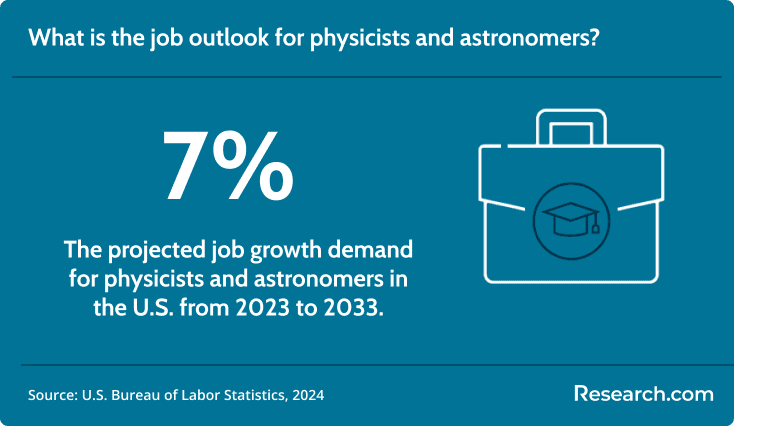
The job market for physics graduates is broad, but the strongest opportunities depend on how students combine the degree with applied skills. According to the figures cited in this guide, there were approximately 21,100 physicists employed in the United States as of 2023. Employment in the field is projected to grow by 7% from 2023 to 2033, which is faster than the average for all occupations. This growth is expected to create about 1,600 job openings annually, including openings tied to retirements and career transitions. The median annual wage for physicists was $166,290 in May 2024.
Those figures are encouraging, but students should interpret them carefully. The physicist labor market often favors candidates with advanced degrees, research experience, programming ability, and specialized technical knowledge. Bachelor’s graduates may find more immediate opportunities in education, data analysis, engineering support, laboratory work, healthcare technology, energy, or government-related roles.
Current employer expectations increasingly favor physics graduates who can combine scientific reasoning with computation and data skills. Students who add programming, statistics, simulation, machine learning fundamentals, or instrumentation experience may be better positioned for applied technical roles than students who complete only the minimum curriculum.
Here’s what graduates have to say about their online physics degree:
Completing physics online let me keep my full-time job while finishing a degree that would not have fit into a traditional campus schedule. The virtual lab tools helped me connect abstract equations with real experiments, and I finished the program feeling ready for the next step in my career. – Gina
I worried that remote physics courses would feel isolating, but the structure, faculty support, and online resources made the experience stronger than I expected. The coursework pushed me hard, and I now use the analytical training in my data analytics role. – Daniel
The online format gave me room to slow down, rewatch difficult lectures, and work through challenging concepts until they made sense. I also learned how to manage time, collaborate remotely, and solve technical problems with classmates in different locations. – Preston
Key Insights
- An online physics degree can be valuable for flexible learners, but the program must have credible accreditation, strong math coverage, and a serious lab model.
- A bachelor’s degree in physics usually requires 120 credit hours and typically takes four years full-time; part-time students often need five to six years.
- Online physics programs can reduce commuting and housing costs, but students must still budget for tuition, fees, lab kits, software, books, and possible extended enrollment.
- Students should verify regional accreditation and confirm whether the program supports federal financial aid, transfer credits, graduate-school goals, or teaching licensure where relevant.
- Physics careers are diverse. Bachelor’s graduates often pursue data, education, lab, engineering-adjacent, or technical roles, while advanced physicist positions commonly require graduate study.
- The cited physicist salary is $166,290, but that figure should not be treated as a guaranteed outcome for every physics graduate.
- The demand for physicists and astronomers in the U.S. is expected to grow by 7% from 2023 to 2033, with about 1,600 job openings annually.
- The best way to improve the career value of an online physics degree is to pair physics training with marketable skills such as programming, data analysis, simulation, lab methods, teaching credentials, or radiation safety expertise.
References:
- Arizona State University. (2025). Online Bachelor of Science in Physics. ASU
- Glassdoor. (2025). Salary: Data Analyst in the United States 2025. Glassdoor
- Liberty University. (2025). Bachelor’s Degree in Physics Online. Liberty University
- Oregon State University. (2025). Radiation Health Physics. OSU
- Payscale. (2025). Geophysicist Salary in 2025. Payscale
- U.S. Bureau of Labor Statistics. (2024). OOH: Physicists and Astronomers. U.S. BLS
- ZipRecruiter. (2025). High School Physics Teacher Salary. ZipRecruiter
Other things you should know about online physics degree programs
To enroll, you typically need a high school diploma or equivalent, with coursework in math and science. Some programs may also require standardized test scores. Check individual program requirements for specific prerequisites.
In 2027, numerous scholarships are available for online physics degree programs. Students can explore options from schools, private organizations, and government grants. Searching specific school websites and scholarship databases can provide detailed information on eligibility and application processes.


