
2027 Cryptographer Careers: Skills, Education, Salary & Job Outlook

Co-Founder and Chief Data Scientist
Choosing a cryptographer career means deciding whether you want a role built on advanced mathematics, secure systems, and long-term technical depth. This is not an entry-level cybersecurity shortcut. Cryptographers typically need a strong foundation in computer science, mathematics, cybersecurity, or a related field, plus practical experience proving they can design, test, and evaluate encryption systems responsibly.
The payoff can be significant. Cryptographer roles are tied to high-value work in government, finance, healthcare, technology, and research, where secure communication and data protection are mission-critical. Median pay is near $170,000 as of 2025, but earnings vary by role, location, specialization, credentials, and years of experience.
This guide explains what cryptographers do, the skills and education employers expect, where the strongest opportunities are, and how to decide whether this demanding career path fits your goals.
Key Things You Should Know About Cryptographer Career
- A cryptographer typically earns between $125,000 and $145,000 annually, with entry-level salaries starting around $87,000 and experienced professionals making $200,000 or more.
- The demand for cryptographers is projected to grow strongly, fueled by rising needs in cybersecurity and data protection across government and private sectors.
- A bachelor's degree in computer science, mathematics, or a related field is required to start, while advanced roles often require a master's or PhD in cryptography or cybersecurity.
- Success hinges on strong skills in mathematics, especially discrete math and number theory, programming languages like Python and C++, expertise in algorithms and data structures, and sharp problem-solving abilities.
- Career advancement can lead from junior analyst positions to senior cryptographer roles, lead engineer, or chief security architect, with opportunities in research, management, and consulting within various industries.
What do Cryptographers do?
Cryptographers protect information by creating and evaluating the mathematical systems that keep data private, authentic, and tamper-resistant. Their work supports secure messaging, online banking, digital identity, cloud security, national defense systems, cryptocurrency infrastructure, and other environments where unauthorized access could cause serious harm.
Unlike many cybersecurity roles that focus on monitoring threats or responding to incidents, cryptographers work closer to the foundations of security. They design encryption algorithms, analyze protocols, test whether systems can withstand attacks, and help organizations apply cryptographic tools correctly.
A day in the life of Cryptographers
A typical day may include reviewing research papers, modeling security assumptions, writing code to test an algorithm, auditing a protocol for weaknesses, or working with software engineers to implement encryption safely. In research-heavy positions, cryptographers may spend substantial time proving whether a method is secure under specific conditions. In applied roles, they may focus on helping teams deploy cryptography without creating avoidable vulnerabilities.
The work is often collaborative. Cryptographers regularly coordinate with cybersecurity analysts, software engineers, compliance teams, product leaders, and, in some settings, government or intelligence professionals. The best outcomes come from both deep technical accuracy and the ability to explain complex security trade-offs clearly.
What are the key responsibilities of Cryptographers?
Cryptographers are responsible for building and validating the systems that keep sensitive information secure. Their responsibilities vary by employer, but most roles combine research, engineering, testing, documentation, and risk analysis.
- Design and implement cryptographic algorithms and protocols that support confidentiality, integrity, authentication, and availability.
- Evaluate existing encryption systems to identify weaknesses, implementation errors, or outdated methods.
- Develop new encryption approaches by applying advanced mathematics, computer science, and security research.
- Test and stress-test security measures against likely attack methods and misuse scenarios.
- Decrypt protected information when legally authorized, such as in intelligence, investigation, or internal security contexts.
- Document findings in a way that technical teams, decision-makers, and stakeholders can use.
The most challenging vs. the most rewarding tasks
The most difficult part of cryptography is that mistakes can be invisible until they are exploited. A protocol may appear secure, pass standard testing, and still contain a subtle flaw. Cryptographers must think like adversaries, question assumptions, and evaluate edge cases that other teams may overlook.
The most rewarding work often comes when a cryptographer helps prevent real-world harm. A well-designed protocol can protect financial assets, medical records, government communications, intellectual property, or personal privacy at large scale. That impact makes the field intellectually demanding but highly meaningful.
Professionals who want to strengthen their credentials can also explore certifications for high-paying jobs, especially if they are building credibility for cybersecurity or security engineering roles that use cryptographic expertise.
What are the key skills for Cryptographers?
Cryptographers need a rare combination of mathematical precision, programming ability, cybersecurity knowledge, and communication skills. Employers look for candidates who can reason rigorously, write reliable code, and explain why a security design is or is not trustworthy.
Core technical skills
- Programming languages: C, C++, Python, and Java are commonly used to prototype, test, and implement cryptographic systems.
- Advanced mathematics: Algebra, number theory, probability, combinatorics, and discrete mathematics help cryptographers understand and build secure models.
- Cryptographic algorithms: Professionals must understand symmetric and asymmetric encryption, hashing, key exchange, digital signatures, and related protocols.
- Computer networking and cybersecurity: Cryptography is only effective when implemented within secure systems, networks, and operational practices.
Important professional skills
- Critical thinking: Cryptographers must evaluate claims, assumptions, and attack scenarios carefully.
- Complex problem solving: The work often involves ambiguous, high-stakes problems without simple answers.
- Written and oral communication: Strong communication is essential when explaining technical risks to engineers, executives, or compliance teams.
- Self-direction and adaptability: Cryptographic standards, attack methods, and computing capabilities continue to evolve, so ongoing learning is part of the job.
The overlooked skill that separates good from great
Innovative thinking is often the difference between competent implementation and major contribution. Strong cryptographers do not simply apply known tools; they question whether the tool fits the threat model, whether assumptions still hold, and whether a new approach is needed.
For example, a cryptographer may notice that a system’s encryption is technically strong but vulnerable because of how keys are generated, stored, or exchanged. That kind of practical insight prevents failures that pure theory alone may miss.
Students who are still deciding on an undergraduate path can compare options such as easy bachelor degrees that pay well, but they should choose carefully. Cryptography typically rewards rigorous preparation in mathematics, computer science, and security, not simply the fastest or easiest credential.
Cryptographer Careers: A Step-by-Step Guide to Getting Started
Becoming a cryptographer is usually a staged process. Most candidates build academic depth first, then gain applied cybersecurity or software experience, and later move into specialized cryptography roles.
- Build the mathematical and computing foundation. Prioritize discrete mathematics, linear algebra, probability, algorithms, data structures, operating systems, and secure programming.
- Complete formal education. A degree in computer science, mathematics, cybersecurity, computer engineering, or information technology is the usual starting point for professional roles.
- Develop practical experience. Look for internships, research assistantships, cybersecurity labs, secure software projects, or entry-level IT security roles where you can apply theory to real systems.
- Create a portfolio of technical proof. Employers value evidence such as research projects, protocol analysis, secure coding samples, capture-the-flag work, or contributions to security tools.
- Pursue certifications strategically. Certifications can help validate broad cybersecurity knowledge or specialized encryption skills, but they work best when paired with strong fundamentals and hands-on experience.
- Advance through specialization. Graduate study, research roles, or advanced industry work can open doors to post-quantum cryptography, protocol design, privacy-preserving systems, and senior cryptography leadership.
The key is sequencing. Do not try to master everything at once. Build the foundation, practice on real systems, document your work, and then specialize toward the type of cryptography role you want.
What education, training, or certifications are required?
A professional cryptographer typically needs a Bachelor of Science (B.S.) degree in Computer Science, Mathematics, Cybersecurity, Computer Engineering, Information Technology, or a closely related field. Because cryptography is mathematically intensive, coursework should go beyond basic programming and include advanced mathematics, algorithms, cybersecurity, and systems design.
Common certifications include CompTIA Security+ from CompTIA and the Certified Information Systems Security Professional (CISSP) issued by ISC2. Specialized credentials such as the EC-Council Certified Encryption Specialist can help demonstrate focused knowledge of encryption concepts. On-the-job training usually spans 3-5 years in cybersecurity or related IT roles, and internships are strongly recommended for gaining practical experience.
Advanced credentials can matter depending on the target role. A Master of Science in Cybersecurity, Computer Science, or Mathematics can strengthen access to specialized positions. Doctoral degrees (Ph.D.) are most useful for candidates pursuing research, academic roles, or highly theoretical cryptographic work. Some employers, especially government agencies, may also require security clearances.
Are advanced degrees or niche certifications worth the investment?
Advanced degrees are most valuable when the role requires original research, formal security proofs, protocol design, or work on emerging areas such as post-quantum cryptography. They can improve competitiveness, but they also require substantial time and cost. Graduate studies may last 1-3 years for a master's and 4+ years for a Ph.D.
Certifications are usually more practical for applied cybersecurity roles, security engineering, or professionals who need to prove current knowledge without committing to a graduate program. They are not a replacement for mathematical depth, but they can help employers see that you understand security principles and industry practices.
If you are starting from an earlier stage, an accelerated associates program may help you begin building technical coursework before progressing toward the bachelor’s-level and advanced preparation usually expected in cryptography.
What is the earning potential for Cryptographers?
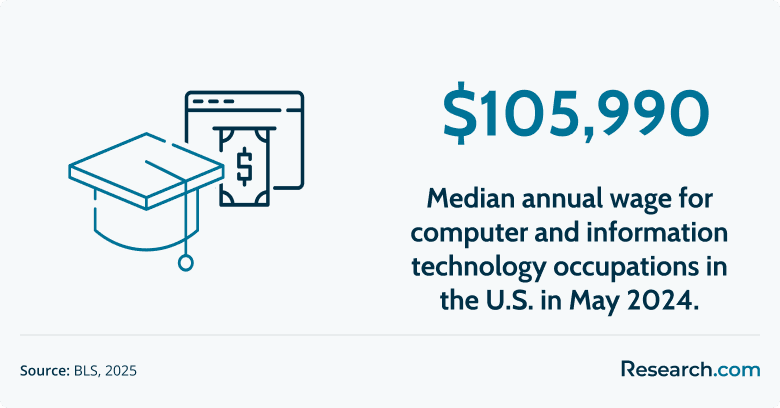
Cryptographers have strong earning potential because their skills protect high-value systems and sensitive data. Nationally, the median annual income ranges between $125,000 and $145,000, reflecting the premium employers place on advanced security expertise.
For entry-level roles, the cryptographer starting salary 2025 expectation is about $87,000 per year, excluding bonuses that can add nearly $4,800. Senior-level experts, especially those with 8 to 10 years or more of experience, may earn between $120,000 and $200,000 annually.
Salary depends on several factors: employer type, location, clearance requirements, specialization, education level, and whether the role is research-focused or applied. Cryptographers working in major technology hubs, defense, finance, scientific research and development services, or highly specialized security roles may see stronger compensation than those in general IT settings.
Factors that can raise or limit earnings
- Specialization: Post-quantum cryptography, secure protocol design, blockchain security, and privacy-preserving computation can command higher value when demand is strong.
- Experience level: Senior cryptographers are often paid for judgment, not just technical execution.
- Industry: Finance, government contracting, defense, and advanced technology roles may pay differently based on risk and regulatory requirements.
- Credentials: Graduate degrees and certifications may improve access to certain roles, but employers still prioritize demonstrated ability.
- Location and work model: Major cities and specialized employers may offer higher salaries, while remote roles can vary widely by company policy.
What is the job outlook for Cryptographers?
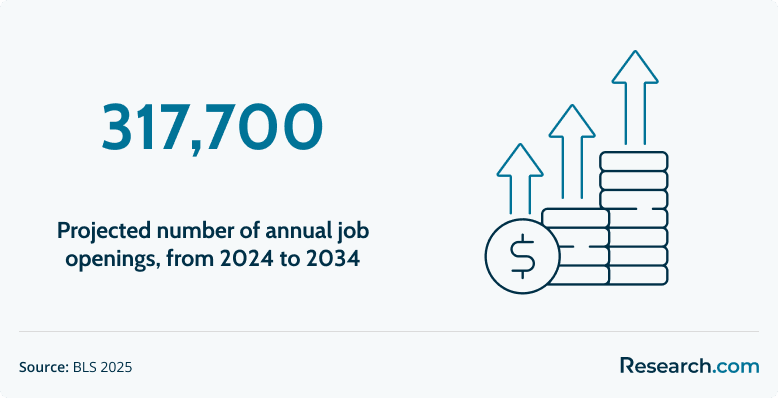
The job outlook for cryptographers is strong, with 8% growth projected by 2034, matching the average pace of growth across all occupations. Demand is supported by the continued need for secure communication, privacy protection, regulatory compliance, and resilient digital infrastructure.
Cryptography is also less exposed to simple automation than many routine technology tasks. Tools can help test, model, or implement cryptographic systems, but organizations still need experts who understand threat models, mathematical assumptions, implementation risks, and the consequences of failure.
The key factors shaping the future outlook
Escalating cybersecurity threats. Organizations must defend against increasingly sophisticated attacks, including threats to data in transit, data at rest, authentication systems, and software supply chains. Cryptographers help build stronger defenses before weaknesses become breaches.
Quantum computing risk. Quantum computing creates pressure to develop and adopt post-quantum cryptography. Professionals who understand quantum-resistant methods may have an advantage as organizations prepare for future threats.
Regulation and compliance. Finance, healthcare, government, and other regulated sectors rely on encryption to protect sensitive information and meet legal and industry requirements. This creates steady demand for professionals who can design and validate secure systems.
Privacy-focused technology. Growth in secure cloud computing, digital identity, blockchain, confidential computing, and privacy-preserving analytics expands the range of roles that use cryptographic expertise.
For students and career changers comparing education options, affordable online degrees can be a practical way to begin building the required technical foundation.
What is the typical work environment for Cryptographers?
Cryptographers usually work in office, lab, secure facility, remote, or hybrid environments, depending on the employer and sensitivity of the work. Many are employed in finance and insurance, government agencies including military and intelligence, healthcare, technology companies, research organizations, and cybersecurity firms.
The schedule often follows standard business hours, with eight-hour days Monday through Friday. However, urgent vulnerabilities, incident response, major product releases, or government deadlines can require evenings or weekends. Research positions may offer more flexibility, while operational security or intelligence roles may be more structured.
Work style varies. Some tasks require long periods of independent concentration, especially mathematical analysis, protocol review, or research writing. Other tasks are highly collaborative, involving software engineers, IT security specialists, product teams, auditors, legal staff, or clients. Remote and hybrid work options are increasingly available in the private sector, but sensitive government roles often require on-site presence because of security requirements.
What are the pros and cons of Cryptographer careers?
Cryptography can be an excellent career for people who enjoy deep technical problems and want their work to protect critical information. It is less ideal for those who prefer quick wins, broad generalist work, or roles with minimal continuing study.
Pros
- High intellectual challenge: The work rewards people who enjoy mathematics, logic, systems thinking, and precise problem solving.
- Meaningful impact: Strong cryptography protects privacy, financial systems, healthcare data, national security, and digital trust.
- Strong earning potential: Specialized expertise can lead to competitive salaries, especially in senior and high-demand roles.
- Continuous learning: New threats, standards, and technologies keep the field from becoming static.
- Specialization options: Professionals can move into post-quantum cryptography, blockchain security, secure hardware, privacy-preserving protocols, or research.
Cons
- Steep learning curve: The field requires advanced mathematics, programming, and security knowledge.
- High pressure: A small design or implementation mistake can have serious consequences.
- Constant updating: Professionals must keep pace with new attacks, standards, and computing developments.
- Limited entry-level cryptography roles: Many candidates start in cybersecurity, software engineering, or research support before moving into cryptographer positions.
- Mental fatigue: Sustained abstract reasoning and high-stakes analysis can be demanding.
If you need flexibility while preparing for this career, affordable online universities for working adults may help you balance education with employment and ongoing skill development.
What are the opportunities for advancement for Cryptographers?
Cryptographer career advancement can follow two main paths: leadership or specialization. Some professionals become senior technical experts who shape protocols and security standards. Others move into management, architecture, or broader cybersecurity leadership.
Common promotion path
- Junior Cryptographer (0-2 years): Build core knowledge, assist with analysis, test implementations, support research, and work under experienced cryptographers or security engineers.
- Senior Cryptographer (4-7 years): Lead protocol design, review complex systems, mentor junior staff, publish research, and influence implementation decisions.
- Lead Cryptographer / Cryptography Manager (7-10+ years): Set cryptographic strategy, manage teams, oversee high-risk decisions, and move toward roles such as chief cryptography officer or broader cybersecurity leadership.
Specialization areas that can strengthen advancement
- Post-Quantum Cryptography: Develop and assess methods designed to resist future quantum computing threats.
- Homomorphic Encryption: Support computation on encrypted data, enabling privacy-preserving processing.
- Zero-Knowledge Proofs & Privacy-Preserving Protocols: Build systems that verify information without exposing the underlying data.
- Confidential Computing & Hardware Security Modules: Protect sensitive data using secure hardware, trusted execution environments, and cloud security architecture.
- Blockchain & Decentralized Finance Security: Secure cryptocurrencies, smart contracts, decentralized applications, and related infrastructure.
The strongest advancement strategy is to combine depth with evidence. Publish research, contribute to secure implementations, document security reviews, earn relevant credentials, and build a reputation for careful judgment.
What other careers should you consider?
If cryptography interests you but you are not sure the pure cryptographer path is the right fit, several related careers use overlapping skills. These roles may offer more direct entry points, broader job availability, or a stronger match for your preferred work style.
- Cryptanalyst: Focuses on analyzing and breaking cryptographic systems, often using advanced mathematics, pattern recognition, and code-breaking methods.
- Security Engineer: Builds and maintains secure systems, including the correct implementation of encryption, authentication, and access controls.
- Blockchain Developer: Uses cryptographic concepts to create decentralized applications, smart contracts, and blockchain-based systems.
- Penetration Tester (Ethical Hacker): Identifies vulnerabilities in networks, applications, and systems, including weaknesses related to encryption or authentication.
- Digital Forensics Analyst: Recovers, examines, and interprets digital evidence, sometimes involving encrypted data or security logs.
Choose based on the type of work that motivates you most. If you enjoy mathematical theory and security proofs, cryptography or cryptanalysis may fit best. If you prefer building and securing systems, security engineering may be stronger. If you like investigation, digital forensics may be a better match. If you want to work on decentralized systems, blockchain development may be worth exploring.
Here's What Professionals Say About Their Cryptographer Careers
- : "I didn't accept rejection as a final answer when I encountered roadblocks in cracking legacy encryption protocols. Instead, I found clever workarounds—essentially hacking around the system's limitations to develop new software tools that strengthened national security defenses. It wasn't a typical approach, and I wouldn't suggest it for everyone, but at that moment, it pushed the boundaries of what was possible. Looking back, knowing that my code contributed to protecting critical information at the highest levels makes every challenge worthwhile. — Anil"
- : "During my undergrad years, I was relentless about mastering cryptanalysis, juggling TA duties, coursework, and fresh research projects. When I wasn't busy, I'd dive into forums like sci.crypt, decoding amateur ciphers and fueling my curiosity. After two intense years, just as I finished my Master's degree, exhaustion hit hard, and I planned to take a long summer break. Yet, fate had other ideas, and that pause turned into a pivotal turning point for me. — Nadira"
- : "After countless late nights spent refining cryptographic algorithms and feeling like I'd been through a marathon with no end in sight, I received an unexpected email from a professional I deeply respected, inviting me to collaborate. That moment of recognition made every setback feel meaningful and confirmed that my relentless effort wasn't in vain. Knowing someone I admired saw potential in my work energized me in ways I hadn't anticipated. It's that rare, validating experience that redefined my perspective on all the hard work. — Elias"
Key Findings
- Cryptographers design, test, and analyze encryption systems that protect sensitive information across government, finance, healthcare, technology, and research settings.
- The field requires strong preparation in mathematics, computer science, cybersecurity, and secure programming; it is usually not a fast-entry career.
- A Bachelor of Science (B.S.) degree in Computer Science, Mathematics, Cybersecurity, Computer Engineering, or Information Technology is typically required, with graduate education helpful for research-heavy roles.
- Certifications such as CompTIA Security+, CISSP, and the EC-Council Certified Encryption Specialist can strengthen credibility, especially when paired with practical experience.
- National median annual income ranges between $125,000 and $145,000, with entry-level expectations around $87,000 per year and senior-level roles ranging between $120,000 and $200,000 annually.
- The job outlook is strong, with 8% growth projected by 2034, supported by cybersecurity threats, compliance needs, and emerging areas such as post-quantum cryptography.
- Cryptography is best suited for people who enjoy rigorous problem solving, continuous learning, and high-stakes technical work where precision matters.
Other Things You Should Know About Cryptographer
In 2027, the job outlook for cryptographers is highly promising. With increasing global demand for data security and privacy, opportunities are expected to grow significantly, especially in financial services, government, and tech industries. This demand is fueled by rising cyber threats and advancements in areas such as quantum computing.
In 2027, knowledge of quantum cryptography techniques is becoming essential for cryptographers. As the quantum computing field advances, understanding how quantum principles can secure or threaten existing cryptographic systems is crucial.
References
- 6 Cryptographer Interview Questions and Answers for 2025 | Himalayas https://himalayas.app/interview-questions/cryptographer
- Cryptography Career Guide: Skills, Education & Options | QuickStart https://www.quickstart.com/blog/information-security/how-to-become-a-cryptographer/
- Computer and Information Technology Occupations : Occupational Outlook Handbook: : U.S. Bureau of Labor Statistics https://www.bls.gov/ooh/computer-and-information-technology/
- What is a Cryptographer? | Duties, Skills, and Career Paths https://www.cyberdegrees.org/jobs/cryptographer/
- Mathematics & Cryptography | GCHQ Careers https://www.gchq-careers.co.uk/our-careers/specialist-roles/mathematics-cryptography.html
- So You Want to Be a Cryptographer? https://www.careersinaudit.com/careers/2018/12/so-you-want-to-be-a-cryptographer/
- Cryptographer: Job Description and Key Challenges https://solutionsreview.com/security-information-event-management/cryptographer-job-description-and-key-challenges/
- Open Positions in Cryptology https://www.iacr.org/jobs/
- Learn How to Become a Cryptographer (Education & Duties) https://www.cybersecurityeducation.org/careers/cryptographer/
- Cryptographer Salary in 2025 [Fresher to Experienced] https://www.knowledgehut.com/blog/security/cryptographer-salary


