
2027 Enterprise Architect Careers: Skills, Education, Salary & Job Outlook

Co-Founder and Chief Data Scientist
Becoming an Enterprise Architect is not an entry-level career move. It is a senior technology role for people who can connect business priorities, software systems, infrastructure, security, data, and long-term organizational strategy. If you are deciding whether this path is worth the time, the real question is not only “Can I learn the tools?” but “Do I want to make technology decisions that affect an entire organization?”
The role can be demanding because it usually requires years of experience in areas such as computer science, systems engineering, software development, IT operations, cybersecurity, project management, or business management. It also requires judgment: Enterprise Architects must understand technical constraints while helping executives make practical decisions about cost, risk, growth, and modernization.
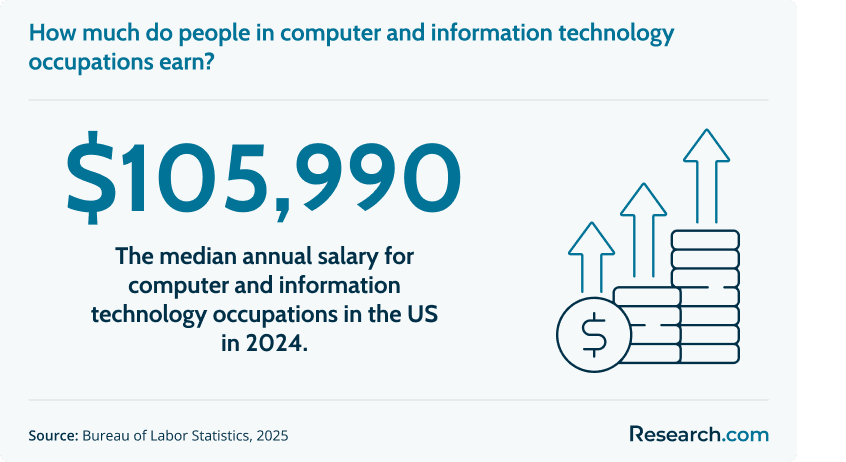
For professionals willing to build that depth, the career can be financially and strategically rewarding. Enterprise Architect careers offer salaries ranging roughly from $93,380 to over $178,430, with a median salary of $137,560 per year. This guide draws on over 10 years of expert career planning to explain what Enterprise Architects do, what skills and credentials matter, how the career path works, and how to decide whether this role fits your goals.
Key Things You Should Know About Enterprise Architect Career
- The typical earning potential for an enterprise architect ranges from $98,000 to $215,000 annually, with average salaries between $137,560 and $155,212 depending on experience and location.
- This career exists within a growing IT sector that consistently demands skilled professionals, making enterprise architecture a stable and promising field.
- A bachelor's degree in computer science, information technology, or a related field is generally required, with advanced degrees or certifications providing a competitive edge.
- Success requires strong technical knowledge of IT systems, strategic planning abilities, business acumen, and excellent communication, leadership, and problem-solving skills.
- Career advancement often leads from entry-level roles to senior positions such as chief enterprise architect, with opportunities to specialize in areas like security or data architecture.
What do Enterprise Architects do?
Enterprise Architects design the high-level technology structure an organization needs to operate, grow, and compete. Their work is less about writing day-to-day code and more about making sure systems, applications, data, security controls, cloud platforms, and business processes fit together in a sustainable way.
In practical terms, an Enterprise Architect translates business goals into technology direction. If a company wants to modernize legacy systems, expand into new markets, improve cybersecurity, reduce duplicate software spending, or move to the cloud, the Enterprise Architect helps define the target architecture and the roadmap to get there.
A day in the life of Enterprise Architects
A typical day may include reviewing technology portfolios, meeting with executives, assessing risks in proposed projects, documenting system dependencies, advising product or engineering teams, and explaining trade-offs to nontechnical leaders. The role requires constant movement between strategic planning and practical implementation.
Enterprise Architects often produce architecture diagrams, capability maps, migration roadmaps, standards, governance documents, and decision records. These materials help teams understand what should be built, what should be retired, what should be integrated, and which technology choices support the organization’s long-term direction.
How the role differs from similar architecture jobs
| Role | Main focus | Typical scope |
| Enterprise Architect | Aligning business strategy with enterprise-wide technology design | Organization-wide systems, capabilities, standards, and roadmaps |
| Solutions Architect | Designing a specific technology solution for a business need | One product, platform, project, or domain |
| Software Architect | Defining software structure, patterns, and development standards | Applications, services, and engineering teams |
| Data Architect | Structuring data models, flows, governance, and analytics foundations | Databases, data platforms, reporting, and information architecture |
What are the key responsibilities of Enterprise Architects?
Enterprise Architects are responsible for creating and maintaining the blueprint that connects business objectives with IT capabilities. Their decisions influence which systems are built, which technologies are retired, how platforms integrate, and how the organization manages technology risk.
- Develop and maintain architecture frameworks, roadmaps, standards, and documentation that guide long-term IT decisions.
- Work with business leaders, IT teams, security specialists, product owners, and vendors to align technology plans with organizational needs.
- Assess existing systems to identify duplication, technical debt, integration problems, security gaps, and modernization opportunities.
- Evaluate current and emerging technologies and recommend options that match business value, cost, risk, scalability, and maintainability.
- Review projects for alignment with architecture standards and provide guidance when teams need to adjust designs or implementation plans.
- Support system integration, cloud migration, application modernization, data strategy, and digital transformation initiatives.
- Communicate complex architecture decisions in plain language so executives and technical teams can act on the same plan.
The most challenging vs. the most rewarding tasks
The hardest part of the job is often not the technology itself. It is building agreement across departments with different priorities, budgets, timelines, and risk tolerance. Enterprise Architects may need to challenge popular but short-term technology choices when those choices create long-term problems.
The most rewarding part is seeing a well-designed architecture improve how the organization works. A successful cloud adoption, platform consolidation, cybersecurity improvement, or digital modernization effort can reduce waste, strengthen resilience, and give teams a clearer path for future growth.
If you are already working in IT and need a faster academic route while staying employed, reviewing the accelerated online degree programs for working adults can help you compare flexible options.
What are the key skills for Enterprise Architects?
Enterprise Architects need both technical depth and business judgment. Employers typically look for professionals who can understand complex systems, evaluate risk, communicate with executives, and guide teams through change. The enterprise architect essential skills 2025 include a mix of architecture, infrastructure, security, data, governance, and leadership abilities.
Core hard skills
- Systems analysis: Evaluating how applications, platforms, infrastructure, data, and processes interact across the organization.
- Architecture frameworks: Using structured methods to document current-state and future-state architecture, define standards, and guide decisions.
- Technology integration: Designing how new and existing systems connect without creating unnecessary complexity or operational risk.
- Cloud and infrastructure planning: Understanding deployment models, scalability, resilience, cost management, and migration trade-offs.
- Network and database management: Knowing how data moves securely and efficiently through enterprise systems.
- Cybersecurity and governance: Embedding security, compliance, access control, risk management, and policy requirements into architecture decisions.
Vital soft skills
- Critical thinking: Separating urgent requests from long-term priorities and identifying the real problem behind a technology proposal.
- Complex problem solving: Working through dependencies, constraints, legacy systems, budget limits, and competing stakeholder needs.
- Communication and influence: Explaining architecture choices clearly to executives, engineers, finance teams, and business units.
- Judgment and decision making: Choosing practical options when perfect information is unavailable.
- Negotiation: Helping teams accept standards, timelines, and trade-offs without slowing necessary innovation.
The one overlooked skill that separates the good from the great
The differentiator skill for strong Enterprise Architects is business capability analysis. This means identifying what the organization must be able to do, comparing that future need with current capabilities, and then shaping technology investments around the gap.
For example, an Enterprise Architect may discover that the IT portfolio no longer supports growth initiatives. Through business capability analysis, they can recommend which systems to modernize, consolidate, integrate, or replace before the mismatch becomes expensive. This skill is especially valuable in fields such as Information Technology and Computer Systems Design Services, where architecture decisions directly affect strategic execution.
If you are comparing graduate study options that may support a move into architecture or technology leadership, a guide to the easiest master's degree options can provide a starting point for evaluating workload and fit.
Enterprise Architect Careers: A Step-by-Step Guide to Getting Started
The Enterprise Architect career path is usually built in stages. Most professionals do not move directly from school into enterprise architecture. They first develop technical credibility, then gain exposure to business strategy, governance, and cross-functional leadership.
- Build a technical foundation. Start with education or training in computer science, information technology, software engineering, network security, data science, systems analysis, or a related field.
- Gain hands-on IT experience. Work in roles such as software developer, systems analyst, cloud engineer, cybersecurity analyst, network specialist, data professional, or project manager.
- Learn how business decisions shape technology. Seek assignments that involve budgeting, vendor selection, compliance, product strategy, operations, or digital transformation.
- Develop architecture thinking. Practice documenting systems, mapping dependencies, identifying technical debt, evaluating trade-offs, and creating future-state designs.
- Pursue relevant credentials. Certifications can help validate knowledge of architecture frameworks, cloud platforms, and enterprise technology standards.
- Move into architecture roles. Target positions such as solutions architect, domain architect, technical architect, or business architect before advancing into enterprise-level responsibility.
- Demonstrate measurable impact. Build a record of improving scalability, reducing duplication, strengthening security, lowering technology risk, or enabling business growth.
The essential steps to become an Enterprise Architect include earning a relevant degree, gaining practical experience, pursuing certifications, and building strategic communication skills. The strongest candidates can show not only what technologies they know, but how their decisions improved business outcomes.
What education, training, or certifications are required?
Common qualifications for Enterprise Architect roles include a bachelor's degree in Computer Science, Information Technology, Software Engineering, Network Security, or Data Science. A degree in Business Administration or Management can also be useful, especially for professionals who already have technical experience and want to strengthen their ability to align IT with business objectives.
Employers often value certifications because they show familiarity with architecture frameworks and major technology platforms. Common examples include the TOGAF® Certification from The Open Group and the AWS Certified Solutions Architect - Professional from Amazon Web Services. Depending on the organization, cloud, cybersecurity, data, enterprise architecture, or vendor-specific credentials may also strengthen a candidate’s profile.
On-the-job preparation is central to this career. Many Enterprise Architects build 5 to 10 years of progressive IT experience before moving into the role. Relevant previous positions include software engineer, developer, systems analyst, network security specialist, cloud engineer, technical project manager, or solutions architect. Internships, apprenticeships, and IT boot camps can help early-career professionals gain exposure, but they usually are not enough on their own for enterprise-level architecture roles.
Formal licensure or supervised hours are not mandated in this field. Hiring decisions typically depend on education, certifications, technical experience, leadership ability, and a demonstrated record of making sound architecture decisions.
Are advanced degrees or niche certifications worth the investment?
Advanced degrees such as a Master of Science in Enterprise Architecture or Information Technology can support movement into senior roles, including principal architect or C-level positions. They may be especially helpful at large enterprises that prefer formal graduate training for strategic technology leaders. The trade-off is cost and time, since these programs often require 1-2 years and tens of thousands of dollars.
Niche certifications such as the Salesforce Certified Technical Architect or EACOE Enterprise Architect Certification can also be valuable when they match your target industry or technology stack. However, credentials are strongest when paired with real-world architecture experience. A certificate alone does not prove that a candidate can handle enterprise politics, integration complexity, cost constraints, or risk management.
If you are considering graduate study but need a shorter path, comparing a quick online master's degree may help you weigh flexibility, time commitment, and career value.
How to choose the right credential path
| Goal | Credential strategy | Best fit |
| Move from technical specialist to architect | Architecture framework certification plus cloud or platform credentials | Engineers, developers, analysts, and administrators |
| Advance into senior enterprise leadership | Graduate degree plus enterprise architecture or governance credentials | Experienced architects targeting principal, chief architect, CTO, or CIO roles |
| Specialize in a major platform | Vendor-specific advanced certification | Professionals working heavily with cloud, Salesforce, security, or data ecosystems |
What is the earning potential for Enterprise Architects?
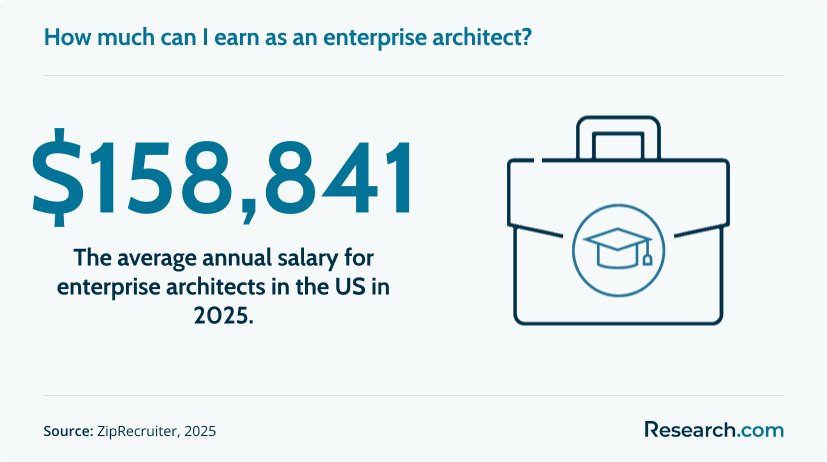
Enterprise architecture is a high-responsibility career, and compensation reflects the seniority and business impact of the role. The median salary for an Enterprise Architect is $137,560 per year. This gives a useful midpoint for evaluating the field, but actual pay can vary widely based on experience, industry, location, company size, and specialization.
The enterprise architect starting salary 2025 typically begins around $95,340 per year. More experienced professionals can earn up to $178,430 annually. The broader career range is often described as roughly $93,380 to over $178,430, which shows the significant increase possible as professionals build expertise and move into senior or executive-level responsibilities.
What affects Enterprise Architect pay?
- Experience: Professionals with a record of leading complex architecture initiatives generally command higher salaries.
- Specialization: Security, cloud, data, platform modernization, and chief architect responsibilities can raise earning potential.
- Industry: Pay may be stronger in sectors with complex technology environments, heavy compliance requirements, or large-scale digital operations.
- Company size: Large organizations often pay more because the architecture scope, risk, and stakeholder complexity are greater.
- Location and work model: Compensation can differ by region and by whether the role is onsite, hybrid, remote, or tied to a high-cost labor market.
When comparing job offers, look beyond base salary. Enterprise Architect roles may differ significantly in bonus potential, equity, leadership authority, travel expectations, team size, and the maturity of the organization’s architecture function.
What is the job outlook for Enterprise Architects?
The projected growth rate for Enterprise Architects from 2022 to 2032 is 4%, which aligns with the average growth rate across all occupations nationwide. This suggests a stable but competitive field rather than a role where credentials alone guarantee quick entry.
Demand is supported by the continued need for organizations to modernize systems, manage technology cost, improve cybersecurity, integrate data, and align IT investments with business strategy. Enterprise Architects are especially useful when organizations must coordinate multiple platforms, vendors, business units, and regulatory requirements.
The key factors shaping the future outlook
- Digital transformation: Organizations need architecture guidance when replacing legacy systems, improving customer experiences, and redesigning internal processes.
- Cloud adoption: Cloud migration creates decisions around cost, resilience, governance, security, and integration.
- Artificial intelligence and hyper-automation: Advanced technologies require architecture that supports responsible deployment, data quality, interoperability, and business value.
- Digital twins: Organizations using advanced simulations and connected systems need architects who can connect operational technology, data, and enterprise platforms.
- Cybersecurity and regulation: Rising threats and stricter compliance expectations increase the need for secure, well-governed architectures, especially within banking, financial services, and insurance sectors.
For students or career changers who need financial aid eligibility and flexible study options, exploring online college courses that accept FAFSA can help identify accessible education pathways.
What is the typical work environment for Enterprise Architects?
The Enterprise Architect work environment is usually office-based, hybrid, or remote, depending on the employer. Much of the work happens on computers, in architecture tools, documentation platforms, project meetings, stakeholder workshops, and strategy discussions.
Most Enterprise Architects work in technology-intensive and corporate environments. Common industries include computer systems design and related services (26%), telecommunications (10%), and management of companies and enterprises (8%). These settings often involve complex systems, multiple departments, and ongoing technology modernization.
A typical workday is usually full-time, Monday through Friday, with frequent collaboration across IT, security, finance, operations, product, and executive leadership. Some periods may be meeting-heavy, especially during major transformation initiatives, vendor evaluations, security reviews, cloud migrations, or budget planning cycles.
What the culture is like
The culture can be strategic, collaborative, and politically complex. Enterprise Architects must be comfortable working with ambiguity and explaining why a technically attractive option may not be the best business decision. The role suits professionals who enjoy systems thinking, long-term planning, and influencing decisions without always having direct authority over every team involved.
What are the pros and cons of Enterprise Architect careers?
Enterprise Architecture can be an excellent career for experienced technology professionals who want broader influence. It is less ideal for people who prefer hands-on technical execution without frequent meetings, documentation, negotiation, and strategic planning.
Pros
- Strategic influence: Enterprise Architects help shape major business and technology decisions.
- High earning potential: The role offers strong compensation, with experienced professionals able to earn up to $178,430 annually.
- Cross-functional visibility: The work involves executives, technical teams, business units, vendors, and governance groups.
- Large-scale problem solving: Architects address system-wide challenges instead of isolated technical tasks.
- Innovation opportunities: The role often includes cloud adoption, platform modernization, automation, security improvements, and emerging technologies.
Cons
- High accountability: Poor architecture decisions can create expensive long-term consequences.
- Organizational politics: Architects must navigate competing priorities, budgets, and departmental preferences.
- Ambiguity: Requirements are often incomplete, and priorities can shift during major initiatives.
- Constant learning: Technology, security expectations, compliance requirements, and business models continue to evolve.
- Less hands-on building: Some professionals miss the direct coding, engineering, or operational work they performed earlier in their careers.
If you want to combine technical expertise with business, policy, management, or another discipline, exploring the best dual degree programs can help you understand broader academic pathways.
Who is this career best for?
This career is best for professionals who enjoy connecting details to strategy. If you like diagnosing system complexity, communicating with senior leaders, and making decisions that balance cost, security, scalability, and business value, Enterprise Architecture may be a strong fit.
What are the opportunities for advancement for Enterprise Architects?
Enterprise Architect career advancement opportunities are strong because the role sits close to business strategy, technology governance, risk management, and executive decision-making. Advancement can happen through leadership, specialization, or movement into broader technology management roles.
Advancement path
- Junior Enterprise Architect: Supports senior architects, documents systems, learns architecture frameworks, and contributes to standards and roadmaps.
- Enterprise Architect: Owns architecture planning for business capabilities, domains, platforms, or enterprise-wide initiatives.
- Senior/Principal Enterprise Architect: Leads architecture strategy, mentors architects, governs major technology decisions, and advises executives.
- Chief Enterprise Architect / CTO / CIO: Sets the organization’s technology vision, investment priorities, governance model, and long-term digital strategy.
The most direct path upward is to show measurable business impact. Promotion is easier when you can point to successful modernization efforts, reduced complexity, improved security posture, better platform integration, lower operating costs, or technology decisions that enabled revenue growth.
Specialization areas
- Cloud Architecture: Designing scalable cloud solutions and integrating them with enterprise systems.
- Cybersecurity Architecture: Protecting IT assets through security frameworks, controls, identity management, and risk-based design.
- Operational Enterprise Architecture: Improving technology operations, reliability, process efficiency, and service delivery.
- Strategic/Transformational Enterprise Architecture: Leading digital transformation and preparing the organization for future business models.
- Risk Management or Compliance-Focused Architecture: Ensuring technology decisions support regulatory requirements and risk controls.
How to strengthen your promotion case
- Build executive communication skills, not just technical documentation skills.
- Track architecture decisions and connect them to measurable outcomes.
- Volunteer for complex integration, modernization, or governance initiatives.
- Develop mentoring ability so you can guide other architects and technical teams.
- Stay current in cloud, cybersecurity, data architecture, automation, and business capability modeling.
What other careers should you consider?
If Enterprise Architecture interests you but you are not sure it is the exact fit, several adjacent careers use similar skills with different levels of scope, technical depth, and leadership responsibility.
- Solutions Architect: Designs technology solutions for specific business problems, often working closer to implementation than an Enterprise Architect.
- Data Architect: Focuses on data modeling, information architecture, governance, quality, and secure data flows.
- Chief Technology Officer (CTO): Leads high-level technology strategy, innovation, and technology leadership across the organization.
- System Architect: Plans system structures, infrastructure components, and technical designs across interconnected platforms.
- Software Architect: Defines software design standards, application structure, patterns, scalability, and maintainability for development teams.
How to choose between these paths
| If you prefer... | Consider... | Why |
| Broad business and technology strategy | Enterprise Architect | The role connects organizational goals with enterprise-wide systems and standards. |
| Designing specific technical solutions | Solutions Architect | The work is closer to project delivery and implementation planning. |
| Data structure, governance, and analytics foundations | Data Architect | The role centers on how information is modeled, stored, secured, and used. |
| Engineering standards and application design | Software Architect | The focus is on software quality, scalability, and technical design choices. |
| Executive-level technology leadership | CTO | The position is broader and includes organizational leadership, innovation, and business accountability. |
Choosing among these careers depends on whether you want to stay close to engineering execution, specialize in a technical domain, or move toward enterprise strategy and executive influence.
Here's What Professionals Say About Their Enterprise Architect Careers
- Amina: "In my role as an Enterprise Architect, I often feel like the vital link connecting business vision to the actual technology solutions. What I find most rewarding is how my designs simplify intricate workflows, giving engineers clear pathways to build scalable systems. It's fulfilling to know that the architecture I create supports growth and enhances the experience for thousands of users, especially as the company expands into new regions and industries. Seeing how this alignment between business and tech drives innovation keeps me motivated daily."
- Jasper: "The first year in Enterprise Architecture was honestly a steep climb. I had to grapple with the misconceptions I had about the job-instead of just overseeing large applications, I needed to master complex frameworks and truly understand business needs. One of the toughest parts was learning how to distill complicated requirements so they didn't overwhelm the engineering teams. Navigating internal politics while improving my negotiation and mentoring skills taught me resilience and the importance of patience in this field."
- Leah: "Leading the integration of our platform with a partner's system in East Africa stands out as the most rewarding experience of my career. Months spent anticipating technical challenges and coordinating cross-functional teams culminated in a stable, scalable system that had a tangible impact for both organizations. Being part of something that will be built upon and extended for years to come showed me how powerful well-executed architecture really is. It's deeply satisfying to see my work enable real business growth and cooperation across continents."
Key Findings
- Enterprise Architecture is a senior technology career that combines systems design, business strategy, governance, communication, and long-term planning.
- The role usually requires a relevant bachelor’s degree, certifications such as TOGAF® Certification or AWS Certified Solutions Architect - Professional, and 5 to 10 years of progressive IT experience.
- The median salary for an Enterprise Architect is $137,560 per year, with the enterprise architect starting salary 2025 typically around $95,340 per year and experienced professionals earning up to $178,430 annually.
- The projected growth rate from 2022 to 2032 is 4%, making this a stable but competitive career path.
- Key skills include systems analysis, technology integration, cybersecurity and governance, communication, judgment, and business capability analysis.
- The best candidates can show how their architecture decisions reduce risk, improve scalability, support modernization, and advance business goals.
- Enterprise Architecture is a strong fit for professionals who want strategic influence, cross-functional work, and complex problem solving at an organization-wide level.
Other Things You Should Know About Enterprise Architect
In 2027, the enterprise architect role is expected to continue evolving with a stronger emphasis on cloud solutions, cybersecurity, and integrating AI technologies. Professionals in this field must adapt to new digital strategies and emerging technologies while focusing on agile methodologies to align with business goals.
A common misconception about enterprise architects is that they solely focus on IT concerns. In reality, they need to effectively bridge business and technology strategies, requiring strong communication skills and a deep understanding of business processes and challenges in 2027.
References
- 7 Amazing Enterprise Architecture Job Opportunities https://www.advisedskills.com/blog/enterprise-architecture/7-amazing-enterprise-architecture-job-opportunities
- Career Development for Enterprise Architects https://www.sparxsystems.us/enterprise-architecture/career-development-for-enterprise-architects/
- Roles Similar to Enterprise Architect https://www.careerbuilder.com/colab/career-path/enterprise-architect
- The Ultimate Enterprise Architect Career Guide https://www.4cornerresources.com/career-guides/enterprise-architect/
- How to become an Enterprise Architect (EA) https://medium.com/@andresalonso.ramirez/how-to-become-an-enterprise-architect-ea-109724f3bc02
- Do Enterprise Architects Have a Good Work-Life Balance in 2025? https://www.tealhq.com/work-life-balance/enterprise-architect
- Following the Software Architecture Career Path - NDepend Blog https://blog.ndepend.com/software-architecture-career-path/
- Enterprise Architect - La Fosse https://www.lafosse.com/job-description/enterprise-architect-job-description/
- Essential Enterprise Architect Skills: That You Must Have https://www.theknowledgeacademy.com/blog/enterprise-architect-skills/


