
2027 Loss Prevention Office Careers: Skills, Education, Salary & Job Outlook

Co-Founder and Chief Data Scientist
Choosing a loss prevention officer career means deciding whether you want a hands-on security role that combines observation, investigation, customer interaction, and legal judgment. The work is not limited to “watching cameras.” Loss prevention officers help businesses reduce theft, respond to incidents, document evidence, support employee safety, and protect inventory, cash, and property.
This career can appeal to people who want a practical entry point into security, retail asset protection, investigations, or criminal justice. It may also suit workers who prefer active, in-person roles over desk-based jobs. At the same time, it requires comfort with confrontation, strict procedures, rotating schedules, and detailed reporting.
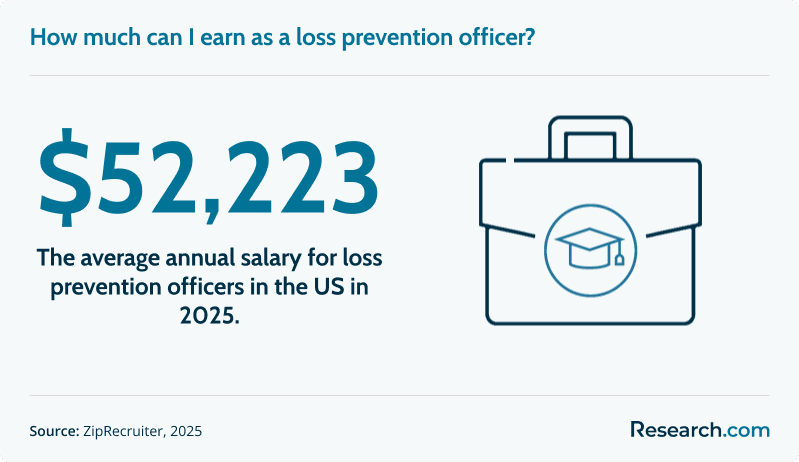
Pay can vary by employer, location, experience, and job scope. Compensation data in this field may be reported differently by source, with figures including a median salary of around $52,223 and, later in this guide, a median annual salary of $41,873 for Loss Prevention Officers. This guide explains what the job involves, what skills and credentials matter, how to enter the field, and how to decide whether loss prevention is the right long-term path for you.
Key Things You Should Know About Loss Prevention Office Career
- The typical earning potential for a loss prevention officer is around $52,223 per year, with most salaries falling between $36,000 and $57,000.
- This field offers steady demand and wide pay variation, signaling solid opportunities for advancement and ongoing need without rapid growth or decline.
- A high school diploma or equivalent is generally sufficient to start, though some employers value additional security or law enforcement training.
- Success depends on keen attention to detail, strong observation and communication skills, conflict resolution ability, and familiarity with surveillance and security systems.
- Advancement can lead from loss prevention officer to supervisory and management roles, including loss prevention supervisor, manager, and asset protection manager, with options to move into corporate security or risk management.
What do Loss Prevention Officers do?
Loss Prevention Officers protect a company’s assets by preventing theft, fraud, damage, and safety incidents. In retail settings, they focus heavily on merchandise shrink, shoplifting, employee theft, suspicious transactions, and policy violations. In broader security environments, they may also monitor access points, respond to disturbances, and support emergency procedures.
The role sits between customer-facing retail work, private security, and basic investigations. Officers must observe carefully, act within company policy, and understand when to intervene, when to document, and when to involve law enforcement. A good officer does not simply react to theft; they help identify patterns that show where the business is vulnerable.
A day in the life of Loss Prevention Officers
A typical shift may include walking the sales floor, reviewing CCTV footage, checking high-risk areas, communicating with store managers, monitoring alarms, and documenting incidents. Some periods are quiet and routine. Others require quick decisions, especially when suspected theft, fraud, workplace conflict, or a safety issue occurs.
The job also involves administrative discipline. Reports must be clear, objective, and accurate because they may be reviewed by managers, insurers, legal teams, or law enforcement. Officers who advance in the field usually become strong at both sides of the job: calm field response and careful documentation.
What are the key responsibilities of Loss Prevention Officers?
Loss Prevention Officers are responsible for reducing preventable losses while maintaining a safe environment for customers, employees, and visitors. Their duties vary by employer, but the core expectation is the same: identify risks early, follow lawful procedures, and create reliable records of what happened.
- Patrol store premises, stockrooms, entrances, exits, parking areas, and other assigned locations to deter theft and identify suspicious activity.
- Monitor CCTV, alarms, electronic article surveillance systems, access points, and other security tools to detect potential incidents.
- Observe suspected shoplifting, internal theft, fraud, or policy violations and respond according to company rules and applicable law.
- Apprehend or detain suspected shoplifters only when permitted by employer policy, training, and local legal standards.
- Write detailed incident reports, preserve evidence, maintain accurate logs, and support follow-up investigations.
- Coordinate with store employees, managers, security teams, and law enforcement when incidents require escalation.
- Respond to emergencies, disturbances, medical incidents, evacuations, or unsafe conditions within the limits of training.
- Recommend practical ways to reduce shrink, such as improving product placement, staffing coverage, camera angles, or cash-handling procedures.
The most challenging vs. the most rewarding tasks
The most difficult part of the job is often direct confrontation. Approaching a suspected shoplifter or disruptive person requires calm judgment, clear communication, and strict adherence to policy. A poor decision can create safety risks, legal exposure, or reputational harm for the employer.
The most rewarding part is seeing a measurable impact. Recovering merchandise, preventing repeat theft, improving store safety, or identifying a loss pattern gives officers a clear sense that their work matters. The role can also build a strong foundation for advancement into investigations, security management, and asset protection leadership.
If you want a faster route to a bachelor’s credential for future leadership roles, compare flexible options such as online accelerated bachelors programs before committing to a schedule or cost structure.
What are the key skills for Loss Prevention Officers?
Effective loss prevention work depends on more than physical presence. Employers look for people who can observe small details, stay composed under pressure, use security technology correctly, document incidents precisely, and communicate without escalating conflict.
Core technical skills
- Surveillance system use: Officers must know how to monitor CCTV, alarms, access systems, and other tools without missing important activity.
- Legal and policy awareness: Apprehension, detention, evidence handling, and reporting must follow company rules and applicable laws.
- Incident documentation: Reports should be factual, chronological, specific, and free of unsupported assumptions.
- Behavioral observation: Officers need to recognize suspicious patterns without relying on bias or profiling.
- Emergency response basics: Depending on the employer, this may include first aid, evacuation support, disturbance response, and coordination with law enforcement.
Soft skills that matter
- Attention to detail: Small inconsistencies in behavior, receipts, camera footage, or inventory movement can reveal larger problems.
- Judgment: Officers must decide when to observe, when to intervene, and when to escalate.
- Communication: Clear, respectful language helps with customers, employees, managers, and police officers.
- Conflict resolution: De-escalation protects everyone involved and reduces avoidable risk.
- Integrity: Loss prevention staff often handle sensitive information and must be trusted to follow procedures consistently.
The overlooked skill that separates good officers from great ones
Analytical thinking is one of the most valuable skills in loss prevention. A reactive officer may stop isolated incidents. A strategic officer looks for patterns: repeat theft times, vulnerable product categories, blind spots, refund fraud trends, employee access issues, or gaps in opening and closing procedures.
For example, an officer who notices recurring theft in one aisle may review camera placement, staffing patterns, product displays, and transaction records. That analysis can lead to changes that prevent future losses rather than simply responding after the fact.
For candidates building foundational credentials, easy associate's degree programs may be worth comparing with employer training, certificate programs, and criminal justice coursework.
Loss Prevention Office Careers: A Step-by-Step Guide to Getting Started
Getting into loss prevention is usually more straightforward than it appears. Most candidates begin with basic education, retail or security experience, employer training, and a clean background check. From there, advancement depends on performance, professionalism, credentials, and the ability to handle sensitive incidents responsibly.
- Earn a high school diploma or equivalent. This is the common baseline for entry-level roles and shows employers that you meet minimum education requirements.
- Build relevant experience. Retail, customer service, warehouse, security, military, corrections, or public safety experience can help because these roles develop observation, communication, and policy-following skills.
- Apply for entry-level loss prevention or asset protection roles. Look for titles such as Loss Prevention Officer, Asset Protection Associate, Security Officer, or Store Detective, depending on the employer.
- Complete background screening and employer training. Many employers require background checks and structured training in surveillance, apprehension policy, report writing, de-escalation, emergency response, and evidence handling.
- Learn the legal limits of the role. Policies differ by employer and jurisdiction. Do not assume that practices used at one company are allowed at another.
- Pursue certifications when they match your goals. Credentials can help you compete for promotion, especially if you want to move into investigations, supervision, or corporate asset protection.
- Track results and build a promotion case. Keep records of completed training, strong reports, successful investigations, shrink reduction efforts, and leadership contributions.
The most successful candidates treat the first job as a proving ground. Reliability, judgment, confidentiality, and calm communication often matter as much as formal education at the entry level.
What education, training, or certifications are required?
Most Loss Prevention Officer jobs require at least a High School Diploma or GED. Some employers prefer candidates with an Associate or Bachelor of Science degree in Criminal Justice, Security Management, Criminology, or a related field. A degree is not always required for entry-level work, but it can help for corporate, supervisory, investigative, or multi-site roles.
Training is often provided by the employer and may include shadowing experienced officers, learning company apprehension policies, using CCTV and alarm systems, writing incident reports, responding to emergencies, and communicating with law enforcement. Many employers also require periodic refresher training so officers remain current on policy and safety procedures.
Common education and credential options
| Option | Best for | What to consider |
| High School Diploma or GED | Entry-level Loss Prevention Officer roles | Usually the minimum requirement, but advancement may require experience or additional training. |
| Associate degree | Candidates who want a stronger foundation in criminal justice or security | Can support advancement without the time commitment of a bachelor’s degree. |
| Bachelor of Science in Criminal Justice or related field | Future supervisors, investigators, and corporate asset protection candidates | May improve competitiveness for leadership roles, but cost and time should match your career goals. |
| Private Security and Loss Prevention certificates | Candidates seeking targeted, job-relevant training | Useful when the curriculum covers surveillance, report writing, legal boundaries, and investigations. |
| LPQ and LPC from The Loss Prevention Foundation | Professionals who want industry-recognized credentials | The LPQ, or Loss Prevention Qualified, and LPC, or Loss Prevention Certified, can demonstrate commitment and professional knowledge. |
Are advanced degrees or niche certifications worth the investment?
Advanced degrees such as a Master of Science in Law Enforcement Intelligence or Criminal Justice are usually not necessary for entry-level Loss Prevention Officer roles. They may make more sense if your goal is corporate security leadership, law enforcement intelligence, risk management, compliance, or advanced investigations.
Professional certifications are often the more practical first investment because they are targeted, faster to complete, and directly connected to loss prevention work. A graduate degree may be worth considering later if it clearly supports a specific promotion path or career change. If you are comparing graduate options, review resources on which masters degree pays the most and weigh potential return against tuition, time, and employer requirements.
The best credential is the one that fits your next career step. Do not collect certifications without a plan. Choose education that helps you qualify for the specific role you want.
What is the earning potential for Loss Prevention Officers?
The median annual salary for a Loss Prevention Officer is $41,873. Reported earnings range from about $28,900 per year at entry level to approximately $61,218 per year for senior professionals. Actual pay can vary widely because “loss prevention” titles may include different responsibilities depending on the employer.
Higher-paying roles are more likely to involve specialized investigations, multi-site responsibility, organized retail crime work, team leadership, or corporate asset protection. Location also matters. Large metropolitan areas and higher-risk retail environments may offer stronger compensation, but they can also bring higher stress, heavier incident volume, and more demanding schedules.
Factors that can increase earning potential
- Experience: Officers who demonstrate sound judgment and strong documentation skills are better positioned for senior roles.
- Certifications: Industry credentials such as LPQ and LPC can support advancement when employers value formal loss prevention training.
- Technology skills: Familiarity with surveillance systems, analytics, case management tools, and fraud detection can improve competitiveness.
- Leadership ability: Supervising teams, training staff, and coordinating investigations can lead to higher-level roles.
- Employer type: Pay may differ between small retailers, national chains, distribution environments, and corporate asset protection departments.
What is the job outlook for Loss Prevention Officers?
The projected job growth for loss prevention officers falls between 2% and 6% over the next decade, which is average to slightly below average compared to all occupations. The field remains relevant because businesses continue to face theft, fraud, inventory shrinkage, workplace safety concerns, and organized retail crime.
The outlook is not uniform. Basic surveillance roles may face pressure from automation, centralized monitoring, and tighter retail budgets. However, officers who can combine field experience with technology, investigations, data analysis, and fraud prevention skills may have stronger long-term prospects.
The key factors shaping the future outlook
- Technology: AI-enabled surveillance, predictive analytics, digital reporting, and remote monitoring are changing how prevention work is done. Officers need to be comfortable learning new systems.
- Retail crime patterns: Theft and fraud are becoming more organized in some environments, increasing demand for officers who can document patterns and support investigations.
- E-commerce and digital fraud: Loss prevention increasingly intersects with online returns, payment fraud, account abuse, and cyber-related risks.
- Economic conditions: Retail profitability, inflation, and consumer spending can affect security budgets and hiring levels.
- Professionalization: Employers may favor candidates who understand legal boundaries, de-escalation, documentation, and data-driven prevention.
If you want to build technology or criminal justice skills without overspending, compare options such as the cheapest accredited online college choices and confirm that any institution you consider is properly accredited.
What is the typical work environment for Loss Prevention Officers?
The typical Loss Prevention Office Work Environment is on-site and active. Most officers work in retail settings such as department stores, big-box retailers, specialty shops, grocery stores, and building supply stores. Employment data shows that 51% work in general merchandise retailers, 13% in clothing and accessories stores, and 7% in building material and garden supply dealers.
Work may involve standing, walking, observing from surveillance rooms, moving through stockrooms, and responding quickly when incidents occur. Officers may work alone during parts of a shift but still coordinate with store leadership, security teams, employees, emergency responders, and law enforcement.
Schedule and culture
The Loss Prevention Office Schedule and Culture often includes evenings, weekends, holidays, and rotating shifts because stores need coverage when customer traffic is highest. Remote and hybrid work are generally not available for front-line roles because officers must be physically present to observe, respond, and support store teams.
The culture can be disciplined and procedure-driven. Strong teams emphasize safety, lawful conduct, clear communication, confidentiality, and respect for customers and employees. A weak culture may push officers toward risky confrontations or unclear expectations, so candidates should ask about training, apprehension rules, staffing, and incident escalation during interviews.
What are the pros and cons of Loss Prevention Officer careers?
Loss prevention can be a good fit for people who want practical security experience, investigative work, and a visible impact on business operations. It can be a poor fit for those who dislike confrontation, inconsistent schedules, strict procedures, or long periods of close observation.
| Pros | Cons |
| Clear entry path for candidates with a High School Diploma or GED | Evening, weekend, holiday, and rotating shifts are common |
| Hands-on experience in security, investigations, and asset protection | Confrontations can be stressful and sometimes unsafe |
| Opportunity to develop transferable skills in reporting, de-escalation, surveillance, and risk awareness | Routine patrols and monitoring can feel repetitive |
| Potential advancement into senior officer, investigator, supervisor, manager, or corporate roles | Strict legal and policy requirements leave little room for careless decisions |
| Work can feel meaningful because it protects employees, customers, property, and business assets | Remote work is generally not an option for front-line positions |
Who is most likely to thrive?
This career tends to suit people who are observant, patient, calm under pressure, and comfortable following detailed rules. It may also appeal to those who like independent work but can still communicate effectively when incidents require teamwork. For readers comparing good jobs for an introvert, loss prevention may offer a workable mix of focused observation and purposeful interaction.
Before pursuing the field, be honest about your tolerance for confrontation and irregular schedules. The role can be rewarding, but it requires maturity and restraint.
What are the opportunities for advancement for Loss Prevention Officers?
Loss prevention can lead to a long-term career if you use the entry-level role to build evidence-based investigation skills, leadership ability, and knowledge of business risk. Advancement may happen through a management path, a specialist path, or a move into adjacent security and compliance functions.
Common advancement path
- Entry-level roles: Loss Prevention Officer, Loss Prevention Associate, Asset Protection Associate, or Security Officer. These roles build core skills in observation, reporting, patrol, policy compliance, and incident response.
- Experienced or senior roles: Senior Officer, Store Detective, Loss Prevention Investigator, or Asset Protection Specialist. These positions may involve more complex cases, evidence review, interviews, and coordination with management.
- Supervisory roles: Loss Prevention Supervisor or Asset Protection Supervisor. These roles add scheduling, training, coaching, case review, and team accountability.
- Management roles: Loss Prevention Manager, Asset Protection Manager, or Director-level roles. These positions require strategy, budgeting, multi-site oversight, program design, and executive communication.
Specialization areas to elevate your career
- Investigations and organized retail crime: Focuses on repeat offenders, coordinated theft, fraud networks, and evidence development.
- Technology and data analysis: Uses surveillance systems, exception reporting, transaction analysis, and analytics to identify loss trends.
- Risk management and compliance: Builds policies, audits procedures, reduces operational risk, and supports regulatory or corporate requirements.
- Training and program development: Teaches de-escalation, incident response, safety practices, reporting standards, and theft prevention procedures.
Promotion is rarely based on apprehension numbers alone. Employers also look for professionalism, sound judgment, accurate reports, low-risk decision-making, and the ability to reduce losses without creating legal or safety problems.
What other careers should you consider?
If you are interested in loss prevention but unsure about the daily demands, compare it with related careers. Adjacent roles may offer a better fit depending on whether you prefer investigations, security operations, leadership, public safety, or risk management.
- Asset Protection Specialist: Similar to loss prevention, with emphasis on shrink reduction, theft prevention, fraud review, and asset security.
- Security Officer: Focuses more broadly on access control, patrol, incident response, and maintaining safety in locations such as offices, hospitals, campuses, warehouses, or events.
- Loss Prevention Investigator: Involves deeper investigative work, evidence collection, case documentation, interviews, and analysis of theft or fraud patterns.
- Asset Protection Manager: Leads teams, develops prevention strategies, reviews performance, manages programs, and coordinates with store or corporate leadership.
- Public Safety Supervisor: Oversees safety procedures, emergency response, staff coordination, and risk management in public-facing environments.
Choose based on the work you want to do every day. If you enjoy observation and store-level response, front-line loss prevention may fit. If you prefer analysis and casework, investigation may be better. If you want broader authority and planning responsibility, asset protection management or risk management may be the stronger target.
Here's What Professionals Say About Their Loss Prevention Office Careers
- : "Being a Loss Prevention Officer means more than watching merchandise. I feel responsible for helping keep the workplace safe for shoppers and employees. The training helps me recognize situations that could escalate, and that preparation matters on difficult shifts. Knowing that my attention can prevent theft and reduce potential harm gives the role real purpose. — Ivan"
- : "Confronting someone suspected of theft can be intense, so staying calm is essential. I have learned to focus on professionalism, de-escalation, and safety for everyone involved. Respect and composure make a major difference when a situation is tense. Each encounter has helped me become more confident and controlled. — Marisol"
- : "The best moments are when I help recover merchandise or calm a situation without anyone getting hurt. It is rewarding to know that my actions protect the business and help coworkers feel safer. Those successes remind me why vigilance and good judgment are so important in this job. — Derek"
Key Findings
- Loss Prevention Officers protect merchandise, money, property, employees, and customers by preventing theft, fraud, and safety incidents.
- Most entry-level roles require a High School Diploma or GED, while degrees in Criminal Justice, Security Management, or Criminology can support advancement.
- Key skills include surveillance, legal and policy awareness, report writing, de-escalation, attention to detail, and analytical thinking.
- The median annual salary for a Loss Prevention Officer is $41,873, with a range from about $28,900 per year to approximately $61,218 per year for senior professionals.
- Projected job growth falls between 2% and 6% over the next decade, with stronger opportunities for candidates who understand technology, fraud, investigations, and data-driven prevention.
- The work environment is usually on-site in retail settings, with evening, weekend, holiday, and rotating schedules common.
- Advancement can lead to roles such as senior officer, investigator, supervisor, asset protection manager, loss prevention manager, or director.
- This career is best suited for people who are observant, ethical, calm under pressure, and comfortable following strict procedures during sensitive incidents.
Other Things You Should Know About Loss Prevention Office
In 2027, loss prevention officers need skills in surveillance, data analysis, and physical security measures. Effective communication, problem-solving, and knowledge of store policies and retail technology are crucial to accurately identifying and preventing losses in various retail environments.
Certifications like the Certified Protection Professional (CPP) and Certified Fraud Examiner (CFE) can enhance a loss prevention career in 2027. They demonstrate expertise and commitment to the field, potentially leading to better job positions and salary increases.
References
- Career Outlook and Job Vacancies for Retail Loss Prevention Specialists https://www.recruiter.com/careers/retail-loss-prevention-specialists/outlook/
- How to Become a Loss Prevention Officer: Career Path & Guide | Himalayas https://himalayas.app/career-guides/loss-prevention-officer
- Loss Prevention Specialist - Alternative Careers and Similar Jobs (Updated for 2025) https://resumeworded.com/career-profiles/loss-prevention-specialist-career-profile
- What are the pros and cons of working as a Loss Control Specialist? https://www.jobzmall.com/careers/loss-control-specialist/faqs/what-are-the-pros-and-cons-of-working-as-a-loss-control-specialist
- Retail Loss Prevention Specialists at My Next Move https://www.mynextmove.org/profile/summary/33-9099.02
- The Top Duties and Skills of Loss Prevention Security https://paladinsecurity.com/security-careers/loss-prevention/
- Loss Prevention Specialist Job Description + Skills, Salary, Resume Examples | ClearPointHCO https://clearpointhco.com/loss-prevention-specialist-job-description/
- Spotterful | Main Responsibilities and Required Skills for a Loss Prevention Officer https://spotterful.com/en/blog/job-description-template/loss-prevention-officer-responsibilities-and-required-skills
- Retail Loss Prevention Specialists Tasks, Knowledge, Skills - BigFuture Career Search https://bigfuture.collegeboard.org/careers/retail-loss-prevention-specialist/tasks-knowledge-skills


