
2027 Tax Consultant Careers: Skills, Education, Salary & Job Outlook

Co-Founder and Chief Data Scientist
Choosing a tax consultant career means deciding whether you want work that combines accounting, financial judgment, client service, and constant legal change. The field can be demanding: tax rules shift, deadlines are strict, and clients expect accurate guidance when mistakes can be expensive. But for people who like problem-solving, detail-oriented analysis, and practical advisory work, tax consulting can offer a durable career path.
This guide explains what tax consultants do, the skills and credentials that matter, how to enter the field, what the work environment is like, and where the career can lead. You will also see how salary and job outlook figures can vary by role definition, employer, location, and source. Some references place tax-related earnings near $70,000-$77,250 with 6% job growth projected through 2031, while other sections below use more specific tax consultant and accountant/auditor figures. Use the data as benchmarks, not guarantees.
Key Things You Should Know About Tax Consultant Career
- A tax consultant typically earns between $70,615 and $90,500 annually, with a median salary around $87,500 in 2025.
- The demand for tax consultants is expected to remain steady, matching the average growth rate of 5% projected for accountants and auditors through 2032.
- Most tax consultants start with at least a bachelor's degree in accounting, finance, or a related field, often enhancing their qualifications with CPA or EA credentials.
- Success in this career depends on strong analytical skills, attention to detail, current tax law knowledge, proficiency in tax software, effective client communication, and problem-solving abilities.
- Career progression typically moves from junior or associate consultant roles to senior consultant and management positions, with opportunities to become a partner or start a private practice.
What do Tax Consultants do?
Tax consultants help individuals, businesses, and organizations understand tax rules, meet filing obligations, and make lawful decisions that may reduce tax liability. Their work is not limited to preparing returns. Strong consultants interpret tax law, review financial records, identify planning opportunities, explain risks, and help clients prepare for audits or major financial events.
In practice, a tax consultant acts as both a compliance professional and an advisor. Compliance work focuses on accuracy, deadlines, documentation, and reporting. Advisory work looks ahead: how a business expansion, sale of property, retirement decision, merger, or cross-border transaction could affect taxes.
A Day in the Life of Tax Consultants
A typical day often blends focused technical work with client communication. A consultant may review financial statements in the morning, research a tax issue before lunch, meet with a client in the afternoon, and finalize return documentation or planning notes before the day ends. During busy seasons, the pace becomes more deadline-driven and detail-intensive.
The best tax consultants are not simply “good with numbers.” They are able to translate complicated rules into practical choices. Clients need to know what they must do, what they may do, what documentation is required, and what risks come with each option.
What are the key responsibilities of Tax Consultants?
Tax consultants are responsible for helping clients comply with tax requirements while making informed financial decisions. The exact duties vary by employer, client type, and specialization, but most roles include a mix of preparation, research, planning, and advisory work.
Tax consultants commonly:
- Prepare and file tax returns for individuals, businesses, or organizations, making sure calculations, forms, and deadlines are handled correctly.
- Meet with clients to understand income, expenses, business activity, investments, major life events, and other tax-relevant details.
- Identify deductions, credits, elections, and planning opportunities that fit the client’s facts and comply with applicable rules.
- Develop tax planning strategies for events such as marriage, retirement, business growth, acquisitions, asset sales, or ownership changes.
- Monitor changes in tax law and explain how new rules may affect clients.
- Support clients during audits, notices, disputes, or requests for additional documentation.
- Research complex issues such as international taxation, mergers, entity structure, payroll tax, or state and local tax exposure.
The Most Challenging vs. The Most Rewarding Tasks
The hardest part of the job is often applying changing tax rules to real financial situations where the answer is not obvious. A consultant may need to interpret guidance, evaluate risk, and document the reasoning behind a recommendation. The stakes can be high, especially for businesses, high-net-worth clients, or clients facing audits.
The most rewarding part is that the work has visible impact. A well-designed tax strategy can improve cash flow, prevent penalties, support a business decision, or give a client confidence during a stressful filing season. For many professionals, that combination of technical challenge and client trust is what makes the career appealing.
If you are still building the academic foundation for this field, an accelerated bachelor's degree may help you complete a relevant undergraduate program more efficiently, depending on your schedule, transfer credits, and career goals.
What are the key skills for Tax Consultants?
Tax consultants need a combination of technical tax knowledge, financial analysis, professional judgment, and client communication. Technical accuracy matters, but it is not enough. Clients also need advice they can understand and act on.
Key Hard Skills
- Tax Law Interpretation: Understand federal, state, and local tax rules and apply them to specific client situations.
- Financial Analysis: Review income statements, balance sheets, ledgers, tax returns, and supporting records to identify issues and opportunities.
- Tax Planning: Evaluate how timing, entity structure, transactions, deductions, credits, and elections may affect a client’s tax position.
- Research: Use tax guidance, regulations, rulings, forms, and professional resources to answer complex questions accurately.
- Documentation: Maintain clear workpapers, calculations, client records, and support for positions taken on returns or in planning memos.
- Technology Use: Work with tax preparation software, spreadsheets, document management tools, and increasingly automated tax workflows.
Key Soft Skills
- Analytical Thinking: Break down complicated facts and rules into a reasoned recommendation.
- Attention to Detail: Catch errors in figures, forms, assumptions, and deadlines before they create problems.
- Communication: Explain tax issues in plain language without oversimplifying risks.
- Organization: Manage multiple clients, filings, notices, and due dates at the same time.
- Professional Skepticism: Ask follow-up questions when records are incomplete, inconsistent, or unclear.
- Client Judgment: Recognize when a client needs conservative compliance support, aggressive planning analysis, or referral to another specialist.
The One Overlooked Skill That Separates the Good from the Great
The overlooked skill is strategic advisory. Average tax consultants answer the question in front of them. Strong consultants also ask what the decision will mean next year, during an audit, in a sale, for cash flow, or for the client’s broader financial plan.
For example, a consultant advising a business owner on a transaction may consider not only the immediate tax result but also how the decision affects future acquisitions, financing, valuation, or succession planning. This broader view is especially valuable in complex business settings, including the management of companies and enterprises sector, which is identified as the highest paying industry for tax consultants.
Students comparing academic routes may review options such as easy college majors, but the better question is whether a program builds the accounting, business, analytical, and communication skills needed for long-term tax work.
Tax Consultant Careers: A Step-by-Step Guide to Getting Started
Becoming a tax consultant is usually a staged process: build the academic base, gain practical exposure, earn credentials where useful or required, and then develop a specialization. You do not need to have every step completed before entering the field, but you should understand how each stage affects your options.
- Build a foundation in accounting, tax, finance, or business. Most candidates start with coursework that covers financial accounting, business law, taxation, auditing, and data analysis.
- Get practical experience early. Internships, seasonal tax preparation roles, bookkeeping work, and entry-level accounting jobs help you learn how tax rules appear in real client records.
- Develop software and documentation habits. Employers value candidates who can use tax software, spreadsheets, client portals, and organized workpapers accurately.
- Pursue credentials that fit your goals. CPA, EA, and other tax-focused credentials can improve credibility and expand the type of work you can perform.
- Choose a practice area. Individual tax, small business tax, corporate tax, international tax, estate and trust tax, and state and local tax can lead to different work styles and advancement paths.
- Keep learning. Tax consulting requires continuing education because laws, forms, agency guidance, and enforcement priorities change over time.
A practical entry strategy is to start where you can get real tax exposure, even if the role is not your long-term target. Seasonal or junior positions can teach return preparation, client communication, and deadline management faster than classroom study alone.
What education, training, or certifications are required?
Most tax consultant roles require at least a bachelor’s degree in accounting, finance, business, or a related field. Accounting is often the most direct route because it covers financial reporting, taxation, auditing, and the recordkeeping concepts used in tax work. Finance and business degrees can also be useful, especially when paired with tax coursework or accounting experience.
Professional credentials can significantly affect credibility, job options, and the scope of services a consultant can provide. Two of the most recognized credentials are the Certified Public Accountant (CPA), issued by State Boards of Accountancy, and the Enrolled Agent (EA), granted by the IRS. Both require exams and continuing education to maintain. The right choice depends on whether you want a broad accounting credential, a tax-focused federal credential, or both.
On-the-job training is also important. Many professionals build competence through around three years of relevant work experience in accounting, auditing, tax preparation, or with tax agencies. Internships and entry-level roles are valuable because they expose you to client records, filing deadlines, documentation standards, and common tax issues.
Are advanced degrees or niche certifications worth the investment?
Advanced degrees, such as a master’s in accounting or taxation, can be worthwhile for professionals who want to move into complex tax planning, corporate tax, international tax, or leadership roles. They may also help students meet education requirements for certain credentials, depending on state rules and program design.
Niche credentials such as the Chartered Tax Consultant (CTC®) or Certified Tax Coach can provide focused training, but they should be evaluated carefully. Before enrolling, check whether employers in your target market recognize the credential, what continuing education is required, and whether the cost fits your expected return.
If graduate school is part of your plan, compare program cost, accreditation, CPA exam alignment, tax course depth, faculty experience, and career outcomes. A master degree that pays well can be a strategic investment, but only if it supports the roles and credentials you actually want.
What is the earning potential for Tax Consultants?
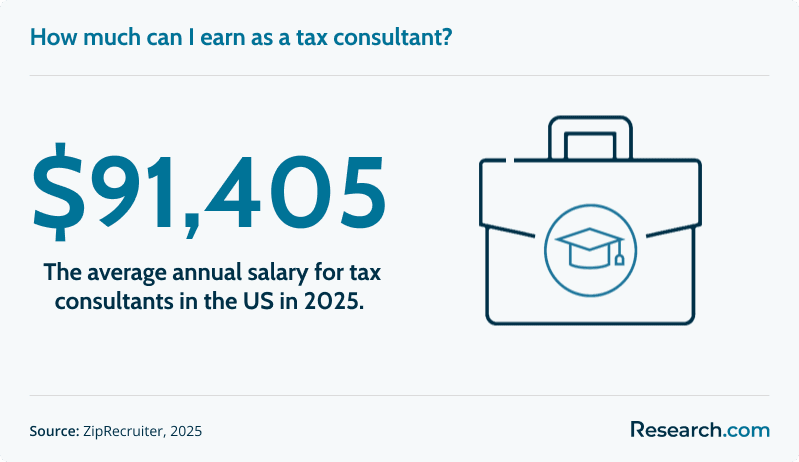
The median annual salary for a Tax Consultant in the United States is $90,500. The tax consultant salary range 2025 spans from entry-level positions starting at $51,500, averages around $73,000 to $90,500, and can reach up to $132,000 for experienced professionals. These figures should be treated as benchmarks because compensation depends heavily on employer type, location, credentials, client base, and specialization.
Entry-level tax professionals usually earn less because they are still learning return preparation, research methods, software systems, and client communication. Earnings tend to rise as consultants handle more complex matters, manage client relationships, supervise staff, or specialize in high-value areas such as corporate tax, international tax, mergers and acquisitions, or tax technology.
Geography also matters. Tax consultants in New York or California often earn well above the national average, but higher pay may come with higher living costs, more competitive hiring markets, and heavier client demands. Industry can also affect compensation: public accounting, corporate tax departments, financial services, and self-employed consulting can produce very different income patterns.
What affects tax consultant pay most?
- Experience: Senior consultants, managers, and specialists generally earn more than entry-level preparers.
- Credentials: CPA and EA credentials can improve trust and expand opportunities, especially for advanced compliance or representation work.
- Specialization: Complex practice areas often command higher compensation than basic individual return preparation.
- Client type: Business, high-net-worth, international, and corporate clients may require deeper expertise and support higher fees.
- Work setting: Large firms, corporate departments, small practices, and independent consulting each have different pay structures and trade-offs.
What is the job outlook for Tax Consultants?
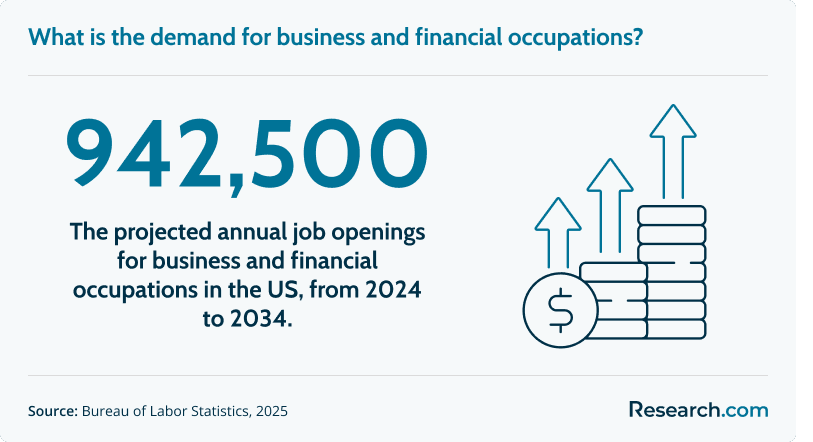
The job outlook for tax consultants is generally stable because tax obligations do not disappear when the economy changes. The occupation is often classified under accountants and auditors, which shows a projected growth rate of 5% from 2024 to 2034 (BLS, 2025). This rate exceeds the average growth expected across all occupations over the same period. Some older or broader references also cite 6% job growth projected through 2031, so readers should note the time period and occupational grouping behind any projection.
The Key Factors Shaping the Future Outlook
The biggest driver of demand is tax complexity. Businesses and individuals need help interpreting changing rules, documenting decisions, responding to notices, and planning transactions. The more complex a client’s financial life becomes, the more valuable qualified tax advice can be.
Technology is also reshaping the profession. Automation and AI can reduce time spent on routine data entry, basic form completion, and repetitive compliance work. That does not eliminate the need for tax professionals; it changes what employers value. Consultants who can review automated outputs, identify errors, interpret rules, advise clients, and use tax technology effectively are likely to be more competitive.
Talent shortages can also support demand. If fewer accounting graduates enter the field, employers may compete more actively for qualified tax professionals. However, candidates should not assume job security without skill development. The strongest outlook belongs to consultants who combine tax knowledge, technology fluency, communication, and sound professional judgment.
Professionals considering advanced education for specialized research, teaching, or senior advisory goals may explore flexible options such as 1 year PhD programs online free, but a doctorate is not a standard requirement for most tax consultant roles.
What is the typical work environment for Tax Consultants?
Tax consultants work in accounting firms, tax preparation businesses, corporate tax departments, financial services firms, payroll and bookkeeping organizations, government-related settings, and independent practices. Most tax consultants work primarily on-site (63%), while others work in hybrid (27%) or remote (10%) settings. The work usually combines independent analysis with scheduled client meetings, team reviews, and deadline-driven production.
The work environment changes significantly by season. Outside the busiest months, many tax consultants work more predictable schedules focused on planning, research, extensions, notices, and client follow-up. During tax season from January to April, 60+ hour weeks with evening and weekend work are frequent. Busy periods can span 6 to 8 months in some practices, especially when business returns, extensions, audits, or specialized consulting projects overlap.
Remote and hybrid work can improve flexibility, but it does not remove the pressure of deadlines or client responsiveness. Some employers still require in-person work for onboarding, team collaboration, confidential document review, or client meetings. Before accepting a role, candidates should ask how the firm handles busy-season hours, overtime expectations, remote work, client load, and post-season flexibility.
What are the pros and cons of Tax Consultant careers?
Tax consulting can be a strong fit for people who like technical analysis, deadlines, and client-facing problem-solving. It can be a poor fit for those who dislike detailed documentation, recurring busy seasons, or constant regulatory change. The career’s advantages and drawbacks are closely connected: the complexity that creates demand also creates pressure.
Pros
- Clear financial value for clients: Consultants can identify deductions, credits, planning strategies, and compliance steps that directly affect a client’s financial position.
- Stable need for expertise: Tax filing, planning, and compliance remain ongoing needs for individuals and businesses.
- Intellectual challenge: The work rewards people who enjoy research, analysis, and solving problems with imperfect facts.
- Multiple career settings: Tax consultants can work in public accounting, corporate tax, financial services, small practices, or self-employment.
- Specialization potential: Professionals can build careers in corporate tax, international tax, estate tax, state and local tax, tax technology, or advisory services.
Cons
- Busy-season pressure: Filing deadlines can lead to long hours, compressed workloads, and high stress.
- Constant rule changes: Consultants must keep learning to avoid outdated advice.
- High accuracy expectations: Errors can create penalties, client disputes, or reputational damage.
- Client stress: Tax problems often involve money, audits, deadlines, or uncertainty, which can make communication difficult.
- Credential and education demands: Advancement may require exams, continuing education, and years of supervised experience.
This career is best for people who can stay calm under deadlines, work carefully with financial records, and explain complicated issues clearly. For learners who need flexibility while building qualifications, the most affordable online colleges for working adults may be worth comparing by cost, accreditation, transfer policy, and accounting coursework.
What are the opportunities for advancement for Tax Consultants?
Tax consulting offers several advancement routes. Some professionals move up within public accounting or corporate tax departments. Others become independent consultants, specialize in a niche, or shift into broader finance leadership. Advancement usually depends on technical depth, client management, credentials, leadership ability, and business development skills.
Career Advancement Path
- Tax Consultant or Junior Tax Consultant: Learn return preparation, basic research, workpaper documentation, client intake, and filing procedures.
- Senior Tax Consultant: Handle more complex returns, review junior staff work, research technical issues, and communicate more directly with clients.
- Tax Manager: Manage client relationships, supervise teams, plan engagements, review tax positions, and coordinate deadlines.
- Director or Partner: Lead practice areas, develop business, oversee risk, mentor professionals, and advise on high-level tax strategy.
- Financial Manager or CFO: Use tax expertise as part of broader financial leadership, budgeting, compliance, and strategic decision-making.
Exciting Specializations in Tax Consulting Careers
Specialization can make a tax consultant more valuable because clients often need help with problems that generalists do not handle every day. The right specialty depends on your interests, preferred clients, and tolerance for technical complexity.
- Transfer Pricing: Advising on cross-border transaction pricing and compliance with international tax laws.
- VAT & Indirect Tax: Focusing on VAT strategy, compliance, and audit defense, often for global clients.
- Corporate Tax Advisory: Providing strategic guidance on mergers, acquisitions, entity structure, and complex restructurings.
- Technology-Integrated Tax Roles: Using AI, automation, data tools, and tax software to improve compliance workflows and advisory insights.
- State and Local Tax: Helping businesses manage multi-state filing obligations, nexus questions, sales tax, and local compliance.
- Estate and Trust Tax: Supporting clients with wealth transfer, fiduciary returns, and tax planning tied to estates and trusts.
The strongest advancement strategy is to build a broad compliance base first, then specialize once you understand which clients and problems you want to serve.
What other careers should you consider?
If tax consulting interests you but you are not sure it is the right fit, compare it with adjacent careers. Many use similar skills but differ in client contact, seasonality, credential requirements, and daily tasks.
- Accountant: Maintains financial records, prepares statements, supports reporting, and may handle tax-related work depending on the role.
- Bookkeeper: Records daily transactions, reconciles accounts, tracks expenses, and keeps financial documentation organized.
- Audit Specialist: Reviews financial statements, controls, records, and compliance processes to identify errors or risks.
- Tax Manager: Leads tax compliance and planning functions, supervises staff, reviews complex work, and manages deadlines.
- Financial Advisor: Helps clients plan investments, retirement, insurance, and financial goals, often considering tax implications as part of the strategy.
Choose tax consulting if you want tax law and planning to be central to your work. Choose accounting if you prefer broader financial reporting. Choose auditing if you like verification and controls. Choose financial advising if you want a more relationship-driven planning role with tax as one part of a larger financial picture.
Here's What Professionals Say About Their Tax Consultant Careers
- Elena: "I've always believed that thorough knowledge of the tax code, combined with genuine care for clients, truly sets you apart. The more I learned, the more confident I became in advocating for them, especially during difficult audits or complex filings. Helping clients feel represented and understood in those moments is what makes the work so rewarding. It's not just about numbers; it's about providing peace of mind that no amount of money can replace."
- Jamal: "There were times when the tax seasons felt overwhelming, with new regulations constantly changing and certain small business accounting tasks that I hadn't tackled before. I didn't have all the answers, but I kept pushing myself to deepen my expertise so I could meet every client's needs accurately. It wasn't always easy, but persevering through those challenges taught me resilience and made me a better advisor. I've grown to appreciate how essential patience and ongoing learning are in this field."
- Marie: "After I fully understood the intricacies of preparing tax returns and handling client interactions, I started to choose the projects that aligned best with my skills and values. I now command rates that reflect the quality and dedication I offer, which makes the demanding aspects worthwhile. Most importantly, I see how my work directly improves clients' financial wellbeing, and that's incredibly fulfilling. Knowing I make a tangible difference in their lives keeps me motivated every day."
Key Findings
- Tax consultants help clients comply with tax rules, reduce risk, and make informed financial decisions through preparation, research, planning, and advisory work.
- The career requires strong technical knowledge, but communication, organization, judgment, and strategic advisory skills are just as important for advancement.
- Common education routes include accounting, finance, business, or law-related degrees, with CPA and EA credentials offering important professional advantages.
- The median annual salary for a Tax Consultant in the United States is $90,500, with the tax consultant salary range 2025 starting at $51,500 and reaching up to $132,000 for experienced professionals.
- The job outlook is stable, with accountants and auditors projected to grow 5% from 2024 to 2034 (BLS, 2025), while some references cite 6% job growth projected through 2031.
- Tax season can be demanding, with 60+ hour weeks common from January to April and busy periods sometimes lasting 6 to 8 months.
- The best candidates are detail-oriented, comfortable with deadlines, willing to keep learning, and able to explain complex tax issues in practical terms.
Other Things You Should Know About Tax Consultant
In 2027, AI and automation are significantly transforming tax consultancy by streamlining data analysis and compliance tasks. This allows consultants to focus more on strategic tax planning and advisory roles, requiring them to adapt by enhancing their tech skills to leverage these new tools effectively.
Entry-level positions for tax consultants in 2026 include roles such as Junior Tax Consultant, Tax Associate, and Tax Analyst. These positions typically involve preparing tax returns, assisting with audits, and researching tax law while gaining experience under the supervision of senior consultants.
References
- 7 Tax Consultant Interview Questions and Answers for 2025 | Himalayas https://himalayas.app/interview-questions/tax-consultant
- Tax Consultant Skills in 2025 (Top + Most Underrated Skills) https://www.tealhq.com/skills/tax-consultant
- Why Choose a Career as a Tax Consultant? https://www.icb.org.za/how-to-become-a-tax-consultant/
- Employment outlook for 2025 https://www.taxconnex.com/blog-/employment-outlook-2025
- What Does a Tax Specialist Do? 2025 Career Guide https://www.coursera.org/articles/tax-specialist
- Careers in Tax | Chartered Institute of Taxation https://www.tax.org.uk/careers-in-tax
- What Is a Tax Consultant? Duties, Skills and Roles | Ascot International https://www.ascotinternational.net/blog/what-is-a-tax-consultant/
- Five Must-Have Hard Skills for Accountants | INAA https://www.inaa.org/five-must-have-hard-skills-for-accountants/
- U.S. Bureau of Labor Statistics. (2025). Accountants and auditors. In Occupational Outlook Handbook. U.S. Department of Labor. Retrieved February 3, 2026, from https://www.bls.gov/ooh/business-and-financial/accountants-and-auditors.htm


