
2027 What Does a Payroll Specialist Do: Responsibilities, Requirements, and Salary

Co-Founder and Chief Data Scientist
A payroll specialist sits at the point where employee trust, financial accuracy, and legal compliance meet. If paychecks are late, deductions are wrong, overtime is miscalculated, or tax records are incomplete, the issue quickly becomes more than an administrative mistake—it can affect morale, audits, cash flow, and regulatory risk.
The role is often a practical entry point into human resources, accounting, finance, or workforce operations. The U.S. employed around 156,950 payroll and timekeeping clerks in 2024, according to the Bureau of Labor Statistics (BLS, 2025). Even as automation changes routine payroll work, organizations still need people who can interpret rules, investigate discrepancies, protect confidential data, and explain pay-related questions clearly.
This guide explains what payroll specialists do, how the role differs from a payroll clerk, what education and certifications may help, what salaries look like, and where the career can lead. It also outlines the job outlook, common challenges, and the skills that can make a payroll professional more resilient in a technology-driven labor market.
Key Things You Should Know About Becoming a Payroll Specialist
- Most payroll specialists hold an associate or bachelor’s degree in accounting, finance, or human resources.
- Earning certifications can improve employment opportunities and potentially raise the median salary, which is around $55,000.
- With experience and continued education, a payroll specialist can advance to leadership or advanced roles.
What are the primary duties of a payroll specialist?
A payroll specialist is responsible for making sure employees are paid accurately, on time, and in compliance with applicable rules. The work blends accounting, human resources, data management, customer service, and regulatory compliance. In many organizations, payroll specialists are the people who turn time records, salary data, tax rules, benefits elections, and company policies into correct paychecks.
Common duties include:
- Processing employee wages, salaries, commissions, and other compensation accurately
- Calculating overtime, deductions, bonuses, paid leave, and adjustments
- Preparing and filing payroll taxes in accordance with federal and state laws
- Maintaining employee payroll records and updating timekeeping data
- Generating payroll reports for managers, auditors, finance teams, and HR leaders
- Coordinating with HR and accounting teams so employee records, benefits, and financial data match
- Managing direct deposits, benefits deductions, wage garnishments, and final pay where applicable
During a typical pay cycle, a payroll specialist verifies timekeeping information, confirms new-hire and termination data, reviews deductions, checks for missing approvals, and resolves exceptions before payroll is submitted. After payroll runs, the specialist may reconcile totals, answer employee questions, correct errors, and prepare reports for accounting or management.
The job requires more than entering numbers into software. Payroll specialists must protect confidential information, understand how policies apply to specific pay situations, and recognize when an issue needs to be escalated to HR, finance, legal, or a payroll manager. Professionals who want to move toward HR leadership may later build on payroll experience through programs such as a master’s degree in human resource management online, especially if they want deeper knowledge of employment law, compensation systems, and workforce data.
A strong payroll specialist does three things consistently: verifies information before payroll closes, documents decisions clearly, and communicates pay issues in plain language. Those habits reduce rework and help employees trust the payroll process.
What is the difference between a payroll specialist and a payroll clerk?
The titles “payroll specialist” and “payroll clerk” are sometimes used interchangeably, but they do not always mean the same thing. In a small company, one person may perform both roles. In a larger organization, a payroll clerk may handle routine entries, while a payroll specialist may manage more complex payroll issues, compliance tasks, reporting, and system-related work.
The practical difference is usually the level of judgment required. Payroll clerks often follow established procedures and focus on accurate data entry. Payroll specialists are more likely to investigate discrepancies, interpret policies, support audits, and coordinate with HR, finance, and tax professionals.
| Area | Payroll Clerk | Payroll Specialist |
| Typical level | Entry-level or early-career | Entry- to mid-level, depending on the organization |
| Main focus | Data entry, timekeeping updates, routine payroll processing | Full-cycle payroll support, compliance, reporting, audits, and issue resolution |
| Decision-making | Usually works under close supervision and follows set procedures | Often applies judgment to resolve payroll exceptions and policy questions |
| Technical depth | Uses payroll systems for basic entries and corrections | May help troubleshoot payroll software, review system outputs, and work with integrated HR or accounting platforms |
| Career direction | Can progress into specialist or coordinator roles | Can progress into senior payroll, payroll analyst, payroll manager, HR, or finance roles |
One common mistake is judging the role by the title alone. A “payroll clerk” in one organization may handle broader duties than a “payroll specialist” in another. Job seekers should read the posting carefully and look for clues such as tax filing, multi-state payroll, system administration, audit support, union payroll, garnishments, and payroll reporting.
Career specialization works similarly in other business functions: professionals may start with general responsibilities and then move into more technical or analytical roles. For example, students comparing online graduate certificate programs in logistics and supply chain management will often see how specialization can change the scope and level of responsibility in a field.
How does the payroll specialist role differ in small vs. large companies?
The size of the employer strongly affects what a payroll specialist does every day. In a small company, payroll work is usually broader and more hands-on. In a large company, payroll work is often more specialized, system-driven, and connected to formal HR, finance, compliance, and analytics teams.
In a small company, a payroll specialist may own the entire pay cycle from start to finish. That can include collecting time sheets, updating employee records, processing direct deposits, reconciling payroll totals, handling benefits deductions, answering questions, and helping with basic bookkeeping or HR administration. The advantage is wide exposure. The trade-off is that one person may carry many deadlines with limited backup.
In a large company, payroll specialists may focus on a narrower part of payroll, such as tax reporting, garnishments, union payroll, benefits deductions, payroll auditing, international payroll coordination, or system testing. These organizations often use more advanced payroll and analytics systems that connect HR, accounting, finance, and compliance data. According to HR.com, larger companies are more likely to treat payroll as a strategic function, with 21% of large teams describing their payroll as transformative.
Transformative payroll goes beyond issuing payments. It uses data to improve decision-making, control costs, strengthen compliance, and improve the employee payroll experience. More than half of transformative payroll teams rate their organization’s performance as excellent in various functions, including controlling unnecessary costs, complying with regulations, and enhancing the payroll employee experience (HR.com, 2025).
| Factor | Small company payroll role | Large company payroll role |
| Scope | Broad, generalist, often full-cycle | Specialized, structured, and team-based |
| Systems | May use simpler payroll tools or fewer integrations | Often uses integrated HR, payroll, accounting, and analytics systems |
| Decision-making | Requires flexibility and practical problem-solving | Requires process discipline, compliance awareness, and cross-functional coordination |
| Learning opportunity | Strong exposure to many payroll and administrative tasks | Stronger exposure to complex compliance, reporting, and technology environments |
| Main risk | Limited backup and competing duties | Complex workflows, high transaction volume, and tighter process controls |
Students and professionals comparing education options often face a similar trade-off between speed, depth, and specialization, as seen in resources such as online master of communication management programs. Payroll careers follow the same pattern: a smaller environment can build range, while a larger environment can build technical depth.
This chart displays the differences in the effectiveness of payroll teams’ strategies.
What academic and certification requirements are required to become a payroll specialist?
Payroll specialist jobs do not always require the same education level, but employers commonly look for evidence that a candidate can work accurately with numbers, confidential records, business software, and employment-related rules. According to Zippia, about 48% of payroll specialists possess a bachelor’s degree, while others start with an associate degree (29%). Meanwhile, payroll clerks can gain an entry-level role with some college courses or a high school diploma (CareerOneStop, 2025).
For entry-level payroll clerk roles, a high school diploma, some college coursework, bookkeeping experience, administrative experience, or familiarity with payroll software may be enough. For payroll specialist roles, employers may prefer candidates with an associate or bachelor’s degree in accounting, finance, business administration, human resources, or a related field.
Different academic paths support different parts of the job:
- Accounting or finance: Helps with reconciliations, payroll liabilities, tax-related records, reporting, and internal controls.
- Human resource management: Supports understanding of compensation practices, employee records, benefits, labor rules, onboarding, and terminations.
- Business administration: Provides a broader view of how payroll connects to operations, budgeting, compliance, and management decisions.
- Information systems or analytics coursework: Can be useful for payroll systems, reporting tools, data validation, and automation-heavy environments.
Students who may eventually move from payroll into accounting or finance should compare program outcomes, cost, format, and time commitment. If they are considering an online accounting pathway, it can also help to research how long does it take to get an accounting degree online before choosing a program.
Certifications are not always mandatory, but they can help candidates demonstrate payroll knowledge, especially when they do not yet have extensive experience. They may also help working professionals prepare for more technical or supervisory roles.
- Fundamental Payroll Certification (FPC): Offered by the American Payroll Association (APA), this credential validates foundational payroll knowledge and can support entry- to mid-level payroll roles.
- Certified Payroll Professional (CPP): Also administered by the APA, the CPP recognizes advanced expertise in payroll management, compliance, and systems administration. It is often pursued by professionals aiming for leadership or senior payroll responsibilities.
- Certified Payroll Specialist (CPS): Issued by the National Association of Certified Public Bookkeepers (NACPB), this certification confirms expertise in payroll reporting, tax filing, and federal regulation compliance.
Graduate education is usually not required for a payroll specialist position. However, a master’s degree in accounting, human resources, business administration, or a related field may be useful for professionals who want to move into senior payroll management, HR leadership, auditing, accounting, or broader finance roles.
What skills do you need to have as a payroll specialist?
Payroll specialists need a mix of technical accuracy, regulatory awareness, communication skill, and discretion. The best payroll professionals are not simply “good with numbers.” They can detect errors, explain pay issues without creating confusion, work under strict deadlines, and protect sensitive employee information.
Key skills include:
- Communication skills: Payroll specialists must explain pay, deductions, tax withholdings, garnishments, and benefits-related issues clearly to employees and managers.
- Math and technical knowledge: Accurate calculations, spreadsheet use, system navigation, and comfort with payroll platforms are essential.
- Legislative knowledge: Around 96% of employers highly value this skill among payroll professionals (Chartered Institute of Payroll Professionals, 2024). Specialists must stay informed about tax codes, wage laws, and labor regulations to support compliance.
- Analytical skills: Payroll work often involves spotting unusual entries, tracing discrepancies, comparing reports, and finding the source of errors.
- Industry knowledge and business acumen: Understanding how payroll affects budgets, accounting records, labor costs, employee satisfaction, and compliance helps specialists make better decisions.
- Timekeeping skills: Accurate tracking of hours, leave, overtime, shift differentials, and benefits is central to correct pay.
- Organization skills: Payroll runs on fixed schedules. Specialists must manage deadlines, approvals, documentation, corrections, and reporting without losing detail.
- Confidentiality: Payroll teams handle salaries, Social Security numbers, banking information, tax data, and personal employee records. Discretion is non-negotiable.
- Problem-solving: Employees often contact payroll when something feels urgent or personal. Specialists need to investigate calmly and resolve issues without making assumptions.
Technology is also reshaping the role. Payroll software, cloud platforms, automation, artificial intelligence, and integrated HR systems can reduce manual work, but they also raise the skill level expected of payroll staff. Specialists must know how to review system outputs, identify exceptions, question suspicious data, and understand where automation may still require human review.
In a U.K. survey by MHR Global (2025), it was found that 88% of payroll teams lack the skills to keep up with technological innovations. This gap can potentially lead to employee burnout and turnover as professionals struggle to balance learning new technologies with meeting ongoing operational demands.
For current and aspiring payroll specialists, the practical lesson is clear: learn the rules, but also learn the systems. Professionals who can combine compliance knowledge with software fluency, reporting ability, and clear communication will be better positioned as payroll becomes less manual and more analytical.
This chart shows the main skills that payroll professionals must possess.
What is the average salary for a payroll specialist?
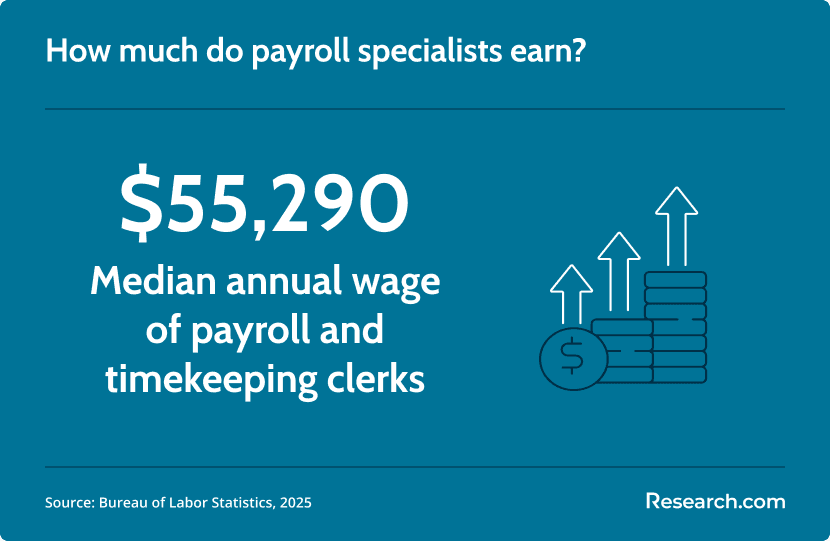
According to the U.S. Bureau of Labor Statistics (BLS), payroll and timekeeping clerks earned a median annual wage of $55,290 in 2024. Salaries typically range from $36,670 at the 10th percentile to $78,830 at the 90th percentile.
This places payroll and timekeeping clerks slightly above the median wage for all occupations ($49,500), but below several related HR and finance occupations. For comparison, HR specialists earned $72,910, compensation and benefits specialists earned $77,020, and accountants earned $81,680.
| Occupation | Median annual wage |
| All occupations | $49,500 |
| Payroll and timekeeping clerks | $55,290 |
| HR specialists | $72,910 |
| Compensation and benefits specialists | $77,020 |
| Accountants | $81,680 |
Actual pay depends on experience, job title, employer size, location, industry, software skills, and the complexity of the payroll environment. A specialist who supports multi-state payroll, tax reporting, union rules, garnishments, audits, or payroll system implementation may have stronger earning potential than someone handling only routine payroll entries.
Certification can also matter, especially when paired with experience. Credentials such as the FPC, CPP, or CPS may help candidates show technical knowledge, but they do not guarantee a specific salary. The strongest salary growth usually comes from moving into senior payroll, payroll analyst, payroll supervisor, HR, accounting, compensation, benefits, or finance roles.
Payroll may not offer the highest earnings among business occupations, but it can offer stable, transferable experience. For workers who want a practical route into HR or finance, the role can be a useful foundation.
What is the typical career path for a payroll specialist?
A payroll career often starts with routine processing and gradually moves toward analysis, compliance, systems, management, or broader HR and finance work. The path is not identical for everyone, but the progression usually follows a clear pattern: learn the pay cycle, master exceptions, take on compliance and reporting, then move into leadership or specialization.
- Payroll clerk or payroll assistant: Early-career professionals learn timekeeping, wage calculation, employee data updates, basic payroll software, and record verification.
- Payroll specialist or payroll coordinator: Professionals begin managing pay cycles more independently, handling deductions, benefits, tax-related tasks, corrections, and employee questions.
- Senior payroll specialist or payroll analyst: Work becomes more complex and may include audits, reporting, process improvement, system testing, multi-state payroll, reconciliations, and compliance reviews.
- Payroll supervisor or payroll manager: Managers oversee payroll staff, establish procedures, review controls, coordinate with HR and finance, and ensure payroll operations meet organizational standards.
- Director of payroll, HR manager, financial controller, or related leadership role: Senior professionals focus on payroll strategy, technology implementation, risk management, budgeting, compliance, and executive-level reporting.
Some payroll specialists move laterally rather than upward. Common transitions include HR specialist, benefits specialist, compensation analyst, accountant, payroll systems analyst, tax specialist, or financial analyst. The right path depends on whether a professional prefers people-focused work, compliance, reporting, software, accounting, or management.
Advanced education is not required for every step, but it may help professionals who want to move into leadership, analytics, or broader business strategy. For example, some working professionals compare graduate business options such as online MBA programs in sports management when evaluating how a business degree might support management-level career goals in specialized industries.
The most marketable payroll professionals are those who can show measurable responsibility: number of employees processed, types of payroll handled, systems used, audit involvement, compliance tasks, and process improvements. Keeping a record of these achievements can make promotions and job searches easier.
What is the job outlook for a payroll specialist?
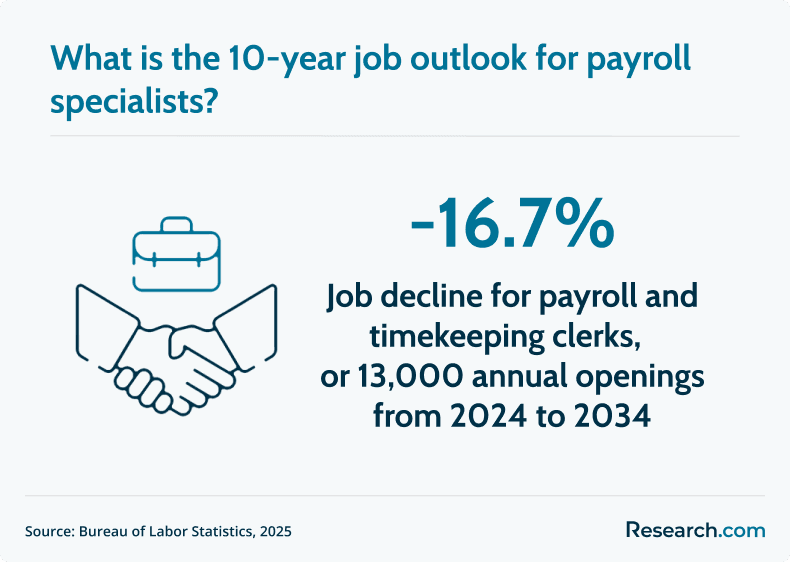
The long-term outlook for routine payroll and timekeeping roles is challenging. According to the BLS, the employment for payroll and timekeeping clerks is projected to decline by 16.7% from 2024 to 2034, with about 13,000 annual openings.
The projected decline is closely tied to automation. Payroll platforms, AI-supported tools, employee self-service systems, integrated accounting software, and automated timekeeping systems can now perform many tasks that previously required manual entry. Retirements and career shifts also affect the number of openings.
The World Economic Forum also lists payroll and timekeeping roles among the top 10 fastest-declining jobs, echoing the rise of digital platforms, AI-driven data processing, and robotic systems as key contributors to this trend.
This does not mean payroll experience has no value. It means the safest career strategy is to move beyond repetitive processing. Employers will still need professionals who can manage exceptions, understand compliance, audit automated outputs, protect data, support system implementations, and explain payroll issues to employees and leaders.
Related occupations may offer stronger long-term options. The BLS projects employment increases for compensation and benefits specialists, accountants and auditors, and financial and investment analysts over the same period. Payroll specialists who build skills in data analytics, accounting, HR compliance, payroll technology, and financial reporting can position themselves for those adjacent roles.
For students and career changers, the decision is not simply whether payroll is “growing” or “declining.” The better question is whether the role will help build transferable skills. Payroll can still be a useful starting point if the professional treats it as a foundation for compliance, HR, accounting, systems, or analytics work rather than as a purely clerical destination.
What other jobs can a payroll specialist do?
Payroll experience can transfer to several careers because the work develops skills in records management, compliance, reporting, employee communication, tax-related processes, benefits administration, and financial accuracy. The easiest transitions are usually into jobs that use similar data, systems, or employment rules.
Professionals who want to move into more analytical or leadership-focused roles may need additional coursework, certifications, or a degree. Programs such as the best online MBA in analytics programs can be relevant for those who want to build stronger data, management, and decision-making skills.
Alternative careers include:
- Tax Examiners and Collectors ($59,740): Review tax returns, identify errors, and ensure that individuals and businesses pay the correct amount of taxes.
- HR Specialists ($72,910): Manage recruitment, onboarding, employee records, HR compliance, and employee relations tasks.
- Accountants ($81,680): Maintain financial records, prepare reports, reconcile accounts, and support compliance with tax and accounting standards.
- Budget Analysts ($87,930): Help organizations plan, monitor, and evaluate spending while recommending ways to control costs.
- Labor Relations Specialists ($93,500): Handle negotiations, contracts, grievances, and workplace disputes between management and employees.
- Financial and Investment Analysts ($101,350): Evaluate financial data, market trends, and investment opportunities to guide business or client decisions in maximizing returns and minimizing risks.
- HR Managers ($140,030): Oversee HR operations, including recruitment, payroll coordination, employee development, policy implementation, and compliance.
- Compensation and Benefits Managers ($140,360): Design and manage pay structures and benefit programs that support recruitment, retention, and workforce planning.
- Financial Managers ($161,700): Oversee an organization’s financial operations and use financial data to drive profitability, ensure compliance, and support executive decision-making.
The most realistic next step depends on the specialist’s current strengths. A payroll professional who enjoys employee questions may fit well in HR. Someone who likes reconciliations and reports may be better suited for accounting. A specialist who enjoys systems, dashboards, and process improvement may want to pursue payroll analytics, HRIS, or finance analytics roles.
What are the typical challenges faced by a payroll specialist?
Payroll is deadline-driven, detail-heavy, and highly visible. Employees notice payroll errors immediately, and regulators may penalize employers for compliance failures. The pressure is manageable, but only when payroll teams use disciplined processes, clear documentation, and reliable systems.
Common challenges include:
- Keeping up with regulatory changes: Payroll professionals must monitor federal, state, and local tax rules, wage laws, reporting requirements, and policy updates. Misinterpreting a rule can create financial and legal risk.
- Maintaining data accuracy: Incorrect time records, tax settings, pay rates, deductions, job codes, or benefits information can lead to incorrect pay. Regular audits and exception reports help reduce errors.
- Protecting confidential data: Payroll teams handle sensitive employee and financial information. Secure systems, access controls, privacy procedures, and cybersecurity awareness are essential.
- Adapting to technology changes: New payroll software, automation tools, HR integrations, and reporting platforms can improve accuracy, but they also require training and careful testing.
- Managing high workload and tight deadlines: Payroll calendars leave little room for delay. Specialists must plan ahead, communicate missing approvals early, and build backup processes for busy cycles.
- Resolving employee concerns: Pay problems can feel personal and urgent to employees. Payroll specialists must respond with accuracy, patience, and professionalism.
- Handling exceptions: Off-cycle payments, retroactive adjustments, final pay, garnishments, bonuses, leave corrections, and multi-state issues often require extra review.
Successful payroll specialists reduce these risks by using checklists, maintaining clean documentation, reconciling reports, confirming policy interpretations, and asking for clarification before payroll closes. The role rewards people who are precise, calm under pressure, and willing to keep learning.
What Professionals Who Work as Payroll Specialists Say About Their Careers
- : "My first year as a payroll specialist was the toughest. Deadlines were relentless, and I worried about making mistakes. With guidance from experienced colleagues and a lot of self-discipline, I developed a strong workflow system. Now, handling complex payroll cycles feels second nature. The journey was challenging, but it helped me grow into a dependable professional who values consistency and integrity. — Amara"
- : "People often assume payroll is just about crunching numbers, but it’s really about helping people. I get questions every week about paychecks, deductions, or benefits, and I enjoy being able to give clear answers and fix problems quickly. The role has taught me to be patient and to communicate clearly, especially when explaining complex tax details. Building trust through transparency is a big part of what I do. — Lane"
- : "When I first joined the field, most payroll tasks were done by hand. Now, with automated systems and cloud-based software, everything runs much more smoothly. Learning new platforms took some effort, but they’ve made my job faster and far more accurate. Embracing technology has made me a better payroll specialist and helped me keep up with the changing demands of the job. — Justin"
Key Findings
- Payroll specialists help ensure employees are paid correctly, on time, and in compliance with tax, wage, benefits, and company rules.
- The role overlaps with payroll clerk positions, but specialists often handle more complex tasks such as audits, compliance, reporting, system troubleshooting, and exception resolution.
- Company size matters. Small-company payroll roles tend to be broad and hands-on, while large-company roles are usually more specialized and technology-driven.
- According to Zippia, about 48% of payroll specialists possess a bachelor’s degree, while others start with an associate degree (29%). Payroll clerks may enter the field with some college courses or a high school diploma (CareerOneStop, 2025).
- Useful credentials include the Fundamental Payroll Certification (FPC), Certified Payroll Professional (CPP), and Certified Payroll Specialist (CPS).
- According to the BLS, payroll and timekeeping clerks earned a median annual wage of $55,290 in 2024, with salaries ranging from $36,670 at the 10th percentile to $78,830 at the 90th percentile.
- The employment for payroll and timekeeping clerks is projected to decline by 16.7% from 2024 to 2034, with about 13,000 annual openings.
- Automation is reducing demand for routine payroll processing, but professionals with compliance, analytics, software, accounting, and HR skills can move into more resilient related roles.
- Payroll can be a strong starting point for careers in HR, accounting, compensation, benefits, tax, finance, and workforce operations.
Other Things You Should Know About Becoming a Payroll Specialist
Working as a payroll specialist in 2027 can be challenging due to evolving tax laws, technological advancements, and increased data security demands. Specialists must stay updated on these changes and manage accurate payroll processing amidst these complexities.
In 2027, a payroll specialist is responsible for managing employee compensation data, ensuring accurate payroll processing, maintaining compliance with tax laws, and addressing payroll-related inquiries. They may also oversee benefits management and collaborate with HR to ensure seamless employee payment operations.
Yes, a payroll specialist can transition into an accounting career with additional education and training. Payroll work provides a strong foundation in financial recordkeeping, data analysis, and tax compliance—all valuable accounting skills. Earning a degree in accounting or completing professional certifications, such as the CPA, can help advance this shift. The switch is achievable with commitment and continued learning.
Human Resources (HR) specialists focus on talent management, employee relations, and compliance. Payroll specialists, in contrast, handle salary calculations, tax deductions, and ensuring employees are paid accurately and on time. While there is overlap, each role requires different expertise and focuses on distinct areas of personnel management.
References
- CareerOneStop. (2025). Payroll and Timekeeping Clerks. Retrieved November 6, 2025, from https://www.careeronestop.org/Toolkit/Careers/Occupations/occupation-profile.aspx?keyword=Payroll%20and%20Timekeeping%20Clerks&location=UNITED%20STATES&onetcode=43305100
- Chartered Institute of Payroll Professionals. (2024, September). CIPP Future of Payroll Report 2024. https://www.cipp.org.uk/resourceLibrary/cipp-future-of-payroll-report-2024.html
- HR.com. (2025, February). HR.com’s Future of Payroll 2025. HR Research Institute. https://www.hr.com/en/resources/free_research_white_papers/hrcom%E2%80%99s-future-of-payroll-2025_m7u6h27d.html
- U.S. Bureau of Labor Statistics. (2024). Payroll and timekeeping clerks [Interactive data]. Occupational Employment and Wage Statistics (OEWS) Profiles. Retrieved November 6, 2025, from https://data.bls.gov/oesprofile
- U.S. Bureau of Labor Statistics. (2025, August 28). Occupational projections, 2024–2034, and worker characteristics, 2024 (Employment in thousands). Employment Projections. https://www.bls.gov/emp/tables/occupational-projections-and-characteristics.htm
- Zippia. (2025, January 8). Payroll specialist education requirements. Retrieved November 6, 2025, from https://www.zippia.com/payroll-specialist-jobs/education


