
2027 What Does a Radiation Therapist Do: Responsibilities, Requirements, and Salary

Co-Founder and Chief Data Scientist
Radiation therapy is a patient-facing oncology career for people who want a clinical role that combines technology, anatomy, safety protocols, and compassionate care. The main decision for aspiring radiation therapists is whether they are ready for a highly precise healthcare job where treatment accuracy, communication, and emotional resilience matter every day.
The need for qualified professionals is clear: recent data shows that the vacancy rate for radiation therapists in the U.S. stands at 13.6%. That shortage does not mean the path is automatic, however. Employers typically expect accredited education, supervised clinical experience, certification readiness, and a strong commitment to patient safety.
This guide explains what radiation therapists do, what education and skills they need, where they work, how much they earn, how to enter the field, and what challenges and advancement paths to consider before committing to this career.
Key Things You Should Know About What Does a Radiation Therapist Do
- A radiation therapist can advance into roles such as lead therapist, clinical supervisor, dosimetrist, or radiation therapy educator, with opportunities to specialize in advanced treatment techniques.
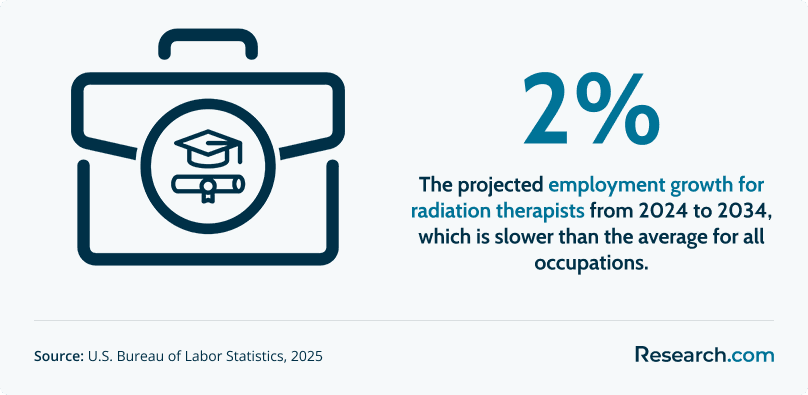
- Employment for radiation therapists is projected to grow 2% from 2024 to 2034, driven by ongoing advancements in cancer treatment and an aging population.
- Radiation therapists in the United States earn an average annual salary of $105,300, or about $51 per hour, reflecting the high skill level and responsibility required in this field.
What does a radiation therapist do?
A radiation therapist delivers prescribed radiation treatments to patients, most often as part of cancer care. The role is not simply operating a machine. Radiation therapists prepare patients, verify positioning, follow detailed treatment plans, monitor reactions, document each session, and coordinate closely with the oncology team to keep treatment safe and accurate.
Typical responsibilities include:
- Explaining treatment plans: Radiation therapists help patients understand what will happen during treatment, how long sessions may take, what side effects may occur, and when to report symptoms.
- Maintaining radiation safety: They follow strict shielding, exposure, equipment, and room-entry procedures to protect patients, coworkers, and themselves from unnecessary radiation exposure.
- Localizing tumors and positioning patients: They use imaging and positioning tools to align the patient’s body with the treatment plan so radiation targets the intended area.
- Operating and checking equipment: They set up, calibrate, and operate radiation therapy machines according to the radiation oncologist’s prescription and departmental protocols.
- Monitoring patients during treatment: They observe patients for unusual reactions, discomfort, distress, or movement that could affect treatment accuracy.
- Documenting care: They record treatment doses, session details, patient responses, and relevant notes so the care team has accurate information for follow-up decisions.
Radiation therapists work inside a team-based oncology environment. They must be comfortable taking direction, asking questions when something does not match the plan, and communicating clearly with both patients and clinical specialists.
- Medical dosimetrists: Calculate precise radiation doses and help translate the physician’s prescription into a treatment plan tailored to the tumor and surrounding tissue.
- Medical physicists: Verify treatment plans, monitor equipment performance, support quality assurance, and help maintain radiation safety standards.
- Oncology nurses: Assess patient symptoms, manage side effects, provide education, and support patients throughout treatment.
- Radiation oncologists: Prescribe radiation therapy, oversee treatment decisions, and adjust plans based on imaging, side effects, and patient response.
- Other healthcare professionals: Radiation therapists may coordinate with surgeons, primary care physicians, nutritionists, mental health counselors, and social workers. Students comparing allied health options can also review what an associate degree in medical assisting can lead to to understand broader patient-care pathways.
What are the educational requirements to become a radiation therapist?
Radiation therapists usually need formal postsecondary training in radiation therapy, radiologic technology, or a closely related health science field. Because the work involves radiation exposure, cancer treatment, and direct patient care, employers generally look for candidates who completed an accredited program with both classroom instruction and supervised clinical experience.
The usual education path includes:
- Associate or bachelor’s degree: Most radiation therapists earn an associate or bachelor’s degree in radiation therapy, radiologic technology, or a related health science field. An associate degree can be a direct entry route, while a bachelor’s degree may provide broader preparation for leadership, education, or later graduate study.
- Accredited program completion: Students should prioritize programs accredited by the Joint Review Committee on Education in Radiologic Technology (JRCERT), especially if they plan to pursue certification and state licensure.
- Core coursework: Programs typically cover anatomy, radiation physics, oncology, patient care, treatment procedures, medical terminology, imaging, and radiation safety.
- Clinical training: Supervised rotations in hospitals or cancer centers allow students to practice positioning, equipment use, patient communication, documentation, and safety procedures under professional oversight.
- Certification preparation: Graduates commonly prepare for the American Registry of Radiologic Technologists (ARRT) certification exam, which is required in most states.
- Continuing education: Radiation therapists must keep up with changing treatment techniques, safety standards, and equipment. Some professionals who want to move into administration or leadership also consider online MSN in health systems management programs, depending on their prior education and career goals.
Overall, 39% of radiation therapists major in biochemistry, biophysics, or molecular biology, which shows the value of a strong science foundation. However, students should not choose a major based on popularity alone. The better question is whether the program includes the clinical training, accreditation, certification preparation, and state eligibility needed for practice.
The chart below shows the most common degrees pursued by aspiring radiation therapists.
What are the required skills to become a radiation therapist?
Radiation therapists need a rare mix of technical precision and human-centered care. The job requires confidence with imaging and radiation equipment, but it also requires the patience to explain procedures to anxious patients and the judgment to stop and verify details when something seems wrong.
Technical Skills Required for Radiation Therapists
Technical skills help radiation therapists deliver prescribed treatment accurately and safely. Key abilities include:
- Patient treatment: Radiation therapists must administer therapy according to the approved treatment plan. This is cited by 5.54% of radiation therapists as a critical skill.
- Dosimetry knowledge: They need to understand how radiation dose, treatment fields, and patient anatomy affect therapy, even when dosimetrists and physicists handle the most advanced calculations. Dosimetry is highlighted by 3.66% of professionals.
- Treatment planning literacy: Therapists must read and follow treatment plans, verify setup requirements, and coordinate with oncologists and dosimetrists. Treatment planning is emphasized by 3.55% of radiation therapists.
- Patient monitoring: Therapists use imaging technology, monitoring systems, and clinical observation to confirm safe treatment delivery and identify issues during sessions. Patient care accuracy is reflected by 27.99% of therapists focusing on this area.
- Collaboration with radiation oncologists: Therapists must understand physician prescriptions, clarify discrepancies, and communicate patient changes effectively. This skill is cited by 8.43% of radiation therapists.
Soft Skills Required for Radiation Therapists
Soft skills are equally important because radiation therapists often see patients repeatedly during a stressful period of diagnosis and treatment. Strong therapists are calm, consistent, and careful under pressure.
- Patient care and communication: Therapists explain procedures in plain language, listen to concerns, and help patients feel respected and prepared. This is important to 8.98% of therapists.
- Attention to detail: Small errors in positioning, documentation, or treatment setup can create serious risk, so accuracy is non-negotiable.
- Critical thinking: Therapists must recognize when a patient response, equipment reading, or setup detail requires review before treatment continues.
- Teamwork and collaboration: Radiation therapy depends on coordinated work among oncologists, nurses, dosimetrists, physicists, and support staff.
- Confidentiality and professionalism: Therapists handle sensitive medical information and must follow privacy rules, ethical standards, and workplace safety policies.
Where do radiation therapists work?
Radiation therapists work mainly in clinical settings where patients receive cancer treatment, although some move into education, research, consulting, technology, or administrative roles. The workplace affects schedule, patient volume, career growth, and the type of technology a therapist may use.
- Health care: About 80% of radiation therapists work in hospitals, cancer treatment centers, or outpatient clinics, where they deliver treatments and monitor patient progress.
- Education: Around 7% work in academic institutions, where they may train students, supervise clinical learning, or contribute to research on treatment techniques.
- Nonprofits: Approximately 3% are employed by nonprofit organizations focused on cancer care, patient advocacy, access to treatment, or health education.
- Professional services: About 2% work in professional service settings, including consulting or medical advisory roles related to oncology services and equipment.
- Other industries: The remaining 5% work in pharmaceutical companies, manufacturing, government programs, start-ups, or Fortune 500 companies, often supporting research, product development, training, or health initiatives.
Radiation therapist jobs are heavily concentrated in the private healthcare sector, which employs about 86% of professionals in this field. On average, radiation therapists tend to stay in their roles for 1–2 years. For job seekers, this can signal mobility and advancement opportunities, but it also makes it important to evaluate employer support, workload, staffing levels, and professional development before accepting a position.
How much do radiation therapists earn?
Radiation therapists in the United States earn an average annual salary of $105,300, or approximately $51 per hour. Actual pay can vary by employer, region, experience, shift structure, and specialization. Candidates should compare total compensation, not just base salary, because benefits and paid time off can meaningfully affect the value of an offer.
Major salary factors include:
- Experience level: Entry-level radiation therapists earn about $103,264, while top earners make around $110,763 annually.
- Location: Pay varies by state and region, with the highest salaries in California ($116,100) and the lowest in Mississippi ($93,900).
- Education: Radiation therapists with a doctorate earn about $96,888, while those with a bachelor’s degree average $85,231.
- Company type: Large hospitals and cancer centers generally offer higher pay, with specialized roles exceeding $120,000 per year.
Benefits also matter. Radiation therapists typically receive benefits packages that include social security (5.6%), healthcare (4.6%), pension (3.1%), and paid time off (9.2%), bringing total average compensation to about $137,020 per year.
When comparing offers, ask about weekend or evening shifts, call expectations, overtime policies, continuing education reimbursement, certification support, staffing ratios, and opportunities to train on advanced equipment. A slightly lower base salary may still be competitive if the role offers stronger benefits, lower burnout risk, or faster advancement.
How to Start Your Career as a Radiation Therapist
To become a radiation therapist, plan backward from licensure and employment requirements in the state where you want to work. The safest path is to choose an accredited program, complete clinical training, prepare for certification, and verify state rules before graduation.
- Research the role before enrolling: Shadowing, informational interviews, and volunteer exposure in oncology settings can help you decide whether you are comfortable with cancer care, repeated patient contact, and highly technical treatment procedures.
- Obtain relevant education: Enroll in an accredited associate or bachelor’s degree program in radiation therapy or a related science field. Confirm that the curriculum supports certification eligibility and includes supervised clinical training.
- Complete a clinical internship: Use clinical rotations in hospitals or cancer treatment centers to build practical experience with patient positioning, treatment rooms, documentation, equipment protocols, and interdisciplinary communication.
- Earn professional certification: Pass the ARRT certification exam to demonstrate technical competence and meet state and employer qualification standards.
- Pursue state licensure: Review your state’s licensing requirements because most states require certification, licensure, and continuing education to practice legally.
- Apply for entry-level positions: Look for roles in hospitals, oncology clinics, and radiation centers where you can learn under experienced therapists and gain exposure to different treatment methods.
- Continue professional development: Keep skills current through continuing education in radiation safety, treatment technologies, imaging, and patient care. Healthcare workers comparing related pathways can also explore sterile processing technician career options to understand other clinical support roles.
What are common career advancement opportunities for radiation therapists?
Radiation therapists can advance by developing specialized clinical expertise, moving into supervision, teaching future practitioners, or transitioning into related technical and administrative roles. The best advancement path depends on whether you prefer patient care, planning and physics, leadership, education, or research.
- Specialization in advanced therapies: Therapists may train in techniques such as proton therapy, stereotactic radiosurgery, or brachytherapy. Specialization can make a therapist more valuable in advanced cancer centers and technology-intensive departments.
- Leadership and management roles: Experienced therapists may become senior therapists or chief therapists, overseeing scheduling, treatment quality, staff performance, workflow, and safety compliance.
- Education and training: Some professionals become clinical instructors or program directors, teaching students, onboarding new staff, and reinforcing safety and documentation standards.
- Dosimetry or medical physics pathways: With additional education, therapists may transition into medical dosimetry or medical physics, where the focus shifts toward treatment planning, dose calculation, quality assurance, and technical verification.
- Research and clinical development: Therapists interested in innovation may explore careers in clinical research, including studies, trials, data collection, or technology development projects designed to improve radiation therapy outcomes.
- Continuing education and certifications: Advanced certifications or graduate education can strengthen credentials for specialized, administrative, teaching, or quality improvement roles.
Before investing in additional education, compare the cost, time commitment, salary potential, and licensing or certification requirements of the target role. Some advancement options require formal credentials, while others depend more on experience, employer needs, and demonstrated leadership.
What is the job outlook for radiation therapists?
The job outlook for radiation therapists is steady but not fast-growing. Employment of radiation therapists is projected to grow 2% from 2024 to 2034, slower than the average for all occupations. Even with modest growth, the occupation remains important because radiation therapy continues to be a core part of cancer treatment.
Despite slower projected growth, about 900 job openings for radiation therapists are projected each year over the decade. Many openings are expected to come from replacement needs as experienced professionals retire, change roles, or move into related healthcare positions.
Over the past five years, radiation therapist salaries have increased by approximately 8%, reflecting the specialized skills required for oncology care. For students, the practical takeaway is that this can be a stable healthcare career, but job prospects may depend on location, clinical experience, certification status, willingness to work in high-need markets, and familiarity with advanced treatment technologies.
What challenges do radiation therapists typically face?
Radiation therapy can be rewarding, but it is not an easy clinical career. The work involves safety risks, emotional intensity, strict accuracy requirements, and frequent interaction with patients who may be frightened, uncomfortable, or seriously ill. Understanding these challenges before enrolling can help students prepare realistically.
1. Exposure to Radiation Risks
Radiation therapists work around ionizing radiation and must follow safety procedures every day. Although shielding, monitoring, equipment checks, and exposure protocols reduce risk, 55% report being exposed to radiation every day. Consistent compliance is essential because shortcuts can endanger both staff and patients.
2. High Workload and Scheduling Pressure
Therapists may treat many patients in a single day, especially in busy public healthcare settings or high-volume cancer centers. Nearly 16% of respondents cite patient workload as their primary clinical distraction. This pressure can make time management, documentation discipline, and teamwork critical to safe care.
3. Emotional Stress from Patient Care
Radiation therapists often see patients repeatedly over the course of treatment, which can create meaningful relationships but also emotional strain. About 40% of radiation therapists report burnout and anxiety affecting their ability to deliver care effectively. Healthy boundaries, peer support, and access to mental health resources are important in this field.
4. Technological Advancements and Training Demands
Radiation oncology technology changes regularly, and therapists must learn updated systems, imaging tools, quality procedures, and treatment workflows. Continuous training is part of the job, not an optional add-on.
5. Balancing Precision and Patient Interaction
Therapists must deliver technically exact treatment while also reassuring patients and responding to their needs. The challenge is maintaining empathy without losing focus on positioning, verification, documentation, and safety checks.
What are the alternative career options for radiation therapists?
Radiation therapists can move into related careers that use their background in anatomy, imaging, oncology, radiation safety, equipment operation, and patient care. Some alternatives require additional education, certification, or licensure, so therapists should confirm requirements before changing paths.
1. Medical Dosimetrist
Medical dosimetrists design and calculate radiation treatment plans based on radiation oncologists’ prescriptions. This pathway may appeal to therapists who enjoy treatment planning, anatomy, dose calculation, and collaboration with physicists and physicians.
Median salary: $129,364 per year
2. Radiologic Technologist
Radiologic technologists perform diagnostic imaging procedures such as X-rays, CT scans, or MRIs. Radiation therapists interested in broader imaging or perioperative support may also compare related training options, including a surgical tech certificate online, depending on the role they want to pursue.
Median salary: $95,196 per year
3. Radiation Oncology Clinical Educator
Clinical educators train students and staff, develop learning materials, support clinical competency, and reinforce safety and procedural standards. This role fits experienced therapists who are strong communicators and enjoy mentoring.
Median salary: $368,086 per year
4. Medical Equipment Sales Specialist
Therapists with strong technical knowledge may move into medical equipment sales, applications training, or product support. These roles often require the ability to explain complex systems to clinicians and decision-makers.
Median salary: $87,398 per year
5. Healthcare Administrator
Healthcare administrators manage staffing, budgets, operations, patient flow, compliance, and quality improvement in hospitals, clinics, and cancer centers. Former radiation therapists can bring practical insight into treatment workflows and patient safety.
Median salary: $94,295 per year
Here’s What Graduates Have to Say About Their Radiation Therapy Careers
- Kathleen: "I transitioned from a general radiography background to radiation therapy because I wanted to specialize and make a bigger difference in cancer care. The online program gave me the structure to upskill without stepping away from my job. Now, I’m part of an oncology team, helping patients through one of the most critical phases of their recovery."
- Jonas: "My goal was to upskill and advance from diagnostic imaging into a more specialized field. The online coursework in dosimetry and treatment planning gave me the edge I needed to step into a higher-paying, more impactful position. It’s rewarding to know my career growth also means helping patients fight cancer with confidence."
- Sean: "When my hospital expanded its oncology department, I saw an opportunity to grow my career. I enrolled in an online radiation therapy program to upskill quickly while continuing my shifts. That choice not only boosted my earning potential but also deepened my understanding of how technology saves lives."
Key Findings
- Radiation therapists deliver prescribed radiation treatments, monitor patients, document sessions, and work closely with radiation oncologists, dosimetrists, physicists, and oncology nurses.
- The career requires formal education, clinical training, certification preparation, and attention to state licensure requirements.
- Students should prioritize accredited programs, especially those accredited by the Joint Review Committee on Education in Radiologic Technology (JRCERT).
- Radiation therapists in the United States earn an average annual salary of $105,300, or approximately $51 per hour, with total average compensation of about $137,020 per year when benefits are included.
- Employment is projected to grow 2% from 2024 to 2034, with about 900 openings projected each year over the decade.
- The role can be emotionally and technically demanding because therapists must balance radiation safety, patient volume, technology updates, and compassionate cancer care.
- Advancement options include advanced therapy specialization, chief therapist roles, clinical education, medical dosimetry, medical physics pathways, research, and healthcare administration.
Other Things You Should Know About Becoming a Radiation Therapist
In 2027, to become a radiation therapist, one typically needs an associate's degree in radiation therapy or a related field. Additionally, most employers require certification, such as from the American Registry of Radiologic Technologists (ARRT), which involves passing an exam. Continuing education is essential to maintain certification and stay updated on advancements.
In 2027, a radiation therapist typically needs to be certified by the American Registry of Radiologic Technologists (ARRT). The certification process includes passing the ARRT examination and maintaining certification through continuing education and adherence to professional standards.
References
- American Society of Radiologic Technologists. (2022). Radiation therapy staffing and workplace survey 2022. Retrieved from ASRT
- American Society of Radiologic Technologists. (n.d.). RTT workplace final report. Retrieved from ASRT
- Bureau of Labor Statistics. (2023). Occupational employment and wages, May 2023: Radiation therapists (29-1124). Retrieved from BLS
- Bureau of Labor Statistics. (n.d.). Radiation therapists. Retrieved from BLS
- Bureau of Labor Statistics. (n.d.). Radiation therapists—Occupational outlook handbook. Retrieved from BLS
- Dev1 ASRT. (n.d.). Be Seen campaign. Retrieved from ASRT
- Ididio. (n.d.). Career overview: Radiation therapists. Retrieved from Ididio
- Interview Guy. (n.d.). Disadvantages of being a radiation therapist. Retrieved from Interview Guy
- PubMed. (2017). Stress and burnout among radiation therapists. Retrieved from PubMed
- Wisdom Lib. (n.d.). International Journal of Environmental Research and Public Health (MDPI). Retrieved from WisdomLib
- ZipRecruiter. (n.d.). Healthcare administrator salary. Retrieved from ZipRecruiter
- ZipRecruiter. (n.d.). Medical dosimetrist salary. Retrieved from ZipRecruiter
- ZipRecruiter. (n.d.). Medical equipment sales representative salary. Retrieved from ZipRecruiter
- ZipRecruiter. (n.d.). Radiation oncologist salary. Retrieved from ZipRecruiter
- ZipRecruiter. (n.d.). Radiology technologist salary. Retrieved from ZipRecruiter
- Zippia. (n.d.). Radiation therapist demographics. Retrieved from Zippia
- Zippia. (n.d.). Radiation therapist education requirements. Retrieved from Zippia


