
2027 What Does an Organizational Development Consultant Do: Responsibilities, Requirements, and Salary

Co-Founder and Chief Data Scientist
Choosing a career in organizational development means deciding whether you want to work at the intersection of people, strategy, systems, and change. Organizations hire organizational development consultants when performance problems are not caused by one employee or one policy, but by deeper issues in structure, leadership, culture, communication, or change readiness.
Demand for this work is rising as employers rethink how teams operate, how leaders communicate, and how organizations adapt to disruption. The market for OD consulting services is projected to grow at a compound annual growth rate (CAGR) of 6.4% through 2033, which reflects continued interest in workplace transformation, employee engagement, and organizational effectiveness.
This guide explains what OD consultants do, how the role differs from HR consulting, what education and certifications can help, which skills matter most, and what salary and job outlook data suggest for career planning. It is designed for professionals considering a move into OD from HR, management, psychology, healthcare leadership, consulting, training, or other people-centered fields.
Key Things You Should Know About What an Organizational Development Consultant Does
- Organizational development consultants analyze structures, processes, and workplace culture to enhance performance and guide companies through strategic change, helping align people and systems with business goals.
- Most consultants hold degrees in business, psychology, or organizational behavior, often supported by certifications like ODCP or CCMP, and rely on strong analytical, communication, and leadership skills to manage change effectively.
- The OD consulting market was valued at $931 million in 2025 and is expected to grow 6.4% annually through 2033; professionals in this field earn an average of $109,958 per year, reflecting steady demand for organizational transformation expertise.
What is an organizational development (OD) consultant, and what is their primary function in a business?
An organizational development consultant helps an organization improve how it functions as a system. Instead of focusing only on individual performance problems, an OD consultant examines how strategy, structure, leadership behavior, communication patterns, decision-making processes, culture, and employee experience work together—or fail to work together.
The primary function of an OD consultant is to diagnose organizational problems and design practical interventions that improve effectiveness. That may include helping leaders align teams around a new strategy, redesigning work processes, improving collaboration, supporting a merger or restructuring, strengthening leadership capability, or increasing employee engagement.
OD consultants usually work with executives, managers, HR teams, and employees. Their work is often evidence-based: they collect information through surveys, interviews, focus groups, observation, performance data, and organizational records before recommending a solution. The goal is not simply to “boost morale” but to create measurable improvements in how the organization performs and adapts.
Professionals with communication, behavioral science, psychology, healthcare, management, or training backgrounds may find OD appealing because the field requires strong listening, analysis, facilitation, and human behavior skills. This overlaps with some people-focused career paths, including jobs you can do with a degree in communication disorders, where communication, assessment, and developmental support are central.
Common responsibilities of an OD consultant
- Assessing organizational effectiveness through surveys, interviews, focus groups, observation, and performance data
- Identifying root causes of problems such as poor collaboration, low engagement, leadership gaps, unclear roles, or resistance to change
- Designing interventions that may involve leadership development, team facilitation, process improvement, communication planning, or culture change
- Helping leaders manage change during restructuring, growth, mergers, technology adoption, or strategic shifts
- Coaching executives and managers on communication, decision-making, conflict management, and change leadership
- Evaluating whether interventions are working and adjusting the plan based on feedback and results
In practice, a strong OD consultant combines the diagnostic discipline of an analyst, the interpersonal skill of a facilitator, and the strategic perspective of a business advisor.
What are the key differences between an OD consultant and an HR consultant?
The key difference is that OD consulting focuses on improving the organization as a whole, while HR consulting usually focuses on the systems and processes used to manage employees. The two fields overlap, but they are not the same.
An HR consultant may help a company improve recruiting, benefits administration, compensation practices, compliance, performance management, employee relations, or HR policies. An OD consultant is more likely to help the organization address larger questions: Why are teams not collaborating? Why is a new strategy not being adopted? Why are leaders receiving poor engagement scores? What cultural or structural barriers are slowing execution?
Focus and Scope
OD consulting has a broader change and effectiveness focus. It uses behavioral science, systems thinking, organizational diagnosis, and change management to improve culture, leadership, structure, processes, and team performance. OD consultants often work across multiple levels of the organization: individual, team, department, and enterprise.
HR consulting is more closely tied to the employee lifecycle and the administration of people programs. It is essential for operational stability, risk management, and workforce support. HR consultants often address hiring, onboarding, policies, employee relations, payroll, benefits, compliance, and HR technology.
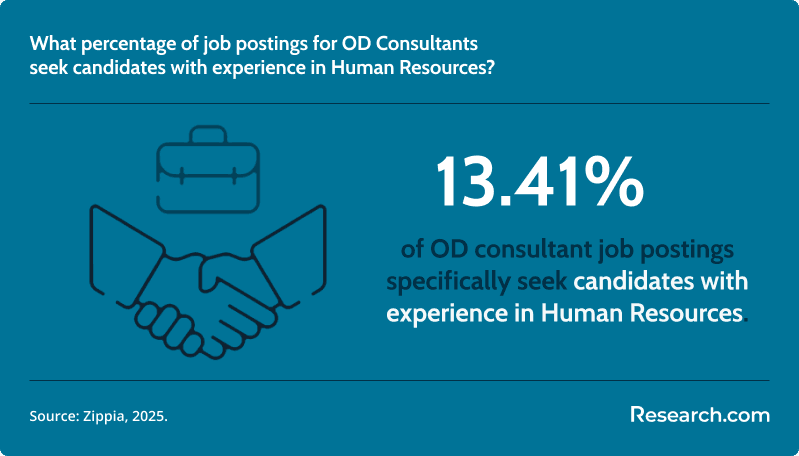
That said, HR knowledge is valuable in OD work. A significant 13.41% of OD consultant job postings specifically seek candidates with experience in Human Resources, which shows that many employers want OD consultants who understand both organizational change and practical people operations.
Professionals with leadership or healthcare management experience—especially those pursuing an executive nurse leadership MSN program online—may also find OD relevant because the work often involves systems management, team coordination, workforce development, and strategic decision-making.
Strategic versus Operational
- OD consulting is usually strategic and developmental. It addresses long-term change, organizational design, leadership capability, culture, collaboration, and alignment between business goals and how work gets done.
- HR consulting is often operational and compliance-oriented. It ensures the organization can hire, support, manage, evaluate, compensate, and retain employees while meeting legal and policy requirements.
Role Integration
In some organizations, OD is a specialized function within HR. In others, it sits under corporate strategy, learning and development, transformation, talent management, or an internal consulting group. External OD consultants may be brought in for complex change initiatives, leadership alignment, culture assessments, or team interventions.
Collaboration
OD and HR work best when they are connected. HR provides the infrastructure that supports employees, while OD helps the organization adapt, learn, and improve. For example, HR may administer an engagement survey, while OD analyzes the results, facilitates leadership conversations, identifies systemic issues, and designs follow-up interventions.
How does an OD consultant manage organizational change effectively?
An OD consultant manages change effectively by turning a broad goal into a structured, evidence-based process. Successful change is rarely achieved through announcements alone. It requires diagnosis, leadership alignment, stakeholder involvement, communication, capability building, resistance management, and follow-up measurement.
The process typically starts with understanding the current state. The consultant gathers data through interviews, surveys, focus groups, performance indicators, HR records, and observation. This helps separate symptoms from root causes. For example, low engagement may be connected to unclear priorities, overloaded managers, poor communication, mistrust after a previous change, or a structure that slows decisions.
Next, the consultant works with leadership to define the desired future state and the practical steps needed to get there. This may include changing workflows, clarifying roles, training managers, redesigning communication routines, creating feedback channels, or coaching leaders on how to sponsor change. Some organizations also need better technology integration and systems thinking, concepts that are emphasized in fields such as accelerated CCSP online training programs.
Core steps in an effective OD change process
- Diagnose the current state. Use data to understand what is happening, why it is happening, and where the most important barriers exist.
- Align leaders. Ensure executives and managers agree on the purpose of the change, the expected outcomes, and their own responsibilities.
- Map stakeholders. Identify who will be affected, who can influence adoption, and where resistance is likely to appear.
- Design targeted interventions. Choose actions that match the diagnosis rather than applying a generic workshop or communication plan.
- Communicate consistently. Explain what is changing, why it matters, what employees should expect, and how feedback will be handled.
- Build capability. Equip leaders and employees with the skills, tools, and support needed to work in the new way.
- Measure and adjust. Track progress, gather feedback, and refine the intervention instead of assuming the first plan will be enough.
A common mistake is treating resistance as a personality problem. Effective OD consultants look deeper. Resistance may signal poor communication, lack of trust, competing priorities, insufficient training, or a change design that does not fit the work reality. Addressing those issues directly makes change more sustainable.
What are the best educational paths for entry-level OD consultant roles?
The best educational path for an entry-level OD consultant usually combines a relevant degree, applied experience, and targeted training in organizational behavior, change management, facilitation, and data analysis. There is no single required major, but employers tend to value academic backgrounds that build both business judgment and understanding of human behavior.
- Bachelor’s Degree: Common majors include Business Administration, Human Resources, Psychology, Organizational Behavior, Communications, Sociology, or Management. These programs can provide a foundation in leadership, motivation, group dynamics, organizational systems, and workplace communication.
- Master’s Degree: Advanced degrees in Organizational Development, Industrial-Organizational Psychology, Human Resources, Business Management, or related fields can improve competitiveness for consulting, leadership development, change management, and internal OD roles. Professionals who want to add technical and analytical competencies may also consider fast-track online CompTIA Cloud+ certification programs as a complement to OD training, especially when working with technology-driven change.
- Experience and Training: Practical experience is critical. Entry-level candidates can build relevant experience through HR roles, learning and development, project coordination, training facilitation, operations improvement, leadership programs, consulting internships, employee engagement projects, or change management support work.
How to choose the right path
Students who are still selecting a degree should look for coursework in organizational behavior, statistics or research methods, leadership, conflict resolution, group dynamics, consulting, human resources, and business strategy. These areas closely match the work OD consultants perform.
Career changers do not always need to restart their education. A professional with experience in HR, management, healthcare leadership, education, training, communications, or operations may be able to move toward OD by adding graduate coursework, OD certificates, change management credentials, facilitation training, or analytics skills.
For entry-level roles, a strong portfolio can matter as much as a credential. Useful evidence includes survey analysis, process improvement projects, workshop designs, team development work, leadership training materials, change communication plans, and measurable results from workplace initiatives.
Meanwhile, the chart below shows the most common organizational development consultant degrees:
Which professional OD certifications are most valuable for a consultant?
Professional certifications can help OD consultants show that they understand recognized models, tools, and ethical practices for organizational diagnosis and change. They are especially useful for consultants who need credibility with senior leaders, career changers who want to signal OD competence, or internal practitioners who want a structured framework for their work.
Certifications are not a substitute for experience. The strongest candidates can connect credentials to real consulting outcomes: diagnosing problems, facilitating difficult conversations, leading change efforts, measuring results, and helping leaders make better decisions.
- Organization Development Certified Professional (ODCP) – This certification establishes foundational skills in OD principles, including the application of concepts such as the Action Research Model to diagnose needs and facilitate change using a whole systems approach.
- Organization Development Certified Consultant (ODCC) – This credential builds on the professional level and signals advanced expertise in leading complex change, including advanced diagnostics, organization design, and culture transformation.
- Certified Change Management Professional (CCMP) – Issued by the Association of Change Management Professionals (ACMP), this globally recognized credential demonstrates practical knowledge for guiding transitions based on the ACMP's Standard for Change Management, which covers formulating strategy, developing plans, and measuring success.
- Graduate Certificates These specialized programs, offered by universities such as the University of Denver and Penn State, provide a focused academic study of OD topics such as organizational culture, strategic planning, and OD interventions. They can function as stand-alone credentials or as a pathway toward a Master's degree.
How to decide which credential fits your goal
- Choose an OD-specific credential if you want to strengthen your ability to diagnose organizational issues, facilitate interventions, and advise leaders on culture or design.
- Choose a change management credential if your target roles focus on implementation, adoption, stakeholder engagement, and transition planning.
- Choose a graduate certificate if you want academic depth, possible credit toward a future degree, or a stronger foundation for senior internal OD roles.
Some professionals enter OD consulting from people-centered careers in healthcare, education, social services, and operations. For example, individuals with backgrounds in LVN jobs may bring valuable skills in empathy, communication, coordination, and working within complex systems—traits that can support a transition into development consulting.
Which soft skills are most important for consulting senior leadership?
The most important soft skills for consulting senior leadership are executive communication, credibility, emotional intelligence, political awareness, and the ability to challenge leaders without damaging trust. Senior leaders often face high-stakes decisions, competing priorities, and limited time, so OD consultants must be concise, evidence-based, and tactful.
Technical knowledge matters, but it is rarely enough. A consultant may have an accurate diagnosis and still fail if they cannot communicate findings clearly, handle resistance, manage confidentiality, or help leaders see their own role in the problem.
Key Soft Skills for Consulting Senior Leadership
- Effective Communication: OD consultants must translate complex organizational data into clear messages, practical recommendations, and executive-level choices. Strong communication also includes listening carefully and asking disciplined questions.
- Interpersonal Skills: Relationship-building is central to consulting. Leaders are more likely to act on difficult feedback when they believe the consultant understands the business context and respects the people involved.
- Emotional Intelligence: Senior-level consulting often involves sensitive issues such as mistrust, conflict, poor leadership behavior, burnout, or failed change efforts. Emotional intelligence helps consultants stay calm, read the room, and respond constructively.
- Adaptability: Organizations change quickly, and consulting plans often need revision. A strong OD consultant can adjust methods without losing sight of the goal.
- Problem-Solving and Decision-Making: Consultants need to connect evidence, human dynamics, and business priorities. The best recommendations are realistic, not just theoretically sound.
- Influencing and Stakeholder Management: OD consultants must align people who may disagree on the problem, the solution, or the urgency. Influence depends on credibility, timing, framing, and trust.
- Leadership and Team Building: Even when consultants do not hold formal authority, they often guide groups through conflict, uncertainty, and decision-making. Facilitative leadership is essential.
Common mistakes when advising executives
- Presenting too much data without a clear interpretation or recommendation
- Avoiding hard truths because the audience is senior
- Using OD jargon instead of business language
- Assuming all leaders share the same priorities
- Failing to protect confidentiality when discussing sensitive findings
Effective senior-level consulting requires both courage and restraint: the courage to name the real issue and the restraint to do it in a way that leaders can hear and act on.
What analytical skills are crucial for an OD consultant to diagnose problems?
The most crucial analytical skill for an OD consultant is root-cause diagnosis. Organizations often describe problems in surface terms—low morale, poor communication, slow execution, weak accountability—but those labels rarely explain what is actually causing the issue. OD consultants need the ability to gather evidence, identify patterns, test assumptions, and connect people-related data to business outcomes.
Strong analysis in OD includes both quantitative and qualitative work. Survey results, turnover data, performance metrics, and HR records may reveal trends, while interviews and focus groups explain the lived experience behind those trends. The consultant’s job is to synthesize both types of evidence into a practical diagnosis.
- Organizational Assessment: The ability to examine structure, culture, leadership practices, workflows, incentives, communication systems, and performance data to identify strengths, weaknesses, and gaps.
- Data Collection and Analysis: Skill in gathering qualitative and quantitative data through surveys, interviews, financial and HR records, and other sources, then interpreting patterns and trends.
- Critical Thinking: The capacity to question assumptions, distinguish symptoms from root causes, compare possible explanations, and avoid recommending solutions before the problem is understood.
- Use of Diagnostic Tools and Models: Familiarity with organizational diagnosis frameworks and techniques such as force-field analysis, input-process-output models, and statistical methods for comprehensive evaluation.
- Problem-Solving: The ability to convert findings into evidence-based recommendations that fit the organization’s goals, constraints, culture, and readiness for change.
- Strategic Thinking: Understanding how diagnosed issues connect to broader organizational goals so interventions do not become isolated training events or disconnected initiatives.
What good OD diagnosis looks like
A weak diagnosis says, “Managers need better communication skills.” A stronger diagnosis explains which communication breakdowns are occurring, where they happen, how they affect decisions or performance, what leaders and systems contribute to the issue, and which intervention is most likely to improve the result.
OD consultants should also be careful not to over-rely on one data source. A survey may show dissatisfaction, but interviews may reveal that the real issue is inconsistent priorities. Performance data may show delays, but process mapping may reveal approval bottlenecks. Effective diagnosis uses multiple inputs before drawing conclusions.
What is the job outlook for organizational development consultants?
The job outlook for organizational development consultants is positive, particularly for professionals who can help organizations manage change, improve leadership effectiveness, support culture transformation, and use data to guide workforce decisions.
The U.S. Bureau of Labor Statistics (BLS) projects a 9% growth rate for management analysts, the broader category that includes OD consultants, from 2024 to 2034, which is much faster than the average for all occupations.
This outlook is supported by ongoing business needs: organizations must adapt to changing markets, new technologies, workforce expectations, restructuring, employee engagement challenges, and pressure to improve efficiency. OD consultants are often brought in when leaders need an outside perspective or specialized expertise to manage these issues.
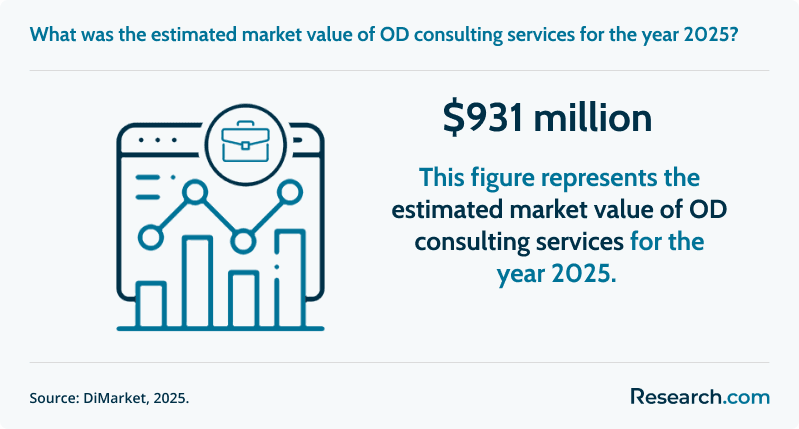
The market for OD consulting services was valued at $931 million in 2025 and is expected to grow at a compound annual growth rate (CAGR) of 6.4% through 2033, potentially reaching $1.5 billion.
Growth is fueled by demand for digital transformation, diversity and inclusion initiatives, and enhanced employee well-being programs. These areas require more than policy changes; they often require shifts in leadership behavior, team norms, systems, and culture.
Where demand is likely to be strongest
- Large organizations that need support with enterprise-wide change, culture transformation, leadership development, or reorganization
- Technology-driven companies that are scaling quickly or implementing new systems
- Healthcare, education, government, and nonprofit organizations facing workforce, leadership, or operational change
- Consulting firms that serve clients on transformation, talent, change management, and organizational effectiveness projects
- Internal HR, talent, and learning teams that need OD expertise to move beyond administration into strategic workforce development
According to the BLS, management analysts held about 1.1 million jobs in 2024. The chart below shows the distribution of these jobs across various sectors, revealing where OD expertise is most in demand:
What are the common career paths after being an organizational development consultant?
After working as an organizational development consultant, professionals often move into roles with greater specialization, leadership responsibility, or strategic influence. The best path depends on whether the consultant wants to remain client-facing, move into internal leadership, specialize in a technical OD area, or transition into executive management.
- OD Specialist: Some consultants deepen expertise in a focused area such as change management, leadership development, team effectiveness, talent management, engagement, or culture work. This path is a good fit for professionals who enjoy hands-on intervention design and facilitation.
- OD Manager: This role involves leading OD specialists or consultants, managing programs and budgets, setting priorities, and aligning OD initiatives with organizational goals. It requires both consulting skill and people management ability.
- Internal OD Leadership: Consultants may move into internal roles within HR, talent, learning and development, transformation, or corporate strategy. These roles allow professionals to shape long-term culture, leadership, and workforce development from inside one organization.
- Executive Leadership: With significant experience and education, OD professionals may advance to executive positions such as Chief Human Resources Officer (CHRO), Chief Learning Officer (CLO), or other senior leadership roles responsible for organizational effectiveness.
- Independent or Senior Consultant: Experienced consultants may become independent contractors, firm partners, or senior advisors. This path can offer more autonomy and variety, but it also requires business development, client management, pricing, and reputation-building skills.
- Related Career Pivots: Common lateral moves include executive coaching, talent development, HR strategy, organizational psychology, learning and development, transformation management, employee experience, or general management.
How to choose a next step
Professionals who enjoy facilitation and client variety may prefer senior consulting or independent practice. Those who want to build long-term influence inside one organization may prefer internal OD leadership. Consultants who are interested in enterprise decision-making may aim for executive roles, while those who enjoy methods and tools may specialize in assessment, coaching, change management, or leadership development.
The strongest career moves usually build on a clear consulting identity: the kinds of problems you solve best, the industries you understand, the interventions you can lead confidently, and the results you can document.
What is the average organizational development consultant salary?
The average salary for an organizational development consultant in the United States is $109,958 per year, which breaks down to about $53 per hour.
This average is a useful benchmark, but individual compensation varies widely. Salary depends on experience, location, employer type, industry, education, certifications, and whether the consultant works internally, for a consulting firm, or independently.
Experience is one of the strongest factors. Entry-level professionals might earn closer to the $60,000 to $70,000 range, while senior consultants with over seven years of experience can command salaries well over $150,000, particularly in Lead Consultant or Director-level roles.
Geographic location also matters. Major metropolitan areas with higher costs of living and strong business markets, such as San Francisco, New York, and Washington D.C., often offer higher compensation than other regions. However, higher pay should be weighed against cost of living, travel expectations, and work-life demands.
Education and professional certifications can also influence pay. Candidates with an MBA, a Master's in Organizational Development, or specialized credentials such as the ODCP or CCMP may be more competitive for senior roles because these credentials signal formal preparation in strategy, diagnosis, change, and consulting practice.
Industry and employer size are major determinants as well. Consultants working for large multinational consulting firms or high-growth sectors such as technology generally earn more than those in nonprofit or smaller organizations. Independent consultants may have higher earning potential, but income can fluctuate based on client demand, pricing, and business development success.
Factors that can raise earning potential
- Experience leading complex change initiatives
- Strong executive consulting and facilitation skills
- Advanced education in OD, business, psychology, or related fields
- Recognized OD or change management certifications
- Industry expertise in high-demand sectors
- Ability to connect OD work to measurable business outcomes
- Experience with data analysis, employee listening tools, and technology-enabled transformation
While the average provides a good baseline, understanding the full earning potential requires looking at the range of salaries across different experience levels, as illustrated by the percentile breakdown below:
How is AI and technology changing the role of the organizational development consultant?
Artificial intelligence and technology are changing OD consulting by making diagnosis faster, expanding access to organizational data, and increasing expectations for evidence-based recommendations. The role is not becoming less human; it is becoming more data-informed. Consultants still need judgment, ethics, facilitation skill, and trust-building ability.
- Data-Driven Insights: AI can help OD consultants analyze large volumes of organizational data more quickly, including survey responses, engagement trends, performance indicators, and employee feedback. This can support more precise diagnosis and better-targeted interventions.
- Automation of Routine Tasks: Technology can automate parts of survey administration, reporting, scheduling, feedback collection, and performance monitoring. This allows consultants to spend more time on interpretation, advising, facilitation, and implementation.
- Personalized Solutions: AI-powered tools can help tailor development programs by combining employee feedback, organizational performance information, and broader workforce trends. Consultants still need to ensure recommendations fit the client’s culture, constraints, and goals.
- Enhanced Collaboration and Network Building: Digital platforms make it easier to work with distributed teams, run virtual workshops, collect feedback, and coordinate across locations. This expands the reach of OD work beyond traditional in-person consulting.
- Supporting Change Management: Technology can provide real-time feedback and predictive insights that help consultants identify adoption risks, monitor sentiment, and adjust change plans sooner.
- Skill Augmentation: AI can strengthen consultants’ problem-solving and decision-making by surfacing patterns and options, but it does not replace the need for ethical judgment, contextual understanding, and human connection.
What OD consultants need to watch carefully
- Data privacy: Employee feedback and organizational data must be handled responsibly, especially when sensitive culture or leadership issues are involved.
- Bias and interpretation: AI-generated patterns can be useful, but consultants must question the data source, model assumptions, and possible bias.
- Over-automation: Change management depends on trust. Automated dashboards cannot replace leader conversations, employee listening, and facilitated sense-making.
- Skill expectations: OD consultants increasingly need comfort with analytics tools, virtual collaboration platforms, employee listening systems, and technology-enabled transformation.
The practical takeaway is clear: technology can improve OD work when it supports better diagnosis and faster feedback, but the consultant remains responsible for meaning-making, ethical practice, leadership alignment, and sustainable change.
Here’s What Organizational Development Consultants Have to Say About Their Careers
- : "Transitioning into organizational development allowed me to combine my background in psychology with business strategy. I enjoy seeing measurable improvements in team collaboration and company culture after every project. It’s rewarding work that blends analysis with empathy. — Monica"
- : "As an OD consultant, I’ve learned that meaningful change takes patience and structured planning. Helping leaders realign their teams and processes has deepened my understanding of how organizations truly grow from within. — Jared"
- : "I started in HR but moved into organizational development to focus on long-term impact rather than daily operations. The work challenges me intellectually while giving me the chance to support people through major transitions. — Leah"
Key Findings
- Organizational development consultants help organizations improve effectiveness by diagnosing issues in culture, structure, leadership, communication, systems, and change readiness.
- OD consulting differs from HR consulting because OD is more focused on strategic change and organizational effectiveness, while HR consulting is often more focused on employee lifecycle processes, compliance, and operations.
- The U.S. Bureau of Labor Statistics projects a 9% growth rate for management analysts, the broader category that includes OD consultants, from 2024 to 2034.
- The market for OD consulting services was valued at $931 million in 2025 and is expected to grow at a compound annual growth rate (CAGR) of 6.4% through 2033, potentially reaching $1.5 billion.
- The average salary for an organizational development consultant in the United States is $109,958 per year, or about $53 per hour, with higher earnings possible for senior consultants, specialized experts, and professionals in major business markets.
- Relevant education may include business, HR, psychology, organizational behavior, management, or OD programs, while certifications such as ODCP, ODCC, and CCMP can strengthen credibility.
- The most valuable OD consultants combine analytical diagnosis, executive communication, emotional intelligence, facilitation skill, change management expertise, and the ability to connect people issues to business outcomes.
- AI and technology are reshaping OD work by improving data analysis, feedback collection, personalization, and virtual collaboration, but human judgment and trust-building remain central to the role.
Other Things You Should Know About What an Organizational Development Consultant Does
In 2027, Organizational Development Consultants are commonly employed in industries like healthcare, technology, finance, and manufacturing. These sectors often require expertise in change management, team development, and process improvement to remain competitive and adaptive in a dynamic market environment.
In 2027, Organizational Development Consultants usually need a bachelor's degree in business, psychology, or a related field. A master's degree or MBA can enhance career prospects. Additionally, expertise in change management, HR practices, and organizational behavior is often highly valued.
References
- Bureau of Labor Statistics, U.S. Department of Labor, Occupational Outlook Handbook, Management Analysts at https://www.bls.gov/ooh/business-and-financial/management-analysts.htm
- Careers in Organizational Development (With salary info). (2025, July 27). Indeed. Retrieved October 30, 2025, from https://www.indeed.com/career-advice/finding-a-job/job-organizational-development
- How to become an Organizational Development consultant: What it is and career path - Zippia. (2025, January 8). https://www.zippia.com/organizational-development-consultant-jobs
- Organizational Development Consultant salary. (2025). ZipRecruiter. Retrieved October 30, 2025, from https://www.ziprecruiter.com/Salaries/Organizational-Development-Consultant-Salary#TableView
- Organizational Development Consulting Service Report: Trends and Forecasts 2025-2033. (2025, June 25). https://www.datainsightsmarket.com/reports/organizational-development-consulting-service-493787


