2027 How to Become an SEO Analyst: Top Tools and Skills

Co-Founder and Chief Data Scientist
Becoming an SEO analyst is a challenging, interesting, and lucrative career choice that is a stepping stone between lower-level SEO positions and the Head of SEO. Doing SEO analytics for a living is a demanding career that requires you not only to be technically savvy but also to have a creative mind and be able to explain the data as a story to the stakeholders.
This article will explain what this job requires, what they do, and how to become an SEO analyst.

Who Is an SEO Analyst
Before we explore how to become an SEO analyst, let’s look in more detail at what an SEO analyst typically does at a company.
Types of Position Titles
Typically, this is a pretty well-defined job, and you can find positions like these under titles like SEO Analyst or Senior SEO Analyst.
Depending on the organization and the size of their team, you can find analytical duties in jobs titled Senior SEO Specialist or SEO Strategist. These jobs typically rely heavily on the skillset of an SEO Analyst, but also entail other duties in terms of forming marketing strategies and overseeing a team that executes them.
Typical Job Duties of an SEO Analyst
The job of an SEO analyst is typically a niche position in the SEO team and is focused on analysing different aspects of SEO performance, with other search engine optimization jobs like choosing the strategies and doing the day-to-day activities delegated to other members of the team. Mostly, an SEO analyst will focus on:
- Manage the company’s SEO data infrastructure.
- Monitoring and analyzing SEO performance.
- Analyzing competitors’ performance.
- Monitoring and analyzing search trends.
- Reporting on the findings to team members.
- Collaborate with the team members to implement better strategies.
As your main daily duties, you’ll be analyzing:
- Keyword targeting strategies.
- Keyword rankings.
- Organic search visibility and traffic.
- AI visibility.
- Website engagement metrics.
- Conversion rates.
- Website technical performance.
If you’re doing this job for an agency, you’ll likely be responsible for client communications as the person with the best understanding of their SEO performance.
Depending on the company, you might also be assigned other SEO duties, ranging from creating search engine optimization strategies to doing small tasks aimed at improving SEO performance. Typically, those would be outlined in the job description, but it’s always better to ask about the expectations for the workload during the interview.
SEO Analyst Salary Expectations
An SEO analyst is a mid to senior-level position, and the salary reflects that. According to ZipRecruiter statistics, the median salary of an SEO analyst is $82,573 annually or $40 per hour. It can range from as low as $53,500 to $112,000 annually.
Typical SEO Analyst Job Perks
Apart from the typical PTO and health insurance, many SEO analyst jobs provide the option to work completely remotely. You can also find perks like these in some SEO analyst jobs:
- Enhanced paid parental leave and support.
- 4-day work week.
- Work laptop provided by the company.
- Wellness and training compensation.
- Revenue sharing.
Not every company provides these perks, so make sure to check with the job description.
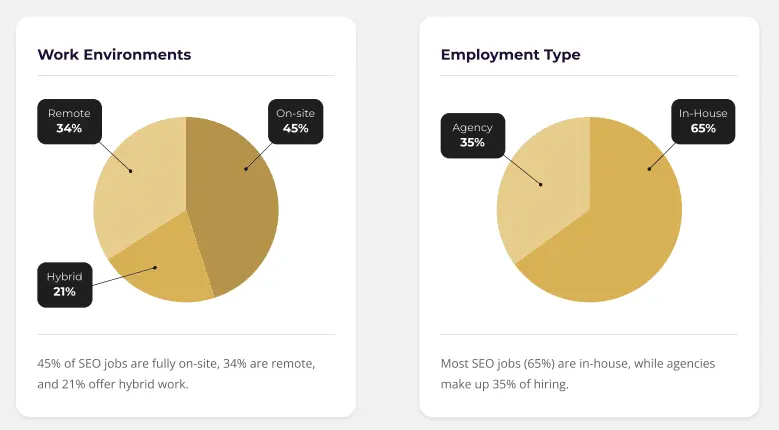
According to an analysis of the SEO job market by Previsible, 45% of SEO jobs require commuting to the office, 34% are fully remote, and 21% allow a hybrid work.
Source: Previsible.io
65% of job ads are for in-house hiring, and most of those are by companies with 250 or more employees. Only 35% are agency positions, which are typically more demanding in terms of performance.
SEO Analyst Job Requirements
Job ads for SEO analyst positions typically highlight a mix of the following requirements:
- A minimum of 2-4 years of relevant SEO experience.
- Experience in the industry of the employer.
- Strong understanding of search principles.
- Strong understanding of website design and related programming languages.
- Proficiency in SEO tools and search engine optimization analytics software.
- Analytical, problem-solving, and communication skills.
- Attention to detail.
- A self-starter approach with good time-management skills.
Very few SEO analyst jobs require a degree, and the ones that do often state that it’s more of a bonus than a non-negotiable requirement. If you do have at least a Bachelor’s degree in Marketing or a related field, it would be nice, but employers tend to look at experience and skills more than a degree.
It’s best that you not only have the experience, but also have a documented history of your work on past projects that show how SEO performance changed with your involvement.
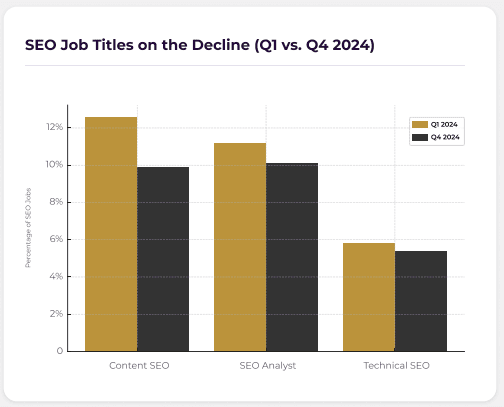
It might be harder to compete for SEO analyst roles in 2025 as the number of open positions shrank from 12% of the SEO job market to 10% by the end of 2024.
Source: Previsible.io
Roles You Can Switch From
An SEO analyst is not a position you can take straight out of college; it requires substantial knowledge of search engine optimization and prior experience. The best way to become an SEO analyst is to switch from a more junior SEO position.
Judging from a brief analysis of LinkedIn profiles, most people who become SEO analysts have been working as digital marketers or generalist SEO specialists before the switch.
This position provides the best experience in SEO and performance analytics that can help you become a great SEO analyst. If you haven’t had experience in SEO prior to this, it’s best to pursue a junior SEO specialist role first.
Another option is to switch from a data analyst position, but that would most likely require learning a lot about SEO before the switch.
Career Specialization Paths
Occupying the role of an SEO analyst for several years can prime you to progress to an SEO strategist or SEO team lead. You can also try to make a switch into general marketing analytics or data analytics if your experience allows it.
Another specialization you can pursue is moving towards a freelance consulting role as an analyst or strategist.
SEO Analyst Knowledge Areas and Tools
To become an SEO analyst, you need to have immense practical knowledge about all areas of SEO, methods of tracking performance, and the top SEO tools in 2025 you can do that with. Let’s explore what an SEO analyst needs to know before taking the position.
SEO Performance Analytics
Analysing website performance in search is among the primary responsibilities of an SEO analyst. The primary focus here is on monitoring key performance indicators like:
- Organic search traffic.
- New vs returning users.
- Average session duration.
- Pageviews.
- Engagement rate.
- Bounce rate.
- Conversion rate.
You’ll also likely need to analyze customer journeys on the website to find possible bottlenecks and optimization opportunities. In some organizations, that area might be given to UX specialists instead, but an SEO analyst’s area of expertise is closely related, and you might be responsible for it if there isn’t a dedicated UX person on the team.
Another area you’ll need to analyze is keyword rankings. You’ll need to track changes in ranking for target keywords, metrics like search visibility, and do competitive analysis of search results.
SEO performance analytics tools that you need to master include:
- Google Analytics. This is the primary tool for analyzing user behavior on the website.
- Google Search Console. This is a basic SEO tool that provides insight into search traffic.
- Keyword rank tracking tools. Tools like Ubersuggest provide insight into ranking for select keywords.
- Heatmap tools. Although not necessary for an SEO analyst career, proficiency in tools like Hotjar can help with understanding user behavior on the site.
AI Search Performance Analytics
AI search is becoming more and more popular, both in terms of 77% of users treating ChatGPT as a search engine and in terms of Google introducing AI Overviews and AI Mode. This adds another area of expertise to the SEO analyst’s skillset—AI search analytics.
You’ll need to measure AI visibility and dig deeper into search engine trends to understand how your website appears in AI searches.
The main tool you’ll need to master is an AI rank tracker like the AI Visibility Tool by SE Ranking. A tool like this can show you in what context your website appears across a variety of AI search software like ChatGPT or Google’s AIO, and provide data for further analysis.
Keyword Research
The basic skillset of keyword research involves finding keywords that you can optimize your website for, grouping them together, and optimizing individual pages for the keyword groups that correspond to them. In most companies, this process is the career of an SEO specialist, but sometimes, an SEO analyst will take on a part of these responsibilities.
What you’ll definitely focus on is researching how keywords correlate with website performance metrics to find underperforming keywords and analyzing search intent behind those keywords.
The tools you need to master for this area of SEO analytics are:
- Google Analytics.
- Google Search Console.
- Keyword research tools like Ubersuggest.
You might also look into using LLMs with a connection to the web for analyzing search intent and competitive analysis of content marketing efforts.
On-page Optimization
On-page optimization for an SEO analyst means comparing website pages to competing ones that outrank them to find possible solutions for ranking higher. These solutions may lie in several areas:
- Keyword optimization.
- Search intent optimization.
- Content quality optimization.
- Internal linking.
The tools you’ll need for the task are:
- Google Search Console.
- Keyword research tools.
- LLMs for researching search intent and compiling internal linking maps.
You’ll also need to communicate with search engine optimization specialists and the content marketing team, who will be tasked with implementing the updates.
Off-page Optimization
The basics of off-page optimization are finding link-building opportunities by analyzing SERP and backlink profiles of competitors. In an SEO analyst role, you’ll go beyond that and look into the correlations between different link-building campaigns and their impact on website ranking to understand what types of links your company should be focusing on.
The tools you’ll need to master are:
- Google Analytics.
- Google Search Console.
- Backlink research tools like Majestic.
You’ll need to consolidate efforts with the whole SEO team to make sure you know all the factors that might go into a change in ranking on each page, so you can create an accurate analysis.
Technical Optimization
One part of technical optimization is monitoring website performance metrics and suggesting methods of getting better Core Web Vitals scores. The other is monitoring and fixing issues with crawling and indexation that are especially common in large websites.
The tools you’ll need to master are:
- Google Search Console.
- Website audit tools like Chrome’s Lighthouse.
- Website crawlers like Screaming Frog.
Invest in learning Screaming Frog’s advanced use cases. It’s the best tool of its kind, and can be invaluable in SEO analytics when used correctly.
Local SEO
For local optimization, SEO analysts should monitor rankings on Google Maps and local search packs, engagement rate with the business profile, business mentions, and dig for correlations between optimization tactics and improvements in ranking.
You’ll need to master these tools to excel:
- Google Search Console.
- Google Business Profile Insights.
- Local rank tracker tools like LocalTrack.
- Custom web scrapers for discovering business mentions.
Data Analytics
The position of an SEO analyst doesn’t just entail working with different analytical tools. You’ll need to bring data from multiple tools into one place and analyze it to find correlations between different metrics, establish cause and effect of optimization activities, and do predictive analytics.
To facilitate this, you’ll need to master these tools:
- MS Excel, Google Sheets, or an equivalent.
- Data import and automation tools like Zapier.
- Google Looker Studio or an equivalent for data visualization and creating custom dashboards.
- A business intelligence tool like Power BI.
This area of expertise is what you’ll want to focus on if you want to stand out among other candidates. Most SEOs are good with the basic SEO analytics tools, but advanced data handling techniques are harder to master and can make you a more effective SEO analyst.
Understanding Current and Future Search Trends
In addition to analyzing and improving the current website performance, SEO analysts need to plan for the future. To do this, you need to understand the search trends that are beginning to shape search experiences today and research the future possibilities.
The main avenues of doing this are analyzing historical SERP trends, keeping up with Google updates, and reading niche SEO blogs.
Soft Skills
An SEO analyst has to communicate with multiple people as part of their work. Explaining the findings from data to the stakeholders and higher-ups, coming up with optimization plans together with IT, UX, and content marketing teams, and making sure the optimization jobs being done are up to your standard.
Due to this, being an effective storyteller and communicator is an important skill in this career.
How to Become an SEO Analyst
Let’s look at some practical steps you should take to start a career as an SEO analyst.
Gain Experience In The Field
If you have never been in the search engine optimization role and don’t have a data analytics background, you should start by acquiring experience in the field. The best position that can prime you to become an analyst is an SEO specialist. It will have you working closely with different aspects of SEO, from planning and research to optimizing individual pages.
You can also start your SEO career path with jobs like an SEO content writer or from positions that handle technical optimization and progress to being an SEO specialist from there.
Close The Learning Gaps
Investigate your skills and find out what you lack. If you have a data analytics background, you might be lacking a hands-on understanding of SEO principles. If you’ve been working in SEO for a while, you might find that your data analytics skills need improvement. You might also find that you lack experience with one of the tools needed for effective SEO analytics.
Close those learning gaps by finding information online, consulting with other specialists, or attending courses. Consider getting a certificate in an area where you have the least knowledge and experience.
Take On More Responsibility
Some things are better understood not through taking a course but by practicing them. Find ways to take on more responsibilities that are aligned with SEO analytics skills in your current career path. For instance, you can volunteer to help in gathering or analyzing SEO data in your organization.
If that’s not an option, consider doing side gigs that involve basic SEO analytics tasks. This both builds up your experience and lets you show a better portfolio at a job interview.
Document Your Successes
Nothing speaks of your professionalism more than showing real-life examples of your work and how it influences SEO performance. If you have a chance, document what you do, especially historical metrics of website performance, to show how your involvement in the project made it grow.
You might need to talk to the head of your department about it and make sure to exclude any private company information from this.
Grow Your Professional Network
Use the opportunities to travel to professional events and take part in training, especially if your company can reimburse the expenses. It will help you build up your skillset and meet new people in the industry.
Network on LinkedIn as well by commenting on people’s posts, creating your own posts, and adding people to your contact list.
Getting yourself out there can help with receiving news about career opportunities and getting recommended for an SEO analyst role.
What To Focus On During An SEO Analyst Interview
When talking to the SEO team, focus on highlighting your experiences and how they have positively changed your company’s website performance. Dig deep into the technical aspects of SEO analytics to show you know the ins and outs of every process.
When talking to the leadership, focus on larger business results instead. They are likely to know a lot less about the little details of SEO work and to be interested in the bigger picture—traffic, conversions, and sales. Show that your work can influence the bottom line, and you’re more likely to get the role.
Other Things You Should Know About How to Become an SEO Analyst
In 2027, essential skills for an SEO analyst include a strong understanding of the latest search algorithms, data analytics proficiency, expertise in using SEO tools like SEMrush and Ahrefs, and excellent communication skills to convey strategies. Familiarity with AI-driven search trends and voice search optimization is also crucial.
Industries ranging from e-commerce to media and technology need SEO analysts. In 2027, businesses across these sectors prioritize digital visibility to stand out in a competitive online environment. SEO analysts are crucial in optimizing search engine rankings to drive traffic, improve brand awareness, and ultimately, increase revenue.
A lot of SEO analyst positions are in-house, but you can find freelance and outstaffing opportunities, especially if you have enough knowledge to do SEO consulting.