
2027 Leadership Training Statistics: Data, Insights & Predictions

Co-Founder and Chief Data Scientist
Leadership training has moved from a nice-to-have benefit to a business necessity. Companies need managers who can retain talent, lead hybrid teams, use data responsibly, and prepare future leaders before gaps appear. At the same time, employees increasingly view leadership development as a path to promotion, higher pay, and long-term career mobility.
This guide breaks down what leadership training statistics really mean, where programs tend to fall short, and how organizations can build leadership development that improves measurable outcomes. It is designed for HR leaders, executives, learning and development teams, people managers, and professionals comparing training with formal education paths such as business, psychology, organizational leadership, and management degrees. It also connects those decisions to broader leadership training trends shaping today’s workplace.
Quick Answer: What Do Leadership Training Statistics Actually Show?
Leadership training works best when it is tied to specific business goals, reinforced over time, and measured against real team outcomes. The data also shows a persistent gap: many organizations invest in leadership development without training new managers, defining success metrics, or checking whether the training changes behavior on the job.
| What the data suggests | Why it matters | What to do with that information |
| The global corporate training market was valued at approximately $390.89 billion in 2024. | Leadership development is part of a major and growing workforce investment. | Do not treat spending as proof of impact; define measurable outcomes first. |
| 60% of new managers reportedly receive no formal training when they enter management roles. | Many leadership problems start at the first-manager level. | Prioritize new supervisors and frontline managers, not only senior leaders. |
| 70% of team engagement is directly attributable to the manager. | Manager behavior heavily influences morale, retention, and productivity. | Track changes in team engagement and performance, not just course completion. |
| Only 18% of organizations report that their leaders are “very effective” at achieving business goals. | There is a wide gap between leadership training activity and leadership effectiveness. | Align training to strategy, performance expectations, and real work challenges. |
Leadership Training Statistics: What Readers Need to Know
- State of leadership training
- Benefits of leadership training
- Common implementation challenges
- Leadership development and education pathways
- What modern leadership training should include
- Why continuous education matters
- How leadership training can support diversity and inclusion
- How leadership training can improve retention
- How to measure ROI
- How certifications can strengthen results
- The role of mentorship
- Digital literacy and innovation
- Morale and motivation
- Resilience and change readiness
- How advanced degrees can help
- Career advancement and compensation
- Why blended learning often works best
- Global mindset development
- How vocational education can complement leadership
- Industry-specific leadership needs
- Succession planning
- Ethics and compliance
- Changing market dynamics
- How legal knowledge supports leadership
State of Leadership Training
Leadership training now sits at the center of talent development, retention strategy, and organizational performance. Companies are spending heavily on learning, but many employees still report weak management, poor feedback, burnout, and low confidence in leadership. That tension explains why leadership development continues to attract attention from executives and HR teams.
- In 2024, the global corporate training market was valued at approximately $390.89 billion, according to Mordor Intelligence.
- That scale shows workplace learning remains one of the largest employer investments in human capital.
- The Global Leadership Forecast highlights rising burnout and trust concerns among leaders, including frontline managers, according to DDI’s 2025 findings.
- Leadership quality continues to matter because it affects execution, culture, employee experience, and retention.
- Workforce demographics are shifting: research suggests that 63% of the global workforce in 2024 is made up of millennials and Gen Zers.
- Trust is a major concern among those groups. Deloitte reports that 57% of Gen Zers and 55% of millennials do not trust business leaders to make decisions with society’s best interests at heart.
Benefits of Leadership Training
The strongest leadership training programs go beyond theory. They help managers apply communication, coaching, delegation, and strategic thinking in real work situations such as hiring, performance reviews, conflict resolution, and team accountability. The goal is not knowledge alone. The goal is changed behavior.
Benefits for Individuals
- After leadership training, participants were found to have a 20% improvement in skill acquisition and a 20% to 28% boost in manager performance metrics (Exec Learn, 2025; Gallup, 2024).
- Participants also showed 22% higher engagement levels and a 19% increase in subordinate problem-solving accuracy (Gallup, 2024; Quarterdeck, 2025).
- Managers who received executive coaching after leadership training displayed a 70% improvement in work performance (AsiaHRM, 2025).
Benefits for Organizations
Companies often prefer to develop leaders internally because those employees already understand the culture, customers, systems, and operational limits of the business. Internal leadership pipelines are especially useful when organizations need continuity, succession readiness, and experienced managers who can step into bigger roles without a long adjustment period.
- Leadership development can produce a return of approximately $7 for every $1 invested in development programs (High5Test, 2025).
- Culture Partners’ 2024 market analysis found that organizations with excellent and inclusive leadership are 25% more likely to financially outperform peers than organizations that limit development to narrow management groups.
- Millennials and Gen Zers make up the majority of the workforce in many settings, and 62% of Gen Z and 59% of millennials report living paycheck to paycheck, often placing salary ahead of other priorities (Deloitte, 2024).
Why It Can Improve Engagement and Reduce Turnover Risk
- Employees often experience the organization through their direct manager, so leadership quality strongly shapes engagement.
- Robert Half found that 62% of workers have quit a job because of a bad boss.
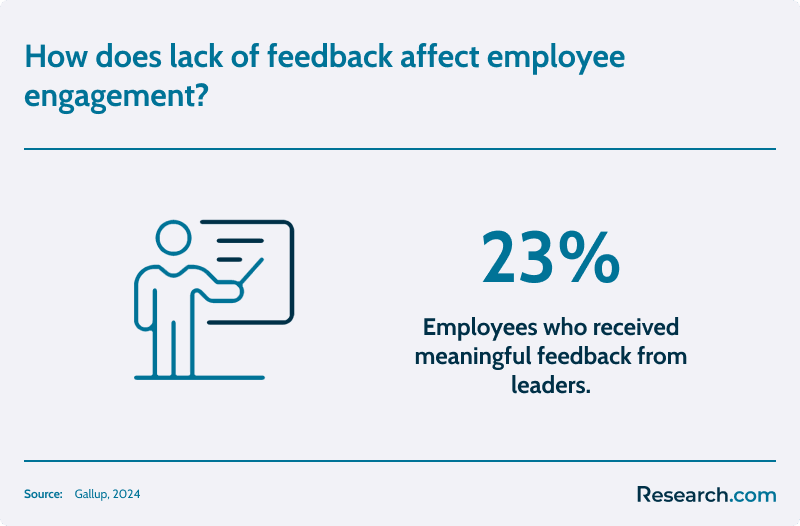
- Oak Engage’s 2025 workplace report found that four in ten employees become actively disengaged when they receive little or no feedback.
- Gallup reported that 92% of employees believe feedback is important for their development, whether it is positive or negative.
- Highly engaged employees are 2.5 times more likely to receive weekly feedback than disengaged employees, according to TeamStage.
Common Challenges in Leadership Training
The biggest issue is not whether leadership training has value. The real problem is that many programs are built like one-time events instead of ongoing systems. A keynote, workshop, or generic online course rarely changes management behavior unless the organization reinforces it with coaching, expectations, practice, and measurement.
Some market estimates place global leadership training at $366 billion (Exec Learn, 2025), but a large budget does not guarantee better leaders. Organizations first need to identify the actual leadership gap they are trying to close before choosing a vendor, platform, certification, or degree path.
- Common obstacles include vague goals, one-size-fits-all content, weak analytics, and poor alignment with employee development needs (Exec Learn, 2025; TalentLMS, 2024).
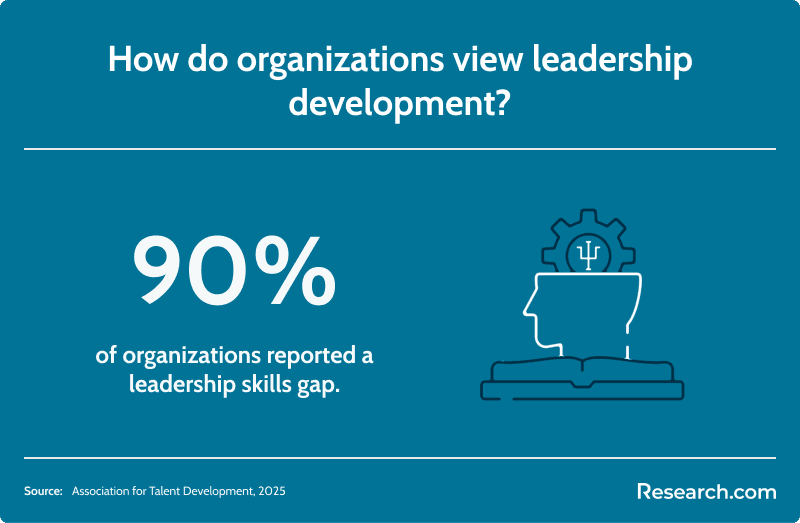
- Only 18% of organizations say their leaders are “very effective” at achieving business goals, which points to a broad execution gap (High5Test, 2025).
- Generic programs often miss the realities of the participant’s role, authority, team structure, industry, and workload (Exec Learn, 2025).
- Analytics and AI are increasingly used to track leadership development impact and improve decision-making (NLP, 2025).
- Organizations should identify baseline metrics such as retention, engagement, and operational efficiency before training begins, then compare those results afterward (Voltage Control, 2025).
- Resource gaps remain a problem because 60% of new managers reportedly receive no formal training when they are promoted.
- Leadership improvement has to show up in team performance, and Gallup reports that 70% of engagement is directly tied to the manager.
How Leadership Training Should Adapt to Remote and Hybrid Work
Remote and hybrid work changed what leaders need to do well. Managers cannot rely on hallway conversations, body language in a shared office, or casual check-ins to understand workload, morale, or conflict. Modern training has to teach leaders how to manage output, trust, communication, and accountability across locations.
- Trust and accountability: Leaders should set clear expectations, define ownership, and follow up consistently without micromanaging.
- Virtual communication: Managers need to know when to use meetings, written updates, project tools, or one-on-one conversations.
- Remote performance management: Training should focus on outcomes, quality, deadlines, collaboration, and customer impact rather than online presence.
- Engagement and inclusion: Distributed workers can become disconnected, so leaders need habits that support recognition, onboarding, psychological safety, and equal access to information.
Leadership Development and Education Pathways
Workplace training and formal education solve different problems. Training can improve a manager’s immediate skills. A degree or certificate can build deeper knowledge in business, psychology, analytics, policy, communication, or organizational behavior. In many cases, the best result comes from combining both.
For working adults who need a faster credential path, the best accelerated bachelor's degree programs can help them finish undergraduate requirements while staying employed. This option may suit employees who have leadership potential but still need a degree for promotion.
Education can also support more specialized leadership goals. For instance, an online psychology degree Texas students can pursue may be useful for leaders interested in motivation, behavior, and workplace dynamics. A broader psychology degree can also help managers better understand teams and decision-making.
Training, Certificates, or Degrees: Which Option Fits Best?
| Option | Best fit | Main limitation | Useful next step |
| Short leadership workshop | Managers who need immediate help with communication, delegation, feedback, or conflict | Skills may fade quickly without practice, coaching, and accountability | Set pre- and post-training goals tied to team outcomes |
| Professional certification | Employees who need targeted expertise in project management, analytics, HR, compliance, or digital tools | May not cover broad leadership theory or strategy | Compare relevant quick certifications that pay well |
| Undergraduate degree | Professionals who need a credential for promotion or a move into management | Requires more time and tuition than a short course | Explore flexible business or accelerated degree options |
| Graduate degree | Experienced professionals aiming for senior leadership, consulting, administration, or executive roles | ROI depends on cost, employer value, and career direction | Review cheapest online master's programs and leadership-focused graduate options |
What Effective Leadership Training Looks Like Today
Modern leadership development should mirror real work. The most useful programs use simulations, peer practice, coaching, digital collaboration tools, data literacy, feedback routines, and practical assignments. They are stronger when participants solve live business problems instead of only discussing abstract leadership models.
Technology has also raised the bar for managers. Leaders are increasingly expected to understand project platforms, learning systems, collaboration tools, analytics dashboards, automation, cybersecurity basics, and digital communication norms. Effective leadership training now needs both people skills and technology fluency.
- Training for the digital workplace should include team leadership, data use, coaching habits, and learning management system adoption.
- Research suggests that 77% of high-performing projects use project management software to support operational success (Visual Planning, 2024).
- Also, 89% of companies now have a Project Management Office (PMO) to support project systems and procedures (Visual Planning, 2024).
- Leaders who collaborate well with other leaders can improve alignment and culture faster than isolated managers.
- Modern managers are increasingly expected to use analytics when reviewing team performance and key metrics.
- Many younger workers want purpose, growth, fairness, and coaching in addition to pay.
- Leadership programs should connect business goals with ethical, social, customer, or community value when that connection is real.
- Millennials and Gen Z employees often respond better to coaching-oriented managers than to command-and-control leadership; 87% of coachees report that coaching significantly improved their confidence and leadership capabilities (Dion Leadership, 2024).
- A 2025 report found that 71% of U.S. organizations now offer leadership training to improve skills, employee engagement, and strategic planning (High5Test, 2025).
- Updated training methods have been linked to a 15% to 25% boost in employee performance and a 7x return on investment (Continu, 2025; High5Test, 2025).
- In digital learning, 72% of businesses say an LMS gives them a competitive edge, and 90% of companies worldwide now offer some form of digital learning (Continu, 2025; DemandSage, 2025).
- Professionals in human services and community-centered leadership may also compare programs like the cheapest online MSW programs if their leadership goals involve nonprofit management or public service.
Why Continuous Education Matters in Leadership Development
Continuous education helps leaders keep up with technology shifts, workforce expectations, regulatory changes, and evolving business models. It also creates structured time to build strategic thinking, communication, ethics, analysis, and judgment.
The right path depends on the leadership setting. A manager in a knowledge-based organization might benefit from a masters in library science online program if their work involves information systems, academic services, public institutions, or knowledge management. In other situations, business, psychology, public administration, education, social work, or law may be a better fit.
How Leadership Training Can Support Diversity and Inclusion
Leadership training supports diversity and inclusion when it teaches behaviors leaders can use every day. Helpful topics include bias interruption, equitable hiring, inclusive meeting practices, cross-cultural communication, accessibility, conflict resolution, and fair performance evaluation.
Organizations should also look at who gets access to development opportunities. More flexible education pathways, including open enrollment online colleges, can help employees from different backgrounds build credentials and compete for advancement.
How Leadership Training Can Improve Employee Retention
Retention improves when managers create environments where employees understand expectations, receive feedback, feel respected, and can see a path forward. People are less likely to stay when they feel ignored, stuck, or poorly managed.
Retention-focused training should help managers hold career conversations, identify burnout early, resolve conflict before it escalates, recognize good work, and explain advancement paths inside the company. This matters especially when employees feel financial pressure or believe job changes are the only way to earn more.
For professionals who want to combine leadership practice with advanced study, flexible options such as cheapest online master's programs may support long-term advancement. Students should still compare accreditation, transfer rules, cost, and career relevance before enrolling.
How to Measure the Return on Investment for Leadership Training
ROI measurement should begin before training starts. Organizations need a baseline, a target, a timeline, and a method for comparison. Without that, they may know employees attended a program but still not know whether leadership improved.
| Metric category | What to track | Why it matters |
| Employee performance | Productivity, quality, deadlines, customer outcomes, project completion | Shows whether training changes work results, not just confidence |
| Engagement and retention | Engagement survey scores, turnover, internal mobility, absenteeism | Connects leadership behavior to commitment and replacement costs |
| Leadership behaviors | 360-degree feedback, coaching frequency, check-ins, conflict response | Reveals whether managers are applying what they learned |
| Business outcomes | Sales, cost savings, operational efficiency, safety, customer satisfaction | Links training to strategic and financial priorities |
| Career progression | Promotions, succession readiness, internal hires for management roles | Shows whether the organization is building a leadership pipeline |
Some professionals use graduate school as part of leadership development. For example, an MBA in organizational leadership can help managers study strategy, organizational behavior, finance, and change management in a more structured setting.
How Supplemental Certifications Can Strengthen Leadership Training
Supplemental certifications can close specific skill gaps that broad leadership programs do not cover. Common examples include project management, data analytics, HR, cybersecurity, financial management, coaching, change management, and compliance. They are most useful when they match the leader’s actual role and industry.
Before enrolling, professionals should ask whether employers recognize the credential, whether it requires renewal, whether it teaches practical tools, and whether the cost makes sense for the expected career benefit. Comparing quick certifications that pay well can help, but the best choice is the one that supports a real career goal.
The Role of Mentorship in Leadership Development
Mentorship helps transform leadership ideas into judgment. A mentor can explain organizational politics, stakeholder management, trade-offs, career risk, and lessons from real decision-making. That is especially helpful for new managers who need support applying training in complex situations.
Strong mentoring programs define expectations, match people intentionally, make time for conversations, and connect the relationship to development goals. Employees studying through online business degree schools can also use mentorship to connect classroom concepts with real leadership challenges.
How Leadership Training Can Accelerate Digital Literacy and Innovation
Digital literacy is now a leadership skill. Managers do not need to become programmers, but they do need to understand how technology affects workflows, data quality, customer experience, cybersecurity, productivity, and decision-making.
Leadership training should include hands-on work with collaboration platforms, dashboards, automation tools, project systems, and AI-supported processes. Professionals who want a shorter academic path into technical or operational roles may also review options such as a fast associates degree online program, especially when paired with work experience.
How Leadership Training Affects Employee Morale and Motivation
Morale improves when managers communicate clearly, recognize effort, explain decisions, support growth, and respond to stress before it turns into burnout. Employees usually do not respond to slogans. They respond to repeated behavior they can trust.
- Clearer communication: Trained leaders reduce confusion by setting expectations, explaining priorities, and inviting questions.
- More confidence in leadership: Employees are more willing to support goals when managers act consistently and competently.
- Better feedback and recognition: Regular, specific feedback helps employees understand what they are doing well and where they can improve.
- Stronger motivation: Leaders who model accountability and resilience influence team energy and commitment.
- Healthier relationships: Training can help managers build trust without losing professional boundaries.
- Burnout prevention: Leaders who notice overload can address priorities, staffing, and support earlier.
- Career visibility: People are more motivated when they can see realistic internal growth opportunities.
Professionals comparing education options alongside leadership development may also review cheapest online colleges that accept FAFSA, while remembering that aid eligibility, accreditation, and program fit still matter.
The Role of Leadership Training in Building Business Resilience
Resilient organizations need leaders who can respond to disruption without causing confusion or panic. Training can help managers prepare for uncertainty by teaching scenario planning, crisis communication, decision-making, change management, and recovery planning.
This training should be practical. Leaders should work through realistic disruptions such as supply-chain failures, cybersecurity incidents, staffing shortages, regulatory changes, technology outages, or sudden market shifts. They should leave with communication plans, escalation paths, and decision criteria they can actually use.
For senior professionals interested in research-driven leadership study, an online doctorate in leadership can provide deeper work in organizational theory, strategy, evidence-based leadership, and change management.
How Advanced Degree Programs Can Improve Leadership Training Outcomes
Advanced degrees can strengthen leadership development when they match the person’s goals. Graduate study can deepen knowledge in research, finance, organizational behavior, analytics, policy, ethics, and strategy. It can also help experienced professionals prepare for executive, consulting, academic, or specialized leadership roles.
For business-focused leaders, comparing the most affordable online doctor of business administration programs may be useful for applied business research, executive leadership, or consulting. Still, the best program is the one that balances accreditation, faculty quality, curriculum relevance, total cost, and expected career payoff.
How Leadership Training Can Support Compensation and Career Advancement
Leadership training can help professionals move forward when it strengthens decision-making, people management, strategy execution, and measurable business performance. Training by itself does not guarantee a raise, but it can support promotion when paired with evidence of results.
Professionals should connect development to a career plan: Which role comes next? What skills does that role require? What outcomes must they demonstrate? Which credentials matter in their industry? Reviewing resources like the best paying MBA specializations can help candidates align education choices with compensation goals.
Why Blended Learning Often Produces Better Leadership Results
Blended learning combines live instruction, online modules, simulations, peer discussion, coaching, and workplace assignments. That mix often works better than a single-format course because leadership requires explanation, repetition, practice, and feedback.
Digital delivery can also make leadership development more flexible and scalable. Options such as accredited online certificate programs can help professionals build targeted skills while continuing to work. The important part is reinforcement in real management situations.
How Leadership Training Can Build a Global Mindset
A global mindset helps leaders work across countries, cultures, time zones, regulations, and customer expectations. Training should include cross-cultural communication, international ethics, regional needs, global supply chains, distributed-team management, and geopolitical risk.
Business education can support that perspective. For example, an accelerated online bachelors in business degree can introduce accounting, management, marketing, economics, and global business foundations that complement workplace leadership training.
How Vocational Education Can Complement Leadership Training
Vocational education makes leadership more practical. Leaders who understand technical work are often better at scheduling, evaluating constraints, communicating with specialists, and making sound operational decisions.
This matters especially in trades, manufacturing, logistics, healthcare support, construction, and technical services. Programs from trade schools online can help professionals build hands-on knowledge that strengthens management ability.
How Industry-Specific Challenges Shape Leadership Training
Leadership training should not be identical across industries. A hospital, software company, school district, construction firm, public agency, and financial services company each face different regulations, customer expectations, risk levels, and talent challenges.
Industry-specific programs should use relevant case studies, tools, metrics, and scenarios. Technical managers may also benefit from resources such as online technical schools when they need a deeper understanding of the work their teams perform.
How Leadership Training Supports Succession Planning
Succession planning prepares people to move into key roles before vacancies disrupt the business. Leadership training helps by identifying high-potential employees, building role-specific skills, and giving future leaders supervised chances to practice decision-making.
Organizations should connect succession plans to performance data, manager input, employee goals, diversity priorities, and business continuity needs. For employees who want broader business preparation, the cheapest accredited online MBA options may be worth comparing if graduate business study fits their leadership goals.
What Ethical and Compliance Issues Should Leadership Training Cover?
Leadership training should teach managers how to make decisions that are effective, fair, lawful, and aligned with organizational values. Common topics include discrimination, harassment prevention, confidentiality, data privacy, conflicts of interest, retaliation, workplace safety, financial controls, and the ethical use of AI.
Advanced education can deepen this work. Some professionals compare programs such as a doctorate online, but speed should not be the only factor. Accreditation, rigor, support, fit, and career relevance matter more than choosing the shortest route.
How Changing Market Dynamics Redefine Leadership Skills
Market shifts constantly change what leaders need to know. Economic uncertainty, automation, AI, supply-chain pressure, evolving employee expectations, and new customer behavior all require leaders who can learn quickly, read data, communicate clearly, and adjust strategy without losing trust.
Formal education can also help professionals adapt. Reviewing a highest paying bachelor's degree resource may help early-career readers understand how different undergraduate fields connect to labor-market opportunities, although salary outcomes always vary by role, location, experience, and industry.
How Legal Expertise Can Complement Leadership Training
Legal knowledge helps leaders manage risk, negotiate responsibly, understand contracts, follow employment rules, protect data, and make stronger governance decisions. Leaders do not need to replace legal counsel, but they should know when legal issues are present and when to seek expert help.
Professionals in compliance-heavy settings may benefit from legal-business education. A master in business law online can complement leadership training for managers handling contracts, compliance, risk, employee relations, or regulated operations.
Common Mistakes to Avoid When Choosing Leadership Training
| Mistake | Why it hurts results | Better approach |
| Choosing a popular program without a needs analysis | A well-known course may not address the organization’s real leadership gaps. | Start with a competency review and business problem definition. |
| Training only senior leaders | Frontline managers often shape the employee experience most directly. | Include new managers, supervisors, and emerging leaders. |
| Measuring completion instead of behavior | Attendance does not prove improved leadership. | Track feedback quality, coaching frequency, retention, engagement, and performance. |
| Ignoring hybrid work realities | Office-based management habits may fail with distributed teams. | Teach virtual communication, digital collaboration, and outcome-based management. |
| Assuming degrees or certificates create leaders automatically | Credentials add knowledge, but leadership still requires practice and feedback. | Combine education with mentorship, coaching, and real responsibility. |
| Focusing only on price | The cheapest option may be too generic or too weak to change behavior. | Compare total value, relevance, support, scalability, and measurable ROI. |
Questions to Ask Before Investing in Leadership Training
- What problem are we trying to solve: turnover, engagement, succession, execution, conflict, innovation, compliance, or manager readiness?
- Which group needs training first: new managers, middle managers, senior leaders, technical leads, or high-potential employees?
- What specific behaviors should change after training?
- How will participants practice those skills in real work settings?
- Who will reinforce the training after the formal program ends?
- Which metrics will show whether the investment worked?
- Does the training reflect remote, hybrid, global, or industry-specific realities?
- Should the organization pair training with certificates, tuition support, mentorship, or degree pathways?
- How will the program support internal mobility and succession planning?
Conclusion: What Makes Leadership Training Worth It?
Leadership training produces the best results when it is treated as a business system, not a one-time event. The strongest programs define the behaviors the organization needs, connect those behaviors to measurable goals, give managers chances to practice, and track whether team performance improves.
Good leadership development also reflects the reality of today’s workplace. Managers need to lead multigenerational teams, support hybrid work, use data responsibly, coach employees, address burnout, communicate through uncertainty, and build inclusive environments. Training that ignores those pressures is unlikely to create lasting change.
For individuals, the best path may include employer training, mentorship, certificates, or formal education. Advanced options such as online doctorate degrees in organizational leadership can fit professionals targeting senior organizational roles, while the best online doctorate in educational leadership may suit leaders in schools, colleges, policy, or education administration.
Key Insights
- Leadership training matters only when it changes behavior. Completion rates mean little if employees do not see better feedback, clearer expectations, stronger coaching, and stronger team results.
- Investment is high, but effectiveness is uneven. The corporate training market was valued at approximately $390.89 billion in 2024, yet only 18% of organizations say their leaders are “very effective” at achieving business goals.
- New managers are a major weak spot. With 60% of new managers reportedly receiving no formal training, leadership development should start earlier than the executive level.
- Managers have a direct impact on retention. Robert Half found that 62% of workers have quit because of a bad boss, and Gallup reports that 70% of engagement is directly attributable to the manager.
- Digital fluency now belongs in leadership training. Collaboration tools, analytics, LMS platforms, project systems, and AI-supported workflows are part of everyday management.
- Education can strengthen leadership development, but it should be chosen carefully. Degrees, certificates, and short courses serve different goals, so accreditation, cost, flexibility, and career fit matter.
- Before using any market figure in a business case, verify what it measures. Some sources refer to corporate training broadly, while others focus on leadership development specifically, so definitions matter.
References:
- Association for Talent Development. (2025). Benchmarks and trends from the 2025 state of the industry report. https://www.td.org/content/atd-blog/benchmarks-and-trends-from-the-2025-state-of-the-industry-report
- Continu. (2025). 50+ Learning Management System (LMS) Statistics. Continu. https://www.continu.com/blog/learning-management-system-statistics
- DDI. (2025). Global Leadership Forecast 2025. https://www.ddi.com/research/global-leadership-forecast-2025
- Deloitte. (2024). Deloitte Global 2024 Gen Z and Millennial Survey: The importance of individuality, purpose and progress. Deloitte. https://www2.deloitte.com/global/en/pages/about-deloitte/articles/deloitte-global-genz-millennial-survey-2024.html
- DemandSage. (2025). E-Learning Statistics 2025. DemandSage. https://www.demandsage.com/elearning-statistics/
- Dion Leadership. (2024). ROI of Leadership Coaching: The Impact on Organizational Performance. Dion Leadership. https://dionleadership.com/coaching-roi
- Executive Learning. (2025). Top Leadership Training Trends & Statistics for 2025. Executive Learning. https://www.executivelearning.com/resources/leadership-stats-2025
- Gallup. (2024, July 26). U.S. employee engagement inches up slightly after 11-year low. https://www.gallup.com/workplace/647564/employee-engagement-inches-slightly-year-low.aspx
- Gallup. (2024). State of the Global Workplace: 2024 Report. Gallup. https://www.gallup.com/workplace/349484/state-of-the-global-workplace.aspx
- HiBob. (2025). Investing in Leadership Learning: ROI and Business Impact. HiBob. https://www.hibob.com/blog/investing-in-leadership-learning/
- High5Test. (2025). Leadership Development Statistics: The Ultimate List. High5Test. https://high5test.com/leadership-statistics/
- Matsh. (2025). The Impact of Leadership Training on Employee Retention. Matsh. https://www.matsh.co/en/the-impact-of-leadership-training-on-employee-retention-with-stats/
- Oak Engage. (2025). 10 employee feedback statistics you need. Oak Engage. https://www.oak.com/blog/employee-feedback-statistics/
- P&S Intelligence. (2024, May). Leadership Training Market Size, Share, Trends, Opportunity and Forecast, 2024–2030. https://www.psintelligence.com/report/leadership-training-market
- Robert Half. (2024, May 21). New Robert Half Research: Nearly 7 in 10 Workers Have Quit a Job Due to a Bad Boss. https://www.roberthalf.com/us/en/insights/research/new-robert-half-research-nearly-7-in-10-workers-have-quit-a-job-due-to-a-bad-boss
- TalentLMS. (2024). Research: The state of L&D in 2024. TalentLMS. https://www.talentlms.com/research/state-of-learning-and-development
- Teachfloor. (2025). 98+ Employee Training Statistics in 2025. Teachfloor. https://www.teachfloor.com/blog/employee-training-statistics
- TeamStage. (2024). Employee Engagement Statistics 2024: Increased Productivity?. TeamStage. https://teamstage.io/employee-engagement-statistics/
- Visual Planning. (2024). Project Management Statistics You Need to Know in 2024. Visual Planning. https://www.visual-planning.com/en/blog/project-management-statistics
- Voltage Control. (2025). Measuring Leadership Development: Metrics That Matter. Voltage Control. https://voltagecontrol.com/blog/leadership-development-metrics/
- Wharton Online. (2024). The ROI of Leadership Training for New Managers. Wharton University of Pennsylvania. https://online.wharton.upenn.edu/blog/roi-leadership-training/
Other Things You Should Know About Leadership Training
In 2027, technology enhances leadership training by leveraging AI and VR to create immersive and personalized learning experiences. These tools enable real-time feedback and data-driven insights, significantly improving engagement and skill application.
Common challenges include unclear or undefined goals, untransferable skills, not leveraging data analytics to measure impact, lack of resources, and lack of strategic alignment with subordinate development. Addressing these challenges requires careful planning, resource allocation, and continuous improvement based on data-driven insights.
Effective leadership training contributes to a 25% increase in organizational outcomes and can significantly improve financial performance when training is inclusive and extends to all levels of the organization. It also reduces employee turnover rates and increases engagement by fostering better relationships between leaders and their teams.
Modern leadership training should incorporate technology, such as project management and collaboration software, leverage data analytics, emphasize purposeful leadership, and develop leaders as mentors or coaches. These approaches address the evolving needs of today's digital age and the preferences of younger workforce generations.
Millennials and Gen Zers make up nearly half of the global workforce and place high importance on career progression, meaningful work, and coaching-oriented leadership. Tailoring leadership training to meet their preferences ensures better engagement, retention, and the development of future leaders.
Yes, the effectiveness of leadership training can be measured using data analytics to track performance metrics such as turnover rates, employee satisfaction, and high-quality outputs. Setting clear goals and measuring outcomes against these metrics helps organizations refine and improve their training programs.
Individuals can pursue advanced leadership courses, online doctorate degrees in organizational leadership, or the best online doctorate in educational leadership for those aiming to advance within academic institutions. These pathways provide comprehensive training and credentials to enhance leadership skills and career prospects.
Modern leadership training emphasizes purposeful leadership, where business success is contextualized as contributing to social and environmental causes. This approach resonates with younger generations who value making a positive impact through their work and aligns organizational goals with broader societal values.


