
2027 Scholarships for ROTC Students

Co-Founder and Chief Data Scientist
ROTC scholarships can make college far more affordable, but they are not ordinary scholarships. They usually combine tuition support, military training, leadership development, and a service obligation after graduation. For students comparing college costs, military service, and long-term career options, the central question is not only “Can ROTC help me pay for school?” but also “Is the ROTC commitment the right path for me?”
This guide explains how ROTC scholarships work, what each military branch offers, how to apply, what eligibility requirements to expect, and how to weigh ROTC against other forms of financial aid. It is designed for high school students, current college students, enlisted service members, parents, and career changers who want a practical, decision-focused overview before applying.
College affordability remains a serious concern. Tuition costs increased by 12% per year over the last decade, making scholarship planning especially important for students who want to limit borrowing. ROTC scholarships can be valuable, but they require careful planning because recipients must meet academic, physical, conduct, and military service requirements.
Quick Answer: Are ROTC Scholarships Worth It?
ROTC scholarships can be worth it for students who want to become military officers, can meet physical and academic standards, and are comfortable serving after graduation. These awards may cover tuition, fees, books, monthly living stipends, and in some cases room and board. In return, recipients participate in ROTC training while completing their degree and usually accept a service obligation after graduation.
They are not the best fit for students who mainly want free college but are unsure about military service. Before applying, students should compare scholarship coverage, branch requirements, service length, degree plans, campus ROTC availability, and what happens if they do not complete the program.
What Are the Main Benefits of ROTC Scholarships?
- Major college cost support: ROTC scholarships may help pay tuition, required fees, books, monthly expenses, and sometimes room and board, depending on the branch and award type.
- Multiple scholarship formats: Options include Four-Year, Three-Year Advanced Designee, Two-Year, Express, Nursing, enlisted-to-officer, reserve-focused, and branch-specific scholarships.
- Built-in leadership training: ROTC combines academic coursework with military instruction, physical training, field exercises, mentorship, and practical leadership responsibilities.
- Clear officer pathway: Graduates usually commission into roles such as Army Second Lieutenant, Navy Ensign, or Air Force Second Lieutenant.
- Transferable career skills: ROTC develops discipline, teamwork, communication, adaptability, and decision-making skills that can support both military and civilian careers.
Key Findings
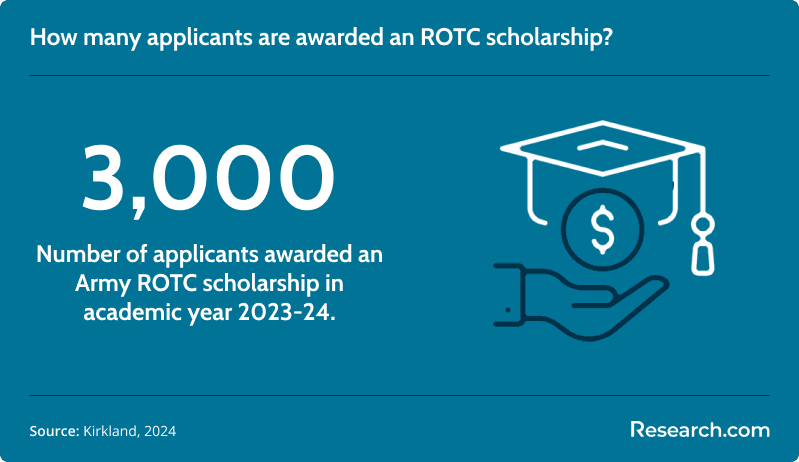
- In the 2023-24 academic year, about 3,000 students earned and received scholarships.
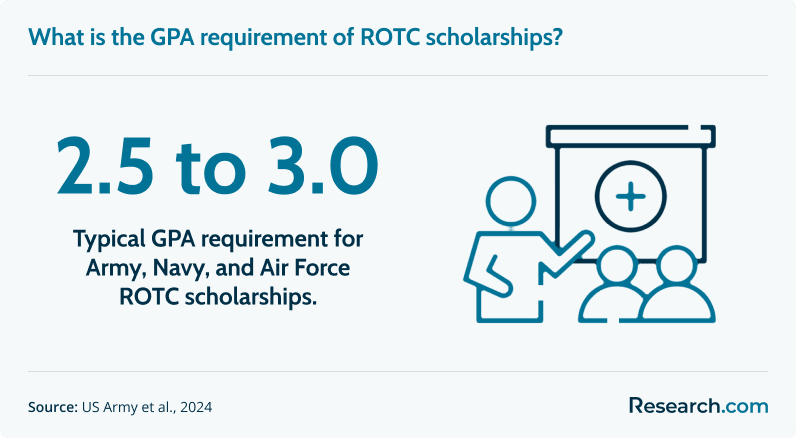
- The GPA requirement for an ROTC scholarship is 2.5 to 3.0.
- ROTC graduates can enter officer roles such as Army Second Lieutenant, Navy Ensign, and Air Force Second Lieutenant and support national defense through branch-specific assignments. They earn basic pay ranging from $12,803.70 to $18,491.70 monthly.
- ROTC scholarship options include four-year awards, nursing scholarships, reserve-focused awards, and branch-specific programs. Some opportunities cover full tuition, while certain Army ROTC education benefits may include 100% tuition coverage for specific graduate degrees.
- Students who complete ROTC can use their military experience to demonstrate leadership, teamwork, discipline, and adaptability when pursuing future military advancement or civilian employment.
ROTC Scholarships Table of Contents
- List of Scholarships for ROTC Students for 2027
- What are ROTC scholarships and how do they work?
- What are the different types of ROTC scholarships available?
- What steps are involved in applying for an ROTC scholarship?
- What are the eligibility criteria for ROTC scholarships?
- How do ROTC scholarships differ from other forms of financial aid?
- How competitive is the process of obtaining an ROTC scholarship?
- What academic majors complement an ROTC career?
- How can candidates prepare effectively for the ROTC scholarship interview?
- Can ROTC graduates advance their education with online degrees?
- How can ROTC students balance college and military responsibilities?
- How can ROTC students protect their well-being?
- What happens if ROTC scholarship obligations are not met?
- How can ROTC experience support accelerated online learning?
- How can ROTC experience strengthen advanced degree applications?
- How does military service work after ROTC?
- How can ROTC graduates add professional certifications?
- What career opportunities are available to ROTC scholarship graduates?
- What are the non-financial benefits of ROTC?
- Key Insights
List of Scholarships for ROTC Students for 2027
ROTC scholarship planning starts with choosing the branch that best matches your service goals: Army, Navy, Air Force, Marine Corps option, Space Force pathway, Army Reserve, Army National Guard, or Navy Nurse option. Each branch structures scholarships differently, so students should compare coverage, required training, eligible schools, major restrictions, and post-graduation obligations before applying.
| Scholarship | Best for | Main financial support | Service or program obligation |
| Army ROTC Four-Year Scholarship | High school graduates, college students, and active-duty enlisted Soldiers seeking an Army officer pathway | 100% tuition, plus monthly expense and book support | 8 years of service in the Army, Army Reserve, or Army National Guard |
| Army Green-to-Gold Scholarship | Enlisted soldiers pursuing a college degree and commission | Tuition OR room and board support, plus stipend and other education-related support | 8 years of service as either active duty or reserve status |
| Army Guaranteed Reserve Forces Duty Scholarship | Cadets intending to commission into the Army National Guard or Army Reserve | 100% tuition and fees OR $10,000/year for room and board | SMP participation and 8 years as a commissioned officer in either the ARNG or USAR |
| Army Women’s Foundation Legacy Scholarship Program | Women soldiers, past and present, and eligible descendants pursuing education | Scholarship awards for certificate, community college, undergraduate, and graduate study | N/A |
| Navy Four-Year National Scholarship | Students seeking Navy, Marine Corps, or Navy Nurse officer paths | Tuition and financial benefits up to $180,000 | Five years active duty for Navy option, four years of activity for Marine Corps and Navy Nurse options |
| Navy Minority Serving Institution Scholarship | Students attending HBCU, HSI, or MSI institutions through NROTC pathways | Tuition and financial benefits up to $180,000 | Five years active duty for Navy option, four years of activity for Marine Corps and Navy Nurse options |
| Navy ROTC Preparatory Scholarships | High school students who need a preparatory year before entering NROTC | 100% tuition and fees for one year | NROTC scholarship application |
| Air Force Type 1 High School Scholarship | High school students pursuing Air Force ROTC at an eligible college | 100% tuition and fees | AFROTC enrollment, field training, course completion, and 4 years of active duty as either an Air Force or Space Force officer |
| Air Force College Student Scholarship | Current AFROTC cadets competing for in-college scholarship support | 100% tuition and fees for Type 1, up to $18,000/year for Type 2 and CMLA | AFROTC enrollment, field training, course completion, and 4 years of active duty as either an Air Force or Space Force officer |
| Air Force Enlisted Airmen Scholarship | Enlisted personnel pursuing a bachelor’s degree and officer commission | 100% tuition and fees for ASCP and SOAR, up to $18,000/year for SLECP-A | 4 years of active duty for SOAR scholars, Officer Training School attendance for SLECP-A scholars |
1. Army ROTC Four-Year Scholarship
The Army ROTC Four-Year Scholarship is a merit-based award for students preparing to become Army officers. It is available to high school graduates, college students, and active-duty enlisted Soldiers. Because the award is based on merit rather than financial need, applicants are evaluated on qualifications such as academics, leadership potential, fitness, and readiness to serve. The scholarship may cover up to 100% of tuition, fees, and/or room and board, with additional funding for living costs and books.
- Coverage: 100% tuition
- Additional Benefits: $420/month for monthly expenses, $1,200/year for books
- Obligations: 8 years of service in the Army, Army Reserve, or Army National Guard
2. Army Green-to-Gold Scholarship
The Army Green-to-Gold Scholarship helps enlisted soldiers complete a college degree while moving toward an officer commission. It can support tuition, room and board, books, and monthly stipends, depending on the option and remaining time in school. The program is especially relevant for active-duty personnel considering college as part of their transition into officer leadership. Awards are tied to the number of college years remaining and emphasize merit rather than financial need.
- Coverage: Tuition OR room and board support
- Additional Benefits: $420/month for up to 10 months per year, monetary support for other expenses like textbooks, supplies, and equipment, Cadet Leadership Course attendance pay during the summer between the junior and senior years of college
- Obligations: 8 years of service as either active duty or reserve status
3. Army Guaranteed Reserve Forces Duty (GRFD) Scholarship
The GRFD scholarship is intended for cadets planning to commission into the Army National Guard or Army Reserve. It can cover tuition and fees or provide room and board support for up to 2 years. Recipients may also receive a book allowance and monthly stipend. Cadets commonly participate in the Simultaneous Membership Program, which includes monthly drills and two-week annual training. ARNG cadets may also be able to use State Tuition Assistance for tuition and fees.
- Coverage: 100% tuition and fees OR $10,000/year for room and board
- Additional Benefits: Annual book allowance, monthly stipend
- Obligations: SMP participation, 8 years as a commissioned officer in either the ARNG or USAR
4. Army Women’s Foundation Legacy Scholarship Program
The Army Women’s Foundation Legacy Scholarship Program supports women soldiers, former women soldiers, and their eligible descendants. Funds may be used for certificate programs, community college study, undergraduate degrees, and graduate degrees. Selection considers factors such as academic potential, merit, essays, community service, recommendation letters, and financial need. Awards are sent directly to accredited institutions and may be applied to tuition, fees, books, and documented room and board expenses for the award year.
- Coverage: $3,000 for The M.M. Costello Scholarship for healthcare fields, $5,000 for The Professional Contract Services, Inc (PCSI) Scholarship for Disabled Veterans, $2,500 for The 6888th Central Postal Directory Battalion Legacy Scholarship
- Additional Benefits: N/A
- Obligations: N/A
5. Navy Four-Year National Scholarship
The Navy Four-Year National Scholarship supports students pursuing Navy, Marine Corps, or Navy Nurse officer pathways through NROTC. Like other major ROTC awards, it is merit-based and can provide substantial education funding without being determined by financial need. The scholarship can cover tuition, fees, room and board, living expenses, books, and required summer training opportunities.
- Coverage: Tuition and financial benefits up to $180,000
- Additional Benefits: $250 to $400/month spending money, $750/year for books and supplies, and other benefits depending on the school affiliation, three summer training cruises
- Obligations: Five years active duty for Navy option, four years of activity for Marine Corps and Navy Nurse options
6. Navy Minority Serving Institution (MSI) Scholarship
The Navy Minority Serving Institution (MSI) Scholarship is designed for students attending Historically Black Colleges & Universities, Hispanic-Serving Institutions, or Minority-Serving Institutions. It allows students to pursue a degree while developing the leadership and management skills expected of future naval officers. This option may be especially relevant for applicants who want both a diverse campus environment and a structured NROTC path.
- Coverage: Tuition and financial benefits up to $180,000
- Additional Benefits: $250 to $400/month spending money, $750/year for books and supplies, and other benefits depending on school affiliation, three summer training cruises
- Obligations: Five years active duty for Navy option, four years of activity for Marine Corps and Navy Nurse options
7. Navy ROTC Preparatory Scholarships
The Navy ROTC Preparatory Scholarships support selected high school students through a one-year university preparatory program before entering the full NROTC scholarship process. These programs are offered through partner universities and are intended to strengthen academic preparation, life skills, and readiness for NROTC expectations. Universities and the Navy identify candidates based on factors such as academic record and character.
- Coverage: 100% tuition and fees for one year
- Additional Benefits: Depending on the partner university
- Obligations: NROTC scholarship application
8. Air Force Type 1 High School Scholarship
The Air Force Type 1 High School Scholarship pays tuition and required fees at colleges with an Air Force ROTC detachment. Recipients also receive a yearly book payment and a monthly living expense stipend that increases by class year. The award can also reimburse travel from home to the Air Force ROTC college around 30 days after the school year begins. It is built for high school students who are ready to pursue both a degree and Air Force or Space Force officer preparation.
- Coverage: 100% tuition and fees
- Additional Benefits: $900/year book stipend, $300 to $500/month stipend, travel reimbursement
- Obligations: Air Force ROTC enrollment during the start of term, 13-day summer field training at Alabama, Air Force ROTC General Military Course and Professional Officer Course completion, 4 years of active duty as either an Air Force or Space Force officer
9. Air Force College Student Scholarship
The Air Force College Student Scholarship is available to current AFROTC cadets and includes several award pathways. Commanders’ In-College Scholarships can cover 100% of tuition and include living and book stipends. The In-College Scholarship Program can provide up to $18,000 per year for tuition, along with living and book stipends. The General Charles McGee Leadership Award provides $18,000 per year for two years.
- Coverage: 100% tuition and fees for Type 1, up to $18,000/year for Type 2 and CMLA
- Additional Benefits: $900/year book stipend, $300 to $500/month stipend, travel reimbursement
- Obligations: Air Force ROTC enrollment during the start of term, 13-day summer field training at Alabama, Air Force ROTC General Military Course and Professional Officer Course completion, 4 years of active duty as either an Air Force or Space Force officer
10. Air Force Enlisted Airmen Scholarship
The Air Force Enlisted Airmen Scholarship includes several commissioning routes for enlisted personnel who want to earn a bachelor’s degree and become officers. Programs include the Airman Scholarship & Commissioning Program, Scholarships For Outstanding Airmen And Guardians To ROTC, Senior Leader Enlisted Commissioning Program, Professional Officer Course-Early Release Program, and Nurse Enlisted Commissioning Program. These options serve different candidate profiles, including airmen who have started college, those who still need a baccalaureate degree, and those pursuing nursing.
- Coverage: 100% tuition and fees for ASCP and SOAR, up to $18,000/year for SLECP-A
- Additional Benefits: $900/year book stipend and $300 to $500/month stipend for ASCP and SOAR scholars
- Obligations: 4 years of active duty for SOAR scholars, Officer Training School attendance for SLECP-A scholars
What are ROTC scholarships and how do they work?
ROTC scholarships are military-linked financial aid awards for students enrolled in Reserve Officers' Training Corps programs. They help pay for college while preparing students to serve as commissioned officers after graduation. In the 2023-24 academic year, approximately 3,000 students qualified for and were awarded scholarships.
The basic exchange is straightforward: the military branch helps fund your education, and you complete ROTC training while earning your degree. If you finish the program and meet commissioning requirements, you then serve according to the scholarship agreement. The exact service length depends on the branch, scholarship type, and career track.
ROTC training usually includes military science or aerospace/naval science courses, physical training, leadership labs, summer training, mentoring, and branch-specific preparation. Students interested in formal leadership theory may also compare ROTC development with advanced academic options such as an online doctorate in organizational leadership, although ROTC is focused specifically on military officer preparation.
What are the different types of ROTC scholarships available?
ROTC scholarships are not one-size-fits-all. Some are designed for high school seniors entering college, while others support current college students, nursing students, enlisted personnel, or students pursuing reserve service. Some branches, including the Army, may also offer scholarships and 100% tuition coverage for select graduate degrees.
| Scholarship type | Who it usually fits | Why it matters |
| Four-Year Scholarships | High school students planning to enter ROTC at the start of college | These awards can provide the longest funding window and may cover full tuition, fees, and living expenses. |
| Three-Year Advanced Designee Scholarships | Students who complete at least one year of college before scholarship activation | This path can work for students who join ROTC after starting college or who were not selected immediately. |
| Two-Year Scholarships | Students with two years remaining in their degree program | This option helps students who commit later but still have enough time to complete ROTC requirements. |
| Express Scholarships | Strong candidates in priority areas or high-demand categories | These awards can streamline selection and may cover full tuition and fees. |
| Nursing Scholarships | Nursing students preparing for military healthcare service | These awards can reduce the burden of nursing education costs and support a military nursing career. Students comparing expenses should also review nursing school cost factors. |
What steps are involved in applying for an ROTC scholarship?
The ROTC scholarship process usually involves choosing a branch, confirming that your target colleges have compatible ROTC programs, completing an application, meeting academic and fitness standards, and interviewing if required. Exact steps vary by branch and scholarship type, so applicants should always verify requirements with the official ROTC source and the campus unit.
- Choose the branch before choosing the scholarship. Army, Navy, Air Force, Marine Corps option, Space Force paths, Reserve, and National Guard routes lead to different service experiences.
- Confirm school participation. Make sure your college has the ROTC detachment, battalion, or cross-town agreement you need. Students who need flexible formats may compare military friendly online schools, but ROTC participation often requires in-person training access.
- Check eligibility early. Review citizenship, age, GPA, test score, physical fitness, medical, legal, and admission requirements before spending time on the application.
- Prepare application materials. Gather transcripts, test scores when required, activity records, leadership examples, recommendations, and personal statements.
- Complete fitness and medical steps. Scholarship selection and contracting usually require meeting branch-specific physical and medical standards.
- Interview with purpose. Be ready to explain why you want to serve, how you lead, and how your academic plans connect to branch needs.
- Review the service obligation before accepting. Do not accept an ROTC scholarship without understanding repayment rules, service length, active-duty or reserve possibilities, and consequences for not completing the program.
What are the eligibility criteria for ROTC scholarships?
Eligibility depends on the military branch, scholarship category, academic level, and intended service path. Most applicants must satisfy citizenship or eligibility rules, academic standards, physical fitness requirements, medical screening, conduct standards, and age limits. The GPA requirement for an ROTC scholarship is 2.5 to 3.0.
| Program | General eligibility requirements stated | What applicants should verify |
| Army ROTC Scholarship | U.S. citizen, age 17 to 31, high school diploma, minimum GPA, SAT or ACT, Army Combat Fitness Test, physical standards, and commitment to the Army, Army Reserve, or Army National Guard | Current branch rules, school participation, medical qualification, and service agreement terms |
| Navy ROTC Scholarship | U.S. citizen, high school graduate, required SAT and ACT scores, age 17 to 23, no criminal record, Navy physical standards, and admission to an approved NROTC college or university | Approved majors, Navy option versus Marine Corps or Nurse option, and summer training expectations |
| Air Force ROTC Scholarship for High School Students | U.S. citizen or eligible, DoDMERB medical exam, 1240 SAT or 26 ACT, 3.0 GPA, and Physical Fitness Assessment | Detachment availability, Space Force considerations, scholarship type, and field training requirements |
| Air Force ROTC Scholarship for College Students | U.S. citizenship or eligibility, DoDMERB physical, GPA requirements, and AFROTC Physical Fitness Assessment minimum score of 75 | In-college selection timing, major competitiveness, and commissioning plan |
The chart below illustrates the number of military personnel on active duty per military branch.
How do ROTC scholarships differ from other forms of financial aid?
ROTC scholarships are different from grants, private scholarships, and student loans because they are tied to officer training and military service. They may reduce college costs significantly, but they also come with obligations that ordinary financial aid does not include. Many students can combine ROTC aid with other aid, but coordination with the school financial aid office and ROTC unit is essential.
| Factor | ROTC scholarship | Other financial aid |
| Primary purpose | Funds college while preparing students for military officer service | Helps students pay for education without necessarily shaping a career path |
| Service commitment | Usually requires military service after graduation | Grants and scholarships usually do not require service; loans require repayment |
| Selection criteria | Academics, leadership, fitness, character, medical qualification, and service motivation | May focus on financial need, academic merit, talent, identity, field of study, or other criteria |
| Training requirements | Includes ROTC classes, labs, physical training, and branch-specific development | Typically does not include military training |
| Risk if requirements are not met | May involve repayment, loss of scholarship, or service consequences depending on the agreement | Usually limited to losing aid eligibility or loan repayment requirements |
How competitive is the process of obtaining an ROTC scholarship?
ROTC scholarships are competitive because awards are limited and branches are selecting future officers, not just funding students. Strong grades matter, but selection also depends on leadership potential, physical readiness, recommendations, conduct, communication, and sincere motivation to serve.
- Academic strength: Take challenging courses, maintain a strong GPA, and meet required test score standards when they apply.
- Leadership evidence: Show examples from school organizations, athletics, work, volunteering, JROTC, scouting, or community roles.
- Fitness preparation: Train before the official assessment so you can meet or exceed the required standard safely.
- Consistent involvement: Depth of commitment is often more persuasive than a long list of short-term activities.
- Strong recommendations: Ask teachers, coaches, supervisors, or community leaders who can speak specifically about your judgment, discipline, and reliability.
- Clean and accurate application: Avoid missing documents, vague essays, inconsistent dates, and unsupported claims.
- Clear service motivation: Be able to explain why you want to lead in the military, not simply why college is expensive.
- Program knowledge: Understand the branch, training model, service expectations, and how your degree supports your goals.
What academic majors complement an ROTC career?
The best major for an ROTC student is one the student can complete successfully while meeting branch needs and commissioning requirements. Engineering, business, international studies, foreign languages, computer science, cybersecurity, nursing, political science, criminal justice, logistics, and behavioral science can all support military careers in different ways. The right choice depends on branch priorities, scholarship rules, academic strengths, and long-term civilian goals.
Students should avoid choosing a major only because it sounds useful to the military. A demanding major can help, but poor academic performance can put the scholarship at risk. Students who want to evaluate income potential beyond military service may also compare degree options through Research.com’s guide to the highest paying majors.
How can candidates prepare effectively for the ROTC scholarship interview?
The ROTC scholarship interview is a leadership and service-readiness conversation. Interviewers want to see maturity, judgment, communication skills, physical readiness, academic focus, and a realistic understanding of military commitment.
- Study the program before the interview. Know the branch mission, ROTC structure, training expectations, and service obligation connected to your scholarship.
- Review your application carefully. Be prepared to explain grades, activities, work experience, leadership roles, awards, and any weak points honestly.
- Learn basic military customs and structure. You do not need to know everything, but basic familiarity shows preparation and respect.
- Prepare leadership stories. Use specific examples where you solved a problem, made a hard decision, helped a team improve, or accepted responsibility.
- Discuss fitness realistically. Know your current level, your training plan, and how you maintain discipline.
- Connect your degree to your service goals. Explain how your academic plan supports your future, whether you are considering fields such as military healthcare, STEM, public service, or an online pathway like a bachelor of education online.
- Practice concise answers. Long, unfocused responses can weaken an otherwise strong interview.
- Show teamwork, not ego. Officers lead people, so examples of collaboration and humility matter.
- Follow current military and global events. Awareness of public issues can help you speak more thoughtfully about service.
- Ask informed questions. Good questions about training, mentorship, commissioning, and cadet life show that you are evaluating the commitment seriously.
Can ROTC graduates advance their education with online degrees?
Yes. ROTC graduates and commissioned officers may use online programs to continue their education while balancing service, relocation, training, or family responsibilities. Online degrees can be especially useful for officers pursuing graduate study, management preparation, technical skills, or career transition planning. However, students should confirm accreditation, military tuition policies, transfer credit rules, and whether the program format is respected in their intended field.
For many service members and veterans, online education is no longer viewed as unusual, but program quality still varies. Research.com’s guide on whether online degrees are respected can help students understand how employers and graduate schools may evaluate online credentials.
How can ROTC students effectively balance academic and military commitments?
ROTC students carry two calendars: the academic schedule and the military training schedule. The students who manage both well usually plan early, communicate with instructors and cadre, protect study time, and treat physical training as a required part of the week rather than an optional activity.
- Build a weekly operating schedule. Block class, study, labs, ROTC events, workouts, meals, sleep, and commuting time.
- Prioritize grades before problems appear. ROTC scholarships have academic standards, so tutoring and office hours should be used early.
- Keep cadre informed. If a class conflict, medical issue, or family emergency affects training, communicate quickly and professionally.
- Choose course loads carefully. Avoid stacking the hardest courses in the same term as major ROTC training events when possible.
- Plan beyond graduation. Officers who expect to pursue graduate education later may compare flexible and affordable options such as the cheapest online masters programs.
How can ROTC students maintain their well-being while balancing training and academics?
ROTC can be rewarding, but the combination of academics, physical training, leadership labs, military expectations, and social pressure can become stressful. Well-being is not separate from performance. Students who sleep poorly, ignore injuries, skip meals, or avoid asking for help often make academic and training problems worse.
- Use campus health and counseling services. Seeking support early is a practical performance strategy, not a weakness.
- Build peer support. Fellow cadets and midshipmen understand the schedule and can provide accountability.
- Take injuries seriously. Training through pain without medical guidance can create longer-term setbacks.
- Protect sleep during high-demand weeks. Fatigue can hurt grades, fitness, judgment, and mood.
- Consider flexible education options when appropriate. Students with military obligations may benefit from researching veteran friendly online colleges, especially for later education after commissioning or service.
What are the consequences of failing to meet ROTC scholarship obligations?
Failing to meet ROTC scholarship requirements can have serious academic, financial, and military consequences. Outcomes depend on the branch, contract status, timing, reason for non-completion, and scholarship agreement. Students who are struggling should speak with their ROTC cadre and school financial aid office as soon as possible rather than waiting until the problem becomes irreversible.
- Loss of scholarship funding: Students who fall below academic, conduct, medical, or training requirements may lose future award eligibility.
- Repayment requirement: If a recipient does not complete the academic program or service commitment, repayment of scholarship funds may be required.
- Military service obligation: In some cases, a student who does not complete scholarship terms may still have a service obligation under the agreement.
- Disciplinary consequences: Serious non-compliance can affect military standing, future opportunities, and career progression.
How can ROTC experience facilitate accelerated online learning?
ROTC students often develop the habits needed for compressed academic formats: time management, discipline, task prioritization, and accountability. These traits can help when completing accelerated online coursework, but speed should not come at the expense of accreditation, learning quality, or transferability.
Students considering fast credentials should ask whether the program fits their long-term education plan, whether credits transfer, and whether the schedule is realistic alongside military duties. For a starting point, Research.com explains options such as an online associate degree in 6 months.
How can ROTC experience boost your eligibility for advanced degrees?
ROTC experience can strengthen graduate school applications by demonstrating leadership, ethical responsibility, resilience, teamwork, operational planning, and the ability to perform under pressure. These qualities can be especially relevant for programs in public administration, business, engineering management, cybersecurity, healthcare leadership, education, and organizational leadership.
Applicants should translate military experience into academic language. Instead of only listing ranks or duties, explain outcomes, teams led, problems solved, and skills developed. Working officers and veterans who need flexible formats may also explore options such as a PhD for working professionals.
How does military service work after completing an ROTC program?
After completing ROTC and graduation requirements, students typically commission as officers in their branch. Their first assignments depend on branch needs, career field selection, performance, medical qualification, and service agreement terms.
- Commissioned officer role: Graduates enter leadership positions and are responsible for people, equipment, missions, and decisions.
- Active duty service: Some officers serve full time and may move between assignments, training locations, and deployments.
- Reserve or National Guard service: Some officers serve part time while also building civilian careers or pursuing further education. A student with interests outside the military might later explore fields such as careers in behavioral psychology.
- Leadership responsibilities: Officers supervise teams, communicate standards, mentor junior personnel, and help units complete assigned missions.
- Specialized training: New officers continue branch-specific education in tactics, technical skills, leadership, and operations.
- Possible deployments: Depending on branch and assignment, officers may support missions in the United States or abroad.
How can ROTC graduates enhance their skill set with professional certifications?
Professional certifications can help ROTC graduates translate military leadership into civilian career opportunities. Certifications may be useful in project management, cybersecurity, data analytics, logistics, emergency management, human resources, and healthcare administration, depending on the officer’s background and goals.
The best certification is one that matches a target job, not simply one that looks impressive. Before enrolling, compare employer demand, exam requirements, renewal rules, cost, and whether the credential is recognized in your field. Research.com’s guide to certifications online can help graduates compare flexible credential options.
What career opportunities are available to ROTC scholarship graduates?
ROTC scholarship graduates typically begin their post-college military careers as commissioned officers. Common starting roles include Army Second Lieutenant, Navy Ensign, and Air Force Second Lieutenant. According to the Defense Finance and Accounting Service, officers can earn basic pay ranging from $12,803.70 to $18,491.70 per month for higher positions. Officers are also entitled to receive housing allowance.
| Starting officer role | Typical responsibility | Examples of future development areas |
| Army Second Lieutenant | Leads soldiers and supports training, operations, administration, and mission execution within Army units | Branch leadership, logistics, operations, intelligence, combat arms, engineering, or specialized Army roles |
| Navy Ensign | Serves as a junior naval officer with duties that may involve ships, submarines, aviation, staff work, or other Navy operations | Surface warfare, submarine service, aviation, intelligence, nursing, or other Navy communities |
| Air Force Second Lieutenant | Begins officer service in areas such as aviation, intelligence, logistics, space-related roles, or other Air Force specialties | Operations, technical leadership, logistics, intelligence, aviation, or Space Force-related assignments |
The chart below details the basic monthly pay for the four to five years of obligated service at this level, based on data published in 2024.
What are the non-financial benefits of participating in ROTC?
Although scholarship funding is often the reason students first research ROTC, the non-financial benefits can be just as important. ROTC is structured to build officer habits over time, not simply provide occasional military exposure.
- Leadership development: Cadets and midshipmen practice decision-making, communication, accountability, and problem-solving in structured environments.
- Physical fitness: Regular training encourages endurance, strength, discipline, and readiness for military standards.
- Mentorship and networking: Students interact with cadre, officers, enlisted personnel, alumni, and peers who can provide guidance throughout military and civilian careers.
- Time management: Balancing classes, ROTC labs, training, and personal responsibilities helps students build strong organizational habits.
- Global and cultural awareness: Military preparation often exposes students to international security issues, cultural considerations, and mission contexts beyond the classroom.
- Service mindset: ROTC emphasizes responsibility to the unit, community, country, and profession of arms.
Common Mistakes to Avoid Before Accepting an ROTC Scholarship
| Mistake | Why it can hurt you | Better approach |
| Applying only for the money | ROTC requires military training and service; lack of commitment can lead to poor performance or withdrawal. | Speak with current cadets, officers, veterans, and family members before deciding. |
| Ignoring service obligations | Repayment or service consequences may apply if requirements are not completed. | Read the contract carefully and ask the ROTC unit to explain every obligation in plain language. |
| Choosing a college without confirming ROTC access | Not every school has the needed detachment, battalion, unit, or cross-town arrangement. | Verify ROTC participation before committing to a college. |
| Underestimating physical standards | Fitness requirements are part of selection, training, and commissioning readiness. | Start a safe training plan before applying and track progress honestly. |
| Taking an unrealistic course load | Academic problems can threaten scholarship eligibility. | Balance major requirements, ROTC commitments, work hours, and recovery time. |
| Assuming all aid stacks automatically | ROTC funding, school aid, grants, and housing benefits may interact differently by institution. | Ask the financial aid office how each award applies to tuition, fees, room, board, and refunds. |
| Relying only on rankings or reputation | A famous college may not be the best ROTC fit for your branch, major, budget, or support needs. | Compare detachment quality, graduation support, campus culture, costs, and career fit. |
Questions to Ask Before You Apply
- Which branch do I actually want to serve in, and why?
- Does my preferred college have the ROTC program or cross-town agreement I need?
- What costs are covered: tuition, fees, books, room, board, monthly stipend, or travel?
- What costs remain my responsibility?
- What GPA, fitness, medical, conduct, and academic progress standards must I maintain?
- What is the exact service obligation after graduation?
- What happens if I change majors, transfer schools, become medically disqualified, or leave the program?
- Can I combine ROTC funding with grants, institutional scholarships, VA education benefits, or other aid?
- How competitive is my intended major or career field within the branch?
- Who can I contact at the campus ROTC unit before accepting admission?
References
- Bureau of Labor Statistics (BLS). (2023). Military Careers. Occupational Outlook Handbook. BLS military careers overview.
- Defense Finance and Accounting Service. (2024). Basic Pay – Officers Effective January 1, 2024. Defense Finance and Accounting Service pay tables.
- Hanson, M. (2023). College Tuition Inflation Rate. Education Data Initiative tuition inflation data.
- Navy. (n.d.). Navy ROTC. Navy ROTC information.
- US Air Force. (n.d.). Scholarships. Air Force ROTC scholarship information.
- US Army. (2024). ROTC Scholarships. US Army ROTC scholarships.
Key Insights
- ROTC scholarships can substantially reduce college costs, but they are tied to military training and post-graduation service.
- The best ROTC scholarship depends on branch, school, major, class year, service goals, and willingness to meet physical and academic standards.
- Applicants should compare total coverage, not just tuition. Books, fees, room, board, stipends, travel, and uncovered costs can vary by scholarship and school.
- Strong candidates show more than good grades. Leadership, fitness, character, communication, and sincere commitment to service matter.
- Students should read the scholarship agreement carefully before accepting because failing to meet requirements can lead to repayment, loss of funding, or service consequences.
- ROTC can provide long-term value beyond financial aid by developing leadership, discipline, teamwork, and career-ready skills for both military and civilian paths.
Other Things You Should Know About ROTC Scholarships
ROTC may benefit you if you are interested in a military career, developing leadership skills, and receiving financial aid. However, it's essential to consider that joining ROTC means committing to military service after graduation. Students considering ROTC should carefully weigh the benefits against the obligations to determine if it aligns with their aspirations and values.
For 2027 ROTC scholarships, applicants must be U.S. citizens, aged 17 to 26, with a high school diploma or equivalent. They must meet physical fitness standards, commit to military service, and demonstrate academic achievement. Each branch may have specific criteria, so it's crucial to check the requirements for the Army, Navy, Air Force, or Marine Corps ROTC scholarships.
ROTC scholarship graduates with military experience gain a decisive advantage in finding jobs after their studies. Employers highly value their leadership, teamwork, and discipline skills. Their strong work ethic, problem-solving abilities, and adaptability make them stand out from other job candidates. Graduates can pursue specialized career paths, succeed in civilian jobs, and explore diverse opportunities in various industries. They can also expect competitive pay. Many choose to use their skills in business and entrepreneurship, and some continue their education, including affordable online MBA programs, to further enhance their career prospects.


