2027 Paralegal Salary by State

Co-Founder and Chief Data Scientist
Understanding paralegal salaries by state in the U.S. can be surprisingly complex. As a career planning and education expert, I’ve seen firsthand how inconsistent data, outdated sources, and regional cost-of-living differences make it difficult for aspiring professionals to make informed decisions. Some states report median wages, others highlight entry-level or top-tier earnings, and many omit crucial factors like certification or firm size.
This guide cuts through the confusion to offer clear, current insights tailored to help students, career changers, and working paralegals assess their earning potential with confidence—no guesswork, just facts that matter.
What are the benefits of a paralegal career?
- Career advancement: Clear paths from junior paralegal to senior specialist, legal operations, or corporate compliance across multiple practice areas.
- Earning potential: National averages cluster in the mid-$50Ks to mid-$60Ks with higher upside in corporate/federal roles (PayScale, Indeed, 2025).
- Skill portability: Research, drafting, e-discovery, and contract workflows transfer across law firms, corporate legal, government, and ALSP/legal-tech settings.
What can I expect from paralegal work?
- Core competencies: Legal research, drafting pleadings/contracts, case management, discovery, and client communication under attorney supervision.
- Structured training: On-the-job mentorship, SOPs, and confidentiality/professional responsibility integrated into daily workflows.
- Tools & tech: Regular use of e-discovery platforms, document management, CLM, and citation/research tools in tech-enabled practices.
- Specialization options: Opportunities in litigation, corporate/transactions, IP, employment, compliance, healthcare, real estate, and finance.
- Professional credentials: Optional certifications (e.g., NALA CP/ACP; NFPA RP) signal competence and can support advancement.
Where can I work as a paralegal?
- Law firms & litigation boutiques: Case prep, discovery, trial support, and client/file management.
- Corporate legal departments: Contract lifecycle, compliance, governance, IP docketing, and M&A support.
- Government & courts: Agency rulemaking support, public records, hearings, and judicial administration.
- Financial services & real estate: Regulatory documentation, closings, titles, and lending compliance.
- Nonprofits, higher education & healthcare: Policy, grants, risk/compliance, and investigations support.
- ALSPs & legal-tech vendors: Managed review, e-discovery operations, and tech-enabled legal services.
How much can I make as a paralegal?
- Entry-level roles: ~$42K/year from $20.03/hr averages, with low-end pay near $41K (Indeed, PayScale
- Mid-career roles: ~$60K–$75K typical band, at around $$65K median total pay (Indeed, Salary.com
- Senior & specialized roles: ~$80K–$120K+ with Senior Paralegal near $102K and upper-tier ladders (Paralegal V medians ≈ $137K) in large markets and complex practices (Glassdoor)
- What are the paralegal salaries by state for 2027? Paralegal Salaries
- What education is required to become a paralegal? Education
- What certifications do paralegals need? Certifications
- What skills are essential for success as a paralegal? Skills
- What are the typical work environments for paralegals? What are the typical work environments for paralegals?
- What are the main responsibilities of a paralegal? Responsibilities
- What is the job outlook for paralegals? Job Outlook
- What career advancement opportunities exist for paralegals? Career Opportunities
- What are the current and future trends in the paralegal profession? What are the current and future trends in the paralegal profession?
What are the paralegal salaries by state for 2027?
Paralegal salaries in the United States vary widely by state, influenced by factors such as regional demand, cost of living, and local legal market dynamics. Understanding these differences is essential for anyone planning a legal support career, as location can significantly impact earning potential and job opportunities.
Geographic location remains one of the most significant drivers of paralegal salary variance, with compensation influenced by regional demand, cost of living, and the concentration of legal markets. Here are the state salaries of paralegals by tier:
Top-Tier States
In 2025, paralegals in Washington earn the highest average annual salary at $67,651, and the District of Columbia offers a similarly high wage of $67,497 (ZipRecruiter, 2025). Other states in the top tier include New York at $65,347 and Massachusetts at $65,233, both of which feature robust legal and financial sectors (ZipRecruiter, 2025).
Rounding out the highest-paying states are Alaska ($64,327), Vermont ($63,509), North Dakota ($63,200), Oregon ($63,152), Colorado ($62,808), and Hawaii ($62,058), according to ZipRecruiter (2025).
These figures, shown in the graph below, display a tendency for the highest salaries to be concentrated in states with major metropolitan hubs, significant government presence, or high costs of living. Much like comparing BBA vs. MBA salaries, understanding these state-based pay differences highlights how specialization and education levels can also influence long-term earning potential in the legal field.
Upper Mid-Range States
A significant number of states offer competitive salaries in the upper-middle bracket, creating a strong intermediate tier in the national pay scale. For instance, Nevada provides an average salary of $60,824, while New Jersey and Wisconsin offer comparable figures at $60,641 and $60,289, respectively (ZipRecruiter, 2025).
The data shows a cluster of states in the Northeast and Mid-Atlantic regions in this category, with Pennsylvania at $59,874, Delaware at $59,782, and Virginia at $59,218, while California also falls into this range at $58,948 (ZipRecruiter, 2025).
This trend indicates that states with diverse economies and large urban centers consistently provide above-average compensation for paralegals.
Lower Mid-Range States
The lower mid-range of salaries encompasses a broad group of states primarily from the Midwest, Southwest, and Mountain West, where costs of living are often lower. Illinois offers an average salary of $57,880, while its neighbors Indiana and Ohio report similar figures at $56,838 and $56,786, respectively (ZipRecruiter, 2025).
In the Southwest, New Mexico has an average of $57,883, and Arizona paralegals earn around $55,662, which is comparable to Texas at $55,648 (ZipRecruiter, 2025).
This salary band demonstrates a tendency for compensation to be closely aligned with regional economic conditions rather than proximity to the nation's largest legal markets.
Lower-Tier States
The states with the lowest compensation for paralegals are predominantly located in the South and parts of the industrial Midwest. Florida reports the lowest average salary in the nation at $44,636, and West Virginia is the second-lowest at $46,242 (ZipRecruiter, 2025).
Several other Southern states, including Arkansas ($49,392), Georgia ($50,435), Louisiana ($51,077), and Alabama ($54,139), also fall into this lower tier (ZipRecruiter, 2025).
The data reveals a significant geographic disparity, with a gap of over $23,000 between the highest and lowest paying states, highlighting the critical role that local economic factors and demand for legal services play in determining earning potential. This regional contrast is not unlike the difference between COTA vs. OTA salary, where state-specific licensing requirements and local demand for professionals lead to significant pay variations across the U.S.
- Assist with Discovery: Handle the exchange of information between parties, including drafting interrogatories and requests for documents.
- Communicate with Clients: Act as a point of contact for clients, providing case updates, gathering information, and scheduling meetings.
- Conduct Legal Research: Investigate case law, statutes, and regulations relevant to a specific case or legal issue.
- Draft Legal Documents: Prepare initial drafts of pleadings, motions, contracts, wills, and other legal correspondence.
- File Documents with Courts: Prepare and electronically file legal documents with state and federal courts, adhering to strict deadlines and rules.
- Interview Clients and Witnesses: Conduct initial interviews to gather facts and details about a case.
- Manage Case Files: Organize and maintain all documents, evidence, and correspondence for cases, ensuring everything is accessible.
- Perform Administrative Tasks: Handle tasks such as maintaining attorney calendars, docketing deadlines, and managing billing records.
- Prepare for Trial: Organize exhibits, prepare trial binders, coordinate witness schedules, and assist attorneys in the courtroom during proceedings.
- Summarize Information: Condense lengthy documents like depositions, medical records, and transcripts into concise summaries for attorneys.
The work of a paralegal is critical for enhancing a law firm's efficiency and allowing attorneys to focus on more complex legal strategy. Their contributions are integral to nearly every aspect of legal practice. If you'd like to jump right into this field, you can study for an accelerated paralegal certificate online.
What education is required to become a paralegal?
Becoming a paralegal requires specialized education that provides a strong foundation in legal principles and practical skills, though the specific path can vary. The journey typically involves a combination of formal coursework and often, professional certification.
- ABA Approval: The American Bar Association approves paralegal education programs that meet high-quality standards, a credential many employers seek.
- Associate's Degree: A two-year program in paralegal studies is a common entry point, providing core legal knowledge and skills.
- Bachelor's Degree: A four-year degree, either in paralegal studies or another field, followed by a certificate, is increasingly preferred by employers.
- Core Coursework: Programs include classes in legal research, writing, litigation, ethics, and various areas of law, like family or corporate law.
- Internships: Many programs require or encourage internships, providing invaluable real-world experience in a legal setting.
- Master's Degree: An advanced option for those seeking specialized knowledge or leadership roles in the legal field.
- Paralegal Certificate Program: Designed for those who already hold a bachelor's degree in another subject, these programs focus exclusively on paralegal coursework.
- Practical Skills Training: Education emphasizes hands-on skills such as drafting documents, using legal software, and case management techniques.
A solid educational foundation is essential for mastering the complex duties of a paralegal and building a successful career, including accelerated paralegal programs. This training ensures professionals are prepared for the demands of working in a fast-paced legal environment. In many ways, this structured education mirrors the paths seen in online doctorate in education no GRE programs, where flexibility and accessibility are designed to help working professionals advance without compromising quality.
What certifications do paralegals need?
While paralegals are not licensed by the state in the same way attorneys are, professional certification is a key benchmark for demonstrating expertise and commitment to the field. These voluntary credentials can significantly enhance a paralegal's career prospects and credibility, and are the main driver for the popularity of online paralegal certification.
- Advanced Certifications: Both NALA and other organizations offer advanced credentials in specialty areas like personal injury, corporate law, or intellectual property.
- Continuing Legal Education (CLE): Maintaining certification typically requires ongoing education to stay current with changes in the law and legal technology.
- Employer Preference: Many employers prefer to hire certified paralegals as it signals a high level of professional knowledge and competence.
- Ethical Standards: Certification programs emphasize a strong understanding of legal ethics, which is critical for the profession.
- NALA Certified Paralegal (CP): Offered by the National Association of Legal Assistants, this is one of the most recognized certifications in the industry.
- NFPA Registered Paralegal (RP): Provided by the National Federation of Paralegal Associations, this is another leading credential for experienced paralegals.
- No Mandatory Licensure: Unlike lawyers, paralegals work under attorney supervision and do not have a mandatory state license to practice.
- State-Specific Credentials: Some states, like California, have specific educational requirements for anyone using the title "paralegal."
Pursuing certification is a strategic move that validates a paralegal's skills and can lead to greater responsibilities and higher earning potential. It is the primary way professionals in the field distinguish themselves.
A 2024 survey by the National Association of Legal Assistants (NALA) explored paralegal perspectives on limited licensure programs, which authorize non-attorneys to perform specific legal tasks without direct attorney supervision. The findings revealed a significant awareness gap, as nearly 40% of respondents were unaware of such programs, while approximately 62% had at least some familiarity. Despite this mixed awareness, there is a strong appetite for these opportunities, with a notable 81% of paralegals expressing interest in pursuing them, as shown in the figure below.
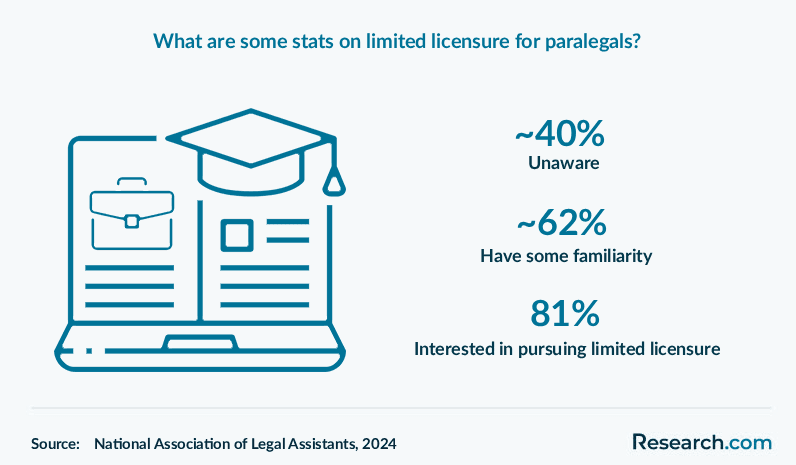
This high level of interest suggests that implementing limited licensure programs could significantly enhance career advancement for paralegals, allowing them to take on responsibilities traditionally reserved for attorneys.
What skills are essential for success as a paralegal?
A successful paralegal combines deep legal knowledge with a robust set of soft and technical skills, enabling them to thrive in a demanding environment. These competencies are crucial for managing complex tasks and supporting legal teams effectively.
- Adaptability: Remain flexible and responsive to the fast-paced and ever-changing nature of legal work.
- Attention to Detail: Ensure absolute accuracy in all work, from proofreading documents to citing legal authorities correctly.
- Communication Skills: Clearly and professionally interact with attorneys, clients, court staff, and opposing counsel both verbally and in writing.
- Critical Thinking: Analyze complex factual and legal issues to anticipate needs and identify potential problems.
- Discretion and Confidentiality: Understand and uphold the strict ethical duty to maintain client confidentiality.
- Multitasking Ability: Juggle multiple cases, deadlines, and priorities simultaneously without sacrificing quality.
- Organizational Skills: Meticulously manage large volumes of documents, track deadlines, and maintain organized case files.
- Research and Writing: Skillfully conduct legal research using databases like Westlaw or LexisNexis and draft clear, concise, and accurate legal documents.
- Teamwork: Collaborate effectively with attorneys and other legal support staff to achieve shared goals.
- Tech Proficiency: Master legal software for billing, case management, e-discovery, and trial presentation.
Mastering this blend of skills allows a paralegal to become an indispensable asset to any legal team. These abilities are the foundation of a long and successful career in the field, and are developed in ABA approved paralegal programs.
What are the typical work environments for paralegals?
Paralegals work in a diverse range of settings, and the specific environment can shape their daily responsibilities, work culture, and career path. While law firms are the most common employers, opportunities exist across many sectors of the economy.
- Corporate Legal Departments: Work "in-house" for corporations, handling matters like contracts, compliance, and governance.
- Financial Institutions: Handle compliance, loan documentation, and regulatory matters within banks and investment firms.
- Freelance/Contract Work: Operate independently, providing paralegal services to various attorneys and firms on a project basis.
- Government Agencies: Serve at the local, state, or federal level in prosecutors' offices, public defenders' offices, or administrative agencies.
- Healthcare Systems: Assist with patient confidentiality issues, regulatory compliance, and medical malpractice litigation.
- Insurance Companies: Work on claims investigation, litigation defense, and policy administration.
- Intellectual Property Firms: Specialize in the processes for patent, trademark, and copyright applications and litigation.
- Law Firms: The most traditional setting, ranging from small solo practices to large, international corporate firms.
- Nonprofit Organizations: Assist with legal work for advocacy groups, charitable organizations, and legal aid societies.
- Real Estate and Title Companies: Focus on preparing documents for property closings, title searches, and other real estate transactions.
The employment landscape for paralegals is overwhelmingly concentrated in the legal services sector, which includes law firms and other legal service providers. According to the U.S. Bureau of Labor Statistics, this industry alone employs 273,590 paralegals and legal assistants, making it the primary employer by a vast margin.
Government sectors are the second-largest employer, with federal, state, and local governments combined employing 43,400 paralegals, including 16,090 at the local level and 10,920 at the state level. The corporate world, represented by the management of companies and enterprises, employs a smaller but significant number of 6,760 paralegals.
This data, shown in the graph below, clearly illustrates that traditional legal settings remain the bedrock of the paralegal profession, accounting for the vast majority of all positions.
While government and in-house corporate roles provide substantial alternative career paths, the core of the profession is firmly rooted in the legal services industry. The wide variety of work environments offers paralegals the flexibility to find a role that aligns with their interests and career goals. This diversity ensures that skilled paralegals are in demand across the entire legal and business landscape.
What are the main responsibilities of a paralegal?
The core responsibilities of a paralegal revolve around providing substantive support to attorneys in all phases of legal work, from the inception of a case through its resolution. Their duties are hands-on and require a deep understanding of legal procedures. In more detail, what does a paralegal do?
- Case Management: Maintaining the case calendar, tracking deadlines for filings, and ensuring the case progresses smoothly.
- Client Intake: Conducting initial interviews with potential clients to gather the basic facts of their legal matter.
- Closing and Settlement Support: Drafting settlement agreements and preparing all necessary documents to formally close a case or transaction.
- Deposition Preparation: Helping attorneys prepare for depositions by summarizing records and outlining potential questions.
- Evidence Management: Cataloging, organizing, and managing all evidence and exhibits for a case, particularly in complex litigation.
- Legal Research and Analysis: Locating relevant statutes and case law and providing attorneys with memos summarizing their findings.
- Litigation Support: Assisting with all stages of a lawsuit, including discovery, motion practice, and trial preparation.
- Pleadings and Motions: Drafting initial versions of complaints, answers, and various motions for an attorney's review and final approval.
- Transactional Support: Preparing and managing documents for business deals, such as mergers, acquisitions, or real estate closings.
- Witness Coordination: Scheduling and communicating with witnesses to prepare them for depositions or trial testimony.
These responsibilities form the backbone of a legal practice, enabling the efficient delivery of legal services to clients. A proficient paralegal is essential for managing the logistical and procedural complexities of modern law.
What is the job outlook for paralegals?
The job outlook for paralegals remains positive, supported by a consistent demand for efficient and cost-effective legal services. While automation and legal tech are reshaping workflows, the profession continues to offer stable employment across industries, driven by both new positions and the need to replace retiring professionals.
- Annual Job Openings: Roughly 38,000 openings are projected each year, driven by both new positions and replacement needs.
- Cost-Effectiveness: Paralegals perform tasks once handled by junior attorneys, providing significant cost savings for clients and employers.
- Demand in High-Growth Areas: Legal specialties in intellectual property, healthcare, compliance, and corporate law continue to expand.
- Employment (2024): Approximately 376,200 paralegals and legal assistants are employed in the U.S.
- Industry Concentration: About 77% of all paralegals work in legal services, with others in corporate, government, and finance sectors.
- Projected Growth (2023–2033): Employment is projected to grow 1%, which is slower than the average for all occupations, yet maintains steady long-term demand.
- Remote & Hybrid Work: Around 82% of paralegals perform some remote work, reflecting post-pandemic flexibility.
- Replacement Needs: A large share of job openings stems from retirements and career transitions.
- Technology Integration: Paralegals skilled in e-discovery, litigation support, and legal tech tools remain in high demand.
- Top-Paying Industries: Management of companies, the Federal Executive Branch, and State Government offer the highest mean salaries.
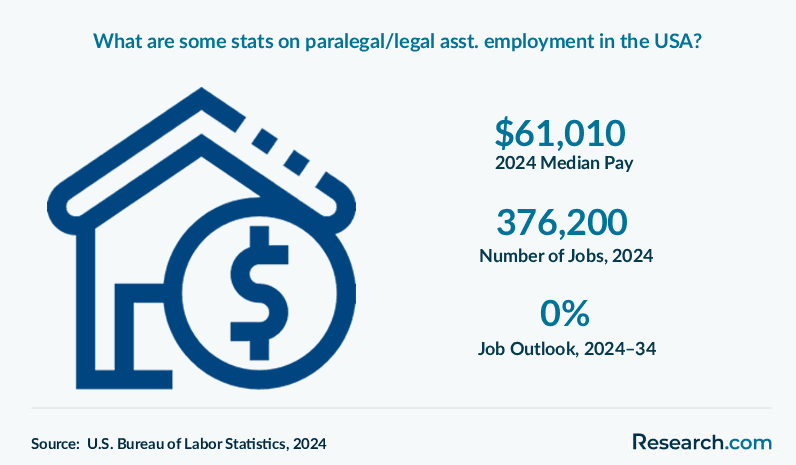
According to the U.S. Bureau of Labor Statistics, the median pay for paralegals and legal assistants in 2024 was $61,010 per year, or $29.33 per hour. The profession employed approximately 376,200 individuals in 2024, with the typical entry-level education being an associate's degree. The job outlook for the decade from 2024 to 2034 is projected to show little or no change, with a 0% growth rate and an estimated addition of only 600 jobs during that period.
These figures, shown in the graphic below, indicate a trend of stability rather than rapid expansion for the paralegal profession. While the field offers solid earning potential, the minimal projected growth suggests that job openings in the coming decade will primarily arise from the need to replace workers who retire or change careers.
The profession offers a promising career path with strong job security for those with the right education, skills, and professional certifications. This overall outlook makes it an attractive choice for credentialed, tech-literate professionals who can adapt to evolving legal processes.
What career advancement opportunities exist for paralegals?
A career as a paralegal offers numerous opportunities for professional growth and advancement, both within the paralegal role and as a stepping stone to other positions in the legal industry. Experienced paralegals can specialize and take on significant leadership responsibilities.
- Case Manager: Specializes in managing the lifecycle of cases in a specific practice area, like mass torts or complex litigation.
- Contract Administrator: Move into a corporate role focused specifically on drafting, negotiating, and managing contracts.
- Freelance Practice: Build an independent business providing specialized paralegal services to a portfolio of attorney clients.
- In-House Corporate Roles: Advance within a company's legal department to roles with greater responsibility in compliance or governance.
- Law School: Use paralegal experience as a strong foundation for pursuing a law degree and becoming an attorney.
- Litigation Support Specialist: Focus on the technical aspects of litigation, including e-discovery management and trial technology.
- Niche Specialization: Become an expert in a high-demand area such as intellectual property, e-discovery, or regulatory compliance.
- Office Manager: Transition into a management role overseeing the administrative operations of a law firm.
- Paralegal Manager/Supervisor: Oversee a team of paralegals and legal assistants, handling workflow, training, and performance reviews.
- Senior Paralegal: Take on more complex cases, manage larger projects, and work with greater autonomy.
The paralegal career is not static; it provides a flexible and dynamic path for professional development. With experience and ambition, paralegals can craft a career that aligns with their evolving skills and interests. Much like evaluating the benefits of a data science master's degree, advancing as a paralegal often depends on balancing specialization, continued education, and market demand to achieve higher earning potential and leadership opportunities.
What are the current and future trends in the paralegal profession?
The paralegal profession is continuously evolving, shaped by technological advancements, shifting client expectations, and changes within the legal industry itself. Staying ahead of these trends is crucial for career growth and long-term success in the field.
- Alternative Legal Service Providers (ALSPs): The growth of ALSPs is creating new career paths for paralegals outside of traditional law firms, often in tech-focused and process-driven environments.
- Cybersecurity and Data Privacy: With an increased focus on data protection, paralegals specializing in cybersecurity and privacy compliance are in high demand.
- Expanded Responsibilities: Paralegals are increasingly taking on more complex duties, such as project management, client relations, and even some tasks once reserved for junior attorneys.
- Focus on Soft Skills: As technology automates routine tasks, soft skills like communication, emotional intelligence, and client management are becoming more valuable.
- Increased Specialization: A trend towards specialization in high-growth areas like intellectual property, healthcare law, e-discovery, and environmental law is creating demand for paralegals with niche expertise.
- Legal Project Management (LPM): Formal project management principles are being applied to legal cases, with skilled paralegals often taking the lead in managing budgets, timelines, and resources.
- Remote and Hybrid Work: The adoption of remote work models has become a permanent fixture, offering paralegals greater flexibility but also requiring strong self-discipline and tech proficiency.
- Rise of Artificial Intelligence (AI): AI and automation are transforming legal work by handling tasks like document review, legal research, and contract analysis, shifting the paralegal's role towards higher-level analysis and oversight.
- Virtual Paralegals: The gig economy has expanded to the legal field, with a growing number of paralegals working as independent contractors for multiple attorneys and firms on a remote basis. These are in addition to the usual criminal law paralegal job requirements.
These trends indicate a shift from traditional administrative support to a more strategic, specialized, and technologically integrated role for paralegals. Professionals who embrace continuous learning and adapt to these changes will be best positioned for future success.
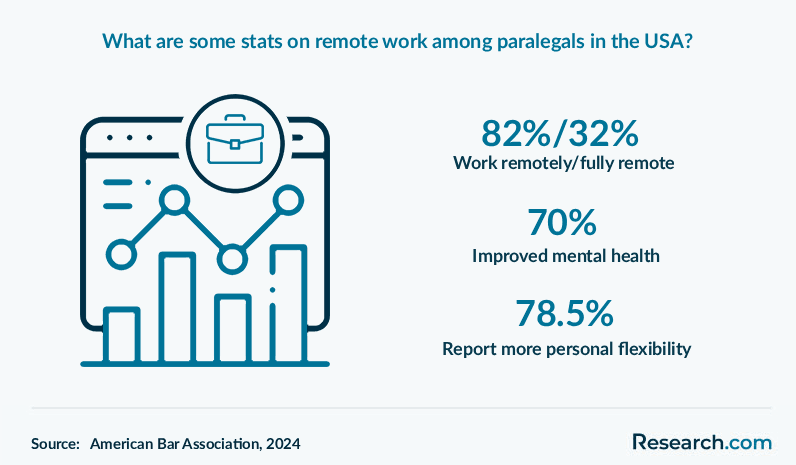
A 2024 survey by the American Bar Association found that 82% of paralegal assistants work remotely in some form, with 32% fully remote, 28.5% remote one to two days weekly, and 21% remote three to four days. Only 14% do not work remotely at all. Remote work has improved well-being: 78.5% report greater personal flexibility, 70% improved mental health, and 64% feel adequately resourced. Just 7.14% believe remote work limits career growth. These figures, illustrated in the graphic below, show that remote work is not only widespread but also positively received across the paralegal profession.
Here's What Graduates Say About Their Paralegal Degree Programs
- Saul: "Earning my paralegal degree gave me the confidence to transition from retail into a legal career. The structured coursework and internship placement helped me land a full-time job at a mid-sized law firm within three months of graduation."
- Eduardo: "My paralegal program emphasized legal research and writing, which turned out to be my strongest assets in the courtroom support role I now hold. I loved how the professors blended theory with real-world case studies—it made everything click. "
- Lydia: "I chose an online paralegal degree to balance my studies with raising two kids, and it was the best decision I’ve made. The flexibility, combined with career services, helped me secure a remote position with a national legal team. Eleni"
Key Findings
- Top-Tier Paralegal Salaries: In 2025, states like Washington ($67,651), the District of Columbia ($67,497), New York ($65,347), and Massachusetts ($65,233) offer the highest average paralegal salaries, with other competitive states like Nevada and New Jersey providing wages over $60,000 (ZipRecruiter, 2025).
- Lower-Tier Paralegal Salaries: A significant salary gap exists across the nation, with states in the South and Midwest offering lower compensation, such as Florida at $44,636, West Virginia at $46,242, Arkansas at $49,392, and Georgia at $50,435 (ZipRecruiter, 2025).
- National Employment Outlook: The U.S. Bureau of Labor Statistics reports a 2024 median pay of $61,010 for the 376,200 paralegals employed, with a stable job outlook projecting 0% growth but adding 600 jobs between 2024 and 2034.
- Primary Employment Sectors: The legal services industry is the dominant employer, with 273,590 paralegals, followed by government sectors, which employ a combined 43,400, and corporate management, which employs 6,760 (U.S. Bureau of Labor Statistics).
- Remote Work Prevalence: Remote work is widespread in the profession, as a 2024 American Bar Association survey found that 82% of paralegals work remotely in some capacity, including 32% who are fully remote and another 21% who do so three to four days a week.
- Impact of Remote Work: The shift to remote work has been largely positive, as the same survey found 78.5% of paralegals report more personal flexibility, 70% claim improved mental health, and only 7.14% feel it hampers their career advancement (American Bar Association, 2024).
- Interest in Limited Licensure: A 2024 NALA survey revealed that while nearly 40% of paralegals are unaware of limited licensure programs that expand their duties, a strong interest exists, with 81% of respondents willing to pursue such opportunities.
References:
- American Bar Association. (2025). The landscape of remote paralegals and legal assistants. American Bar Association.
- American Bar Association. (2025). Wages. American Bar Association.
- Glassdoor. (2025). Paralegal salaries in the United States. Glassdoor.
- Indeed. (2025). Paralegal salaries by state. Indeed.
- Master of Legal Studies. (2025). Paralegal job outlook 2024: Securing opportunities in an evolving legal landscape. Master of Legal Studies.
- NALA – The Paralegal Association. (2025, January 15). 2024 national utilization & compensation report: Executive summary. NALA – The Paralegal Association.
- PayScale. (2025). Paralegal salary in the United States. PayScale.
- Salary.com. (2025). Paralegal I salary in the United States. Salary.com.
- The University of Texas at San Antonio. (2025). Is it worth it to become a paralegal in 2024? The University of Texas at San Antonio.
- U.S. Bureau of Labor Statistics. (2025). Occupational employment and wages, May 2023, 23-2011 paralegals and legal assistants. U.S. Bureau of Labor Statistics.
- U.S. Bureau of Labor Statistics. (2025, April 17). Paralegals and legal assistants. U.S. Bureau of Labor Statistics.
- ZipRecruiter. (2025). Average paralegal salary by state. ZipRecruiter.
Other Things You Should Know About Paralegals
In 2027, California had the highest average paralegal salary with professionals earning approximately $68,000 annually, reflecting the demand for legal expertise and cost of living in the state.
In 2027, paralegal salaries differ significantly across states. For instance, paralegals in California earn an average salary of $67,250, while those in Florida receive around $51,000. Factors influencing these differences include cost of living and state demand for legal services.
In 2027, California boasts the highest average paralegal salary among U.S. states, owing to its high cost of living and demand for legal services. Conversely, Mississippi offers the lowest average salary, reflecting a lower cost of living and fewer financial demands on law firms.