
2027 Is a Master's in Data Science Worth It? Cost, Jobs & Education Options

Co-Founder and Chief Data Scientist
In today's economy, companies across every sector win by making smarter decisions, and data is the engine of that intelligence. This has made data science a core business function, creating immense demand for professionals who can translate complex data into strategic action. Pursuing a master's degree in the discipline is a viable option.
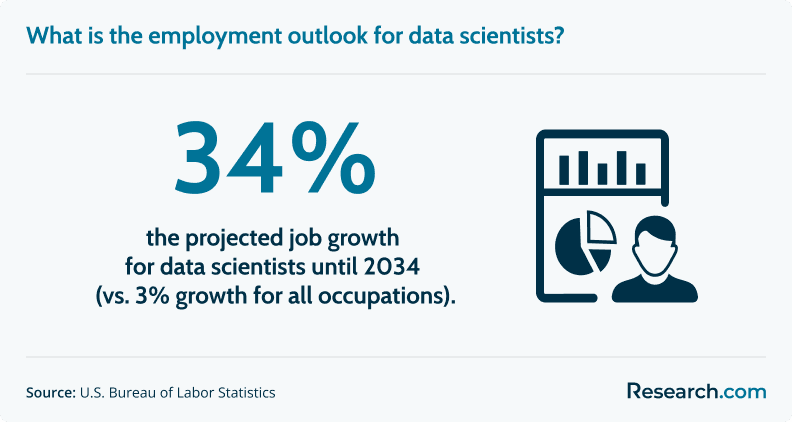
Prepared by seasoned career planning experts, this guide details the specific costs, job titles, and salary progression to help you calculate the ROI for your unique career goals. For example, in the U.S., employment of data scientists is projected to grow 34% until 2034, much faster than the average for all occupations. Ultimately, it answers the question, “Is a master’s in data science worth it?”
Key Things You Should Know About Master's Degrees in Data Science
- The U.S. Bureau of Labor Statistics projects that data scientist roles will grow by 34% between 2023 and 2034, a rate much faster than the average for all occupations.
- A data scientist's salary grows significantly with experience. The typical progression ranges from around $88,000 for a junior role to $148,000 for a lead position.
- A master's degree is primarily a career accelerator. It provides the most reliable pathway to senior-level roles and top-tier salaries in the field.
- The average annual cost for a graduate program can range from approximately $27,000 at a public, in-state university to over $56,000 at a private institution.
- The degree’s core value is in teaching you how to solve complex, ambiguous problems from first principles, providing a deeper theoretical understanding than other training options.
- What is the salary potential with a master's in data science? Earning Potential
- What is the job outlook for data scientists in 2027 and beyond? Job Outlook
- Is a master's degree necessary to become a data scientist? Is a master's degree necessary to become a data scientist?
- How much does a master's in data science typically cost? Education Cost
- What are the common admission requirements for these programs? Admission Requirements
- How long does it take to complete the degree? Program Duration
- What specific jobs can you get with a master's in data science? Career Paths
- Which industries pay the most for data scientists? Top Industries
- What does the typical career path and salary progression look like? What does the typical career path and salary progression look like?
- What skills do you learn in a data science master's program? What skills do you learn in a data science master's program?
- Are there alternatives to a master's degree for becoming a data scientist? Program Alternatives
- How do you choose the right data science master's program for your goals? How do you choose the right data science master's program for your goals?
What is the salary potential with a master's in data science?
The salary potential for a data scientist is substantial, with a clear and predictable progression based on experience. According to data from Zippia, the typical annual salary ladder for a data scientist based on tenure ranges from $88,000 to $148,000.
An important insight for professionals evaluating this path is to look beyond averages. The real value is in the career trajectory. A master's degree is designed to equip you with the foundational skills to climb this ladder more efficiently, positioning you for senior and lead roles sooner than might be possible otherwise. This predictable growth allows you to map out a reliable long-term financial return on your educational investment.
For comparison, those exploring other healthcare or STEM paths often weigh similar return-on-investment questions—like asking is a bachelor's in health science worth it before pursuing graduate study. Data science follows the same logic: salary outcomes depend on specialization, industry demand, and long-term growth potential.
Of course, strong salary potential is most valuable in a secure job market. The next section examines the long-term demand for data science professionals.
What is the job outlook for data scientists in 2027 and beyond?
The job outlook for data scientists is exceptionally strong, providing a secure foundation for a long-term career. According to the U.S. Bureau of Labor Statistics, the projected job growth rate for data scientists is 34% until 2034. This is considered much faster than the average for all occupations, ensuring high demand for qualified professionals for the next decade.
In addition, the job portal Indeed reports that there are currently over 7,000 openings for data science roles.
Why Demand Remains So High
The sustained demand for data scientists is a structural shift in the economy. As businesses in every industry—from finance to manufacturing—continue to adopt data-driven decision-making and artificial intelligence, the need for experts who can manage and interpret vast datasets becomes fundamental to their success.
This demand is also intersecting with adjacent fields like cybersecurity. Professionals exploring whether to pursue cyber intelligence vs cyber security roles will notice overlap in the use of machine learning, big data, and predictive modeling—all of which rely on data science foundations.
This means that investing in a data science education is not about chasing a fleeting job title but aligning your skills with a core, long-term business need.
The high demand confirms the field's stability, but the next question is about the most effective way to enter and advance within it.
Is a master's degree necessary to become a data scientist?
No, a master's degree is not strictly necessary to get an entry-level job as a data scientist. However, this is a nuanced question, and the answer depends entirely on your career goals. The most helpful way to view the degree is not as a mandatory gatekeeper for the profession, but as a powerful career accelerator.
For professionals whose goal is to reach senior-level roles and top-tier salaries, the master's provides the most reliable and direct pathway. It equips you with a depth of theoretical knowledge and applied problem-solving skills that employers value for leadership positions.
While other paths like bootcamps or certifications can help you land a first job, the master's degree is designed to propel you through the mid-career ranks more quickly. This distinction is the key to answering the question, "Is a master's in data science worth it?" for your specific ambitions.
While a data science master's provides broad analytical skills, professionals in other fields may find that a specialized degree, like the fastest online master's degree in supply chain management, offers a more targeted route to leadership within their industry. For data science, the investment is about the long-term trajectory, which begins with understanding the costs.
How much does a master's in data science typically cost?
The cost of a master's in data science varies significantly depending on the type of university you attend. Based on figures from the Education Data Initiative, the average annual cost of a graduate program ranges from $27,146 for in-state students at public universities to $56,628 for students at private, non-profit institutions.
Out-of-state students at public universities can expect to pay around $45,708 annually.
Calculating Your Total Investment
For professionals treating this as a serious investment, it's a mistake to focus on a single average cost. Instead, you should calculate a more complete picture of the total investment. The data shows that your choice of a public versus a private university is the single biggest lever you can pull to manage tuition costs.
Beyond tuition, be sure to factor in additional expenses like technology fees, software, and books. Considering the total cost is the only way to accurately answer if a master's in data science program is worth it for your financial situation.
Students and families who do not have access to ample resources can obtain financial aid from various sources. You can start by applying for the Free Application for Federal Student Aid (FAFSA) to know which kinds of federal aid are available to you.
This cost comparison mirrors broader trends across other academic decisions—such as the accounting certificate vs degree debate—where total investment, program depth, and long-term earning potential determine which option delivers the best value.
Understanding the financial commitment is the first step. Next, let’s look at what it takes to get accepted into one of these programs.
What are the common admission requirements for these programs?
While admission requirements vary, most programs prioritize a strong quantitative background over a specific undergraduate major. A common fear is that you need a computer science degree to be considered, but that is often not the case. Instead, admissions committees look for demonstrated proficiency in key areas, regardless of your degree title.
The most common requirements include:
- An accredited bachelor's degree. This is the foundational requirement. While degrees in STEM fields are common, programs increasingly accept applicants from diverse backgrounds like economics or social sciences, provided they can demonstrate strong quantitative skills through prerequisite coursework.
- Demonstrated quantitative proficiency. This is the most critical evidence of your readiness. Admissions committees will look for strong grades in foundational courses like calculus, linear algebra, and statistics, as well as programming experience in a language like Python or R.
- A strong academic record. While many programs list a minimum GPA of 3.0, this is often viewed in the context of your entire application. For mid-career professionals, significant, relevant work experience can provide a compelling counter-balance to an older academic record.
- GRE or GMAT scores. A key trend to note is that many top programs are now "test-optional" or have waived the GRE/GMAT requirement entirely. This allows you to focus on showcasing your skills through your portfolio and professional experience instead.
- A compelling personal narrative. Your application is a story told through your statement of purpose (your goals and motivation), letters of recommendation (third-party validation of your skills), and a resume or portfolio (proof of your experience).
Applicants often ask how much previous academic background matters. The answer depends on your field—similar to how expectations differ between masters vs PhD in clinical psychology programs. Admissions committees evaluate not only grades but also your potential to apply data science in meaningful, real-world research or professional contexts.
How Experience Shapes Your Application
Your background plays a significant role in how you approach these requirements. For recent graduates, a strong academic record with the right prerequisite courses is paramount.
However, for mid-career professionals, relevant work experience can be a powerful asset. If you have spent years working as a data analyst, for example, your professional portfolio can demonstrate the quantitative aptitude and problem-solving skills that admissions committees value, sometimes offsetting a lack of a specific prerequisite course.
Once you've confirmed your eligibility, the next practical consideration is the time commitment.
How long does it take to complete the degree?
Most full-time master's in data science programs are designed to be completed in about two years. However, a key insight for busy professionals is that you have significant flexibility. Many universities now offer accelerated programs that can be finished in as little as 12 months, as well as part-time options that may take three or more years to complete.
The flexibility directly addresses a major concern for many applicants: the fear of having to put a career on hold for a mandatory two-year period.
Choosing the Right Pace for Your Career
The best program format is the one that aligns with your personal and professional life.
- Full-time programs are often the best fit for recent graduates or those making a complete career change who can immerse themselves fully in their studies.
- Part-time programs are specifically designed for working professionals. The rise of online, asynchronous learning means you can often complete coursework on your schedule, allowing you to maintain your income and apply what you learn at work in real time.
- Accelerated programs are a growing trend in graduate education. Even specialized fields now offer options like the shortest online masters in emergency management degree programs to meet professional demand. For data science applicants with a strong existing background, an accelerated pace can be the most efficient path to a return on investment.
With a clear picture of the investment in time and money, you can now explore the specific career returns this degree unlocks.
What specific jobs can you get with a master's in data science?
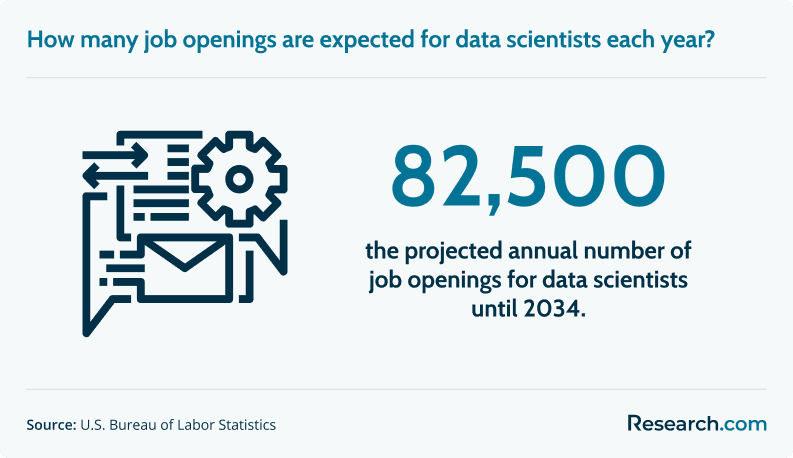
A master's in data science unlocks a diverse range of specialized and senior-level technical roles. With an average of 82,500 job openings projected each year for the next decade, the opportunities extend far beyond a single job title. Here are some of the key career paths that a master's degree prepares you for:
- Data Scientist: This is the foundational role, focused on cleaning, analyzing, and interpreting complex datasets to extract actionable insights that guide business strategy.
- Machine Learning Engineer: A more specialized and technical role, these professionals design, build, and deploy production-level machine learning models for applications like recommendation engines or predictive analytics.
- Applications Architect: This high-level position involves designing the end-to-end data architecture that supports an organization's software applications, ensuring data flows efficiently and securely.
- Enterprise Architect: A strategic role that bridges the gap between technical teams and executive leadership. They are responsible for aligning the company's data infrastructure and strategy with its overall business goals.
- Security Data Scientist: This is a high-impact specialization focused on applying data science techniques like anomaly detection and predictive modeling to identify and mitigate cybersecurity threats.
The ability to specialize is a key advantage of a master's education. For those particularly interested in roles at the intersection of data and security, a fast-track homeland security master's degree online can provide an even more focused path into the field. These specialized jobs are available across many sectors, but some industries offer significantly higher pay.
Which industries pay the most for data scientists?
While data science skills are in demand across the entire economy, certain sectors offer significantly higher average salaries. For professionals focused on maximizing their financial return, targeting these high-paying industries is a key career strategy.
Based on salary data from Zippia, the top five highest-paying industries for data scientists are:
- Start-up: Averaging $123,913 annually, start-ups often offer competitive salaries and equity to attract top talent who can build their data infrastructure from the ground up.
- Technology: At an average of $122,350, the tech sector remains a primary employer, with established companies and innovators alike needing data scientists for product development and optimization.
- Retail: With an average salary of $119,530, the retail industry leverages data science for everything from supply chain logistics to personalized marketing and e-commerce.
- Manufacturing: Averaging $106,752, manufacturers use data science to optimize production lines, predict maintenance needs, and improve operational efficiency.
- Finance: At an average of $104,421, the finance industry relies on data scientists for algorithmic trading, risk assessment, and fraud detection.
The application of data analytics is also expanding into non-traditional fields. High-growth sectors like competitive gaming are now using data to optimize performance, creating new opportunities for those with an accelerated esports business management degree online.
Knowing which industries pay the most is a great start, but understanding how your career and salary can grow over time is the next crucial piece of the puzzle.
What does the typical career path and salary progression look like?
The career path for a data scientist is a clear and well-defined ladder, moving from tactical execution to strategic leadership over about a decade. This progression brings a steady increase in both responsibility and compensation, allowing you to build a long-term, high-growth career.
The typical 10-year journey can be broken down into four key stages:
- Junior Data Scientist (0-2 Years): With an average salary of $88,000, your focus is on executing specific tasks like data cleaning, feature engineering, and building models under the guidance of senior team members.
- Mid-Level Data Scientist (3-5 Years): Earning around $106,104, you gain more autonomy, begin to own projects from start to finish, and may start mentoring junior colleagues.
- Senior Data Scientist (6-9 Years): At $126,000, your role becomes more strategic. You are expected to translate ambiguous business problems into data science solutions and set the technical direction for major projects.
- Lead Data Scientist (10+ Years): With an average salary of $148,000, you are now a leader, responsible for driving the data science vision for your team or department and influencing overall business strategy.
How a Master's Degree Accelerates This Path
The primary value of a master's degree is its ability to accelerate your movement through these stages. While you can certainly gain experience on the job, the deep theoretical foundation and structured problem-solving skills from a master's program specifically prepare you for the strategic challenges of senior and lead roles.
This allows you to take on greater responsibility earlier in your career, shortening the timeline to reach the highest levels of impact and compensation.
Understanding this career trajectory is vital, but it's also important to know what specific skills you'll learn to make it happen.
What skills do you learn in a data science master's program?
While you will certainly master essential tools like Python and SQL, the true value of a master's program is in building a deeper, more strategic skill set. The curriculum is designed to move beyond simply using tools to understanding why they work, which is the key to solving novel and complex business problems.
The core skills you develop are built on three pillars:
- Deep Foundational Theory: This is the "why" behind the "how." You'll gain a rigorous understanding of the statistics, mathematics, and computer science principles that underpin all data science models. This allows you to select and validate the right approach, not just run a familiar script.
- A Comprehensive, Structured Curriculum: Unlike learning piecemeal from various online sources, a master's program provides an integrated curriculum. You'll learn how concepts like data engineering, machine learning, and data visualization connect, giving you a holistic view of the entire data lifecycle.
- Applied, Ambiguous Problem-Solving: The curriculum moves beyond textbook examples to focus on complex, real-world problems. You'll learn to translate an ambiguous business question into a formal data science problem, manage a long-term project, and effectively communicate your findings to stakeholders—the core functions of a senior data scientist.
This combination of skills is what prepares you for leadership and justifies the investment. To round out the analysis, it's helpful to compare this path to other available options.
Are there alternatives to a master's degree for becoming a data scientist?
Yes, there are several viable alternatives to a master's degree for entering the data science field, but they are generally better suited for different career goals. While a master's is designed to accelerate your path to senior roles, alternatives like bootcamps and certifications are excellent for gaining entry-level skills or for upskilling in a specific tool.
Understanding the strategic purpose of each option is key to deciding the answer to "Is a master's in data science worth it?"
Positioning Your Options Strategically
Instead of viewing these as competing choices, it's more effective to see them as tools for different jobs.
- Data Science Bootcamps are intensive, short-term programs focused on teaching practical, job-ready skills. They are an excellent option for those looking to land an entry-level data analyst or junior data scientist role quickly. However, they typically lack the deep theoretical foundation of a master's program.
- Professional Certifications (e.g., in AWS or Google Cloud) are ideal for current professionals who need to validate a specific skill or learn a new technology. They are a powerful way to upskill and stay current, but they are not a substitute for a comprehensive, foundational education.
- Master's Degrees are a long-term investment in career trajectory. Its focus on foundational theory and complex problem-solving is what prepares you for the strategic challenges of senior and lead data scientist roles.
With a full understanding of the landscape, the final step is to choose the specific program that aligns with your personal goals.
How do you choose the right data science master's program for your goals?
The best data science program is the one that thoroughly aligns with your specific career objectives, budget, and learning style. Rather than relying solely on university rankings, a more effective approach is to use a decision framework to evaluate programs based on the factors that matter most to your success.
Here are four key areas to investigate for any program you consider:
- Curriculum and Specializations: Look beyond the course titles. Does the curriculum emphasize the theoretical foundations you need? Does it offer specialized tracks, such as in security data science or AI, that align with your career interests? A generalist program is great for broad skills, while a specialized degree like a fast-track sports analytics masters online could be better for a targeted career.
- Faculty Expertise and Industry Connections: Who will be teaching you? Look for faculty who are not just academics but also practitioners with real-world industry experience. Their insights and connections can be invaluable.
- Career Outcomes and Alumni Network: This is the ultimate proof of a program's value. Ask the admissions office for data on job placement rates, average starting salaries, and the companies that hire their graduates. A strong alumni network can also be a significant career asset.
- Program Format and Total Cost: Does the program offer a flexible format (online, part-time) that fits your life? Have you calculated the total cost, not just the tuition? Truth told, answering the question "Is a master's in data science worth it?" requires finding a program that delivers the career outcomes you need at a price you can afford.
Ultimately, this decision is a personal one. By using this framework, you can move beyond the marketing and make a clear-eyed choice that serves as a strategic investment in your future.
The chart below shows the most lucrative industries for data scientists.
Here’s What Graduates Have to Say about Their Master's in Data Science Program
- Donna: "The biggest change for me was the level of opportunities that opened up, even before I graduated. As soon as I added "Master's in Data Science Candidate" to my resume, I started getting contacted by recruiters for senior roles that I wasn't considered for previously. The credential itself signaled a higher level of expertise and ambition. It absolutely accelerated my career timeline."
- Sheryl: "As a biology major, I felt like I was making a huge leap into a new field and was worried my background would be a disadvantage. The program was the perfect bridge. It taught me how to apply the analytical mindset I already had to a new set of technical tools. It showed me that having a different perspective is actually a major asset in data science."
- Geneva: "One of the most valuable and unexpected skills I learned was data storytelling. The program didn't just teach us how to build complex models; it constantly pushed us to communicate our findings clearly to a non-technical audience. Being able to explain the "so what" of an analysis to executives is a skill that has been invaluable in my career."
Key Findings
- The investment in this degree is significantly de-risked by the exceptional job security of the profession, which is projected to grow by 34% over the next decade.
- The primary financial value of the master's degree is its function as a career accelerator, enabling a faster climb through the established salary ladder, which progresses from an average of $88,000 for junior roles to $148,000 for lead positions.
- With annual costs for graduate programs ranging from approximately $27,000 to over $56,000, the "worth" of the degree is a highly personal calculation that depends on choosing a program that aligns with your specific financial and career goals.
- For those focused on maximizing financial returns, targeting high-paying industries like the start-up sector, which offers an average salary of $123,913, provides a clear path to a faster return on investment.
- While alternatives like bootcamps are effective for securing entry-level roles, the master's degree provides a distinct strategic advantage for professionals aiming specifically for senior and leadership positions.
- The curriculum's focus on deep foundational theory and solving ambiguous problems provides a more durable and strategic skill set than simply learning specific programming tools, which is the key to long-term career relevance and advancement.
References:
- Education Data Initiative. (2025). Average cost of college. Retrieved October 7, 2025, from https://educationdata.org/average-cost-of-college
- Northeastern University. (2024). Data science careers: Shaping our future. Retrieved October 7, 2025, from https://graduate.northeastern.edu/knowledge-hub/data-science-careers-shaping-our-future/
- U.S. Bureau of Labor Statistics. (2025). Data scientists. In Occupational Outlook Handbook. Retrieved October 7, 2025, from https://www.bls.gov/ooh/math/data-scientists.htm
- U.S. Bureau of Labor Statistics. (2025). Occupational employment and wages, May 2023: 15-2051 Data Scientists. Retrieved October 7, 2025, from https://www.bls.gov/oes/2023/may/oes152051.htm
- Zippia. (2025). Data scientist salaries. Retrieved October 7, 2025, from https://www.zippia.com/salaries/data-scientist/
Other Things You Should Know About Master's in Data Science Programs
In 2027, funding opportunities for master's in data science students include scholarships specific to data science, graduate assistantships, and federal or private student loans. Some universities also offer industry partnerships, providing financial assistance in exchange for future employment commitments.
Yes, it is definitely possible. Admissions committees are typically more interested in your demonstrated quantitative skills than your specific degree title. If your background is in a non-STEM field like economics or social sciences, you can build a strong application by successfully completing prerequisite coursework in areas like calculus, linear algebra, and programming, and by developing a portfolio of projects that showcase your technical abilities.
Common prerequisites for enrolling in a master's in data science program in 2027 include a bachelor's degree, typically in a related field, and proficiency in programming languages like Python or R. Some programs may require previous coursework in statistics or mathematics.


