
2027 Psychology Licensure Requirements by State

Co-Founder and Chief Data Scientist
Licensed professionals in the field of psychology have been in stable demand in the United States (US) over recent years. For instance, the country only had 31.23% of its need for mental health care professionals met based on geographic area in the first quarter of 2025 (Bureau of Health Workforce, 2025). Aspiring psychologists may consider the current state of the country’s mental health as their encouragement to pursue psychology licensure.
To help you through the process, I created this guide to psychology licensure requirements per US state. Explore national and state-specific qualifications, the cost of licensure, renewal requirements, and reciprocity potential.
Key Things to Know about Psychology Licensure
- To become eligible for psychology licensure in the US, aspirants must earn a doctoral degree in psychology, pass a licensure exam and a jurisprudence exam, and obtain 2 years of supervised experience.
- From 2024 to 2034, employment for psychologists in the US is expected to increase by 6%. An average of around 12,900 annual job openings have been forecasted for these professionals over the decade (US BLS, 2025).
- In May 2024, licensed psychologists across the country had a median annual wage of $94,310 (US BLS, 2025).
- What are the basic psychology licensure requirements across the US? Basic Requirements
- What are the psychology licensure requirements specific to US states? State-specific Requirements
- How much does it cost to apply for psychology licensure? Cost of Licensure
- How often do psychologists need to renew their license by state? Licensure Renewal
- Which states offer reciprocity for psychology licenses? Licensing Reciprocity
- Can you become a licensed psychologist with a master’s degree in any state? Can you become a licensed psychologist with a master’s degree in any state?
- Which states recognize both PsyD and PhD for psychology licensure? Which states recognize both PsyD and PhD for psychology licensure?
- How many supervised clinical hours are required for psychology licensure by state? How many supervised clinical hours are required for psychology licensure by state?
- How can candidates effectively prepare for their psychology licensure examinations? How can candidates effectively prepare for their psychology licensure examinations?
- Which states require additional state-specific psychology exams? Which states require additional state-specific psychology exams?
- Which states have the highest employment levels for licensed psychologists? Which states have the highest employment levels for licensed psychologists?
What are the basic psychology licensure requirements across the US?
Psychology licensure requirements are designed to ensure that professionals are fully prepared to practice competently and ethically. While eligibility varies by US state, most share basic licensure requirements, such as completing a doctoral or master’s degree in psychology, accumulating supervised clinical experience, and passing a national examination.
Students who aim to pursue private equity accounting careers may also find it valuable to understand these licensure standards if they plan to work with healthcare or psychology-focused funds, as regulatory compliance and professional credentials often intersect with financial oversight.
- Doctoral Degree in Psychology: Applicants must complete a doctoral program, such as a PhD or PsyD, from an accredited academic institution to demonstrate advanced education and training. Understanding accreditation for psychology programs is essential, since only degrees from recognized accrediting bodies qualify for licensure.
- Supervised Clinical Experience: Applicants must complete predoctoral internships and, in many states, postdoctoral supervised hours to gain hands-on experience under the guidance of licensed psychologists.
- Licensure Examination: All states require passing the Examination for Professional Practice in Psychology (EPPP), which is administered by the Association of State and Provincial Psychology Boards (ASPPB).
What are the psychology licensure requirements specific to US states?
As mentioned in the previous section, aspiring psychologists across the US must meet basic requirements to acquire their license to practice legally in the field. Many states require the following credentials:
- Earn a doctoral degree in psychology from an accredited academic institution, such as through a traditional or online social psychology degree pathway
- Complete supervised clinical experience
- Pass the Examination for Professional Practice in Psychology (EPPP)
Notably, many states also mandate a state-specific exam or a jurisprudence exam to assess legal and ethical competence. Each state also has its own local granting authority. Explore the following psychology licensure requirements per US state:
Alabama
- Granting Board: Alabama Board of Examiners in Psychology
- Minimum Degree: Doctoral Degree in Psychology
- Examinations: EPPP; Professional Standards Exam
Alaska
- Granting Board: Board of Psychologist and Psychologist Associate Examiners
- Minimum Degree: Doctoral Degree in Clinical Psychology, Counseling Psychology, or Education in an Eligible Area of Specialization
- Examinations: EPPP; Written State Law and Ethics Examination
Arizona
- Granting Board: Arizona Board of Psychologist Examiners
- Minimum Degree: Doctoral Degree in Psychology
- Examinations: EPPP
Arkansas
- Granting Board: Arkansas Board of Examiners in Psychology
- Minimum Degree: Doctoral Degree in Psychology
- Examinations: EPPP; Oral Exam
California
- Granting Board: California Board of Psychology
- Minimum Degree: Doctoral Degree in Psychology, Educational Psychology, or Education with the FIeld of Specialization in Counseling Psychology or Educational Psychology
- Examinations: EPPP; Oral Exam
Colorado
- Granting Board: Colorado Board of Psychologist Examiners
- Minimum Degree: Doctoral with a Major in Psychology or Its Equivalent
- Examinations: EPPP; Clinical and Counseling Oral Examination; Colorado Jurisprudence Written Exam
Connecticut
- Granting Board: Connecticut Department of Public Health
- Minimum Degree: Doctoral Degree in Psychology
- Examinations: EPPP and CT State Law Examination
Delaware
- Granting Board: Delaware Board of Examiners of Psychology
- Minimum Degree: Doctoral Degree in Psychology
- Examinations: EPPP
District of Columbia
- Granting Board: Department of Health
- Minimum Degree: Doctoral Degree in Psychology
- Examinations: EPPP; Jurisprudence Exam
Florida
- Granting Board: Florida Department of Health
- Minimum Degree: Doctoral Degree in Psychology
- Examinations: EPPP; Florida Laws and Rules
Georgia
- Granting Board: Georgia State Board of Examiners of Psychologists
- Minimum Degree: Doctoral Degree from a Professional Training Program in Applied Psychology
- Examinations: EPPP; Georgia Jurisprudence Exam
Hawaii
- Granting Board: Department of Commerce and Consumer Affairs-Professional & Vocational Licensing Division (DCCA-PVL)
- Minimum Degree: Doctoral Degree in Psychology
- Examinations: EPPP; Jurisprudence Exam
Idaho
- Granting Board: Idaho State Board of Psychologist Examiners
- Minimum Degree: Doctorate in Psychology
- Examinations: EPPP
Illinois
- Granting Board: Illinois Clinical Psychologists Licensing and Disciplinary Board
- Minimum Degree: Doctoral Degree in Clinical Psychology, School Psychology, or Counseling Psychology
- Examinations: EPPP
Indiana
- Granting Board: Indiana State Psychology Board
- Minimum Degree: Doctoral Degree in Psychology
- Examinations: EPPP; Written Jurisprudence Exam
Iowa
- Granting Board: Indiana Department of Public Health
- Minimum Degree: Doctoral Degree in Psychology
- Examinations: EPPP; State Oral Exam; State Law Examination
Kansas
- Granting Board: Kansas Behavioral Sciences Regulatory Board
- Minimum Degree: Doctoral Degree in Psychology
- Examinations: EPPP
Kentucky
- Granting Board: Kentucky Board of Examiners of Psychology
- Minimum Degree: Doctoral Degree in Psychology
- Examinations: EPPP; Oral Exam
Louisiana
- Granting Board: Louisiana State Board of Examiners of Psychologists
- Minimum Degree: Doctoral Degree in Psychology
- Examinations: EPPP; Oral Exam; Jurisprudence Exam
Maine
- Granting Board: Department of Professional and Financial Regulation
- Minimum Degree: Doctoral Degree in Psychology
- Examinations: EPPP; Maine Oral Exam
Maryland
- Granting Board: Maryland Board of Examiners of Psychologists
- Minimum Degree: Doctoral Degree in Psychology
- Examinations: EPPP; Jurisprudence Exam
Massachusetts
- Granting Board: Division of Professional Licensure
- Minimum Degree: Doctoral Degree in Psychology
- Examinations: EPPP; Jurisprudence Exam
Michigan
- Granting Board: Bureau of Health Professions, Michigan Board of Psychology
- Minimum Degree: Doctoral Degree in Psychology
- Examinations: EPPP
Minnesota
- Granting Board: Minnesota Board of Psychology
- Minimum Degree: Doctoral Degree in Psychology
- Examinations: EPPP; Professional Responsibility Exam
Mississippi
- Granting Board: Mississippi Board of Psychology
- Minimum Degree: Doctoral Degree in Psychology
- Examinations: EPPP; Oral Exam
Missouri
- Granting Board: Missouri State Committee of Psychologists
- Minimum Degree: Doctoral Degree in Clinical Psychology or Counseling Psychology
- Examinations: EPPP; Oral Exam; Jurisprudence Exam
Montana
- Granting Board: Montana Board of Psychologists
- Minimum Degree: Doctoral Degree in Clinical Psychology
- Examinations: EPPP; Oral Exam
Nebraska
- Granting Board: Nebraska Department of Health and Human Services
- Minimum Degree: Doctoral Degree in Psychology
- Examinations: EPPP; Jurisprudence Exam
Nevada
- Granting Board: Nevada Board of Psychological Examiners
- Minimum Degree: Doctoral Degree in Psychology
- Examinations: EPPP; Oral Exam
New Hampshire
- Granting Board: New Hampshire Board of Mental Health Practice
- Minimum Degree: Doctoral Degree in Psychology
- Examinations: EPPP; Oral Exam
New Jersey
- Granting Board: New Jersey State Board of Psychological Examiners
- Minimum Degree: Doctoral Degree in Psychology
- Examinations: EPPP; Oral Exam
New Mexico
- Granting Board: New Mexico Board of Psychologist Examiners
- Minimum Degree: Doctoral Degree in Psychology
- Examinations: EPPP; Oral Exam
New York
- Granting Board: New York State Department of Education
- Minimum Degree: Doctoral Degree in Psychology
- Examinations: EPPP
North Carolina
- Granting Board: North Carolina Psychology Board
- Minimum Degree: Doctoral Degree in Psychology
- Examinations: EPPP; State Exam
North Dakota
- Granting Board: Education Standards and Practices Board
- Minimum Degree: Doctoral Degree in a Program of Studies Substantially Psychological in Nature
- Examinations: EPPP; Oral Exam
Ohio
- Granting Board: Ohio State Board of Psychology
- Minimum Degree: Doctoral Degree in Psychology or School Psychology
- Examinations: EPPP; Oral Exam
Oklahoma
- Granting Board: Oklahoma State Board of Examiners of Psychologists
- Minimum Degree: Doctoral Degree in Psychology
- Examinations: EPPP; Oral Exam; Jurisprudence Exam
Oregon
- Granting Board: Oregon Board of Psychologist Examiners
- Minimum Degree: Doctoral Degree in Psychology
- Examinations: EPPP; Oral Exam
Pennsylvania
- Granting Board: State Board of Psychology
- Minimum Degree: Doctoral Degree in Psychology
- Examinations: EPPP; Pennsylvania Psychology Law Examination
Rhode Island
- Granting Board: Rhode Island Board of Psychology
- Minimum Degree: Doctoral Degree in Psychology
- Examinations: EPPP; Oral Exam
South Carolina
- Granting Board: South Carolina Board of Examiners in Psychology
- Minimum Degree: Doctoral Degree in Psychology
- Examinations: EPPP; Oral Exam
South Dakota
- Granting Board: South Dakota Board of Examiners of Psychologists
- Minimum Degree: Doctoral Degree in Psychology
- Examinations: EPPP; Oral Exam
Tennessee
- Granting Board: Tennessee Department of Education
- Minimum Degree: Doctoral Degree in Psychology
- Examinations: EPPP; Oral Exam
Texas
- Granting Board: Texas State Board of Examiners of Psychologists
- Minimum Degree: Doctoral Degree in Psychology
- Examinations: EPPP; Jurisprudence Exam; Oral Exam
Utah
- Granting Board: Utah Department of Commerce
- Minimum Degree: Doctoral Degree in Psychology
- Examinations: EPPP; Utah Psychology Law Examination
Vermont
- Granting Board: Board of Psychological Examiners
- Minimum Degree: Doctoral Degree in Psychology
- Examinations: EPPP; Jurisprudence Exam
Virginia
- Granting Board: Virginia Board of Psychology
- Minimum Degree: Doctoral Degree in Psychology
- Examinations: EPPP; Jurisprudence Exam
Washington
- Granting Board: Examining Board of Psychology, Department of Health
- Minimum Degree: Doctoral Degree in Psychology
- Examinations: EPPP; Oral Exam
West Virginia
- Granting Board: West Virginia Board of Examiners of Psychologists
- Minimum Degree: PhD or Its Equivalent
- Examinations: EPPP; Oral Exam
Wisconsin
- Granting Board: Psychology Examining Board, Bureau of Health Service Professions
- Minimum Degree: Doctoral Degree in Psychology
- Examinations: EPPP; Examination on the Elements of Practice Essential to the Public Health, Safety, or Welfare “Ethics” Exam
Wyoming
- Granting Board: Wyoming State Board of Psychology
- Minimum Degree: Doctoral Degree in Psychology
- Examinations: EPPP
How much does it cost to apply for psychology licensure?
Applying for psychology licensure in the US involves several expenses that vary by state. Licensure application fees typically range from $100 to $300, depending on the state board. For professionals considering career transitions or dual paths—such as healthcare finance or mental health administration—knowing the average postpartum nurse salary can help contextualize potential earnings relative to the cost of licensure and ongoing professional development.
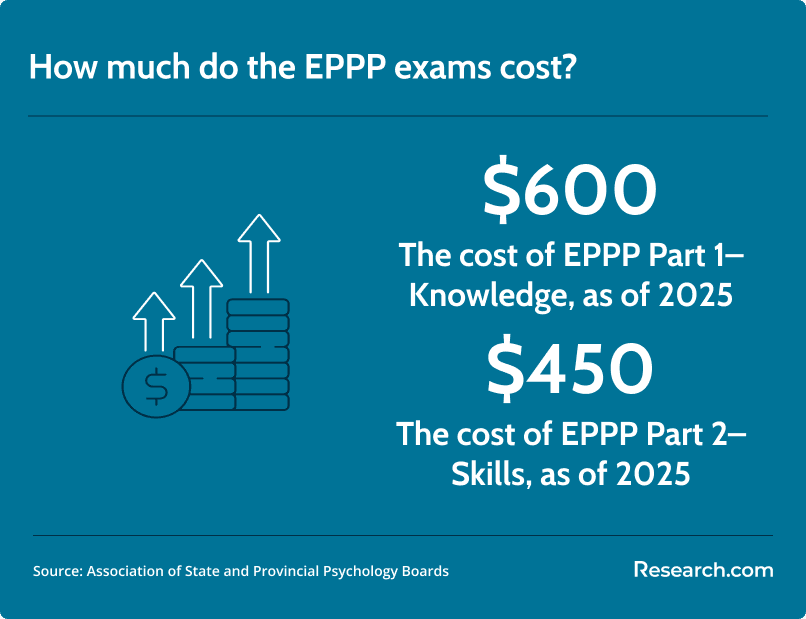
Meanwhile, as of 2025, the application fee for the first part of the Examination for Professional Practice in Psychology (EPPP), which is Part 1–Knowledge, costs $600. EPPP Part 2–Skills costs $450. Applicants are also required to pay for the test site appointment fees for both parts of the EPPP, which costs $91.88.
Many states also require state-specific exams or jurisprudence exams. Your local licensing authority will be able to provide you with the information on application fees for these exams. Applicants wishing to reschedule their exams must check the corresponding test site rescheduling fees based on their original scheduled appointment.
How often do psychologists need to renew their license by state?
Psychologists in the US must renew their licenses regularly, with most states requiring psychology licensure renewal every 2 years. This qualification ensures that psychology professionals remain current with continuing education and training. Some practitioners also pursue dual degree programs in psychology to strengthen their credentials and broaden career opportunities.
Psychology licensure renewal usually involves submitting an application, paying application fees, and completing a set number of continuing education hours, which often ranges from 20 to 40 hours per cycle. In a 2024 survey by the Centre for Data and Analysis on Psychology Licensure, 100% of all respondents, which are psychology licensing boards, require licensees to finish continuing professional development or continuing education every renewal cycle.
Failure to renew on time may result in late fees, inactive status, or the need to reapply. In the same 2024 survey mentioned above, around 66% of the respondents report that they provide for an inactive license status.
Which states offer reciprocity for psychology licenses?
As of 2025, 42 US states provide licensed psychologists with the opportunity to apply for license reciprocity through the Psychology Interjurisdictional Compact (PSYPACT®). PSYPACT® is an interstate agreement that enables licensed psychologists to practice telepsychology and temporary in-person psychological services in other compact states.
While one state, Montana, has enacted the PSYPACT® legislation, it has yet to put the legislation in effect in October 2025. Moreover, the following states are non-PSYPACT states or jurisdictions:
- Alaska
- California
- Guam
- Hawaii
- Iowa
- Louisiana
- New Mexico
- Oregon
- Puerto Rico
- US Virgin Islands
The PSYPACT Commission creates and finalizes the bylaws, rules, and regulations found in PSYPACT®. The commission also grants licensed psychologists the authority to practice across states. To be able to practice telepsychology in PSYPACT states, applicants must first acquire an E.Passport Certificate from the ASPPB, and then register for an Authority to Practice Interjurisdictional Telepsychology (APIT™) through the commission.
To temporarily practice in person in participating states, applicants must first acquire an Interjurisdictional Practice Certificate (IPC) from the ASPPB. Afterward, they must register for a Temporary Authorization to Practice (TAP™) through the PSYPACT Commission.
Can you become a licensed psychologist with a master’s degree in any state?
In the US, individuals cannot become licensed psychologists with only a master’s degree. All states require a doctoral degree, usually a PhD in psychology or a Doctor of Psychology (PsyD), to qualify for licensure. Those interested in areas of public health may pursue master’s-level degrees in psychology or related fields to work in research, policy, or community programs, but these roles do not confer the ability to practice as a licensed psychologist.
While a master’s degree alone does not meet the educational standard for psychology licensure, it can lead to other professional pathways. For instance, graduates may pursue licensure as licensed professional counselors (LPCs), marriage and family therapists (MFTs), or school psychologists, depending on state regulations. Many students also choose online counseling psychology programs to prepare for these alternative career paths.
These relevant roles still allow professionals to provide counseling and support services but are distinct from the practice of licensed psychologists. Therefore, students seeking to become licensed psychologists must plan on completing doctoral-level education.
Which states recognize both PsyD and PhD for psychology licensure?
All US states recognize both Doctor of Psychology (PsyD) and Doctor of Philosophy (PhD) degrees in psychology as meeting the educational requirements for licensure. This reflects the shared emphasis on rigorous doctoral-level training, whether focused on clinical practice (PsyD) or research and academic scholarship (PhD). Similar to the requirements to get a professional engineer license, psychology licensure ensures that professionals meet high standards of knowledge, competence, and ethical practice before entering their field.
US states, such as California, Texas, New York, Florida, and Illinois, accept either degree when paired with supervised clinical experience and successful completion of the EPPP exam.
Notably, academic institutions must be accredited, and doctoral degree programs must be approved by the American Psychological Association. Students interested in alternative routes may also consider an online applied psychology degree as preparation for other career options.
Ultimately, students can pursue either a PsyD or PhD, as both are valid and widely recognized educational pathways toward becoming a licensed psychologist.
How many supervised clinical hours are required for psychology licensure by state?
Supervised clinical training is an important requirement for psychology licensure. The number of hours for supervised clinical experience varies by state. Most states require between 1,500 and 2,000 hours of supervised predoctoral internship experience to ensure that candidates gain direct practice under licensed psychologists.
Moreover, many states, such as California, New York, and Florida, mandate 1,500 to 2,000 postdoctoral supervised hours. While a few other states, such as Idaho, may accept fewer postdoctoral requirements or count predoctoral hours toward the total.
These supervised clinical hours must usually include client contact, assessment, and professional development activities. Because requirements differ among states, students must check the guidelines set by their local psychology licensing authority to ensure that they meet the necessary clinical experience before applying for licensure.
How can candidates effectively prepare for their psychology licensure examinations?
Candidates should adopt a structured study plan that focuses on both national and state-specific exam content. Utilizing practice tests, targeted study guides, and engaging with subject matter experts can improve understanding of complex psychological theories and ethical practices. Review official materials regularly and participate in study groups to exchange insights and clarify state-related variations. Additionally, consider exploring supplementary certifications or courses to broaden practical knowledge, such as gaining insights from the cheapest BCBA accredited programs online. Adopting these strategies can lead to a more comprehensive preparation and enhance exam readiness.
Which states require additional state-specific psychology exams?
In addition to the Examination for Professional Practice in Psychology (EPPP), many US states require psychology licensure candidates to pass additional state-specific examinations. These examinations assess knowledge of ethics, jurisprudence, or professional standards unique to the state.
For instance, Alabama mandates a Professional Standards Exam, while Alaska, Iowa, and Connecticut require a state law test. Some states, such as California, Arkansas, and Kentucky, administer oral examinations, while other states, such as Maryland, Massachusetts, and Nebraska, offer jurisprudence examinations.
Notably, several states, such as Texas, Louisiana, and Missouri, require both oral and jurisprudence examinations. Meanwhile, states such as Pennsylvanie and Utah offer psychology law examinations.
These additional assessments ensure that psychologists are well-versed in local laws and ethical practices to reinforce public protection and professional accountability within each jurisdiction.
The chart below provides a visualization of the US states with the highest median annual wages for clinical and counseling psychologists, according to 2025 data from the US BLS.
Which states have the highest employment levels for licensed psychologists?
The following US states have the highest employment levels for clinical and counseling psychologists in 2024 (US BLS, 2025):
- California (11,900): California is the largest state in terms of population, with over 335,000,000 residents (Tikkanen, 2025) and is ranked 20th in terms of health system performance for 2025 (The Commonwealth Fund, 2025). Thus, the Golden State may offer abundant job opportunities in healthcare facilities, schools, and private practices.
- New York (7,190): New York is a cultural and economic hub, which contributes to the demand for licensed psychologists in its communities and institutions.
- Pennsylvania (3,850): Pennsylvania ranked 13th out of all US states and the District of Columbia in terms of health system performance in 2025 (The Commonwealth Fund, 2025). Its strong healthcare system and large network of academic institutions create the need for psychology professionals.
- Illinois (3,470): Chicago’s metropolitan area may help drive career opportunities for licensed psychologists in public health and community-based settings.
- Massachusetts (3,470): Massachusetts is known for reputable academic and healthcare institutions, contributing to the Bay State's demand for mental health services.
The chart below provides a visualization of the US states with the highest employment for clinical and counseling psychologists in 2024, according to 2025 data from the US BLS.
Here’s What Psychology Professionals Say about Their Licensure Experience
- Keane: "Earning my psychology license was a challenging but rewarding process. The supervised hours and exams tested my commitment, but the license allowed me to practice independently. Now I can provide therapy with confidence, knowing my qualifications meet the highest professional standards."
- Wilma: "Completing state licensure requirements was intense, but it gave me the skills and credibility to serve my community. With my license, I’m trusted by clients and employers alike, and I’ve gained opportunities in clinical settings that wouldn’t be possible without it."
- Maya: "Securing my psychology license validated years of education and training. Although the application process felt overwhelming, it gave me resilience. Today, I benefit from career stability, good earning potential, and the privilege of helping people in ways only licensed psychologists can."
Key Findings
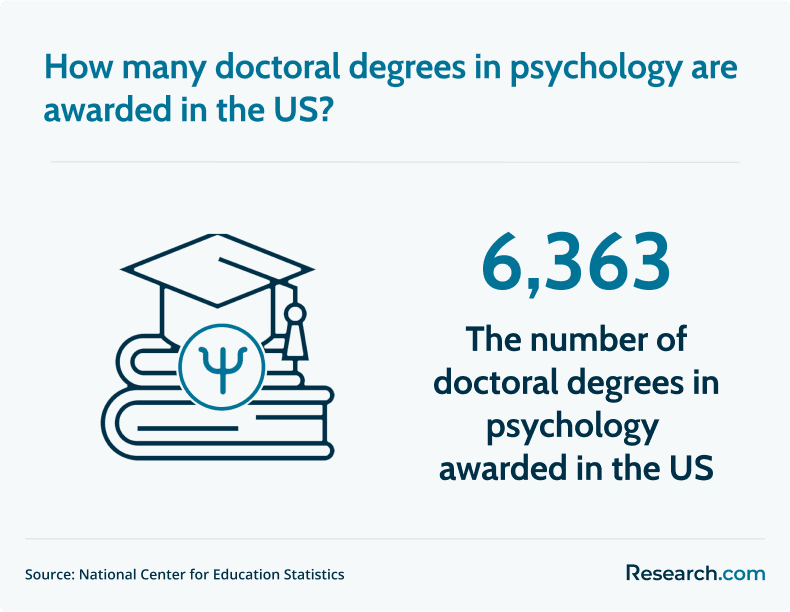
- In 2020–2021, 6,363 doctoral degrees in psychology were awarded in the US (National Center for Education Statistics, 2024).
- All US states require aspiring licensed psychologists to pass the Examination for Professional Practice in Psychology (EPPP), which is administered by the Association of State and Provincial Psychology Boards (ASPPB).
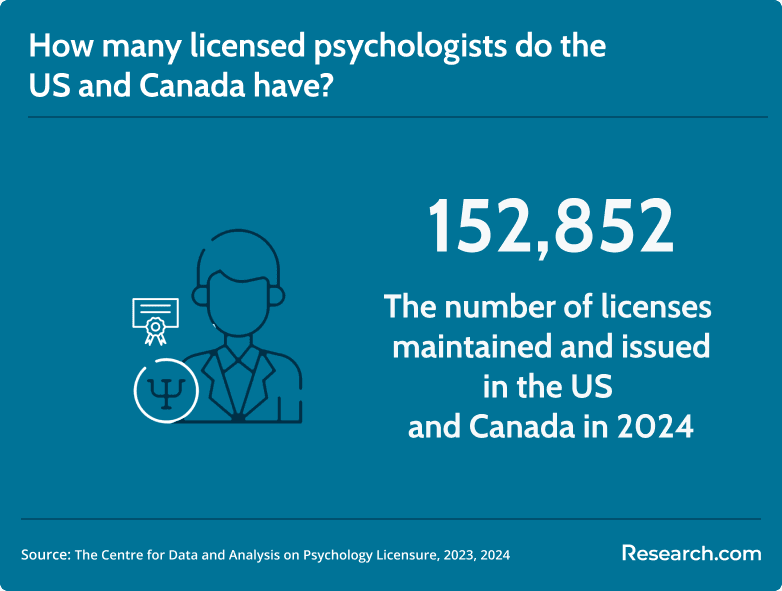
- A 2024 survey reported that 152,852 psychology licenses were maintained and issued in the US and Canada (The Centre for Data and Analysis on Psychology Licensure, 2023, 2024).
- As of 2025, the application fee for the first part of the EPPP, which is Part 1–Knowledge, costs $600. EPPP Part 2–Skills costs $450. Applicants are also required to pay for the test site appointment fees for both parts of the EPPP, which costs $91.88.
- As of 2025, 42 US states provide licensed psychologists with the opportunity to apply for license reciprocity through the Psychology Interjurisdictional Compact (PSYPACT®). PSYPACT® is an interstate agreement that enables licensed psychologists to practice telepsychology and temporary in-person psychological services in other compact states.
References:
- American Psychological Association Services Inc. (2022, April). State licensure and certification information for psychologists. https://www.apaservices.org/practice/ce/state/state-info
- Association of State and Provincial Psychology Boards. (n.d.). Requirements to Practice. https://asppb.net/consumers/choosing-a-psychologist/requirements-to-practice
- Bureau of Health Workforce. (2025). Designated Health Professional Shortage Areas Statistics: Second Quarter of Fiscal Year 2025. US Department of Health & Human Services. https://data.hrsa.gov/topics/health-workforce/shortage-areas
- The Centre for Data and Analysis on Psychology Licensure. (2024). Number of Licenses. https://asppbcentre.org/spotlight/number-of-licenses
- The Centre for Data and Analysis on Psychology Licensure. (2024). License Renewals. https://asppbcentre.org/spotlight/renewals
- The Commonwealth Fund. (2025, June 18). 2025 Scorecard on State Health System Performance. https://www.commonwealthfund.org/publications/scorecard/2025/jun/2025-scorecard-state-health-system-performance
- National Center for Education Statistics. (2022, September). Table 325.80. Degrees in psychology conferred by postsecondary institutions, by level of degree and sex of student: Selected academic years, 1949-50 through 2020-21. Digest of Education Statistics. https://nces.ed.gov/programs/digest/d22/tables/dt22_325.80.asp
- Tikkanen, A. (2025, June 27). list of U.S. states by population. Encyclopedia Britannica. https://www.britannica.com/topic/largest-U-S-state-by-population
- US Bureau of Labor Statistics. (2025). May 2024 OEWS Profiles. Occupational Employment and Wage Statistics (OEWS) Profiles. https://data.bls.gov/oesprofile
- US Bureau of Labor Statistics. (2025, August 28). Psychologists. Occupational Outlook Handbook. https://www.bls.gov/ooh/life-physical-and-social-science/psychologists.htm
Other Things You Should Know about the Psychology Licensure Process
To obtain a psychology license in 2027, candidates must pass the Examination for Professional Practice in Psychology (EPPP). This standardized test evaluates essential knowledge and skills necessary for practice. While passing scores can vary by state, the EPPP remains a central requirement across the U.S. for aspiring psychologists.
In 2027, most states require aspiring psychologists to complete 1,500 to 4,000 hours of supervised professional experience. This must occur over one to two years, post-graduation or during a doctoral program, and be supervised by a licensed psychologist or equivalent.
To become licensed as a psychologist in 2027, candidates typically need a doctoral degree in psychology from an accredited program. This often includes either a Ph.D. or Psy.D. Supervised clinical experience and completion of postdoctoral hours are also commonly required across various states.


