2027 Professional Engineer License Requirements

Co-Founder and Chief Data Scientist
Engineering has always been central to solving complex challenges, with a total workforce of approximately 1.6 million engineers in the United States alone (Bureau of Labor Statistics, 2024). The sector is growing faster than the national average, underscoring the constant need for skilled professionals.
While a bachelor's degree provides the technical foundation, a professional engineer license is a critical credential that signifies a higher level of competence and responsibility. It is a sign of an engineer's commitment to public safety and professional standards.
In this article, I will explain the typical step-by-step process for obtaining a professional engineer (PE) license, compare the key differences between the Fundamentals of Engineering (FE) and Principles and Practice of Engineering (PE) exams, and discuss how licensure requirements vary by state.
Key Things to Know About Professional Engineer Licensure
- Passing the FE exam, gaining four years of experience under a licensed PE, and passing the PE exam are the three key steps to earning a professional engineer license.
- The typical timeline to become a licensed PE is four to eight years, with four years of qualifying work experience required after passing the FE exam.
- The PE exam costs around $400, while state application fees range from about $50 to more than $300.
- Licensure by comity allows a professional engineer to practice in multiple states by providing a streamlined process for obtaining a new license.
- What is the typical step-by-step process for getting a professional engineer license? Licensure Process
- How long does it typically take to go from graduation to becoming a licensed professional engineer? How long does it typically take to go from graduation to becoming a licensed professional engineer?
- How do professional engineer license requirements vary from state to state? How do professional engineer license requirements vary from state to state?
- What are the experience requirements for a professional engineer license by state? Experience Requirements
- What is comity licensure? Comity Licensure
- What are the key differences between the Fundamentals of Engineering (FE) and Principles and Practice of Engineering (PE) exams? What are the key differences between the Fundamentals of Engineering (FE) and Principles and Practice of Engineering (PE) exams?
- How much does the PE exam registration and application fee cost in most states? Application Fees
- What are the continuing education requirements for maintaining a professional engineer license? What are the continuing education requirements for maintaining a professional engineer license?
- What impact does a professional engineer license have on earning potential and salary growth? What impact does a professional engineer license have on earning potential and salary growth?
- What other career benefits does holding a professional engineer license have? Licensure Benefits
What is the typical step-by-step process for getting a professional engineer license?
An engineering license, often referred to as a Professional Engineer (PE) license, is a testament to an engineer's competence and commitment to public safety. The process of obtaining this license is designed to ensure that engineers have a solid foundation of academic knowledge, practical experience, and a deep understanding of ethical principles.
While specific requirements can vary from state to state, the overall path to licensure is consistent across the country. Individuals exploring private equity careers for finance or accounting degree holders can similarly benefit from understanding structured professional pathways, as both fields require credentialing, experience, and adherence to industry standards to maximize career potential.
The typical steps to obtaining a professional engineer license are outlined below:
- Earn an Accredited Engineering Degree: The first step is to earn a four-year bachelor's degree in engineering from an institution accredited by the Accreditation Board for Engineering and Technology (ABET). A graduate degree may also be required by some state boards, and pursuing an online master’s in engineering management is an excellent way to continue your education and advance your career.
- Pass the Fundamentals of Engineering Exam: The FE exam is typically the first of two required exams and is generally taken during the final year of college or shortly after graduation. Passing this exam allows you to be certified as an Engineer in Training (EIT) in most states.
- Gain Practical Work Experience: You must gain a requisite amount of engineering experience, which for most states is at least four years under the supervision of a licensed PE. This experience must be progressive and involve the application of engineering principles.
- Pass the Principles and Practice of Engineering Exam: This exam tests your knowledge and skills in a specific engineering discipline and is generally taken after fulfilling the experience requirements. The exam is designed to assess a minimum level of competency in your chosen field.
- Submit Your Application to the State Board: The final step is to submit a comprehensive application to your state's engineering licensure board, including your academic transcripts, work experience records, and references. Some states may also require a background check or a state-specific ethics exam.
The path to professional licensure is a marathon, not a sprint. It is a rigorous process that demonstrates a commitment to public welfare and a high level of professional competence that is recognized and respected across the industry.
How long does it typically take to go from graduation to becoming a licensed professional engineer?
The journey from college graduation to becoming a licensed Professional Engineer (PE) typically spans four to eight years. This timeline is heavily influenced by the structured, multi-step process required for licensure, which includes education, examinations, and progressive work experience.
Professionals exploring certifications in other fields, such as CRCR certification, can see parallels in how credentialing ensures expertise, maintains industry standards, and supports career advancement.
While the academic portion of this journey is usually completed in four years, the licensure process itself begins during or after college and continues for several more years.
The most time-intensive phase of the process is the accumulation of qualifying work experience. Most states require a minimum of four years of progressive engineering experience under the supervision of a licensed PE before an applicant is eligible to take the Principles and Practice of Engineering (PE) exam. This experience must demonstrate a gradual increase in complexity and responsibility.
Some states may allow a master's degree in engineering to be credited toward one year of the experience requirement, while a doctorate may count for two years, potentially shortening the overall timeline.
The time it takes to become licensed can vary based on individual circumstances and state-specific rules. For example, some states may allow you to take the PE exam without the four years of experience, but you will still not be able to obtain your license until the experience requirement is fulfilled. This is an important distinction, as passing the exam early does not immediately grant licensure.
The final step of submitting your application to the state board can also add several months to the process, depending on the board's review time.
How do professional engineer license requirements vary from state to state?
While the core path to professional licensure is consistent nationwide, the specifics of PE license requirements vary significantly from state to state. Each state’s engineering licensure board has its own set of rules, which can affect everything from application fees and continuing education to the order in which you take your exams. When planning your education and licensure path, it’s also helpful to understand the benefits of studying in for-profit colleges, as these institutions may offer flexible programs or accelerated timelines that align with state-specific licensing requirements.
Here are some of the most common ways in which PE licensure requirements differ by state:
- Decoupling: Most states now "decouple" the FE and PE exams, meaning you can take the PE exam before you have completed the required four years of experience. However, some jurisdictions, such as Maryland, still require you to meet the experience requirements before you can even register for the PE exam.
- Unique Jurisdictional Exams: Several states require an additional, state-specific exam beyond the standard FE and PE exams. In Washington, for example, candidates must pass the Washington Engineers Law Review with a score of 80% to be eligible for licensure. Florida requires applicants for both an Engineer Intern certification and PE licensure to complete the Board’s Laws and Rules Study Guide and pass with a score of 90% or greater.
- Background Checks: Some state boards, such as California’s, require a full set of fingerprints as part of a licensure application. This ensures the board can run a background check during the review process.
- Education and Experience Equivalency: While a bachelor's degree from an ABET-accredited program is the standard for licensure, some states, like Oregon, offer alternative pathways. Another way to gain education credit towards licensure is through the best online engineering management MBA degree programs, which can sometimes substitute for a year of experience depending on the state board's discretion.
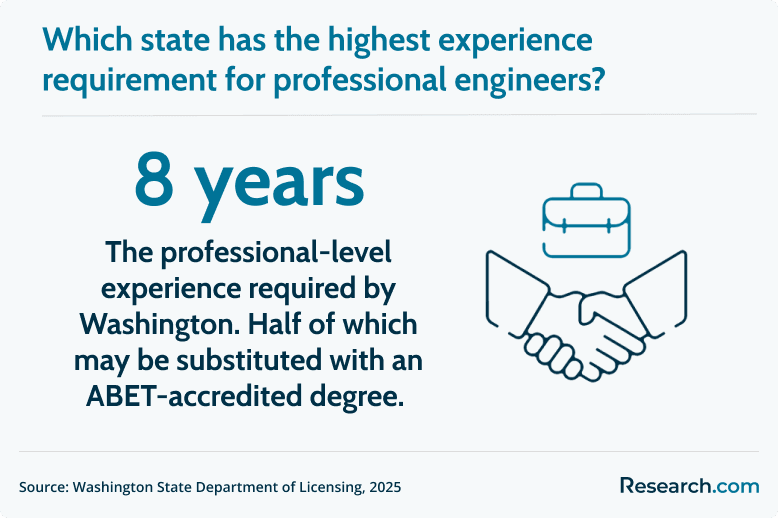
- Experience Requirements: While most states require a minimum of four years of progressive experience, Washington state requires eight years of professional-level experience, though an ABET-accredited degree may count for up to four years of this requirement. Arizona requires a total of 96 months of education and/or experience before you can apply for a PE license.
Ultimately, the best advice for navigating the state-by-state variations is to consult the specific state licensing board. Even if your licensure path appears to be straightforward, small differences can have a significant impact on your timeline and eligibility.
What are the experience requirements for a professional engineer license by state?
The experience requirements for a professional engineer license are a crucial part of the licensure process, as they ensure that candidates have applied their academic knowledge in practical, real-world settings. Individuals with backgrounds in health or science may also explore branches of public health, as understanding diverse professional pathways highlights the importance of applied experience and specialization across industries.
While the National Council of Examiners for Engineering and Surveying (NCEES) recommends at least four years of progressive engineering experience, state boards have the ultimate authority to set their own rules, which can result in significant variations.
The following are common ways in which state-specific experience requirements differ:
- Standard Four-Year Requirement: The most common requirement is four years of progressive, verifiable work experience under the supervision of a professional engineer. This experience must demonstrate a gradual increase in complexity and responsibility, with the documentation often scrutinized by the state board to ensure its validity.
- Education for Experience: Several states allow academic work to substitute for a portion of the required work experience. A master's degree in engineering may count for one year of experience, while a doctorate may count for two years, potentially reducing the required work experience to as little as two or three years. In Maryland, an unaccredited engineering degree may be accepted, but it requires at least eight years of work experience instead of the standard four.
- Alternative Pathways: Some states, like Texas, offer a "combined education and experience" approach for licensure. For instance, a candidate with a non-ABET-accredited degree in engineering or a related science may be required to have eight years of experience, double the standard amount for those with an accredited degree.
- Verification: All states require that an applicant's work experience be documented and verified by their supervisor. This involves a detailed statement from the applicant and a verification from a licensed professional engineer who can attest to the nature and extent of the work performed.
The work experience component is vital as it bridges the gap between theoretical knowledge and practical application, ensuring that licensed professional engineers are not only academically proficient but also professionally competent and prepared to protect the public's welfare.
What is comity licensure?
Licensure by comity is the process by which a professional engineer who is licensed in one state obtains a license in a different one. While the term "reciprocity" suggests an automatic exchange of credentials, true reciprocity is rare, and comity is the most common route for multi-state licensure.
Comity involves one state voluntarily recognizing another's licensing standards and credentials, but it still requires the applicant to go through a formal process to prove they meet the new state's requirements.
The comity process typically requires you to submit an application, verify your existing license, and provide documentation of your education, exams, and work experience. The NCEES Records program can streamline this by compiling and verifying all of your credentials in one place for transmission to multiple state boards.
However, even with an NCEES record, you may still need to meet state-specific requirements, such as taking a law and ethics exam or providing fingerprints for a background check.
How does licensure by comity allow multi-state practice for engineers?
Licensure by comity serves as a foundational process for professional engineers to expand their practice beyond their initial jurisdiction, allowing them to work on projects in other states without repeating the entire licensure process from scratch.
It is a system built on trust and a mutual understanding that a licensed professional engineer has already met a rigorous, standardized set of qualifications. This approach streamlines the administrative burden and provides a clear pathway for multi-state practice.
The steps for obtaining a license by comity are outlined below:
- Credential Verification: The first step is to have your existing license and credentials verified. This includes submitting proof of your current license, passing scores for both the FE and PE exams, and a documented record of your education and experience, which could include specialized training from an online environmental engineering degree program.
- Application to the New State: An engineer must submit a formal application to the new state's licensing board, which will review the verified credentials to ensure they meet its specific requirements. This is where minor differences between states can come into play. For example, the state may have a unique code of ethics or a unique set of laws for engineers in its jurisdiction..
- Final Review and Approval: Once the application is submitted and all required supplemental documents and fees are received, the board will conduct a final review and approve the license. In most cases, a professional engineer can expect the process to take anywhere from 30-90 days.
Through these steps, licensure by comity facilitates professional mobility and career advancement, ensuring that a professional engineer's hard-earned credentials are recognized and accepted across the nation.
What are the key differences between the Fundamentals of Engineering (FE) and Principles and Practice of Engineering (PE) exams?
The journey to becoming a professional engineer involves two critical exams: the FE and the PE. While both are administered by National Council of Examiners for Engineering and Surveying (NCEES) and are required for licensure, they serve distinct purposes in an engineer's career progression.
The FE exam is a stepping stone that tests foundational knowledge, while the PE exam is the culminating assessment of professional competence. Understanding the key differences between these exams is crucial for aspiring engineers planning their path to licensure.
The most important distinctions between the two exams lie in their content, timing, and purpose:
- Exam Timing and Purpose: The FE is for students nearing graduation or recent graduates, serving as a prerequisite for the PE. The PE is taken after gaining four years of experience and assesses practical judgment within a specific discipline.
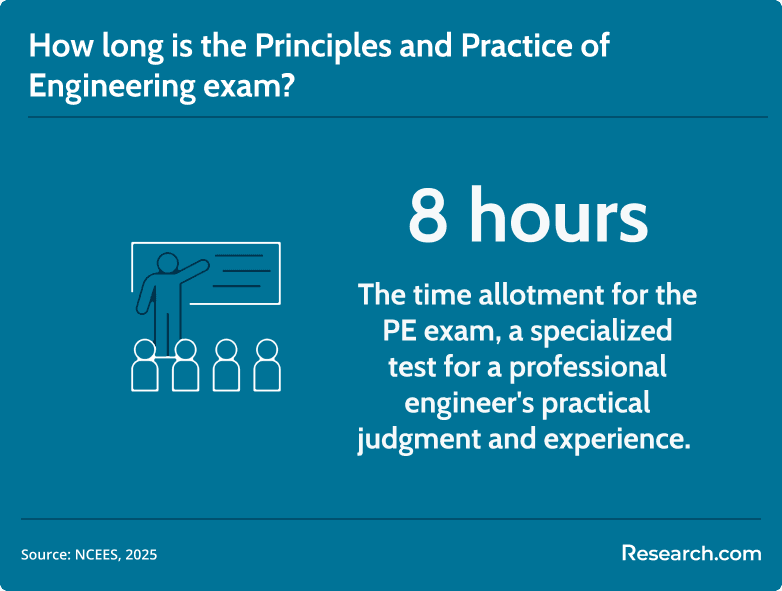
- Content and Focus: The FE is a broad, 6-hour exam covering undergraduate topics across seven discipline-specific modules. The PE is a longer, 8-hour exam that is highly specialized and focuses on one discipline.
- Exam Format and Administration: Both exams are computer-based and administered year-round. The PE, however, includes complex problem-solving questions that test an understanding of engineering codes and ethics.
In essence, the FE exam is about proving you have the academic foundation to become an engineer in training, while the PE exam is about demonstrating you have the professional experience and practical knowledge to be trusted with a license.
What happens if you fail the PE exam, and how soon can you retake it?
Failing the PE exam is a common occurrence and does not disqualify you from pursuing licensure. After a failed attempt, NCEES provides a diagnostic report that shows your performance across all subject areas, highlighting your strengths and weaknesses to guide your future study plan.
While most states do not have a limit on the number of times you can retake the exam, some, like Maryland, require a new application after three failed attempts.
NCEES allows candidates to retake the exam once per three-month testing window, with a maximum of three attempts in a 12-month period. While this is the NCEES policy, some state boards may have their own rules that can affect this. The exam fee must be paid again for each new attempt. The fastest way to retake the test is to sign up for the next available testing window while the material is still fresh.
What are the typical passing rates for the PE exam by discipline?
The passing rates for the PE exam can vary significantly by discipline, offering a valuable perspective for engineers as they prepare for this critical career milestone. While some disciplines consistently show higher pass rates for first-time takers, others can be more challenging.
It is important to note that NCEES does not publish a specific passing score for the exam. Instead, they use a scaled scoring system to ensure fairness across different exam versions and difficulties, with the results reported as either pass or fail.
The pass rates for repeat test takers are noticeably lower, which underscores the importance of thorough preparation for the initial attempt. Below is a table showing the approximate passing rates for first-time test takers across various PE disciplines, based on recent NCEES data.
How much does the PE exam registration and application fee cost in most states?
The cost of obtaining a professional engineer license can be broken down into two main categories: initial fees and recurring fees. While the exact amounts vary by state, there is a general range of what you can expect to pay for both the exams and the application process itself.
Here is a breakdown of the typical costs:
- NCEES Exam Fees: The cost to register for the FE exam is approximately $175, while the PE exam is around $400. These fees are paid directly to NCEES and are consistent across all states.
- State Application Fees: The fees charged by state licensing boards for the application and license issuance vary widely. For example, California’s Board for Professional Engineers, Land Surveyors, and Geologists (BPELSG) lists the application fee for a professional engineer license as $175. In Maine, the combined application and licensure fee is $170.
- Additional Costs: Some states may have additional, state-specific exams, which come with their own fees. For instance, in California, the Seismic Principles and Engineering Surveying exams each cost $175. Other costs can include fees for background checks, fingerprinting, and transferring records through NCEES.
The total cost to obtain your license can range from a few hundred dollars to over a thousand dollars, depending on your state's requirements and whether you need to retake any exams.
Are there any recurring costs after you obtain your professional engineer license?
Obtaining a professional engineer license is a significant investment in your career, but the costs do not end with the initial application and exam fees. To maintain your credentials and legal authority to practice, licensed professional engineers must account for several recurring expenses.
Here is a breakdown of the typical recurring costs:
- License Renewal Fees: Most states require a professional engineer license to be renewed annually or biennially. These fees vary widely by jurisdiction, from about $25 to over $300. In Texas, the renewal fee is $50, while in Florida it is about $98 every two years.
- Continuing Education: Nearly all states require a certain number of continuing education hours, or PDHs, for each renewal period. The costs of meeting these requirements depend on the courses chosen, which can range from free webinars to paid seminars and university courses.
- Late Fees: Many state boards impose late fees if a renewal is not submitted on time. In Wyoming, for instance, a late renewal can incur an additional $15 per month in fees.
While these costs can seem significant, they are a necessary part of a professional engineer's commitment to safeguarding the public's welfare through continued competence.
What are the continuing education requirements for maintaining a professional engineer license?
Nearly every state requires continuing education, typically referred to as Continuing Professional Competency (CPC) or Professional Development Hours (PDH) to maintain a professional engineer license. The specific requirements for these hours vary significantly by state.
For example, the fastest online AutoCAD certificate programs can be completed in as little as a few months. These programs are often self-paced, providing a flexible option for professional engineers who need to manage their continuing education alongside their careers.
Here is a breakdown of the typical continuing education requirements:
- PDH Requirements: The number of hours required varies, with 30 PDHs every two years being a common standard. Some states, however, have annual requirements, such as Mississippi, which requires 15 PDHs per year. A few states, including Arizona, California, Colorado, Connecticut, and Hawaii, do not have a continuing education requirement.
- Content Requirements: Many states specify that a certain number of hours must be dedicated to particular topics. For example, Texas requires one PDH in ethics per renewal cycle, while Florida mandates one hour in ethics and one in laws and rules, in addition to four hours related to the licensee's area of practice.
- Documentation and Audits: It is the responsibility of the professional engineer to maintain detailed records of their completed continuing education for a period of several years. This typically includes course descriptions, attendance verification, and certificates of completion. State boards conduct random audits to verify compliance, and failure to provide proper documentation can lead to penalties.
- Carryover Credits: Most states allow a certain number of excess PDHs to be carried over from one renewal period to the next. For example, in Nebraska, you can carry over a maximum of 15 hours. However, some states, like the District of Columbia, do not allow any hours to be carried over.
By fulfilling these requirements, professional engineers demonstrate their commitment to lifelong learning, ensuring they stay current with the latest advancements in technology, ethics, and safety standards to protect the public's welfare.
What impact does a professional engineer license have on earning potential and salary growth?
Earning a professional engineer license can have a significant and immediate impact on an engineer's salary and long-term earning potential. According to recent surveys, licensed professional engineers earn a higher median income than their non-licensed counterparts. This financial advantage reflects the increased trust, authority, and responsibility that comes with being a licensed professional.
Here is a breakdown of how licensure impacts your career and finances:
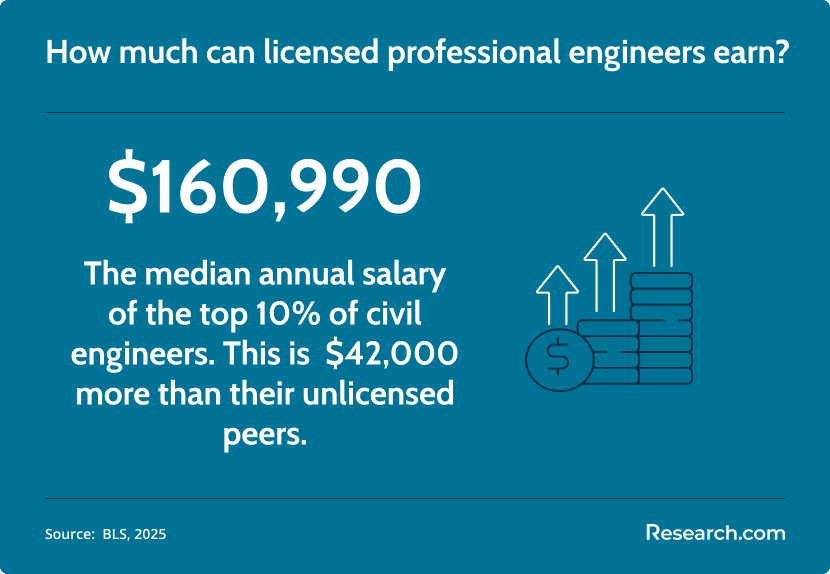
- Salary Increase: A professional engineering license often leads to an immediate salary bump. The National Society of Professional Engineers (NSPE) reports that a licensed engineer earns 5% more than an unlicensed engineer. The American Society of Civil Engineers (ASCE) found a more dramatic difference, with licensed civil engineers earning nearly $42,000 more a year than those without a license or certification.
- Career Advancement: A license opens doors to leadership and management roles that are often unavailable to unlicensed engineers. Many firms and government agencies require a professional engineering license for positions involving the supervision of other engineers, signing and sealing plans, and leading major projects.
- Long-Term Earning Potential: Over a career, the earnings gap between licensed and unlicensed engineers tends to widen. With a license, professionals have more leverage in salary negotiations and are more likely to be considered for high-paying opportunities, such as starting their own firm or becoming an expert witness.
A professional engineering license is a strategic investment that pays off throughout a professional's career, providing a competitive edge and a solid foundation for financial growth.
The following graph illustrates how a professional engineer license directly correlates with higher earnings, using the median annual salary for civil engineers as a key benchmark.
What other career benefits does holding a professional engineer license have?
A professional engineer license is a strategic asset that provides career benefits beyond higher pay. It grants a level of authority, security, and independence that an unlicensed professional engineer does not have.
The most important non-monetary benefits are outlined below:
- Authority and Standing: Only a licensed professional engineer can legally prepare, sign, and seal engineering plans that are submitted to a public authority for approval. This is a legal requirement for those in private practice and consulting. The license also brings credibility, serving as a public affirmation of a professional's expertise.
- Career Advancement: Employers often view licensure as a key indicator of leadership potential, giving a tangible advantage to those seeking senior roles. The license also provides job security, protecting you from industry downsizing or outsourcing by broadening your opportunities.
- Flexibility and Opportunities: A professional engineer license gives you the legal foundation to establish your own engineering or consulting firm. It also allows you to serve as a legal expert witness in court cases, a requirement for that specialized role.
A professional engineer license provides a clear advantage in a dynamic market, including for those in electrical engineering jobs. By enabling greater authority, career growth, and flexibility, the credential ensures you remain relevant throughout your professional life.
Key Findings
- While the PE and FE exams are consistent nationwide, requirements can differ by state, including varying experience requirements, additional state-specific exams, and differing application processes.
- Some states offer alternative pathways to licensure for those with non-ABET-accredited degrees, and others require unique steps like fingerprinting or a background check as part of the application.
- Most states require a minimum of four years of progressive experience under a licensed professional engineer, though some allow academic degrees to substitute.
- The FE is a 6-hour exam testing foundational knowledge, while the PE is an 8-hour, specialized exam that assesses a professional engineer's practical judgment and experience.
- The total initial cost for the PE exam and state application fees ranges from around $450 to over $700, with recurring biennial renewal costs between $25 and more than $300.
- A professional engineer license provides a significant financial advantage, with licensed engineers earning a median salary that is 5% higher than their unlicensed peers.
References:
- ASCE. (2025). FE vs. PE Exam: What’s the Difference? https://www.asce.org/career-growth/licensure-and-certification/fe-and-pe-exams/fe-vs-pe-exam-what-s-the-difference
- BRPELS. (2025). Professional Engineer by Exam - Licensing. https://brpels.wa.gov/licensing/engineering/professional-engineer-exam
- Bureau of Labor Statistics. (2025, August 28). Civil Engineers. https://www.bls.gov/ooh/architecture-and-engineering/civil-engineers.htm#tab-5
- California Board for Professional Engineers, Land Surveyors, and Geologists. (2025). Fee Schedule. https://www.bpelsg.ca.gov/applicants/application_fees.shtml
- Civil Engineering Academy. (2025). Failed the FE or PE Exam, Now What? https://civilengineeringacademy.com/failed-the-fe-or-pe-exam-now-what/
- Florida Board of Professional Engineers. (2025). Engineer Intern (EI) & Professional Engineer (PE) Laws and Rules Study Guide. https://fbpe.org/licensure/licensure-process/laws-and-rules-study-guide/
- Maryland Department of Labor. (2025). Licensing Frequently Asked Questions (FAQs) - Professional Engineers. https://www.labor.maryland.gov/license/pe/pefaqsgenl.shtml
- McKissock Learning. (2025). What Is Professional Engineer Reciprocity and What States Offer It? https://www.mckissock.com/blog/professional-engineering/what-is-professional-engineer-reciprocity-and-what-states-offer-it/
- National Society of Professional Engineers. (2025). About PE Licensure. Retrieved September 23, 2025, from https://www.nspe.org/resources/pe-licensure
- National Council of Examiners for Engineering and Surveying. (2025). Licensure by Comity. https://www.nspe.org/resources/licensure/resources/licensure-comity
- PPI2Pass. (2025). 2024 PE Exam Pass Rates. https://ppi2pass.com/resources/pe-exam/pass-rates
- School of PE. (2024). How to Qualify for the PE Exam: Experience Requirements. https://www.schoolofpe.com/blog/2024/11/what-experience-do-you-need-to-take-pe-exam.html
- Texas Board of Professional Engineers. (2025). Licensing FAQs. https://pels.texas.gov/lic_faq.htm
- Washington State Department of Licensing. (2025). Professional Engineer License Requirements. https://www.dol.wa.gov/business/engineersandsurveyors/professional-engineer-license-requirements
Other Things You Should Know About Professional Engineer Licensure
While requirements vary by state, most allow candidates with non-ABET degrees to take the PE exam, provided they have additional years of relevant work experience. Often, this means accumulating at least four more years of experience under a licensed engineer than those with an accredited degree.
To start an engineering firm in 2027, you typically need a Professional Engineer (PE) license for a key individual in the firm. This requires passing the PE exam and having the necessary education and experience. Additionally, firm registration or a Certificate of Authorization might be required, depending on the state.
In 2027, to start your own engineering firm, you need a Professional Engineer (PE) license. This requires passing the PE exam and fulfilling experience prerequisites, including a four-year ABET-accredited degree. State requirements may vary, so check your local guidelines.
In 2027, most states in the U.S. require a four-year ABET-accredited engineering degree to take the PE exam. However, some states allow alternative paths, such as demonstrating relevant work experience or completing a degree in a related field. Always verify specifics with the licensing board in the state where you plan to practice.