
2027 Public Health Concentrations: Which Path Should You Choose?

Co-Founder and Chief Data Scientist
Three-quarters (75%) of public health employees now intend to stay at their agencies, reflecting greater stability and satisfaction in the field compared to previous years (de Beaumont Foundation, 2025). This insight is especially encouraging for those considering a future in public health, as it signals strong career prospects and long-term opportunities. Public health spans a wide range of specialties, from health education and policy to global health, giving students the chance to tailor their path to their interests and strengths.
Based on my team’s extensive research, I will guide you through the main public health concentrations, the key factors to consider when choosing one, and the career pathways each concentration can open.
Key Things to Know About Public Health Concentrations
- Public health professionals can earn competitive salaries, especially in specialized areas such as epidemiology, biostatistics, or health policy. Advanced degrees and leadership roles often lead to higher earning potential.
- Graduates can pursue diverse roles in government agencies, nonprofit organizations, hospitals, research institutions, and global health organizations. Demand is growing as public health challenges continue to evolve.
- Careers in public health offer the chance to make a meaningful difference by addressing health disparities, improving community wellness, and shaping policies that protect and enhance population health.
- What are the main concentrations available in the Master of Public Health (MPH) and related programs? Concentrations
- What are the factors to consider when choosing a public health concentration? What are the factors to consider when choosing a public health concentration?
- Which public health concentrations require the most quantitative (math and statistics) training? Which public health concentrations require the most quantitative (math and statistics) training?
- Which public health concentrations are the most flexible for students with non-health backgrounds? Which public health concentrations are the most flexible for students with non-health backgrounds?
- Which public health concentrations are the easiest to transition into another public health specialty later? Which public health concentrations are the easiest to transition into another public health specialty later?
- What are the pros and cons of choosing a very specialized vs. a broad concentration? What are the pros and cons of choosing a very specialized vs. a broad concentration?
- What kinds of careers are linked to public health concentrations? Career Paths
- What salary ranges are associated with each public health concentration? Salaries
- Which public health concentrations are growing the fastest? Job Outlook
- How important is it to pursue board certification after earning an MPH or DrPH Certifications
What are the main concentrations available in the Master of Public Health (MPH) and related programs?
Students pursuing an MPH or related degree in 2027 have access to a wide range of types of public health certifications and concentrations that align with their skills, passions, and career goals. Each concentration equips graduates with specialized expertise, preparing them for roles in research, policy, community engagement, or healthcare leadership.
The most common concentrations include the following:
- Epidemiology. This concentration focuses on studying disease patterns and determinants in populations, preparing graduates for careers in disease surveillance, outbreak investigation, and public health research.
- Biostatistics. Students develop advanced skills in statistical analysis and data modeling, enabling them to support research, clinical trials, and evidence-based decision-making in healthcare.
- Global Health. This concentration emphasizes health equity and international collaboration, training professionals to address infectious diseases, health disparities, and humanitarian crises.
- Health Policy and Management. Students learn to design, evaluate, and manage health policies and programs, making them strong candidates for leadership roles in government, hospitals, and nonprofit organizations.
- Environmental Health. This concentration examines the relationship between the environment and human health, covering issues such as pollution, occupational hazards, and climate change.
- Social and Behavioral Sciences. Students explore how social, cultural, and behavioral factors influence health, preparing them to design interventions that improve health outcomes at the community level.
- Maternal and Child Health. This area focuses on the health needs of women, infants, and children, with career opportunities in clinical programs, advocacy, and global maternal health initiatives.
- Public Health Nutrition. Students in this track address issues of food security, obesity, and dietary health, often leading to roles as nutrition policy analysts or community nutrition specialists.
- Health Informatics/Digital Health. This emerging concentration combines data science with healthcare systems, preparing graduates to work with electronic health records, big data, and health technology.
What are the factors to consider when choosing a public health concentration?
Choosing a public health concentration is a major decision that can shape a student’s education, career path, and long-term satisfaction. Just as it’s important to understand what is a for-profit college before enrolling, students should also carefully evaluate the following factors before committing to a public health specialization. Several important considerations include:
- Personal interests and passions. Students should choose a concentration that aligns with what excites and motivates them, whether that is working with data, influencing policy, or engaging with communities.
- Career goals. Each concentration leads to distinct roles, so aligning future aspirations with the right specialization ensures a smoother path to the desired profession.
- Job market demand. Certain fields, such as digital health, epidemiology, and environmental health, are growing faster and may provide more career opportunities in 2027 and beyond.
- Educational background. A student’s prior studies in science, social sciences, or mathematics can influence which concentrations feel most natural or manageable.
- Skill strengths. Concentrations vary in the balance between quantitative, research, and communication skills, making it important to select one that plays to a student’s strengths.
- Certifications and professional growth. Some concentrations align with specific certifications, such as Certified in Public Health (CPH), Certified Health Education Specialist (CHES), or Certified Industrial Hygienist (CIH), which can enhance employability and career progression.
- Flexibility and versatility. Students may want to consider concentrations that offer transferable skills, allowing them to work in multiple sectors or shift career directions over time.
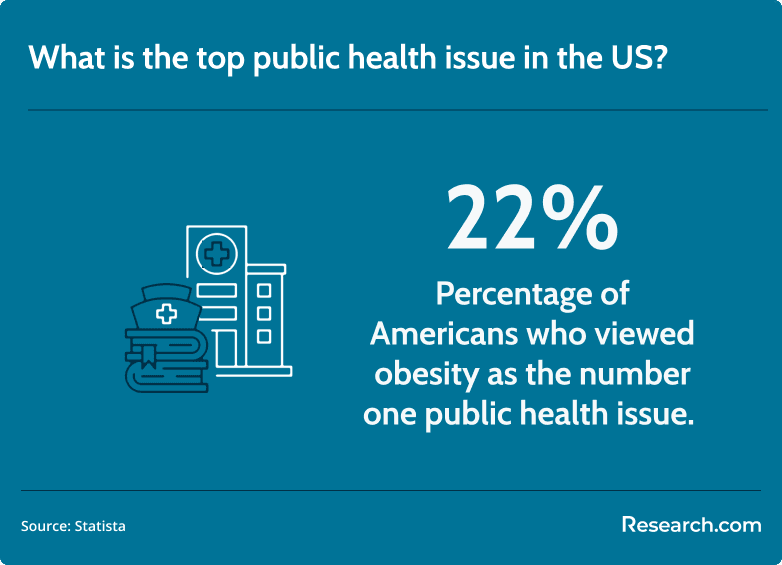
If you are concerned about tackling today’s most urgent health challenges, then choosing a concentration that aligns with these issues can help you make a meaningful impact. For example, 22% of Americans identified obesity as the leading public health issue (Statista, 2025).
Meanwhile, 15% of respondents considered opioid and fentanyl addiction to be the most pressing public health threat in the United States. A concentration in Community Health, Nutrition, Health Policy and Management can prepare you to shape treatment programs and influence policy.
Which public health concentrations require the most quantitative (math and statistics) training?
Among all public health concentrations, Biostatistics is widely recognized as the most quantitative. Understanding PE license requirements similarly emphasizes the importance of meeting strict, measurable criteria—just as biostatistics requires mastery of mathematics, probability, and advanced statistical methods to analyze health-related data and inform decision-making.
Students pursuing Biostatistics should be comfortable working with numbers, statistical software, and large datasets, as much of their training involves designing studies, interpreting complex data, and applying mathematical models.
Epidemiology is another concentration that requires a solid foundation in statistics, but Biostatistics typically demands more advanced and technical training. For students with strong analytical skills or a background in mathematics, this concentration provides a highly valued and in-demand skill set.
Which public health concentrations are the most flexible for students with non-health backgrounds?
MSN public health jobs and other roles in the industry are not reserved for students with health backgrounds. Students entering public health from non-health fields often look for concentrations that welcome diverse academic and professional experiences. The following concentrations are generally considered the most flexible:
- Health Policy and Management. This concentration draws students from backgrounds in political science, business, economics, and law, since it focuses on leadership, strategic planning, and policy development rather than clinical knowledge.
- Global Health. With its emphasis on equity, humanitarian work, and international collaboration, Global Health is accessible to students from international relations, sociology, and even communications backgrounds.
- Social and Behavioral Sciences. This path is ideal for students with degrees in psychology, education, or anthropology, as it focuses on human behavior, health promotion, and community engagement rather than technical health sciences.
If you are thinking about pursuing a career in public health but do not have a health background, you are not alone, and you are definitely not behind.
The table below shows that the field is filled with professionals from all levels of education, including 14.9% with no college degree and 12.7% with an associate’s degree (de Beaumont Foundation, 2025). This proves that public health welcomes people from many different starting points, not just those with traditional health or medical training.
Which public health concentrations are the easiest to transition into another public health specialty later?
Community Health, often grouped with Social and Behavioral Sciences, is generally the easiest concentration to transition from into other public health specialties. For professionals in private equity fund accounting jobs, the transferable skills mindset is similar: just as accounting expertise can pivot across finance roles, Community Health equips public health practitioners with adaptable skills—like program planning, health communication, and cultural competence—that are valuable in multiple specialties.
For example, a graduate who begins in Community Health can shift into Maternal and Child Health by focusing on family-based programs, or move into Global Health by applying community outreach skills in international settings.
Health Policy and Management is also relatively versatile, as leadership and policy analysis skills are relevant across multiple specialties. These pathways provide flexibility for students who may want to adjust their focus as their careers progress.
What are the pros and cons of choosing a very specialized vs. a broad concentration?
Choosing between a highly specialized and a broad concentration depends on a student’s career goals and risk tolerance. A specialized concentration, such as Maternal and Child Health or Public Health Nutrition, offers deep expertise and positions graduates as subject-matter experts, which can make them highly attractive to employers in niche areas.
However, the drawback is that these roles may be limited, and graduates might face challenges switching to unrelated fields. On the other hand, broader concentrations, such as Health Policy and Management or Social and Behavioral Sciences, provide flexibility to work across multiple sectors and adapt to changing job markets.
The trade-off is that graduates may face more competition since their skills are not as narrowly defined. Ultimately, students must balance focus with adaptability when deciding which type of concentration fits best.
This balance is especially important when considering workforce realities. The 2024 Public Health Workforce Interests and Needs Survey table below found that while job satisfaction was high at 86.1% and benefits satisfaction was at 82.5%, pay satisfaction was much lower at 56.1% (de Beaumont Foundation, 2025).
The abovementioned data suggests that even if professionals enjoy their work, financial dissatisfaction may motivate them to shift roles or sectors. Those with broad concentrations may find it easier to adapt and pursue higher-paying opportunities, while those with specialized expertise may secure niche, stable roles but with fewer options for mobility.
What kinds of careers are linked to public health concentrations?
Each public health concentration opens doors to unique career paths, and students can find opportunities that match their personal interests and skills. The following examples highlight the types of roles commonly linked to different concentrations:
- Epidemiology. Graduates often become epidemiologists, outbreak investigators, or research scientists working for health departments, universities, or global organizations.
- Biostatistics. Careers include biostatisticians, data analysts, and clinical trial coordinators who design and interpret studies in healthcare and research institutions.
- Global Health. Professionals may work as program managers, health consultants, or humanitarian coordinators with international organizations such as the World Health Organization (WHO) or non-governmental organizations (NGOs).
- Health Policy and Management. Career options include hospital administrators, policy analysts, and public health program directors shaping healthcare delivery and reform.
- Environmental Health. Graduates can work as environmental health specialists, occupational safety officers, or climate health researchers addressing pollution, workplace hazards, and climate change.
- Social and Behavioral Sciences. Careers for those with a behavioral or an online social sciences degree include health educators, program evaluators, or behavioral health specialists who design interventions to change health behaviors in communities.
- Maternal and Child Health. Professionals may become maternal health program coordinators, child health advocates, or global health specialists focusing on women’s and children’s wellness.
- Public Health Nutrition. Common roles include nutrition policy advisors, community nutritionists, or wellness program managers promoting healthy diets and food security.
- Health Informatics/Digital Health. Careers include health informatics specialists, data managers, or technology consultants who integrate digital tools into healthcare systems.
These career paths illustrate how each concentration provides distinct opportunities, allowing students to choose the one that best aligns with their desired impact in public health.
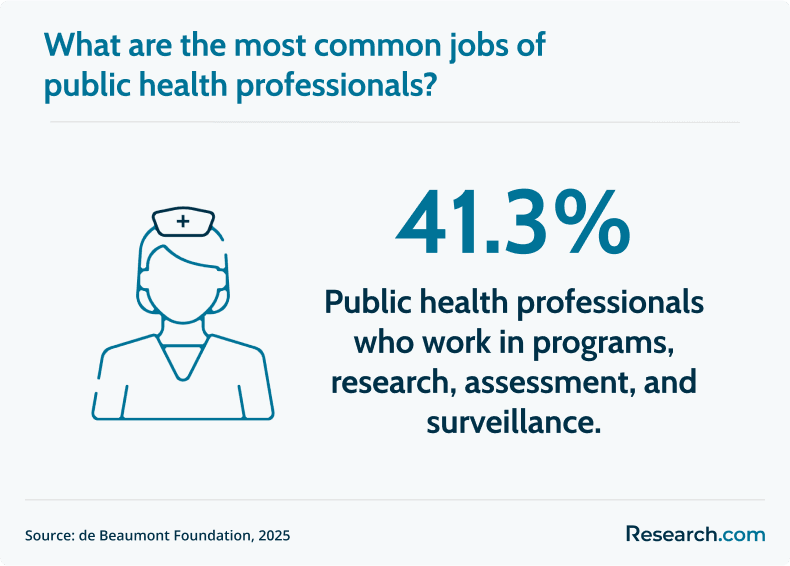
Many careers in public health are built around designing, studying, and improving programs that directly impact communities. According to a public health workforce survey, 41.3% of employees are involved in public health programs, research, assessment, and surveillance, showing just how central these functions are within the field (de Beaumont Foundation, 2025).
What salary ranges are associated with each public health concentration?
Salary potential is often a deciding factor for students considering a Master of Public Health (MPH) or related graduate program. While salaries vary by location, employer, and experience, ZipRecruiter provides useful averages for roles connected to different public health concentrations. Here are eight examples:
- Public Health Epidemiologist. Public health epidemiologists study patterns of disease and health conditions in populations to prevent outbreaks and guide public health responses. The average salary for a Public Health Epidemiologist is $79,657/year in the U.S. (about $38.30/hour).
- Health Policy Manager. Health policy managers oversee the development and implementation of healthcare policies that improve systems and patient outcomes. A Health Policy Manager role shows an average salary of about $109,580/year (≈ $52.68/hour) in the U.S.
- Biostatistician. Biostatisticians apply statistical methods to analyze health-related data, helping to design studies and interpret findings in medicine and public health. The average salary for a Biostatistician in the U.S. is about $119,702/year. At the senior level, a Senior Biostatistician can earn around $136,471/year ($65.61/hour).
- Environmental Health Specialist. Environmental health specialists monitor and address environmental risks such as water quality, pollution, and occupational hazards to protect community health. An Environmental Health Specialist earns on average $62,691/year in the U.S. ($30.14/hour).
- Public Health Nutritionist. Public health nutritionists design and implement nutrition programs to improve dietary habits and reduce food-related health disparities in populations. A Public Health Nutritionist in the U.S. earns on average $60,112/year ($28.90/hour).
Advanced degrees, including MSN Public Health Nursing, can significantly boost salary potential in public health careers. Graduate-level training equips nurses with leadership, policy, and population health skills that qualify them for higher-paying roles. With this credential, professionals can access positions like health services manager or program director, often earning well above the national nursing average.
Which public health concentrations are growing the fastest?
Several public health concentrations are seeing faster growth than others in 2025, driven by shifts in healthcare delivery, technology, policy, and public demand. Some of the fastest-growing concentrations include:
- Population Health Management/Digital Health/Health Informatics. The PHM market is projected to expand rapidly with a CAGR of around 18.9 % globally from 2025 to 2030 (Grand View Research, 2025).
- Predictive Analytics and Big Data in Public Health. Related to PHM, the market for big data analytics in healthcare is growing strongly with reported CAGRs in various segments ranging from 15 to 20% (Grand View Research, 2025).
- Epidemiology. Employment of epidemiologists is projected to grow 16% from 2024 to 2034, much faster than the average for all occupations (Bureau of Labor Statistics [BLS], 2024).
- Health Information/Health Informatics/Health Information Technologists and Registrars. Career options in health information management include health information technologists and medical registrars, who are expected to grow 15% from 2024 to 2034, also much faster than average (BLS, 2024).
- Medical and Health Services Managers. Employment in this area is projected to grow 23% between 2024 and 2034 (BLS, 2024).
If you are pursuing an MPH with a concentration in Health Policy and Management, the strongest employment opportunities are in hospitals, which employ nearly one-third (29%) of all medical and health services managers.
The chart below also shows that physician offices (14%), nursing and residential care facilities (9%), and outpatient care centers (7%) also provide valuable career paths, especially for those seeking smaller or more specialized work environments. Choosing the right setting depends on whether you prefer direct operational management in healthcare facilities or shaping broader health policies and programs.
How important is it to pursue board certification after earning an MPH or DrPH?
Pursuing board certification after completing a Master of Public Health (MPH) or Doctor of Public Health (DrPH) is often most relevant for professionals who want to validate their expertise and strengthen their credentials in the job market. The Certified in Public Health (CPH) exam is open to graduates of Council on Education for Public Health (CEPH)–accredited programs, as well as those with relevant public health work experience.
The Certified Health Education Specialist (CHES) credential is typically for those with a degree in health education who have pursued health education jobs or a related field. Meanwhile, the Certified Industrial Hygienist (CIH) is aimed at those with academic training and practical experience in industrial hygiene or environmental health sciences.
In short, these certifications are available to professionals who have completed advanced public health training or who bring substantial field experience, making them an important next step for those committed to advancing their careers.
What Public Health Workers Say About Their Careers
- Dwight: "Working in epidemiology has allowed me to track disease patterns and contribute to life-saving prevention strategies. Knowing that my research helps protect entire communities gives my work a deep sense of purpose."
- Jenny: "My career in health policy has shown me how evidence-based decisions can improve access to care. Seeing real changes in legislation that reduce health disparities has been incredibly fulfilling."
- Kate: "Public health education has given me the chance to empower people with knowledge that improves their daily lives. Watching individuals make healthier choices because of programs I helped design is the most rewarding part of my job. "
Key Findings
- 22% of Americans identified obesity as the top public health issue, while 15% viewed opioid and fentanyl addiction as the most pressing threat.
- 72.4% of public health professionals hold higher education degrees, including bachelor’s, master’s, and doctoral.
- 41.3% of employees in public health work in programs, research, assessment, and surveillance, highlighting the core functions of the field.
- The Population Health Management (PHM) market is expected to grow at a global CAGR of 18.9% over the next five years.
- Employment for Medical and Health Services Managers is projected to increase by 23% between 2024 and 2034, showing strong demand in health policy and management roles..
References:
- de Beaumont Foundation. (2025, July 14). PH WINS 2024 findings and tools for action. https://debeaumont.org/news/2025/ph-wins-2024-findings-and-tools-for-action/
- Grand View Research. (2025). Population health management (PHM) market analysis. https://www.grandviewresearch.com/industry-analysis/population-health-management-phm-market
- U.S. Bureau of Labor Statistics. (2024). Health information technologists and medical registrars. https://www.bls.gov/ooh/healthcare/health-information-technologists-and-medical-registrars
- U.S. Bureau of Labor Statistics. (2025). Medical and health services managers. https://www.bls.gov/ooh/management/medical-and-health-services-managers.htm
- U.S. Bureau of Labor Statistics. (2025). Epidemiologists. https://www.bls.gov/ooh/life-physical-and-social-science/epidemiologists.htm
- ZipRecruiter. (2025). Environmental health specialist salaries. https://www.ziprecruiter.com/Salaries/Environmental-Health-Specialist-Salary?
- ZipRecruiter. (2025). Health policy management salaries. https://www.ziprecruiter.com/Salaries/Health-Policy-Management-Salary?
- ZipRecruiter. (2025). Public health epidemiology salaries. https://www.ziprecruiter.com/Salaries/Public-Health-Epidemiology-Salary?
- ZipRecruiter. (2025). Public health nutritionist salaries. https://www.ziprecruiter.com/Salaries/Public-Health-Nutritionist-Salary?
- ZipRecruiter. (2025). Biostatistician average salary by state. https://www.ziprecruiter.com/Salaries/What-Is-the-Average-Biostatistician-Salary-by-State?
Other Things to Know About Public Health Concentrations
In 2027, concentrations like Epidemiology and Health Informatics are projected to have strong job prospects due to the growing demand in data analysis and outbreak response. These fields are essential in tackling global health challenges and are supported by current labor market trends.
In 2027, popular concentrations in Master of Public Health (MPH) programs include Epidemiology, Biostatistics, Environmental Health, Health Policy and Management, and Community Health. Each concentration offers specialized skills and knowledge in specific areas of public health, catering to diverse career goals.


