
2027 Best Online Electrical Lineworker Trade School Programs

Co-Founder and Chief Data Scientist
Individuals interested in a career as an electrical lineworker often question whether an online education is a worthwhile investment. This article addresses that concern by offering a comprehensive guide to online electrical lineworker trade school programs. With a projected employment growth of 8% until 2033, the demand for skilled electrical power-line installers and repairers is significant, underscoring the importance of this career path.
The Research.com team, with over a decade of experience in career planning, has compiled this guide using only credible sources. Our detailed analysis will help you understand the benefits and drawbacks of online programs, providing you with the necessary information to make an informed decision about your future.
What are the benefits of getting online electrical lineworker trade school programs?
- Online electrical lineworker trade school programs prepare you for various in-demand jobs such as lineperson, electrician, and electrical engineer, opening doors to stable careers in utility companies and related fields.
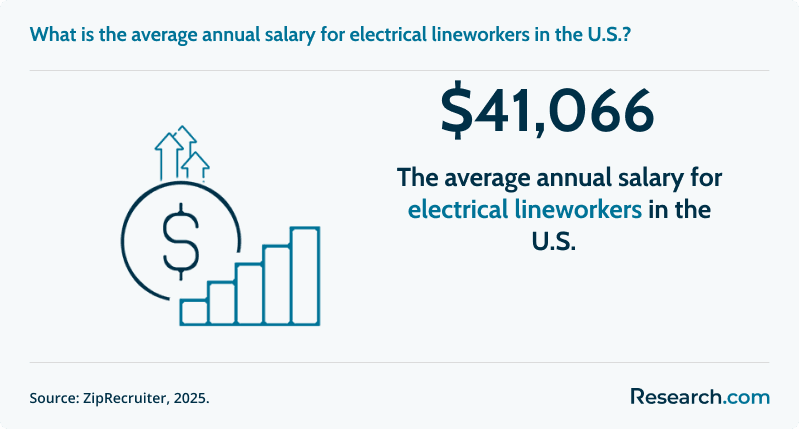
- The average salary for electrical lineworkers is $41,066 per year nationally, with top earners making upwards of $119,499, reflecting strong earning potential in this trade.
- The online format allows for flexible, self-paced learning from home, eliminating travel expenses and making education accessible for those working or living out of state while still covering essential theoretical and technical skills needed for certification and career advancement.
What can I expect from an online electrical lineworker trade school program?
An online electrical lineworker trade school program typically covers a core curriculum focused on electrical theory, safety practices, equipment handling, and technical skills needed for linework. Many online electrical lineworker programs include a capstone project to apply what you’ve learned practically. Internship or fieldwork hours are often required to gain hands-on experience.
Tuition for these programs usually ranges from $5,000 to $15,000, depending on the school and program length. Online classes are generally delivered through video lectures, interactive modules, and virtual labs, allowing flexible, self-paced learning.
Some online electrical lineworker programs also offer live sessions or support from instructors to help students stay on track while balancing work or personal commitments. This format makes it easier to access quality training without needing to travel.
Where can I work with an online electrical lineworker trade degree?
An online electrical lineworker trade degree opens doors to diverse career opportunities across many industries. Graduates can work in utility companies, corporate settings, government agencies, and nonprofit organizations. Some pursue roles in management, consulting, or research related to electrical systems. Others start their own businesses, leveraging technical skills and industry knowledge.
The degree also provides pathways into education, technology, healthcare, and creative fields. Skills gained, such as problem-solving, communication, and critical thinking, enable graduates to adapt to various work environments. The electrical lineworker field is growing, with about 10,700 job openings expected each year.
How much can I make with an online electrical lineworker trade degree?
With an online electrical lineworker trade degree, entry-level professionals may earn closer to $40,000 to $55,000 per year, while experienced lineworkers can make significantly more, especially in high-paying states such as Washington or New York, where salaries can exceed $130,000.
Salaries vary by industry too; for example, work in utilities or government agencies often pays more than in other sectors. Additionally, obtaining advanced certifications like Certified Journeyman Lineman (CJL) can boost your earning potential by demonstrating higher skill levels.
- List of the Best Online Electrical Lineworker Trade School Programs for 2027 List of Programs
- How long does it take to complete an online electrical lineworker trade school program? Completion Time
- How does an online electrical lineworker trade school program compare to an on-campus program? How does an online electrical lineworker trade school program compare to an on-campus program?
- What is the average cost of an online electrical lineworker trade school program? Program Cost
- What are the financial aid options for students enrolling in an online electrical lineworker trade school program? Financial Aid
- What are the prerequisites for enrolling in an online electrical lineworker trade school program? What are the prerequisites for enrolling in an online electrical lineworker trade school program?
- What courses are typically in an online electrical lineworker trade school program? What courses are typically in an online electrical lineworker trade school program?
- What types of specializations are available in an online electrical lineworker trade school program? What types of specializations are available in an online electrical lineworker trade school program?
- How to Choose the Best Online Electrical Lineworker Trade School Program How to Choose the Best Online Electrical Lineworker Trade School Program
- What career paths are available for graduates of an online electrical lineworker trade school program? Career Paths
- What is the job market for graduates with an online electrical lineworker trade school program? Job Market
Best Online Electrical Lineworker Trade School Programs for 2027
Choosing an electrical lineworker trade school is not the same as choosing a fully online academic program. Linework is physical, safety-sensitive, and equipment-heavy, so the strongest “online” options are usually hybrid programs: students complete theory, safety, electrical fundamentals, or code-related coursework online, then attend required in-person labs, climbing sessions, driving training, or field exercises. This guide is for students comparing lineworker certificates, associate degrees, apprenticeship-prep programs, and related electrical trade pathways.
You will learn which programs stand out, how long training usually takes, what it may cost, what admissions requirements to expect, how online and campus formats differ, and how to judge whether a program is a practical route into utility, power distribution, renewable energy, or electrical maintenance work.
Quick answer: Are online electrical lineworker programs worth considering?
Yes, but only if the program includes verified hands-on training or a clear pathway to apprenticeship. Electrical lineworker training cannot be completed entirely through online coursework because students must practice climbing, rigging, equipment handling, rescue procedures, and field safety. A good online or hybrid program should help you build foundational knowledge, earn relevant safety credentials, prepare for CDL requirements when applicable, and connect with utility employers or apprenticeship opportunities.
How Research.com evaluated these programs
Because trade school costs, completion time, and career outcomes can vary widely, our ranking process emphasizes transparent, decision-useful information. We reviewed institutional and program data using sources such as the IPEDS database, Peterson's database, the College Scorecard database, and the National Center for Education Statistics. These sources help verify school-level information and provide context for comparing programs. You can learn more about the evaluation process on Research.com's methodology page.
Comparison of featured online and hybrid electrical lineworker trade programs
| School and program | Credential or focus | Program length | Listed cost information | Credits | Accreditation |
| Blackhawk Technical College - Electric Power Distribution | Electric power distribution training | 1 year | $5,593 | 31 | Higher Learning Commission (HLC) |
| Blue Ridge Community and Technical College - Electric Distribution Engineering Technology | Associate of Applied Science | 2 years | $4,992 (full year; in-state), $9,264 (full-year; out-of-state) | 60 | HLC |
| College of Southern Idaho - Electrical Apprenticeship Program | State-approved electrical apprenticeship | N/A | $995 | N/A | Northwest Commission on Colleges and Universities (NWCCU) |
| Connecticut State Community College - Eversource Lineworker Program | Lineworker certificate preparation | 13 weeks | $2,999 | N/A | New England Commission of Higher Education (NECHE) |
| Lansing Community College - Utility Lineworker Program | Utility lineworker training | Approximately 13 months | In-district: $120; In-state: $240; Out-of-state: $360 | N/A | HLC |
| Los Angeles Trade-Technical College - Electrical Line Worker Program | Associate of Science and certificates | N/A | $46 per unit for in-state students. | 21 | Accrediting Commission for Community and Junior Colleges, Western Association of Schools and Colleges (ACCJC-WASC) |
| Midlands Technical College - Maintenance Electrical Technician | Maintenance electrical technician certificate | N/A | In-county: $204; Out-of-county: $255; Out-of-state/international: $612 | N/A | Southern Association of Colleges and Schools Commission on Colleges (SACSCOC) |
| Ogden-Weber Technical College - Electrical Trades Preparation | Electrical trades preparation | 5 months | $805 | 8 | Council on Occupational Education (COE) |
| St. Petersburg College - Electrical Lineworker with CDL Certification | Lineworker training with CDL preparation | 4 months | $7,500 class price | N/A | SACSCOC |
| Texas State Technical College - Electrical Lineworker & Management | Certificate or Associate of Applied Science | 20 months (AAS degree) or 12 months (Certificate) | $11,052 - $18,420 | 60 for AAS | SACSCOC |
1. Blackhawk Technical College - Electric Power Distribution
Blackhawk Technical College offers an Electric Power Distribution program for students preparing for entry-level work in the power utility field. The program emphasizes practical lineworker fundamentals, including climbing, safe work methods, equipment use, and the technical skills needed to work around electrical distribution systems.
- Program length: 1 year
- Cost per credit: $5,593
- Total credits: 31
- Accreditation: Higher Learning Commission (HLC)
2. Blue Ridge Community and Technical College - Electric Distribution Engineering Technology
Blue Ridge Community and Technical College offers an Associate of Applied Science pathway for students who want broader preparation in electric distribution work. The program combines classroom instruction with field-based learning, including access to equipment and paid internship opportunities designed to help students transition into the utility workforce.
- Program length: 2 years
- Cost per credit: $4,992 (full year; in-state), $9,264 (full-year; out-of-state)
- Total credits: 60
- Accreditation: HLC
3. College of Southern Idaho - Electrical Apprenticeship Program
The College of Southern Idaho provides a state-approved Electrical Apprenticeship Program for students pursuing the Journeyman Electrician route. The program combines employment-based training with evening instruction covering the National Electrical Code, installation practices, safety, and trade knowledge used by working electricians.
- Program length: N/A
- Cost per credit: $995
- Total credits: N/A
- Accreditation: Northwest Commission on Colleges and Universities (NWCCU)
4. Connecticut State Community College - Eversource Lineworker Program
The Connecticut State Community College Eversource Lineworker Program is a 13-week certificate option developed with Eversource Energy and IBEW Locals 420 and 457. It is built for students seeking entry-level line helper apprentice preparation and focuses on the core skills used to support installation and maintenance of electric distribution systems.
- Program length: 13 weeks
- Cost per credit: $2,999
- Total credits: N/A
- Accreditation: New England Commission of Higher Education (NECHE)
5. Lansing Community College - Utility Lineworker Program
Lansing Community College offers a Utility Lineworker Program for students preparing to enter the utility sector. The program is structured as intensive career training and includes climbing preparation delivered either through the college or approved partners, along with technical and safety instruction relevant to utility work.
- Program length: Approximately 13 months
- Cost per credit: In-district: $120; In-state: $240; Out-of-state: $360
- Total credits: N/A
- Accreditation: HLC
6. Los Angeles Trade-Technical College - Electrical Line Worker Program
Los Angeles Trade-Technical College provides certificates and an Associate of Science option in Renewable Energy Generation, Transmission & Distribution with an emphasis on Powerline Mechanics. Students study utility industry fundamentals such as overhead and underground systems, troubleshooting, pole framing, and entry-level powerline work.
- Program length: N/A
- Cost per credit: $46 per unit for in-state students.
- Total credits: 21
- Accreditation: Accrediting Commission for Community and Junior Colleges, Western Association of Schools and Colleges (ACCJC-WASC)
7. Midlands Technical College - Maintenance Electrical Technician
The Midlands Technical College Maintenance Electrical Technician Training Certificate is more industrial maintenance-focused than utility lineworker-focused. It may appeal to students who want electrical skills for manufacturing environments, including motor controls, troubleshooting, electrical fundamentals, and programmable logic controllers (PLCs).
- Program length: N/A
- Cost per credit: In-county: $204; Out-of-county: $255; Out-of-state/international: $612
- Total credits: N/A
- Accreditation: Southern Association of Colleges and Schools Commission on Colleges (SACSCOC)
8. Ogden-Weber Technical College - Electrical Trades Preparation
Ogden-Weber Technical College offers a hybrid Electrical Trades Preparation program for adults and high school students. The program blends online coursework with lab-based practice and is designed to prepare students for apprenticeships or entry-level roles across electrical trades.
- Program length: 5 months
- Cost per credit: $805
- Total credits: 8
- Accreditation: Council on Occupational Education (COE)
9. St. Petersburg College - Electrical Lineworker with CDL Certification
The St. Petersburg College Electrical Lineworker program, offered with Duke Energy and other partners, is designed for students seeking lineworker trainee preparation. The program includes foundational lineworker skills and prepares students for credentials such as the Restricted Class A Commercial Driver’s License (CDL) and safety-related certifications.
- Program length: 4 months
- Cost per credit: $7,500 class price
- Total credits: N/A
- Accreditation: SACSCOC
10. Texas State Technical College - Electrical Lineworker & Management
Texas State Technical College offers Electrical Lineworker & Management as both a certificate and an Associate of Applied Science degree. The hybrid, performance-based program covers field skills such as climbing, rigging, transformer connections, and management-oriented topics that may support longer-term advancement in utility operations.
- Program length: 20 months (AAS degree) or 12 months (Certificate)
- Cost per credit: $11,052 - $18,420
- Total credits: 60 for AAS
- Accreditation: SACSCOC
How Long Does an Online Electrical Lineworker Trade School Program Take?
Most short electrical lineworker trade school programs take about 10 to 18 weeks, although the timeline depends heavily on the credential, school calendar, and amount of hands-on training included. Some community college programs run from roughly 12 weeks to two years, while associate degree options can take 18-24 months.
Accelerated pre-apprenticeship programs are usually shorter, often around 10 to 16 weeks. These programs are not a complete substitute for apprenticeship. Instead, they help students build the safety knowledge, physical readiness, and technical foundation needed to compete for entry-level line helper, trainee, or apprentice opportunities.
Students should also compare the lineworker route with longer engineering-focused education. For example, the fastest online electrical engineering degree programs still typically take around four years to complete because they prepare students for engineering, design, and technical analysis roles rather than field linework.
| Training option | Typical timeline from the article | Best fit | Important limitation |
| Short pre-apprenticeship or trade program | 10 to 18 weeks | Students seeking fast preparation for entry-level linework applications | Usually requires later apprenticeship and employer-based training |
| Community college certificate or technical program | About 12 weeks to two years | Students who want structured instruction, labs, and school support | Hands-on requirements may limit fully online study |
| Associate degree | 18-24 months | Students who want broader technical education and possible advancement options | Takes longer and may cost more than a short certificate |
| Electrical engineering degree | Around four years | Students interested in engineering design or technical professional roles | Not the direct route for becoming a field lineworker |
Online vs. On-Campus Electrical Lineworker Programs: What Changes?
The main difference is not the subject matter; it is how and where students practice. Online and hybrid lineworker programs can deliver electrical theory, safety concepts, basic system knowledge, and code-related instruction remotely. However, climbing, rescue, tool use, bucket work, pole framing, and equipment handling still require supervised in-person training.
| Factor | Online or hybrid program | On-campus program | Decision point |
| Course delivery | Often uses remote modules for theory, electricity basics, safety, and related topics | Usually combines classroom instruction with scheduled lab or field sessions | Choose online or hybrid if you need schedule flexibility for academic coursework |
| Hands-on training | Requires in-person labs, field intensives, partner sites, or scheduled practical sessions | Provides regular access to climbing yards, instructors, tools, and equipment | Verify the exact location and number of hands-on training days before enrolling |
| Safety preparation | May include remote safety instruction and credentials such as OSHA certifications | May reinforce safety through immediate supervised practice | Do not choose a program that treats safety as only an online topic |
| Flexibility | Better for students balancing work, family, or long commutes | More structured and less flexible | Self-paced study works best for disciplined learners |
| Instructor and peer access | May rely on video meetings, forums, email, and scheduled labs | Provides more frequent face-to-face coaching | Ask how quickly instructors respond and how performance is evaluated |
| Apprenticeship preparation | Can be effective if the school has strong employer or utility connections | Can be effective if the campus has established local industry partnerships | Format matters less than employer recognition and field readiness |
In short, online delivery can make the classroom portion more convenient, but it should never replace supervised field training. The chart below shows common electrical lineworker degree and credential paths.
How Much Does an Online Electrical Lineworker Trade School Program Cost?
Online electrical lineworker trade school programs commonly range from approximately $1,000 to $18,000 or more, depending on the provider, program length, credential level, location, equipment requirements, and whether hands-on field training is included.
- Shorter online or pre-apprenticeship options may cost less than $1,000, such as the National Public Power Pre-Apprenticeship, described as a fully online 5-week course.
- More comprehensive programs that combine online coursework with required in-person field training may cost between $17,000 and $18,250.
- Some community college or technical school options may list estimated fees around $1,100 for specific coursework, with tools, equipment, licensing, or other expenses charged separately.
- Programs may cost more when they include climbing gear, boots, tools, safety credentials, CDL preparation, or licensing-related expenses.
Costs to check before you enroll
| Cost item | Why it matters | Question to ask the school |
| Tuition or program price | This is the headline cost, but it may not include required extras | Is the listed price the full program cost or only tuition? |
| Tools, boots, and protective equipment | Lineworker training often requires specialized safety gear | Which items are included, and which must I buy separately? |
| CDL or permit costs | Some employers require or strongly prefer commercial driving credentials | Does the program include CDL preparation or testing fees? |
| Travel and lodging | Hybrid programs may require visits to training yards or partner sites | Where are the in-person labs, and how many days must I attend? |
| Certification and testing fees | Safety credentials may add to the total cost | Are certification fees included in the published price? |
| Lost income | Intensive programs may reduce work availability | Can I complete the program while working full time? |
If you are comparing skilled-trade and allied health options based primarily on cost, programs can differ significantly by field. For example, an affordable sterile processing technician certification online can often be completed for under $2,000, with some options costing only a few hundred dollars. That comparison is useful if your main goal is a shorter training path with a lower upfront price, though the work environment and career requirements are very different from linework.
Financial Aid Options for Electrical Lineworker Trade School Students
Financial aid eligibility depends on the school, credential, program length, and whether the program qualifies for federal aid. Students should confirm aid options directly with the institution before assuming that grants or federal loans apply.
- Federal financial aid: Start with the FAFSA if the program is offered through an eligible college or community college. Federal grants such as the Pell Grant and federal student loans may be available for qualifying students and programs.
- State grants and scholarships: Many states support workforce and vocational training. A school financial aid office or state education agency can explain whether lineworker programs qualify.
- Institutional scholarships: Some trade schools and colleges offer scholarships based on financial need, academic performance, career goals, or local workforce priorities.
- Employer sponsorship: Utility companies, contractors, or apprenticeship sponsors may help pay for training or reimburse tuition in exchange for employment commitments after completion.
- Private loans and school financing: Some schools offer payment plans or private financing. Use caution, especially if the program is not eligible for federal Title IV aid.
- Workforce development funding: Students who are unemployed, underemployed, changing careers, or retraining may qualify for programs such as the Workforce Innovation and Opportunity Act.
Smart ways to reduce your out-of-pocket cost
- Ask whether tools, boots, climbing gear, testing fees, and CDL expenses are included before comparing prices.
- Check whether your local workforce board funds utility or skilled-trade training.
- Compare in-district, in-state, and out-of-state tuition if the program is offered by a public college.
- Ask utilities and contractors in your area which programs they recognize or sponsor.
- Avoid taking on private debt until you confirm job placement support, apprenticeship connections, and total program cost.
Common Prerequisites for Online or Hybrid Electrical Lineworker Programs
Admission requirements vary, but lineworker programs often screen for academic readiness, legal eligibility to work and drive, physical ability, and safety suitability. These requirements exist because students train around heights, heavy tools, electrical hazards, vehicles, and job-site risk.
| Requirement | Why programs ask for it | What to verify |
| At least 18 years old | Many field, driving, and employment requirements apply to adults | Whether younger high school students can enroll in preparatory programs |
| High school diploma or General Educational Development (GED) certificate | Confirms basic academic preparation | Whether transcripts or official GED documentation are required |
| Valid driver’s license | Lineworkers often operate or travel in utility vehicles | Whether a CDL or CDL permit is required before or during the program |
| Criminal background check and drug screening | Utilities and contractors may require safety and employment screening | Timing, cost, and disqualifying conditions |
| Proof of student health insurance | Hands-on training can involve physical risk | Whether school-provided insurance is available |
| Physical evaluation signed by a physician | Programs need evidence that students can complete demanding field training | Which medical forms and deadlines apply |
| Weight limits such as under 275 or 300 pounds | Safety equipment and climbing systems may have rated limits | The exact limit used by the program and equipment provider |
| Complete application documents before class begins | Programs may need time to review eligibility and order equipment | Deadlines for registration, testing, forms, and deposits |
What Do Students Learn in an Online Electrical Lineworker Trade School Program?
Electrical lineworker programs teach the theory, safety practices, and practical trade skills needed to begin training for utility and power distribution work. Online courses usually cover the classroom portion, while labs and field sessions develop climbing, rescue, construction, and equipment skills.
- Electrical fundamentals: Students study basic electricity, circuits, voltage, current, resistance, Ohm’s law, and how power systems operate.
- Safety procedures: Programs commonly cover OSHA 10 safety, CPR, pole top rescue, bucket truck rescue, arc flash hazards, traffic control, and safe job-site behavior.
- Climbing and field techniques: Students may learn pole setting, climbing methods, aerial framing, rigging, and rescue practices.
- Installation and maintenance: Coursework may address cross arms, transformers, electrical lines, underground distribution, meter work, and trade tools.
- Construction methods: Students are introduced to overhead line construction, underground systems, transmission basics, and substation construction concepts.
- Commercial driving preparation: Some programs include CDL permit or commercial truck driving preparation because utility work often involves large vehicles.
- Troubleshooting and testing: Students learn how faults are located, equipment is tested, and power line systems are maintained.
- Communication and teamwork: Linework is crew-based, so programs emphasize coordination, clear communication, and safe decision-making under pressure.
Electrical Lineworker Specializations to Consider
Most students begin with general lineworker or electrical trades preparation, then specialize after gaining employer-based experience, apprenticeship hours, and additional credentials. The right specialization depends on whether you prefer working at heights, underground systems, substations, long-distance transmission, or renewable energy infrastructure.
| Specialization | What the work involves | Best fit for students who want |
| Overhead linework | Installation, repair, and maintenance of lines and equipment on poles or towers | Climbing, rigging, field construction, and outage restoration work |
| Underground linework | Installation and repair of buried cable systems and related equipment | Technical troubleshooting, cable work, and work common in urban or suburban areas |
| Substation linework | Maintenance and repair of substations, transformers, breakers, and control systems | Equipment-focused work in critical power distribution facilities |
| Transmission linework | Work on high-voltage lines that move electricity over long distances | Remote fieldwork, large structures, and physically demanding high-voltage environments |
| Renewable energy support | Connecting solar, wind, and battery-related infrastructure to the grid | Working where utility line skills intersect with changing energy infrastructure |
Overhead linework
Overhead lineworkers build, inspect, repair, and maintain electrical systems mounted on poles and towers. This specialization requires strong climbing ability, comfort with heights, rigging skill, and disciplined safety habits around energized or potentially energized equipment.
Underground linework
Underground lineworkers focus on buried cables and related distribution equipment. The work may involve cable splicing, locating faults, and operating in confined or restricted spaces. It is especially important in areas where overhead lines are impractical or restricted.
Substation linework
Substation-focused workers maintain equipment that transforms and distributes power. This path requires knowledge of transformers, breakers, protective systems, and control equipment used inside essential grid facilities.
Transmission linework
Transmission lineworkers work on the high-voltage systems that move electricity from generation sources to substations. The work can involve tall structures, remote locations, and demanding physical conditions.
Renewable energy
Renewable energy specialization may involve supporting the grid connections for solar farms, wind projects, and battery storage systems. Students interested in this area should look for programs that discuss modern grid infrastructure as well as traditional distribution and transmission work.
The chart below highlights the electrical lineworker skills that employers often value.
How to Choose the Best Online Electrical Lineworker Trade School Program
The best program is not always the fastest or cheapest. For linework, the strongest choice is the program that matches your schedule, includes real hands-on training, prepares you for safety and driving expectations, and has credible employer or apprenticeship connections. If you are still exploring the occupation itself, Research.com's guide on how to become a lineman can help you understand the broader career path.
Questions to ask before applying
| Category | What to ask | Why it matters |
| Accreditation | Is the school accredited, and by which agency? | Accreditation can affect transferability, aid eligibility, and employer confidence |
| Hands-on training | How many in-person training hours or sessions are required? | Linework cannot be learned through theory alone |
| Training site | Where do field labs, climbing practice, and equipment sessions take place? | Travel costs can change the true program price |
| Safety credentials | Which safety certifications or rescue trainings are included? | Employers value workers who arrive with safety fundamentals |
| CDL preparation | Does the program include CDL permit or license preparation? | Driving requirements can affect employability |
| Employer relationships | Which utilities, contractors, or apprenticeship sponsors recruit from the program? | Industry connections can improve your transition from school to work |
| Completion requirements | What physical tests, attendance rules, and performance standards apply? | Students should understand the demands before paying tuition |
| Total cost | What is the full cost after fees, tools, travel, testing, and gear? | The advertised price may not reflect the real financial commitment |
Common mistakes to avoid
- Choosing a “fully online” program without field training: A lineworker program should clearly explain how students practice climbing, rescue, and equipment work in person.
- Comparing only tuition: Tools, boots, protective equipment, CDL costs, travel, testing, and lost work hours can change affordability.
- Ignoring accreditation and employer recognition: A low-cost program is less useful if local utilities or apprenticeship sponsors do not recognize it.
- Assuming completion guarantees a job: A program can improve preparation, but employment depends on hiring needs, physical readiness, interviews, driving eligibility, and apprenticeship selection.
- Overlooking physical requirements: Students should be realistic about climbing, working outdoors, lifting, heights, weather, and emergency response expectations.
- Skipping local labor market research: Ask nearby utilities and contractors which credentials they prefer before enrolling in an out-of-area program.
When an online or hybrid lineworker program makes sense
- You need to complete theory coursework around a job or family schedule.
- You can travel to required field labs or training sites.
- The program has documented hands-on instruction and safety training.
- You want a structured pre-apprenticeship route before applying to utilities or contractors.
- You have confirmed that employers in your region value the program.
When a campus program may be the better choice
- You learn best through daily supervised practice.
- You want regular access to instructors, climbing yards, and equipment.
- You live close to a strong technical college or utility-sponsored program.
- You need more structure than self-paced online coursework provides.
Career Paths After an Online Electrical Lineworker Trade School Program
Graduates typically start by applying for entry-level line helper, lineworker trainee, or apprentice lineworker positions. These roles support experienced workers with installing, maintaining, and repairing power distribution and transmission systems while building the field experience required for advancement.
With experience, additional training, and employer or apprenticeship progression, workers may advance into journeyman lineworker roles. Journeyman lineworkers handle more complex construction, repair, troubleshooting, and maintenance tasks across overhead and underground systems.
| Career direction | Typical focus | How trade school helps |
| Line helper or trainee | Assists crews with tools, materials, safety procedures, and field tasks | Provides basic safety, terminology, and physical readiness |
| Apprentice lineworker | Learns linework through supervised on-the-job training | Can make applicants more prepared for selection and early training |
| Journeyman lineworker | Performs skilled construction, maintenance, and repair work | Trade school supports the foundation, but advancement requires experience |
| Underground, substation, or transmission specialist | Focuses on a more technical or specialized part of the grid | Foundational lineworker training can lead to later specialization |
| Renewable energy grid support | Works with systems connecting solar, wind, or battery infrastructure | Utility fundamentals transfer to modern grid projects |
| Crew lead, supervisor, or safety trainer | Oversees crews, projects, compliance, or training | Experience, leadership skills, and additional education may support advancement |
Some experienced lineworkers later move into crew leadership, project coordination, safety training, meter services, substation maintenance, or contractor management. Workers who want management roles in utilities or related organizations may eventually explore additional education, such as a fast-track online master's in organizational leadership, although that step is not required for entry-level linework.
Job Market Outlook for Electrical Lineworker Program Graduates
The labor market for electrical power-line installers and repairers is supported by ongoing grid work, renewable energy infrastructure, maintenance needs, and the replacement of experienced workers leaving the field. Graduates should still understand that hiring varies by region, utility budget, weather-related demand, apprenticeship openings, and contractor activity.
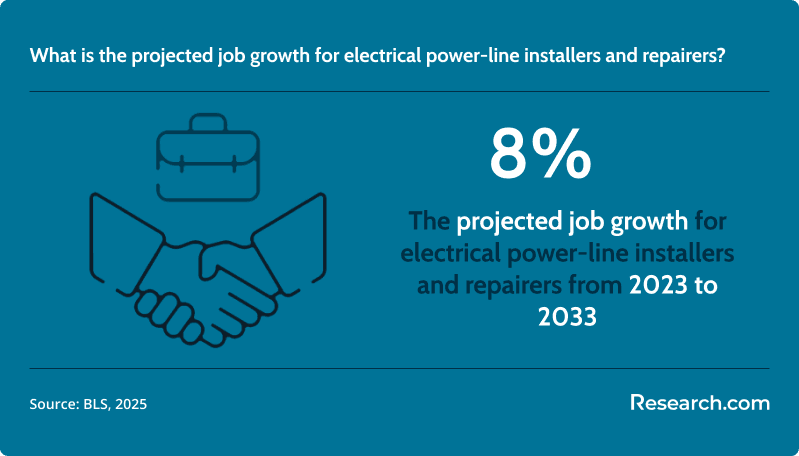
The Bureau of Labor Statistics anticipates that employment of electrical power-line installers and repairers will grow 8% through 2033, which is faster than the average for all occupations. The same outlook points to approximately 10,700 job openings each year over the next decade.
Students comparing career demand across fields may also look at healthcare and therapy labor markets; for example, Research.com separately examines the question “Are speech therapists in high demand?” for readers evaluating non-trade career options. For lineworker students, the more important step is to check hiring conditions in the state or utility region where they plan to work.
The chart below shows states with the highest employment levels for Electrical Power-Line Installers and Repairers.
Current Trends Affecting Lineworker Training and Hiring
- Hybrid training is becoming more practical: Schools can teach theory online, but employers still expect proof of field readiness, safety habits, and hands-on competence.
- Grid modernization is shaping skill needs: Lineworkers increasingly interact with infrastructure tied to system upgrades, reliability improvements, and changing energy sources.
- Renewable energy creates adjacent opportunities: Solar, wind, and battery storage projects still require grid connections, distribution work, and maintenance support.
- Safety credentials matter: Employers need workers who understand hazard awareness, rescue procedures, traffic control, and safe crew communication.
- CDL expectations can affect job access: Students should check whether local employers require a CDL, CDL permit, or the ability to obtain one soon after hire.
Practical Step-by-Step Plan for Choosing a Program
- Start with your target employer: Identify utilities, municipalities, cooperatives, and contractors in your area, then ask which schools or credentials they recognize.
- Confirm hands-on requirements: Do not enroll until you know where climbing, rescue, field labs, and equipment training happen.
- Check accreditation: Verify the school’s accreditor and whether the program is eligible for the type of financial aid you plan to use.
- Calculate the full cost: Add tuition, fees, tools, boots, gear, travel, lodging, tests, CDL expenses, and time away from work.
- Review admissions requirements early: Gather your diploma or GED, driver’s license documentation, medical forms, insurance proof, and background check materials.
- Ask about apprenticeship outcomes: Request details on employer partnerships, placement support, interview preparation, and recent graduate pathways.
- Assess your physical readiness: Lineworker training involves heights, outdoor work, lifting, climbing, and stressful safety conditions.
- Compare timelines honestly: A 13-week program can be a strong start, but the full career path usually includes longer apprenticeship and on-the-job development.
Key Insights
- Online electrical lineworker programs are usually hybrid because climbing, rescue, equipment handling, and field safety must be practiced in person.
- Short programs may take 10 to 18 weeks, while associate degree options can take 18-24 months and provide broader technical preparation.
- Program costs vary widely, from approximately $1,000 to $18,000 or more, depending on training length, gear, certifications, CDL preparation, and field requirements.
- The best program is one that is accredited, recognized by employers, transparent about total cost, and specific about hands-on training locations and requirements.
- Graduates commonly pursue line helper, trainee, apprentice lineworker, and eventually journeyman lineworker roles, with possible specialization in overhead, underground, substation, transmission, or renewable energy-related work.
- The Bureau of Labor Statistics projects 8% employment growth for electrical power-line installers and repairers through 2033, with approximately 10,700 job openings each year over the next decade.
- Before enrolling, ask local utilities and contractors what they require. Regional employer recognition can matter more than a program’s marketing claims.
References
- Electric line worker salary. (2025). ZipRecruiter. Retrieved August 9, 2025, from https://www.ziprecruiter.com/Salaries/Electric-Line-Worker-Salary#Yearly
- Electrical Lineman salary. (2025). ZipRecruiter. Retrieved August 9, 2025, from https://www.ziprecruiter.com/Salaries/Electrical-Lineman-Salary#Yearly
- Electrical Power-Line installers and repairers. (2025, April 18). US. Bureau Of Labor Statistics. Retrieved August 9, 2025, from https://www.bls.gov/ooh/installation-maintenance-and-repair/line-installers-and-repairers.htm#tab-2
- How to become an electrical line worker: what it is and career path - ZiPpia. (2025, January 8). https://www.zippia.com/electrical-line-worker-jobs
- Occupational Employment and Wage Statistics. (2024, April 3). U.S. Bureau of Labor Statistics. Retrieved August 9, 2025, from https://www.bls.gov/oes/2023/may/oes499051.htm
- What is the average electrical lineman salary by state. (2025). ZipRecruiter. Retrieved August 9, 2025, from https://www.ziprecruiter.com/Salaries/What-Is-the-Average-Electrical-Lineman-Salary-by-State
Other Things You Should Know About Online Electrical Lineworker Trade School Programs
To enroll in a 2027 online electrical lineworker trade school, students typically need a high school diploma or GED. Some programs may require a valid driver's license, aptitude for physical activities, and basic math skills. It's beneficial to have some basic understanding of electrical systems, though it's not always mandatory.
In 2027, some of the top online electrical lineworker trade school programs include institutions like Northwest Lineman College, FlexTech, and Lineman Institute of the Northeast. These programs offer a range of online and hybrid courses tailored to equip future lineworkers with essential technical and safety skills.
In 2027, most online electrical lineworker trade school programs typically range from 6 to 12 months. These programs offer flexible schedules, allowing students to balance their studies with other commitments while equipping them with the necessary skills for entry-level positions in the industry.


