
2027 Best Construction Management Certifications

Co-Founder and Chief Data Scientist
You have years of experience running complex job sites, but your career has hit a ceiling. You see roles you know you can do, but your resume gets passed over because it lacks the formal credentials HR filters are looking for.
This guide is for you. Our career planning experts, with over 10 years of experience, created it not to replace your hard-won expertise, but to translate it into the language of executive leadership. The right construction management certifications are the key to making your experience legible to decision-makers, unlocking senior roles, and securing the salary you've earned in a field with 9% job growth and a median pay of $106,980.
What are the benefits of getting a construction management certification?
- It opens doors to senior-level management roles and provides a competitive edge in the hiring process.
- You can expect to increase your earning potential, with certified managers earning a median annual salary of $106,980.
- It allows you to study online while you gain the necessary years of field experience required to sit for the exam.
What can I expect from a construction management certification?
Consider this a comprehensive professional lifecycle, not just a one-time test. It’s a serious undertaking that unfolds in three distinct phases.
First, there's the upfront commitment. This involves a detailed application, where you'll need to demonstrate that you have the required years of professional experience. It also includes paying application and exam fees.
Second is the exam reality. You can expect a period of serious, focused study for a rigorous, high-stakes exam. Finally, there's the maintenance requirement. To keep your construction management certifications valid, you'll need to complete ongoing continuing education. Think of this not as a burden, but as a feature that guarantees your credentials remain relevant and valuable throughout your career.
Where can I work with a construction management certification?
You can work in senior roles for general contractors, as an owner's representative for large clients, in public sector capital projects, and in specialized consulting.
This credential is your key to career mobility. It moves you beyond your current company and into entirely new career tracks. You can transition from managing projects on-site to representing the owner's interests for a university or a major tech company.
It also opens doors to managing large-scale infrastructure projects or launching your own consulting practice in areas like risk management. This is how you shift from an operational career to a strategic one.
How much can I make with a construction management certification?
Certified professionals consistently earn more, and a credential is a key factor in reaching the median salary of $106,980 and beyond. While a pay bump at your current company is common, the real financial power of a certification comes from the career mobility it provides.
Think of it as a passport to the most lucrative sectors of the construction industry. It's what makes you a viable candidate for senior roles in top-paying fields like oil and gas extraction, where average salaries can exceed $211,000, or in specialized financial investment projects paying over $212,000.
These opportunities are often inaccessible without the proper credentials on your resume. The certification is the investment that unlocks a higher-paying career trajectory for the rest of your professional life.
- List of the Best Construction Management Certifications for 2027 List of Programs
- How long does it take to complete a construction management certification program? Completion Time
- How does an online construction management certification program compare to an on-campus program? How does an online construction management certification program compare to an on-campus program?
- What is the average cost of a construction management certification program? Certification Cost
- What are the financial aid options for students enrolling in a construction management certification program? Financial Aid
- What are the prerequisites for enrolling in a construction management certification program? What are the prerequisites for enrolling in a construction management certification program?
- What courses are typically in a construction management certification program? What courses are typically in a construction management certification program?
- What types of specializations are available in a construction management certification program? Specializations
- How to choose the best construction management certifications? How to choose the best construction management certifications?
- What career paths are available for graduates of a construction management certification program? Career Paths
- What is the job market for graduates of a construction management certification program? Job Market
- Should I combine a construction management certification with an MBA? Should I combine a construction management certification with an MBA?
List of the Best Construction Management Certifications for 2027
How do we rank schools?
Choosing the right program is one of the most important decisions you'll make for your career, and you need a clear, unbiased picture to do it with confidence. That’s why we build our rankings on a foundation of solid, impartial information.
We analyze data from the most trusted sources in education, including the IPEDS database, Peterson's database, the College Scorecard, and the National Center for Education Statistics. This gives you a reliable starting point for your own research. For a more in-depth look at our process, please visit our methodology page.
1. Construction Management Association of America - Certified Construction Manager (CCM)
The Construction Management Association of America offers the Certified Construction Manager (CCM), the industry's gold standard for validating the capabilities of seasoned professionals. This ANSI-accredited credential proves you have mastered the entire project lifecycle and possess the expertise to control a project's time, cost, and quality from start to finish.
- Best For: Executive Leadership
- Experience Requirement: A minimum of four years of responsible-in-charge experience.
- Key Competencies: Time and cost management, safety and quality management, and contract administration.
2. National Association of Safety Professionals - Certified Safety Manager: Construction (CSMC)
The National Association of Safety Professionals provides the Certified Safety Manager: Construction (CSMC) to formally recognize you as an indispensable on-site safety leader. This program confirms your ability to develop and manage comprehensive safety protocols, interpret complex OSHA standards, and effectively mitigate workplace risks and liabilities.
- Best For: Indispensable Site Authority
- Experience Requirement: No formal prerequisites are required, but prior safety knowledge is highly recommended.
- Key Competencies: OSHA standard interpretation, hazard analysis and control, and incident investigation.
3. American Institute of Constructors (AIC) - Certified Associate Constructor (CAC) & Certified Professional Constructor (CPC)
The American Institute of Constructors provides a two-level credential that validates mastery of the entire construction process. The CAC establishes a strong foundation for emerging managers. At the same time, the CPC is the highest designation, signifying an established leader with extensive experience overseeing complex projects.
- Best For: Foundational & Technical Mastery
- Experience Requirement: CAC requires four years of combined experience and education; CPC requires four additional years of experience, including two years managing construction work.
- Key Competencies: Bidding and estimating, budgeting and cost control, project scope development.
4. National Center for Construction Education & Research (NCCER) - Construction Foreman & Construction Superintendent
The National Center for Construction Education & Research offers credentials that confirm the critical skills of on-site field leadership. The Foreman certification validates your ability to drive crew-level productivity and safety. In contrast, the Superintendent certification proves high-level expertise in overall project scheduling and risk management.
- Best For: Indispensable Site Authority
- Experience Requirement: Requires a verifiable history of field experience, submitted via an Experience Verification Form.
- Key Competencies: Crew leadership and supervision, project scheduling, and stakeholder communication.
5. U.S. Green Building Council - LEED Green Associate & LEED AP with Specialty
The U.S. Green Building Council's LEED credentials are the undisputed industry benchmark for sustainability expertise. The LEED Green Associate signifies a core competency in green building principles, while the LEED AP confirms you have the advanced, specialized skill to lead high-performance sustainable projects.
- Best For: Specializing in High-Growth Markets
- Experience Requirement: None for the Green Associate; the LEED AP requires passing the Green Associate exam and is ideal for those actively working on green projects.
- Key Competencies: Core green building principles, expertise in a specific LEED rating system (e.g., BD+C, O+M), and sustainable design and construction practices.
6. National Council of Examiners for Engineering and Surveying (NCEES) - Engineering & Surveying Licensure Exams
The National Council of Examiners for Engineering and Surveying administers the mandatory exams required to become a licensed Professional Engineer (P.E.). This is a formal licensure path, not a certification, that grants a legally protected title essential for engineers in design and oversight roles.
- Best For: Engineering Licensure
- Experience Requirement: The FE exam is for recent engineering graduates; the PE exam requires a minimum of four years of post-college work experience.
- Key Competencies: Discipline-specific engineering principles; Application of engineering ethics and law.
7. American Concrete Institute (ACI) - Specialized Concrete Professional Certifications
The American Concrete Institute offers highly specialized credentials for professionals who must demonstrate in-depth technical expertise in critical concrete applications. These certifications validate elite knowledge in areas from quality management and tilt-up construction to residential foundations, signifying a superior level of technical skill.
- Best For: Validating Foundational & Technical Mastery
- Experience Requirement: Varies by certification; for example, the Tilt-Up Supervisor requires 7,500 hours of construction experience.
- Key Competencies: Varies widely; includes concrete quality assurance, tilt-up construction methods, and foundation standards.
8. Occupational Safety and Health Administration - Outreach Training Program
The Occupational Safety and Health Administration's program provides essential safety knowledge, culminating in a 10-hour or 30-hour completion card. While not a certification, this training is a non-negotiable baseline requirement for site access on numerous construction projects nationwide.
- Best For: Foundational Safety Compliance
- Experience Requirement: None; the 10-hour training is required for all workers, and the 30-hour training is required for those with safety responsibilities.
- Key Competencies: Hazard identification and avoidance; Understanding worker rights and employer responsibilities.
9. Project Management Institute - PMI Construction Professional (PMI-CP)™
The Project Management Institute offers the PMI Construction Professional (PMI-CP) credential. This globally recognized certification applies project management principles specifically to the construction industry. This certification is designed to sharpen your ability to lead complex projects by building deep skills in contract and risk management.
- Best For: Executive Leadership
- Experience Requirement: Three years of on-the-job experience in construction projects within the last 10 years.
- Key Competencies: Construction contract and risk management, scope and change order management, and interface management.
10. National Commission for the Certification of Crane Operators (NCCCO) - CCO Certifications
The National Commission for the Certification of Crane Operators provides the definitive CCO credentials for verifying the skills of heavy equipment operators. These programs utilize rigorous written and practical exams to ensure operators possess the proven proficiency to safely and effectively handle high-risk machinery.
- Best For: Validating Foundational & Technical Mastery
- Experience Requirement: Must be at least 18 years of age and pass both written and practical exams.
- Key Competencies: Safe operation of specific crane types; Rigging and signaling principles.
How long does it take to complete a construction management certification program?
It requires several years of professional experience, followed by three to six months of dedicated study, to complete a certification. The first part of that timeline is the four to eight years of on-the-job experience needed to even qualify for most high-level credentials. The second part is the focused preparation for the exam itself.
Actionable Tips for Time Management
A demanding professional schedule requires a strategic approach to studying. First, reverse-engineer your study plan. Pick a target exam date and work backward, breaking down the core topics into weekly, manageable goals to prevent last-minute cramming.
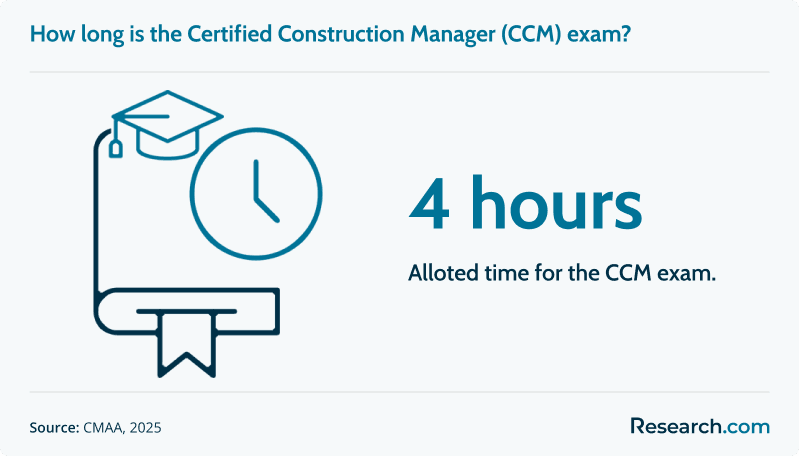
Second, leverage micro-learning. You don't always need two solid hours. Use the 15 minutes before a morning meeting or during a lunch break to review key terms on your phone. These small sessions add up. An exam like the Certified Construction Manager (CCM) is a 4-hour test, so a disciplined and consistent plan is essential for success.
How does an online construction management certification program compare to an on-campus program?
The key difference is the testing location, not the program itself. You can take the exam either at a physical testing center or from your home with a remote online proctor. The value and credibility of the certification are identical regardless of the method you choose.
Exam Day Success: Choosing the Right Modality for You
Your choice between a test center and remote proctoring is largely a matter of logistics and personal preference. Each has its advantages.
A physical testing center provides a controlled environment, eliminating any risk of your own technology failing. The downside is the need to travel and less scheduling flexibility. If you choose this route, do a dry run a week before the exam. Familiarize yourself with the route, parking situation, and check-in process to minimize stress on the day of the event.
Remote proctoring offers maximum convenience and comfort. The significant risk, however, is a technical failure. To minimize this, secure a wired internet connection with an Ethernet cable instead of relying on Wi-Fi. A stable connection is the most critical factor for a smooth remote exam experience.
Many professionals evaluating online certification options also compare career trajectories across related fields. For instance, exploring what engineering job pays the most can provide helpful context when determining whether construction management offers the long-term salary and growth potential aligned with your goals.
What is the average cost of a construction management certification program?
Costs vary significantly based on the credential's focus and depth. A foundational safety card, such as the OSHA 10-Hour, can be purchased for under $100. Core professional credentials, such as the LEED Green Associate or the Certified Associate Constructor (CAC), typically range from $200 to $400.
For top-tier executive certifications, such as the CCM or PMI-CP, the exam fees typically range from $400 to $900, excluding any required prerequisite courses or study materials. Comprehensive programs, such as those for the CSMC or an NCCER Superintendent, represent the highest investment, often costing between $2,000 and $4,000.
Understanding the Return on Your Investment
The most important number to focus on isn't the cost of the exam, but the return it can generate for your career. The best way to think about this is as a strategic, one-time investment in your future earning potential.
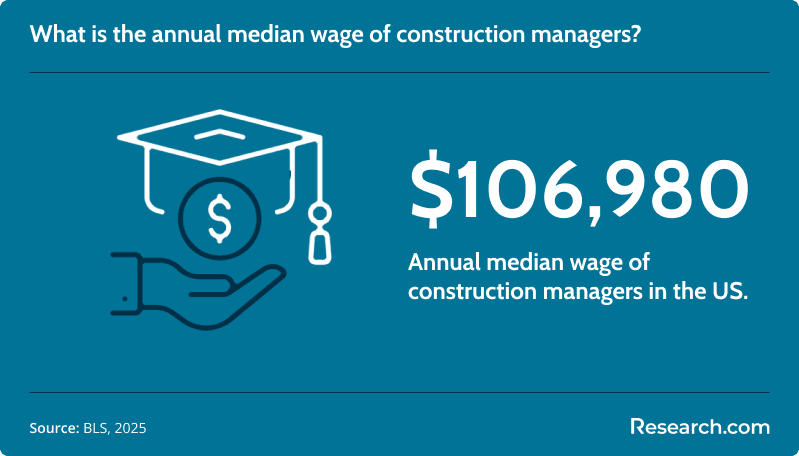
When you consider that the median annual wage for construction managers is $106,980, the cost of a certification comes into sharp focus. Whether you invest $500 or $3,500, it is a single expense that qualifies you for a higher salary bracket for years to come. This credential is the tool that can put you in the running for roles that offer a significant and lasting financial return.
Additionally, for professionals looking to expand beyond construction into broader project oversight or executive leadership roles, many find that graduate-level studies can further enhance earning potential. For example, understanding trends in MBA project management salary outcomes can help professionals evaluate how advanced degrees complement certifications to maximize long-term career growth.
What are the financial aid options for students enrolling in a construction management certification program?
Traditional financial aid, like student loans, typically doesn't apply to professional certifications. Your primary and most effective funding source is employer sponsorship or reimbursement. Most companies have a professional development budget, and your certification is a direct investment in their success.
Making the Business Case: Getting Your Employer to Invest in You
You need to frame this as a high-return investment for the company, not just a personal benefit. Here are the key talking points to present to your manager, connecting your professional growth to the company's bottom line.
- This certification can lower our company's liability insurance rates. A credentialed manager, especially in safety, is a recognized risk-mitigation asset that underwriters value.
- Having a certified manager makes our bids more competitive. Many public and private owners list credentials like the CCM as a preference or requirement in their Requests for Proposals (RFPs).
- This credential can open up new revenue streams. A LEED AP, for example, equips you to lead the company's first green building project, giving you access to the $1.8 trillion sustainable construction market.
Presenting a clear, data-backed case demonstrates your strategic thinking. For those who need to complete prerequisite coursework before tackling a certification, exploring options like the most affordable community colleges online is a cost-effective first step in a larger professional development plan.
What are the prerequisites for enrolling in a construction management certification program?
The main prerequisite for high-level construction management certifications is not an academic degree, but several years of verifiable, responsible-in-charge experience. Most top-tier credentials require between four and eight years of documented experience leading projects in the field.
Certification Prerequisites vs. Academic Degrees
It's essential to understand the fundamental difference between these two paths. An academic program is designed to provide you with foundational knowledge before you have extensive experience. A certification, on the other hand, is designed to validate the professional experience you already have.
That's why certifying bodies place such a high value on your proven track record. While a degree program like a masters in engineering management online builds a strong theoretical framework, a professional certification serves as proof that you have successfully applied that knowledge to manage real-world projects, budgets, and teams. It codifies the expertise you've earned on the job.
What courses are typically in a construction management certification program?
Instead of formal courses, certification exams test your mastery of core business and management knowledge domains. The key areas for construction management certifications consistently include Project Management, Cost and Time Management, Contract Administration, Quality Management, and Safety.
Bridging the Gap Between Field and Office
You already know how to manage these areas in practice; the exam tests whether you know the formal theory and terminology behind them. The goal is to bridge the gap between field leadership and executive strategy. A key study tip is to translate, not just memorize. Connect every formal term back to a real-world experience you've had on a job site.
Mastering this formal language enables you to communicate effectively with legal, financial, and executive teams, demonstrating your understanding of the business drivers behind your projects. This expertise is in high demand across the country, especially in states with the highest employment for construction managers, including Texas, California, and Florida. For those interested in the broader context of project location and site analysis, a geography degree online can offer valuable insights into regional development patterns.
The chart below lists the states with the highest number of jobs for construction managers, as reported by the BLS in 2025.
What types of specializations are available in a construction management certification program?
It’s best to think of these not as specializations, but as certification tiers with a specific strategic focus. Your choice depends on your career goal. The main categories are Broad Executive Management (like the CCM), High-Growth Market Specialization (like LEED), Indispensable Site Authority (like the CSMC), and Deep Technical Mastery from organizations like the American Concrete Institute.
This is distinct from a trade-specific credential, such as an online flooring installers training certification, which validates a craft skill rather than management expertise.
Power Move: The Art of Certification Stacking
The most strategic professionals don’t just earn one credential; they “stack” them to create a unique and powerful profile. Combining a CCM with a LEED AP credential, for example, sends a clear message: you can manage a project on time and on budget, and you can meet modern sustainability demands.
This kind of combined expertise makes you an ideal candidate for leadership roles in the most demanding and top-paying industries. Sectors such as securities and commodity contracts, or oil and gas extraction, require leaders with verifiable, multifaceted skills, and they pay top dollar for that talent.
The chart below lists the top-paying industries for construction managers, as published by the BLS in 2025.
How to choose the best construction management certifications?
You choose the best certification by first defining your primary career objective. The proper credential is the one that directly supports your specific goal, whether that's moving into an executive role, becoming the undisputed safety leader on-site, or specializing in a high-growth market. Think of this choice as your career investment thesis.
- For Executive Leadership & Maximum ROI: Your investment thesis here is executive credibility. To bypass HR filters and maximize your earning potential, focus on obtaining the Certified Construction Manager (CCM) or the PMI Construction Professional (PMI-CP)™, as these are the gold-standard credentials recognized in the C-suite.
- For Indispensable Site Authority: Your investment thesis is a risk mitigation strategy. With 1,075 construction fatalities annually, proven safety leadership is non-negotiable, and credentials like the Certified Safety Manager: Construction (CSMC) give you the formal authority to enforce a culture of safety.
- For Specializing in High-Growth Markets: Your investment thesis is market specialization. To capitalize on the $1.8 trillion green building opportunity, earning a credential like the LEED AP makes you the go-to expert for sustainability, positioning you to lead high-profile, high-value projects.
Choosing the right certification also involves understanding how certifications fit into longer professional development pathways. For example, professionals considering parallel fields of the built environment often look into how long does it take to get architecture license as a point of comparison—highlighting the differences in required education, supervised experience, and exam pathways across related career tracks.
What career paths are available for graduates of a construction management certification program?
A certification opens paths to senior roles, such as Senior Project Executive, Director of Construction, an owner's representative, or a specialized consultant. These are the positions that move you from managing a single job site to overseeing a portfolio of projects or a business unit.
From Operational to Strategic: The Leader's Journey
This career progression represents a fundamental shift from operational management to strategic leadership. Your focus expands from the daily timeline and budget of one project to the long-term profitability and risk profile of the entire company.
As a Director of Construction, for example, you're no longer just executing the plan; you're helping to create it. You're involved in strategic decisions about which projects the company pursues and how to staff them for success. You will be managing the leaders of specialized teams, such as those covered in the best online landscaping technology trade school programs, rather than managing the craftspeople themselves. It's a transition from being an expert in building things to being an expert in building the business.
What is the job market for graduates of a construction management certification program?
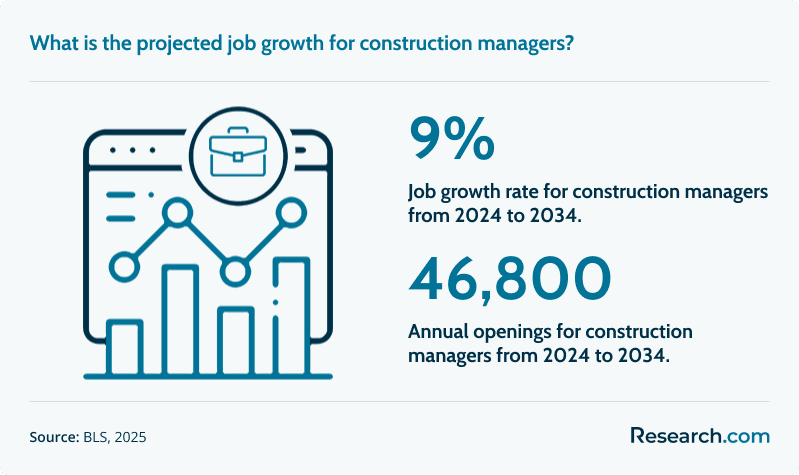
The job market for qualified construction managers is strong, with a projected growth rate of 9%, resulting in an average of 46,800 job openings each year over the next decade. High demand for skilled leadership makes this a secure field, and having one of the top construction management certifications is your key competitive advantage.
The Perfect Storm of Opportunity
The industry is facing a perfect storm of opportunity that is creating this sustained, long-term demand for credentialed leaders.
First, a wave of experienced baby boomers is retiring, creating a significant leadership vacuum at the top of many organizations. Second, a massive influx of federal and private spending on infrastructure, manufacturing, and energy projects is creating more complex, high-stakes projects than ever before.
This combination is what's driving the high demand for proven leaders. A certification is your proof that you are the right person to step in and lead these critical projects, ensuring your investment is secure for years to come.
For those comparing different skilled trades or leadership tracks, it’s helpful to understand how advancement timelines differ across professions. For example, researching how long to be a master electrician can provide a useful contrast in the amount of time, experience, and credentialing required to move into top-tier roles within other technical fields.
Should I combine a construction management certification with an MBA?
While a construction management certification validates field-specific expertise, an MBA broadens your strategic and financial management skills, offering a complementary perspective to leadership. Merging these credentials can enhance your decision-making prowess by integrating hands-on project oversight with high-level business strategy. This combination often positions professionals for accelerated career growth and diversified responsibilities, making them attractive candidates for executive roles that oversee both operational and corporate functions. For a cost-effective pathway to advanced business education, consider exploring cheap MBA programs online.
Here’s What Graduates Have to Say About Their Construction Management Certification Program
- Markus: "I could run any job site with my eyes closed, but in meetings with the finance and legal teams, I felt like I was speaking a different language. Studying for the certification exam filled that gap for me. Learning the formal language of contracts and risk management gave me a new level of confidence in those high-level strategy discussions."
- Beline: "It was always frustrating that my two decades of hands-on experience didn't seem to count as much as a piece of paper to some people. The certification process changed that perspective. It didn't teach me how to do my job—it proved I already knew how. It was the formal recognition I needed to get the respect I'd already earned in the field."
- Kenji: "I’ll admit, I hesitated on the cost at first. But I made a clear business case to my boss, and the company ended up sponsoring me. Studying online after work was tough but completely manageable, and I didn't have to miss a single day on site. Six months after I passed the exam, I was promoted to a new role with a 15% pay increase."
Key Findings
- The median annual wage for construction managers is $106,980, making the cost of certification a strategic investment toward higher lifetime earning potential.
- The field is projected to grow by 9%, resulting in 46,800 job openings annually, indicating a strong and sustained demand for qualified and credentialed leaders.
- With 1,075 fatalities in 2023, the construction industry faces immense pressure to improve worksite safety, making the value of managers with formal safety certifications even more significant.
- The sustainable construction market represents a $1.8 trillion opportunity, creating a clear financial incentive for professionals who earn specialized green building credentials.
- Top-paying industries offer average salaries exceeding $212,000 for construction managers, a career track that often requires executive-level certifications as a prerequisite for entry.
- Top-tier credentials, such as the Certified Construction Manager, require a rigorous 4-hour exam that validates a professional's expertise against a formal, industry-wide standard.
References:
- Construction Management Association of America. (2025). CCM application handbook. Retrieved September 25, 2025, from CMAA.
- Mischke, J., Sjödin, E., Smit, S., & Wieringa, G. (2024). Delivering on construction productivity is no longer optional. McKinsey & Company. Retrieved September 25, 2025, from McKinsey & Company.
- U.S. Bureau of Labor Statistics. (2024). National census of fatal occupational injuries in 2023. U.S. Department of Labor. Retrieved September 25, 2025, from BLS.
- U.S. Bureau of Labor Statistics. (2025). Construction managers. In Occupational Outlook Handbook. Retrieved September 25, 2025, from BLS.
- U.S. Bureau of Labor Statistics. (2025). Occupational employment and wage statistics: Construction managers. Retrieved September 25, 2025, from BLS.
- World Economic Forum. (2024, June). Green building revolution could open $1.8 trillion global market opportunity by 2030. Retrieved September 25, 2025, from WEF.
Other Things You Should Know About Construction Management Certification Programs
In 2027, the Certified Construction Manager (CCM) is highly recommended for industry newcomers. It's accessible to those with limited experience, offering foundational knowledge in project management, construction safety, and ethical practice. This certification helps lay a solid groundwork for newcomers aiming to advance their careers.
In 2027, many construction management certifications require a mix of education and experience. For example, the Certified Construction Manager (CCM) certification typically requires a degree plus professional experience. However, options like the Construction Manager-in-Training (CMIT) may be available for individuals just starting in the field.
In 2027, the most recognized construction management certifications are the Certified Construction Manager (CCM) by CMAA, the Project Management Professional (PMP) by PMI, and the ASPE Certified Professional Estimator (CPE) certification. These certifications signify advanced skills and are widely acknowledged across the industry.


