
2027 How Long Does It Take to Become an Architect?

Co-Founder and Chief Data Scientist
The path to becoming a licensed architect is a significant commitment, typically taking between 8 and 11 years from the start of college to licensure. While that sounds like a long time, it is a structured process you can break down into three clear and manageable stages: earning an accredited education, gaining professional experience, and passing the final exams. It is a marathon, not a sprint, and understanding the steps is the first move toward a successful career.
The career planning experts who created this guide have 10 years of experience helping students navigate this exact path. We will walk you through each phase of how to become a licensed architect, so you can feel confident and prepared for the process ahead.
What are the benefits of becoming an architect?
Becoming an architect offers a unique blend of creative fulfillment and professional stability. For those willing to undertake the rigorous process, the career provides several key benefits.
- You get to use both creative and analytical skills to shape the world around you.
- The profession offers strong earning potential, with a median annual salary of about $97,018.
- It is a respected and licensed profession with diverse and stable career opportunities.
What can I expect from the process of becoming an architect?
You can expect a structured but demanding journey that extends well beyond the classroom. The process is best understood as a professional apprenticeship that happens in three distinct stages.
First, you'll complete an intensive, project-based education in a university setting. This is where you build your foundational design and technical skills. After graduation, you move into the second stage: a mandatory, paid internship period known as the Architectural Experience Program (AXP). Here, you work under the supervision of licensed architects to gain real-world experience.
The final stage is passing the Architect Registration Examination (ARE), a multi-part test that assesses your knowledge and skills. The entire process requires significant dedication, self-discipline, and a focus on methodical progress. It is a challenging path, but the exam is designed to ensure you are fully prepared for the responsibilities of the profession.
Where can I work as an architect?
Most licensed architects work in architectural and engineering firms, which provide a stable and collaborative environment. This is the most common career path, accounting for the vast majority of jobs in the profession.
However, that is not the only option. The skills of an architect are valuable across several sectors of the construction and design industry. About 10% of architects are self-employed, running their own firms and managing their own projects. Others find roles in the construction industry, working for design-build companies, or in government agencies, helping to manage public projects and urban planning initiatives.
This diversity of environments allows you to align your career with your personal goals, whether you prefer the security of a large firm or the autonomy of your own practice.
How much can I make as an architect?
The earning potential for a licensed architect is strong, reflecting the high level of education and professional responsibility required. The median annual wage for architects was about $97,018 in 2024.
While starting salaries for newly licensed architects are typically lower, this median figure shows the solid financial return you can expect as you build your career. Top earners in the field can make over $146,300 per year, with factors like specialization, firm size, and location all playing a role in your long-term earning potential. This makes the profession a financially rewarding path for those who complete the licensure process.
- How long does it take to become an architect? Program Duration
- How many years of college does it take to be an architect? How many years of college does it take to be an architect?
- What are the main steps to get an architecture license? Steps to Licensure
- Can you become an architect if you have a different degree? Can you become an architect if you have a different degree?
- What is the average starting salary for an architect? Architect Salary
- What is the fastest way to become a licensed architect? What is the fastest way to become a licensed architect?
- Do you need to be good at math to be an architect? Math Skills
- Is architecture a difficult degree to study? Difficulty
- How much does it cost to get an architecture license? Program Cost
- Is there a high demand for architects? Career Outlook
- Should I Consider an Online Master's in Architecture? Should I Consider an Online Master's in Architecture?
How long does it take to become an architect?
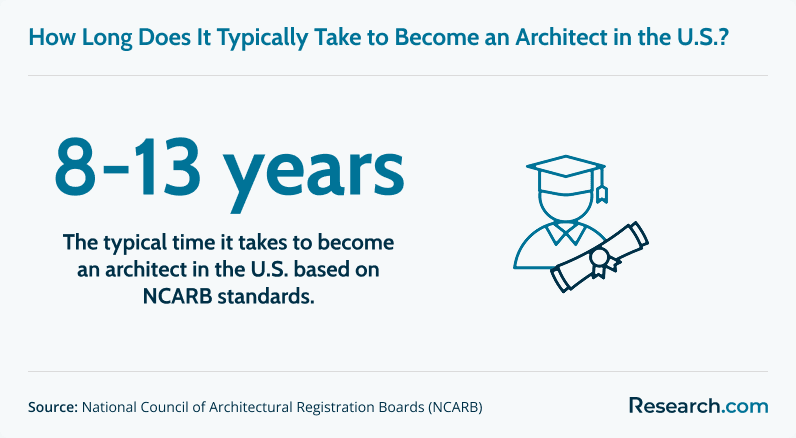
Becoming an architect is a lengthy process that typically takes at least 8 to 13 years after high school graduation. The exact timeline varies depending on the country and specific path you choose, but it generally involves three main phases: education, experience, and examination.
The first step is to earn an accredited professional degree in architecture, which usually takes 4 to 5 years for a Bachelor of Architecture (B.Arch) or a "4+2" route involving a four-year bachelor's degree followed by a two-year Master of Architecture (M.Arch). Some programs, particularly for those with a non-architecture bachelor's degree, may take longer.
After completing your education, you will enter the experience phase, often through an internship or apprenticeship program like the Architectural Experience Program (AXP) in the U.S. This phase requires logging thousands of hours of practical work under the supervision of a licensed architect and can take anywhere from two to three years or more.
The final hurdle is passing a comprehensive multi-part licensing exam, such as the Architect Registration Examination (ARE) in the U.S. This exam tests your knowledge across various aspects of the profession and can take an additional one to two years to complete.
Once you have successfully passed all exams and met all education and experience requirements, you can apply for your official license and legally use the title "architect."
Similar to other skilled professions, the journey involves a structured training path, much like the progression in electrical trades. For example, many people also ask how long does it take to become a master electrician, since both careers require a combination of formal education, hands-on apprenticeship experience, and passing state or professional licensing exams before reaching full professional status.
How many years of college does it take to be an architect?
The amount of time you spend in college depends on which accredited degree path you take. A professional architecture degree is longer than a typical four-year bachelor's degree.
There are two primary types of accredited degrees that lead to licensure:
- Bachelor of Architecture (B.Arch): This is an undergraduate degree that typically takes five years to complete.
- Master of Architecture (M.Arch): This is a graduate degree that can take anywhere from one to five years, depending on your undergraduate background.
Choosing Your Path: B.Arch vs. M.Arch
The right path for you depends on your educational starting point. The 5-year Bachelor of Architecture is the most direct route for students entering college directly from high school. It integrates a full professional education into a single undergraduate program.
The Master of Architecture is designed for students who have already completed a bachelor's degree. For those with a four-year, non-professional architecture degree, the M.Arch may take two additional years. For those with a degree in a completely unrelated field, the M.Arch program typically takes three to four years. Many of the best online architecture degree programs are designed for students with existing degrees, offering flexibility for those balancing work and study.
What are the main steps to get an architecture license?
To become a licensed architect in the United States, you must complete three mandatory steps. This structured path ensures that all professionals meet a high standard of competence before they can practice independently.
The three core steps are:
- Earn an Accredited Degree. You must graduate from a program accredited by the National Architectural Accrediting Board (NAAB).
- Complete the Architectural Experience Program (AXP). This is a paid, supervised internship where you document thousands of hours of real-world work.
- Pass the Architect Registration Examination (ARE). This is a comprehensive, multi-division exam that tests your knowledge across all aspects of architectural practice.
Who Manages the Path to Licensure?
It is helpful to know that this entire process is overseen by a single organization. The National Council of Architectural Registration Boards (NCARB) is the governing body that develops and administers both the AXP and the ARE. NCARB sets the national standards for licensure, which provides a clear and consistent pathway no matter where you plan to practice. Understanding their role is a key part of knowing how to become a licensed architect.
Through 2024, the average time to earn an architecture license in the U.S. has slightly decreased as shown in the next chart. This timeline includes a combination of education, professional experience, and successful completion of the Architect Registration Examination (ARE).
Can you become an architect if you have a different degree?
Yes, you can absolutely become an architect if you already have a bachelor's degree in a different field. The path for career changers is well-established and specifically designed for this purpose.
The key is to enroll in a Master of Architecture (M.Arch) program. These programs have a specific track, often called a Track 1 or 3-year M.Arch, created for students who do not have an undergraduate background in architecture. This curriculum is longer because it first provides you with the foundational architectural education before moving on to advanced, graduate-level coursework.
Similarly, professionals from other technical or scientific fields often explore careers that leverage their prior degrees, such as transitioning into architecture or engineering. For those considering engineering, it’s useful to research highest paid engineering jobs to understand which specializations offer top salaries and strong career growth.
How Your Background Can Be an Asset
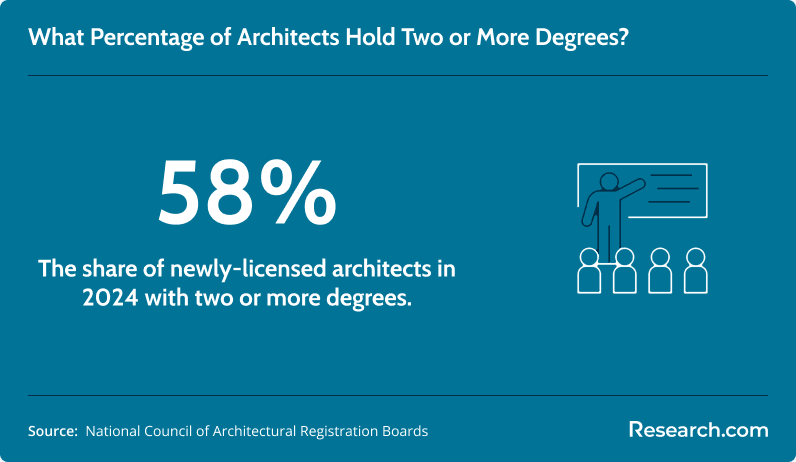
Your previous education is not a disadvantage; in many cases, it is a significant asset. Of the roughly 3,600 architects who were licensed in 2024, 58% held two or more degrees.
The field of architecture benefits from professionals with diverse perspectives. For instance, some of the most popular college majors, like engineering, psychology, or business, provide unique skills in technical problem-solving, understanding human behavior, or managing projects that are highly relevant to architectural practice. An undergraduate degree in art history can provide a deep understanding of design context, while a background in environmental science is invaluable for sustainable design.
What is the average starting salary for an architect?
While the median annual wage for all architects is about $97,018, it is important to understand that starting salaries for newly licensed architects are typically lower. This median figure represents the strong earning potential you can work towards as you gain experience in the field.
Entry-level positions for architects just starting their careers generally fall into a lower range as they begin to apply their skills and build a professional portfolio. The key is to see this as a starting point on a path toward significant long-term earning potential.
Understanding Your Earning Potential
The salary range for architects is quite wide. While the lowest 10 percent earn less than $59,312, the highest 10 percent can earn more than $146,300. Several factors will influence your salary throughout your career, including the size and type of firm you work for, your area of specialization, and your geographic location.
For example, architects working in high-demand specialties like sustainable design or for large corporate firms often command higher salaries. As in many fields, some of the highest paying degrees are found in roles that blend technical expertise with management responsibility, a path many architects pursue as they advance in their careers.
What is the fastest way to become a licensed architect?
The fastest way to become a licensed architect is by optimizing the established process, not by taking shortcuts. For most people, the most direct path involves two key strategies.
First, enrolling in a 5-year Bachelor of Architecture (B.Arch) program is typically the quickest educational route. Second, and most importantly, is to begin logging your Architectural Experience Program (AXP) hours while you are still in school. Many students can gain and document paid work experience during summers or part-time during the school year. This overlap between the education and experience phases is the most effective way to shorten the total time it takes to become eligible for the final exams.
For those looking to accelerate their academic journey even further, researching the quickest way to get a bachelor's degree in architecture or related fields can help identify programs that offer accelerated courses, credit for prior learning, or intensive summer schedules to reach licensure eligibility sooner.
A Warning About "Shortcuts"
Be cautious of any program that seems too good to be true. The single biggest mistake you can make is enrolling in a non-accredited architecture program. While it might seem faster or cheaper at first, a degree from a non-accredited school will not be accepted for licensure by any state board. This ends up being the longest and most expensive mistake, as you would have to start your education all over again.
The total number of students enrolled in a NAAB-accredited program has been steadily growing over the past several years. Of the more than 33,000 total enrollees, nearly 7,000 graduated in 2024. For those looking for efficiency, the best option is to find an accelerated online architecture degree from a fully accredited institution.
Over the last five academic years, the number of students enrolled in NAAB-accredited architecture programs has shown a steady increase. This growth highlights the consistent demand for a formal, accredited education as the primary pathway toward architectural licensure. Here are the most common college majors for architects:
Do you need to be good at math to be an architect?
You need to be competent in math, but you do not need to be a math genius to succeed as an architect. The belief that architects are constantly doing complex calculations by hand is a common misconception.
A solid understanding of foundational math concepts is essential. You will use algebra, geometry, and trigonometry to understand structural principles, calculate dimensions, and work with design software. However, the day-to-day work of an architect relies more on strong spatial reasoning and creative problem-solving than on advanced mathematics.
Problem-Solving Is the Real Skill
Think of math as a tool, not the main event. The most critical skills are your ability to visualize in three dimensions and solve complex design challenges. In modern practice, most of the heavy calculations are handled by sophisticated computer-aided design (CAD) and building information modeling (BIM) software.
Your job is to understand the principles behind the calculations to use these tools effectively. This is similar to how many engineering degrees online focus on applying principles rather than on pure theoretical math. If you have strong problem-solving skills and a good grasp of geometry, you have the key abilities you need.
Is architecture a difficult degree to study?
Yes, architecture is widely considered to be a very demanding and time-intensive degree. Students in architecture programs consistently report one of the highest workloads of any major, often spending long hours on projects.
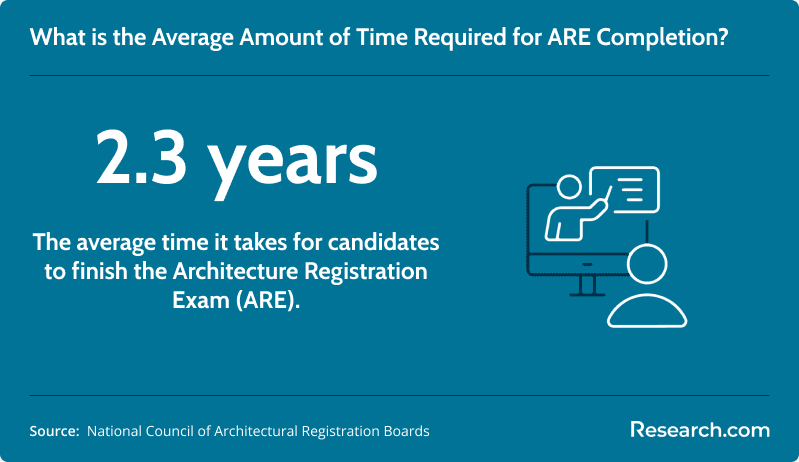
However, the difficulty is usually not about the complexity of the subjects themselves. The main challenge comes from the sheer volume of work and the project-based nature of the curriculum. However, in 2024, the proportion of candidates who completed the Architect Registration Examination (ARE) in a shorter-than-average time frame grew by 5 percentage points, with almost half of all candidates now finishing within two years.
It requires excellent time management, a high level of dedication, and the ability to integrate creative design ideas with technical requirements under tight deadlines.
Understanding "Studio Culture"
The heart of an architecture education is the design studio. This is not a typical lecture class; it's a hands-on workshop where you will be given a design problem and then spend weeks, or even a whole semester, developing a project to solve it. You'll spend countless hours in the studio building physical models, creating drawings, and preparing presentations.
This "studio culture" is intense and collaborative. You'll be working alongside your peers, learning from each other and getting constant feedback from your professors. While it's one of the most challenging aspects of the degree, it's also the most rewarding. It's where you build your portfolio and develop the practical skills you'll use every day as a professional.
How much does it cost to get an architecture license?
The total cost to get an architecture license goes beyond just university tuition. While tuition is by far the largest expense, there are two other sets of mandatory fees you need to budget for after you graduate.
The total investment breaks down into three main categories:
- University Tuition and Fees: This is the most significant cost and can vary dramatically depending on whether you attend a public or private university.
- Architectural Experience Program (AXP) Fees: There is an application fee and an annual renewal fee to maintain your NCARB record while you complete your experience hours.
- Architect Registration Examination (ARE) Fees: You must pay a fee for each division of the multi-part exam.
Budgeting Beyond Tuition
While the cost of a five-year professional degree can be substantial, the good news is that the post-graduate fees are much smaller and very predictable. The national fees for the AXP and ARE are set by NCARB, so you can know the exact costs well in advance and plan for them. Thinking about these as the final, manageable steps in your investment can make the overall financial picture of how to become a licensed architect feel much more achievable.
For students planning their long-term career path, it can also be helpful to consider which undergraduate degree is best for MBA if they envision eventually moving into leadership, management, or business roles within architecture firms or construction companies.
Is there a high demand for architects?
The demand for architects is projected to be stable and steady in the coming years. Employment for architects is expected to grow about 4% between 2024 and 2034, which is as fast as the average for all occupations.
This growth translates to about 7,800 job openings for architects projected each year over the decade. This indicates a healthy and consistent demand for qualified professionals, making it a solid long-term career choice for those who complete the rigorous path of how to become a licensed architect.
A Look Behind the Numbers
It is important to understand where this demand comes from. Many of the annual job openings are created by the need to replace architects who are retiring or leaving the profession. This creates a predictable and consistent need for new talent to enter the field.
Like many professions tied to construction, the job market for architects can be cyclical and influenced by the overall economy. However, the fundamental need for well-designed buildings and infrastructure remains constant. A professional degree in architecture is also valuable in related fields, just as there are many master degrees that pay well by providing specialized skills applicable across various industries.
Should I Consider an Online Master's in Architecture?
Advancing your education with a Master’s degree can provide specialized skills and expand career opportunities. An online Master’s program offers flexibility for working professionals and those seeking a balance between practical work and academic study. Carefully verifying accreditation and curriculum quality ensures that the degree meets industry standards. For candidates looking to minimize tuition expenses without compromising education quality, exploring our guide to the cheapest masters of architecture online can be an effective strategy.
Here's What Professionals Have to Say About Becoming an Architect
- David: "Coming back to school for my M.Arch was a huge decision, but I was tired of just moving numbers around. I was worried my business background wouldn't translate, but it's been surprisingly valuable for managing project budgets and client expectations. The degree gave me the creative and technical language to finally build something real, and my past experience helps me run the business side of the projects."
- Marcus: "The path was long, no doubt about it—five years of my B.Arch, then the experience hours, then the exams felt like a marathon. But now, with a stable career and a salary that reflects that hard work, I know it was the right investment. I’m not just working a job; I’m practicing a licensed profession with real security and a future I can build on"
- Samir: "For me, architecture became a way to make a tangible difference. My master's program focused heavily on sustainability, which opened my eyes to how buildings can either harm or help the environment. Now, I get to work on projects that incorporate green roofs, passive solar design, and recycled materials, which feels less like a job and more like a purpose."
Key Findings
- The entire process to become a licensed architect takes 8 to 13 years, a significant commitment that is broken down into three distinct phases of education, experience, and examination to provide a clear pathway.
- With a median annual salary of $96,690, the profession offers a strong return on investment, helping to justify the financial and time commitment required for the multi-year licensure process.
- The job market for architects is stable, with a projected growth of 4% and approximately 7,800 openings each year, offering reassurance about long-term career viability after completing the lengthy track.
- The educational path is flexible to accommodate different starting points; the 5-year Bachelor of Architecture (B.Arch) offers the most direct route, while the Master of Architecture (M.Arch) provides a clear pathway for career changers.
- While university tuition is the largest expense, the mandatory post-graduation costs for licensure are predictable, with Architectural Experience Program fees around $350 and Architect Registration Examination fees totaling about $1,410.
- While 76% of architects work in traditional firms, the career offers diverse opportunities for employment, including 10% who are self-employed, providing options for both stability and entrepreneurial autonomy.
References:
- U.S. Department of Labor, Bureau of Labor Statistics. (2025,). Architects: Occupational outlook handbook.
- National Council of Architectural Registration Boards. (2025). NCARB by the Numbers 2025.
- National Council of Architectural Registration Boards. (2025). NCARB by the Numbers 2025: Building competency.
- National Council of Architectural Registration Boards. (2025). NCARB by the Numbers 2025: Examination.
- National Council of Architectural Registration Boards. (2025). NCARB by the Numbers 2025: State of licensure.
- Zippia. (2025). Architect demographics and statistics in the US. https://www.zippia.com/architect-jobs/education/
Other Things You Should Know About How Long It Takes to Become an Architect
In 2027, candidates who fail a division of the Architect Registration Examination (ARE) can typically retake it after a mandatory 60-day waiting period. There is no limit on the number of retakes, allowing candidates to improve their understanding and performance for eventual success.
Yes, you can begin earning hours for the Architectural Experience Program (AXP) as soon as you enroll in any NAAB-accredited degree program, including a Master of Architecture (M.Arch). Many students work part-time or during the summers to log these paid experience hours. This allows you to complete the education and experience requirements simultaneously, which can shorten your overall time to licensure.
By 2027, aspiring architects can pursue a Bachelor of Architecture (B.Arch) or a Master of Architecture (M.Arch). B.Arch is typically a five-year program, while M.Arch, for those with a non-architecture bachelor's, generally takes two to three additional years.
In 2027, becoming a licensed architect typically takes 7 to 12 years. This duration includes completing a bachelor's or master's degree in architecture (5-7 years) and fulfilling the Architectural Experience Program (AXP) requirements alongside passing the Architect Registration Examination (ARE) (2-5 years).


