
2027 Construction Management Certificate vs. Degree: Which Path Should You Pursue

Co-Founder and Chief Data Scientist
As a career planning and education expert, I understand that determining the right educational course in construction management can be a formidable task. You're often faced with a bewildering amount of information, making it difficult to distinguish the optimal route for your specific career goals. Whether a focused certificate program or a comprehensive degree is the better choice depends entirely on your background, ambitions, and professional needs.
This guide is designed to cut through the confusion, providing a clear, expert-driven comparison to help you confidently decide on the path that will build your future in the construction industry.
What are the benefits of pursuing a Construction Management Certificate vs. a Degree?
- Career Advancement: A certificate offers rapid entry into supervisory roles, while a degree qualifies you for senior or executive positions in major firms and public agencies.
- Earning Potential: Certificate holders earn about $109,000/year (PayScale, 2025) vs. degree holders averaging $106,980/year, with top managers exceeding $175,000 (BLS, 2025).
- Flexible Learning: Certificates take 6–18 months with focused training; degrees span 4 years with broader theoretical and business coursework.
What can I expect from a certificate program in Construction Management?
- Applied Technical Curriculum: Courses on cost estimating, scheduling, contracts, risk management, quality control, safety, and construction methods
- Blended Delivery Methods: Online lectures, in-person/site visits (if hybrid), case studies, software labs (e.g., Primavera, MS Project)
- Short Completion Window: Many certificate programs are designed to be completed within 6 to 18 months
- Capstone or Project-Based Learning: Realistic project simulations or field assignments to integrate learned skills
- Industry Practitioner Faculty: Instructors with active experience in construction management and contracting
- Pathway Credits: Option to transfer credits toward a bachelor’s degree, depending on institution agreements
Where can I work with a Construction Management Certificate?
- General Contractor / Construction Firms: Assist project managers, supervise subcontractors, and coordinate field operations
- Subcontracting Specialty Firms: Roles in mechanical, electrical, plumbing, and structural trades supporting project integration
- Real Estate & Development Companies: Oversee construction from the developer side, ensuring budgets and schedules
- Consulting & Construction Services: Construction oversight, project controls, scheduling, cost estimating services
- Government / Public Works: Manage infrastructure, highway, municipal, or school construction projects
- Facilities Management / Renovation Projects: Oversee expansions, retrofits, maintenance construction
How much can I make with a Construction Management Certificate (versus degree paths)?
- Entry / Assistant Roles: With a certificate, entry roles in supervision or assistance may start $55,000 to $75,000 annually (
- Mid-Level / Project Coordinator / Assistant PM: Responsibilities for parts of a project can yield $70,000 to $100,000
- Project Manager / Construction Manager: Full responsibility roles generally command $90,000 to $115,000+ (Payscale: ~$86,699 average for construction manager) (
- Senior Manager / Director Roles: In large firms or complex projects, total compensation (base + bonuses) may exceed $145,000–$165,000+ (
- Median Industry Benchmark: U.S. median wage for construction managers was $106,980 as of May 2024 (BLS)
- What are the similarities and differences between a construction management certificate and a degree? Certificate vs. Degree
- What are the career opportunities for graduates of certificate and degree programs in construction management? Career opportunities
- What are the salaries of professionals with a construction management certificate vs. a degree? Salaries
- What is the job market like for certificate holders compared to degree graduates in construction management? Job market
- What are the accreditation and financial aid options for certificate vs. degree programs? Financial aid
- What challenges do students face in construction management certificate and degree programs? What challenges do students face in construction management certificate and degree programs?
- What skills does one learn in a construction management program? Skills
- What are the current and future trends in construction management in the USA? Trends
- Is it Beneficial to Combine Construction Management and Business Education? Is it Beneficial to Combine Construction Management and Business Education?
What are the similarities and differences between a construction management certificate and a degree?
While both a certificate and a degree in construction management provide foundational knowledge for the industry, they are designed for different career stages and objectives. They differ significantly in scope, depth, duration, and the professional opportunities they unlock.
- Admission Requirements: A degree typically requires a high school diploma, standardized test scores, and a formal application process, whereas a certificate may only require a high school diploma or, for advanced certificates, a bachelor's degree in a related field.
- Career Advancement: A degree is often a prerequisite for senior management and executive positions, while a certificate is better suited for entry-level roles or for professionals seeking to add a specific skill.
- Core Concepts: Both pathways cover essential industry topics such as blueprint reading, estimating, scheduling, and project management, representing their core similarity.
- Cost: The total tuition for a comprehensive bachelor's degree program is substantially higher than the cost of a focused certificate program.
- Credit Transferability: Credits earned in an accredited degree program are widely transferable, while credits from a certificate program may not be accepted toward a full degree. Many accelerated construction management degree programs accept transfer credits.
- Curriculum Focus: A certificate offers a narrow, skills-based curriculum focused on immediate job application, whereas a degree provides a broad education, including business, mathematics, science, and communication.
- Depth of Study: Degree programs offer an in-depth, theoretical understanding of construction principles, while certificate programs provide a more practical, surface-level overview.
- General Education: Degree programs include mandatory general education courses (e.g., humanities, social sciences), which are absent in skill-focused certificate programs.
- Industry Perception: Employers generally view a degree as a higher, more credible credential, often preferring degree-holders for management-track positions.
- Internship Opportunities: Degree programs frequently integrate required internships and co-op experiences, which are less common in shorter certificate programs.
- Networking: The longer duration and cohort structure of a degree program provide more extensive networking opportunities with peers, faculty, and alumni.
- Target Audience: Certificates are ideal for current professionals seeking to upskill or individuals wanting a fast track to an entry-level job, while degrees are aimed at those starting their careers and seeking a long-term management path.
Therefore, the choice between these two credentials depends on an individual's existing experience, career aspirations, and financial resources. This decision will fundamentally shape one's entry point and long-term trajectory within the construction industry.
How long does it take to complete a construction management certificate vs. a degree program?
The time commitment to complete a construction management credential varies dramatically, reflecting the different levels of academic depth and career preparation each path offers. A certificate can be completed relatively quickly, while a degree represents a more substantial, multi-year investment.
- Associate Degree: Typically requires two years of full-time study at a community college or technical school.
- Bachelor's Degree: The standard timeline is four years of full-time study at a university or college.
- Certificate Program: Can range from a few months to one year, depending on the program's intensity and scope.
- Master's Degree: Generally takes one to two years of full-time study beyond a bachelor's degree.
- Part-Time Study: Enrolling part-time will extend the completion time for any program; for example, a bachelor's degree could take six to eight years.
Ultimately, the duration of study is directly proportional to the complexity of the credential being pursued. The chosen path should align with how quickly a student wishes to enter or advance within the workforce. The best 2 year construction management degree online programs can kickstart your career.
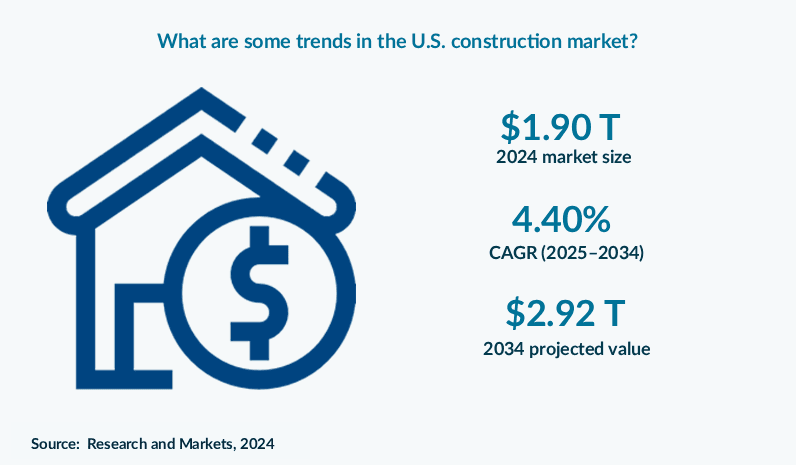
According to 2024 data from Research and Markets, the U.S. construction market demonstrates a clear and significant growth trend. The market size for 2024 is valued at $1.90 trillion. Projections indicate a steady expansion over the next decade, with an anticipated compound annual growth rate (CAGR) of 4.40% between 2025 and 2034, as shown in the graphic below.
This sustained growth is expected to increase the market's total value to a projected $2.92 trillion by 2034. This upward trend highlights considerable opportunities across the building and infrastructure industries. The expansion points to emerging prospects in residential, commercial, industrial, and institutional construction sectors.
What are the career opportunities for graduates of certificate and degree programs in construction management?
Both educational paths lead to vital roles within the construction sector, but the level of responsibility and potential for advancement differ significantly. A degree typically opens the door to management and leadership roles, while a certificate is a strong starting point for technical and support positions.
- Assistant Project Manager: A common role for recent degree graduates, involving supporting the project manager in planning, executing, and closing projects.
- Building Inspector: A role accessible with a certificate and experience, focused on ensuring structures comply with building codes and safety regulations.
- Construction Estimator: A position available to both pathways, responsible for calculating the material, labor, and equipment costs for a project.
- Construction Foreman: Often achievable with a certificate and significant field experience, this role involves supervising a specific crew of workers on-site.
- Contract Administrator: Typically requiring a degree, this professional manages contracts, procurement, and negotiations with subcontractors and suppliers.
- Cost Engineer: A degree-preferred role that involves analyzing and controlling project costs from inception to completion.
- Field Engineer: An entry-level position for degree holders, focused on technical aspects of a project such as surveying, quality control, and interpreting plans.
- Project Coordinator: A position accessible to certificate holders, involving administrative support for a project team, such as scheduling meetings and managing documents.
- Project Engineer: A stepping-stone role for degree graduates, linking the project management team with the technical aspects of construction.
- Project Manager: The lead role in overseeing a construction project, almost always requiring a bachelor's degree and considerable experience.
- Quality Control Manager: A specialized role that ensures all work meets quality standards, often requiring the technical depth provided by a degree.
- Safety Manager: Responsible for implementing and enforcing safety protocols on-site; this role is accessible with specialized certificates but benefits from a degree.
- Scheduler: A specialized position that focuses on developing and maintaining the project timeline, accessible with either a certificate or a degree.
- Superintendent: Manages the day-to-day operations on a construction site, a senior role typically held by degree graduates with extensive field experience.
In essence, a certificate provides a direct route to functional roles that support a project's execution. A degree, however, is the standard credential for pursuing a long-term career in project leadership and corporate management.
Students considering which path to pursue often weigh their options much like those comparing a dental assisting certificate vs associate degree, where certificates offer faster workforce entry while degrees provide broader advancement potential over time.
What are the salaries of professionals with a construction management certificate vs. a degree?
Compensation in the construction management field is directly influenced by education, with a clear financial advantage for those holding a degree. While a certificate provides a respectable entry into the industry, a degree consistently yields higher starting salaries and greater long-term earning potential.
- Bonus and Incentive Pay: Professionals with degrees in senior management roles are far more likely to receive substantial bonuses and profit-sharing incentives tied to project success.
- Certificate Holder Salary Range: Entry-level professionals with a certificate can expect to earn between $55,000 and $75,000 annually, depending on the role and location.
- Degree Holder (Bachelor's) Salary Range: Graduates with a bachelor's degree typically see starting salaries from $70,000 to $90,000, with mid-career earnings often exceeding $120,000.
- Degree Holder (Master's) Salary Range: A master's degree can elevate starting salaries to over $95,000 and push senior-level earnings well above $150,000.
- Entry-Level Disparity: The initial salary gap between a certificate holder and a bachelor's degree graduate for a similar entry-level role is often around 15–25%.
- Executive and Senior Roles: Top-tier positions such as Director of Construction or Vice President, which require a degree, can command salaries exceeding $200,000.
- Experience Impact: While experience can close the salary gap over time, degree holders generally advance faster, leading to a wider pay disparity at the 5- and 10-year career marks.
- Geographic Location: Salaries for all education levels are significantly influenced by regional factors, with higher compensation in major metropolitan areas with high construction activity.
Verified 2024–2025 data shows that entry-level construction roles, such as engineering project coordinator average $54,760, project coordinator II earns $54,900, and project management specialist earns $57,500, while national project coordinator salaries range from $56,658 to $66,516 and reach $80,887 in California.
Specialized roles like construction estimator average $74,629, construction project manager earns $86,235, and construction manager averages $86,897, while engineering-focused positions like civil engineering manager and civil project manager earn $96,956 and $98,522, respectively. Broader national averages for construction managers are reported at $98,412 with a median of $106,980, and heavy civil construction project managers average $110,964.
Geographic disparities are stark, with the lowest average salaries in Mississippi ($69,350), West Virginia ($70,400), and Arkansas ($72,200), and the highest in the District of Columbia ($149,170), Alaska ($155,900), and California ($158,620). These are shown in the graph below.
When viewed alongside comparable career fields, the income gap between certificate and degree holders is similar to trends seen in massage therapy certification vs license, where additional education and credentials directly influence earning power and professional credibility.
Overall, salaries rise with responsibility and specialization, but location remains the most influential factor, with top-paying states offering more than double the compensation of the lowest.
What is the job market like for certificate holders compared to degree graduates in construction management?
The job market for construction management is strong for candidates from both educational backgrounds, driven by ongoing infrastructure and development needs. However, degree graduates possess a distinct competitive advantage, accessing a broader range of opportunities and enjoying greater career mobility.
- Advancement Trajectory: The job market for degree holders includes a clear path toward senior management, while certificate holders often find their upward mobility capped at supervisory or specialized technical roles.
- Company Size Preference: Large, top-tier construction firms and general contractors overwhelmingly prefer to hire degree graduates for their management training programs.
- Demand for Specialization: Certificate holders are highly valued in niche markets where a specific skill (e.g., safety, estimating) is in high demand.
- Entry-Level Access: Both pathways provide access to entry-level jobs, but degree holders are often recruited for roles with "Engineer" or "Manager" in the title, while certificate holders may start in "Coordinator" or "Technician" roles.
- Government and Public Works: Public sector jobs, especially federal ones, often have rigid educational requirements that favor or mandate a four-year degree for management positions.
- Industry Cyclicality: During economic downturns, degree holders may have more job security and flexibility due to their broader skill set and qualifications.
- Large-Scale Projects: Complex, multi-million-dollar projects almost exclusively seek degree-educated managers to handle intricate planning, financial, and legal aspects.
- Market Resilience: The demand for skilled trades and on-site supervisors, accessible with a certificate, remains consistently high, offering strong job security in specific roles.
- Recruiter Perception: Recruiters and hiring managers often use a bachelor's degree as a primary filter for leadership-track candidates, giving degree holders greater visibility.
Ultimately, degree graduates navigate a job market with more opportunities for leadership, higher compensation, and greater career flexibility. Certificate holders thrive in a market that values specific, immediately applicable skills for essential on-site and support functions.
According to the U.S. Bureau of Labor Statistics (2025), construction managers held approximately 550,300 jobs in 2024, reflecting a strong national employment base across diverse sectors of the construction industry. The largest share of these professionals—36%—were self-employed, underscoring the field’s high rate of independent contracting and project-based work. Another 17% were employed by specialty trade contractors, while 16% worked in nonresidential building construction, a key area supporting large-scale commercial and institutional projects. Employment in residential building construction accounted for 10%, and heavy and civil engineering construction represented 8% of total jobs, as shown in the graph below.
Similar to other applied professions, students comparing technical versus academic routes—such as OTA vs COTA in occupational therapy—should understand that both credentials hold value but determine very different career ceilings and advancement paths.
These data highlight a workforce that is widely distributed across private and independent sectors, with self-employment remaining the dominant mode of practice. Overall, the employment composition suggests that construction management continues to favor flexibility, contract-based specialization, and strong demand in both residential and infrastructure markets.
What are the accreditation and financial aid options for certificate vs. degree programs?
- Accreditation for Degree Programs: Most reputable bachelor’s or associate construction management degree programs seek accreditation from ACCE (the American Council for Construction Education), which is recognized by CHEA. That accreditation signals the program meets rigorous standards in curriculum, faculty, resources, and industry relevance.
- Accreditation (Certificates): Certificate programs are less uniformly accredited by bodies like ACCE, especially when offered outside degree frameworks. Some are accredited regionally or by institutional accreditation, but many are not formally recognized by construction-specific accrediting bodies. (Certificates may not always meet ACCE standards unless structured within a larger accredited program.)
- Federal Financial Aid for Degree Programs: All qualified degree programs (associate, bachelor’s, master’s) at Title IV–eligible institutions typically qualify students to use federal student aid (grants, work-study, direct loans) subject to FAFSA eligibility.
- Federal Aid for Certificate Programs (when eligible): Some certificate programs do qualify for federal aid, but only under strict conditions:
- Course Applicability Limits: Only courses required for the declared degree or certificate count for financial aid eligibility. Elective or unrelated courses may not be funded.
- Institutional & State Aid: Many schools and states provide institutional scholarships, grants, or tuition assistance for both degree and certificate students, but these often require that the certificate be part of an eligible, accredited program.
- Graduate Certificate Aid Constraints: In many cases, graduate certificates are not eligible for federal student aid because they don’t meet the Department of Education’s criteria for aid eligibility.
- Online programs: Many universities now offer construction management bachelor degree online programs that can also save costs on board and on-site campus expenses.
In short:
- Degree programs benefit from broad accreditation and consistent access to federal aid.
- Certificates have more variability; only some are eligible for accreditation or federal aid, depending on program design, institutional approval, and compliance with federal rules.
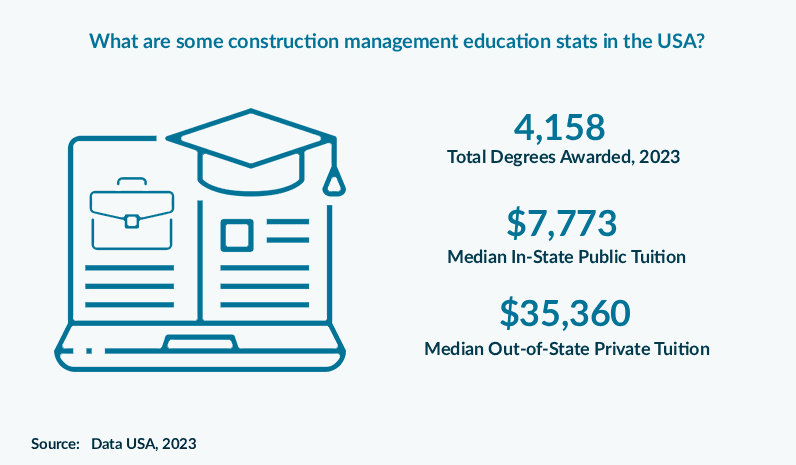
According to 2023 statistics from Data USA, the field of construction management awarded a total of 4,158 degrees, a number that showed 0% growth from the previous year. The cost of this education is increasing, with the median in-state public tuition rising by 1.4% to $7,773, while the median out-of-state private tuition grew by 4% to $35,360, as shown in the graphic below.
The data reveals several workforce trends: the average wage for professionals in the field is $109,808, having grown by 3.8%, and the total workforce consists of 12.2 million people, an increase of 2.33%. The average employee age is 44, which saw a slight increase of 0.32%.
These statistics indicate that while the number of new graduates remained static, the construction workforce is expanding, aging slightly, and becoming more lucrative. The consistent rise in wages and tuition costs suggests a growing demand and value for skilled professionals in the industry.
Which universities and institutions in the USA offer construction management certificates and degrees?
Numerous U.S. institutions offer reputable programs, both on-campus and online, each with unique advantages, connections, and resources. From the most challenging to the easiest construction management degree programs, there are a lot of choices you can pick from.
- Arizona State University (ASU): The Del E. Webb School of Construction offers a B.S. in Construction Management & Technology (online and in-person) that integrates business, engineering, and technology. Students complete two mandatory summer internships—one field and one managerial—for practical experience and strong job placement.
- Texas A&M University: The Department of Construction Science houses one of the largest construction programs in the nation, serving approximately 1,400 undergraduates, 150 master’s, and 30 Ph.D. students, with deep connections to major construction firms across the U.S.
- Auburn University: The McWhorter School of Building Science offers a B.S. in Building Construction with strong ties to regional construction industries and extensive collaboration networks that enhance internship and employment opportunities.
- Clemson University: The Department of Construction Science and Management provides a B.S. in Construction Science & Management, emphasizing sustainability, design coordination, and interdisciplinary teamwork across engineering and architecture.
- Colorado State University: The Department of Construction Management offers both undergraduate and graduate degrees and is known for applied research in infrastructure, sustainable building, and the built environment.
- Louisiana State University (LSU): The Bert S. Turner Department of Construction Management hosts one of the largest CM programs in the country, with strong industry partnerships along the Gulf Coast and a focus on project leadership and heavy construction.
- Purdue University: The School of Construction Management Technology offers a B.S. in Construction Management Technology supported by advanced laboratories, active industry partnerships, and applied research centers.
- University of Florida: The M.E. Rinker, Sr. School of Construction Management provides a long-established program featuring research opportunities, professional extension services, and a powerful alumni network throughout the Southeast.
- University of Washington: The Department of Construction Management offers both degree and certificate options, leveraging connections with Pacific Northwest construction markets and regional industry relationships.
- UC Berkeley Extension / NYU School of Professional Studies / San Diego State University Global Campus: These institutions provide professional certificates and continuing education programs for working adults, emphasizing project-based learning, networking with industry experts, and flexible online or hybrid formats.
Each program distinguishes itself through experiential learning (internships, co-ops, fieldwork), industry advisory boards, accreditation, specialized tracks, and alumni/employer connections — all of which enhance a student’s access to jobs, mentorship, and professional growth beyond the classroom.
What challenges do students face in construction management certificate and degree programs?
Students pursuing construction management education encounter a range of academic, technical, and practical challenges that vary by program level and learning format. Both certificate and degree pathways require balancing rigorous coursework, evolving technology, and real-world application to succeed in an increasingly competitive industry.
- Academic Rigor: Degree programs demand mastery of advanced math, business management, contract law, and engineering concepts, which can be difficult for students without strong technical foundations.
- Access to Support Services: Certificate students may have limited access to advising, tutoring, and career placement resources compared to degree programs that offer full academic and institutional support.
- Balancing Theory and Practice: Many students struggle to connect classroom theory—such as project finance or structural systems—with on-site realities and construction workflows.
- Credential Bias and Skepticism: Certificate holders can face skepticism from employers that prioritize candidates with bachelor’s degrees for management-track roles.
- Distance Learning Barriers: Online students must manage time effectively, maintain self-discipline, and overcome limited hands-on learning and networking opportunities. Even the cheapest online construction management degree programs can be challenging.
- Limited Hands-On Experience: Certificate programs often lack extensive lab work, field placements, or internships, making it harder to gain practical exposure.
- Networking and Mentorship: Short-term certificate students may miss out on long-term relationships with professors, mentors, and alumni that degree programs naturally foster.
- Pace and Workload Intensity: Certificates compress months of content into weeks, while degree programs require sustained effort over several years, both leading to potential burnout.
- Resource Constraints: Some institutions lack up-to-date lab facilities, equipment, and simulation tools, limiting experiential learning.
- Retention and Attrition: Extended degree timelines increase dropout risks due to academic pressure, financial strain, or personal responsibilities.
- Technology and Tool Mastery: Students must continuously adapt to evolving construction software such as BIM, Primavera P6, and Procore to stay industry-relevant.
- Time and Resource Commitment: Multi-year degree programs require major investments of time and money, often conflicting with work and family obligations.
Understanding these differences helps learners choose the path best suited to their career and lifestyle needs.
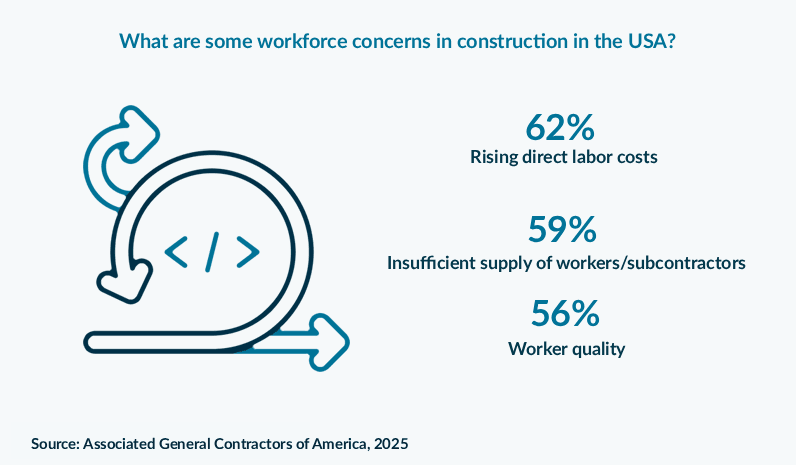
Challenges also exist in the labor force, and a 2025 survey by the Associated General Contractors of America shows a sharp shift toward workforce concerns, with 62% citing rising labor costs, 59% noting a shortage of workers or subcontractors, and 56% pointing to worker quality, as shown in the graphic below.. Materials costs were the only other major concern at 54%, while nine respondents wrote in tariffs. Economic fears declined, with only 41% listing high-interest rates or recession—down from over 60% in 2024.
Safety concerns also center on labor, with 75% of firms identifying inexperienced workers as the top risk. Mental health challenges were cited by 38%, followed by poor subcontractor safety (26%), third-party hazards like motorist crashes (24%), unclear regulations (24%), and excessive enforcement (22%).
The data highlights a clear pivot from macroeconomic worries to labor-related challenges as both business and safety priorities.
What skills does one learn in a construction management program?
Construction management programs develop a blend of technical, managerial, and analytical skills essential for overseeing complex projects from planning to completion. Students gain both theoretical knowledge and practical expertise aligned with current industry standards and technologies.
- Budgeting and Cost Estimation: Students learn how to prepare, manage, and control project budgets using cost-tracking systems and estimating software.
- Building Information Modeling (BIM): Mastery of BIM platforms enables students to coordinate design, scheduling, and collaboration across project teams.
- Business and Financial Management: Coursework includes accounting, project finance, and contract administration to support sound fiscal decision-making.
- Communication and Leadership: Training focuses on effective team management, negotiation, and client relations to facilitate project success.
- Construction Law and Ethics: Students study construction contracts, dispute resolution, and regulatory compliance to ensure legal and ethical project delivery.
- Data Analysis and Reporting: Programs integrate analytical methods for interpreting performance metrics and improving project outcomes.
- Design Coordination: Skills in interpreting blueprints and integrating architectural, engineering, and structural elements are emphasized.
- Project Planning and Scheduling: Students gain proficiency with scheduling software such as Primavera P6 and Microsoft Project to manage timelines and milestones.
- Quality and Safety Management: Emphasis is placed on OSHA standards, quality control, and risk mitigation to maintain safe and compliant job sites.
- Sustainability and Environmental Stewardship: Courses address green building standards, energy efficiency, and LEED certification principles.
- Technical Software Proficiency: Training includes tools such as Procore, AutoCAD, and Revit, preparing graduates for digital project workflows.
- Teamwork and Collaboration: Group projects simulate real-world coordination among architects, engineers, and subcontractors.
Overall, a construction management degree equips graduates with the ability to manage budgets, people, and technology in a dynamic and high-stakes environment. These programs produce professionals capable of balancing efficiency, safety, and sustainability in modern construction projects.
This multidisciplinary nature is comparable to graduate programs like a MHS vs MPH, where both emphasize data analysis, management, and leadership—but apply these competencies in distinct professional contexts, whether in construction, health, or public policy.
What are the current and future trends in construction management in the USA?
Construction management and education in the United States are undergoing rapid transformation, integrating digital tools, sustainability goals, and innovative delivery methods to meet the demands of a changing industry.
- Artificial Intelligence (AI): AI tools are being adopted for predictive analytics, risk assessment, design automation, and schedule optimization, enabling data-driven project decisions.
- Augmented and Virtual Reality (AR/VR): Immersive technologies are increasingly used for safety training, design visualization, and virtual site walkthroughs.
- Big Data and Analytics: Data collection and analysis have become essential for cost forecasting, scheduling accuracy, and risk mitigation across large-scale projects.
- Building Information Modeling (BIM) and Digital Twins: BIM is now a core competency for construction professionals, evolving into real-time digital twin systems that replicate physical projects for maintenance and performance tracking.
- Connected Construction and IoT Integration: Wearables, sensors, and cloud-based platforms allow managers to monitor safety, productivity, and equipment usage in real time.
- Digital Transformation: Cloud collaboration, mobile apps, and centralized data systems are redefining how teams communicate and share project information.
- Drone and Robotics Integration: Drones are increasingly used for surveying, inspection, and progress tracking, while robotics automates tasks such as concrete placement, bricklaying, and material handling.
- Generative Design and Automation: AI-driven design platforms help optimize layouts, structural elements, and resource usage for efficiency and cost reduction.
- Industry Growth and Labor Demand: Construction management employment is projected to grow 9% from 2024 to 2034, adding about 46,800 new jobs annually (U.S. Bureau of Labor Statistics, 2025).
- Integrated Project Delivery (IPD) and Lean Construction: Collaborative contracting and lean principles reduce waste, align stakeholder goals, and increase project efficiency.
- Modular and Off-Site Construction: Prefabrication and modular building methods shorten project timelines, enhance quality, and minimize on-site waste.
- Online and Hybrid Learning: Universities and training programs increasingly offer flexible formats for professionals balancing education with work commitments. Several construction management degree online cost ranges make it quite affordable.
- Policy and Infrastructure Investment: Federal infrastructure spending, energy incentives, and sustainability mandates are accelerating innovation and workforce demand.
- Robotics and 3D Printing: Automated systems and 3D-printed components are being deployed for housing, bridges, and modular structures.
- Safety Technology: Integration of wearables, AI-driven sensors, and site monitoring software enhances hazard prediction and compliance.
- Supply Chain Resilience: Construction firms are adopting strategic sourcing and real-time analytics to reduce disruptions and material shortages.
- Sustainability and Green Construction: Emphasis on LEED certification, renewable materials, and low-carbon building methods continues to expand in both education and practice.
- Technology-Enhanced Education: Universities incorporate BIM labs, simulation tools, and project management software (e.g., Procore, Primavera P6) into curricula to prepare graduates for a tech-driven industry.
- Workforce Development and Upskilling: Persistent labor shortages are driving demand for continuing education, certificate programs, and digital competency training.
The future of construction management education lies in combining technical mastery with leadership and sustainability expertise—preparing graduates for an industry that is both digitally advanced and environmentally responsible.
Here's What Graduates Say About Their Construction Management Certificate/Degree
- Juan: "I chose the Construction Management Certificate because it fit perfectly into my work schedule and gave me the practical skills I needed to move up quickly. Within six months, I was leading my own projects and finally felt confident managing teams."
- Echo: "Earning my degree in Construction Management opened doors to larger firms and long-term career growth. The in-depth coursework and networking opportunities gave me a strong foundation in both technical and leadership skills."
- Nics: "The certificate program was a great stepping stone—it was affordable, fast, and helped me land a job right away. Later, I pursued the full degree to deepen my expertise and qualify for senior roles. Tavian"
Key Findings
- Construction Management Employment Distribution: The U.S. Bureau of Labor Statistics (2025) reports that construction managers held about 550,300 jobs in 2024, with 36% self-employed, 17% in specialty trade contracting, 16% in nonresidential construction, 10% in residential building, and 8% in heavy and civil engineering construction.
- Workforce and Labor Shortages: The Associated General Contractors of America (2025) found that 62% of firms cited rising labor costs, 59% reported worker or subcontractor shortages, and 56% noted concerns about worker quality, with materials costs a concern for 54%.
- Salary and Role Variations: Verified 2024–2025 data show entry-level positions like engineering project coordinator earn $54,760, project coordinator II earns $54,900, and project management specialist earns $57,500, while national project coordinator salaries range from $56,658 to $66,516 and reach $80,887 in California (PayScale, 2025; Salary.com, 2025).
- Regional Wage Disparities: Geographic pay gaps are substantial, with the lowest average salaries in Mississippi ($69,350), West Virginia ($70,400), and Arkansas ($72,200), compared to the highest in the District of Columbia ($149,170), Alaska ($155,900), and California ($158,620) (U.S. Bureau of Labor Statistics, 2025).
- Tuition Growth and Education Costs: Construction management programs awarded 4,158 degrees, showing 0% growth year-over-year, with median in-state public tuition up 1.4% to $7,773 and median out-of-state private tuition up 4% to $35,360 (Data USA, 2023.
- Market Expansion and Industry Growth: The U.S. construction market was valued at $1.90 trillion in 2024 and is projected to grow at a 4.40% compound annual growth rate (CAGR) through 2034, reaching $2.92 trillion (Research and Markets, 2024).
- Career Advancement Challenges: Although higher education leads to higher salaries—construction managers average $106,980 nationally—students face barriers like academic rigor, long program durations, and high tuition, which limit access for some learners (U.S. Bureau of Labor Statistics, 2025).
- Technology and Skills Gaps: The industry’s increasing reliance on digital tools such as BIM, Procore, and data analytics creates challenges for students and professionals who must adapt rapidly to evolving software and technical standards (Construction Management Association of America, 2025).
Is it Beneficial to Combine Construction Management and Business Education?
The convergence of technical construction skills with business expertise is increasingly critical for effective project leadership and strategic decision-making. Augmenting a construction management credential with a targeted business qualification can enhance financial analysis, operational efficiency, and long-term planning capabilities, ultimately broadening career prospects and boosting earning potential. For professionals seeking to expand their managerial skill set, consider exploring the cheapest MBA online programs.
References:
- Construction Management Association of America. (2025). Certified Construction Manager (CCM) program overview. Construction Management Association of America.
- Data USA. (2023). Construction Management. Data USA.
- PayScale. (2025). Construction manager salary data. PayScale.
- Research and Markets. (2024). United States Construction Market Report and Forecast 2025–2034. Research and Markets.
- Salary.com. (2025). Construction manager salary in the United States. Salary.com.
- U.S. Bureau of Labor Statistics. (2025). Construction managers. U.S. Bureau of Labor Statistics.
- U.S. Bureau of Labor Statistics. (2025). May 2024 state occupational employment and wage estimates. U.S. Bureau of Labor Statistics.
- University of San Diego Professional and Continuing Education. (2025). Construction management certificate vs. degree: 10 points to consider. University of San Diego Professional and Continuing Education.
- ZipRecruiter. (2025). Construction management certificate jobs. ZipRecruiter.
- ZipRecruiter. (2025). Construction management salary in the United States. ZipRecruiter.
Other Things You Should Know About Construction Management Certificate vs. Degree
In 2027, a construction management certificate typically covers foundational topics over a shorter period, while a degree offers comprehensive courses including project management, cost estimating, and contract law, often requiring several years of study. A degree may offer more in-depth exploration and specialization opportunities.
A construction management certificate can lead to roles like assistant project manager or estimator, while a degree may open doors to higher-level positions such as project manager or construction manager. The degree often offers broader career advancement potential within the industry.


