
2027 Best Ultrasound Technician Certification Programs

Co-Founder and Chief Data Scientist
An ultrasound technician certification is a practical route into diagnostic medical imaging for people who want a patient-facing healthcare career without spending four years in school. Ultrasound, also called sonography, uses noninvasive, high-frequency soundwaves to create images of organs, tissues, blood vessels, pregnancy development, and the heart. WebMD notes that an ultrasound procedure can cost from as little as $200 up to $1,000 or more, depending on the setting and type of exam.
This guide is for prospective students comparing ultrasound technician certification programs, online sonography options, costs, clinical requirements, and career outcomes. You will learn how long these programs take, what they cost, how online and campus formats differ, what accreditation matters, which specialties are available, and how to judge whether the investment fits your career goals.
Quick answer: Is an ultrasound technician certification worth considering?
An ultrasound technician certification can be worth it if you want a hands-on healthcare career focused on diagnostic imaging and patient care. Many programs take 12 to 24 months, combine classroom instruction with supervised clinical training, and prepare students for credentialing exams from organizations such as ARDMS or CCI. PayScale reports an early 2025 median annual salary of $73,001 for diagnostic medical sonographers, while entry-level graduates may start around $55,000–$65,000, based on data gathered from the U.S. Bureau of Labor Statistics (BLS).
- Best fit: Students who are comfortable with anatomy, physics, technology, patient interaction, and clinical rotations.
- Typical settings: Hospitals, outpatient imaging centers, physician offices, OB/GYN clinics, cardiology practices, vascular labs, and mobile imaging services.
- Main caution: A program should include hands-on clinical experience and, ideally, accreditation that supports eligibility for national certification exams.
What can I expect from an ultrasound technician certification?
An ultrasound technician certification program teaches students how to operate ultrasound equipment, capture diagnostic-quality images, work safely with patients, and support physicians who interpret imaging results. Although program titles vary, most training falls under diagnostic medical sonography, cardiac sonography, vascular sonography, or a related medical imaging specialty.
| Program factor | What to expect | Why it matters |
| Curriculum | Common subjects include anatomy, physiology, patient care, ultrasound physics, sonographic instrumentation, abdominal imaging, obstetric and gynecologic sonography, and vascular or cardiac imaging. | You need both science knowledge and technical skill to produce usable images in clinical settings. |
| Clinical training | Even online programs require in-person clinical rotations at approved healthcare facilities. | Employers need graduates who can scan real patients, communicate clearly, and follow safety procedures. |
| Tuition | On-campus programs may average $4,000–$25,000, while online programs can range from $4,000–$20,000, depending on the school. | The lowest tuition is not always the best value if the program lacks accreditation, clinical placements, or exam preparation. |
| Program length | Many ultrasound technician certification programs take 12 to 24 months, depending on full-time or part-time enrollment. | Your timeline affects total cost, work schedule, financial aid planning, and when you can pursue certification exams. |
Where can I work with an ultrasound technician certification?
Certified ultrasound technicians work in healthcare settings where physicians need noninvasive imaging to support diagnosis, monitoring, or treatment planning. Hospitals are one of the most common employers because they need sonographers for abdominal, obstetric, vascular, cardiac, emergency, and inpatient exams. These roles may involve varied shifts, high patient volume, and exposure to many types of cases.
Private clinics and physician offices can offer a more predictable schedule. Sonographers in OB/GYN clinics may focus on pregnancy and reproductive health, while cardiology practices may hire cardiac sonographers to perform echocardiograms. Outpatient imaging centers and diagnostic laboratories also employ ultrasound technicians for scheduled scans and specialty imaging services.
Some graduates pursue less traditional roles. Mobile ultrasound services send technicians to patient homes, nursing facilities, or partner medical sites. Experienced sonographers may move into education, research support, imaging department supervision, applications training, or medical equipment sales.
How much can I make with an ultrasound technician certification?
According to data gathered from the U.S. Bureau of Labor Statistics (BLS), entry-level ultrasound tech certification graduates can expect salaries around $55,000–$65,000. PayScale reports an early 2025 median annual salary of $73,001 for diagnostic medical sonographers. Earnings can rise with experience, specialty credentials, shift differentials, leadership responsibilities, and work in higher-paying markets.
Work setting also affects pay. Hospitals and outpatient care centers may offer higher wages than some physician offices, with outpatient facilities often paying the most. Location matters as well: salaries in California, Hawaii, and Washington sometimes exceed $90,000 per year, and urban areas or high-cost regions may pay more than rural locations.
Compensation is not limited to wages. Full-time ultrasound technicians in hospitals and large healthcare facilities often receive health insurance, retirement benefits, paid time off, and continuing education support. Still, salary outcomes are not guaranteed; they depend on credentials, specialty, employer type, local demand, and experience.
- Best Ultrasound Technician Certification Programs for 2027
- How long does it take to complete an ultrasound technician certification?
- How does an online ultrasound technician certification compare to an on-campus program?
- What is the average cost of an ultrasound technician certification program?
- What financial aid options are available?
- What are the prerequisites for admission?
- What courses are included?
- What ultrasound specializations can students choose?
- How does ultrasound technician certification compare with other allied health certifications?
- What continuing education and recertification requirements apply?
- Can ultrasound technician certification lead to advanced degrees?
- Can certification programs shorten future academic pathways?
- What challenges should students expect?
- What is the ROI of an ultrasound technician certification?
- How should you choose the best program?
- What career paths are available after certification?
- What is the job market for ultrasound technician certification graduates?
- Graduate perspectives, key insights, and references
Best Ultrasound Technician Certification Programs for 2027
How do we rank schools?
To evaluate ultrasound technician certification and sonography programs, Research.com reviews data from established education sources, including the IPEDS database, Peterson's Distance Learning Licensed Data Set, College Scorecard database, and the National Center for Education Statistics.
Readers who want a deeper explanation of how schools are assessed can review our research methodology section, which explains the data collection and analysis process.
1. Hinds Community College, AAS in Diagnostic Medical Sonography
Hinds Community College offers an AAS in Diagnostic Medical Sonography designed to build technical sonography skills through anatomy, ultrasound technology, sonographic procedures, and clinical best practices. Students begin with foundational coursework and later move into abdominal, obstetric, and gynecologic sonography content. The program is primarily face-to-face, although some courses may be available online.
- Program Length: No available information
- Tracks/Concentrations: No available information
- Cost: $150-$275 per credit
- Required Units: 71
- Accreditation: Commission on Accreditation of Allied Health Education Programs (CAAHEP)
2. Lamar Institute of Technology, AAS in Diagnostic Medical Sonography
Lamar Institute of Technology provides an AAS in Diagnostic Medical Sonography that combines classroom learning with clinical preparation. Students study technologies such as M-Mode, 2D, and 3D Echo, along with spectral and color flow Doppler. The program is offered full-time and on campus.
- Program Length: No available information
- Tracks/Concentrations: No available information
- Cost: $80-$500 per credit
- Required Units: 65
- Accreditation: CAAHEP
3. Santa Fe College, AS in Diagnostic Medical Sonography
Santa Fe College uses a 5-semester structure for its AS in Diagnostic Medical Sonography. Students complete a 23-credit basic sequence before entering a 57-credit core covering anatomy, vascular techniques, clinical procedures, and related sonography skills. As of the latest data, 100% of graduates qualified in their credentialing exams.
- Program Length: No available information
- Track/Concentration: No available information
- Tuition & Fees: $9,190-2,563
- Required Credits: 80
- Accreditation: CAAHEP
4. State Fair Community College, AAS in Diagnostic Medical Sonography
State Fair Community College offers diagnostic medical sonography training through a blend of online coursework, campus-based lab sessions, and supervised clinical education. Students complete academic courses online, attend labs at the Sedalia campus, and finish the program with clinical training.
- Program Length: 22 months
- Track/Concentration: Generalist and Cardiac
- Cost: $351-$466 per credit
- Required Units: 80.5-82.5
- Accreditation: CAAHEP
5. Jackson College, AAS in General Sonography
Jackson College offers an AAS in General Sonography that starts with general education and moves into sonographic techniques, medical terminology, and instrumentation. Coursework is available online, while clinical requirements take place in Michigan or affiliated states. The program is structured to prepare students for national registry exam eligibility.
- Program Length: No available information
- Tracks/Concentrations: Obstetrics/Gynecology
- Cost: $185-209 per credit hour
- Required Credits: 80
- Accreditation: CAAHEP
6. Cincinnati State Technical and Community College, AAS in Diagnostic Medical Sonography
Cincinnati State combines general education, sonography coursework, and clinical experience at Greater Cincinnati healthcare facilities. Students can pursue tracks that prepare them for everyday ultrasound practice in cardiac, vascular, abdominal, obstetric, and gynecologic imaging. The school reports an average national exam pass rate of around 80%.
- Program Length: No available information
- Tracks/Concentrations: Cardiac and Vascular Sonography; Abdominal, Obstetric, and Gynecological Sonography
- Tuition: $4,410-$8,811
- Required Credits: 66
- Accreditation: CAAHEP
7. Loma Linda University, Certificate in Diagnostic Cardiac Sonography
Loma Linda University offers a Diagnostic Cardiac Sonography certificate focused on heart assessment. Students study normal anatomy, heart hermodynamics, disease processes, treatment considerations, and cardiac imaging techniques. Students must pass the ARDMS Standard Physics and Instrumentation (SPI) exam before program completion.
- Program Length: 12 months
- Tracks/Concentrations: Abdominal Sonography - Extended, Obstetrics and Gynecology Sonography, Adult Cardiac Sonography and Vascular Sonography
- Tuition: $20,963
- Required Credits: No available information
- Accreditation: CAAHEP
8. Rochester Institute of Technology, Certificate in Diagnostic Medical Sonography
Rochester Institute of Technology offers a diagnostic medical sonography certificate that covers multiple areas of sonography and is developed to align with the goals of CAAHEP's Joint Review Committee on Education in Diagnostic Medical Sonography. The program is intended for health practitioners and applicants who already hold an associate's or bachelor's degree in a related field.
- Program Length: 18 months
- Tracks/Concentrations: No available information
- Tuition: $58,324
- Required Credits: 53
- Accreditation: CAAHEP
9. Seattle University, Post-Baccalaureate Certificate in Diagnostic Ultrasound
Seattle University offers a post-baccalaureate certificate in diagnostic ultrasound for students who already have a bachelor's degree. The program includes 1-year classes and hands-on internship experience in local healthcare facilities. Students must also meet immunization, yearly health screening, medical insurance, and applicable state and federal requirements.
- Program Length: 2 years
- Tracks/Concentrations: Cardiac, General or Vascular
- Cost: Starts at $23,085
- Required Credits: 89
- Accreditation: Northwest Commission on Colleges and Universities
10. Washburn University, Certificate in Diagnostic Medical Sonography
Washburn University offers a 1-year advanced certificate in diagnostic medical sonography for students who already hold an associate's degree or higher. Courses are delivered online, and clinical rotations can be completed where students are located, making it a flexible option for qualified applicants.
- Program Length: 1 year
- Tracks/Concentrations: Abdominal, Extend, and OB/GYN; Adult Cardiac, and Vascular
- Tuition: $16,116-$18,960
- Required Credits: No available information
- Accreditation: CAAHEP
How long does it take to complete an ultrasound technician certification program?
Most ultrasound technician certification programs take 12 to 18 months, although some students may need closer to two years if they study part time or must coordinate clinical placements around work and family responsibilities. Programs for students who already have healthcare training may be shorter than associate degree pathways designed for first-time college students.
Online coursework can make scheduling easier, but it does not remove the clinical requirement. Students still need in-person training with patients, ultrasound equipment, and supervised scanning procedures. This is one reason prospective students should ask each school where clinical rotations take place before enrolling.
Students comparing imaging careers may also look at radiology tech online programs. Some accelerated certification options can be completed in as little as 10 to 12 months, but faster programs usually require a heavier weekly workload and less scheduling flexibility.
Post-secondary certification remains a job requirement in the field for many roles, so students should treat exam eligibility and credential preparation as central parts of their program search.
How does an online ultrasound technician certification compare to an on-campus program?
Online and campus-based ultrasound technician certification programs can both prepare students for sonography careers, but the learning experience differs. The most important point is that no legitimate sonography program is fully online if it prepares students for clinical practice; hands-on scanning must be completed in person.
| Factor | Online or hybrid program | On-campus program |
| Course delivery | Lectures, assignments, simulations, and discussion activities may be completed online. | Students attend classes, labs, and faculty-led sessions on campus. |
| Clinical training | Students complete rotations at approved healthcare sites, often near where they live if the school can arrange placement. | Clinical sites may be coordinated through local hospital, clinic, or imaging center partnerships. |
| Hands-on practice | Students may need to travel for labs, intensives, or clinical scanning experiences. | Campus labs and immediate instructor feedback may be easier to access. |
| Costs | Online sonography programs may reduce commuting or housing costs, but tuition and clinical fees still vary. | Students may pay for commuting, parking, housing, or campus fees, but some schools offer stronger local clinical support. |
| Best for | Self-directed students who need schedule flexibility and can confirm local clinical placement. | Students who learn best through face-to-face instruction, structured labs, and direct faculty access. |
What is the average cost of an ultrasound technician certification program?
Research.com found that ultrasound technician certification tuition ranges from $4,000 to $25,000. Community colleges and public technical schools often cost less than private or specialized institutions, particularly for in-state students. Online ultrasound tech certification programs generally fall between $4,000 and $20,000, although students may still pay separate fees for clinical training, labs, equipment, textbooks, background checks, or insurance.
Cost should be evaluated alongside quality. Students looking for quick online degrees should confirm that the program is properly accredited, includes required clinical hours, and prepares graduates for relevant credentialing exams.
Many programs also expect students to pursue American Registry for Diagnostic Medical Sonography (ARDMS) exams. These exams have separate costs, generally ranging from $200 to $250 per specialty exam.
What are the financial aid options for students enrolling in an ultrasound technician certification program?
Students may be able to reduce out-of-pocket costs through federal aid, scholarships, grants, payment plans, employer tuition assistance, and workforce training funds. Availability depends on the school, program length, accreditation, enrollment status, and student eligibility.
- SDMS Sonography Student Scholarship: The Society of Diagnostic Medical Sonography Foundation offers up to $2,500 for students in accredited sonography programs. Awards consider academic performance, leadership potential, and financial need.
- IFSER Scholarship: The International Foundation for Sonography Education and Research provides annual scholarships ranging from $500 to $1,000 for students in accredited diagnostic medical sonography programs. Selection is based on academic merit, commitment to the profession, and financial need.
- Ultrasound Schools Info Student Scholarship: This private scholarship awards $1,000 to students enrolled in an accredited ultrasound or diagnostic medical sonography program.
- ASRT Student Scholarships: The American Society of Radiologic Technologists Foundation offers scholarship programs for skilled radiologic technologists. Students submit one application and may be matched with awards ranging from $500 to $5,000.
What are the prerequisites for enrolling in an ultrasound technician certification program?
Admission requirements vary by school and credential level. Some certificate programs are designed for applicants who already have an allied health background, while associate-level programs may accept students earlier in their academic pathway. Before applying, students should review prerequisites, clinical eligibility requirements, and deadlines carefully.
- Education: Most programs require a high school diploma or GED. Some prefer or require previous college study, an associate degree, or a bachelor's degree in a related field. Students exploring accelerated pathways may compare options such as a 6-month associate degree online, but should verify whether those credits meet sonography prerequisites.
- Science and math coursework: Algebra, biology, anatomy, physiology, and physics may be required or strongly recommended.
- Healthcare experience: Some programs prefer applicants with patient care experience, such as medical assistants, nurses, or radiologic technologists.
- CPR certification: Schools may require CPR certification before clinical placement.
- Clinical clearance: Background checks, drug screening, immunization records, health insurance, and proof of physical ability may be required before students can train in healthcare settings.
What courses are typically in an ultrasound technician certification program?
Sonography coursework blends medical science, imaging technology, patient care, and supervised scanning practice. The exact course sequence depends on whether the program emphasizes general, cardiac, vascular, abdominal, or obstetric and gynecologic sonography.
- Introduction to Sonography: Students learn the professional role of the sonographer, basic imaging procedures, ethical standards, patient communication, and healthcare documentation.
- Ultrasound Physics and Instrumentation: This course explains sound waves, Doppler imaging, machine controls, image optimization, and the technical factors that affect diagnostic quality.
- Abdominal Sonography: Students learn to image organs such as the liver, kidneys, pancreas, spleen, and gallbladder and recognize findings that may require physician review.
- Obstetric and Gynecologic Sonography: Training covers prenatal imaging, fetal development assessment, and imaging of the female reproductive system.
- Cardiac and Vascular Sonography: Students study echocardiography, blood flow evaluation, and vascular imaging techniques used to assess the heart and circulatory system.
What types of specializations are available in an ultrasound technician certification program?
All sonography students need a foundation in anatomy, patient care, ultrasound physics, and equipment operation. Specialization determines the types of exams you perform most often and the employers most likely to hire you.
| Specialization | What it focuses on | Common work settings |
| Abdominal Sonography | Imaging of organs such as the liver, kidneys, pancreas, spleen, and gallbladder to help identify issues such as tumors, gallstones, and liver disease. | Hospitals, outpatient imaging centers, diagnostic labs |
| Obstetric and Gynecologic Sonography | Pregnancy imaging, fetal development monitoring, and evaluation of the female reproductive system. | OB/GYN clinics, maternity units, women's health centers |
| Cardiac Sonography | Ultrasound imaging of the heart to evaluate structure, function, and cardiovascular conditions. | Hospitals, cardiology practices, cardiac labs |
| Vascular Sonography | Imaging of veins and arteries to assess blood flow, clots, blockages, and circulatory problems. | Vascular clinics, hospitals, outpatient imaging facilities |
| Musculoskeletal Sonography | Evaluation of muscles, tendons, ligaments, joints, sports injuries, and arthritis-related concerns. | Sports medicine clinics, orthopedic practices, imaging centers |
How does ultrasound technician certification compare to other allied health certifications?
Ultrasound technician certification is more imaging-focused and clinically hands-on than many allied health credentials. Medical billing and coding, for example, is more administrative and documentation-based, while sonography requires scanning skills, patient positioning, image optimization, and comfort with anatomy and physics. Students comparing healthcare pathways should weigh clinical intensity, program length, certification requirements, and expected work setting.
| Pathway | Primary focus | Best for students who want |
| Ultrasound technician certification | Diagnostic imaging, patient interaction, clinical scanning, and specialty sonography. | A technical, patient-facing healthcare role with hands-on imaging responsibilities. |
| Medical billing and coding | Insurance coding, claims, documentation, and healthcare reimbursement processes. | A healthcare-related role with less direct patient care. Students comparing costs can review How much does it cost to become a medical coder?. |
| Radiologic technology | X-ray and other imaging procedures, often involving radiation safety protocols. | A broader imaging pathway that may involve different equipment and credentialing requirements. |
What are the continuing education and recertification requirements for ultrasound technicians?
Continuing education helps ultrasound technicians keep their credentials active and stay current with imaging standards, patient care practices, and technology changes. Requirements depend on the certifying organization and specialty credential, so professionals should track renewal deadlines, approved continuing education activities, and documentation rules.
Continuing education may include online courses, workshops, specialty training, conferences, and employer-sponsored education. Students planning long-term professional development can also compare flexible school options, including online colleges with free applications, if they want to continue toward additional credentials or degrees.
What are the emerging trends in ultrasound technician education?
Ultrasound education is becoming more technology-driven. Programs increasingly use simulation tools, digital modules, virtual case studies, and blended learning formats to help students practice decision-making before working with patients. Some curricula are also beginning to incorporate AI-driven diagnostic modules and data-informed imaging concepts, although students should still expect traditional anatomy, physics, and clinical scanning to remain central.
Hybrid education is also becoming more common: students may complete theory online while attending labs and clinical rotations in person. Prospective students seeking flexible and cost-conscious options can review schools such as online colleges in california that accept FAFSA, while remembering that sonography clinical requirements cannot be completed entirely online.
Can ultrasound technician certification propel you toward advanced degrees?
Ultrasound technician certification can support future academic advancement, especially for professionals who want to move into imaging management, education, healthcare administration, research support, or specialized clinical practice. The clinical experience gained during certification can strengthen applications to advanced programs, although transfer credit and admissions policies vary by institution.
Certified technicians considering graduate study may compare flexible options such as one year masters programs. Before enrolling, they should ask whether their sonography credits, clinical experience, or professional certification can count toward prerequisites or elective requirements.
Can certification programs accelerate your academic advancement?
Some certification programs may help students move faster through later academic pathways if a college accepts prior coursework, clinical training, or professional credentials for credit. This is not automatic. Policies differ widely, so students should ask schools for written transfer credit evaluations before assuming they can shorten a degree.
Students interested in compressed timelines can compare accelerated programs such as what is the fastest associates degree to get. The key is alignment: an accelerated degree is only useful if it supports licensure, certification, transfer, or career goals.
What challenges should I expect during my ultrasound technician certification program?
Ultrasound technician certification programs can be demanding because students must learn medical science, imaging physics, equipment operation, patient care, and clinical scanning within a short timeframe. The workload is often heavier than students expect, especially during clinical rotations.
- Time pressure: Balancing coursework, labs, clinical hours, transportation, and personal responsibilities can be difficult.
- Clinical readiness: Students must become comfortable scanning real patients while maintaining professionalism, privacy, and safety.
- Technical complexity: Ultrasound physics and image optimization can be challenging for students without a strong science background.
- Financial planning: Tuition, lab fees, exam fees, supplies, background checks, and travel costs can add up.
- Technology changes: Students must stay adaptable as imaging equipment, software, and clinical protocols evolve.
Students comparing healthcare and online education pathways sometimes review easy online degrees that pay well. However, sonography should not be considered an “easy” pathway; it requires in-person clinical skill, accuracy, and strong patient care habits.
What is the ROI of an ultrasound technician certification program?
The return on investment for ultrasound technician certification depends on tuition, fees, exam costs, time out of the workforce, entry-level wages, and the specialty you pursue. With program costs ranging from $4,000 to $25,000 and ARDMS specialty exams costing around $200 to $250, students should calculate the full cost before enrolling.
Based on entry-level salary estimates of around $55,000–$65,000 and higher earning potential for experienced or specialized technicians, many graduates may be able to recover their initial education investment within a few years. The break-even point will be faster for students who choose lower-cost accredited programs, receive financial aid, continue working during school, or enter higher-paying specialties and markets.
Some professionals eventually stack additional credentials or degrees for long-term advancement. Those considering advanced academic routes can compare options such as short online doctorate programs, but should first confirm whether the credential supports a realistic career goal.
How do you choose the best ultrasound technician certification program?
The best ultrasound technician certification program is not simply the cheapest or fastest option. It is the program that gives you the clinical training, exam eligibility, accreditation, support, and schedule fit needed to enter the field responsibly.
| Question to ask | Why it matters |
| Is the program accredited by CAAHEP or otherwise recognized for certification eligibility? | Accreditation can affect exam eligibility, employer confidence, transfer options, and financial aid access. |
| Where will I complete clinical rotations? | Online coursework is not enough; students need approved in-person scanning experience. |
| Which exams does the program prepare students for? | Many employers look for ARDMS or CCI certification, so exam preparation should be built into the curriculum. |
| What are the graduation, exam pass, and job placement outcomes? | These data points help show whether students finish, pass credentialing exams, and find work. |
| What is the true total cost? | Tuition may exclude lab fees, books, supplies, background checks, immunizations, travel, and exam fees. |
| Does the schedule fit my life? | Clinical rotations may occur during daytime hours, even if coursework is online. |
Students who need flexibility can compare online degree programs for working adults, but should focus on sonography programs that have strong clinical placement support. Those seeking a faster route may also consider accelerated sonography programs, provided the program still meets clinical and certification expectations.
Common mistakes to avoid when choosing a program
- Choosing based only on tuition: A low-cost program can become expensive if it lacks clinical placement, exam preparation, or transfer value.
- Assuming online means fully remote: Sonography requires in-person labs or clinical rotations.
- Ignoring accreditation: Accreditation can influence credentialing eligibility and employer acceptance.
- Not checking specialty alignment: A cardiac-focused program may not prepare you for the same roles as a general sonography pathway.
- Overlooking clinical commute time: A distant clinical site can increase transportation costs and scheduling stress.
- Assuming salary outcomes are guaranteed: Pay varies by location, specialty, employer, credential, and experience.
What career paths are available for graduates of ultrasound technician certification programs?
Graduates can pursue several imaging roles depending on their training, certification, and specialty. Most roles involve preparing patients, capturing images, documenting findings, communicating with physicians, and maintaining equipment safety standards.
- Diagnostic Medical Sonographer: Performs ultrasound exams of organs, tissues, and blood flow to support diagnosis in hospitals, outpatient centers, and medical practices.
- Obstetric and Gynecologic Sonographer: Focuses on pregnancy imaging and female reproductive health in OB/GYN clinics, maternity departments, and women's health centers.
- Cardiac Sonographer: Also called an echocardiographer, this professional uses ultrasound to evaluate heart structure and function in hospitals, cardiology clinics, and diagnostic labs.
- Vascular Technologist: Performs ultrasound exams of arteries and veins to help identify clots, aneurysms, poor circulation, and other vascular concerns.
- Research and Education: Experienced sonographers may teach future technicians, support medical studies, or contribute to ultrasound technology and clinical training programs.
What is the job market for graduates with ultrasound technician certification programs?
The job market for ultrasound technician certification graduates is favorable, supported by demand for noninvasive diagnostic imaging. Employment for diagnostic medical sonographers and cardiovascular technologists is projected to grow 11% from 2023 to 2033, much faster than the average for all occupations.
Demand is linked to medical imaging needs among an aging population, including evaluation of conditions such as heart disease, cancer, and other chronic illnesses. Ultrasound is also often preferred when appropriate because it does not use radiation.
Specialty matters. Cardiovascular, obstetric, and vascular sonography remain important hiring areas, with additional growth in musculoskeletal and breast imaging. Location also influences opportunity: urban regions and large healthcare networks often have more openings, while rural areas may have shortages of qualified sonographers.
California has the highest employment level in diagnostic medical sonographers, as shown in the table below.
Here’s what graduates have to say about ultrasound technician certification programs
"My ultrasound technician certification program gave me the science foundation and clinical practice I needed to feel prepared for patient care. Learning to help physicians make important diagnostic decisions has made the career feel meaningful every day." – Jessica
"Certification helped me enter a healthcare field with strong demand and room to keep developing. I appreciate that sonography combines technical skill, patient interaction, and long-term career stability." – Daniel
"Ultrasound training gave me more career flexibility than I expected. I can work in hospitals, clinics, or imaging centers, and I know there are specialties I can pursue as I gain experience." – Melissa
Key Insights
- Ultrasound technician certification is a strong option for students who want a hands-on healthcare career in diagnostic imaging, but it requires science coursework, technical skill, and in-person clinical training.
- Program length commonly ranges from 12 to 24 months, while tuition can range from $4,000 to $25,000 depending on school type, format, and fees.
- Online sonography programs can make coursework more flexible, but students must still complete approved clinical rotations in person.
- Accreditation, clinical placement support, exam preparation, and specialty alignment should matter more than rankings or tuition alone.
- PayScale reports an early 2025 median annual salary of $73,001 for diagnostic medical sonographers, while entry-level graduates may start around $55,000–$65,000.
- ARDMS specialty exams generally cost around $200 to $250 per specialty exam, so students should include credentialing costs in ROI calculations.
- Many programs require a background check, drug screening, immunization records, and CPR certification before clinical placement.
- At least 19% of ultrasound technician jobs require a post-secondary certification.
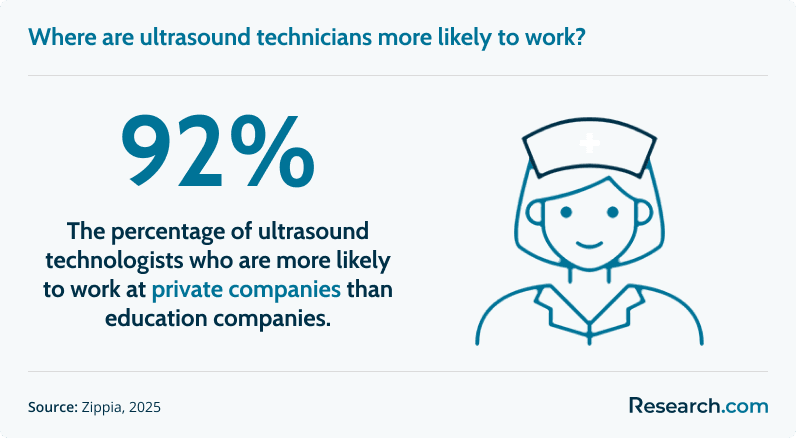
- A 2025 study shows that 92% of ultrasound technicians prefer to work at private firms.
- Ultrasound is a useful imaging option for many patients because it does not use radiation.
References:
- ARDMS. (n.d.). How to Become a Sonographer. Retrieved March 28, 2025, from ARDMS.
- BLS. (2024, August 29). Diagnostic Medical Sonographers and Cardiovascular Technologists and Technicians. Retrieved March 28, 2025, from BLS.
- Brinser, A. (n.d.). Ultrasound. Retrieved March 31, 2025, from WebMD.
- Mayo Clinic. (n.d.). Diagnostic Medical Sonographer. Retrieved March 28, 2025, from Mayo Clinic.
- PayScale. (2025). Average Diagnostic Medical Sonographer Hourly Pay. Retrieved March 28, 2025, from PayScale.
Other Things You Should Know About an Ultrasound Technician Certification Program
In 2027, ultrasound technician certification programs typically include courses like anatomy, medical terminology, sonographic physics, and instrumentation. These programs often incorporate clinical practice to ensure students gain hands-on experience with ultrasound equipment in a healthcare setting.
Ultrasound technicians must renew their certification every two years. The process involves completing 24 continuing education credits approved by the American Registry for Diagnostic Medical Sonography (ARDMS). Renewal ensures technicians stay updated with advancements and maintain professional standards in 2027.
Accreditation ensures that the ultrasound technician certification program meets high educational and professional standards. It signifies that the program regularly undergoes evaluation to ensure curriculum quality and relevance, aiding graduates in becoming competent professionals. For 2027, accredited programs from CAAHEP or ARRT are highly recommended.
To enroll in ultrasound technician certification programs in 2027, candidates typically need a high school diploma or GED. Some programs may also require coursework in anatomy, medical terminology, and physics. Prior healthcare experience or related degree can enhance prospects.


