
Best Universities in the World – 2024 Online Ranking (3rd edition)

Co-Founder and Chief Data Scientist
Choosing a university is no longer just a question of brand recognition. Students, researchers, faculty members, and employers increasingly look at whether an institution consistently produces influential research, attracts highly cited scientists, supports international collaboration, and gives learners flexible academic pathways. Research.com released its third edition of the world’s best universities report on August 7, 2024, to help readers evaluate institutions through a research-centered lens.
This guide explains the major findings from the 2024 ranking, how the ranking was built, which countries and regions have the strongest representation, and how students can use this information when comparing universities, online programs, specialized credentials, and career-focused degrees. It is designed for readers who want more than a list: it shows what the ranking can and cannot tell you, and how to apply the data to real education and career decisions.
Quick answer: What does the 2024 Research.com world university ranking show?
Harvard University ranks as the best university in the world in the 2024 Research.com report, with a total h-index of 224,482 and 2,572 of the world’s top scientists. The United States has the highest number of ranked universities with 576, while Asia has the largest continental total with 1,295 leading universities. The ranking is based on the evaluation of over 166,000 scientist profiles and related institutional research indicators.
| Category | 2024 finding | What it means for readers |
| Top university worldwide | Harvard University | Harvard continues to lead based on research influence, top scientist concentration, and aggregate h-index performance. |
| Country with the most ranked universities | United States with 576 | The United States remains the strongest national system by number of institutions represented. |
| Continent with the most ranked universities | Asia with 1,295 | Asia has the broadest regional representation among ranked institutions. |
| Top 10 distribution | Nine universities from the United States and one from the United Kingdom | North America and the United Kingdom remain highly concentrated at the very top of the list. |
| US state with the most ranked universities | California with 53 | California remains a major center for research universities and scientific talent. |
How the ranking should be understood
The Research.com ranking focuses heavily on academic research performance and the concentration of leading scientists. This makes it different from rankings that emphasize selectivity, student satisfaction, campus resources, or employer surveys. For graduate students, researchers, faculty candidates, and students considering research-intensive careers, that distinction matters.
A high position in this ranking can signal that a university has a strong research ecosystem, influential faculty, and a record of producing widely cited scholarship. However, it should not be the only factor in a student’s decision. Program accreditation, cost, location, faculty fit, degree format, student support, graduation outcomes, and career goals should also be weighed carefully.
Recent research breakthroughs show why university research strength matters
Research universities play a central role in scientific discovery, and the 2024 report appears at a time when academic institutions are contributing to important advances across technology, medicine, agriculture, and space science. In quantum computing, researchers have made progress in quantum error correction methods, a key area for making quantum computers more reliable for future applications in data processing, security, and complex modeling.
Health research is another area where universities continue to shape public knowledge and treatment possibilities. Researchers have identified over 205 newly associated depression genes, a finding that may support more targeted approaches to mental health research and treatment development. Universities are also contributing to sustainable agriculture research, climate adaptation, and interdisciplinary work that connects science, policy, and public welfare.
Main findings from the 2024 world university ranking
- Harvard University is ranked as the world’s best university, with a total h-index of 224,482 and 2,572 of the world’s top scientists.
- The United States has the largest number of top universities, with 576 institutions included.
- Asia has the highest number of ranked universities by continent, with 1,295 institutions.
- Among the top 10 universities, nine are located in the United States and one is located in the United Kingdom.
- California is the US state with the highest number of top universities, with 53 institutions.
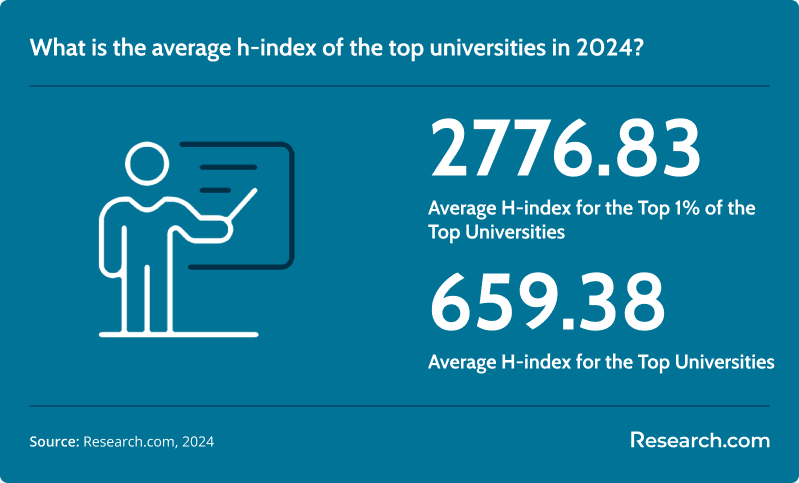
- The average h-index for the top 1% of the leading universities is 2777, compared with an average of 659 for the universities included in the ranking.
- Harvard University earned the highest number of awards, with 2,704.
Readers can view the complete 2024 list here: Research.com best universities in the world ranking.
How to use a world university ranking when choosing a school
A global ranking can help narrow your search, but it should not replace a program-level review. A university may be highly ranked overall yet vary significantly by department, teaching model, student support, cost, and career alignment. The strongest choice is the institution that fits your academic goals, financial situation, and intended career path.
| Decision factor | Why it matters | Questions to ask before applying |
| Research strength | Important for students pursuing graduate study, academic careers, laboratory work, or research-heavy fields. | Does the department publish in your area of interest? Are faculty members active in your target specialty? |
| Program fit | A strong university brand does not always mean every program is equally strong. | Does the specific degree match your career goals, prerequisites, and preferred learning format? |
| Cost and aid | Rankings rarely show the full cost after scholarships, assistantships, grants, and living expenses. | What is the net cost after aid, and how much debt would you need to take on? |
| Career services | Internships, employer connections, alumni access, and advising can affect the transition from school to work. | Which employers recruit from the program? What support is available for internships or job placement? |
| Flexibility | Online, hybrid, part-time, and accelerated formats can make education more accessible for working adults. | Can you study around work or family responsibilities without extending the timeline too far? |
| Accreditation and recognition | Licensure, transfer credits, employer acceptance, and financial aid eligibility may depend on accreditation. | Is the institution properly accredited, and does the program meet requirements in your location or profession? |
Where affordable online specialized programs fit into university choice
Global rankings are useful for judging institutional research strength, but not every student needs a traditional full-time campus pathway. Many learners are seeking targeted, lower-cost, career-aligned training that can be completed online while they continue working. In those cases, the better question is not simply “Which university is highest ranked?” but “Which credential gives me the skills, recognition, schedule, and cost structure I need?”
For example, students looking for healthcare administration support roles may compare options such as a low-cost online medical billing and coding course rather than pursuing a broader degree immediately. A specialized program can make sense when the target occupation values specific technical preparation, when the student wants a shorter training route, or when cost control is a priority.
Can short certification programs improve career mobility?
Short credentials can be valuable when they teach a clearly defined skill, align with employer needs, and complement a learner’s existing experience. They are not a universal replacement for a degree, but they can help workers update technical knowledge, shift into adjacent roles, or document job-ready competencies.
Before enrolling, compare curriculum depth, employer recognition, assessment methods, cost, and whether the credential can later transfer into a degree or stack toward a larger qualification. Learners who want a fast, employment-oriented option can review short certificate programs that can lead to well-paying careers and then verify which credentials are valued in their target field.
Countries with the largest number of leading universities
The United States remains the country with the most ranked universities, increasing from 559 last year to 576 in the 2024 report. It also holds nine of the top 10 positions and 15 of the top 20, showing both broad representation and strong performance among the highest-ranked institutions.
Other countries with large numbers of ranked institutions include China with 318, up from 304 in 2023; Japan with 241, up from 228; India with 212, up from 189; and the United Kingdom with 130, up from 129.
| Country | Number of top universities | Change noted in the 2024 report |
| United States | 576 | Up from 559 last year |
| China | 318 | Up from 304 in 2023 |
| Japan | 241 | Up from 228 |
| India | 212 | Up from 189 |
| United Kingdom | 130 | Up from 129 |
How university reputation can affect career opportunities
A highly ranked university can help students in several ways: it may provide stronger access to research projects, influential faculty, alumni networks, industry partnerships, and graduate school pathways. For fields where research output and institutional reputation carry weight, such as academia, medicine, engineering, data science, and policy, this can be especially meaningful.
Still, reputation alone does not guarantee a job. Employers also look for skills, internships, portfolios, certifications, communication ability, and evidence of performance. Students considering practical or nontraditional career routes should compare the value of a university credential with skills-based pathways, apprenticeships, and career-specific training. Research.com’s guide to high-paying blue collar jobs for women is one example of how career opportunity can extend well beyond conventional academic tracks.
Regions with the largest number of leading universities
Asia leads all continents in the number of ranked universities, with 1,295 institutions, up from 1,031 last year. Europe follows with 818, down from 822 in 2023, while North America ranks third with 667, up from 639.
When looking at the highest-ranked universities rather than total representation, North America is strongest at the top of the list. The region includes nine of the top 10 universities and 16 of the top 20.
Within North America, the United States has 576 top universities, while Canada has 60. In Asia, China leads with 318, followed by Japan with 241. In Europe, the United Kingdom has the highest count with 130 universities, followed by France with 117. Brazil leads South America with 75 ranked institutions, and Australia leads Oceania with 42 universities.
| Region or area | Leading country named in the report | Number of ranked universities |
| North America | United States | 576 |
| North America | Canada | 60 |
| Asia | China | 318 |
| Asia | Japan | 241 |
| Europe | United Kingdom | 130 |
| Europe | France | 117 |
| South America | Brazil | 75 |
| Oceania | Australia | 42 |
Why alumni networks and career services should be part of your school comparison
Research strength matters, but students should also examine what happens after enrollment. Strong alumni communities can create mentorship, referral, internship, and hiring opportunities. Career services can help with resumes, interviews, employer events, internship searches, and graduate school planning.
This is especially important for students choosing flexible or accelerated programs, where the academic timeline may be shorter and career planning must start early. Learners comparing faster academic routes can use guides such as quick college degrees with strong earning potential as a starting point, then evaluate whether each institution offers enough advising, employer access, and academic support.
Which college majors offer strong career value?
The value of a university often depends on the program a student chooses. A prestigious institution may open doors, but a major that aligns with labor market demand, personal strengths, and practical experience can be just as important. Students should compare majors by curriculum, internships, licensing requirements, graduate school options, and likely career pathways.
Rather than choosing a major only because it is popular or attached to a highly ranked school, students should evaluate how the degree connects to specific roles. Research.com’s overview of the best college majors to pursue can help readers think through academic interests, job relevance, and long-term flexibility.
US states with the most leading universities
California has the largest number of ranked universities in the United States, with 53 institutions, rising from 50 last year. New York returns to second place with 48 universities, one more than last year. Pennsylvania moves to third with 40, up from 37. Texas ranks fourth with 39, up from 38, and Massachusetts remains fifth with 29, the same total as last year.
| US state | Number of leading universities | Report note |
| California | 53 | Up from 50 last year |
| New York | 48 | Up one from last year |
| Pennsylvania | 40 | Up from 37 |
| Texas | 39 | Up from 38 |
| Massachusetts | 29 | Same as last year |
How online universities are responding to digital transformation
Online universities continue to expand their use of educational technology, especially in fields where simulation, applied practice, and personalized learning can improve the student experience. Virtual reality and augmented reality are being used to create more immersive lessons, particularly in disciplines such as healthcare and engineering, where students benefit from realistic practice environments.
AI is also influencing online education by helping personalize learning pathways, automate administrative processes, and support more responsive student services. The report notes that VR and related technologies can increase online student retention by 40% and can improve teamwork and collaboration skill development by around 65%.
Another major shift is the growth of lifelong learning models. Online universities increasingly offer micro-credentials, stackable degrees, and modular programs that allow students to update skills without committing immediately to a long degree pathway. The report also notes that 62% of organizations see microcredentials as an emerging technology in education. Blockchain-based credentialing is another area of interest because it may support more secure, transparent academic records.
Is a 6-month online master’s degree a realistic route to advancement?
Accelerated graduate programs can appeal to professionals who want advanced coursework without spending several years out of the workforce. These programs may be useful when the curriculum is tightly focused, the student already has relevant preparation, and the credential is accepted in the target industry.
However, speed should not be the only selling point. Students should ask whether the program is accredited, whether the workload is realistic, whether faculty support is available, and whether the degree aligns with employer expectations. Readers comparing fast graduate options can review 6 month master’s degree online programs and then verify admissions, pacing, and career outcomes directly with each school.
Can a doctorate with no dissertation support career growth?
Some online doctoral programs replace the traditional dissertation with applied research projects, capstone work, professional portfolios, or practice-based assessments. This structure may suit working professionals who want advanced training tied closely to real workplace problems.
A no-dissertation format does not mean the program is easy or less serious. Students should still expect advanced reading, research design, writing, analysis, and faculty evaluation. Before enrolling, compare accreditation, faculty qualifications, residency requirements, project expectations, and whether the degree is appropriate for academic, administrative, or professional roles. Research.com’s guide to online Ph.D. programs with no dissertation can help readers understand how this pathway differs from a traditional doctorate.
H-index leaders, institutional averages, and research distribution
Harvard University again ranks first globally and first in North America, with an aggregate h-index of 224,482. This is a notable increase from 197,552 in 2023. The rest of the global top five includes Stanford University with 105,524, the University of Oxford with 78,049, the University of Washington with 77,792, and the University of Pennsylvania with 76,865.
In Europe, the University of Oxford leads the region with an h-index of 78,049 and a world ranking of 3. In Asia, Tokyo University in Japan is the top institution, with an h-index of 43,769 and a global rank of 25th.
The University of Melbourne is the leading university in Oceania, with an h-index of 38,647 and a world ranking of 36. In South America, Universidade de São Paulo in Brazil ranks highest in the region, with an h-index of 14,828 and a world ranking of 144. In Africa, the University of Cape Town in South Africa leads the continent, with an h-index of 6,311 and a world ranking of 341.
Harvard University also has the largest number of top scientists, with 2,572. It is followed by Stanford University with 1,384, the University of Michigan–Ann Arbor with 1,151, the University of Washington with 1,123, and the University of Oxford with 1,112.
The average H-index for the top 1% of universities is 2776.83, compared with 659.38 for all universities in the online ranking. The average citation count for the top 1% of universities is 910,963, compared with 270,307 for all top universities included.
Common mistakes to avoid when using university rankings
- Choosing a university only because of its overall rank. A school may rank highly overall while another institution has a stronger department in your specific field.
- Ignoring total cost. Tuition, fees, housing, travel, lost income, and interest on student loans can change the real value of a degree.
- Assuming online and campus programs offer the same outcomes. Format, student support, clinical requirements, internships, and employer perception can differ by program.
- Overlooking accreditation. Accreditation can affect transfer credits, financial aid eligibility, licensure, and employer recognition.
- Confusing research strength with teaching quality. A research-intensive university may have outstanding faculty output, but students should still examine advising, class access, and academic support.
- Assuming salary outcomes are guaranteed. Career results depend on location, experience, field, networking, internships, and economic conditions.
Practical steps for choosing the right university or program
- Define the outcome you want. Decide whether your priority is research preparation, professional licensure, faster employment, career change, graduate school admission, or personal enrichment.
- Compare the specific program, not just the institution. Review curriculum, faculty expertise, labs, projects, internships, and graduate outcomes.
- Check accreditation and requirements. Confirm institutional accreditation and, when relevant, programmatic accreditation or licensure alignment.
- Calculate net cost. Look beyond sticker price and include aid, scholarships, assistantships, living expenses, and the time required to finish.
- Evaluate career support. Ask about employer partnerships, alumni access, internship placement, advising, portfolio development, and job search support.
- Review flexibility carefully. If you need online, hybrid, part-time, accelerated, or modular learning, confirm how courses are delivered and how much synchronous participation is required.
- Use rankings as one input. A ranking can identify strong institutions, but your final decision should reflect fit, affordability, academic quality, and career relevance.
Key insights
- Harvard University leads the 2024 Research.com world university ranking, supported by a total h-index of 224,482 and 2,572 top scientists.
- The United States remains the strongest country by representation, with 576 ranked universities, while Asia has the largest continental total with 1,295.
- Research.com’s ranking is most useful for readers who care about research influence, scientific talent, and institutional scholarly output.
- Students should not use rankings in isolation. Program fit, cost, accreditation, format, career services, and faculty alignment can matter as much as institutional prestige.
- Online programs, micro-credentials, accelerated degrees, and no-dissertation doctorates can be useful for some learners, but only when they are properly accredited, realistically paced, and aligned with career goals.
- The best education decision is not always the highest-ranked option. It is the option that offers the right combination of quality, affordability, flexibility, recognition, and career value.
About Research.com
The research process was coordinated by Imed Bouchrika, Ph.D., a computer scientist with extensive experience collaborating on international research projects across the academic community. His responsibility was to help ensure that the data remained unbiased, accurate, and current.
Research.com is a leading research portal for science and education rankings. Its mission is to help professors, research fellows, and students advance their work and identify top experts across scientific disciplines. Research.com also supports students as they compare colleges, explore academic options, and evaluate career pathways.
Readers can review the ranking methodology on the Research.com methodology page.


