
2027 Correspondence Course vs. Online Course: Explaining the Difference

Co-Founder and Chief Data Scientist
Deciding between a correspondence course and an online course in the United States is an important step in your educational journey. The biggest challenge lies in navigating the overwhelming amount of misleading information, as many institutions deliberately blur the distinction between the two formats. Correspondence learning is typically self-paced, non-interactive, and often delivered through mail, while online learning requires consistent digital interaction and usually follows a structured academic calendar.
This regulatory difference is significant because it can influence financial aid eligibility, accreditation, and the long-term value of your credential. As a career planning and education expert, my goal is to help you cut through the confusing terminology so you can make a choice that aligns with your goals.
What are the benefits of taking a correspondence course vs. an online course (USA)?
- Career Advancement: Online courses are generally more employer-recognized, leading to roles such as instructional designer, e-learning specialist, or online faculty, while correspondence courses may be viewed as less competitive.
- Earning Potential: Professionals in online learning roles earn median salaries such as $72,653/year for e-learning specialists (PayScale, 2025) and $96,482/year for online course designers (Glassdoor, 2025), compared to correspondence-focused administrative roles averaging $77,231/year (ZipRecruiter, 2025).
- Flexible Learning: Correspondence courses offer complete self-pacing with minimal tech requirements, while online courses balance flexibility with structure through interactive platforms, instructor support, and scheduled deadlines.
What can I expect from a correspondence course vs. an online course in the USA?
- Accreditation Standards: Online courses typically meet stricter regulatory and accreditation frameworks, while correspondence courses may not always qualify for federal aid.
- Assessment Methods: Online incorporates quizzes, projects, and peer reviews, whereas correspondence relies on mailed assignments and exams.
- Delivery Mediums: Correspondence relies on mailed materials and written assignments, while online learning uses learning management systems, video lectures, and interactive forums.
- Interaction Level: Online requires consistent engagement with instructors and peers, while correspondence is mostly independent with limited feedback.
- Structured Curriculum: Online follows academic calendars with set deadlines, while correspondence offers looser timelines with greater self-pacing.
- Technology Requirements: Online demands stable internet and digital devices, while correspondence may only need postal access and basic materials.
Where can I apply skills learned through correspondence / online education?
- Consulting Services: Advise clients on improving distance learning effectiveness, cost-efficiency, and student engagement.
- Corporate Training & eLearning: Implement compliance, onboarding, and workforce development programs in businesses.
- Distance Learning Administration: Manage and coordinate education programs delivered remotely for schools or organizations.
- Educational Policy & Accreditation: Contribute to compliance, quality control, and regulatory oversight of distance education.
- Higher Education & EdTech: Support online course delivery within universities or private education technology firms.
- Instructional Design & Curriculum Development: Build engaging educational content and digital course modules.
How much can I make in roles tied to online / correspondence education formats?
- Correspondence Specialist: About $77,231/year (ZipRecruiter, 2025).
- Distance Learning Coordinator: Median around $79,434/year (CareerExplorer, 2025).
- E-Learning Specialist: Average of $72,653/year (PayScale, 2025).
- Online Course Designer: Average about $96,482/year (Glassdoor, 2025).
- Online Course Facilitator/Instructor: Around $86,065/year (Glassdoor, 2025).
- Training/Learning & Development Administrator: Roughly $73,390/year (ZipRecruiter, 2025) or $28.84/hour (Indeed, 2025).
- What are the similarities and differences between a correspondence course vs. an online course? Correspondence vs. Online
- How long does it take to complete a correspondence course or an online course? Duration
- What are the career opportunities for graduates of correspondence and online programs? Career opportunities
- What are the salaries of professionals with correspondence vs. online credentials? Salaries
- What is the job market like for correspondence course graduates compared to online course graduates? Job market
- What are the accreditation and financial aid implications for correspondence vs. online courses? Financial aid
- Which universities and institutions in the USA offer correspondence vs. online programs? Universities
- What are the biggest challenges faced by correspondence course students compared to online learners? What are the biggest challenges faced by correspondence course students compared to online learners?
- What are the advantages and opportunities offered by online learning over correspondence formats? Opportunities
- What are some current and future trends in distance education in the USA? Trends
- Which Fields Deliver the Highest ROI for Distance Education? Which Fields Deliver the Highest ROI for Distance Education?
What are the similarities and differences between a correspondence course vs. an online course?
Deciding between a correspondence course and an online course can be confusing, as both fall under the umbrella of distance education but differ in important ways. While each offers flexibility for learners, the delivery methods, level of interaction, and recognition by employers vary significantly.
Examples of Correspondence courses
Bookkeeping and Accounting
The Bookkeeping and Accounting correspondence course teaches the essentials of financial recordkeeping, reporting, and compliance for small businesses and organizations. Students learn how to manage ledgers, balance sheets, payroll, and tax documentation using both manual and digital systems. This course is ideal for those seeking entry-level roles in finance or aiming to support their own business operations. It provides a solid foundation for further study in accounting or preparation for certification programs.
Legal Secretary
The Legal Secretary correspondence course prepares students to work in legal environments by teaching administrative procedures, legal terminology, and document preparation. Topics include court filing systems, transcription, legal correspondence, and ethics in law offices. Graduates are equipped to assist attorneys, manage case files, and handle client communications in law firms, corporate legal departments, or government agencies. It’s a practical pathway for those interested in legal support roles without pursuing a law degree.
Medical Terminology
The Medical Terminology correspondence course introduces students to the language used in healthcare settings, focusing on anatomy, physiology, and clinical procedures. Learners gain familiarity with prefixes, suffixes, and root words that form the basis of medical vocabulary across specialties. This course is valuable for aspiring healthcare professionals, administrative staff, or anyone preparing for further study in nursing, coding, or allied health. It enhances communication and accuracy in medical documentation and patient care.
Small Business Management
The Small Business Management correspondence course teaches the essentials of starting, operating, and growing a small enterprise. Topics include business planning, marketing, financial management, customer service, and legal considerations. Students gain practical skills to launch their own business or improve existing operations. It’s ideal for aspiring entrepreneurs or current business owners seeking flexible, self-paced learning to sharpen their management capabilities.
Examples of online courses
Business
Business is a broad and adaptable field focused on the principles of management, marketing, finance, and entrepreneurship. Students explore how organizations operate, make strategic decisions, and respond to changing markets through courses in leadership, accounting, and operations. Graduates are equipped for careers in management, consulting, sales, and financial services across a wide range of industries. With its emphasis on problem-solving and innovation, a business degree offers strong career flexibility and advancement potential.
Students exploring online business or finance paths often ask is an online associate in finance worth it, since both correspondence and online formats promise flexibility but differ in recognition and interactivity. The online route, however, typically offers more employer-aligned accreditation and faster feedback systems that enhance career outcomes.
Data Science
Data Science merges statistics, programming, and domain knowledge to uncover insights from large and complex datasets. Students learn tools and techniques in machine learning, data visualization, and analytics to solve real-world problems. Careers include roles such as data analyst, machine learning engineer, and business intelligence developer in sectors like tech, healthcare, and finance. The field is fast-growing and ideal for those who enjoy working with data to drive informed decisions.
Nursing
Nursing is a critical healthcare profession centered on patient care, clinical expertise, and health advocacy. Programs combine coursework in anatomy, pharmacology, and evidence-based practice with hands-on clinical experience. Graduates become registered nurses (RNs) or pursue advanced roles such as nurse practitioners, educators, or administrators. Nursing offers a stable, meaningful career with opportunities to specialize and make a lasting impact on individual and community health.
Education
Education prepares individuals to teach, lead, and support learning across diverse age groups and settings. Coursework includes instructional methods, curriculum development, educational psychology, and classroom management. Graduates become teachers, principals, curriculum designers, or educational consultants, shaping the future through knowledge and mentorship. The field offers a fulfilling path for those passionate about equity, growth, and lifelong learning.
Similarities between correspondence and online courses
- Accessibility: Both formats allow students to learn remotely without relocating.
- Adult Learner Focus: Both are commonly chosen by working adults seeking career advancement.
- Affordability: Both may be more cost-effective compared to traditional in-person programs.
- Alternative Pathways: Both serve as non-traditional routes for those who cannot attend in-person classes.
- Credential Earning: Both can lead to certificates, diplomas, or degrees, depending on the program.
- Diverse Subjects: Wide ranges of programs and disciplines are available in both formats.
- Flexibility: Students can often study on a schedule that fits personal and professional commitments.
- Independent Study Skills: Both formats encourage students to work independently with minimal supervision.
- Scalability: Institutions can reach a larger pool of students across regions.
- Self-Discipline Requirement: Success in either format requires strong time management and self-motivation.
Differences between correspondence and online courses
- Accreditation Recognition: Online courses are more likely to meet current accreditation standards and qualify for federal aid.
- Assessment Style: Online programs often use quizzes, online exams, and projects, while correspondence depends on mailed assignments or proctored tests.
- Curriculum Structure: Online programs follow academic calendars with deadlines, while correspondence is largely self-paced.
- Delivery Method: Correspondence courses use mailed print materials, while online courses rely on digital platforms.
- Employer Perception: Online credentials are typically viewed more favorably than correspondence certifications.
- Feedback Speed: Online learners receive faster feedback through digital communication, while correspondence students may wait weeks.
- Interaction Level: Online courses provide live or asynchronous interaction with instructors and peers, while correspondence is mostly solitary.
- Program Updates: Online content is easily updated, while correspondence materials may become outdated quickly.
- Resource Availability: Online courses include multimedia resources and digital libraries, while correspondence relies on printed texts.
- Student Networking: Online learning fosters peer interaction through forums and group projects, while correspondence offers little networking.
- Technology Requirements: Online courses require internet access and devices, while correspondence can be completed with minimal technology.
Correspondence and online courses both expand access to education for learners who need flexibility and alternative pathways. However, online learning’s stronger accreditation, interactivity, and employer recognition make it the more widely accepted format in today’s workforce.
How long does it take to complete a correspondence course or an online course?
The time required to complete a course depends heavily on whether the program is designed for maximum self-pacing or follows a structured academic schedule. This fundamental difference in course structure directly impacts a student's commitment and timeline for graduation.
- Asynchronous (standard): Most online courses still run on a traditional 8- to 16-week semester schedule, requiring adherence to weekly assignment deadlines.
- Enrollment flexibility: Correspondence students can typically enroll and begin coursework at any time of the year, outside of standard semester timelines.
- Fast-track options: Some online certificate or graduate programs offer condensed formats, such as five-week or seven-week modules, to accelerate completion.
- Fixed start/end dates: Online programs are tied to the academic calendar, with set start dates, add/drop periods, and firm end dates for predictability.
- Maximum time limit: Correspondence institutions usually set a broad deadline, such as 9 to 12 months or longer, within which all course requirements must be submitted.
- No weekly deadlines: Correspondence formats generally have no required log-in times or interim submission dates.
- Self-paced completion: Correspondence allows completion time to be determined almost entirely by a student’s personal pace and discipline.
- Synchronous (live): Online students may need to participate in virtual class sessions at specific, scheduled times each week.
Data from the National Council for State Authorization Reciprocity Agreements (NC-SARA) details the total exclusively distance education enrollments facilitated by the SARA framework across the United States from 2018 to 2024. As shown in the graph below, enrollments began at 1,168,724 in 2018, saw a strong increase to 1,265,538 in 2019, and then experienced a significant surge to peak at 1,699,651 in 2020. This spike, likely reflecting the global shift to remote learning, was followed by a modest dip to 1,502,171 in 2021 and near-stabilization at 1,500,912 in 2022.
The trend indicates a renewed upward trajectory in recent years, with enrollments climbing to 1,612,617 in 2023 and reaching 1,661,689 in 2024. The data shows that in fall 2024, more than 1.6 million students attended out-of-state institutions exclusively via distance education through SARA, a figure consistent with the 1.6 million students reported in fall 2023.
Students comparing program timelines often make similar considerations to those asking is an ABSN degree worth it—weighing speed, structure, and flexibility against career readiness and long-term payoff.
This pattern illustrates that the initial rapid expansion of distance learning in 2020 has largely established a new, higher baseline for cross-state online education. The sustained enrollment figures confirm the critical and growing role of the SARA framework in maintaining widespread access to remote educational opportunities.
What are the career opportunities for graduates of correspondence and online programs?
The career recognition of a graduate is influenced by accreditation status, perceived rigor, and the type of interaction offered, creating a notable difference in marketability.
- Advanced leadership roles: Online master’s and doctoral degrees from accredited universities are widely recognized, preparing graduates for director, dean, or even C-suite positions where strategic leadership is required.
- Career change/upskilling: Online programs provide structured credentials (graduate certificates, MBAs, master’s degrees) that working professionals use to shift industries, such as moving from education into business analytics or healthcare management.
- Certifications/non-degree: Correspondence courses are most often used for vocational certifications or skill-based credentials in fields such as bookkeeping, drafting, or office administration, where hands-on licensing may not be required.
- Federal government: Online degrees from regionally accredited institutions meet the requirements for federal employment under the General Schedule system, ensuring access to competitive jobs with strong benefits.
- Industry compliance: Correspondence is frequently used for annual or mandated compliance courses, such as OSHA training or insurance CEUs, where the objective is certification renewal rather than career advancement.
- Industry-specific fields: Online programs dominate in areas with high employer demand, like information technology, engineering, nursing, and business administration, which increasingly require accredited credentials for entry.
- International employment: Many multinational employers now recognize U.S. online degrees from accredited universities, expanding opportunities abroad in consulting, finance, and education.
- Limited professional mobility: Because correspondence lacks interactive rigor and accreditation recognition, graduates are often excluded from management tracks or state-licensed professions.
- Self-employment/entrepreneurship: Correspondence programs provide knowledge in niche or technical fields useful to freelancers, small business owners, or those seeking personal enrichment rather than formal advancement.
The salary outcomes for graduates also depend heavily on field and credential. For instance, psychology-related roles—like those affecting forensic psychologist salary potential—may require accredited graduate-level credentials, which are far more accessible through modern online programs than through traditional correspondence methods.
What are the salaries of professionals with correspondence vs. online credentials?
Salary outcomes are directly tied to qualification level and market acceptance, highlighting the contrast between vocational certificates from correspondence programs and fully accredited online degrees.
- Degree parity: Pay reflects the degree and role, not whether the program was online or on campus; 2024 median weekly earnings were $1,543 for bachelor’s and $1,840 for master’s degree holders (Bureau of Labor Statistics, 2025).
- Entry-level wages: Without a degree, earnings cluster near high school–level pay; 2024 median weekly earnings for high school graduates were $960 (Bureau of Labor Statistics, 2025).
- Graduate level premium: The 2024 median weekly earnings premium for master’s vs. bachelor’s was ~19% (1,840 vs. 1,543), illustrating the benefit of graduate study regardless of delivery mode (Bureau of Labor Statistics, 2025).
- Lacking degree premium: Correspondence credentials that are non-degree/non-accredited generally do not deliver a degree-level pay boost; wages tend to align with certificate/trade roles rather than bachelor’s/master’s benchmarks (Bureau of Labor Statistics, 2025). This trade school careers list can be an option for those without a college degree.
- Management pay: Degree-qualified roles reachable via online paths include postsecondary education administrators (median $103,960, 2024), administrative services & facilities managers (median $108,390; facilities $104,690, 2024), and training & development managers (median $127,090, 2024) (Bureau of Labor Statistics, 2024).
- Non-accredited impact: Where a program lacks recognized accreditation, employers and licensing bodies often discount the credential, limiting access to degree-required roles and associated wage tiers (Bureau of Labor Statistics, 2025).
- STEM/tech fields: Online degrees funnel into high-pay occupations such as software developers (median $133,080, 2024), web developers/digital designers (median $90,930 and $98,090, 2024), and electrical/electronics engineers (medians $111,910 and $127,590, 2024) (Bureau of Labor Statistics, 2024).
- Title protection: Employers typically weigh the degree title (e.g., BA, BS, MS) and experience; delivery mode is not separately reported in earnings data (Bureau of Labor Statistics, 2025).
- Vocational fields: Many correspondence-style, skill-focused paths align with trades where 2024 medians include drafters ($65,380), HVACR mechanics & installers ($59,810), and electricians ($62,350) (Bureau of Labor Statistics, 2024).
The various data points show a persistent earnings gap favoring online degree pathways tied to bachelor’s or higher credentials over correspondence-oriented certificates; meaningful experience or additional licensure is typically required to narrow the gap (Bureau of Labor Statistics, 2024).
For instance, HVACR mechanics and installers earn a median $59,810, electricians $62,350, and drafters $65,380—figures typical of correspondence-oriented certificate pathways.
This is also seen in the increased popularity of accelerated bachelor's degree online programs. Online degree holders more often enter higher-paid digital, management, and engineering roles: web developers $90,930, digital designers $98,090, postsecondary education administrators $103,960, administrative services and facilities managers $108,390, electrical engineers $111,910, training and development managers $127,090, electronics engineers $127,590, and software developers $133,080 (Bureau of Labor Statistics, 2024). These are shown in the graph below.
Across all roles, median pay spans $59,810–$133,080, with degree-requiring positions clustering at or above $100,000 while trade roles and trade school majors remain under $70,000 (Bureau of Labor Statistics, 2024).
What is the job market like for correspondence course graduates compared to online course graduates?
Employer perceptions now favor online course graduates and online education, especially after the COVID-19 era normalized digital learning. Correspondence formats are increasingly viewed as outdated and less rigorous.
- COVID-19 era normalization: In fall 2023, 53.2% of students took at least one distance-education course and 25.6% studied exclusively online, signaling mainstream acceptance of online learning (National Center for Education Statistics, 2025).
- Demonstrates soft skills: Employers hiring new graduates prioritize problem-solving (~90%), teamwork (~80%), and communication (≥75%), aligning with the interactive nature of accredited online programs (National Association of Colleges and Employers, 2025).
- Historic perception (correspondence): Correspondence study remains associated with mail-based self-study and lacks instructor-initiated interaction under federal definitions, prompting closer scrutiny of applied skills (U.S. Department of Education, Federal Student Aid, 2024).
- Identical diploma (online): Many public universities do not mark “online” on diplomas or transcripts, reducing modality stigma in hiring (University of Kentucky, n.d.; University of Texas at San Antonio, 2024).
- Interview scrutiny (correspondence): Candidates from correspondence programs often need stronger portfolios or work samples because peer/faculty interaction is not evidenced by the modality (U.S. Department of Education, Federal Student Aid, 2024).
- Limited networking (correspondence): The solo, non-interactive format offers fewer alumni/faculty touchpoints than cohort-based online programs, which can matter for referrals and team experience (National Association of Colleges and Employers, 2025).
- Positive momentum (online): A majority of employers report using skills-based hiring for entry roles, and about half say some positions are degree-flexible, trends that pair well with accredited online upskilling and microcredentials (National Association of Colleges and Employers, 2025).
- Sector-specific acceptance (correspondence): Correspondence persists mainly in niche, skills-first trades where portfolios and certifications dominate signaling; it lacks the federally defined interaction standards used to ensure quality in online programs (U.S. Department of Education, Federal Student Aid, 2024).
- Skill-based hiring (overall): The shift toward skills means online learners who can document projects, teamwork, and tech fluency are advantaged relative to correspondence learners who cannot evidence structured interaction (National Association of Colleges and Employers, 2025).
- Transferable technology skills (online): Work remains hybrid—33% of employed people worked from home on days worked in 2024—so experience with LMS, video platforms, and online collaboration maps directly to job realities (Bureau of Labor Statistics, 2025).
- Wide access (online across states): More than 1.6 million students studied exclusively online across state lines via SARA in fall 2023–2024, reinforcing sustained demand and nationwide visibility of accredited online education (National Council for State Authorization Reciprocity Agreements, 2025).
As digital work continues to dominate, courses focusing on modern IT and protection systems—such as those comparing data security vs cyber security—illustrate how online credentials align better with workforce needs than traditional correspondence models.
What are the accreditation and financial aid implications for correspondence vs. online courses?
The U.S. Department of Education defines correspondence and online education differently, and this classification is central to federal aid eligibility.
- Accreditation requirement: Online course programs must be accredited by DOE-recognized agencies to qualify for aid. Consult this list of regionally accredited online colleges for more information.
- Accreditation status: Many correspondence institutions hold national accreditation, which can be less portable than regional accreditation.
- Financial aid restriction: Federal aid for correspondence enrollees is capped at half-time, regardless of credit load.
- Full financial aid: Online students are eligible for the same Pell Grants and Stafford Loans as residential students.
- Ineligible expenses: Aid calculations for correspondence exclude room, board, and transport.
- Interaction definition: Correspondence is defined as limited, student-initiated interaction.
- Program integrity: Online institutions must maintain regular and substantive interaction (RSI) or risk being reclassified as correspondence.
- Regular and substantive interaction: Online instructors must initiate predictable contact for programs to retain distance education status.
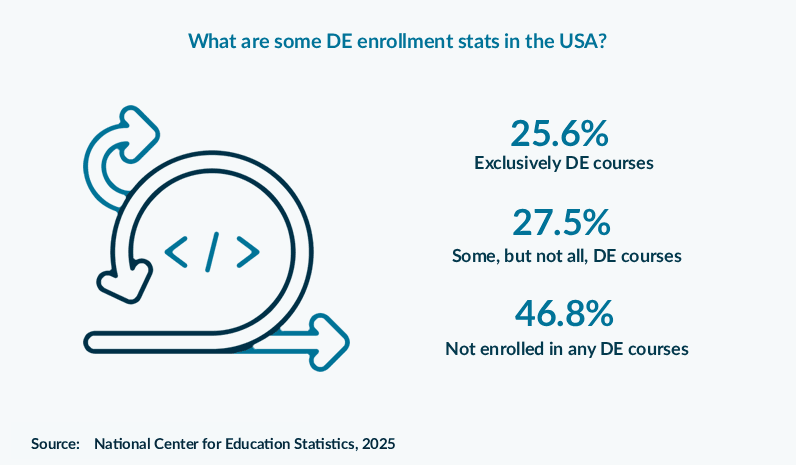
Data from the National Center for Education Statistics (NCES) provides a snapshot of distance education enrollment across all institutions, totaling 19,427,907 students. Of these students, 46.8% (9,099,046) took no distance education (DE), while 53.1% participated in DE—split between 27.5% (5,346,433) taking some but not all DE and 25.6% (4,982,428) taking exclusively DE.
Among exclusively DE students, 4,468,319 (23% of all students) attended institutions that are not exclusively DE, versus 514,109 (2.6%) at institutions that operate exclusively via DE. These figures, shown in the graphic below, show a majority engaging in remote learning, largely through traditional institutions rather than fully online schools.
Which universities and institutions in the USA offer correspondence vs. online programs?
Most universities now focus on online course development and online learning, though a few maintain correspondence options for niche audiences such as military learners.
- Arizona State University (ASU): Offers a wide range of undergraduate and graduate online degrees, recognized for scale and innovation in digital delivery.
- Boston University (BU): Provides selective online graduate programs in fields such as management, public health, and communications, noted for strong faculty engagement.
- Colorado State University Pueblo: Maintains some correspondence-style courses, largely as legacy print-based offerings for degree completion or specialized study.
- Military education: The U.S. armed forces continue to use correspondence and self-paced study for deployed service members, particularly where internet access is unreliable.
- North Carolina State University (NCSU): Has one of the most comprehensive online portfolios, particularly strong in STEM disciplines like engineering and technology.
- Non-credit entities: Private vocational schools and non-accredited providers still issue correspondence-style self-study courses, mainly for professional enrichment rather than formal advancement.
- Oregon State University (OSU): Offers more than 110 online programs, including undergraduate degrees and professional certificates.
- State university continuing ed: Many state universities maintain continuing education or extension divisions with correspondence-style courses, usually in niche subjects.
- The Ohio State University (OSU): Expanding its online graduate programs in business, healthcare, and education.
- University of North Carolina at Chapel Hill (UNC): Continues to broaden its online graduate and undergraduate programs while maintaining rigorous admission standards.
- University of Oklahoma (OU): Provides global online learning opportunities in multiple professional fields, building on its traditional campus strengths.
- Western Governors University (WGU): A fully online, competency-based model known for affordability and flexibility, widely accepted in IT, teaching, and healthcare.
These are only a few of the many accredited online universities, so be sure to do more research for your own specific career goals.
The NC-SARA technical report for fall 2024 reveals the top ten institutions by total reported exclusively distance education enrollments (EDEE), which are overwhelmingly dominated by private, non-profit entities.
As shown in the graphic below, the largest institution by a significant margin is Western Governors University in Utah, reporting 214,676 EDEE, followed closely by Southern New Hampshire University in New Hampshire with 182,710 EDEE. The remaining top institutions show a sharp drop in size, with the University of Phoenix in Arizona reporting 110,682 EDEE, and Grand Canyon University in Arizona at 89,386 EDEE.
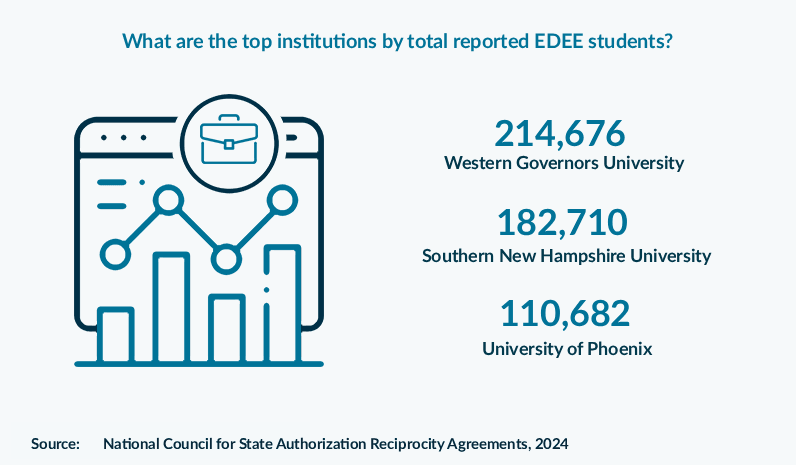
The top six online course programs are completed by Liberty University in Virginia at 87,140 EDEE and Penn Foster College in Arizona with 78,968 EDEE, demonstrating that the largest exclusively distance education providers are primarily non-profit organizations focused heavily on online delivery. Public institutions hold the remaining four spots, led by Arizona State University in Arizona at 73,906 EDEE, followed by the University of Maryland Global Campus in Maryland with 55,452 EDEE, South Texas College in Texas at 55,030 EDEE, and the American Public University System in West Virginia rounding out the top ten with 48,659 EDEE.
This clearly illustrates that the market for exclusively distance education is heavily concentrated among a few large, private non-profit universities, which significantly outpace even the largest public university online programs in terms of enrollment volume. This also shows that correspondence course programs have decreased in popularity over the years.
What are the biggest challenges faced by correspondence course students compared to online learners?
The primary challenges for students in both formats stem from the separation from a physical classroom, yet the specific hurdles faced by correspondence course students and online learners diverge based on their reliance on technology and interaction levels.
- Adapting to new pedagogy: Online learners often struggle initially with structured but remote education, particularly if returning to study after years in the workforce.
- Delayed feedback cycle: Correspondence students face long waits—sometimes weeks or months—for assignment grading and feedback, slowing momentum.
- Digital access barrier: The lack of online resource integration makes correspondence less relevant in today’s tech-driven knowledge environment.
- Effective time management: Online students must juggle weekly deadlines with personal responsibilities, requiring consistent organization and focus.
- Exams and proctoring: Correspondence students may need to travel to designated centers for proctored exams, adding cost and logistical challenges.
- Home distractions: Online students are prone to interruptions from household responsibilities, childcare, or competing work priorities.
- Lack of community: Correspondence learners often study in isolation without peer interaction, which reduces motivation and collaborative opportunities.
- Limited academic support: While online students have access to tutoring, digital libraries, and tech support, correspondence students may have only mailed materials.
- Motivation and structure: Correspondence requires sustaining self-motivation over a long period without external deadlines, a hurdle for many learners.
- Technical difficulties: Online learners may face unstable internet, hardware problems, or steep learning curves with learning management systems.
- Video conferencing fatigue: Frequent synchronous classes in online programs can create burnout from prolonged screen exposure.
What are the advantages and opportunities offered by online learning over correspondence formats?
Online learning provides significant advantages and expanded opportunities over the traditional correspondence model, primarily by replacing isolated self-study with dynamic, digitally enhanced, and interactive educational environments.
- Accessibility to resources: Online students benefit from instant access to digital libraries, databases, and e-books that are updated regularly.
- Affordability and cost savings: Online learners save on commuting, housing, and ancillary campus fees, making higher education more accessible financially.
- Better interaction quality: Tools like video conferencing, discussion boards, and messaging apps foster meaningful engagement with instructors and peers.
- Develops professional skills: Online study builds digital collaboration, communication, and critical thinking skills highly valued in modern workplaces.
- Educational continuity: Online courses are available worldwide, enabling students to keep learning during relocation, deployment, or travel.
- Equivalent credential value: Accredited universities award the same degree titles to online and on-campus students, ensuring equal recognition.
- Faster feedback loop: Digital submissions enable instructors to provide comments and grades more quickly than traditional mail.
- Global networking: Online cohorts often include students across states and countries, broadening professional networks and perspectives.
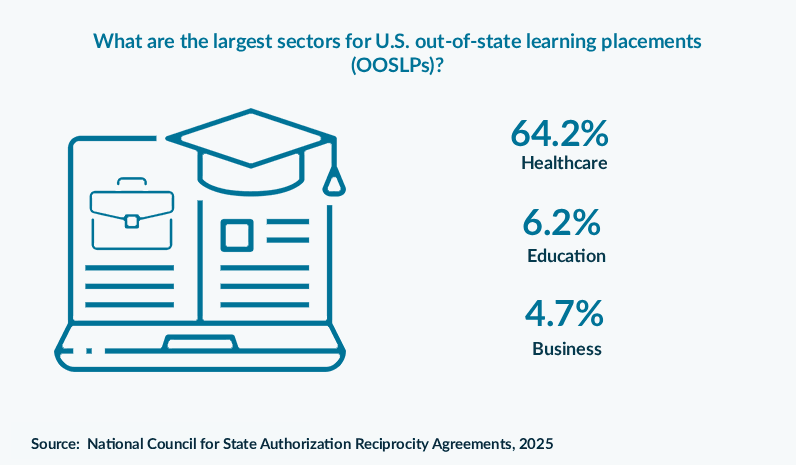
The largest concentrations of out-of-state learning placements (OOSLPs) are overwhelmingly focused on fulfilling the workforce development needs of a few key professions.
Healthcare-related programs, specifically health professions, constitute the vast majority of all OOSLPs, accounting for 64.2% of placements. The next largest sectors fall far behind, with education representing 6.2% of placements and business comprising 4.7%. The remaining 24.9% of OOSLPs are distributed across a variety of other fields, such as engineering and social sciences. This distribution, shown in the figure below, clearly demonstrates that experiential learning reciprocity, facilitated by SARA, is critically important for licensed professions, particularly those in the healthcare sector.
What are some current and future trends in distance education in the USA?
The trajectory of distance education in the USA is rapidly moving away from its historical roots, such as those in correspondence course programs, toward a highly personalized, interactive, and technologically sophisticated future driven by advancements in artificial intelligence and immersive learning.
- Artificial intelligence (AI) integration: AI tools are increasingly used to personalize coursework, automate grading, and offer instant feedback.
- Collaborative learning platforms: Modern LMS platforms emphasize group projects, real-time communication, and interactive case studies.
- Expansion of video-based learning: Courses are incorporating micro-videos, interactive modules, and embedded assessments for greater engagement.
- Gamification: Features like digital badges, progress dashboards, and point systems encourage motivation and persistence.
- Higher education expansion: Universities continue to scale online degree offerings to reach broader student populations worldwide.
- Hybrid/blended models: Many programs combine online coursework with short on-campus residencies, especially in healthcare and business.
- Immersive learning (VR/AR): Virtual and augmented reality applications are emerging in science labs, healthcare simulations, and design fields.
- Micro-credentials and nanodegrees: Universities and MOOC providers are offering short, stackable programs aligned with immediate workforce needs.
- Mobile learning: Course design is increasingly mobile-first, enabling full participation through smartphones and tablets.
- Personalized learning experiences: Data analytics help instructors tailor assignments, pacing, and feedback to individual student needs.
The key distinction remains the U.S. Department of Education’s definition of “regular and substantive interaction,” which correspondence lacks, and online programs must uphold to qualify for aid. For modern career mobility, choosing an accredited online program offers far greater opportunities for recognition, networking, and advancement compared to correspondence education.
Here's What Graduates Say About Their Correspondence vs. Online Courses
- Gomer: "I started with a correspondence course and loved the flexibility of studying at my own pace without needing internet access. Later, switching to an online course gave me instant feedback and interactive lessons that kept me engaged."
- Jimmy: "The online course format helped me balance my full-time job and studies with live sessions and recorded lectures. But I also appreciated the discipline I developed during my earlier correspondence course days."
- Rhea: "Taking a correspondence course taught me self-motivation and time management, while the online course offered community through discussion boards and virtual meetups. Both formats helped me grow in different ways. "
Which Fields Deliver the Highest ROI for Distance Education?
Evaluating return on investment helps identify fields where distance education can lead to superior career outcomes. Prospective students must consider industry growth trends, median salary data, and the cost-efficiency of obtaining credentials before committing to a program. Detailed comparisons across sectors such as technology, healthcare, and business illustrate how accredited online learning can enhance long-term earning potential and career stability. For further analysis and in-depth market data, refer to the best degrees online.
Key Findings
- Online Enrollment Trend: Exclusively distance education enrollments (EDEE) through SARA peaked in 2020 at 1,699,651, then stabilized, with 1,661,689 enrollments recorded in 2024, maintaining a high baseline above 1.6 million students.
- Overall Distance Education Status: The majority of students across all institutions (53.1% or 10,328,861 of 19,427,907 students) participate in some form of distance education (DE), with 46.8% (9,099,046) taking no DE courses.
- Exclusively DE Student Enrollment: Of all students, 25.6% (4,982,428 students) are exclusively distance education students, with the vast majority (4,468,319 or 23%) attending traditional institutions rather than fully online schools (514,109 or 2.6%).
- Top Institution Enrollment Concentration: The exclusively distance education market is highly concentrated, led by Western Governors University (214,676 EDEE) and Southern New Hampshire University (182,710 EDEE), which significantly outpace the largest public university provider, Arizona State University (73,906 EDEE).
- High-Demand Career Pay: Online degree holders are commonly found in high-paying digital and management roles, with median salaries ranging from $90,930 for web developers to $133,080 for software developers.
- Salary Disparity by Credential: Across all roles, median annual pay spans $59,810 to $133,080, noting that positions requiring academic degrees typically cluster at or above $100,000, while roles associated with trade school majors often remain under $70,000.
- Experiential Learning Field: Out-of-state learning placements (OOSLPs) are critically dominated by health professions (64.2% of all placements), far exceeding education (6.2%) and business (4.7%), underscoring the importance of SARA reciprocity for licensed health careers.
- Top Private Provider Dominance: The top six largest exclusively distance education providers are primarily non-profit organizations, with enrollment figures ranging from 214,676 down to 78,968 (Penn Foster College), demonstrating their command of the national remote learning market.
References:
- CareerExplorer. (2025). Distance learning coordinator salary. CareerExplorer.
- Glassdoor. (2025). Online course designer salary. Glassdoor.
- Glassdoor. (2025). Online course facilitator salary. Glassdoor.
- Indeed. (2025). Learning and development administrator salaries. Indeed.
- National Association of Colleges and Employers. (2024, November). Job Outlook 2025 (Research report). National Association of Colleges and Employers.
- National Association of Colleges and Employers. (2025, January 28). The attributes employers look for on new grad résumés—and how to showcase them (Press release). National Association of Colleges and Employers.
- National Association of Colleges and Employers. (2025, March 21). Job Outlook 2025 Spring Update (Research report). National Association of Colleges and Employers.
- National Center for Education Statistics. (2025). Trend generator: Distance education status of student — Fall 2023 (IPEDS). U.S. Department of Education.
- National Center for Education Statistics. (2025). IPEDS table 36439: Distance education status by program level and institution type. U.S. Department of Education.
- National Council for State Authorization Reciprocity Agreements. (2024). Annual data report executive summary 2024. National Council for State Authorization Reciprocity Agreements.
- National Council for State Authorization Reciprocity Agreements. (2025). Data report executive summary 2025. National Council for State Authorization Reciprocity Agreements.
- PayScale. (2025). E-learning specialist salary. PayScale.
- U.S. Bureau of Labor Statistics. (2023). Education administrators, all other (Occupational Employment and Wage Statistics). U.S. Bureau of Labor Statistics.
- U.S. Bureau of Labor Statistics. (2023). Education administrators, kindergarten through secondary (Occupational Employment and Wage Statistics). U.S. Bureau of Labor Statistics.
- U.S. Bureau of Labor Statistics. (2023). Education administrators, postsecondary (Occupational Employment and Wage Statistics). U.S. Bureau of Labor Statistics.
- U.S. Bureau of Labor Statistics. (2023). Education and childcare administrators, preschool and daycare (Occupational Employment and Wage Statistics). U.S. Bureau of Labor Statistics.
- U.S. Bureau of Labor Statistics. (2024, April 18). Tutors and teachers and instructors (Occupational Outlook Handbook). U.S. Bureau of Labor Statistics.
- U.S. Bureau of Labor Statistics. (2025). Administrative services and facilities managers (Occupational Outlook Handbook). U.S. Bureau of Labor Statistics.
- U.S. Bureau of Labor Statistics. (2025). Drafters (Occupational Outlook Handbook). U.S. Bureau of Labor Statistics.
- U.S. Bureau of Labor Statistics. (2025). Electricians (Occupational Outlook Handbook). U.S. Bureau of Labor Statistics.
- U.S. Bureau of Labor Statistics. (2025). Electrical and electronics engineers (Occupational Outlook Handbook). U.S. Bureau of Labor Statistics.
- U.S. Bureau of Labor Statistics. (2025). Heating, air conditioning, and refrigeration mechanics and installers (Occupational Outlook Handbook). U.S. Bureau of Labor Statistics.
- U.S. Bureau of Labor Statistics. (2025). Postsecondary education administrators (Occupational Outlook Handbook). U.S. Bureau of Labor Statistics.
- U.S. Bureau of Labor Statistics. (2025). Software developers (Occupational Outlook Handbook). U.S. Bureau of Labor Statistics.
- U.S. Bureau of Labor Statistics. (2025). Training and development managers (Occupational Outlook Handbook). U.S. Bureau of Labor Statistics.
- U.S. Bureau of Labor Statistics. (2025). Web developers and digital designers (Occupational Outlook Handbook). U.S. Bureau of Labor Statistics.
- U.S. Department of Education, Federal Student Aid. (2024). 2024–2025 Federal Student Aid Handbook (Vol. 2, Ch. 2: Program eligibility, written arrangements, and distance education). U.S. Department of Education.
- ZipRecruiter. (2025). Correspondence specialist salary. ZipRecruiter.
- ZipRecruiter. (2025). Training administrator salary. ZipRecruiter.
Other Things You Should Know About Correspondence vs. Online Courses
In 2027, online courses offer interactive platforms encouraging real-time engagement and networking through discussion forums and video calls. In contrast, correspondence courses typically lack immediate, interactive features, relying more on self-guided material, limiting spontaneous communication opportunities.
In 2026, correspondence courses may have lower upfront costs as they generally require fewer technological investments. However, online courses often provide extensive digital resources, potentially translating to higher initial fees but better overall value through multimedia content and interactive platforms.


