
2027 Medical Lab Tech Programs Online: Best Schools

Co-Founder and Chief Data Scientist
Choosing an online medical lab tech program is not just a question of convenience. You need a program that fits your schedule, prepares you for hands-on clinical work, meets certification or licensure expectations, and makes financial sense. Medical laboratory technicians, or MLTs, support patient care by testing blood, tissue, urine, and other specimens that physicians use to diagnose and monitor disease.
This guide is for students comparing online and hybrid MLT programs, working adults who need a flexible healthcare pathway, and career changers who want a laboratory-focused role without committing immediately to a four-year degree. You will learn how online MLT programs work, what they cost, how long they take, which schools are listed here, what employers look for, and how to avoid choosing a program that will not support your career goals.
Quick Answer: Are Online Medical Lab Tech Programs Worth Considering?
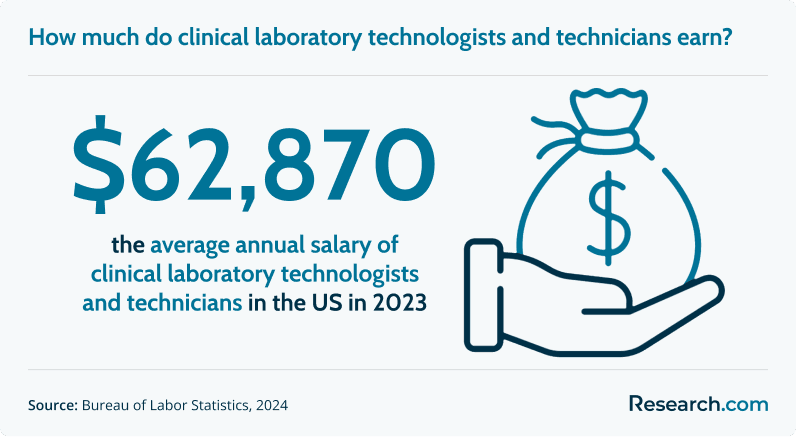
Online medical lab tech programs can be a practical option if they are properly accredited, include in-person clinical training, and prepare students for certification and employment requirements. Most programs lead to an associate degree, take about two years, and combine online science coursework with supervised laboratory experience at approved healthcare sites. The US Bureau of Labor Statistics projects 5% employment growth for medical laboratory technicians from 2022 to 2032, and reported wages vary by source and year, including approximately $57,380, $60,780, and an average annual wage of $62,870 in cited data.
Key Things You Should Know About Medical Lab Tech Programs
- Typical completion time. Most MLT associate programs take around two years and require 60 to 75 credit hours. Some accelerated formats may be completed in 12 to 18 months when students have transfer credits, prior healthcare coursework, or the ability to study full time.
- Online does not mean fully remote. Lecture-based coursework may be delivered online, but clinical practicums must be completed in person at hospitals, diagnostic laboratories, clinics, or other approved facilities.
- Accreditation matters. Students should confirm that the program is accredited and that it supports certification, employment, and any applicable state licensure requirements before enrolling.
- Costs vary widely. Online MLT program expenses may range from $8,000 to $25,000, while some programs discussed in this guide show tuition estimates between $6,660 and $24,975 based on credit requirements and listed per-credit rates.
- Financial aid may be available. Eligible students may use federal aid, scholarships, grants, employer tuition assistance, and institutional support to lower out-of-pocket costs.
- Career outcomes depend on credentials and clinical experience. Employers usually focus on certification eligibility, laboratory skills, clinical training, and program quality more than whether didactic courses were online.
What are the benefits of enrolling in medical lab tech programs online?
Online MLT programs are designed for students who need a more flexible route into laboratory healthcare work. They can be especially useful for working adults, parents, rural students, and learners who cannot relocate for a campus-based program. Instead of commuting several days a week for lectures, students may complete much of the academic coursework through online modules, recorded instruction, live virtual sessions, assignments, and simulations.
The main advantage is scheduling flexibility. Many students use online coursework to continue working while progressing toward an associate degree. This can reduce lost income and make the program easier to manage alongside family or caregiving responsibilities.
Online study may also reduce indirect expenses. Students may save on commuting, parking, housing, and some campus-based fees. However, online MLT programs are not automatically cheaper. Tuition, technology fees, textbooks, laboratory supplies, background checks, immunizations, and clinical placement costs can still add up. Some online programs report costs between $10,000 and $30,000, so students should compare the full cost of attendance rather than tuition alone.
The strongest online MLT programs do not weaken the laboratory component. They pair remote coursework with required clinical training so students can practice specimen collection, equipment use, quality control, testing procedures, and laboratory safety in real healthcare settings.
What can I expect from medical lab tech programs online?
An online medical lab tech program usually includes three parts: general education, laboratory science coursework, and in-person clinical practice. Students study core subjects such as hematology, microbiology, clinical chemistry, immunology, urinalysis, phlebotomy, and laboratory safety. Programs may use virtual labs and simulations, but these tools supplement hands-on training rather than replace it.
The clinical practicum is one of the most important parts of the program. Students must complete supervised training at an approved laboratory or healthcare facility. Clinical requirements differ by school, but many programs require 600 to 1,200 hours of hands-on work. Before enrolling, students should ask whether the school arranges clinical placements or expects students to find their own sites.
Students should also expect academic advising, access to online learning resources, communication with instructors, and career guidance. In a well-structured program, online learners should receive clear deadlines, technical support, clinical placement instructions, and preparation for certification or employment requirements.
| Program Component | What Students Usually Do | Why It Matters |
| Online science courses | Study microbiology, chemistry, hematology, immunology, and related laboratory concepts | Builds the theory needed to understand diagnostic testing and specimen analysis |
| Virtual labs or simulations | Practice decision-making, workflows, and case-based laboratory scenarios | Reinforces concepts before students enter clinical settings |
| In-person clinical practicum | Train under supervision in an approved medical or diagnostic lab | Develops the practical skills employers and certification bodies expect |
| Certification preparation | Review exam content, laboratory procedures, and professional standards | Helps graduates compete for entry-level MLT roles |
Where can I work after graduating from medical lab tech programs online?
Graduates of accredited online or hybrid MLT programs can pursue entry-level laboratory roles in many healthcare and scientific settings. Hospitals and diagnostic laboratories are common employers because they rely on technicians to process patient specimens, run tests, check results for accuracy, and communicate findings through established laboratory systems.
Other employment settings may include outpatient clinics, physician offices, blood banks, public health laboratories, biotechnology companies, pharmaceutical organizations, forensic laboratories, and research facilities. Duties vary by workplace. A hospital lab may require shift work and high-volume testing, while a research or biotechnology setting may focus more on quality control, data collection, or specialized procedures.
Some graduates later move into areas such as cytotechnology, histotechnology, molecular diagnostics, blood banking, or laboratory management. Advancement often requires experience, additional certification, or further education, such as a bachelor’s degree in medical laboratory science.
How much can I make with a certificate from medical lab tech programs online?
Medical lab technician pay depends on location, employer type, experience, shift schedule, certification, and specialization. The US Bureau of Labor Statistics has reported a median annual wage of $60,780 for this occupational area, while other cited figures in this article include approximately $57,380 and an average annual wage of $62,870 in 2024. These figures should be treated as reference points rather than salary guarantees.
MLTs in higher-cost or high-demand regions may earn more. The original data notes that some professionals in metropolitan areas can earn $70,000 or more annually, especially in states such as California, New York, and Massachusetts. Specialized laboratory areas, including molecular diagnostics and blood banking, may also offer stronger earning potential for experienced technicians.
Career growth can increase earnings over time. Some MLTs continue their education and become medical lab scientists, move into supervisory roles, enter quality assurance, teach, or work in research. The article data notes that medical lab scientists may average $80,000 or higher, depending on role and setting.
- Best medical lab tech schools and online programs for 2027
- How long does an online medical lab tech program take for 2027?
- How do online and campus-based MLT programs differ?
- What is the average cost of an online medical lab tech program?
- What financial aid can online MLT students use?
- What prerequisites do online MLT programs require?
- What courses are included in online MLT programs?
- What MLT specializations are available online?
- How should you choose the best online MLT program?
- Do employers respect online medical lab tech degrees?
- What jobs can graduates pursue after online MLT programs?
- Can extra certifications improve MLT career options?
- What is the job market for online MLT graduates?
- Do online MLT programs offer career services?
- Are online MLT programs accredited and quality-assured?
- Can additional credentials help online MLT graduates advance?
- Can MLT graduates move into medical coding?
- What challenges should online MLT students expect?
- How are new technologies changing online MLT education?
- How can online MLT graduates keep building credentials?
- Can an online MLT degree lead to advanced healthcare roles?
Best Medical Lab Tech Schools & Online Programs for 2027
The programs below are examples of medical laboratory technology pathways with online or hybrid elements. Use this list as a starting point, not as the only factor in your decision. Before applying, verify current tuition, clinical placement rules, accreditation status, certification exam eligibility, state requirements, and whether the program accepts students from your location.
| School | Program | Credits | Listed Cost | Accreditation |
| Weber State University | MLT Associate of Applied Science Online | 73-77 credits | $299.00 per credit hour | National Accrediting Agency for Clinical Laboratory Science (NAACLS) |
| Louisiana State University - Alexandria | Associate of Science in Medical Laboratory Science | 72 credits | $325.00 per credit | National Accrediting Agency for Clinical Laboratory Science (NAACLS) |
| Albany State University | Medical Laboratory Technology, Career Associate of Science | 70 semester hours | $111.00 per credit; $403 online fee | National Accrediting Agency for Clinical Laboratory Science (NAACLS) |
| Lake Land College | Associate of Applied Science in Medical Laboratory Technology | 65 credit hours | $152.80 for Lake Land residents; $181.10 for out-of-county residents; $359.10 for out-of-state residents | National Accrediting Agency for Clinical Laboratory Science (NAACLS) |
| Mercer County Community College | Associate in Applied Science in Medical Laboratory Technology (Hybrid) | 60 credits | $221.25 for Mercer residents; $325.25 for non-Mercer residents; $382.25 for out-of-state residents | National Accrediting Agency for Clinical Laboratory Science (NAACLS) |
1. Weber State University – MLT Associate of Applied Science Online
Weber State University offers an online Associate of Applied Science in Medical Laboratory Technician education for students preparing to enter clinical laboratory work. The program requires 73-77 credit hours and is structured to be completed in two years. Coursework covers major laboratory areas such as clinical chemistry, microbiology, hematology, and immunohematology.
At $299 per credit hour, the program may appeal to students seeking an online format with a defined clinical training pathway. Students should confirm clinical placement expectations, certification preparation, and state eligibility before enrolling.
Program Length: 2 years
Credits: 73-77 credits
Cost per Credit: $299.00
Tracks/Concentrations: N/A
Accreditation: National Accrediting Agency for Clinical Laboratory Science (NAACLS)
2. Louisiana State University - Alexandria – Associate of Science in Medical Laboratory Science
Louisiana State University - Alexandria offers an Associate of Science in Medical Laboratory Science that prepares students for diagnostic laboratory responsibilities. The two-year, 72-credit program combines science instruction with clinical experience so students can build competence in laboratory methods, instrumentation, specimen testing, and data interpretation.
The program is intended to support preparation for medical laboratory technician certification and entry-level employment in hospitals, clinics, research laboratories, and related settings. Students interested in later advancement can also use this foundation to explore further laboratory science study.
Program Length: 2 years
Credits: 72 credits
Cost per Credit: $325.00 per credit
Tracks/Concentrations: N/A
Accreditation: National Accrediting Agency for Clinical Laboratory Science (NAACLS)
3. Albany State University – Medical Laboratory Technology, Career Associate of Science
Albany State University provides a Medical Laboratory Technology Career Associate of Science for students who want training in laboratory testing and diagnostic procedures. The two-year program includes 70 semester hours and develops technical knowledge in clinical chemistry, hematology, microbiology, and related laboratory areas.
Students complete academic coursework and practical clinical experiences intended to prepare them for certification and entry-level work in medical laboratories, hospitals, and research environments.
Program Length: 2 years
Credits: 70 semester hours
Cost per Credit: $111.00 per credit; $403 online fee
Tracks/Concentrations: N/A
Accreditation: National Accrediting Agency for Clinical Laboratory Science (NAACLS)
4. Lake Land College – Associate of Applied Science in Medical Laboratory Technology
Lake Land College offers an Associate of Applied Science in Medical Laboratory Technology that emphasizes applied laboratory skills. The program requires 65 credit hours across two years and includes instruction in laboratory procedures, quality control, specimen analysis, and clinical testing methods.
Clinical rotations are a key part of the student experience. These supervised placements help students practice real-world workflows and prepare for work in hospitals, diagnostic laboratories, and related healthcare settings.
Program Length: 2 years
Credits: 65 credit hours
Cost per Credit: $152.80 for Lake Land residents; $181.10 for out-of-county residents; $359.10 for out-of-state residents
Tracks/Concentrations: N/A
Accreditation: National Accrediting Agency for Clinical Laboratory Science (NAACLS)
5. Mercer County Community College – Associate in Applied Science in Medical Laboratory Technology (Hybrid)
Mercer County Community College offers a hybrid Associate in Applied Science in Medical Laboratory Technology. The program blends online coursework with in-person laboratory and clinical requirements, making it a better fit for students who want flexibility but still need structured hands-on training.
The two-year, 60-credit curriculum prepares students for entry-level clinical laboratory work through a combination of science courses, technical instruction, and supervised practice.
Program Length: 2 years
Credits: 60 credits
Cost per Credit: $221.25 for Mercer residents; $325.25 for non-Mercer residents; $382.25 for out-of-state residents
Tracks/Concentrations: N/A
Accreditation: National Accrediting Agency for Clinical Laboratory Science (NAACLS)
How long does it take to complete a medical lab tech program online for 2027?
Most online medical lab tech programs take about two years and lead to an associate degree. Credit requirements commonly fall between 60 and 75 credits, although the programs listed here range from 60 to 77 credits. Some accelerated options may allow completion in 12 to 18 months, depending on transfer credits, prior coursework, clinical scheduling, and whether the student can study full time.
This timeline is similar to other healthcare pathways that combine academic coursework with practical training, such as affordable accelerated nursing programs. However, MLT students should not evaluate speed alone. A shorter program is only valuable if it still includes required clinical hours, prepares students for certification, and meets employer expectations.
According to the National Center for Education Statistics, the average time to complete an associate degree is about 2.3 years. MLT students may take longer if they attend part time, wait for a clinical placement, repeat science prerequisites, or need additional general education courses.
Because many students can complete a medical lab tech degree relatively early in their careers, younger adults are strongly represented in the field. The original workforce data notes that the 25-29 age range dominates the industry.
How does an online medical lab tech program compare to an on-campus program?
Online and campus-based MLT programs can lead to similar career outcomes when both are accredited and include supervised clinical training. The biggest difference is not the credential itself; it is how students complete lectures, labs, scheduling, peer interaction, and clinical coordination.
| Factor | Online or Hybrid MLT Program | On-Campus MLT Program | Best Fit |
| Course delivery | Many lectures and assignments are completed remotely | Students attend scheduled classes on campus | Online works well for students who need flexibility |
| Clinical training | Still required in person at approved sites | Usually arranged through local campus partners | Campus may be easier if you want built-in local lab access |
| Schedule | May include asynchronous coursework, depending on the school | Usually follows fixed class and lab times | Online may suit working adults and caregivers |
| Learning style | Requires self-direction, time management, and comfort with technology | Offers more face-to-face structure and immediate lab access | Campus may be better for students who need frequent in-person support |
| Cost considerations | May reduce commuting or housing costs | May include more campus-based expenses | Compare full cost, not only tuition |
- Flexibility. Online formats often make it easier to balance school with employment or family responsibilities.
- Clinical placement. Remote coursework does not remove the need for in-person clinical hours. Students must verify how placements are handled before enrolling.
- Technology. Online programs may use virtual simulations and digital lab tools, while campus programs provide more immediate access to physical laboratories.
- Cost. Online study may reduce transportation and housing expenses. A similar trade-off appears in other fields, such as choosing a behavioral psychology degree online instead of a campus option.
- Employer recognition. Accredited online and campus programs can both be respected when graduates meet certification and clinical training standards.
The better choice depends on your schedule, learning style, location, budget, and access to clinical sites. If you live far from partner laboratories or need extensive in-person support, a campus or local hybrid program may be more practical.
What is the average cost of a medical lab tech program online?
Online MLT program costs vary by school, residency status, credit load, fees, and clinical requirements. Based on the program data listed here, tuition per credit ranges from $111 at Albany State University to $325 at Louisiana State University - Alexandria. With programs requiring 60 to 77 credits, estimated tuition ranges from $6,660 to $24,975, depending on the institution.
These totals may not include every expense. Students should budget for textbooks, lab supplies, uniforms, immunizations, background checks, drug screening, technology fees, travel to clinical sites, and certification exam preparation. Some schools may also charge online course fees or clinical placement fees.
For context, the average annual cost of attending a community college in the United States is approximately $7,560, including tuition and fees. Across a two-year associate program, that totals about $15,120. Many online MLT programs are broadly comparable to this range, but the final cost depends on residency status and school policies.
Students comparing healthcare credentials may also review the cheapest medical coding certification online if they want a shorter administrative healthcare path or a complementary credential.
What are the financial aid options for students enrolling in a medical lab tech program online?
Financial aid can make an online MLT program more affordable, but eligibility depends on the school, the student’s enrollment status, and whether the program qualifies for federal aid. The National Center for Education Statistics reports that 72% of undergraduate students receive some type of financial aid, making it important for students to compare aid packages carefully.
- Federal Student Aid. Students should complete the FAFSA to be considered for federal grants, loans, and work-study. Pell Grants do not require repayment and may provide up to $7,395 per year for eligible students.
- Scholarships and grants. Colleges, state agencies, professional associations, and private organizations may offer awards for students in laboratory science or healthcare programs.
- Employer tuition assistance. Some hospitals, laboratories, and healthcare organizations help employees pay for education in high-need fields.
- State and institutional aid. Depending on location and school policy, students may qualify for state grants, tuition discounts, or college-funded scholarships.
- Private loans. Private student loans may fill funding gaps, but they often have different interest rates, credit requirements, and repayment protections than federal loans.
| Funding Option | Best For | Question to Ask |
| FAFSA-based federal aid | Students seeking grants, loans, or work-study | Is this MLT program eligible for federal student aid? |
| Scholarships | Students with academic merit, financial need, or healthcare career goals | Does the school list MLT-specific scholarships? |
| Employer tuition support | Current healthcare employees | Will my employer reimburse tuition or require a work commitment? |
| State aid | Residents attending eligible in-state institutions | Are online or hybrid programs covered under my state’s aid rules? |
| Private loans | Students with remaining balances after other aid | What are the interest rate, fees, and repayment terms? |
What are the prerequisites for enrolling in a medical lab tech program online?
Online MLT programs set admission requirements to make sure students are ready for college-level science and clinical training. Requirements differ by school, but most programs expect a high school diploma or GED, science preparation, and documentation needed for healthcare placements.
- High school diploma or GED. This is the usual minimum education requirement. Some programs may also review GPA or placement test results.
- Science and math background. Biology, chemistry, and algebra are commonly required or strongly recommended because MLT coursework is science-intensive.
- Health documentation. Clinical sites may require immunization records, TB testing, and other health screenings.
- Background check and drug screening. Because students train in healthcare environments, many programs require screenings before clinical placement.
- Technical readiness. Online students need reliable internet, a suitable computer, and the ability to use learning platforms, video tools, and digital lab resources.
Before applying, request the official admissions checklist and clinical eligibility policy. A student may be admitted to the academic portion of a program but still face delays if clinical documentation, background requirements, or local placement options are incomplete.
What courses are typically in a medical lab tech program online?
Online MLT curricula combine general education with specialized laboratory science. The goal is to prepare students to handle specimens, operate instruments, follow safety procedures, recognize abnormal findings, and support accurate diagnostic testing.
- General education. Courses such as English composition, mathematics, psychology, or communication help students build writing, quantitative, and interpersonal skills.
- Clinical chemistry. Students learn how chemical analysis of blood and other fluids supports diagnosis and patient monitoring.
- Hematology. Coursework covers blood cells, coagulation, blood disorders, and related laboratory testing.
- Microbiology. Students study microorganisms and testing methods used to identify bacteria, fungi, parasites, and other pathogens.
- Immunology and serology. These courses examine immune responses, antibody-antigen reactions, and related diagnostic methods.
- Urinalysis and body fluids. Students learn how to evaluate urine and other specimens for clinical clues.
- Phlebotomy and specimen handling. Training may include blood collection, labeling, processing, and chain-of-custody procedures.
- Ethics, safety, and regulations. Students study laboratory safety, patient confidentiality, HIPAA expectations, and professional conduct.
- Clinical practicum. Supervised in-person training lets students apply their knowledge in an actual laboratory environment.
What types of specializations are available in a lab tech program online?
Some MLT programs offer formal concentrations, while others introduce specializations through electives, clinical rotations, or post-graduation certificates. Specialization can help students target specific laboratory settings, but entry-level MLT programs usually focus first on broad clinical competency.
- Clinical chemistry. Focuses on chemical testing of blood and body fluids, often using automated instruments.
- Microbiology. Emphasizes identification of bacteria, viruses, fungi, and parasites for infectious disease diagnosis.
- Hematology. Covers blood cells, coagulation studies, and disorders involving blood-forming tissues.
- Immunology and serology. Examines immune system testing, autoimmune indicators, allergy-related testing, and vaccine-related laboratory concepts.
- Molecular diagnostics. Uses DNA and RNA-based testing in areas such as genetic disorders, cancer diagnostics, and forensic applications.
Students interested in broader health sciences may also compare laboratory training with an affordable exercise science degree, although that pathway focuses more on human movement, physiology, and performance than clinical specimen testing.
How to choose the best medical lab tech program online?
The best online MLT program is the one that aligns with your state requirements, clinical access, budget, schedule, and career plans. A low tuition rate or fast timeline is not enough if the program does not prepare you for certification or cannot support clinical placement where you live.
- Confirm accreditation first. Look for accreditation from the National Accrediting Agency for Clinical Laboratory Sciences (NAACLS) or another recognized accrediting structure relevant to the program.
- Ask about clinical placements. Find out whether the school places students, provides a list of approved partners, or requires students to secure their own sites.
- Check state eligibility. If your state has licensure or specific certification expectations, confirm in writing that the program meets those requirements.
- Compare full costs. Include tuition, fees, textbooks, lab materials, travel, immunizations, background checks, and exam costs.
- Review student outcomes. Ask for completion rates, certification exam pass rates, job placement data, and clinical placement success rates.
- Evaluate online support. Strong programs provide advising, tutoring, instructor access, technical help, and career services for remote students.
Choosing a program should be more rigorous than simply searching for the fastest or easiest option. Similar to evaluating the easiest business major, students should look beyond convenience and ask whether the program supports their long-term goals.
| Question to Ask Before Enrolling | Why It Matters |
| Is the program accredited for medical laboratory technology? | Accreditation can affect certification eligibility, employer confidence, and transfer options. |
| Who arranges my clinical practicum? | Clinical placement delays can extend your graduation timeline. |
| Does the program meet requirements in my state? | Some states or employers may have specific credential expectations. |
| What are the certification exam pass rates? | Pass rates can indicate how well the curriculum prepares students. |
| What is the total estimated cost? | Fees and clinical expenses can significantly change affordability. |
| Can I complete clinical hours near my home? | Online students may still need to travel if local sites are unavailable. |
Do employers value online medical lab tech degrees?
Employers can value online MLT degrees when the program is accredited, includes verified clinical training, and prepares graduates for certification. In most hiring decisions, the delivery format matters less than whether the applicant can perform laboratory procedures safely, follow quality control standards, document results accurately, and work effectively in a clinical environment.
Students should be cautious with programs that advertise fully online laboratory credentials without explaining how clinical training is completed. A credible online MLT program should clearly describe its practicum expectations, partner sites, supervision model, and certification preparation.
Students who want to broaden their healthcare skill set may also compare laboratory training with administrative pathways such as the best school for medical coding, especially if they are interested in health information, claims, and coding rather than specimen testing.
What career paths are available for graduates of medical lab tech programs online?
Graduates of accredited online or hybrid MLT programs can pursue laboratory and healthcare support roles in hospitals, diagnostic laboratories, clinics, research organizations, and biotechnology settings. The right path depends on certification, state rules, clinical experience, and the type of lab work the graduate wants to perform.
- Medical laboratory technician. Performs routine laboratory tests on patient specimens to support diagnosis, treatment, and monitoring.
- Phlebotomist. Draws blood for laboratory testing, transfusion, donation, or related medical purposes.
- Research laboratory assistant. Supports scientific studies in academic, clinical, private, or biotechnology research environments.
- Specialized laboratory technologist. With additional education or experience, may focus on microbiology, hematology, molecular diagnostics, or another laboratory area.
- Laboratory management or education. Experienced professionals may move into supervisory, training, quality assurance, or teaching roles.
Career selection should reflect your interests and tolerance for laboratory workflows. For example, students comparing healthcare and behavioral science options may also explore the easiest psychology degree online, though psychology careers generally involve a different education and licensing pathway.
Can supplementary certifications enhance career prospects for online MLT graduates?
Additional certifications can help MLT graduates demonstrate focused skills, especially when they support a clear career goal. For example, a laboratory professional may pursue training in phlebotomy, molecular diagnostics, quality control, blood banking, or health information depending on the role they want.
Supplementary credentials are most useful when they complement, rather than distract from, laboratory competency. A graduate interested in administrative healthcare work may consider a 4-week online course for medical coding and billing to understand documentation and coding basics, but that credential serves a different function than MLT certification.
What is the job market for graduates with a medical lab tech program online degree?
The job market for MLT graduates is supported by ongoing demand for diagnostic testing in hospitals, clinical laboratories, outpatient centers, and related settings. According to the Bureau of Labor Statistics, employment for clinical laboratory technologists and technicians is projected to grow 5% from 2023 to 2033. Earlier data cited in this article also noted 5% projected growth from 2022 to 2032.
The BLS reported that the average annual wage for medical laboratory technicians was $62,870 in 2024. Actual pay may be higher or lower depending on region, credentials, shift differentials, experience, and employer type. Graduates with accredited training, strong clinical evaluations, certification eligibility, and comfort with modern laboratory systems are generally better positioned for employment.
What Graduates Have to Say About Their Medical Lab Tech Program Online
-
: "
"Cost was the reason I chose an online medical lab tech program. Campus programs were more than I could manage, and I wanted to avoid heavy debt. I completed my coursework online, finished clinical training close to home, and now work in a diagnostic lab without feeling financially overwhelmed." - Doug
"
-
: "
"I expected online learning to feel distant, but my instructors were responsive and the simulations helped me practice the material. Being able to replay lessons made a big difference. When I started my externship, I felt prepared instead of lost." - Susan
"
-
: "
"I worried that studying online would limit networking, but I ended up building a strong group of classmates. We studied together virtually, traded exam tips, and shared job openings. Online learning did not mean learning alone." - Jasmine
"
May online MLT programs provide robust career support services?
Many online MLT programs offer career services, but the depth of support varies. Useful services may include resume feedback, interview preparation, certification exam guidance, clinical placement coordination, alumni contacts, employer partnerships, and job search advising.
Students should ask whether career support is available to online learners or only to students near campus. A strong program should help remote students understand local employer expectations, prepare for certification, and document clinical competencies. Students interested in administrative healthcare roles may also review online medical coding classes with financial aid as a related but distinct pathway.
Are Online MLT Programs Accredited and Quality-Assured?
Accreditation is one of the most important checks when evaluating an online MLT program. Students should verify that the program is accredited by a recognized body such as the National Accrediting Agency for Clinical Laboratory Science (NAACLS), and they should confirm that accreditation applies to the specific program, not only the institution.
Quality assurance also includes certification exam pass rates, clinical site quality, instructor qualifications, curriculum updates, laboratory safety training, and graduate outcomes. If a school cannot clearly explain these areas, students should proceed carefully.
Students considering broader science-focused study may also compare MLT training with affordable online biology degree programs, but biology degrees and MLT programs typically lead to different credentials and job functions.
Can additional certifications boost the career of an online MLT graduate?
Additional certifications can strengthen an MLT graduate’s profile when they match the graduate’s target role. Credentials in specialized testing, phlebotomy, laboratory quality, or health information can help professionals show continued learning and a wider skill base.
However, certifications should be chosen strategically. Students should first identify the job they want, then check employer postings and certification requirements. Some learners may explore medical certificate online programs to add focused healthcare training, but they should avoid spending money on credentials that employers in their area do not request.
Can MLT Graduates Transition to Medical Coding Careers?
MLT graduates can move into medical coding, but it is a career change rather than a direct laboratory advancement. Laboratory experience can help because MLTs understand medical terminology, diagnostic testing, and clinical documentation. Still, coding roles require separate knowledge of coding systems, reimbursement rules, health records, and payer requirements.
Graduates considering this move should research certification expectations, job postings, and training requirements before leaving the lab pathway. A practical first step is learning how to become a medical coder and comparing the work environment, salary expectations, and credential process with MLT roles.
What are the potential challenges of pursuing an online MLT degree?
Online MLT programs can be convenient, but they are not easy shortcuts. Students must manage science-heavy coursework, complete clinical hours, stay organized, and communicate with instructors and clinical coordinators.
| Common Mistake | Why It Causes Problems | Better Approach |
| Choosing a program before checking accreditation | It may affect certification eligibility and employer acceptance | Verify program-level accreditation before applying |
| Assuming online means no clinical training | MLT education requires hands-on laboratory practice | Ask where and how clinical hours are completed |
| Comparing only tuition | Fees, supplies, travel, and screenings can increase total cost | Request a full cost estimate from each school |
| Ignoring state requirements | Some locations or employers may expect specific credentials | Confirm state eligibility and certification preparation in writing |
| Underestimating time management | Online science courses can be demanding and deadline-driven | Create a weekly study plan before classes begin |
| Relying only on rankings | A highly ranked program may not fit your location or clinical needs | Compare outcomes, clinical access, cost, and student support |
Students who want a shorter patient-care entry point may compare MLT programs with a medical assistant program, but medical assisting and laboratory technology involve different duties, training depth, and career outcomes.
How are emerging technologies shaping online MLT programs?
Online MLT education increasingly uses virtual simulations, digital learning platforms, remote case studies, and laboratory information system concepts to prepare students for modern diagnostic environments. These tools can help students understand workflows before entering clinical sites.
Technology is also changing the laboratory profession itself. Automation, digital lab management, data analytics, and AI-supported diagnostic tools are influencing how specimens are processed, how results are reviewed, and how technicians interact with laboratory systems. Students should look for programs that teach not only classic laboratory methods but also quality control, data accuracy, instrumentation, and professional judgment.
Learners interested in broader health technology and movement science may also review an accelerated kinesiology degree online, though kinesiology is not a substitute for MLT training.
How Can Online MLT Graduates Enhance Their Professional Credentials through Continuing Education?
Continuing education helps MLT graduates stay current with laboratory methods, regulations, equipment, and certification expectations. Useful areas may include molecular diagnostics, laboratory management, clinical research, quality assurance, public health, and specialized testing.
Graduates should choose continuing education based on a career plan. A technician who wants leadership experience may focus on management and quality systems. A technician interested in advanced testing may pursue molecular or specialty laboratory training. Those considering broader health and wellness education may explore how to become a certified nutritionist, but that path has different credentialing and career requirements.
Can an Online MLT Degree Open Doors to Advanced Healthcare Opportunities?
An online MLT degree can be a starting point for more advanced healthcare education. Graduates may later pursue a bachelor’s degree in medical laboratory science, laboratory management, public health, clinical research, or other health-related fields. Some may move toward supervisory roles, specialized diagnostics, teaching, or research support.
Students with long-term interest in pharmacy or pharmaceutical sciences may compare laboratory science experience with a cheap online doctorate in pharmacy program. However, advanced healthcare degrees often have separate admissions requirements, prerequisites, accreditation standards, and licensure considerations. Students should map these requirements early so credits and experience support, rather than delay, the next step.
Practical Steps Before You Apply
- Confirm the credential. Make sure the program leads to the degree or certificate required for the MLT jobs you want.
- Verify accreditation. Check program-level accreditation with the accreditor, not only the school’s website.
- Ask about certification eligibility. Request written confirmation that graduates are prepared for relevant certification pathways.
- Check state rules. Contact your state board or relevant agency if licensure or specific credentials may be required.
- Review clinical placement policies. Ask whether clinical sites are guaranteed, competitive, local, or student-arranged.
- Calculate total cost. Include tuition, fees, books, supplies, travel, health screenings, and exam expenses.
- Compare outcomes. Ask about graduation rates, certification pass rates, and job placement data.
- Talk to current students or graduates. Ask about workload, instructor responsiveness, clinical scheduling, and career support.
Key Insights
- Online MLT programs can be legitimate, but clinical training is non-negotiable. A quality program combines remote coursework with supervised in-person laboratory experience.
- Accreditation should be your first filter. Program-level accreditation affects certification preparation, employer trust, and professional mobility.
- Most students should expect a two-year timeline. Some programs advertise 12 to 18 month options, but clinical placement and transfer credit policies can change the actual completion date.
- Costs must be compared beyond tuition. Listed per-credit rates do not always include lab supplies, clinical travel, background checks, immunizations, fees, or certification expenses.
- Employers focus on skills and credentials. Graduates from accredited online or hybrid programs can compete when they have strong clinical experience and meet certification or licensure expectations.
- The field offers stable healthcare opportunities. The Bureau of Labor Statistics projects 5% growth for clinical laboratory technologists and technicians from 2023 to 2033, with cited wage figures including $60,780 and $62,870 depending on measure and year.
- The best program is the one that fits your location and goals. A fast or inexpensive program is not a good choice if it cannot place you clinically, prepare you for certification, or meet your state’s requirements.
References:
- Data USA. (2025). Clinical laboratory technologists & technicians. datausa.io
- National Center for Education Statistics. (26 Jul 2023). Nearly three-quarters of undergraduates received some type of financial aid in 2019-20. nces.ed.gov
- National Center for Education Statistics. (2024). Fast facts: Financial aid (31). nces.ed.gov
- O*NET OnLine. (2025). Medical and clinical laboratory technologists. onetonline.org
- US Bureau of Labor Statistics. (29 Aug 2024). Clinical laboratory technologists and technicians. bls.gov
- US Bureau of Labor Statistics. (3 Apr 2024). 29-2010 clinical laboratory technologists and technicians. bls.gov
Other Things You Should Know About Medical Lab Tech Programs Online
In 2027, admissions requirements for online medical lab tech programs typically include a high school diploma or GED, completion of prerequisite science courses, a minimum GPA, and occasionally standardized test scores. Some programs may also require letters of recommendation, a personal statement, and relevant experience in a healthcare setting.
The job outlook for medical lab tech graduates in 2027 is promising, with a projected growth rate of 7% from 2026 to 2036, according to the U.S. Bureau of Labor Statistics. This demand is driven by increased testing needs in healthcare facilities.
Top online medical lab tech programs in 2027 incorporate virtual simulations and remote lab kits to provide hands-on training. These resources emulate physical labs, ensuring students gain practical skills. Additionally, partnerships with local healthcare facilities enable clinical rotations, bridging the gap between online learning and real-world experience.
In 2027, top online medical lab tech programs excel through accredited curricula, experienced faculty, and hands-on clinical practice components. These features ensure students receive quality education and gain practical experience. Flexible scheduling and robust student support services further enhance learning experiences in these programs.


