
2027 Highest-Paying Occupational Therapist Specialties to Pursue

Co-Founder and Chief Data Scientist
Occupational therapists in the U.S. can earn more than $129,000 a year when they choose the right specialty and work setting. With demand for these professionals projected to grow by 14% in the next decade, choosing the right path can mean higher pay, better job security, and more fulfilling work.
This article breaks down the highest-paying occupational therapist specialties to pursue in 2027, what credentials they require, and where the best opportunities lie. By the end, you’ll know which specialization could maximize both your income and career growth.
Key Things You Should Know About Occupational Therapist Specialties
- Occupational therapy specialties allow practitioners to focus on specific populations or conditions, such as pediatrics, neurology, or hand therapy. Specializing often requires additional certifications, but it can significantly increase earning potential and create opportunities in high-demand healthcare settings.
- Salary levels vary widely between specialties, with some roles offering six-figure incomes while others pay closer to the median. Choosing a specialty aligned with both financial goals and personal interests is crucial to ensuring career satisfaction and professional longevity.
- Job outlook differs by specialty and setting. For example, home healthcare and geriatric care are projected to grow rapidly as the population ages. Understanding workforce trends helps occupational therapists select specialties that not only pay well but also offer long-term stability.
- What are the highest-paying occupational therapist specialties to pursue in 2027? Top-Paying Specialties
- What certifications or credentials do I need for top-paid OT specialties? Certifications
- What skills or personal traits are best suited for each OT specialty? Skills & Traits
- How competitive are admissions or entry into specialized OT roles? Admissions Competitiveness
- What are the typical work settings and responsibilities by specialty? Work Settings
- How long does it take to train or certify in each high-earning OT specialty? Training Timeline
- How Can Non-Clinical Certifications Enhance My OT Career? How Can Non-Clinical Certifications Enhance My OT Career?
- What is the return on investment (ROI) for becoming specialized in OT? ROI
- Are there geographic differences in pay for OT specialties? Are there geographic differences in pay for OT specialties?
- How do lifestyle factors (like work–life balance) vary across OT specialties? How do lifestyle factors (like work–life balance) vary across OT specialties?
Highest-paying occupational therapist specialties in 2027: what to know before choosing a path
Choosing an occupational therapy specialty is not just a clinical preference. It affects your salary range, work setting, certification timeline, patient population, schedule, and long-term career mobility. The U.S. Bureau of Labor Statistics (BLS) reports a median salary of $98,340 for occupational therapists overall, but pay can vary widely by specialty, location, employer type, and advanced credentials.
This guide is for OT students, licensed occupational therapists, and career changers comparing specialty options in 2027. It explains which OT specialties tend to pay the most, which are in demand, what certifications may be required, how long specialization can take, and how to weigh salary against lifestyle, job stability, and patient impact.
Quick answer: which OT specialties pay the most?
The highest-paying occupational therapy specialties are typically those tied to complex medical rehabilitation, neurological recovery, aging-related care, and advanced upper-extremity practice. Physical rehabilitation is closely aligned with the overall BLS median for occupational therapists at $98,340, or about $47 per hour. Several specialized roles, including gerontology, brain injury, mental health, and neurology, are reported by ZipRecruiter at about $94,375 annually, or $45.37 per hour. Hand therapy is also a strong-paying path, with ZipRecruiter reporting about $94,297, or roughly $45.34 per hour.
Lower-paying but still meaningful specialties include pediatrics, autism-focused pediatric OT, and driving and community mobility. These areas may appeal to therapists who prioritize a specific population, school-based schedules, or independence-focused community work over maximizing salary alone.
| OT specialty | Reported pay | Best fit for | Main trade-off |
| Physical Rehabilitation (BCPR) | $98,340, or about $47 per hour | OTs who want broad hospital, outpatient, and post-acute opportunities | Physically demanding caseloads and complex recovery plans |
| Gerontology (BCG) | $94,375, or $45.37 per hour | OTs interested in aging, fall prevention, home safety, and chronic condition support | Work may involve long-term care, home health travel, or high medical complexity |
| Brain Injuries (CBIS) | $94,375, or roughly $45.37 per hour | Therapists drawn to stroke, traumatic brain injury, and cognitive rehabilitation | Requires patience, advanced neuro knowledge, and family education skills |
| Mental Health (Psychiatric OT) | $94,375 per year, equivalent to $45.37 per hour | OTs who want to support routines, coping skills, participation, and recovery | Emotionally intensive settings may require strong boundaries |
| Neurology (CNS) | $94,375 annually, about $45.37 per hour | OTs interested in Parkinson’s disease, multiple sclerosis, spinal cord injury, and motor-cognitive recovery | Complex cases often require ongoing professional development |
| Hand Therapy (CHT) | $94,297, or roughly $45.34 per hour | OTs who enjoy orthopedic rehabilitation, splinting, and precise upper-extremity care | Credentialing requires extensive experience and direct practice hours |
| Pediatrics (BCP) | $86,665, or about $41.67 per hour | OTs who want to help children with development, school participation, and daily function | Pay may be lower than adult medical specialties |
| Autism-focused pediatric OT | $67,585 per year, translating to around $32–33 per hour | Therapists committed to sensory, developmental, and family-centered autism support | Compensation may lag behind demand and specialization needs |
| Driving & Community Mobility (CDRS) | $53,201 annually, or $25.58 per hour | OTs focused on transportation independence and community reintegration | Lower reported pay compared with medical rehabilitation specialties |
Physical Rehabilitation (BCPR)
Physical rehabilitation is one of the most financially reliable OT paths because it connects directly to core healthcare needs: recovery after surgery, injury, illness, or functional decline. Therapists in this area help patients rebuild strength, mobility, self-care skills, endurance, and independence in daily activities.
The BLS reports a median annual wage for occupational therapists of $98,340, or about $47 per hour, which closely reflects the broad rehabilitation market. Work opportunities commonly exist in hospitals, skilled nursing facilities, inpatient rehabilitation centers, outpatient clinics, and home health. This specialty is a strong option for OTs who want clinical variety, steady demand, and a clear route into leadership, case management, or advanced rehabilitation practice.
Gerontology (BCG)
Gerontology focuses on older adults and the functional challenges that often come with aging, including fall risk, reduced mobility, chronic illness, cognitive changes, and home safety concerns. OTs in this specialty may recommend adaptive equipment, redesign routines, support caregivers, and help clients stay as independent as possible.
ZipRecruiter reports an average annual salary of about $94,375, or $45.37 per hour for OTs in gerontology. This specialty is especially relevant as older adults require more rehabilitation, long-term care, home-based support, and prevention-focused services. It suits therapists who communicate well with families, understand aging-related conditions, and are comfortable working across medical and community settings.
Brain Injuries (CBIS)
Occupational therapists with a Certified Brain Injury Specialist (CBIS) credential support people recovering from traumatic brain injuries, strokes, and related neurological events. Treatment may involve cognitive retraining, compensatory strategies, self-care relearning, visual-perceptual work, emotional adjustment, and return-to-work or return-to-school planning.
ZipRecruiter reports average earnings of $94,375 annually, or roughly $45.37 per hour. These roles are common in rehabilitation hospitals, trauma centers, outpatient neuro clinics, and post-acute programs. The work can be demanding because recovery is often nonlinear, but it can also be one of the most clinically rewarding OT specialties for therapists who enjoy complex problem-solving.
Mental Health (Psychiatric OT)
Mental health occupational therapists help clients build routines, manage symptoms, develop coping strategies, improve social participation, and return to meaningful daily activities. They may work with people experiencing depression, anxiety, substance use disorders, serious mental illness, trauma-related conditions, or difficulty functioning in school, work, or community life.
ZipRecruiter reports average pay of around $94,375 per year, equivalent to $45.37 per hour. Psychiatric OT can be a strong fit for therapists who are skilled at therapeutic communication, crisis awareness, group facilitation, and behaviorally informed care. It may not be the right path for someone who wants mostly hands-on physical rehabilitation or highly predictable clinical routines.
Neurology (CNS)
Neurology-focused occupational therapists work with patients affected by conditions such as multiple sclerosis, Parkinson’s disease, spinal cord injuries, and other neurological disorders. Their interventions often target motor control, balance, cognition, self-care, adaptive equipment use, fatigue management, and long-term independence.
ZipRecruiter places the average salary for neurology OTs at $94,375 annually, about $45.37 per hour. This specialty tends to be strongest in hospitals, rehabilitation centers, specialty clinics, and outpatient neuro programs. It is a good match for OTs who like evidence-based practice, detailed assessment, and long-term patient progress, but it requires ongoing learning because neurological care continues to evolve.
Hand Therapy (CHT)
Hand therapy is a highly technical specialty centered on the hand, wrist, elbow, and upper extremity. Certified Hand Therapists (CHTs) often collaborate with orthopedic surgeons, plastic surgeons, physical therapists, and rehabilitation teams after fractures, tendon repairs, nerve injuries, burns, repetitive strain injuries, or surgery.
According to ZipRecruiter, CHTs earn about $94,297, or roughly $45.34 per hour. This path can offer strong compensation and specialized clinical identity, but it requires a significant investment in experience and certification preparation. It is best for OTs who enjoy precision, anatomy, splinting, wound and scar management, and measurable functional outcomes.
Pediatrics (BCP)
Pediatric occupational therapists help children build the skills needed for school, play, self-care, feeding, sensory processing, motor development, and participation at home and in the community. They may work with children with developmental delays, physical disabilities, sensory needs, learning challenges, or complex medical conditions.
ZipRecruiter reports average annual salaries of $86,665, or about $41.67 per hour. Pediatric OT may pay less than adult medical rehabilitation specialties, but it offers strong mission alignment for therapists who want to work with children and families. Board Certification in Pediatrics (BCP) can strengthen professional credibility and may help with advancement in clinical, school-based, or program leadership roles.
Autism-focused pediatric OT
OTs who specialize in Autism Spectrum Disorder (ASD) often support sensory regulation, daily living skills, play, feeding, motor planning, school participation, communication-related routines, and family education. This specialty requires patience, creativity, and strong collaboration with caregivers, teachers, behavioral health providers, and other clinicians.
PayScale reports average salaries for pediatric OTs with ASD skills at about $67,585 per year, translating to around $32–33 per hour. The pay is lower than many adult medical specialties, but the work can be deeply meaningful for therapists who want to focus on early intervention and child development. It is also a specialty where families often seek providers with specific autism and sensory integration expertise.
Driving & Community Mobility (CDRS)
Driving and Community Mobility specialists help clients determine whether they can drive safely, return to driving after illness or injury, or use alternative transportation to stay active in the community. They may evaluate vision, cognition, reaction time, physical control, vehicle adaptations, route planning, and mobility options.
ZipRecruiter reports average pay for Certified Driver Rehabilitation Specialists (CDRS) at about $53,201 annually, or $25.58 per hour. This specialty is not usually the highest-paying OT path, but it has a clear purpose: helping people maintain autonomy, access work or appointments, and remain socially connected. For therapists comparing OT to other healthcare fields, it may be useful to review broader earning patterns among the highest paying health science jobs.
Which occupational therapy specialties are most in demand?
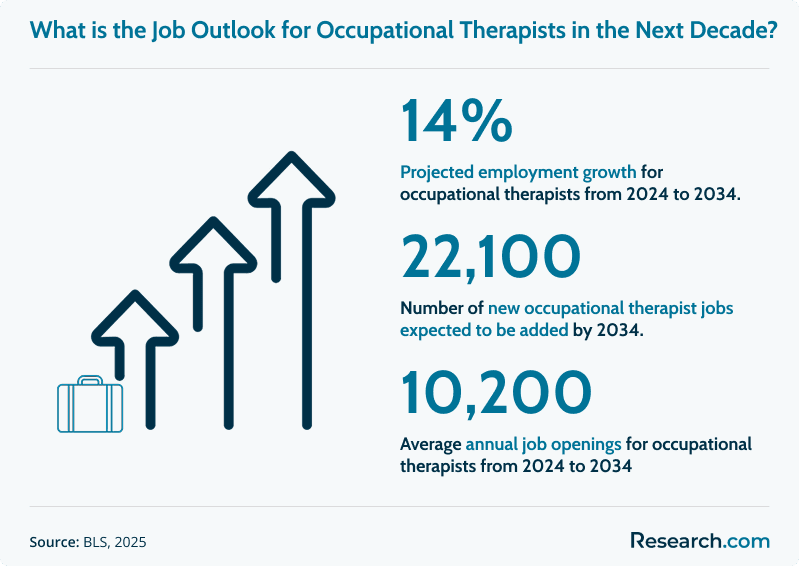
Occupational therapy demand is strongest where healthcare systems need help with aging, rehabilitation, neurological recovery, developmental support, and mental health. The BLS projects overall employment for occupational therapists to grow 14% between 2024 and 2034, adding more than 22,000 jobs nationwide.
Gerontology, physical rehabilitation, and neurology are likely to remain important because older adults often need support after falls, surgeries, strokes, chronic illness, and functional decline. Pediatrics and autism-focused practice also continue to matter as families, schools, and clinics seek early intervention and developmental services. Mental health OT is gaining attention as more care teams recognize that daily routines, participation, and functional recovery are central to behavioral health treatment.
Demand alone should not determine your specialty. A high-need area may still vary by region, employer budget, payer mix, and certification expectations. Before committing, review local job postings, ask practicing OTs about caseloads, and compare salary with schedule demands.
If you are still deciding whether OT is the right therapy profession, review broader training pathways such as what degree do you need to be a therapist. Occupational therapy usually requires graduate-level education, NBCOT exam completion, state licensure, and, for many specialties, additional credentials or documented clinical experience.
The visual below summarizes job growth, openings, and demand trends for occupational therapists, with the strongest opportunities often tied to aging, rehabilitation, neurological care, and developmental services.
What certifications do you need for high-paying OT specialties?
All occupational therapists must meet baseline professional requirements before specializing: complete an accredited OT program, pass the NBCOT exam, and obtain state licensure. Specialty credentials come later and are used to document advanced competence in a focused practice area. They can improve credibility, support promotion, and help applicants stand out for competitive clinical roles.
Certification is not always a guaranteed path to higher pay. Its value depends on your employer, setting, location, caseload, and whether the credential is required or preferred for the role. Still, for technical and high-acuity specialties, credentials often signal that you can manage more complex patients.
| Credential | Specialty area | Why it matters |
| Board Certification in Physical Rehabilitation (BCPR) | Adult rehabilitation and recovery after illness, injury, or surgery | Shows advanced rehabilitation knowledge and commitment to complex functional recovery |
| Certified Hand Therapist (CHT) | Hand, wrist, arm, and upper-extremity rehabilitation | Commonly valued in orthopedic and surgical rehabilitation settings |
| Certified Brain Injury Specialist (CBIS) | Traumatic brain injury, stroke, and cognitive-functional recovery | Signals focused preparation for neurological and brain injury care |
| Certified Autism Specialist (CAS) | Autism-focused pediatric or developmental practice | Supports work with ASD populations and family-centered intervention |
| Board Certification in Pediatrics (BCP) | Child development, school participation, pediatric disability, and family care | Validates advanced pediatric OT experience and clinical knowledge |
| Board Certification in Gerontology (BCG) | Aging, chronic conditions, fall prevention, and senior independence | Supports advancement in older adult, home health, long-term care, and rehabilitation roles |
| Certified Neuro Specialist (CNS) | Neurological rehabilitation | Demonstrates focused training in neurorehabilitation concepts and interventions |
Therapists interested in behavioral, developmental, or counseling-adjacent work can also compare OT preparation with related fields. This behavior therapist career guide offers useful context for professionals considering autism, mental health, or child-focused services.
What skills and traits fit each occupational therapy specialty?
The best OT specialty is not always the one with the highest salary. It should match how you like to solve problems, communicate with patients, handle stress, and measure progress. A hand therapist may thrive on anatomy and precision, while a pediatric OT may need creativity, flexibility, and strong family coaching skills. A mental health OT needs emotional steadiness and excellent therapeutic communication, while a neuro OT must be comfortable with slow, complex recovery.
| Specialty | Helpful strengths | What can make the role difficult |
| Physical rehabilitation | Clinical reasoning, stamina, teamwork, safe transfer skills, goal planning | Fast patient turnover and physically demanding caseloads |
| Gerontology | Patience, caregiver education, home safety knowledge, empathy | Complex chronic conditions and family decision-making |
| Brain injury | Neuro knowledge, problem-solving, emotional resilience, cognitive strategy training | Unpredictable recovery and behavior or communication challenges |
| Mental health | Therapeutic communication, crisis awareness, group facilitation, boundary setting | Emotional intensity and systems-level barriers to care |
| Neurology | Attention to detail, evidence-based practice, patience, motor and cognitive assessment | Long recovery timelines and high medical complexity |
| Hand therapy | Precision, anatomy knowledge, splinting, measurement, surgical protocol awareness | Technical credentialing and detailed documentation demands |
| Pediatrics | Creativity, family collaboration, play-based intervention, developmental knowledge | Progress can depend heavily on school, home, and caregiver support |
| Autism-focused OT | Sensory expertise, flexibility, caregiver coaching, patience | High family expectations and the need for interdisciplinary coordination |
| Driving and community mobility | Safety judgment, community assessment, adaptive equipment knowledge, communication | Lower reported pay and possible travel or scheduling variability |
Across specialties, employers still value core OT skills: patient care, documentation, communication, interdisciplinary collaboration, assessment, treatment planning, and ethical judgment. Compensation can also be affected by setting and scope, similar to the way role differences shape comparisons such as social worker vs therapist salary.
The chart below shows common occupational therapist skills employers look for today. Use it as a checklist when building your resume, choosing continuing education, or preparing for specialty interviews.
How competitive is it to enter OT school and specialized OT roles?
Occupational therapy admissions can be selective. Premier OT institutions collectively report an average acceptance rate of 27.1%, while New York University reports admitting as few as 9.4% of applicants. Anecdotal and forum-based reports suggest some programs may fall in the 8–15% range, although applicants should treat forum figures cautiously because they are not always verified or comparable across schools.
Specialized OT jobs can also be competitive after graduation. Hand therapy, neurorehabilitation, brain injury, and advanced rehabilitation roles often favor applicants with specialty rotations, mentoring, continuing education, documented experience, and a clear plan to pursue certification. New graduates can improve their positioning by choosing fieldwork placements strategically, seeking PRN or assistant-level exposure where appropriate, and networking with specialty clinics.
Students comparing OT with adjacent graduate paths may also consider programs outside traditional rehabilitation. For example, an online masters in nutrition no GRE may appeal to learners interested in wellness, counseling-adjacent education, or nutrition-focused health support rather than occupational therapy licensure.
Where do occupational therapists work by specialty?
Work setting has a major effect on daily responsibilities, schedule, patient acuity, and salary. A hospital-based rehabilitation OT may work with patients immediately after surgery or stroke, while a school-based pediatric OT may focus on classroom participation, handwriting, sensory strategies, and accommodations. A home health gerontology OT may spend much of the day assessing fall risks and caregiver needs in real environments.
| Specialty | Common settings | Typical responsibilities |
| Physical rehabilitation | Hospitals, inpatient rehab, skilled nursing facilities, outpatient clinics | ADL retraining, mobility support, discharge planning, adaptive equipment recommendations |
| Gerontology | Home health, long-term care, assisted living, hospitals | Fall prevention, home safety, caregiver education, chronic condition management |
| Brain injury | Trauma centers, rehabilitation hospitals, outpatient neuro clinics | Cognitive rehabilitation, self-care relearning, visual-perceptual work, community reintegration |
| Mental health | Psychiatric hospitals, outpatient programs, community health organizations | Routine building, coping skills, social participation, group therapy, functional recovery |
| Neurology | Hospitals, rehab centers, specialty clinics, outpatient neuro programs | Motor control, balance, cognition, adaptive strategies, long-term independence planning |
| Hand therapy | Outpatient orthopedic clinics, hospital departments, surgical rehab programs | Splinting, range of motion, scar management, strengthening, post-surgical protocols |
| Pediatrics | Schools, early intervention programs, outpatient clinics, hospitals | Developmental skills, sensory support, feeding, play, classroom participation |
| Driving and community mobility | Rehabilitation programs, community mobility services, outpatient settings | Driving evaluation, vehicle adaptation, transportation alternatives, safety planning |
For students considering OT within the broader healthcare labor market, comparing health science major salary trends can help show how state, specialization, and education level influence long-term earning potential.
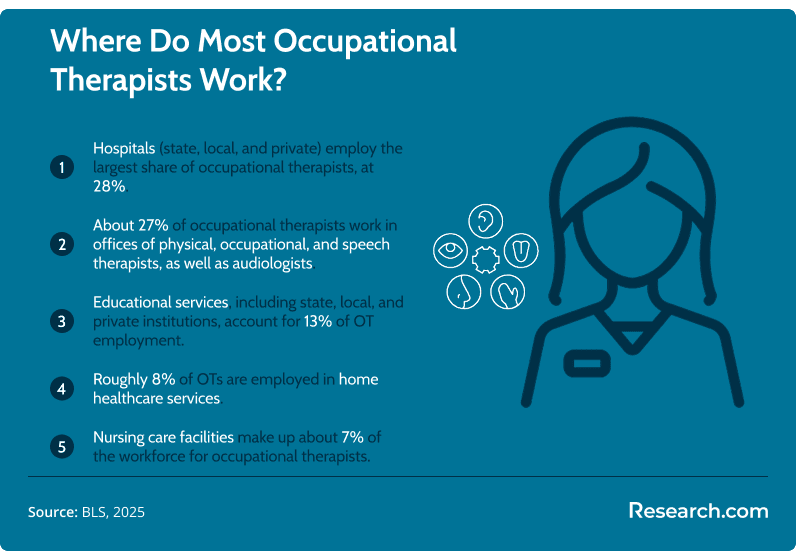
The infographic below breaks down common occupational therapy employment settings, including hospitals, clinics, schools, home health, and nursing facilities.
How long does it take to become specialized in occupational therapy?
The base path to becoming an occupational therapist usually includes a bachelor’s degree, a master’s degree in occupational therapy, passing the NBCOT exam, and obtaining state licensure. A master’s degree in occupational therapy typically takes two to three years beyond a bachelor’s degree. After that, higher-paying specialties often require additional years of clinical experience, mentorship, continuing education, and credential preparation.
For hand therapy, the Certified Hand Therapist (CHT) credential requires at least three years of practice plus 4,000 hours of direct hand therapy experience before attempting the exam. The Certified Brain Injury Specialist (CBIS) generally involves specialized coursework and documented professional experience, with the timeline often shaped by your caseload. AOTA board certifications such as Physical Rehabilitation (BCPR), Pediatrics (BCP), and Gerontology (BCG) usually require five years of experience with at least 5,000 hours of practice in the specialty area.
So, how long does it take to be an occupational therapist? Licensure may be possible within six to seven years of higher education, but reaching the highest-paid or most specialized roles can require several additional years of focused practice.
| Stage | Typical time or requirement stated | Decision point |
| Graduate OT education | Two to three years beyond a bachelor’s degree | Choose an accredited program with fieldwork aligned to your target specialty |
| Initial licensure | After NBCOT exam completion and state licensure requirements | Confirm state rules before relocating or choosing online coursework |
| CHT pathway | At least three years of practice plus 4,000 hours of direct hand therapy experience | Start building upper-extremity caseloads early if hand therapy is your goal |
| AOTA board certification pathway | Five years of experience with at least 5,000 hours of practice in the specialty area | Track hours, cases, continuing education, and outcomes from the beginning |
| Advanced specialty growth | Several years beyond initial licensure | Balance credential value against cost, salary upside, and preferred work setting |
Can non-clinical certifications improve an OT career?
Yes, but the value depends on your career goal. Non-clinical training in billing, coding, compliance, documentation, supervision, informatics, or practice management can help OTs who want to move into administration, consulting, private practice, utilization review, or leadership. These credentials are usually not substitutes for clinical specialization, but they can strengthen business and operational skills.
For example, learning revenue cycle basics can help therapists understand documentation requirements, payer expectations, authorization issues, and reimbursement delays. OTs interested in clinic operations or private practice may benefit from an affordable medical billing and coding certification program, especially if they want to better coordinate with billing teams or reduce preventable claim problems.
Is specializing in occupational therapy worth the ROI?
Specialization can be worth the investment when it leads to better job options, stronger clinical confidence, higher compensation, leadership opportunities, or work you can sustain long term. However, ROI is not automatic. Certification fees, continuing education, exam preparation, reduced work hours, and years spent building specialty experience all affect the return.
Financially, the strongest ROI often appears in specialties close to or above the BLS median annual wage of $98,340, such as physical rehabilitation, neurology, gerontology, brain injury, and hand therapy. By contrast, autism-focused pediatric OT may report about $67,585 annually according to PayScale, but therapists may still choose it because of mission fit, population preference, or school and family-centered work.
Think of ROI in three layers: salary, employability, and sustainability. A specialty that pays well but causes burnout may not be a good long-term investment. A lower-paying path with excellent schedule fit, strong local demand, and meaningful work may be the smarter choice for some therapists. Similar trade-offs appear across therapy careers; for comparison, see how training length affects another profession in how long does it take to get a MFT degree.
| ROI factor | Why it matters | Question to ask before specializing |
| Salary lift | Higher pay can offset certification and continuing education costs | Do local employers actually pay more for this credential? |
| Time to qualify | Some credentials require years of documented experience | Can I realistically build the required caseload in my current setting? |
| Job availability | A specialty may pay well but have limited local openings | Are there hospitals, clinics, schools, or agencies nearby that hire this specialty? |
| Work-life fit | Schedule, emotional load, and physical demands affect retention | Can I see myself doing this work for several years? |
| Career mobility | Some credentials support leadership, consulting, teaching, or private practice | Will this specialty expand or narrow my future options? |
The chart below compares OT specialties by salary level and can help you identify which credentials may offer the strongest financial upside relative to the training required.
Do OT specialty salaries vary by location?
Yes. Geography can strongly influence occupational therapy pay. According to the BLS, states such as California, New York, and Nevada are among the higher-paying locations, and California OTs earn an average of $113,550 annually. However, higher wages can come with higher housing, transportation, tax, and insurance costs, so take-home value may differ from the headline salary.
Location also affects which specialties are easier to enter. Large metropolitan areas may offer more hand therapy, neurology, trauma, and specialty outpatient roles because they have advanced medical centers and larger referral networks. Rural and suburban areas may have strong demand for gerontology, home health, rehabilitation, and school-based OT because communities still need aging, recovery, and developmental services even when specialty clinics are limited.
If your goal is to earn at the top of the profession, evaluate location alongside credentials. A high-paying state, in-demand specialty, and employer that rewards advanced skill can make a meaningful difference. This is especially important for therapists researching how to make six figures as a therapist.
The chart below highlights top-paying states for occupational therapists and shows how location can change the financial value of specialization.
How does work-life balance differ across OT specialties?
Salary is only one part of a good OT career decision. Work-life balance varies by specialty, setting, and employer expectations. School-based pediatric OTs may have more predictable calendars, while hospital rehabilitation and acute neuro roles may involve weekend coverage, productivity expectations, or physically intense patient care. Home health and community mobility roles may offer autonomy but include travel time and variable scheduling.
| Specialty or setting | Potential lifestyle advantage | Potential drawback |
| School-based pediatrics | More predictable school-year schedule | Heavy documentation, IEP meetings, and large caseloads may occur |
| Hospital rehabilitation | Strong clinical team environment and medical learning opportunities | Weekend, holiday, or high-acuity demands may affect balance |
| Hand therapy clinics | Often structured outpatient hours | High precision, productivity targets, and technical documentation |
| Gerontology and home health | Meaningful independence-focused work and possible schedule flexibility | Travel, safety concerns, and complex family dynamics |
| Mental health OT | Deep therapeutic relationships and functional recovery focus | Emotionally demanding cases and crisis exposure |
| Driving and community mobility | Independence-focused work with varied client goals | Travel, scheduling complexity, and lower reported pay |
When comparing specialties, ask how many patients you will see per day, whether weekend work is expected, how productivity is measured, how much documentation is required, and whether mentorship is available. These details often matter as much as salary. Similar work-life trade-offs appear in other therapy roles, including those described in what does a licensed marriage and family therapist do.
What graduates say about online occupational therapy specialty training
- : "Preparing for hand therapy certification online let me keep my full-time job while building a more advanced clinical skill set. The coursework was demanding, but it connected directly to cases I was already seeing in practice. — Maribel"
- : "My gerontology specialty training changed how I approach older adult care. Studying online gave me time to work through case examples carefully and apply new strategies with patients in my clinic. — Florian"
- : "The pediatric OT specialization was more interactive than I expected. Simulations, discussion boards, and applied assignments helped me practice clinical reasoning while still managing family responsibilities at home. — Ailani"
Common mistakes to avoid when choosing an OT specialty
- Choosing only by salary. A higher-paying specialty may also require more years of training, higher stress, weekend work, or physically demanding caseloads.
- Ignoring accreditation and licensure rules. Before enrolling in any OT program, confirm that it supports eligibility for NBCOT and state licensure requirements.
- Assuming certification guarantees a raise. Some employers reward specialty credentials; others may not adjust pay unless the role requires the credential.
- Overlooking local job demand. A specialty can be valuable nationally but have limited openings in your region.
- Failing to track clinical hours early. Credentials such as CHT and AOTA board certifications depend on documented experience, so organized recordkeeping matters.
- Underestimating emotional and physical demands. Brain injury, mental health, gerontology, and intensive rehabilitation can be rewarding but challenging.
- Relying only on rankings or online salary averages. Use salary tools as a starting point, then compare employer postings, benefits, productivity standards, and cost of living.
How to choose the right occupational therapy specialty
- Start with the population you want to serve. Decide whether you prefer children, older adults, neurological patients, orthopedic cases, mental health clients, or community mobility work.
- Compare salary with lifestyle. Look at pay, schedule, documentation load, physical demands, travel, and emotional intensity.
- Review local job postings. Search for required credentials, preferred experience, caseload type, and whether employers mention specialty certification.
- Plan fieldwork strategically. If you are still in school, pursue placements that align with your target specialty.
- Find a mentor. Specialty areas such as hand therapy, neurorehabilitation, and brain injury are easier to enter with guidance from experienced clinicians.
- Track hours and continuing education. Keep records of caseloads, diagnoses, interventions, supervision, and outcomes if you plan to pursue certification.
- Calculate ROI before paying for credentials. Estimate costs, time, likely salary change, and whether the credential opens roles you actually want.
Questions to ask before enrolling in an OT program or specialty course
- Is the OT program accredited and aligned with NBCOT eligibility?
- Does the program or course prepare students for the specialty credential I want?
- What fieldwork, mentorship, or supervised practice opportunities are available?
- Do graduates work in the specialty settings I am targeting?
- How does the program support working students if I need part-time or online options?
- What are the total costs beyond tuition, including fees, travel, exams, and materials?
- Will the credential be recognized by employers in my state or practice setting?
- What salary range do local employers offer for this specialty?
Key Insights
- Physical rehabilitation is one of the strongest-paying OT paths, with the BLS reporting a median OT wage of $98,340, or about $47 per hour.
- Gerontology, brain injury, mental health, and neurology are reported at about $94,375 annually by ZipRecruiter, making them financially competitive specialties tied to complex care needs.
- Hand therapy can offer strong pay, but the CHT pathway is demanding and requires at least three years of practice plus 4,000 hours of direct hand therapy experience.
- Pediatrics, autism-focused OT, and driving and community mobility may pay less than adult medical specialties, but they can offer strong mission fit and meaningful patient impact.
- Demand is broad: the BLS projects OT employment to grow 14% between 2024 and 2034, adding more than 22,000 jobs nationwide.
- Specialization ROI depends on more than salary. Consider credential costs, years of experience required, local openings, schedule, burnout risk, and advancement potential.
- Before choosing a specialty, compare local job postings, talk to practicing OTs, confirm credential requirements, and choose fieldwork or mentorship that supports your target path.
References:
- American Occupational Therapy Association. Advanced Certification Program – Physical Rehabilitation.
- Bureau of Labor Statistics. Occupational Employment and Wages, May 2023: Occupational Therapists (29-1122).
- Bureau of Labor Statistics. Occupational Outlook Handbook: Occupational Therapists.
- CollegeTuitionCompare. Best Occupational Therapy Schools Comparison Tables.
- CoreMedicalGroup. OT Alphabet Soup: Occupational Therapy Credentials.
- Student Doctor Network. Percentage of Acceptance in Occupational Therapy.
- Healthcare Staffing Plus. Navigating the Job Market as an Occupational Therapist.
- PubMed Central. The Global Status of Occupational Therapy Workforce Research Worldwide: A Scoping Review.
- PayScale. Pediatric Occupational Therapist Salary (Autism Spectrum Disorders – ASD).
- UnivStats. Occupational Therapy Admission Comparison.
- ZipRecruiter. Certified Hand Therapist Salary.
- ZipRecruiter. Driver Rehabilitation Specialist Salary.
- ZipRecruiter. Geriatric Occupational Therapist Salary.
- ZipRecruiter. Mental Health Occupational Therapist Salary.
- ZipRecruiter. Neuro Occupational Therapist Salary.
- ZipRecruiter. Occupational Therapist – What Is & How to Become.
- ZipRecruiter. Occupational Therapist Must-Have Resume Skills and Keywords.
- ZipRecruiter. Occupational Therapist Salary.
- ZipRecruiter. Pediatric Occupational Therapist Salary.
Other Things You Should Know About Occupational Therapist Specialties
Several factors affect salary differences among specialties, including geographic location, years of experience, and additional certifications like SIPT for pediatric or LSVT BIG for neurological therapy. Work settings, whether hospitals or private practices, also play a crucial role in salary variations.
Certifications such as Certified Hand Therapist (CHT) and Neuro-Developmental Treatment (NDT) can position occupational therapists for higher salaries in 2027. These certifications underscore expertise in specialized areas, making candidates more attractive to employers offering top compensation.
To pursue a high-paying occupational therapist specialty in 2027, you generally need a Master’s or Doctorate in Occupational Therapy from an accredited program. Certification from the National Board for Certification in Occupational Therapy (NBCOT) is also required, along with state licensure. Specializing may require additional certifications in areas such as geriatrics or pediatrics.


