
2027 How Long Is Occupational Therapy School? Average Program Length

Co-Founder and Chief Data Scientist
As a career and education expert, I know that preparing for a career in occupational therapy starts with finding reliable information about the educational path. Sifting through the vast amount of online content can be confusing, with details often being inconsistent or out of date. This makes it difficult to understand the true requirements for admissions, the typical length of programs, and the specific career outcomes.
This guide aims to clarify these points with precise, accurate information, giving you a clear picture of what to expect from an OT program in the United States. It's my goal to provide the definitive resource you need to make an informed decision about your future.
What are the benefits of completing an occupational therapy degree?
- Career Advancement: Graduates qualify for professional licensure as occupational therapists, opening doors to clinical practice, leadership, and specialized roles in pediatrics, geriatrics, rehabilitation, and mental health.
- Earning Potential: Entry-level occupational therapists in the U.S. earn median salaries around $80,000–$96,000 annually, depending on setting and location (PayScale, 2025; Indeed, 2025).
- Professional Recognition: Completing an ACOTE-accredited OT program ensures eligibility for the National Board for Certification in Occupational Therapy (NBCOT) exam, the key credential for practice.
What can I expect from an occupational therapy degree program?
- Graduate-Level Coursework: Programs cover anatomy, neuroscience, kinesiology, occupational science, and mental health interventions.
- Structured Curriculum: Students complete a blend of didactic coursework, laboratory practice, and integrated fieldwork experiences.
- Applied Clinical Training: Required fieldwork includes Level I placements for exposure and Level II rotations totaling at least 24 weeks full-time, preparing students for independent practice.
- Doctoral Capstone (OTD only): Doctoral students complete an additional 14-week practicum focused on leadership, research, or advanced clinical skills.
- Condensed vs. Extended Timelines: Master’s programs typically run 2–3 years full-time, while entry-level OTD programs average 3 years (33–36 months).
- Networking Opportunities: Students train alongside peers, faculty, and clinical supervisors in hospitals, schools, and rehabilitation centers, creating strong professional networks.
Where can I work after completing an occupational therapy degree?
- Hospitals and Rehabilitation Centers: Support recovery from injuries, surgeries, strokes, or chronic conditions.
- Schools and Pediatric Settings: Help children with developmental delays, autism spectrum disorder, or physical impairments succeed in daily activities.
- Outpatient Clinics: Provide therapy for orthopedic injuries, neurological disorders, or long-term conditions.
- Home Health and Community Practice: Assist patients in regaining independence at home and adapting their environments.
- Geriatric and Long-Term Care Facilities: Address mobility, fall prevention, and daily function for aging populations.
- Pathway to Leadership: With advanced training, OTs may move into roles such as Clinical Director, Rehabilitation Manager, or Academic Faculty.
How much can I make as an occupational therapist in the USA?
- Entry-Level Roles: Newly licensed occupational therapists typically earn $72,000–$80,000 annually (PayScale, 2025; Salary.com, 2025).
- Mid-Career Roles: Experienced OTs in hospitals, schools, or outpatient care earn around $85,000–$96,000 annually (Indeed, 2025).
- Specialized or Senior Roles: Specialists in hand therapy, neurorehabilitation, or leadership positions can command $100,000–$115,000+ annually (PayScale, 2025; Salary.com, 2025).
- What are the career opportunities for occupational therapy program graduates? Career paths
- What are the salaries of occupational therapy program graduates? Salaries
- What is the job market like for occupational therapy program graduates? Job market
- What internship and research opportunities are available in an occupational therapy program? What internship and research opportunities are available in an occupational therapy program?
- Which universities offer top-ranked occupational therapy programs? Universities
- What are the biggest challenges faced by students pursuing an occupational therapy degree? What are the biggest challenges faced by students pursuing an occupational therapy degree?
- What are the biggest opportunities for students pursuing an occupational therapy degree? Opportunities
- What are some current and future trends in the occupational therapy field? Trends
- What financial aid and cost optimization options are available for occupational therapy students? What financial aid and cost optimization options are available for occupational therapy students?
How long does it take to complete an occupational therapy program in 2027?
The total time to become a licensed occupational therapist can vary, but generally takes five to seven years, including both undergraduate and graduate studies in occupational therapy school. The most common paths involve earning a bachelor's degree followed by either a Master of Science in Occupational Therapy (MSOT) or a Doctor of Occupational Therapy (OTD).
- Accelerated Programs: Some universities offer accelerated programs that combine a bachelor's degree and an MSOT or OTD, allowing students to complete both in as little as five years.
- Bachelor's Degree: A prerequisite for graduate-level study, this typically takes four years to complete.
- Certification and Licensure: After graduation, a student must pass the national certification exam and apply for state licensure, which can take several weeks or months.
- Doctor of Occupational Therapy (OTD): An alternative graduate degree that is becoming more common, this program generally requires about three years of full-time study.
- Fieldwork Requirements: All programs require a significant amount of fieldwork, which is included in the program length, but can sometimes add a few weeks or months depending on the specific schedule.
- Master of Science in Occupational Therapy (MSOT): This graduate program is the most common degree and usually takes two years of full-time study to complete.
- Part-Time Study: Many programs offer a part-time option, which extends the overall length of the program to accommodate students' schedules.
- Prerequisite Courses: The time needed to complete prerequisite science courses, if not included in the undergraduate major, can add to the total duration.
The specific duration depends heavily on the chosen degree path and the student's enrollment status. Overall, students should plan for a multi-year commitment to their education and training.
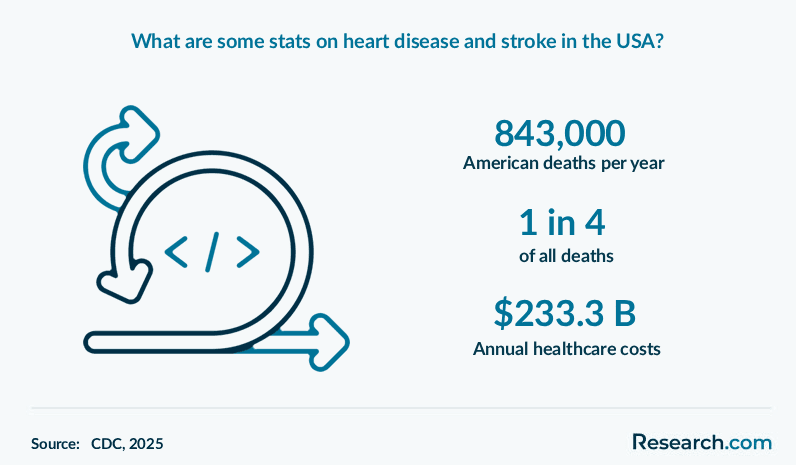
This is why occupational therapists are much needed—the CDC reports that heart disease and stroke cause more than 843,000 U.S. deaths each year—over 1 in 4 of all deaths—imposing $233.3 billion in healthcare costs and $184.6 billion in lost productivity annually, as shown in the graphic below, with total costs projected to reach about $2 trillion by 2050.
For students who are early in their education journey, some begin by exploring foundational credentials in related fields—such as learning how to get a Child Development Associate credential—which provides hands-on experience in developmental support settings and can help build a strong foundation for future occupational therapy coursework.
What are the career opportunities for occupational therapy program graduates?
An occupational therapy degree prepares graduates for a wide array of career opportunities, extending beyond the traditional clinical setting to roles in management, education, and research. The skills gained are highly transferable, allowing for flexible career progression after occupational therapy school.
- Care Manager: Coordinates care plans for individuals with complex needs, often working with a team of healthcare professionals to ensure all aspects of a person's health are addressed.
- Community and Public Health: Works to improve health outcomes for specific populations or communities through program development and health promotion initiatives.
- Educator or Researcher: Holds an academic position at a university or works on research projects to advance the knowledge and practice of occupational therapy.
- Ergonomist: Specializes in designing environments and workstations to prevent injury and promote efficiency in workplaces.
- Geriatric Occupational Therapist: Assists older adults in maintaining their independence and quality of life by addressing issues related to aging and chronic conditions in settings like nursing homes or assisted living facilities.
- Hand Therapist: A specialized role that focuses on treating patients with injuries or conditions affecting the hands and upper extremities.
- Home Health Therapist: Provides therapy services in a client's home, helping them adapt their environment and routines to live safely and independently.
- Mental Health Occupational Therapist: Supports individuals with mental health conditions to develop coping strategies and daily living skills necessary for community integration and employment.
- Pediatric Occupational Therapist: Works with children and their families in schools, clinics, or home settings to help them develop skills for play, school performance, and daily living.
- Rehabilitation Therapist: Helps patients recover from injuries or illnesses, such as strokes, spinal cord injuries, or traumatic brain injuries, to regain function and independence.
The profession offers a diverse range of settings and populations to work with, allowing graduates to align their career with their personal interests. These varied opportunities reflect the broad and holistic nature of occupational therapy, and you can find out more about how to become a therapist.
According to Fortune Business Insights (2023), the U.S. occupational and physical therapy services market was valued at $49.19 billion in 2022, is projected to rise to $53.08 billion in 2023, and is expected to reach $92.38 billion by 2030. This trajectory reflects a compound annual growth rate of 8.2% over the forecast period, shown in the graphic below.
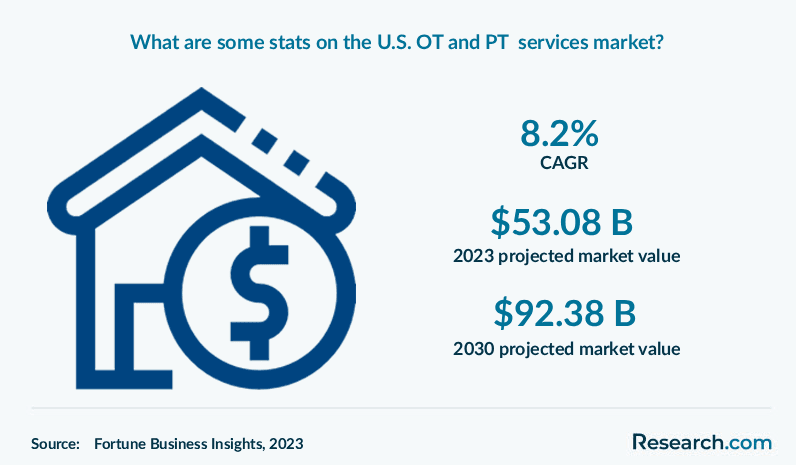
Growth is anticipated to be led by the outpatient clinics segment due to the rising number of physical therapy outpatient facilities, indicating a significant and sustained expansion for the market.
What are the salaries of occupational therapy program graduates?
Occupational therapy graduates can expect a competitive salary that varies based on factors such as location, specialization, years of experience, and practice setting. The profession is generally considered to have a strong earning potential after occupational therapy school.
- Average Starting Salary: Entry-level occupational therapists in the United States can expect an average annual salary in the range of approximately $80,000 to $90,000.
- Highest Paying Settings: Top salaries are often found in home health services, skilled nursing facilities, and hospitals.
- Private Practice: OTs who own their own private practice have the potential for higher earnings, though this comes with business-related responsibilities.
- Regional Variations: Salary can differ from state to state, with top-earning states for occupational therapists including Washington, New York, and California.
- Salary by Experience: Pay typically increases with experience, with mid-career therapists earning considerably more than new graduates.
- Salary by Location: Earnings can be significantly higher in certain states or metropolitan areas with a higher cost of living or greater demand for OTs.
- Specialization Pay: Therapists who pursue specialized certifications, such as in hand therapy or lymphedema, may command higher salaries.
As the profession evolves, more OTs are choosing to specialize in niche clinical areas. This trend has highlighted some of the highest-paying occupational therapist specialties, including hand therapy, neurorehabilitation, pediatric feeding therapy, and lymphedema treatment. These advanced practice areas often require post-graduate training or certification but may result in significantly higher earning potential over time.
Analysis of salary data from various sources for occupational therapy occupations reveals several key trends. Occupational therapy salaries vary widely by role, specialization, and location.
The median national salary for an occupational therapist is $98,340, higher than that of medical assistant jobs, while average earnings rise to $107,649 for general practice and $120,161 for pediatric specialists. In high-cost areas like New York, NY, pediatric occupational therapists earn up to $139,255.
Leadership roles offer even higher pay: directors of rehabilitation average $144,309, and occupational therapy managers earn $127,225. Entry-level positions, such as occupational therapy aides, have a median salary of $37,370, reflecting the impact of education and responsibility on compensation. These are shown in the graph below.
What is the job market like for occupational therapy program graduates?
The job market for occupational therapy graduates is currently very strong, with a projected growth rate that is much faster than the average for all occupations. This favorable outlook is driven by several key factors.
- Demand in specific settings: Hospitals (28%), offices of PT/OT/speech therapists (27%), educational services (13%), home health (8%), and skilled nursing facilities (7%) employ most OTs; median pay signals strong demand in SNFs ($103,210) and home health ($103,010) vs. hospitals ($100,770), offices ($96,380), and schools ($83,890) (U.S. Bureau of Labor Statistics, 2025).
- Evolving roles: Hybrid and non-traditional delivery continues to grow—10% of rural and 14% of urban Traditional Medicare beneficiaries used telehealth as of Q3 2024, widening avenues for OT beyond clinic walls (KFF, 2025). (
- Focus on wellness and prevention: Chronic conditions remain widespread—6 in 10 U.S. adults have at least one chronic disease—keeping function, self-management, and prevention central to OT demand (CDC, 2024).
- Growing aging population: The U.S. 65+ population grew 3.1% to 61.2 million from 2023 to 2024, expanding the need for OT to maintain independence and safety in aging (U.S. Census Bureau, 2025).
- Legislation and insurance coverage: Medicare allows patients to receive non-behavioral telehealth from home through Sept. 30, 2025, while behavioral telehealth at home is permanent; the CY 2025 Medicare Physician Fee Schedule also continues key telehealth flexibilities—policies that keep OT services accessible (HHS Telehealth, 2025; CMS, 2024).
- Technological advancements: Telehealth use remained meaningful—>1 in 10 Traditional Medicare beneficiaries used telehealth at the end of 2023, supporting ongoing adoption of virtual and hybrid OT (KFF, 2024).
- Increased chronic conditions: Multimorbidity is substantial—42% of U.S. adults have two or more chronic conditions—driving continued demand for OT to support daily function and participation (CDC, 2024).
The positive job market outlook provides a sense of security for graduates entering the workforce. The profession's versatility and adaptability ensure it will remain a vital part of the healthcare system for the foreseeable future.
For students preparing to enter programs in such a strong job market, planning the college application process wisely can also make a difference. Understanding what is a good number of colleges to apply to can help applicants balance opportunities with practicality. Many students aim for a thoughtful mix of reach, match, and safety schools to improve their chances of acceptance while managing workload and application costs.
Based on data from the U.S. Bureau of Labor Statistics, the field of occupational therapy is experiencing significant growth. The median annual wage for occupational therapists was reported to be $98,340 in 2024. The profession is projected to grow by 14% from 2024 to 2034, which is a much faster rate than the average for all occupations, as shown in the graphic below.
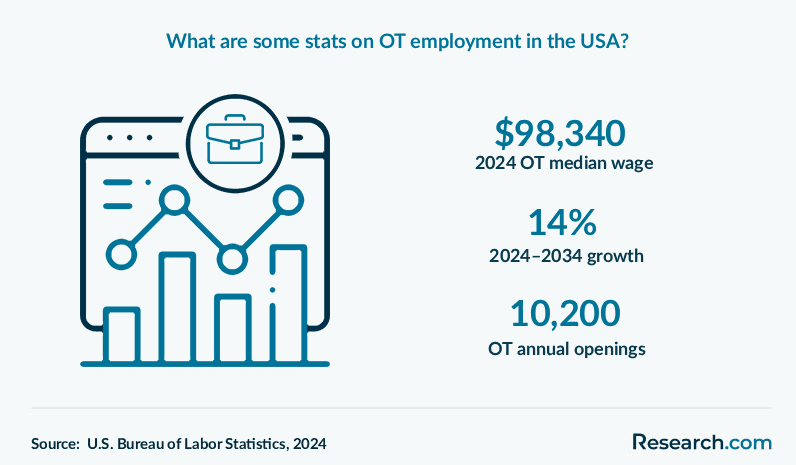
This growth is expected to result in approximately 10,200 annual job openings for occupational therapists. These statistics reveal a very strong job market with high demand and excellent prospects for individuals entering the field.
What are some specializations within an occupational therapy program?
Occupational therapy offers a wide range of specializations, allowing professionals to focus on a particular population, practice area, or type of intervention. These specializations are often pursued through post-graduate training and certification after occupational therapy school.
- Assistive Technology: Specializes in the use of devices and equipment to help people with disabilities live more independently.
- Driving Rehabilitation: Assesses and provides training for individuals with disabilities to enable them to drive safely.
- Geriatrics: Specializes in the unique needs of older adults, helping them adapt to changes in their physical and cognitive abilities.
- Hand Therapy: Involves the treatment of conditions and injuries of the hand, wrist, elbow, and shoulder.
- Low Vision: Helps individuals with visual impairments maximize their remaining sight to perform daily tasks.
- Lymphedema Management: Focuses on treating chronic swelling caused by a compromised lymphatic system.
- Mental Health: Concentrates on helping individuals with psychiatric conditions improve their daily functioning and social participation.
- Pediatrics: Works with infants, children, and adolescents, often in school, clinic, or home settings, to address developmental delays or disabilities.
- Physical Rehabilitation: Focuses on restoring function for individuals who have experienced a physical injury, illness, or surgery.
- Productive Aging: This area helps older adults proactively engage in meaningful occupations to maintain health and well-being as they age.
- School Systems: OTs who work in schools help students with disabilities participate in the educational environment.
These specializations allow occupational therapists to develop deep expertise and create a career path that is personally rewarding and impactful. Pursuing a niche area can also lead to increased professional opportunities and higher earning potential. Also, healthcare management vs healthcare administration pathways are choices for those seeking higher-level roles.
According to 2023 BLS data, the highest OT employment concentration is in offices of other health practitioners with 42,840 OTs (3.75%), followed by home health care services with 11,740 (0.73%) and nursing care facilities with 9,950 (0.72%). This distribution, shown in the graph below, highlights strong employment in outpatient and home-based settings alongside hospitals.
What internship and research opportunities are available in an occupational therapy program?
Occupational therapy programs place a high value on hands-on experience and research, providing numerous opportunities for students to apply their knowledge in real-world settings. These experiences are integral to developing clinical skills and advancing the profession.
- Clinical Partnerships: Universities often have established partnerships with hospitals, schools, and rehabilitation centers to place students for their fieldwork.
- Interdisciplinary Collaboration: Students have opportunities to work with other healthcare professionals, such as physical therapists and speech-language pathologists, during their training.
- Level I Fieldwork: Shorter, introductory fieldwork experiences that are often integrated into coursework to expose students to various practice settings and populations.
- Level II Fieldwork: Two full-time, three-month experiences required for all accredited programs, providing intensive, supervised clinical training in a specific setting.
- Observation Hours: Before entering a program, students are typically required to complete observation hours with a practicing occupational therapist, which provides a foundational understanding of the profession.
- Research Projects: Many graduate programs require or offer the option to complete a research project, capstone project, or doctoral thesis. You can also start with how to become a biologist and continue from there.
- Student Organizations: University-based OT student organizations often host volunteering and community service events that provide practical experience.
These hands-on experiences are crucial for building the skills and confidence necessary to become a competent therapist. The combination of clinical training and academic inquiry prepares students for a career of lifelong learning and professional growth.
Which universities offer top-ranked occupational therapy programs?
Selecting a top-ranked university can be an important factor for students pursuing an occupational therapy degree. These institutions are recognized for their rigorous academics, experienced faculty, and strong clinical training opportunities. Here are the top occupational therapy school programs in the USA.
- Boston University: Renowned for its comprehensive curriculum and research opportunities, offering multiple pathways to a Doctor of Occupational Therapy (OTD).
- Colorado State University: Boasts a 100% national certification exam pass rate and strong employment rates for its graduates.
- New York University: A well-regarded program located in a major city, providing access to a wide range of diverse clinical settings.
- Ohio State University: Known for its award-winning faculty and a curriculum that includes extensive fieldwork and a capstone experience.
- Thomas Jefferson University: Offers both master's and doctoral options with a flexible hybrid format, allowing students to balance coursework with other commitments.
- Tufts University: Offers a strong graduate program with opportunities for students to engage in research and interdisciplinary projects.
- University of Florida: Known for its strong public health focus and an emphasis on evidence-based practice.
- University of Southern California: Recognized as a leader in occupational science and therapy education, consistently earning high rankings for its doctoral program.
These universities are widely regarded as having some of the most competitive and well-respected occupational therapy programs in the United States. They offer students the foundational knowledge and practical experience needed to excel in the field.
For students comparing healthcare-related graduate programs more broadly, it can also be helpful to look at flexible learning options. For example, some institutions offer masters in nutrition online no GRE programs, which provide an accessible pathway for students who want to advance their education without additional testing requirements. This can be especially appealing to working professionals or those balancing multiple responsibilities.
What are the biggest challenges faced by students pursuing an occupational therapy degree?
Pursuing an occupational therapy degree is a demanding and rigorous academic journey that comes with its own set of challenges. Students at occupational therapy school must navigate a complex curriculum and intense clinical requirements.
- Clinical and Fieldwork Pressure: Fieldwork experiences are intense and require students to apply their knowledge in a high-stakes, supervised environment, which can be intimidating.
- Complexity of Patient Cases: Students often work with clients who have complex and multifaceted needs, requiring advanced problem-solving skills that can be difficult to develop.
- Financial Burden: The high cost of graduate-level education, along with the need to cover living expenses while completing unpaid fieldwork, presents a significant financial challenge for many.
- Finding and Securing Fieldwork Placements: Competition for fieldwork placements can be fierce, and securing the right placement that aligns with a student's interests can be challenging.
- Heavy Academic Workload: OT programs are highly concentrated, requiring students to master a vast amount of material in a short period, including anatomy, physiology, and therapeutic techniques.
- Juggling Multiple Roles: Many students balance school with part-time jobs, family responsibilities, and fieldwork, making time management a constant struggle.
- Stress and Burnout: The emotionally demanding nature of the profession, coupled with a high academic and clinical load, can lead to significant stress and the risk of burnout.
These challenges highlight the dedication and resilience required to succeed in an occupational therapy program. However, overcoming these hurdles builds the professional character and competence needed to thrive in the field.
What are the biggest opportunities for students pursuing an occupational therapy degree?
Despite the challenges, a career in occupational therapy offers many rewarding opportunities for students throughout their degree and beyond. These opportunities make the hard work and dedication worthwhile.
- Advocacy and Leadership: Students can join professional organizations and get involved in advocacy, learning how to influence healthcare policy and advance the profession.
- Hands-on Clinical Experience: Students get to apply classroom knowledge to real-world scenarios through fieldwork, which is a powerful way to learn and grow.
- High Job Satisfaction: Occupational therapists consistently report high job satisfaction due to the direct impact they have on improving clients' quality of life.
- Interdisciplinary Collaboration: Programs often encourage students to work with other healthcare professionals, providing valuable insight into the broader healthcare system.
- Networking and Mentorship: Fieldwork placements and academic projects offer a chance to network with experienced professionals and build relationships with mentors.
- Research and Innovation: Students can get involved in research, contributing to the development of new treatments and best practices in the field.
- Specialization and Career Customization: The opportunity to specialize early in the program allows students to tailor their education and future career to a specific area of passion.
In addition, accelerated healthcare administration degree online programs are available for those who seek higher admin roles. These opportunities provide a rich and fulfilling educational experience that goes far beyond the classroom. By taking advantage of them, students can build a strong foundation for a successful and meaningful career.
What are some current and future trends in the occupational therapy field?
The field of occupational therapy is continually evolving, with new trends and innovations shaping how services are delivered. Staying informed about these trends is essential for future professionals.
- Aging in Place Initiatives: A focus on designing home environments and providing community-based interventions to help older adults remain in their homes safely and independently for longer.
- Data Analytics and Health Monitoring: The use of data to analyze client progress, inform treatment plans, and provide a more holistic view of health in various settings.
- Interdisciplinary Collaboration: A growing trend towards OTs working closely with other healthcare professionals, such as physical therapists and psychologists, to provide a more integrated care model.
- Mental Health and Wellness Focus: An increased emphasis on addressing the mental and emotional well-being of clients, moving beyond purely physical rehabilitation.
- Personalized Care: A shift away from a one-size-fits-all approach to developing highly customized treatment plans that are specific to a client's individual needs, goals, and preferences.
- Robotics and Assistive Technology: The use of robotic exoskeletons and smart home devices to assist clients with physical impairments and promote independence.
- Telehealth Services: The use of video conferencing and other digital tools to deliver OT services remotely, increasing access for clients in rural or underserved areas.
- Virtual and Augmented Reality: The use of immersive technologies such as augmented reality and virtual reality to create engaging and effective therapeutic environments for pain management, cognitive therapy, and skill-building.
- Wearable Technology: The integration of wearable devices, such as smartwatches and fitness trackers, to monitor client data and provide real-time feedback.
In addition, online degrees for working adults have become very popular and cost- and time-efficient for many.
These trends signify a dynamic and forward-thinking profession that is constantly adapting to new technologies and evolving healthcare needs. By embracing these changes, occupational therapists can continue to provide innovative and effective care.
What financial aid and cost optimization options are available for occupational therapy students?
Students can mitigate the financial burden of an occupational therapy program by exploring multiple aid avenues. Federal funding, scholarships, grants from professional bodies, and work-study programs are viable options to reduce tuition costs. Additionally, identifying cost-saving strategies—such as leveraging employer tuition reimbursement programs and evaluating alternative educational investments like affordable medical billing and coding courses—can further optimize expenses. Meticulous financial planning, including budgeting for ancillary costs and assessing low-interest loan options, plays a critical role in sustaining academic progress while managing overall debt.
Here's What Graduates Say About Their Occupational Therapy Degrees
- Aidan: "It's been an incredible journey, and I've loved the hands-on fieldwork that's allowed me to apply what I learned in class to real patient cases. The professors are so supportive, and the clinical rotations have helped me find a passion for pediatric occupational therapy. It's been truly fulfilling."
- Leilani: "The program's focus on research was a huge plus for me; I got to work on a capstone project exploring the latest advancements in assistive technology. I was able to collaborate with leading faculty, which gave me a new perspective on how technology is changing our field. The experience made me feel like I was contributing to the future of occupational therapy."
- Darian: "I was initially nervous about the academic rigor, but the interdisciplinary approach of the program really made a difference. Working alongside physical therapy and speech-language pathology students taught me the importance of collaboration in patient care, which I know will be invaluable in my future practice. The emphasis on real-world teamwork has been an incredible benefit."
Key Findings
- Entry-level roles: Entry-level positions for occupational therapy graduates with less than one year of experience typically average $35,570, and roles like occupational therapy aides have a median salary of $37,370 (PayScale, 2025; U.S. Bureau of Labor Statistics).
- Mid-career and licensed roles: The national median salary for an occupational therapist is $98,340, with general practitioners averaging $107,649; experienced OTs with 7–9 years of experience see median pay rising from $73,000 to $84,000 (BLS, 2024; AOTA, 2023).
- Highest-paying roles: Directors of rehabilitation average $144,309, occupational therapy managers earn about $127,225, and in high-cost markets like New York, NY, pediatric occupational therapists can earn up to $139,255.
- Growing employment: The occupational therapy profession is projected to grow 14% from 2024–2034, much faster than average, driven by aging and prevention-focused care.
- Top employment settings: The highest employment concentrations are in hospitals (28%), offices of physical/occupational/speech therapists (27%), and educational services (13%), with median pay signaling strong demand in skilled nursing ($103,210) and home health ($103,010) compared with hospitals ($100,770) and schools ($83,890) (U.S. Bureau of Labor Statistics, 2025).
- Digital and telehealth opportunities: More than 1 in 10 Traditional Medicare beneficiaries used telehealth at the end of 2023, and the CY 2025 Medicare Physician Fee Schedule continues to support virtual care delivery—expanding OT roles beyond clinic walls.
- Demand drivers: An aging population of 61.2 million people aged 65+ (2024) and the prevalence of chronic disease (6 in 10 U.S. adults have at least one chronic condition) sustain demand for OT to support daily function and independence.
- Market size and growth trajectory: The U.S. occupational and physical therapy services market was $49.19 billion in 2022, is projected at $53.08 billion in 2023, and is expected to reach $92.38 billion by 2030 (8.2% CAGR) (Fortune Business Insights, 2023).
References:
- American Hospital Association. (2025, February 7). Fact sheet: Telehealth. American Hospital Association. https://www.aha.org/fact-sheets/2025-02-07-fact-sheet-telehealth
- Centers for Disease Control and Prevention. (2024, October 4). About chronic diseases. Centers for Disease Control and Prevention.
- Centers for Medicare & Medicaid Services. (2024, November 1). Calendar year (CY) 2025 Medicare Physician Fee Schedule final rule (fact sheet). Centers for Medicare & Medicaid Services.
- Centers for Medicare & Medicaid Services. (2025). Medicare telehealth trends. Centers for Medicare & Medicaid Services.
- Fortune Business Insights. (2023, October 10). U.S. Occupational & Physical Therapy Services Market Size to Surpass USD 92.38 Billion by 2030, at a CAGR of 8.2%. Yahoo Finance.
- IBISWorld. (2024, November). Occupational Therapists in the US - Market Research Report (2014–2029). IBISWorld.
- Kaiser Family Foundation. (2024, October 2). What to know about Medicare coverage of telehealth. Kaiser Family Foundation. https://www.kff.org/medicare/what-to-know-about-medicare-coverage-of-telehealth/
- Medicare.gov. (2025). Telehealth insurance coverage — Medicare. U.S. Centers for Medicare & Medicaid Services.
- Salary.com. (2025, September 1). Assistive technology specialist salary. Salary.com.
- Salary.com. (2025, September 1). Low vision therapist salary. Salary.com.
- Salary.com. (2025, September 1). Occupational therapy assistant salary. Salary.com.
- Salary.com. (2025, September 1). Occupational therapy manager salary. Salary.com.
- Salary.com. (2025, September 1). Occupational therapist (OT) salary. Salary.com.
- Salary.com. (2025, September 1). Occupational therapist – home care salary. Salary.com.
- Salary.com. (2025, August 1). Outpatient OT salary. Salary.com.
- Salary.com. (2025, September 1). Pediatric occupational therapist salary. Salary.com.
- Salary.com. (2025, September 1). Director of rehabilitation salary. Salary.com.
- Salary.com. (2025, September 1). School occupational therapist salary. Salary.com.
- U.S. Bureau of Labor Statistics. (2025). Occupational therapists. In Occupational Outlook Handbook. U.S. Department of Labor.
- U.S. Census Bureau. (2025, June 26). Older adults outnumber children in 11 states and nearly half of U.S. counties. U.S. Census Bureau.
- U.S. Department of Health and Human Services. (2025, March 20). Telehealth policy updates. Telehealth.HHS.gov.
Other Things You Should Know About Occupational Therapy Programs
Occupational therapy programs in 2027 generally require a bachelor's degree and specific coursework such as human anatomy, physiology, psychology, and statistics. Some programs may also require experience in healthcare or related volunteer work. It is advisable to check specific program requirements as they can vary.
The admissions process typically involves submitting an application through platforms like OTCAS, providing transcripts, writing a personal statement, and possibly attending interviews. Additionally, candidates must meet prerequisites, such as having completed relevant courses and obtaining sufficient GRE scores.
In 2027, accredited occupational therapy programs typically require students to complete around 24 weeks of full-time, supervised fieldwork. This consists of approximately 960 hours in clinical settings, allowing students to gain hands-on experience and apply academic knowledge in real-world scenarios.


