
2027 Most Affordable Online Ed.S Degree in Special Education Programs

Co-Founder and Chief Data Scientist
An online Education Specialist (Ed.S.) in Special Education is designed for educators who already have graduate training and want to move into higher-impact special education roles without committing to a doctorate. For many teachers, counselors, intervention specialists, and school-based leaders, the key question is not simply whether the degree is respected. The real question is whether it can help them qualify for leadership, improve services for students with disabilities, meet licensure expectations, and justify the cost.
This guide explains how online Ed.S. programs in Special Education work, what they cost, how long they take, which affordable programs stand out, and what career outcomes may be available. It also covers accreditation, licensure, financial aid, specialization choices, online versus campus learning, common selection mistakes, and practical questions to ask before enrolling.
Quick answer: Is an online Ed.S. in Special Education worth it?
An online Ed.S. in Special Education can be worth it for licensed educators who want advanced preparation for special education leadership, district coordination, instructional support, educational diagnosis, compliance, or program supervision. It is usually most valuable for professionals who already have classroom or special education experience and need a post-master’s credential to qualify for higher responsibility roles.
| Best fit | Why it may make sense |
| Licensed teachers with a master’s degree | The Ed.S. can build advanced skills in IEPs, law, assessment, behavioral supports, leadership, and inclusive program design. |
| Special education professionals seeking leadership | Graduates may pursue roles such as special education supervisor, coordinator, administrator, diagnostician, consultant, or instructional specialist. |
| Working educators who need flexibility | Online formats often allow students to keep working while completing graduate coursework, practicums, or leadership projects. |
| Students comparing cost and ROI | Programs in this guide range from about $220 to $475 per credit, with total costs commonly influenced by credit load, fees, and materials. |
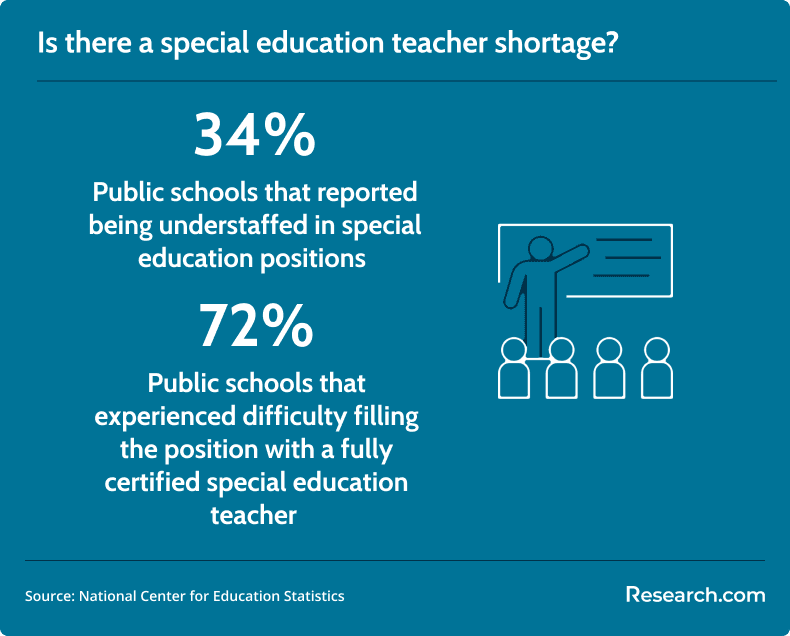
| Educators in states with special education staffing needs | The National Center for Education Statistics reported that 34% of public schools were understaffed in special education positions in SY 2024–2025. |
What are the main benefits of an online Ed.S. degree in Special Education?
- Career mobility in special education. Graduates may be prepared for roles such as special education teacher leader, instructional coordinator, special education administrator, intervention specialist, or district-level program coordinator. The U.S. Bureau of Labor Statistics (2023) projects about 35,900 openings each year for special education teachers from 2023 to 2033, largely because of retirements and workers moving into other roles.
- Potential access to higher-paying leadership work. ZipRecruiter (2025) reports an average annual salary of $87,941 for Special Education Administrators, or about $42 per hour. Pay varies by district, location, contract structure, experience, and licensure.
- Flexible graduate study for working educators. Online Ed.S. programs are often built for professionals who cannot pause their careers. Students may complete coursework through asynchronous classes, scheduled virtual sessions, hybrid fieldwork, or local practicums.
- Advanced expertise in high-stakes areas. The degree can deepen knowledge of IEP development, special education law, inclusive instruction, behavioral intervention, assessment, data analysis, and program compliance.
- A post-master’s alternative to a doctorate. An Ed.S. is more advanced than a master’s degree but typically shorter than an Ed.D. or Ph.D., making it a practical option for educators focused on applied leadership rather than doctoral research.
What can I expect from an online Ed.S. degree in Special Education?
An online Education Specialist degree in Special Education is a post-master’s graduate credential focused on advanced practice, leadership, and applied problem-solving in special education. Students usually study legal compliance, disability categories, inclusive curriculum, behavioral supports, IEP systems, assessment, program evaluation, and research-based instructional strategies.
Most programs are designed for practicing educators. Coursework may be asynchronous, synchronous, hybrid, or delivered in accelerated terms. Even when classes are fully online, students may still need to complete field experiences, practicums, internships, capstone projects, or leadership-based assignments in a school or district setting.
The most important detail to verify is whether the program aligns with your state’s licensure or endorsement requirements. Some online Ed.S. programs are designed for professional advancement only, while others may support administrative, supervisory, special education director, or leadership credentials. Before enrolling, ask the school to explain exactly what the program does and does not qualify you for in your state.
Where can I work with an online Ed.S. degree in Special Education?
Graduates can work in many education settings, especially where advanced knowledge of disability services, instructional support, compliance, and teacher leadership is needed. Common employers include public school districts, private K–12 schools, charter schools, state education agencies, nonprofit education organizations, early intervention programs, and higher education support offices.
In K–12 schools, Ed.S. graduates may serve as lead special education teachers, instructional specialists, IEP team leaders, behavior support specialists, or special education coordinators. At the district level, they may help manage services, monitor compliance, train teachers, evaluate programs, coordinate interventions, or support families through eligibility and placement processes.
Some graduates move into consulting, advocacy, adjunct teaching, or academic support roles for students with disabilities. The degree is especially relevant for professionals who want to influence systems, not only individual classrooms.
How much can I make with an online Ed.S. degree in Special Education?
Salary depends heavily on role, location, school district pay scale, union contract, licensure, years of experience, and whether the position is classroom-based or administrative. ZipRecruiter (2025) reports that Special Education Administrators commonly earn between $85,500 and $94,999, with an average annual salary of $87,941.
Special Education Consultants are reported in the $76,000–$85,499 range, particularly when they work in urban districts or roles with significant leadership, compliance, or program improvement responsibilities. Some districts also place educators with advanced credentials higher on the salary schedule or offer stipends for graduate degrees, but these policies vary widely.
The online format can improve affordability because many students continue working while enrolled. Still, the degree should be evaluated like any other investment: compare total tuition, fees, licensure value, salary schedule impact, advancement potential, and the time required to complete fieldwork or capstone requirements.
- Top online Ed.S. degree programs in Special Education for 2027
- How long does an online Ed.S. in Special Education take?
- Online versus on-campus Ed.S. programs in Special Education
- Average cost of an online Ed.S. in Special Education
- Financial aid options for online Ed.S. students
- Admission requirements for online Ed.S. programs
- Common courses in online Ed.S. Special Education programs
- Specialization options in online Ed.S. Special Education programs
- Emerging trends in online Ed.S. Special Education degrees
- Accreditation and employer recognition
- Networking and mentorship opportunities
- Diversity, equity, and inclusion in special education training
- How to choose the right online Ed.S. program
- Career paths for Ed.S. graduates
- Job market outlook for Ed.S. graduates in Special Education
Top online Ed.S. degree programs in Special Education for 2027
How this ranking was developed
This list focuses on affordability, online availability, program structure, credit requirements, and accreditation. Research.com’s education team reviewed information using its published ranking methodology and data sources such as the Integrated Postsecondary Education Data System (IPEDS), Peterson’s database, the College Scorecard, and the National Center for Education Statistics (NCES). Rankings should be used as a starting point, not a substitute for confirming state licensure rules, current tuition, fees, and program availability with each university.
| School | Program highlights | Credits | Cost per credit | Accreditation |
| University of West Georgia | Fully online Ed.S. in Special Education with advanced coursework, an Exit Examination, and a Research Project | 27 | Approximately $321 | Southern Association of Colleges and Schools Commission on Colleges (SACSCOC) |
| Valdosta State University | Fully online Ed.S. for practicing special educators with an all-inclusive tuition model | Varies | All-inclusive rate; specific amount not provided | SACSCOC |
| University of the Cumberlands | Online Ed.S. with six eight-week enrollment periods and a One Price Promise covering tuition, fees, and books | Varies | $220 | SACSCOC |
| Arkansas State University | Online Ed.S. in Educational Leadership with a Special Education Director concentration and an internship | 33 | $340 | Higher Learning Commission (HLC) |
| Kennesaw State University | 100% online, 27-hour Ed.S. in Special Education with two tracks | 27 | Approximately $383 | SACSCOC |
| Northern Kentucky University | 100% online Ed.S. in Teaching and Leading – Learning & Behavior Disorders | 30 | $412 | Council for the Accreditation of Educator Preparation (CAEP) |
| Northwestern State University of Louisiana | Online Ed.S. in Educational Leadership and Instruction with a Special Education concentration | 30 | $475 | SACSCOC |
| University of West Alabama | Fully online Ed.S. in Special Education (6–12) | Varies | $429 | SACSCOC |
| National University | Online Ed.S. in Special Education with foundational courses, electives, research courses, and a capstone | 33 | Approximately $442 | WASC Senior College and University Commission (WSCUC) |
| Pittsburg State University | Ed.S. in Leadership with a Special Education focus, including leadership, law, evaluation, and practical experiences | 36 | $410 | Council for the Accreditation of Educator Preparation (CAEP) |
1. University of West Georgia
The University of West Georgia offers a fully online Ed.S. in Special Education for educators who already hold a master’s degree in education or speech-language pathology. The program focuses on advanced professional competencies and prepares students to act as improvement-oriented leaders in special education settings. Requirements include at least 27 graduate credit hours, an Exit Examination, and a Research Project.
- Program length: Varies
- Tracks or concentrations: Tier 1 Leadership
- Cost per credit: Approximately $321
- Credits required: 27
- Accreditation: Southern Association of Colleges and Schools Commission on Colleges (SACSCOC)
2. Valdosta State University
Valdosta State University provides a fully online Ed.S. in Special Education for practicing special educators with a master’s degree. The program is structured to strengthen professional expertise and uses an all-inclusive tuition rate that covers tuition and course materials without additional fees.
- Program length: Varies
- Tracks or concentrations: Not specified
- Cost per credit: All-inclusive rate; specific amount not provided
- Credits required: Varies
- Accreditation: SACSCOC
3. University of the Cumberlands
The University of the Cumberlands offers an online Ed.S. in Special Education that may be completed in just over a year. Students move through six eight-week enrollment periods, and the school’s One Price Promise includes tuition, fees, and books.
- Program length: Just over 1 year
- Tracks or concentrations: Not specified
- Cost per credit: $220
- Credits required: Varies
- Accreditation: SACSCOC
4. Arkansas State University
Arkansas State University offers an online Ed.S. in Educational Leadership with a Special Education Director concentration. The program is intended for educators preparing for campus-level or district-level leadership and includes an internship that can be completed while the student remains employed.
- Program length: As few as 18 months
- Tracks or concentrations: Special Education Director
- Cost per credit: $340
- Credits required: 33
- Accreditation: Higher Learning Commission (HLC)
5. Kennesaw State University
Kennesaw State University offers a 100% online, 27-hour Ed.S. in Special Education with two tracks. Coursework addresses major issues in special education, including legislative impacts on students with exceptionalities and the role of advanced educators in improving practice.
- Program length: Varies
- Tracks or concentrations: Two tracks; specifics not provided
- Cost per credit: Approximately $383
- Credits required: 27
- Accreditation: SACSCOC
6. Northern Kentucky University
Northern Kentucky University offers a 100% online Ed.S. in Teaching and Leading – Learning & Behavior Disorders (LBD). The program is designed for educators who want to mentor new LBD teachers, evaluate curriculum and instruction, build research and leadership skills, and prepare for school or district leadership opportunities.
- Program length: As few as 18 months
- Tracks or concentrations: Learning & Behavior Disorders
- Cost per credit: $412
- Credits required: 30
- Accreditation: Council for the Accreditation of Educator Preparation (CAEP)
7. Northwestern State University of Louisiana
Northwestern State University of Louisiana offers an online Ed.S. in Educational Leadership and Instruction with a Special Education concentration. The curriculum includes special education coursework, related-field study, research, statistics, and either a thesis or field study.
- Program length: Varies
- Tracks or concentrations: Special Education
- Cost per credit: $475
- Credits required: 30
- Accreditation: SACSCOC
8. University of West Alabama
The University of West Alabama offers a fully online Ed.S. in Special Education (6–12). The program is intended for educators who want advanced knowledge of special education for grades 6–12 and emphasizes practical application and leadership in school settings.
- Program length: Varies
- Tracks or concentrations: Special Education (6–12)
- Cost per credit: $429
- Credits required: Varies
- Accreditation: SACSCOC
9. National University
National University offers an online Ed.S. in Special Education requiring foundational coursework, specialization electives, research courses, and a capstone. The program totals 33 credit hours and is designed for completion in approximately 18 months.
- Program length: Approximately 18 months
- Tracks or concentrations: Special Education
- Cost per credit: Approximately $442
- Credits required: 33
- Accreditation: WASC Senior College and University Commission (WSCUC)
10. Pittsburg State University
Pittsburg State University offers an Education Specialist degree in Leadership with a Special Education focus. Students study educational leadership, special education law, and program evaluation while completing practical experiences that connect coursework to real school environments.
- Program length: 2–3 years
- Tracks or concentrations: Special Education
- Cost per credit: $410
- Credits required: 36
- Accreditation: Council for the Accreditation of Educator Preparation (CAEP)
How long does completing an online Ed.S. degree in Special Education take?
Most online Ed.S. programs in Special Education take 12 to 24 months, depending on credit requirements, term length, enrollment pace, transfer policies, and fieldwork expectations. This timeline is much shorter than the path described in guides on how long it takes to get a teaching degree, which commonly centers on about 4 years of full-time undergraduate study.
Many programs require about 27 to 33 credit hours, often spread across 3–6 semesters. Accelerated formats may use eight-week terms, year-round enrollment, or multiple start dates so working educators can move faster. Other programs allow a slower part-time pace for students with demanding teaching schedules or family responsibilities.
Program length also depends on whether the degree includes an internship, practicum, capstone, action research project, exit exam, or state-specific leadership requirement. Before choosing a faster program, confirm that the pace is realistic for your work schedule and that the accelerated timeline does not create licensure problems in your state.
Efficient program completion matters because the special education workforce continues to face staffing pressure. According to the National Center for Education Statistics (SY 2024–2025), 34% of public schools reported being understaffed in special education positions, and 72% of schools with vacancies had difficulty filling those jobs with fully certified teachers.
| Program pace | Typical situation | Best for |
| Accelerated | Compressed terms, year-round coursework, or a program that can be completed in just over a year | Educators with predictable schedules and strong time management |
| Standard full-time | Usually completed within the 12 to 24 month range | Students who want steady progress while continuing to work |
| Part-time | Fewer courses per term and a longer completion timeline | Teachers balancing heavy caseloads, leadership duties, or family obligations |
How does an online Ed.S. degree in Special Education compare to an on-campus program?
Online and on-campus Ed.S. programs can lead to the same credential when they are offered by properly accredited institutions and meet the same academic and state requirements. The main differences are delivery format, interaction style, schedule structure, local fieldwork logistics, and the level of self-direction required.
| Factor | Online Ed.S. | On-campus Ed.S. |
| Schedule | Often more flexible, with asynchronous courses or limited live sessions | Usually follows scheduled class meetings on campus |
| Best learning style | Works well for independent students who manage deadlines without daily in-person structure | Works well for students who prefer face-to-face discussion and a fixed routine |
| Faculty and peer interaction | Usually occurs through discussion boards, video meetings, email, virtual office hours, and group projects | Includes in-person discussion, immediate feedback, and spontaneous collaboration |
| Field experiences | Often completed locally with school approval and university supervision | May be coordinated through nearby partner schools or districts |
| Cost considerations | May reduce commuting and relocation costs; fees vary by school | May involve transportation, parking, housing, or schedule-related costs |
Online programs are often the better fit for working educators who cannot relocate or attend classes at set times. Similar to students comparing the cheapest Christian ministry degree online options, Ed.S. students should look beyond convenience and confirm program quality, accreditation, support, and total cost.
Campus programs may be preferable for students who want regular in-person mentorship, immediate access to faculty, and a structured weekly routine. Neither format is automatically better. The stronger choice is the one that matches your learning style, licensure needs, budget, and professional responsibilities.
What is the average cost of an online Ed.S. degree in Special Education?
The average cost of an online Ed.S. in Special Education generally falls between $6,000 and $15,000. Costs are shaped by required credits, tuition per credit, student fees, books, course materials, technology fees, and whether a school uses all-inclusive pricing. The programs in this guide list costs per credit from $220 to $475, with many requiring 27 to 33 credits.
Students comparing graduate education costs may also review Research.com’s guide to affordable online education degrees to understand broader tuition patterns. However, Ed.S. pricing should be evaluated separately because it is a post-master’s credential and may include fieldwork, research, leadership projects, or licensure-related requirements.
Some universities bundle textbooks, fees, and course materials into one price, while others charge separate application, graduation, online learning, technology, or student service fees. Ask for a written total-cost estimate before enrolling.
The number of special education students increased by 3.4% in 2023, and it is projected to increase yearly (U.S. Dept. of Education, 2023). For educators, that growth can make advanced preparation more relevant, but it does not guarantee a specific salary or promotion. The degree’s value depends on how well it connects to local staffing needs, district pay policies, licensure rules, and your target role.
| Cost item | Why it matters |
| Tuition per credit | The largest cost driver, especially for programs requiring 27 to 33 credits |
| Fees | Application, graduation, technology, online course, and student service fees can raise the final price |
| Books and materials | Some programs include these in tuition, while others bill them separately |
| Fieldwork or internship expenses | Students may need background checks, travel, placement coordination, or district approvals |
| Licensure-related costs | Testing, certification applications, or state documentation may be separate from tuition |
What financial aid options are available for students in online Ed.S. Special Education programs?
Graduate students should treat financial aid as part of program selection, not an afterthought. While the original cost may look affordable, the final out-of-pocket amount depends on federal loan eligibility, scholarships, employer reimbursement, state incentives, payment plans, and whether the program qualifies for aid.
Students researching leadership-oriented graduate programs may also compare aid strategies used in other fields, including affordable online doctorate in behavioral leadership programs, but Ed.S. students should prioritize education-specific funding sources.
- FAFSA-based federal aid. Eligible graduate students may use the Free Application for Federal Student Aid to apply for Direct Unsubsidized Loans and Graduate PLUS Loans.
- State grants, waivers, or special education incentives. Some states provide support for educators preparing for high-need special education roles.
- Institutional scholarships and grants. Universities may offer need-based, merit-based, educator-specific, or online graduate student awards. National University is one example of an institution that offers scholarship options.
- Military and veteran education benefits. Qualified students may use VA benefits, Yellow Ribbon benefits, military tuition assistance, or military spouse scholarship support.
- Employer tuition reimbursement. School districts may help pay for advanced credentials when the degree supports district staffing, leadership, or licensure needs.
- Third-party scholarships. Organizations such as the HIE Help Center, Teacher.org, and P.E.O. International offer scholarship opportunities for graduate education students, including those focused on special needs populations.
- Payment plans. Many online programs allow students to divide tuition into installments across a term or academic year.
| Question to ask | Why it matters |
| Is this Ed.S. program eligible for federal financial aid? | Not every credential or enrollment status is treated the same for aid purposes. |
| Does my district reimburse tuition for this specific program? | Some reimbursement policies require prior approval, minimum grades, or continued employment. |
| Are books and fees included? | All-inclusive pricing can make cost comparisons easier. |
| Will this program lead to a salary lane change? | District salary schedules vary, and advanced credits do not always produce the same pay increase. |
What are the prerequisites for enrolling in an online Ed.S. degree in Special Education?
Admission requirements vary by school, but most online Ed.S. programs in Special Education are built for experienced educators who already hold graduate-level preparation. Applicants should expect schools to review academic history, licensure, professional experience, leadership potential, and fit with the program’s goals.
- Master’s degree in education or a related field. Most programs require a graduate degree from a regionally accredited institution.
- Valid professional teaching license. Many Ed.S. programs expect applicants to hold current teaching certification or a related education credential.
- Minimum graduate GPA. A 3.0 or higher graduate GPA is commonly required. This expectation is similar to the academic and credential standards discussed in guides on what you need to teach special education.
- Teaching or school-based experience. Many programs prefer or require two to three years of classroom, special education, counseling, or related experience.
- Letters of recommendation. References typically speak to the applicant’s professionalism, leadership ability, instructional skill, and commitment to students with disabilities.
- Personal statement or essay. Applicants usually explain career goals, reasons for pursuing the Ed.S., and interest in special education leadership or advanced practice.
- Résumé or CV. Schools use the résumé to review employment history, licenses, certifications, leadership roles, training, and accomplishments.
Résumé data for Special Education Administrators shows that IEP expertise appears most frequently at 14.9%. Knowledge of education programs appears at about 10%, and public school experience appears at 9.5%. Other valued skills include event logistics and K–12 experience. An Ed.S. can help candidates strengthen several of these areas, particularly when coursework includes IEP systems, leadership, law, data use, and program coordination.
What courses are typically offered in an online Ed.S. degree in Special Education?
An Ed.S. curriculum is more advanced and leadership-focused than many shorter credentials, including online ESL teaching certification programs. Students usually study both classroom-level interventions and system-level special education leadership.
| Course area | What students typically learn |
| Advanced instructional strategies for exceptional learners | How to adapt instruction, curriculum, and supports for students with varied disabilities and learning profiles |
| Special education law and policy | Legal responsibilities under frameworks such as IDEA and Section 504, along with compliance and policy implementation |
| Assessment and data-based decision-making | How to interpret assessments, monitor progress, analyze data, and use evidence to guide IEP and instructional decisions |
| Behavioral intervention and classroom management | Research-based strategies for positive behavior support and effective learning environments |
| Collaboration and IEP development | How to work with families, teachers, specialists, administrators, and multidisciplinary teams |
| Research methods and applied inquiry | How to evaluate educational problems, collect data, interpret findings, and apply research to practice |
| Capstone, practicum, or internship | A culminating field-based project, leadership experience, action research study, or supervised internship |
What types of specializations are available in online Ed.S. Special Education programs?
Specializations help students align the Ed.S. with the populations, roles, and leadership responsibilities they want to pursue. Not every school offers every track, so students should compare concentration names, required courses, fieldwork expectations, and licensure outcomes carefully.
- Learning and Behavior Disorders (LBD). This track focuses on students with mild to moderate learning and behavioral challenges, including instructional supports, behavior strategies, and legal considerations. Students interested in behavior-focused work may also compare the types of applied behavior analysis certification online to see whether ABA credentials fit their goals.
- Autism Spectrum Disorders (ASD). Coursework typically covers characteristics of autism, evidence-based interventions, communication supports, social skill development, and individualized planning.
- Emotional and Behavioral Disorders (EBD). This specialization prepares educators to identify behavioral and emotional needs, design interventions, and collaborate with families and school teams.
- Gifted and Talented Education. Students study identification, differentiation, advanced curriculum, creativity, critical thinking, and support for twice-exceptional learners.
- Early Childhood Special Education. This option emphasizes developmental assessment, family-centered planning, early intervention, and inclusive supports for young children.
- Special Education Leadership or Administration. Students build skills in supervision, compliance, program coordination, policy implementation, advocacy, and resource management.
- Assistive Technology. This track focuses on evaluating, selecting, implementing, and training others to use tools that support communication, access, independence, and learning.
Disability-category data can also inform specialization decisions. The largest school-age group of students with disabilities is students with Specific Learning Disabilities at 33.5%, followed by Speech Language Impairment at 17.8% and Other Health Impairments at 16.4%. Autism accounts for 13.7%, while Intellectual Disability represents 5.7% and Emotional Disturbance represents 4.3%.
These figures do not mean every student should choose the largest category. Instead, they show where service needs are concentrated and why specializations in learning disabilities, speech-language-related supports, autism, behavioral needs, and health-related impairments may be especially relevant. Just as students compare options such as the cheapest online FNP graduate certificate programs by weighing cost against career direction, Ed.S. students should choose a specialization that matches local demand, licensure rules, and the student populations they most want to serve.
What emerging trends are shaping online Ed.S. degrees in Special Education?
Online Ed.S. programs are changing as schools respond to new technology, staffing needs, inclusive education goals, and student mental health concerns. Many programs now use digital collaboration platforms, adaptive learning tools, online simulations, case-based assignments, and virtual coaching to help educators apply special education strategies in realistic contexts.
Another trend is demand for flexible and accelerated pathways. Educators comparing post-master’s options often look at the Ed.S. alongside doctoral routes such as the quickest online EdD programs. The Ed.S. may be more appropriate for students who want advanced applied expertise without the broader doctoral research commitment.
Employer expectations are also shifting toward data literacy, compliance knowledge, culturally responsive practice, behavior support, assistive technology, and collaborative leadership. Programs that connect coursework to school-based implementation are likely to be more useful than programs that remain purely theoretical.
Is my online Ed.S. degree accredited and recognized by employers?
Accreditation is one of the first things to verify. A reputable online Ed.S. should be offered by an institution with recognized institutional accreditation, and educator preparation programs may also hold professional accreditation such as CAEP when applicable. Accreditation can affect financial aid eligibility, transferability, employer recognition, and state licensure review.
Employer recognition also depends on whether the degree fits the position you want. For example, a district may value an Ed.S. for salary advancement or leadership hiring, but a state may require a specific administrative license, director credential, endorsement, assessment, or supervised internship. Always check your state education agency and your district’s human resources office before enrolling.
Students comparing quality and affordability may also review Research.com’s guide to the cheapest online masters of education, but post-master’s Ed.S. programs should be evaluated by their own accreditation, licensure alignment, curriculum, and outcomes.
What networking and mentorship opportunities can improve your online Ed.S. experience?
Strong online programs do more than post lectures. They create opportunities for students to build professional relationships with faculty, classmates, alumni, district leaders, and mentor practitioners. Useful supports may include virtual office hours, cohort discussion groups, professional learning communities, alumni events, career advising, practicum coordination, and webinars with special education leaders.
Mentorship is especially important for students moving from classroom roles into coordination, diagnostic, supervisory, or administrative work. A mentor can help students interpret legal responsibilities, lead IEP teams, manage conflict, communicate with families, and make decisions that affect services across a school or district.
Some educators eventually compare the Ed.S. with doctorate-level leadership options, including the cheapest doctor of education online. Networking can help clarify whether the Ed.S. is enough for your target role or whether a doctorate may be useful later.
How do online Ed.S. programs address diversity, equity, and inclusion in special education?
Diversity, equity, and inclusion are central to effective special education leadership. Online Ed.S. programs may address these issues through culturally responsive instruction, differentiated assessment, disability rights, family engagement, policy analysis, bias reduction, inclusive classroom design, and equitable access to services.
Strong programs help educators examine how disability, language, race, culture, socioeconomic status, and school resources can affect identification, placement, discipline, intervention, and family communication. Coursework may use case studies, community-based assignments, legal analysis, and collaborative projects to prepare future leaders for complex real-world decisions.
When comparing affordability and structure across fields, students may review unrelated program examples such as the cheapest online political science program. For Ed.S. students, however, the most relevant DEI question is whether the program prepares graduates to improve outcomes for diverse learners with disabilities in actual schools.
How do I choose the best online Ed.S. degree in Special Education?
The best online Ed.S. program is not always the cheapest, fastest, or highest-ranked option. It is the program that fits your license, career goal, budget, schedule, learning style, and state requirements. Students comparing other education-related options, such as affordable health education programs online, should use the same decision logic: outcomes first, cost second, convenience third.
- Confirm accreditation. Verify institutional accreditation and any educator preparation accreditation relevant to your state or target role.
- Check licensure alignment before applying. Ask whether the program leads to, supports, or does not support administrative, supervisory, special education director, or endorsement eligibility in your state.
- Compare total cost, not only tuition. Include fees, materials, background checks, fieldwork costs, graduation fees, and possible licensure expenses.
- Review curriculum depth. Look for advanced work in special education law, IEP systems, assessment, intervention, inclusive leadership, data use, and program evaluation.
- Evaluate fieldwork requirements. Make sure internships, practicums, or projects can be completed where you live and work.
- Look for faculty support. Online students need access to advising, mentorship, practicum help, writing support, library resources, and career services.
- Match the specialization to your role. Choose a track based on the students you serve, the position you want, and the credentials your state recognizes.
Common mistakes to avoid when choosing an online Ed.S. program
| Mistake | Better approach |
| Choosing a program only because it is inexpensive | Compare accreditation, licensure alignment, support, graduation requirements, and employer recognition. |
| Assuming every online Ed.S. qualifies for leadership licensure | Ask the university and your state education agency to confirm the exact credential outcome. |
| Ignoring district salary policies | Check whether the degree or credits move you to a higher salary lane or qualify for stipends. |
| Underestimating fieldwork demands | Confirm whether internships, observations, or projects can be completed at your current school or district. |
| Relying only on rankings | Use rankings as a shortlist, then verify cost, fit, schedule, and licensure details directly with the school. |
| Assuming salary outcomes are guaranteed | Review local job postings, district contracts, state rules, and your own experience level. |
Questions to ask admissions advisors
- Is the program fully online, or are campus visits required?
- Does the program lead to any license, endorsement, or administrative credential?
- Is the program approved for students in my state?
- What is the total cost, including fees and materials?
- Can I complete fieldwork in my current school or district?
- What support is available for online students during the practicum, capstone, or research project?
- How do graduates typically use this degree professionally?
- Does the university publish licensure disclosure information for my state?
What career paths are available for graduates of an online Ed.S. degree in Special Education?
An online Ed.S. in Special Education can support several career paths in schools, districts, agencies, nonprofits, consulting, and higher education. Some roles require additional state credentials, so graduates should verify requirements before assuming eligibility.
| Career path | Typical responsibilities | Why the Ed.S. may help |
| Special Education Coordinator or Administrator | Oversees programs, supports compliance, coordinates services, supervises staff, and improves instructional systems | The degree builds leadership, legal, assessment, and program management skills. |
| Instructional Specialist or Curriculum Developer | Designs, evaluates, and improves inclusive curriculum and interventions | Advanced coursework supports data-informed instruction and differentiated learning. |
| Educational Diagnostician or Intervention Specialist | Assesses student needs, interprets data, and contributes to IEP planning | Training in assessment, disability categories, and IEP systems is directly relevant. |
| Special Education Consultant | Advises schools, agencies, or nonprofits on compliance, program quality, and instructional improvement | The Ed.S. can strengthen credibility and applied leadership expertise. |
| Adjunct Faculty or Teacher Mentor | Supports new teachers, leads professional development, or teaches education-related coursework | Post-master’s preparation may support mentorship, coaching, and educator development roles. |
Salary data in the chart below shows several higher-paying special education roles. Special Education Director is listed with an average salary of $103,250, Education Specialist at $90,750, and Special Education Administrator at around $90,000. Other roles include Special Education Supervisor at $85,500, Orientation and Mobility Specialist at $84,750, and Educational Diagnostician at $67,750. These figures show the range of leadership and specialist roles connected to advanced special education preparation, though actual pay depends on employer, location, experience, and credentials.
What is the job market for graduates with an Ed.S. degree in Special Education?
The job market for Ed.S. graduates is shaped by two realities: overall special education teacher employment is projected to show little or no change from 2023 to 2033, but schools still need qualified professionals because of replacement demand, certification shortages, retirements, and movement into other occupations.
The Bureau of Labor Statistics (2023) projects about 35,900 openings for special education teachers each year, on average, over the decade. Many of those openings are expected to come from workers leaving the occupation or exiting the labor force.
Preschool special education teachers, including professionals connected to a teaching certificate in Early Childhood, are projected to see 2% employment growth (BLS, 2023), higher than other special education teaching levels. This reflects continued need for early intervention and specialized supports for young children with disabilities.
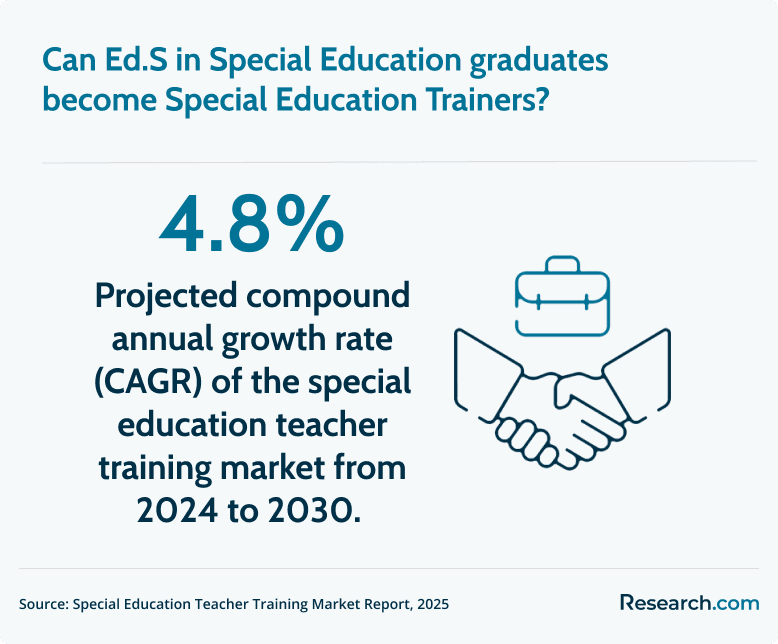
Globally, the special education teacher training market is forecasted to grow at a compound annual growth rate (CAGR) of 4.8% from 2024 to 2030, according to the Special Education Teacher Training Market Report (2025). Growth is associated with greater awareness of learning disabilities, improved identification of students with special needs, and broader adoption of inclusive education practices.
For Ed.S. graduates, the strongest opportunities may be in roles that combine advanced special education knowledge with leadership, compliance, teacher training, data use, and program improvement. The degree can be a strong credential, but job outcomes still depend on state rules, district budgets, open positions, and the graduate’s prior experience.
What students often value about online Ed.S. programs in Special Education
- Flexibility while working. Many educators choose online Ed.S. programs because they can continue teaching while completing coursework, fieldwork, and projects.
- Immediate classroom relevance. Students often apply what they learn in IEP development, behavior support, assessment, and legal compliance directly to their current school roles.
- Preparation for broader impact. The degree can help educators shift from serving one classroom to supporting teachers, families, programs, and district-level special education systems.
References
- Bureau of Labor Statistics. (2024, May). Special education teachers: Occupational outlook handbook. U.S. Department of Labor. https://www.bls.gov/ooh/education-training-and-library/special-education-teachers.htm
- HIE Help Center. (2024). Scholarship for special educators. https://hiehelpcenter.org/scholarship-for-special-educators/
- National Center for Education Statistics. (2024). Fast facts: Students with disabilities. U.S. Department of Education. https://nces.ed.gov/fastfacts/display.asp?id=59
- National University. (n.d.). Education specialist (Ed.S.) in educational leadership. https://www.nu.edu/degrees/educational-leadership/programs/education-specialist/
- ZipRecruiter. (2025). The 25 highest paying special education jobs in 2025. https://www.ziprecruiter.com/g/Highest-Paying-Special-Education-Jobs
- Zippia. (2025). 15 special education administrator skills for your resume. https://www.zippia.com/special-education-administrator-jobs/skills/
Key Insights
- An online Ed.S. in Special Education is best for licensed, experienced educators who want post-master’s preparation for leadership, coordination, intervention, compliance, or specialist roles.
- Affordable programs in this guide list costs from $220 to $475 per credit, but students should compare full program cost, not tuition alone.
- Most programs take 12 to 24 months and require about 27 to 33 credits, though some offer accelerated formats or longer part-time options.
- Accreditation and state licensure alignment are non-negotiable. Confirm whether the program supports the credential or salary outcome you need before applying.
- Online and on-campus Ed.S. programs can be equally credible when properly accredited, but online study requires stronger self-management and local fieldwork planning.
- Specialization choice should be tied to your target population, state requirements, and local job market—not simply the most popular concentration.
- Salary outcomes vary. ZipRecruiter (2025) reports an average annual salary of $87,941 for Special Education Administrators, but pay depends on location, employer, experience, and credentials.
- The strongest Ed.S. programs connect coursework to real school problems: IEP systems, special education law, inclusive instruction, assessment, behavior support, data use, and program improvement.
Other Things You Need to Know About Online Ed.S Degree in Special Education
Participating in these programs typically requires a reliable internet connection, a computer with updated software, and access to virtual learning platforms. Some institutions may also specify compatibility with certain operating systems; check specific program guidelines for details.
Admission requirements for the most affordable online Ed.S degree programs in Special Education in 2027 typically include a master's degree in education or a related field, a valid teaching license, and professional experience in special education. Applicants may also need to submit letters of recommendation, a personal statement, and transcripts.


