
2027 What Degree Do You Need To Be a Social Worker: Education Requirements in Oregon

Co-Founder and Chief Data Scientist
Oregon faces a growing demand for qualified social workers amid rising mental health and substance abuse issues. Approximately 48% of Oregon residents experience behavioral health challenges annually, underscoring the critical need for skilled professionals. Entering this field requires specific educational credentials, with a Bachelor of Social Work (BSW) as the minimum, though many positions demand a Master of Social Work (MSW) to obtain licensure.
Pursuing these degrees not only meets state requirements but also enhances job prospects in Oregon's expanding social services sector. This article, crafted by career planning experts, outlines the essential degree paths and educational requirements to guide prospective social workers toward successful licensure and employment in Oregon.
Key Things to Know About Social Work Education Requirements in Oregon
- A minimum of a Bachelor of Social Work (BSW) is required for entry-level social work positions in Oregon, typically a 4-year degree.
- To qualify for Licensed Clinical Social Worker (LCSW) status, candidates must earn a Master of Social Work (MSW) from an accredited program and complete 3,200 hours of supervised clinical experience.
- Oregon's growing social services workforce shows demand for MSW holders is projected to increase 16% by 2030, reflecting a strong emphasis on advanced qualifications.
- What is the minimum degree required to become a licensed social worker in Oregon?
- What courses are covered in a social work degree program in Oregon?
- How long does it take to complete a social work degree program in Oregon?
- How much does a social work degree cost in Oregon?
- What degrees are required for different social work specializations in Oregon?
- What financial aid options are available to social work students in Oregon?
- How do you navigate the social work licensure process in Oregon?
- What are the alternative pathways to become a social worker in Oregon?
- Are online social work degrees recognized in Oregon?
- What organizations accredit social work degree programs in Oregon?
- What are the top institutions offering social work degree programs in Oregon?
- How can integrating counseling skills boost my social work career in Oregon?
What is the minimum degree required to become a licensed social worker in Oregon?
In Oregon, the minimum degree required for social work licensure depends on the level of license being pursued. Each step in the licensing pathway requires a specific academic credential from a CSWE-accredited program, ensuring consistency in preparation and professional standards. Below are the degree requirements tied to each licensure level:
- Bachelor of Social Work (BSW): Required for the Registered Baccalaureate Social Worker (RBSW) license. This undergraduate degree provides foundational training in generalist social work practice.
- Master of Social Work (MSW): Required for the Licensed Master of Social Work (LMSW) and Clinical Social Work Associate (CSWA) licenses. The MSW emphasizes advanced practice, policy, and research skills.
- Doctor of Social Work (DSW): May also be used to meet the educational requirement for LMSW, CSWA, and Licensed Clinical Social Worker (LCSW) licensure. This terminal practice degree builds leadership, policy, and advanced clinical expertise.
According to Oregon social work education requirements, while the BSW represents the baseline academic qualification, approximately 60% of licensed social workers hold graduate-level credentials. This aligns with the growing emphasis on advanced degrees for clinical and supervisory competencies within the profession. For those interested in career progression beyond initial licensure, exploring the career path of a social worker offers comprehensive insight into opportunities that align with these educational benchmarks.
What courses are covered in a social work degree program in Oregon?
Completing specialized coursework in social work degree programs is essential to equip graduates with skills that meet Oregon’s professional and regional demands. Oregon’s programs align with national accreditation standards while addressing key local challenges such as trauma-informed care and rural practice needs. Below is a summary of core courses typical in Oregon social work degrees:
- Introduction to Social Work: Covers professional values, ethics, and the scope of social work practice to establish a foundational identity for students.
- Human Behavior and Social Environment: Focuses on developmental processes across lifespan stages and the influence of social and psychological factors.
- Diversity, Equity, and Inclusion: Addresses race, ethnic relations, social justice, and Oregon’s diverse community contexts and policy landscape.
- Social Work Practice (Micro, Mezzo, Macro): Trains students in direct practice methods with individuals, groups, organizations, and communities to prepare for varied professional environments.
- Research Methods and Applied Statistics: Equips students to critically evaluate and apply research findings using statistical tools relevant to social work.
- Addictions, Mental Health, and Trauma: Emphasizes trauma-informed approaches, mental health issues, and substance use, reflecting Oregon’s workforce priorities.
- Ethics and Law: Reviews ethical decision-making frameworks, confidentiality rules, and legal responsibilities essential for professional conduct.
- Field Practicum and Seminar: Provides supervised practical experience, typically exceeding 400 hours, crucial for licensure and career readiness.
Oregon does not require a unique state-mandated course but programs typically prioritize trauma-informed care and rural practice to address specific regional workforce needs shaped by demographic and health factors.
How long does it take to complete a social work degree program in Oregon?
Program length is a key factor for students planning their social work education in Oregon, as it influences career entry timing and financial planning. Degree durations vary by level—Bachelor’s through Doctoral—and by enrollment status, full-time or part-time. Additional options like advanced standing and online formats also impact how quickly students can finish their studies.
- Bachelor of Social Work (BSW): Typically designed for full-time completion in 4 years, with part-time study extending this to 5–6 years; programs include significant fieldwork usually in the final year.
- Master of Social Work (MSW): Standard tracks require 2 years full-time or up to 4 years part-time; curriculum includes 62 credit hours and 448–560 practicum hours annually.
- Advanced Standing MSW: Accelerated options for BSW graduates reduce full-time completion to 8–20 months, with some online programs finishing in as little as 12 months.
- Doctor of Social Work (DSW): Full-time study generally takes 3–4 years, while part-time options may extend to 5–6 years; focus is on advanced practice and leadership. The degree emphasizes advanced practice and leadership, and as shown in the chart below, the majority of DSW degrees were conferred by private institutions.
- PhD in Social Work: Completed in 4–6 years full-time or up to 7–8 years part-time, emphasizing research and academic leadership.
- Factors influencing duration: Part-time schedules often add 1–2 years or more; fieldwork requirements impact pacing; online programs offer flexibility and potential acceleration.
An Oregon social worker, who graduated from a local university, shared that completing her MSW took nearly three years due to balancing employment and family commitments, reflecting the common experience of part-time students. She described the practicum hours as both intensive and rewarding, but said managing coursework alongside these hours required strong time management. “I underestimated how much flexibility I’d need,” she noted, “and the part-time format was a lifeline.”
Her journey highlighted how the program length extends naturally when life obligations intersect with professional goals, but also how the local institutions’ support enabled her eventual success. This perspective underscores the variable timelines students can expect and the importance of choosing a path aligned with personal circumstances.
How much does a social work degree cost in Oregon?
Knowing the cost of a social work degree in Oregon is vital for effective financial planning and selecting the best programs for your budget. Tuition for BSW/MSW programs and other advanced social work degrees varies by institution type, residency status, and delivery method.
- Bachelor of Social Work (BSW): Public universities typically charge in-state students $10,000–$14,000 annually, while out-of-state students may pay $30,000 or more; private colleges often exceed $35,000 per year. Online BSW options may provide reduced or in-state tuition rates regardless of residency.
- Master of Social Work (MSW): In-state tuition at Oregon public universities ranges from $14,000 to $20,000 per year, with out-of-state costs often above $30,000; some online MSW programs charge by credit ($500–$900) and offer flat rates for all students.
- Doctor of Social Work (DSW): Available mainly at select institutions, public programs charge $15,000–$25,000 per year for residents, while private and out-of-state programs can reach $40,000 or more; online DSW options may offer flexible payments but are limited locally.
- PhD in Social Work: Tuition aligns with other doctoral programs, typically $15,000–$20,000 annually for residents and up to $38,000 for non-residents; many programs provide tuition waivers or stipends for full-time students.
Affordability at public universities like Portland State University is enhanced by in-state tuition discounts, while private institutions maintain uniform, higher rates. Online degree formats may lower total expenses by reducing housing and commuting costs and often apply the same tuition rates for all students. For more detailed insights into financial outcomes, see the social worker salary data by state.
What degrees are required for different social work specializations in Oregon?
Different social work roles in Oregon require varying educational credentials due to the distinct skills and legal qualifications necessary for each specialization. These requirements ensure professionals are properly prepared to meet the needs of diverse populations and comply with state licensing standards.
- Clinical Social Work: A Master of Social Work (MSW) from an accredited program is required, along with two years (3,500 hours) of supervised clinical experience and passing the clinical level ASWB exam. The MSW is the minimum degree needed to provide therapy in Oregon.
- School Social Work: Typically requires an MSW with coursework or field experience focused on children and educational settings. Some school districts may also mandate teacher licensure or specialized training.
- Healthcare Social Work: A Bachelor of Social Work (BSW) allows entry-level positions, but an MSW is preferred or required for advanced roles such as patient counseling or leadership. Licensing is mandatory for healthcare social workers in Oregon.
- Child and Family Services: Entry-level jobs generally require a BSW from a CSWE-accredited program, while clinical intervention or supervisory roles demand an MSW and licensure. Employment in this field in Oregon is projected to grow by 12% through 2030.
- Social Work Research and Teaching: A Doctorate in Social Work (DSW) or PhD is necessary for university-level teaching or research, preparing professionals for academic leadership and policy roles.
What financial aid options are available to social work students in Oregon?
Financial aid is essential for students pursuing social work degrees in Oregon as it helps alleviate the substantial costs associated with tuition and educational expenses. Access to various financial resources enables more students to complete their programs and enter the social work profession, which plays a critical role in community well-being. Key financial aid options available to social work students in Oregon include:
- Federal Grants: These include Pell Grants and Federal Supplemental Educational Opportunity Grants (FSEOG), awarded based on financial need and do not require repayment. Students must submit the FAFSA to apply.
- Oregon State Grants: Programs like the Oregon Opportunity Grant (OOG) support over 30,000 students annually with need-based tuition assistance, alongside the Oregon Promise Grant and tribal student grants for eligible applicants.
- Scholarships for BSW and MSW Programs: The Higher Education Coordinating Commission’s OSAC administers over $100 million in scholarships yearly, including awards tailored for social work students like the Patty Gibbs-Wahlberg and Carl A. Scott Book Scholarships.
- Work-Study Programs: Federal and state work-study options offer part-time employment to students with financial need, often tied to social work-related community service roles, accessible via FAFSA application.
- Student Loans: Federal loans such as Direct Stafford and Graduate PLUS Loans provide lower interest rates and flexible repayment compared to private loans, which should be a last resort after exhausting federal options.
- Loan Repayment and Forgiveness Programs: The Oregon Behavioral Health Loan Repayment Program assists Licensed Clinical Social Workers serving in underserved areas by offering loan repayment benefits.
- Professional Organization Funding: Regional and national organizations like the National Association of Social Workers offer scholarships and grants supporting students engaged in leadership and advocacy within social work.
Students exploring financial aid for social work students in Oregon may also consider flexible degree options such as 1 year MSW programs online no BSW to expedite their education while managing costs effectively.
How do you navigate the social work licensure process in Oregon?
Once you complete your degree from a CSWE-accredited institution, focus on fulfilling the supervised practice hours required by the Oregon Board of Licensed Social Workers. Register for the appropriate ASWB licensing exam and utilize targeted study materials and practice tests to ensure readiness. Submit all necessary documentation—such as transcripts and records of supervised experience—in a timely manner. For further guidance on aligning these steps with state-specific requirements, review how to become a social worker in Oregon. Maintaining a schedule for continuing education will also support your professional growth and secure your licensure over the long term.
What are the alternative pathways to become a social worker in Oregon?
Individuals with degrees or experience outside social work can transition into the profession in Oregon using several alternative pathways, avoiding the need to start over. These options accommodate professionals from related fields while maintaining rigorous standards and addressing workforce demands.
- Traditional MSW Track for Non-BSW Holders: Applicants with bachelor’s degrees in psychology, sociology, or public health typically complete a two-year full-time Master of Social Work program.
- Advanced Standing MSW Programs: Those with a CSWE-accredited BSW may finish the MSW in one year, reducing time and cost.
- Using Related Degrees as Foundation: Degrees in human services or counseling fulfill MSW prerequisites and strengthen applications.
- Post-Bachelor’s Certificate or Bridge Programs: Graduate certificates help students with non-social work degrees meet requirements or gain foundational knowledge.
- State-Specific Alternative Licensure Initiatives: Oregon explores practice-based assessments and modified supervised experience to expand licensure options.
A social worker from Oregon, who graduated from a local university, shared insights on navigating these pathways. They described feeling uncertain initially, given their background outside social work, but found the bridge programs invaluable for building confidence and relevant skills.
“It wasn’t easy to balance coursework with my previous career experiences,” they reflected, “but the support from faculty and tailored curriculum made the transition manageable.” Their journey highlights the growing flexibility in Oregon’s social work education landscape, emphasizing that alternative routes can lead to meaningful and fulfilling careers in this field.
The chart below shows the top employment areas for PhD graduates in social work. This highlights how advanced degrees can open academic, research, and leadership pathways beyond traditional practice roles.
Are online social work degrees recognized in Oregon?
Online Bachelor of Social Work (BSW) and Master of Social Work (MSW) programs have grown significantly in Oregon, appealing to working adults and rural students seeking flexible education. Recognition of these degrees is critical because it affects eligibility for state licensure and employment in social service agencies. Without recognized credentials, graduates risk ineligibility to practice professionally in Oregon.
Recognition depends largely on accreditation by the Council on Social Work Education (CSWE) and compliance with Oregon Board of Licensed Social Workers standards. Both online and campus-based programs must hold CSWE accreditation to qualify graduates for licensure.
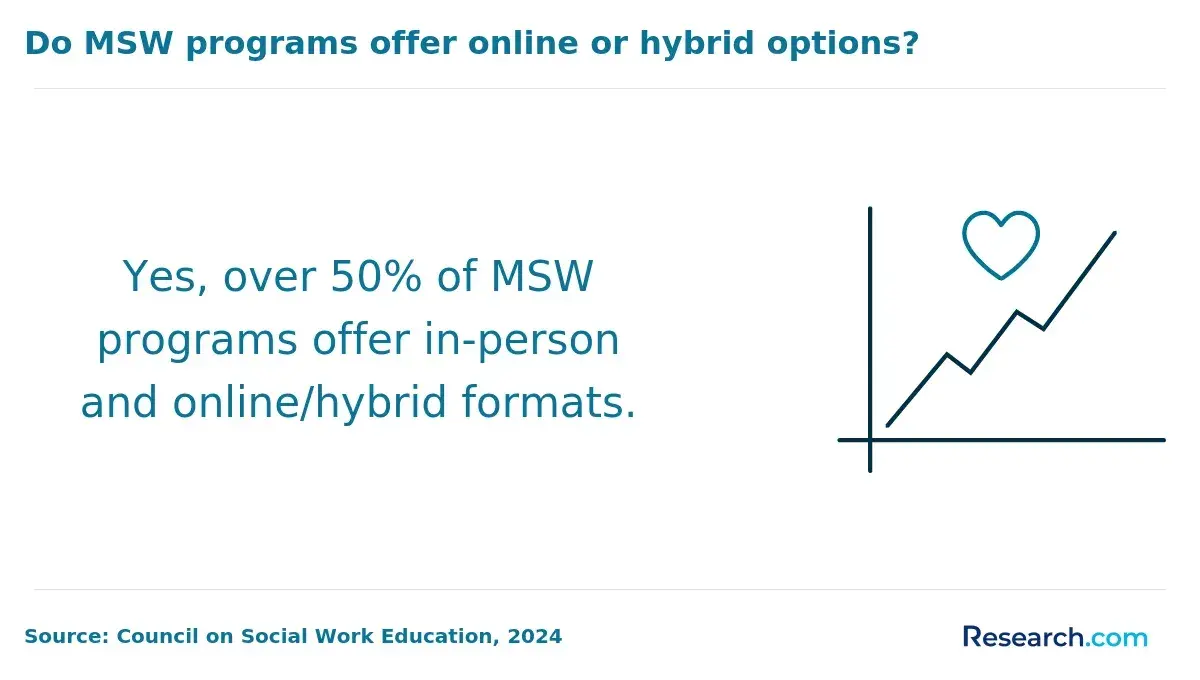
A 2022 Society for Human Resource Management survey found that 61% of U.S. employers view online degrees from accredited institutions as equivalent to traditional degrees, underscoring shifting employer attitudes. Portland State University’s CSWE-accredited MSW program exemplifies recognized online options, while Eastern Oregon University’s fully online MSW is pending accreditation as of 2025.
Students must also complete supervised, in-person fieldwork—400 hours for BSW and 900 for MSW—regardless of online coursework. Hybrid models that combine online learning with on-campus sessions and community practicums help meet these requirements while offering flexibility. Choosing a regionally and CSWE-accredited program in Oregon ensures the degree meets licensure criteria and holds value with employers, making verification of current accreditation status essential before enrollment.
What organizations accredit social work degree programs in Oregon?
Accreditation plays a critical role in ensuring social work degree programs in Oregon maintain high standards for curriculum, faculty, and student support. Graduates from accredited programs are eligible for licensure and widely recognized by employers, which underscores the importance of choosing programs approved by reputable organizations.
- Council on Social Work Education (CSWE): This national accrediting body oversees social work degree programs across the U.S. Only graduates from CSWE-accredited Bachelor of Social Work (BSW) or Master of Social Work (MSW) programs qualify for licensure in Oregon, including credentials like LCSW and LMSW.
- Regional Accrediting Agencies: Institutions offering social work degrees in Oregon must also have accreditation from regional bodies recognized by the U.S. Department of Education, primarily the Northwest Commission on Colleges and Universities (NWCCU). This ensures institutional quality and federal financial aid eligibility.
- Oregon Higher Education Coordinating Commission (HECC): While HECC does not accredit individual programs, it authorizes private and out-of-state schools to operate in Oregon. This oversight guarantees that institutions meet state academic standards and protect consumers.
As of 2024, the Oregon Employment Department reports over 6,000 employed social workers statewide, nearly all requiring degrees from CSWE accredited social work programs in Oregon, reflecting the impact of accreditation on career opportunities. For those exploring flexible options, reviewing affordable online MSW programs can be a strategic step toward fulfilling education requirements efficiently.
What are the top institutions offering social work degree programs in Oregon?
Choosing the right school for your social work education in Oregon impacts accreditation, career readiness, and the overall financial investment required. Accredited social work degree programs Oregon are essential for licensure eligibility and employer recognition in a growing profession.
- Portland State University (PSU): Oregon’s largest public university with the first public MSW program, offering multiple campuses, online options, and nationally ranked social work tracks with strong field placements.
- George Fox University: A private institution emphasizing integration of Christian faith with practice, featuring a CSWE-accredited MSW program and flexible online and Advanced Standing tracks.
- Eastern Oregon University (EOU): Offers a fully online MSW program focused on trauma-informed and generalist practice, ideal for rural and working adult learners balancing commitments.
- Pacific University: Known for culturally responsive community engagement, Pacific provides a CSWE-accredited MSW with diverse field education and flexible scheduling for professionals.
- University of Portland: Provides a liberal arts grounded BSW program with personalized advising and strong local field placement opportunities preparing students for licensure and advanced study.
For students considering flexible learning pathways, accessing a social worker online degree can complement traditional routes and expand accessibility. With social work employment in Oregon projected to grow 12% by 2032, selecting a top social work school in Oregon ensures a competitive edge through education aligned with evolving professional demands.
How can integrating counseling skills boost my social work career in Oregon?
Integrating counseling training with traditional social work education equips professionals with enhanced client-intervention techniques and broader service capabilities. This dual approach not only deepens the understanding of mental health challenges but also creates additional avenues for career advancement in Oregon’s dynamic social services landscape. For comprehensive guidance on combined certification options that align with state requirements and satisfy employer expectations, consider exploring the fastest way to become a counselor in Oregon.
Here's What Social Workers in Oregon Have to Say About Their Degree
- Completing my social work degree at Portland State University was truly transformative. The program’s focus on community engagement allowed me to connect deeply with Oregon’s diverse populations and equipped me with practical skills I still use daily. Starting my career working in a local school has been fulfilling beyond words; I am passionate about supporting students and fostering their resilience. The balance between academic rigor and hands-on experience made all the difference. Koleen
- My journey through the University of Oregon’s social work program was both challenging and inspiring. Oregon’s unique cultural and environmental context offers a distinctive backdrop for social work, especially when addressing rural and indigenous communities. The experience broadened my perspective and strengthened my ability to advocate effectively. I value how the program prepared me to embrace these challenges professionally, opening doors for advancement in ways I hadn’t imagined before. Layla
- Pursuing a social work degree in Oregon revealed to me the vast potential for personal and professional growth in this field. At Eastern Oregon University, I appreciated the tight-knit community atmosphere and focus on mental health services, which aligned perfectly with my passion for youth well-being. The opportunities for community impact are abundant here, and working in a local school has allowed me to contribute meaningfully to shaping healthier futures. The support I received fueled my confidence and commitment to this career path. Dionna
Related Articles for Nearby States
- 2027 What Degree Do You Need To Be a Social Worker: Education Requirements in Washington
- 2027 What Degree Do You Need To Be a Social Worker: Education Requirements in California
- 2027 What Degree Do You Need To Be a Social Worker: Education Requirements in Idaho
- 2027 What Degree Do You Need To Be a Social Worker: Education Requirements in Nevada
- 2027 What Degree Do You Need To Be a Social Worker: Education Requirements in Montana
- 2027 What Degree Do You Need To Be a Social Worker: Education Requirements in Utah
- 2027 What Degree Do You Need To Be a Social Worker: Education Requirements in Wyoming
- 2027 What Degree Do You Need to Be a Social Worker: Education Requirements in Arizona
- 2027 What Degree Do You Need To Be a Social Worker: Education Requirements in Colorado
- 2027 What Degree Do You Need To Be a Social Worker: Education Requirements in New Mexico
References:
- 4 CSWE-Accredited Oregon MSW Programs - Social Work Education Center https://www.socialworkdegree.net/msw-programs/oregon/
- Board of Licensed Social Workers : Become a Supervisor : State of Oregon https://www.oregon.gov/blsw/pages/supervision.aspx
- Family and human services | Admissions https://admissions.uoregon.edu/majors/family-and-human-services
- How to Become a Social Worker in Oregon https://socialworklicensemap.com/social-work-licensure/become-a-social-worker-in-oregon/
- How to Become a Licensed Social Worker in Oregon | George Fox University https://www.georgefox.edu/socialwork/career/social-worker-oregon.html
- Oregon Social Work Degrees | Schools | Careers | CareersinPsychology.org https://careersinpsychology.org/social-work-degrees-schools-employment-or/
- Program: Psychology, Counseling, Social Work, or Human Service Preprofessional Program - Southern Oregon University - Modern Campus Catalog™ https://catalog.sou.edu/preview_program.php
- Social Work, BA | University of Portland https://college.up.edu/socialwork/undergraduate-programs/social-work-ba.html
- Social Work (MSW) | Pacific University https://www.pacificu.edu/social-work-msw
- Social Work Masters Degree Programs | Social Work https://www.pdx.edu/academics/programs/graduate/msw-social-work
Other Things You Should Know About Becoming a Licensed Social Worker in Oregon
To become a licensed social worker in Oregon in 2027, you need at least a Bachelor of Social Work (BSW) degree. More advanced roles, such as clinical social workers, typically require a Master of Social Work (MSW) degree, along with meeting specific state licensing requirements.
In Oregon, a doctorate is not required to become a clinical social worker. The state mandates that candidates obtain a minimum of a master’s degree in social work from an accredited program, complete supervised clinical experience, and pass a licensing exam. While a doctorate can enhance expertise and career opportunities, it is not necessary for licensure or practice as a clinical social worker. This makes the field more accessible to those who want to enter clinical social work without the additional time and expense of doctoral studies.
To be initially licensed as a social worker in Oregon in 2027, you need at least a Bachelor of Social Work (BSW) from a CSWE-accredited program for entry-level positions. For clinical roles, a Master of Social Work (MSW) is required, also from an accredited program.


