
How to Write a Research Question for 2027: Types, Steps, and Examples

Co-Founder and Chief Data Scientist
Author note from Imed Bouchrika, PhD, career planning and academic research expert:
A research question is the decision point that shapes the rest of a study. It determines what literature you review, what data you collect, which methods you use, and how you interpret your findings. After more than 10 years of academic research and writing experience, I have seen many students and early-career researchers struggle not because their topic is weak, but because their question is too broad, too vague, or not feasible. This guide explains how to turn a general idea into a focused, researchable question using practical academic standards, including literature review, feasibility checks, ethical review, and question-building frameworks. It also explains how primary and secondary research can help you refine a question before you commit to a full study.
How to Write a Research Question Table of Contents
- What is a Research Question?
- Types of Research Questions
- Steps to Developing a Good Research Question
- Examples of Good and Bad Research Questions
- Common Pitfalls in Formulating Research Questions
- How Can You Validate Your Research Question Effectively?
- How to Align Research Questions with Study Objectives and Outcomes
- How Can Strong Research Question Formulation Propel Your Career?
- Strategies for Strengthening Research Question Formulation Skills
- How Can Formal Education Enhance Your Research Question Formulation?
- Can Additional Online Certifications Enhance Your Research Question Formulation?
- Can Technological Innovations Boost Your Research Question Formulation?
- Do Peer Reviews and Mentorship Sessions Enhance Your Research Question Formulation?
- How Can Accredited Higher Education Institutions Bolster Your Research Question Formulation?
Quick Answer: What Makes a Good Research Question?
A good research question is clear, focused, researchable, feasible, ethical, and relevant to an identifiable scholarly or practical problem. It should define what you want to study, who or what is involved, which variables or concepts matter, and what kind of evidence can answer the question. Strong research questions are not simple yes-or-no prompts. They require analysis, interpretation, and a defensible conclusion.
| Feature | What it means in practice |
| Specific scope | The question names a defined population, setting, concept, variable, or time frame instead of asking about a broad topic in general. |
| Researchable evidence | The question can be answered through credible sources, data collection, observation, experiments, interviews, surveys, or document analysis. |
| Methodological fit | The wording matches the intended approach, such as quantitative measurement, qualitative exploration, or mixed-methods integration. |
| Feasibility | The study can realistically be completed with the researcher’s available time, access, skills, funding, and ethical approvals. |
| Scholarly value | The question addresses a gap, tests an assumption, extends prior work, or clarifies a meaningful problem in the field. |
What is a Research Question?
A research question is the central question a study is designed to answer. It connects the topic, problem, evidence, and argument of the project. In many academic papers, the research question works closely with the thesis statement: the question defines the inquiry, while the thesis or conclusion presents the answer supported by analysis.
A well-written research question usually identifies the issue being investigated, the population or case being studied, the key variables or concepts, and the type of answer the study seeks. It gives the project boundaries. Without it, the study can drift into unrelated literature, unnecessary data, or conclusions that do not directly address the original problem.
Research questions are also provisional in the early stages. As you read more sources, compare theories, review methods, and test feasibility, you may need to refine the wording. This is normal. A strong research question often becomes clearer after an initial literature review and after the researcher understands what has already been studied.
Why the Research Question Matters
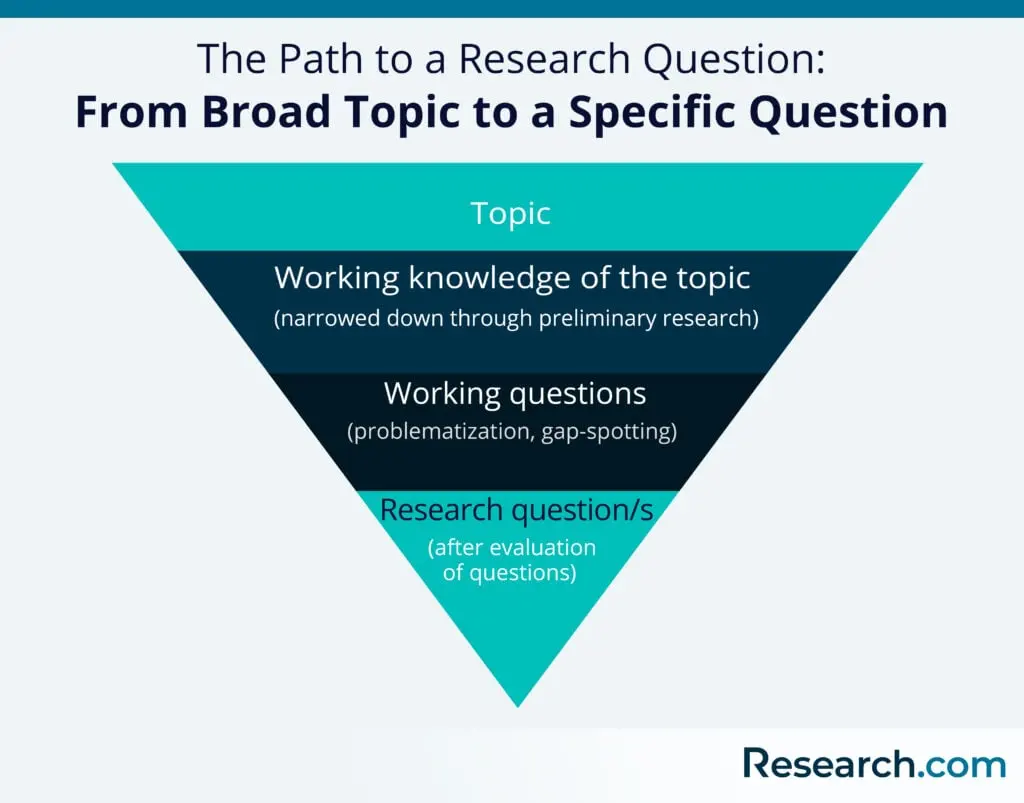
The main purpose of a research question is to turn a broad area of interest into a focused inquiry. ATLAS.ti (2025) explains that a research question narrows a topic and gives the study direction. Scientific Writing for Publication (2026) also emphasizes that the question helps shape purpose, design, data collection, analysis, and conclusions. In practical terms, your question affects nearly every later decision, including your research methodology, sample size, instruments, analysis plan, and final discussion.
A weak question creates problems throughout the project. If the wording is too broad, you may collect more information than you can analyze. If it is too narrow, the study may not contribute much. If it is not ethical or feasible, you may not be able to conduct the study at all.
Research Question vs. Topic vs. Hypothesis
Students often confuse a topic, a research question, and a hypothesis. They are connected, but they serve different purposes.
| Element | Purpose | Example |
| Topic | Names the general subject area. | Social media and student attention |
| Research question | Asks the specific question the study will answer. | What effect does daily YouTube use have on the attention span of children aged under 16? |
| Hypothesis | States a testable expectation, usually in quantitative research. | Higher daily YouTube use is associated with shorter attention spans among children aged under 16. |
Types of Research Questions
The type of question you write should match the kind of study you plan to conduct. Before you begin research paper planning, decide whether your project is mainly quantitative, qualitative, or mixed-methods. Each approach uses different wording, evidence, and logic.
Doody and Bailey (n.d.) discuss the importance of setting a research question, aim, and objective. The categories below build on that principle by showing how question types differ by design.
Quantitative Research Questions
Quantitative research questions focus on measurable variables, numerical data, and patterns that can be tested or described statistically. Litmaps (2025) notes that these questions often define the population, variables, and design early because they guide data collection and analysis. A strong quantitative question should not simply ask whether something exists. It should point to measurement, comparison, association, prediction, or effect.
- Descriptive questions: Ask what exists, how often it occurs, or how a variable appears in a defined group.
- Comparative questions: Examine differences between two or more groups, conditions, programs, or time periods.
- Relationship-based questions: Investigate associations, trends, or links between two or more variables.
Qualitative Research Questions
Qualitative research questions explore meanings, experiences, processes, beliefs, contexts, or social dynamics. McCombes (2025) explains that qualitative questions are usually more flexible and open-ended than quantitative questions. They may evolve as the researcher interviews participants, observes settings, analyzes documents, or identifies patterns in the data.
- Contextual questions: Describe what is happening in a setting or group.
- Descriptive questions: Capture the qualities or characteristics of a phenomenon.
- Exploratory questions: Investigate areas where limited prior research exists.
- Explanatory questions: Examine why a process, belief, or experience occurs.
- Evaluative questions: Assess how a program, approach, or practice is experienced or judged.
- Generative questions: Build new ideas, models, or theoretical directions.
- Emancipatory questions: Produce knowledge that supports action, especially for marginalized or disadvantaged groups.
- Ideological questions: Examine or advance a position connected to a particular worldview or social argument.
Mixed-Methods Research Questions
Mixed-methods studies combine quantitative and qualitative approaches. McCombes (2025) explains that some mixed-methods projects use separate quantitative and qualitative questions, while others include an integrated question that connects both strands. This approach is useful when numbers can show a pattern but qualitative evidence is needed to explain why that pattern exists.
| Research approach | Best used when you need to | Typical wording |
| Quantitative | Measure variables, compare groups, test relationships, or analyze numerical trends. | What is the relationship between X and Y among Z? |
| Qualitative | Understand experiences, meanings, perceptions, practices, or processes in context. | How do participants describe or experience X? |
| Mixed-methods | Combine numerical patterns with deeper explanation from interviews, observations, or documents. | How do quantitative outcomes and participant experiences together explain X? |
Steps to Developing a Good Research Question
Learning how to write a research paper is easier when the research question is already clear. Rochester Institute of Technology Library (2025) describes strong research questions as focused, researchable, and relevant. The International Journal for Multidisciplinary Research (2025) also emphasizes that developing an effective question requires narrowing a broad topic while checking feasibility, significance, and available evidence.
1. Start with a Broad Topic
Begin with a subject area that is large enough to explore but not so unfamiliar that you cannot understand the literature. Brainstorm subtopics, create a concept map, or discuss thought-provoking questions with classmates, instructors, or colleagues. The goal is not to finalize the wording yet. The goal is to locate promising angles.
Choose a topic you can stay engaged with for the duration of the project. Interest matters, especially for long papers, theses, dissertations, and funded studies. At the same time, check whether the topic is active in current scholarship, because an active research conversation can help you identify gaps, debates, and unresolved questions.
2. Conduct Preliminary Research
Preliminary reading helps you understand what scholars already know, what they disagree about, and where evidence is still limited. This first review does not need to be a full systematic review, but it should be organized enough to show patterns in the literature.
Look for recent studies, review articles, theoretical debates, limitations sections, and calls for future research. These sources can reveal underexplored groups, outdated assumptions, inconsistent findings, weak methods, or contexts that need further investigation. If you use writing support tools such as a humanized AI writer, use them to improve clarity and organization, not to replace your own reading, judgment, or citation work.
The National Institutes of Health (2025) notes that applicants may need to show awareness of existing studies so they can justify why a proposed project is necessary. Even outside grant writing, this principle matters: a research question is stronger when it is connected to a real gap rather than personal curiosity alone.
3. Narrow the Topic into Possible Questions
After you understand the literature, turn your broad topic into several candidate questions. Sandberg and Alvesson (n.d.) describe “gap-spotting” as one way to build questions from limitations or overlooked areas in prior research. Another approach is problematization, which challenges the assumptions behind existing theories, methods, or interpretations.
Practitioners can also use professional experience as a source of researchable problems. Lipowski (n.d.) emphasizes that patterns in practice may reveal questions worth studying. For example, a housing administrator interested in student housing trends might move from a broad topic like “campus housing” to a focused question about how housing costs affect first-year student retention in a particular setting.
4. Test Each Question with the FINER Criteria
Once you have several possible questions, evaluate them before choosing one. Hulley et al. (n.d.) are associated with the FINER criteria, a practical checklist for judging whether a question is suitable for research.
| FINER criterion | Question to ask yourself | Why it matters |
| Feasible | Can I complete this study with my time, skills, data access, funding, and approvals? | A question that cannot be studied realistically will delay or derail the project. |
| Interesting | Will I and my intended audience care about the answer? | Sustained interest helps you complete the work and communicate its value. |
| Novel | Does the question add, extend, test, or clarify knowledge rather than merely repeat it? | Original contribution is central to academic and professional research. |
| Ethical | Can the study be conducted without harming participants or violating review standards? | Ethical problems can prevent approval and damage the credibility of the work. |
| Relevant | Does the question matter to the field, a community, policy, practice, or future research? | Relevant questions produce findings that others can use or build on. |
5. Use a Framework to Structure the Final Question
Frameworks help you avoid vague wording by forcing you to identify the essential parts of your study. They are especially useful in health sciences, education, psychology, social science, and applied research, but the logic can help in many fields.
| Framework | Elements | Best fit |
| PICOT | Population, intervention or indicator, comparison group, outcome, and timeframe. | Clinical research, intervention studies, evidence-based practice, and quantitative comparisons. |
| PEO | Population, exposure, and outcome. | Qualitative and observational studies focused on experiences or exposure to conditions. |
| SPIDER | Sample, phenomenon of interest, design, evaluation, and research type. | Qualitative evidence synthesis and studies where experience or perception is central. |
| CLIP | Client group, location of service, improvement or information or innovation, and professionals. | Service delivery, practice improvement, and applied professional research. |
The PICOT framework was introduced by Richardson et al. and is commonly used when a study compares an intervention, indicator, or condition against another group or baseline. PEO is often better when the study is qualitative and focuses on how a population experiences an exposure or condition.
6. Make Sure the Question Fits the Paper Structure
A research question should influence every major section of the paper. If a section does not help answer the question, it may be unnecessary or misdirected.
| Paper section and topic | How the research question should guide the section |
| 1. Title and title page | The title should signal the main variables, concepts, population, relationship, or theoretical issue being examined; the author note may identify special circumstances or acknowledgments when needed. |
| 2. Abstract | The abstract should briefly state the problem, participants or subjects, relevant characteristics, study method, key findings, effect sizes, confidence intervals and/or statistical significance levels when applicable, and the main implications. |
| 3. Introduction | The introduction should explain why the problem matters, summarize relevant scholarship, identify objectives or hypotheses, and show how the design follows logically from the question. |
| 4. Method | The method section should describe how the study will generate evidence capable of answering the research question. |
| Participant characteristics | Eligibility, exclusion criteria, demographics, and topic-specific characteristics should match the population named or implied in the question. |
| Sampling procedures | Participant selection, data collection settings, locations, agreements, compensation, institutional review board requirements, ethical standards, and safety monitoring should be appropriate for the question and design. |
| Sample size, power, and precision | The intended and actual sample size, along with the method used to determine sample size, should be defensible for the question being asked. |
| Measures and covariates | Primary and secondary measures, covariates, data collection tools, quality controls, validated instruments, or ad hoc instruments should directly connect to the variables or concepts in the question. |
| Research design | The design should clarify whether conditions were manipulated or naturally observed and identify the type of design used. |
| 5. Results | The results should present findings in an order that helps answer the research question rather than simply listing all available data. |
| Participant flow | The study should report the total number of participants and explain how they moved through each stage of the research process. |
| Recruitment | Recruitment dates and periods of repeated measurement or follow-up should be reported when they affect interpretation. |
| Statistics and data analysis | The analysis should address statistical assumptions, data distribution issues, missing data, specialized software, and any additional analyses that affect the validity of the findings. |
| Ancillary analyses | Additional analyses should be interpreted carefully, including possible effects on statistical error rates. |
| 6. Discussion | The discussion should state whether the original hypotheses or expectations were supported, compare findings with prior work, interpret the results, address generalizability, and explain implications for future research, programs, or policy. |
Examples of Good and Bad Research Questions
The best way to understand question quality is to compare weak and improved versions. The research question examples below show how specificity, evidence, and scope make a question more useful.
Example 1: Too Broad vs. Focused
Weak: How does social media affect people’s behavior?
Stronger: What effect does the daily use of YouTube have on the attention span of children aged under 16?
The weak version uses broad terms such as “social media” and “people’s behavior,” which could refer to countless platforms, groups, and outcomes. The stronger version names the platform, behavior of interest, and population. Students who struggle with precise wording can improve their question-writing by strengthening source comprehension and improving reading skills.
Example 2: Yes-or-No vs. Analytical
Weak: Has there been an increase in childhood obesity in the US in the past 10 years?
Stronger: How have school intervention programs and parental education levels affected the rate of childhood obesity among 1st to 6th-grade students?
The weak version can be answered with a simple yes or no if the data are available. The stronger version requires analysis of interventions, parental education levels, and obesity rates in a defined student group. It invites explanation rather than a basic factual response.
Example 3: Method Posing as a Question
Weak: Can I conduct interviews with teachers about online learning?
Stronger: How do middle school teachers describe the challenges of maintaining student engagement during online learning?
The weak version describes a method, not a research problem. The stronger version identifies the group, setting, phenomenon, and type of evidence needed.
Common Pitfalls in Formulating Research Questions
Many research problems begin with a question that seems reasonable but fails under closer review. The table below shows common mistakes and better alternatives.
| Common mistake | Why it weakens the study | Better approach |
| Writing a question that is too broad | The project becomes unfocused, and the researcher may collect unrelated evidence. | Define the population, context, variable, concept, or time frame. |
| Choosing a question that is not feasible | The researcher may lack access to participants, data, funding, equipment, or time. | Confirm access and resources before finalizing the question. |
| Using vague wording | Readers may not understand what is being measured, explored, or compared. | Replace abstract terms with precise concepts that can be studied. |
| Skipping the literature review | The study may repeat what has already been answered or miss important debates. | Review current and foundational scholarship before deciding on the final wording. |
| Ignoring ethical concerns | The study may risk harm, violate privacy, or fail institutional review. | Consider participant risk, consent, confidentiality, and review board expectations early. |
| Confusing a contribution with a question | Statements such as “This study will improve policy” do not identify what will be investigated. | Ask a question that evidence can answer, then explain the contribution later. |
| Framing a method as the question | “Can I survey students?” identifies a tool, not a research problem. | Ask what the survey will help you discover, measure, compare, or explain. |
How Can You Validate Your Research Question Effectively?
Validation means checking whether your question is clear, feasible, ethical, original, and aligned with your design before you invest heavily in data collection. Start by asking peers, mentors, or subject-matter experts to review the wording. Ask them what they think the study will measure or explore. If their interpretation differs from yours, revise the question.
You can also validate a question by conducting a small pilot test, reviewing whether data are actually accessible, and comparing the question against FINER, PICOT, PEO, SPIDER, or another suitable framework. For funded or advanced studies, interdisciplinary feedback can help identify assumptions that researchers inside one field may overlook. Strong question formulation is also a transferable skill for academic and professional advancement, including pathways connected to highest paying bachelor degrees, although degree choice and career outcomes depend on many factors beyond research skill alone.
How to Align Research Questions with Study Objectives and Outcomes
A research question should not sit apart from the rest of the study. It should match the study objective, the expected outcomes, and the methods used to produce evidence. Misalignment is one of the fastest ways to create a confusing paper.
How to Build Alignment
- State the main objective. Write one sentence explaining what the study aims to accomplish.
- Identify the expected outcome. Decide what type of result would answer the question, such as a measured difference, described experience, observed pattern, or tested relationship.
- Match the wording to the method. Use quantitative wording for measurement, qualitative wording for meaning and experience, and mixed-methods wording when both are integrated.
- Check every major section. The literature review, sample, data collection, analysis, and discussion should all help answer the same question.
Examples of Alignment
Misaligned example:
- Objective: To assess the impact of diet on athletic performance.
- Research question: How do athletes perceive dietary guidelines?
This question explores perceptions, not the direct effect of diet on performance. It may be a valid qualitative question, but it does not match the stated objective.
Aligned example:
- Objective: To assess the impact of diet on athletic performance.
- Research question: How does adherence to a high-protein diet affect endurance levels in marathon runners?
This version names the dietary factor, outcome, and population. It gives the study a clearer path from question to method to findings.
Why Alignment Matters
- Clarity: Readers can quickly understand what the study is trying to answer.
- Focus: The researcher avoids collecting evidence that does not serve the project.
- Usability: Findings are easier to interpret because they respond directly to the stated objective.
- Credibility: Reviewers can see a logical connection between the question, design, and conclusions.
Important Points to Keep in Mind in Creating a Research Question
Research question development is rarely a one-step task. You may revise the wording after reading more sources, testing feasibility, receiving feedback, or clarifying your method. Use the points below as a final decision checklist.
- Expect revision. A strong question often emerges after several rounds of reading, discussion, and narrowing.
- Stay current. Track recent studies, methodological changes, and technological developments in your field.
- Use concise wording. Remove terms that do not affect meaning or research design.
- Seek expert input. Mentors, committee members, librarians, practitioners, and peers can spot problems you may miss.
- Do not mistake the method for the question. A survey, interview, or experiment is a tool, not the inquiry itself.
- Do not write the anticipated contribution as the question. First ask what you will investigate; explain the contribution after the evidence supports it.
How Can Strong Research Question Formulation Propel Your Career?
The ability to formulate strong research questions builds skills that transfer beyond academic writing. It strengthens problem framing, evidence evaluation, analytical thinking, and decision-making. These skills are valuable in research, consulting, policy, education, healthcare, business strategy, data analysis, and other fields where professionals must define problems before solving them.
For students comparing long-term education and career options, research ability can complement broader planning around 4 year degrees that pay over 100k. However, no research skill or degree guarantees a specific salary. Outcomes depend on field, location, experience, employer expectations, licensure, market demand, and individual performance.
Strategies for Strengthening Research Question Formulation Skills
Improving research question writing requires deliberate practice. One useful exercise is to read published studies and identify the question, objective, hypothesis, variables, population, and methods. Then ask whether the evidence actually answers the question. This trains you to see how wording affects research design.
You can also compare weak and strong questions in your field. Look at how successful authors limit scope, define terms, avoid unsupported assumptions, and connect the question to a literature gap. If you are pursuing advanced academic work, structured programs such as the cheapest online EDD programs may help develop research literacy, but program quality, accreditation, curriculum, faculty support, and fit should be evaluated carefully.
A practical habit is to test every draft question immediately against FINER or a discipline-specific framework. If the question fails on feasibility, ethics, or relevance, revise before building the proposal.
How Can Formal Education Enhance Your Research Question Formulation?
Formal education can strengthen research question development by teaching research design, academic writing, literature review methods, statistics, qualitative inquiry, ethics, and disciplinary theory. Students in accredited online bachelor degree programs may encounter research assignments, capstone projects, faculty feedback, and peer review activities that help them practice turning broad interests into focused questions.
Before choosing a program, confirm institutional accreditation, course offerings, faculty expertise, transfer credit policies, research support, and whether the curriculum matches your academic or professional goals.
Can Additional Online Certifications Enhance Your Research Question Formulation?
Online certificates and microcredentials can help students and professionals update specific skills, especially in research methods, data literacy, evidence evaluation, academic writing, or discipline-specific tools. Accredited online certificate programs may be useful when you need targeted training without committing to a full degree.
When evaluating a certificate, look beyond the title. Review the syllabus, instructor qualifications, assessment methods, employer or academic recognition, accreditation status when applicable, and whether the coursework includes hands-on research practice.
Can Technological Innovations Boost Your Research Question Formulation?
Digital tools can make early-stage research more efficient, but they should not replace scholarly judgment. Literature mapping platforms, citation managers, database alerts, qualitative analysis software, survey tools, and collaborative workspaces can help researchers organize sources, detect patterns, manage evidence, and refine question wording.
AI tools may assist with brainstorming or summarizing, but researchers must verify sources, check citations, and avoid relying on generated text as evidence. Students who want practical technical skills alongside academic preparation may explore options such as accelerated associates degree online programs, while remembering that program length, rigor, transferability, and career relevance vary by institution.
Do Peer Reviews and Mentorship Sessions Enhance Your Research Question Formulation?
Yes. Peer review and mentorship can reveal unclear wording, hidden assumptions, scope problems, and feasibility risks. A mentor may ask whether your population is accessible, whether your variables are measurable, whether your interview questions match your central inquiry, or whether your proposed contribution is already covered in the literature.
For best results, ask reviewers specific questions: Is the question clear? Is it too broad? What evidence would answer it? What ethical issues might arise? What literature should I review next? Students seeking faster routes into applied study may compare programs such as the fastest degree to get online, but they should still evaluate accreditation, curriculum quality, workload, transfer policies, and career fit.
How Can Accredited Higher Education Institutions Bolster Your Research Question Formulation?
Accredited colleges and universities can support stronger research question development through faculty advising, library databases, writing centers, research ethics training, methodology courses, peer discussion, and access to institutional review processes. These supports are especially important for students completing capstones, theses, dissertations, or publication-oriented projects.
When comparing institutions, consider whether they provide research support that matches your goals. Resources from the best accredited non-profit online schools may help students access structured academic environments, but the best choice depends on accreditation, cost, student services, program design, and the level of faculty guidance available.
Questions to Ask Before Finalizing Your Research Question
- Can this question be answered with evidence rather than opinion alone?
- Have I reviewed enough current and foundational literature to justify the question?
- Does the wording clearly identify the population, setting, variable, concept, or phenomenon?
- Is the scope realistic for the assignment, thesis, dissertation, article, or grant timeline?
- Do I have access to the data, participants, documents, tools, or sites needed?
- Does the question require ethical review, informed consent, confidentiality protections, or risk mitigation?
- Does the question align with my objective, method, data analysis plan, and expected outcome?
- Would a knowledgeable reader understand exactly what the study will investigate?
Key Insights
- A research question is the foundation of the study. It shapes the literature review, methodology, data collection, analysis, and final interpretation.
- Strong questions are focused and researchable. They define what is being studied and can be answered through credible evidence.
- The method should match the question. Quantitative questions measure variables, qualitative questions explore meaning or experience, and mixed-methods questions integrate both forms of evidence.
- FINER is a useful quality check. A strong question should be feasible, interesting, novel, ethical, and relevant.
- Frameworks improve clarity. PICOT, PEO, SPIDER, and CLIP help researchers identify the population, concepts, outcomes, and design elements that matter.
- Alignment prevents confusion. The question, objective, method, results, and discussion should all point to the same inquiry.
- Validation saves time. Peer review, mentor feedback, pilot testing, and literature checks can reveal problems before data collection begins.
- Technology can help, but judgment is essential. Digital tools can support literature review and organization, but researchers must verify evidence and make the final scholarly decisions.
References:
- Berger, R. (n.d.). Researcher position and reflexivity in qualitative inquiry. Qualitative Research, 15 (2), 219-234. https://doi.org/10.1177/1468794112468475
- Creswell, J.W. (n.d.). Qualitative Inquiry and Research Design: Choosing Among Five Approaches, 3rd ed. Thousand Oaks, CA: Sage.
- Creswell, J.W. (n.d.). Educational Research: Planning, Conducting, and Evaluating Quantitative and Qualitative Research, 5th ed. Upper Saddle River, NJ: Pearson Education.
- Doody, O., & Bailey, M. E. (n.d.). Guidance on setting a research question, aim, and objective. Nurse Researcher, 23 (4). https://journals.rcni.com/doi/pdfplus/10.7748/nr.23.4.19.s5
- Farrugia, P., Petrisor, B.A., Farrokhyar, F., & Bhandari, M. (n.d.). Research questions, hypotheses, and objectives in surgical research. Canadian Journal of Surgery, 53 (4), 278. https://www.ncbi.nlm.nih.gov/pmc/articles/PMC2912019/
- Lipowski, E. E. (n.d.). Developing strong research questions. American Journal of Health-System Pharmacy, 65 (17), 1667-1670. https://academic.oup.com/ajhp/article-abstract/65/17/1667/5128061
- Marshall, C., & Rossman, G. B. (n.d.). Designing qualitative research. Sage publications. Google Books
- Mayo, N., Asano, M., & Barbic, S.P. (n.d.). Distinguishing research questions from non-research questions. Journal of Rehabilitation Medicine, 45 (6), 513-518. https://doi.org/10.2340/16501977-1150
- Patnaik, S., & Swaroop, S. (n.d.). Developing hypotheses from research questions. Indian Journal of Public Health Research & Development, 10 (11). http://www.indianjournals.com/ijor.aspx?target=ijor:ijphrd&volume=10&issue=11&article=097
- Ritchie, J., Lewis, J., Nicholls, C. M., & Ormston, R. (Eds.). (n.d.). Qualitative Research Practice: A Guide for Social Science Students and Researchers. Thousand Oaks, CA: Sage. http://jbposgrado.org/icuali/Qualitative%20Research%20practice.pdf
- Sandberg, J., & Alvesson, M. (n.d.). Gap-spotting and problematization as ways to construct research questions. Organization, 18 (1), 23-44. https://journals.sagepub.com/doi/abs/10.1177/1350508410372151
- Stone, P. (n.d.). Choosing and refining a research question. Palliative Medicine, 16, 265267. https://doi.org/10.1191/0269216302pm562xx
- Tashakkori, A., & Teddlie, C. (Eds.). (n.d.). Sage Handbook of Mixed Methods in Social & Behavioral Research. Thousand Oaks, CA: Sage. https://doi.org/10.4135/9781506335193
- ATLAS.ti. (2025). Research questions: Importance, tips & examples. https://atlasti.com/guides/qualitative-research-guide-part-1/research-question
- Scientific Writing for Publication. (2026). Part 3: Clarifying a research purpose and questions. https://open.library.okstate.edu/writingforpublication/chapter/research-purpose/
- Litmaps. (2025, April 9). A complete guide to quantitative research questions: Types, examples, and how to write them. https://www.litmaps.com/articles/quantitative-research-questions
- McCombes, S. (2025, January 16). Qualitative vs. quantitative research: Differences, examples & methods. Scribbr. https://www.scribbr.com/methodology/qualitative-quantitative-research/
- Rochester Institute of Technology Library. (2025). Research question: Social/behavioral sciences research guide. https://infoguides.rit.edu/researchguide/researchquestion
- International Journal for Multidisciplinary Research. (2025). Developing effective research questions in academic research. https://www.ijfmr.com/papers/2025/2/38948.pdf
- National Institutes of Health. (2025). Research project grant (R01) application guide. https://grants.nih.gov/grants/how-to-apply-application-guide
Other Things You Should Know About Writing a Research Question for 2025
Yes, numerous online resources offer examples of effective and ineffective research questions, including academic websites and educational platforms. These examples can help guide the development of your own research questions, providing a clearer understanding of what makes a question strong or weak.
Developing a research question is crucial because it narrows down a broad topic into a specific area of study. It also guides the research framework, methodology, and analysis, ensuring the study's cohesion and relevance.
Research questions can be categorized into quantitative, qualitative, and mixed-methods. Quantitative questions are precise and structured, qualitative questions are flexible and exploratory, and mixed-methods questions combine both approaches.
Start by choosing a broad topic of interest. Conduct preliminary research to learn about current issues and gaps in existing literature. Narrow down the topic to a specific area of study and identify potential research questions.
A good research question should be feasible, interesting, novel, ethical, and relevant. This means it should be realistically investigable, engaging, provide new insights, be ethically sound, and pertinent to the field of study.
Frameworks like PICOT for quantitative research and PEO for qualitative research help ensure that research questions are structured clearly and address essential elements such as population, intervention, and outcome, improving the study's focus and clarity.
Avoid posing a question as an anticipated contribution or framing a question as a method. Ensure the question is clear, specific, and avoids terms that don't add meaningful context or clarity to the research focus.


