
The Impact of Generative AI on Research Integrity in Higher Education

Co-Founder and Chief Data Scientist
The immediate reaction of the higher education sector to the public release of Generative Artificial Intelligence (GenAI) was, universally, panic. In late 2022, when ChatGPT demonstrated its ability to synthesize literature, draft coherent essays, and generate passable code, universities scrambled to fortify their walls. Syllabi were rapidly rewritten. Bans were instituted over campus Wi-Fi networks. Committees were formed to debate the impending death of the undergraduate essay.
However, looking back at that initial wave of anxiety, it is clear that institutions were fighting the last war. The panic was almost entirely localized around a traditional, text-centric definition of academic misconduct: the fear that students would use machines to plagiarize written assignments.
But the true impact of Generative AI on research integrity in higher education goes far deeper than an undergraduate submitting a ghostwritten history paper. The integration of Large Language Models (LLMs) into the academic ecosystem has triggered a structural earthquake. It is altering the peer-review process, exposing deep-seated biases in how we evaluate "acceptable" academic English, and creating an unprecedented administrative nightmare for the committees tasked with enforcing codes of conduct.
To understand the real threat and the necessary evolution of research integrity, we must examine three critical, under-discussed phenomena: the emergence of the "AI Ouroboros" in peer review, the paradox of algorithmic detection penalizing international scholars, and the collapse of the traditional burden of proof in academic disciplinary hearings.
Part 1: The "AI Ouroboros" and the Contamination of Peer Review
The foundation of global scientific and academic advancement is the peer-review process. It relies on the assumption of rigorous, human-driven critical analysis. A researcher submits a manuscript, and independent experts scrutinize the methodology, the data, and the conclusions. Generative AI is quietly turning this foundational pillar into a closed-loop system of synthetic validation.
We are witnessing the dawn of the "AI Ouroboros", a snake eating its own tail. In this scenario, a researcher utilizes an LLM to generate the literature review, smooth out the methodology, or even hallucinate the data interpretation of a paper. That paper is then submitted to a journal. The assigned peer reviewer, overwhelmed by the unpaid and time-consuming burden of academic service, feeds the submitted manuscript into an LLM and asks it to generate a critical review. The AI reviewer reads the AI-generated paper, recognizes its own statistical patterns and logical structures, and generates a favorable, boilerplate review. Human oversight is effectively bypassed, yet the paper is stamped with the highest mark of academic legitimacy.
This is not a hypothetical dystopian future; the statistical footprints of this phenomenon are already visible in the academic record.
The Bibliometric Footprint of Synthetic Science
Since early 2023, data scientists and bibliometric researchers have noted an unnatural, exponential spike in specific vocabulary across published, peer-reviewed literature. Words that are highly favored by models like GPT-3.5 and GPT-4 such as "delve," "meticulous," "intricate," "commendable," and "multifaceted," have seen their usage skyrocket in massive repositories like PubMed and arXiv.
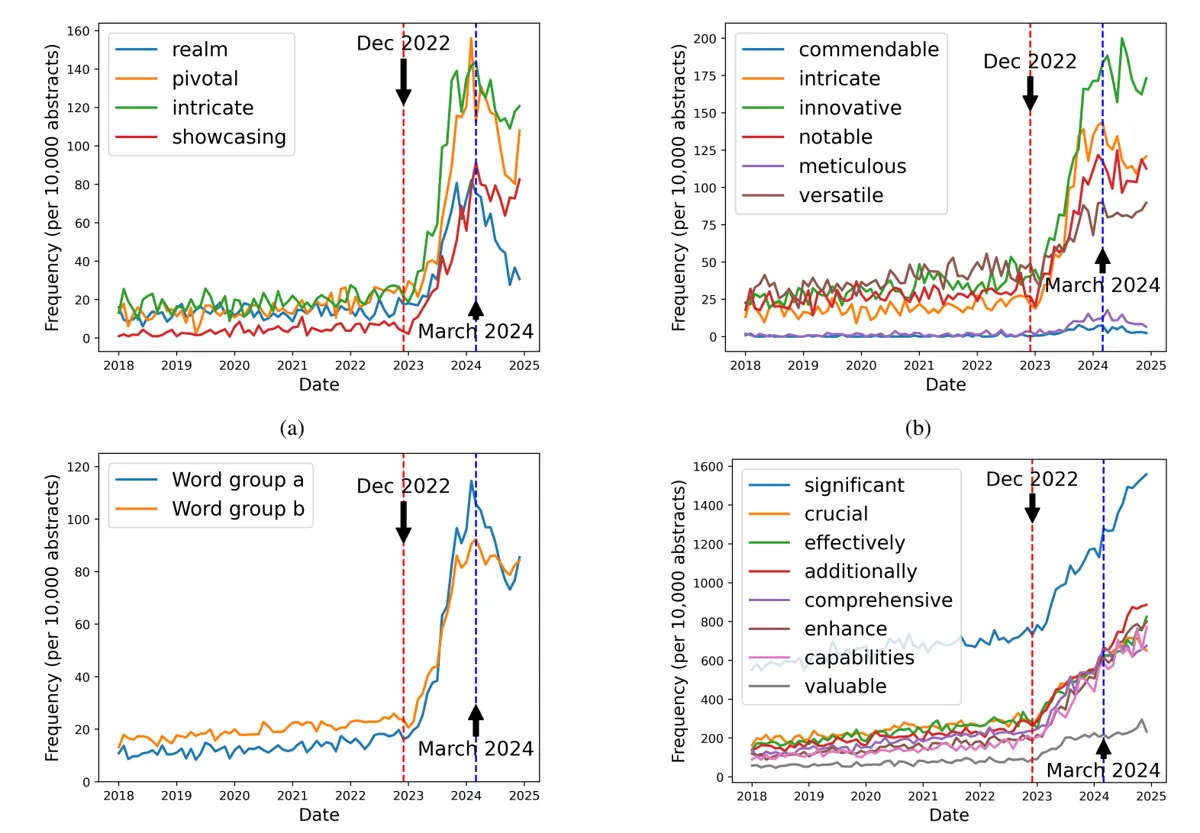
Figure 1: The AI Lexicon Spike in Academic Abstracts (2018–2025). This multi-panel chart tracks the frequency of common LLM-favored vocabulary (e.g., "intricate," "meticulous," "commendable") per 10,000 academic abstracts. The red dashed line (December 2022) marks the public release of ChatGPT, immediately followed by an unnatural, exponential surge in these specific words. Notably, the blue dashed line (March 2024) illustrates a recent dip in certain terms, suggesting researchers are actively adapting and filtering out obvious "AI buzzwords" to avoid detection.
Source - Human-LLM Coevolution: Evidence from Academic Writing
Also, the recent analysis highlighted in Nature explored how these specific "AI buzzwords" have infiltrated thousands of papers, suggesting that a significant portion of newly published scientific literature has been heavily massaged, if not outright generated, by AI.
When peer review becomes automated by the very tools used to generate the research, the integrity of the scientific record degrades. The danger here is not just that a researcher cheated; the danger is the pollution of the baseline truth. Future AI models will be trained on these very databases. If the databases are filled with AI-generated papers validated by AI-generated reviews, the models will train on synthetic data, leading to a phenomenon known as "model collapse." The academic record will become an echo chamber of machine-generated consensus, devoid of novel human insight.
Part 2: The Equity vs. Integrity Trap
As universities recognized the threat of AI-generated text, their immediate response was to purchase and deploy AI detection software. Companies promising to accurately flag AI-written text became overnight sensations, integrating their APIs into popular learning management systems like Canvas and Blackboard.
Administrators believed they had found a technological silver bullet to enforce academic integrity. Instead, they walked blindly into an equity trap.
The mandate to root out AI usage collided violently with the university's mandate to foster inclusive, global academic communities. As it turns out, the algorithmic mechanisms that AI detectors use to identify synthetic text are fundamentally biased against non-native English speakers.
A landmark 2023 study from Stanford University researchers (Liang et al.) exposed this glaring flaw. The study found that popular AI detectors falsely flagged over half of the TOEFL (Test of English as a Foreign Language) essays written by non-native students as AI-generated. Conversely, the same detectors accurately identified 90% of essays written by native U.S. students as human. By relying on these detectors, universities essentially weaponized an algorithm against their international student bodies.
The Mechanics of Bias: Perplexity and Burstiness
To understand why this happens, we must look beneath the hood of how AI detection actually functions. AI text generators do not leave a hidden watermark in their prose; detectors must guess the origin of the text based on statistical probabilities.

Roman Milyushkevich, CTO at HasData, a technology executive deeply familiar with the architecture of large language models, explains that AI detectors rely on two primary metrics: perplexity and burstiness, both of which inherently encode linguistic bias.
"Most AI detectors lean on a rough proxy: 'How predictable does this writing look compared to typical human writing in the detector’s training set?'" Milyushkevich explains. "Perplexity is essentially how surprising the next words are to a language model. Lower perplexity means the text is more predictable."
This is where the trap snaps shut on English as a Second Language (ESL) scholars. As Milyushkevich notes: "Many non-native writers produce English that is more formulaic and safer: high-frequency vocabulary, standard sentence frames, fewer idioms... That often makes the text statistically smoother and more predictable, so perplexity drops. Detectors often treat 'very predictable prose' as AI-like, even though it can also reflect a learner optimizing for clarity and correctness."
The second metric, burstiness, measures the variance in sentence length and complexity. Native speakers naturally write with high burstiness: mixing short, punchy sentences with long, complex, meandering thoughts. ESL writers, seeking grammatical safety, often write with low burstiness, producing sentences of uniform length and structure. To a machine learning detector, this uniform, low-burstiness writing looks exactly like a machine.
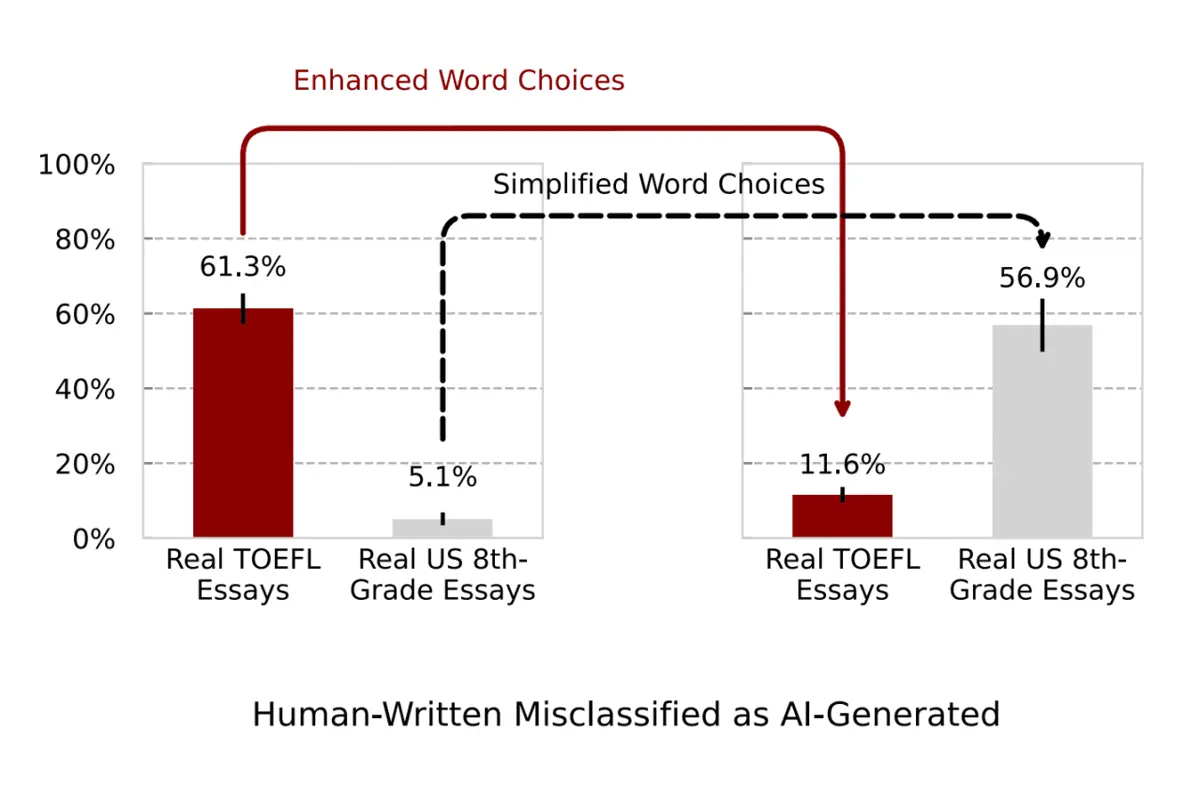
Figure 2: Visualizing Detection Bias: Perplexity vs. Burstiness.
A conceptual visualization of how AI detectors evaluate text. Native English writing typically exhibits higher variance (burstiness) and less predictability (perplexity). Because non-native writers often favor grammatical safety and formulaic structures, their writing statistically clusters closer to the low-variance patterns of Large Language Models, triggering false positives.
Source - GPT detectors are biased against non-native English writers
"These metrics are calibrated on assumptions about 'typical human English,' often drawn from native speaker corpora or edited academic prose," Milyushkevich adds. "If the baseline 'human' distribution underrepresents second-language patterns, the detector can confuse 'learner regularity' with 'model regularity.'"
An Unwinnable Arms Race
If the detectors are biased, can they simply be improved? According to technologists, the arms race between AI generation and AI detection is fundamentally unwinnable for universities.
"If 'winning' means reliably labeling a piece of text as AI-generated from the text alone, that is close to a losing battle in the long run," Milyushkevich states. He points to the issue of convergence: generators can easily be tuned to mimic the exact statistical quirks that detectors look for. Furthermore, once a student lightly edits or paraphrases AI output, the statistical footprint becomes too muddied to trace.
By treating AI detectors as authoritative arbiters of truth, higher education has built a disciplinary apparatus on top of a flawed, probabilistic foundation. This brings us to the third, and perhaps most complex, challenge facing academic institutions today: the crisis of enforcement.
Part 3: The Burden of Proof and the Enforcement Crisis
When an AI detector flags a student’s essay or a researcher’s manuscript, it initiates a chain reaction. The professor reports the student, the academic integrity office opens an investigation, and the institution's disciplinary gears begin to turn.
Historically, academic misconduct was relatively straightforward to prove. If a student plagiarized from Wikipedia, a professor could hold up the student's essay in one hand, the Wikipedia printout in the other, and point to the identical text. The evidence was deterministic, physical, and undeniable.
Generative AI has destroyed this paradigm. Because AI generates entirely unique text on demand, there is no original source document to point to. The only "evidence" a university has is a percentage score from a black-box AI detector - a detector that, as we have established, is deeply flawed and biased.
How does a university discipline a student, revoke a scholarship, or fire a researcher when the evidence is entirely probabilistic?
This is no longer just an academic philosophical debate; it is a massive human resources, legal, and compliance crisis. If a university sanctions a student based on a 75% AI-likelihood score, and that student happens to be an international scholar, the university opens itself up to severe litigation regarding discriminatory practices and lack of due process.
The HR Perspective: Probabilistic Signals are Not Proof
To navigate this enforcement nightmare, academia must look to the corporate world, where HR and compliance departments have long dealt with the challenge of managing risk based on imperfect data.

Anush Gasparian - Director of Human Resources at Phonexa, emphasizes that universities must stop treating AI detector scores as judge and jury.
"From HR and compliance, a probabilistic signal is a lead, not proof. The core principle is procedural fairness," Gasparian explains. "Set an evidence threshold: Use a clear internal standard for action. For serious sanctions, require corroboration beyond a score. Treat the score like a risk indicator that triggers review, similar to a hotline tip or anomaly report."
The fundamental error universities make is placing the burden of proof on the algorithm. Gasparian stresses the absolute necessity of demanding independent corroboration. Administrators must look for process evidence and contextual facts: drafts, version history, timestamps, and prior work samples.
"If you cannot build a coherent fact pattern, you do not escalate," she warns. "Separate investigation from decision: One group gathers facts, another applies policy. This reduces confirmation bias, especially when a tool output feels authoritative."
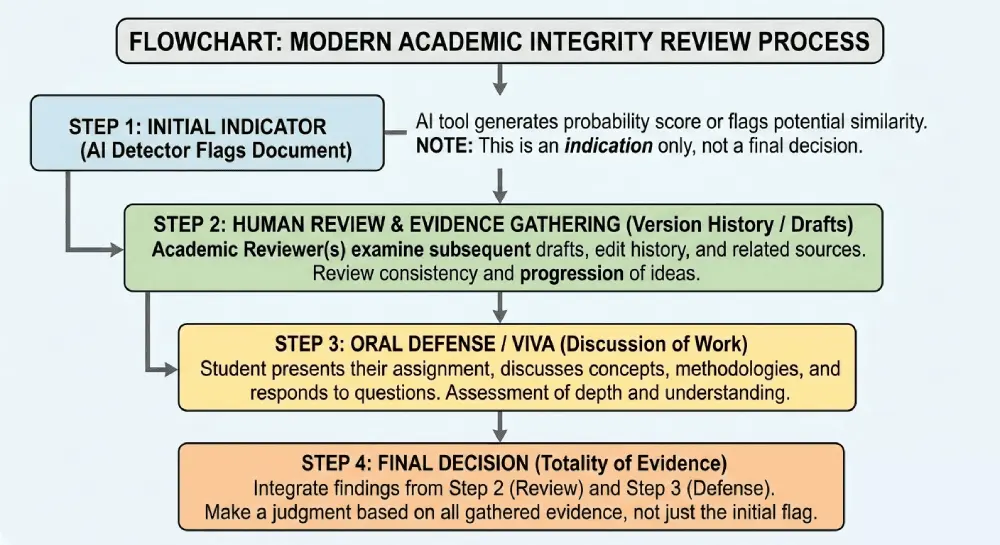
Figure 3: A Modern Academic Integrity Review Process.
This flowchart illustrates the necessary shift in disciplinary procedure. Instead of acting as the final judge, the AI detector serves merely as an "Initial Indicator" (Step 1). The process mandates human review of version histories (Step 2) and an oral defense (Step 3), ensuring that any final decision is based on a verifiable totality of evidence rather than a probabilistic algorithmic score.
Calibrating Outcomes to Confidence
The era of zero-tolerance policies resulting in immediate expulsion for a single infraction is fundamentally incompatible with the realities of Generative AI. Codes of conduct must be rewritten to reflect the gray area of synthetic assistance.
Gasparian advises that institutions must calibrate their outcomes to their level of confidence. "If confidence is moderate, use educational or restorative remedies rather than punitive ones: redo assessment, oral defense, training, monitoring. Reserve harsh penalties for strong, multi-source evidence."
Furthermore, academic codes need to move away from attempting to ban the tool, and instead focus on protecting the integrity of the work. This means explicitly defining the protected interest.
"Make the misconduct about misrepresentation of authorship, unauthorized assistance, or failure to follow declared process, rather than 'using AI' in the abstract," Gasparian suggests. She recommends introducing process-based obligations: requiring students and researchers to retain their notes, drafts, and change logs. "This creates verifiable expectations without relying on mind-reading."
If the rules hinge on uncertain attribution provided by a flawed algorithm, trust between the institution and the student body will collapse. As Gasparian notes, "If rules hinge on transparent process and demonstrable learning, enforcement becomes both fairer and more resilient."
Part 4: Redefining Academic Misconduct for the Synthetic Age
The insights from the technological and human resources sectors point to a singular conclusion: higher education is currently focused on the wrong metrics. By obsessing over text generation and text detection, universities are playing a losing game of algorithmic whack-a-mole.
To preserve research integrity, higher education must undergo a paradigm shift in how it defines, assigns, and evaluates academic work.
From Text to Process Verification
The most immediate shift must be moving from "detecting the tool" to "verifying the learning." If a final written product can no longer be trusted as proof of knowledge, the evaluation must shift to the process of creation.
This requires a total assessment redesign. Universities must pivot toward:
- Version Control as Standard: Just as software engineers use GitHub to track code commits, researchers and students should be expected to show the digital evolution of their documents.
- The Return of the Oral Defense: The "micro-viva" or short oral defense must become a standard part of grading. A short, structured conversation that probes a student’s reasoning, tradeoffs, and error correction is virtually impossible to fake with an LLM.
- Personalized and Localized Prompts: Connecting assignments to local data, specific in-class discussions, or highly unique constraints drastically reduces the utility of generic AI output.
The Looming Threat: Synthetic Data Fabrication
While administrators are currently fixated on essays, the next frontier of academic misconduct is already here, and it is vastly more dangerous. The real crisis on the horizon is the generation of fake datasets, fabricated scientific imagery, and synthetic lab results.
According to recent reports by scientific watchdogs, advanced generative models can now hallucinate incredibly convincing, completely fake CSV datasets, Western blots (protein visualizations), and microscopy images. It is becoming nearly impossible for a peer reviewer to tell if a medical researcher actually ran an experiment in a physical lab, or if they simply prompted an AI to generate the statistical data that perfectly proves their hypothesis.
If universities do not urgently update their definitions of academic misconduct to explicitly include "synthetic data fabrication" and "forged AI documentation," they will find themselves entirely defenseless against the next, much darker wave of research fraud.
Conclusion
Generative AI has irrevocably altered the landscape of higher education. The initial panic, characterized by bans and the rapid deployment of flawed AI detectors, was a natural, albeit misguided, defense mechanism.
As we move forward, we must acknowledge the complex reality: AI detectors are fundamentally biased against non-native speakers, creating an unacceptable equity trap. The traditional burden of proof has collapsed, requiring a massive overhaul of academic HR and disciplinary procedures. And the threat of the "AI Ouroboros" threatens the very foundation of peer-reviewed science.
The path forward is not to build a better detector. The path forward is to build better assessments. By focusing on process verification, procedural fairness, and the defense of original thought through direct human interaction, higher education can survive the synthetic age. The goal is no longer to catch the machine; the goal is to verify the human.


