
How To Cite a Research Paper for 2027: Citation Styles Guide

Co-Founder and Chief Data Scientist
If you are looking for the best advice on how to write a research paper, the first thing you would find is to cite your sources. In academic research, it is standardized by many institutions. And, publication venues such as conferences and journals are somehow strict about their formats. Hence, it is best for students with PhD degrees and aspiring researchers to know how to cite a research paper and other sources in their works. Citing your sources properly is also important for many reasons. One of the most important ones is that you can easily establish to your reviewers and readers the context around and relevancy of your work.
But, creating a reference section for your paper or dissertation can be a tedious task. As such, this article should serve as your guide on how to reference a research paper in popular formats: APA, MLA, Chicago/Turabian, and the IEEE style. A list of digital tools that can make citation easier and a quick tutorial will also be provided. This way, you can concentrate more on the content of your paper rather than what many consider a cumbersome task.
How To Cite a Research Paper Table of Contents
- The Rationale Behind Citations
- APA Style Citation Guide
- MLA Style Citation Guide
- Chicago/Turabian Style Citation Guide
- IEEE Style Citation Guide
- Common Mistakes to Avoid When Citing Research Papers
- How Can an Effective Citation Strategy Propel Your Academic Career?
- How Can You Evaluate the Credibility of Your Sources?
- How Do Evolving Citation Standards Impact Your Research?
- Tools and Strategies for Streamlining Citation Practices
- Can Self-Paced Online Courses Improve Your Citation Proficiency?
- The Role of Citations in Enhancing Research Visibility and Credibility
- Can Intensive Academic Programs Enhance Your Citation Accuracy?
- How Do Copyright Considerations Affect Citation Practices?
The Rationale Behind Citations
The main reason for citing references properly is to avoid intellectual dishonesty. Presenting ideas of other scholars without proper research paper citation goes against scientific ethics. While this is not the highest of ethical requirements, it is simply basic decency. This is because we humans have a strong sense of ownership, not just of our physical properties but also of our intellectual works and achievements. We have a strong drive to know who or where exactly pieces of information came from and how ideas develop. Thus it is important to know how to give reference in a research paper.
In research, this is very apparent in literature where scholars discuss and debate who first created a research methodology, an idea, or made a discovery (e.g., Newton versus Leibniz for calculus and Le Verrier versus Adams for Neptune).
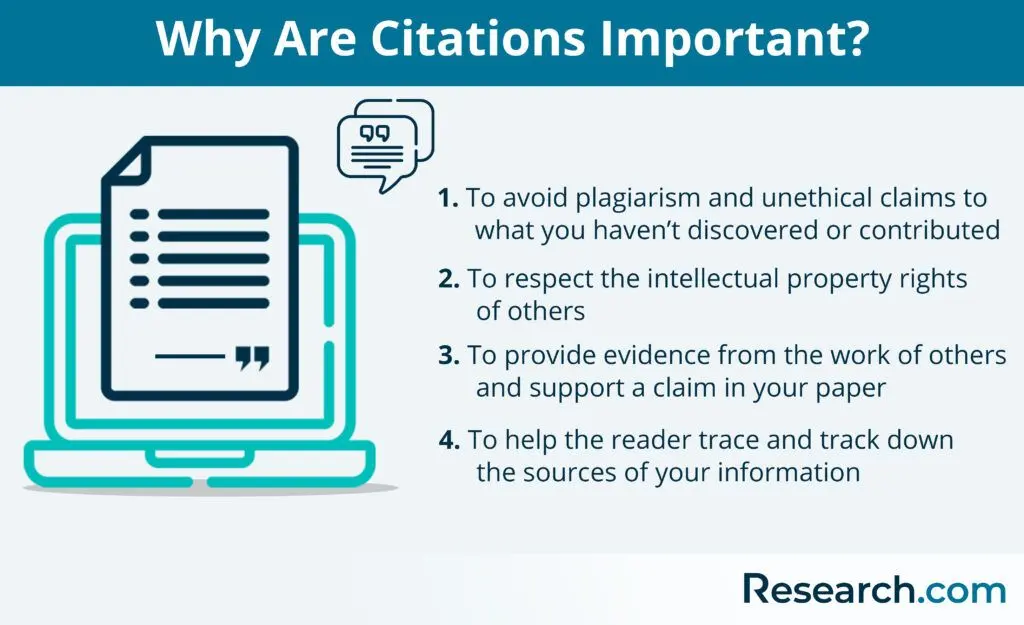
A free plagiarism checker for students does not make the cut. You must properly reference a source even if you have reworded the idea you lifted from it. Properly referencing a source is not only important that the right people get the proper recognition for their ideas. It is also crucial to the whole research publication and consumption process for the following reasons:
- To Avoid Plagiarism Citations allow researchers to properly quote the work of others. It helps them acknowledge where the information came from.
- Respect for Intellectual Property Rights Research work can include industry information legally protected by intellectual property rights. These include trademarks, patents, industrial designs, and geographical indications. Creative works for entertainment are also included, ranging from films to architectural designs.
- To Provide Evidence Citing studies and data properly allows you to provide evidence for key points of your work. This is especially important when making a case for a position you take.
- To Give Details on Source Documents Citations make it easier for reviewers to check for data and even the line of arguments. Also, it helps direct the readers to original sources where they can find more detailed information about the point you cited and the subject matter.
Overall, referencing helps research communities place a work in its proper context to better judge its potential impact on its field.
There are many different fields and disciplines in the research world. And, they have different styles and standards for what proper referencing is. Rules also vary from the types of sources you cite, including but not limited to research papers, technical reports, books, patents, court cases, conference journals, conference papers, podcasts, YouTube videos, and social media posts. But, most styles have common elements on how to write references in a research paper.
Basic Citation Elements
- Author(s)
- Title(s)
- Source or venue name (e.g. name of the journal it was published or conference where it was presented)
- Editor(s)
- Volume and edition
- Date or year of publication
- Page numbers
- City and country
- Publisher or university for theses
- URL for online sources
- DOI
- Retrieval date for online sources with dynamic content subjected to change
Aside from the above mentioned, it’s important to note that there are two aspects to consider on how to write a citation in a research paper: in-text and the reference list section. In-text citations are included in the body of your work. These are also repeated but in more detail in the reference list usually situated after your article. Different levels of styles have different ways to cite works. However, they usually include the critical information listed above.
Furthermore, the choice of citation styles or formats largely depends on your discipline, your institution, and other venues for publication (e.g., journals and conferences). So, it is best to check your target venue for submission for its preferred citation style. It is also good to note that some have specific style preferences, apart from the popular formats (e.g. APA, MLA, Chicago, and IEEE). Hence, it is best to check the author’s instructions page on their websites and articles that have already been published for reference.
Appropriate Level of Citation: Undercitation, Overcitation, and Unethical Citations
Just like most things, citation in research should be done in a reasonable amount. You must avoid undercitation and overcitation. The former is when you miss out to cite a source while the latter is when you put unnecessary citations that can be too distracting (Appropriate Level of Citation, n.d.). By citing all utilized sources used and giving proper credit to actual authors, scholarly writers do not only prevent plagiarism but also show that they have conducted extensive research, are well-informed about the study subject, and their research is reliable.
In this section on how to make citations in research, we will discuss when you must cite a source and how to avoid overcitation.
When to Cite a Source
The components in a citation or reference entry are devised to allow the reader to identify or locate the specific source that is cited. Whenever you use another individual’s work, you really must cite a source. Forgetting to or intentionally not doing so can lead to a serious dent on your reputation. Thus, remember to cite properly when you:
- Quote the exact words of authors
- Paraphrase or state the ideas of others in your own words
- Refer to data or data sets
- Reprint a long text passage or a copyrighted test item
- Reprint or adopt a figure or a table, including free images and diagrams from the internet even when free or licensed via Creative Commons
When writers fail to cite their sources, they commit undercitation, as the APA (n.d.) calls it. This leads to plagiarism. This is really frowned upon not just in the academic research community. It is also a no-no in every type of publication, from films to music. So, it is best to be really thorough in collecting and referencing your sources. Learning how to cite papers is simple. But, you also have to be careful not to be too thorough. Whether you choose to pay for a research paper independently or get expert guidance, understanding the difference between necessary and excessive citation is what separates a polished paper from a cluttered one. Too much care or fear of undercitation can lead to overdoing them.
Putting more citations than required is called overcitation. This is also frowned upon but to a somewhat lesser extent. The reasoning here is that when you place inappropriate amounts of citations, it can be quite distracting for readers. This is especially true when dealing with in-text citations. Readers and reviewers will find it difficult to follow the thoughts and arguments in your paper if they are constantly getting interrupted by unnecessary in-text citations. It can really become annoying. The key to writing a coherent research paper lies in knowing how to cite a study and when to add in-text citations.
Overcitation usually happens when writers repeat the same citation in every sentence even though the topic and source have not changed at all. To avoid overdoing citations when paraphrasing, remember to place a citation for a key point in a paragraph only in the first sentence where it is relevant. Do not repeat the citation when the source of the material remains clear and the same.
Moreover, overcitation can also be very unethical especially when a writer cites a source as evidence even when the source does not really count as one. This unethical practice usually happens when a writer cites a study or dataset to support a claim but when reviewers and readers go through the source, they would find it not to be valid evidence for the writer’s claim. Sometimes, this can happen unintentionally, especially when a writer misunderstands what was cited or the implications of the information cited. But, there can be instances when there is malicious intent to boost the credits of a claim by beefing up cited works. This must be avoided at all costs.
Furthermore, it is highly discouraged for writers to cite themselves especially when their works are unrelated. It may be quite tempting to cite your work or your colleagues’ to boost your profiles or publications. But, this should be avoided to keep the integrity of the current work. Reviewers and other researchers are able to recognize self-promotion when they see it. Keep in the context of the work and keep unrelated stuff and self-promotion out of it.
In the next few sections, we’ll provide basic guides on how to cite various sources using four popular citation formats: (1) APA, (2) MLA, (3) Chicago/Turabian, and (4) IEEE.
APA Style Citation Guide
APA stands for American Psychological Association. The APA style for citation is popular among behavioral and social science journals. However, it is not limited to such disciplines. The style originated in 1929, created by a group of psychologists, anthropologists, and business managers to improve reading comprehension. The citation style has undergone many changes throughout the years.
The latest version is the APA 7th edition. This section draws from the APA official Style and Grammar Guidelines (American Psychological Association, n.d.).
The guidelines on how to add references in a research paper, including in-text citation, formatting of the reference list, or bibliography section are explained in this section.
APA In-Text Citation
In-text citations let users know which ideas are attributed to whom. The APA citation style has two major elements for in-text citation: the author and the date. Also, they come in two forms: parenthetical and narrative.
Parenthetical Citations
For parenthetical citations, both author and date appear separated by a comma. A parenthetical citation may appear within or at the end of a sentence.
- …98% of participants (Smith, 2026).
Should other texts appear within the parenthetical citation, one should use commas around the year.
- …however old the findings may be (see Bishop, 2026, for further explanation).
If both text and citation are included in parentheses, use a semicolon to separate them. Never use parentheses within parentheses.
- …(e.g., experimental anomalies in clinical trials; Chan, 2026).
Narrative Citations
In narrative citations, the author’s last name appears in the running text while the date appears in parentheses after it. The author’s name can be placed in any part of the sentence that makes sense.
- Yang (2026) suggested that…
In cases where both the author and date element appear in the running text, do not use parentheses.
- In 2026, Yang concluded that…
Citations by the Number of Authors
For a single author
- Coleman (2026) stated that early…
- …hominids hunted large game (Coleman, 2026).
For two authors
- Smith and Johnson (2026) avoided the term…
- …paradigm because of its use in ordinary language (Smith & Johnson, 2026).
For three to five authors
- Use the last name of the first author and “et al." even for the first citation: …especially when observers are involved (James et al., 2026).
- …especially when observers are involved (James et al., 2026).
For six or more authors
- Cite only the name of the first author, use et al., and the year: …for complex adaptive systems (Chambers et al., 2026).
- …for complex adaptive systems (Chambers et al., 2026).
- Chambers et al. (2026) put forward a model…
If the author information is not available, you can use the source title to replace the author element. When there is no date included in the source, cite the first few words of the article inside quotation marks using a headline-style capitalization with the year after the comma in your in-text citation in the form:
- (“No Author, No Date," n.d.).
APA Reference List Entries Format
For the reference lists located at the end of the research paper, you need to cite four major elements:
- Author: includes the individual author names format and group author names format
- Date: includes the date format and how to include retrieval dates
- Title: includes the title format and how to include bracketed descriptions
- Source: includes the source format and how to include database information
Below are the APA style rules for each of them.
APA Individual Author Names Format
When citing individual author’s names, write the surname first. This is followed by a comma then the author’s initials.
- Kimathi, J. M.
If there is more than one author, place a comma to separate an author’s initials from subsequent author names. This is also applicable even when there are only two authors. Also, use an ampersand “&" before the final author’s name and put one space between initials.
- Kimathi, J. M., & Yuen, C. W.
Include both surnames and initials or up to and including 20 authors. Again, in this case, use an ampersand before the last author’s name.
- Kimathi, J. M., Yuen, C. W., & Glenn, F. V.
If there are 21 authors or more, include the first 19 authors’ names, then insert an ellipsis before adding the final author’s name. Note that you should not use an ampersand in this case.
- Kimathi, J. M., Yuen, C.W., Glenn, F.V., James, C. T., Bahn, F. F., Childress, Y. B., Uy, J. F., Fong, U. T., Rivera, C. N., Karl, J. E., Chan, K. O., Yu, B. N., Jones, C. V., Williams, J. J., Adebayo, M. N., Tong, G. H., Prince, A. L., Santos, F. L., Garcia, J. H., . . . , Vernon, A. R.
Moreover, it is important to write the author’s name as it appears in published works. This does not only include two-part surnames and hyphenated surnames but also the author’s preferred capitalization.
- Rodriguez-Lopez, C., & Bixler Zavala, O. M.
- cherry, B. or de Souza, N. C.
Group Author Names Format
Usually, group authors come in the form of task forces, non-profit organizations, and government agencies. When only the name of the group is used on the cover or title page of a publication, treat it as having a group author. This is even the case when individuals are credited elsewhere in the work itself like the acknowledgment section. However, if there are individual names in the cover or title page, treat the work as having multiple individual authors.
For the reference list entry, you should spell out the full name of the group then add a period after it.
- Correct: American Psychological Association.
- Incorrect: APA
- Incorrect: American Psychological Association (APA)
You can use the abbreviation of the group in the text (e.g. APA for the American Psychological Association).
Use the most specific agency as the author when there are various layers of government agencies listed. Parent agencies not appearing in the group author name should be found in the source element as the publisher of the work.
- Minority Business Development Agency. (2026). The state of minority business enterprises: An overview of the 2026 survey of business owners. U.S. Department of Commerce. https://www.mbda.gov/page/state-minority-business-enterprises-overview-2026-survey-business-owners-0
Date Format
For most publications, you only use the year. Put the year of publication inside parentheses followed by a period.
- (2026).
For others that require day, month, and/or season along with the year, place the month and date or season after the year. Separate them with a comma.
- (2026, February 5).
- (2026, January).
- (2026, Spring).
If the work you are citing has been accepted for publication yet is still to be published, use “in press" instead of the year. However, for in-progress works, unpublished papers, and informally published documents, never use “submitted for publication" or “in progress." Instead, give the year the work was produced instead. Also, if you are citing a work that is an advanced online publication, use the year of the advanced online publication.
- (in press)
For dates with an approximate date of publication use “ca." for “circa" before the year.
- (ca. 2026)
If you want to cite publications that are designed to change over time, you would need to provide the retrieval date for the document. Use this following format:
- Retrieved June 11, 2026, from https://…
If there is no date available, again, use “n.d." The entry can take the form of:
- No Work Available. (n.d.) In Jerry’s House Help Agency. Retrieved from http://jerry…
Title Format
There are two main kinds of titles. Firstly, titles can be the name of the standalone work like books and research papers. In this case, the title of the work should appear in the title element of the reference. Secondly, they can be a part of a bigger work, such as edited chapters, podcast episodes, and even songs. In this case, the title of the article or chapter or part of the work should appear in the title element. The title of the bigger work should appear in the source element.
For standalone works, italicize the title. Also, use sentence case.
- End of the rope: The gleeful ending of movie credits.
When citing parts of a bigger work like an edited chapter or journal articles, capitalize the title using sentence case. Do not, however, italicize the title or place it between quotation marks.
- A critical analysis of movie credits: From fonts to scroll speeds
If there are different editions, volumes, or report numbers, include these after the title enclosed in parentheses. Do not use a period to separate the title and the parenthetical. If both volume information and edition are included, use a comma as a separator and put the edition number first.
- Necromancy and witchcraft (6th ed.).
- Casting spells: For little boys and girls (3rd ed., Vol. 6).
When the numbered volume has its own title, both of them should be included as part of the main title instead of the parenthetical information. Also, the title element should be finished with a period whenever the title does not end with a question mark or exclamation point. In cases where titles do, use the appropriate punctuation marks.
- Birdwatching handbook for the visually-impaired enthusiast: Vol. 2. Seeing through sounds.
- Why birds sing their songs?
When citing works outside the peer-reviewed academic literature, give a description of the work in square brackets after the title but before the period. You should capitalize the first letter but do not italicize the description. Do this for YouTube videos, audiobooks, manuscripts in preparation, theses, and others. Moreover, bracketed descriptions can also be used for social media references.
- Economic stimulation simulation (Version 1.0.5) [Computer software].
- Curling updates. (2020, January 15). Get to know the rising stars in Canada. Will one of them be the Michael Jordan of curling? [Image attached] [Status update]. Facebook. https://www.facebook.com/xxx.xxx.x.xxxx…
Source Format
Different sources require different formatting conventions. There are usually six types of source references commonly cited: journal articles, conference papers, authored book or whole edited book, edited book chapter, webpage on a website with authors different from the site name, and webpage on a website where authors name is the same with the site.
For journal articles, there are five components: periodical title, volume, issue, page range, and DOI or URL. So, for the article with the title “The Basic Problem of the Theory of Levels of Reality" by Roberto Poli published in 2001, you write the reference as:
- Poli, R. (2001). The basic problem of the theory of levels of reality. Axiomathes, 12(3), 261-283. https://doi.org/10.1023/A:1015845217681
Above, “Axiomathes" is the name of the journal, “12" is the volume number, “3" is the issue number, and “261-283" is the page range.
When citing a paper or session in a conference that is not formally published in the proceedings, the format is:
- Author, F. M. (Year, Month). Title of contribution. [Type of contribution]. Conference Name, City. DOI or URL when applicable. Example: Johns, Y. (2018, January). An analysis of Klingon syntax. [Poster presentation], Fictional Language Conference 2018, Auckland, New Zealand. https://bit.ly/xxxxx
- Example: Johns, Y. (2018, January). An analysis of Klingon syntax. [Poster presentation], Fictional Language Conference 2018, Auckland, New Zealand. https://bit.ly/xxxxx
When citing an authored book or whole edited book, provide the name of the publisher and the DOI or URL. The format is:
- Author, F. N. (Year). Title of book. Publisher. DOI or URL if available. George, R. F. (2009). Quicks and other tells. Rubbarb. https://doi.org/xx.xxx/x.xxxxxx
- George, R. F. (2009). Quicks and other tells. Rubbarb. https://doi.org/xx.xxx/x.xxxxxx
And, when citing a book chapter for edited books, you cite each chapter separately. When citing more than one chapter, you cite each chapter as a different source. The format is:
- Author, F. N. (Year). Chapter title. In Editor(s) name(s) (Ed.), Book title (page range). Publisher. DOI or URL if applicable. Example: Spurlock, C. (2005). Dire consequences of plagiarism. In J. Morgan & C. Spurlock (Eds.), The greatest blunders in publishing (pp. 65-72). Hop Press. https://doi.org/xx.xxx/xxxx
- Example: Spurlock, C. (2005). Dire consequences of plagiarism. In J. Morgan & C. Spurlock (Eds.), The greatest blunders in publishing (pp. 65-72). Hop Press. https://doi.org/xx.xxx/xxxx
For webpages that have different authors’ names from the site name, provide the website name and the URL for the source element. For webpages whose authors’ names are the same as the site, only provide the URL.
- Bikram News. https://www.bikramnews.com/xxx-xxx/xxx
- https://www.sinkholeobserver.com/xx/x
Database Information
In APA style references, DOIs and URLs are used. DOI is short for digital object identifiers. These are alphanumeric strings identifying unique content while providing a persistent link to their locations. You can find these in database records and reference lists.
DOIs come in the form of: “https://doi.org/xxxxx" where “xxxxx" is the DOI number. On the other hand, URL is short for uniform resource locators. These are basically the links you find on the address bar of your browser. So, when do you include DOIs and URLs? Here are the APA guidelines.
- When a work has a DOI, include a DOI regardless of whether you used the online or print version.
- If you are using a print work without a DOI, do not include a URL or DOI.
- When citing an online work that has both DOI and a URL, only include the DOI.
- If an online work has no DOI but has a URL, include the URL in the reference when citing websites without DOIs, not including academic research databases. Make sure the URL works for your readers.
- When citing works in academic research databases without DOIs, do not include a URL or database information. The reference should be the same as the ones in print versions. This is because the work is already widely available.
- If citing works from databases publishing exclusive original propriety material (e.g. UpToDate database), or for works of limited circulation (e.g. monographs in the ERIC database), provide the name of the database and the URL of the work. In cases where the URL needs a login to access, give the URL of the home page or the log-in page instead of the direct URL of the work.
In the APA style, you do not include other alphanumeric identifiers, such as the International Standard Serial Number (ISSN) and the International Standard Book Number (ISBN). Also, when using DOIs and URLs, present them as hyperlinks. This means they begin with “http:" or “https:". And, it is acceptable to display the link in blue font and underlined like in the default setting in your word-processing software or you can use plain text.
Examples of APA Reference List
In this section, an example of a reference list containing different types of sources that you could use as a quick guide.
Book
- Ridley, M. (1994). The red queen: Sex and the evolution of human nature. Penguin UK.
Chapter of an Edited Book
- Spurlock, C. (2005). Dire consequences of plagiarism. In J. Morgan & C. Spurlock (Eds.), The greatest blunders in publishing (pp. 65-72). Hop Press. https://doi.org/xx.xxx/xxxx
Journal Article
- Benoit, J. N., Barrowman, J. A., Harper, S. L., Kvietys, P. R., & Granger, D. (1984). Role of humoral factors in the intestinal hyperemia associated with chronic portal hypertension. American Journal of Physiology-Gastrointestinal and Liver Physiology, 247(5), G486-G493.
Conference Paper/Presentation
- Dodson, J. (2005, April). Faith and medicine [Conference session]. Medical Sociology 2005, Austin, Texas.
Webpages
- Coyne, J. (2020, June 29). WaPo editor emits bigoted and hateful tweets, but will she be disciplined as others have been? Why Evolution Is True. Retrieved June 30, 2020, from https://whyevolutionistrue.com/2020/06/29/wapo-editor-emits-hateful-tweets-but-will-she-be-disciplined-in-the-same-way-as-others/
Thesis/Dissertation
- Dough, K. (2009). The future rationale of post-modernist art [Unpublished doctoral dissertation]. Academy of Art University. San Francisco, California.
MLA Style Citation Guide
MLA is short for the Modern Language Association based in the U.S. The MLA style is used worldwide and is popularly used in the humanities. The latest version is the 8th edition. And, just like APA, it has in-text citation and reference list rules. However, when you use the MLA format, you use the title “Works-Cited List" for your reference list. In this section, the rules for both in-text citation and the works-cited list will be discussed.
MLA In-Text Citation
The MLA in-text citations have two elements: the author’s surname and the page or page-range where the reference is found. MLA style in-text citations also come in two forms: parenthetical and narrative. Also, they are usually inserted immediately after a quote or parenthetical or in a natural pause. In-text references are used to reference works that you quote or paraphrase from. The latest version is the MLA 8th edition.
- Parenthetical: (Handel 354)
- Narrative: Handel suggested that…(354).
If there are more two to three authors, they should be cited in the following format.
- (Kwan, Yang, and Connor 238)
For more than three authors, you only include the surname of the first author followed by “et al." such as:
- (Kwan et al. 238)
If there are no authors, you should italicize the whole title for books. For articles, you enclose the title in quotations. Also, you can use a shortened title within quotation marks instead of the author’s name.
- For books: The Birdwatching Handbook shows “…" (123) or (The Birdwatching Handbook 123)
- For articles: “Theoretical Foundations of Birdwatching" states “…" or (“Theoretical Foundations of Birdwatching" 123).
For authors with multiple cited works, include a shortened version of the title within the citation.
- (Kwan, Theoretical Foundations of Birdwatching 123)
In cases where authors have the same surnames, you should include an initial to differentiate.
- (Y. Kwan 123) and (J. Kwan 9)
If there are no page numbers, then include the number pattern included in the book like chapters or paragraphs. If there are no numbered sections, then only the name should be included.
- No page number, with chapters: (Kwan, ch. 9)
- No number pattern: (James)
When citing a quote or a parenthetical, use “qtd." before the author’s name.
- (qtd. In Kwan 123)
Also, when citing audio-visual sources, use a timestamp instead of a page number. The format should be in “hh:mm:ss".
- (Johnson 01:15:22)
MLA Works-Cited List
The MLA style uses a “Works-Cited List" instead of a reference list on a new page after the document. This list contains all the sources referenced in the document containing different elements, depending on the source type. Moreover, it is also ordered alphabetically by the name of the first author or title (when the author is unknown). Also, when alphabetizing, you should ignore the articles “a," “an," and “the."
Furthermore, if there are multiple works by a single author, you should order these by date. If the works were published in the same year, order them alphabetically by the title. Also, the first reference must contain the full name of the author. Subsequent references should have author name replaced by “- -."
Format-wise, entries must be double spaced and the second and subsequent lines of the source are indented by half an inch from the margin. Also, different types of sources cited require different formats for citation.
MLA Style Citation for Books, Chapters (or Essays) in a Book, and E-Books
The basic structure for citing books is:
- MLA books citation format: Last name, first name. Title. Title of container, Contributors, Version, Number, Publisher, Year of publication.
- Example: Wilson, Edward O. Sociobiology: The new synthesis. Harvard University Press, 2000. Note: Author name. Title. Publisher, Year of Publication.
- Note: Author name. Title. Publisher, Year of Publication.
When there are two authors, the first author’s name should be written surname first while the second author’s name should be written in its normal order. There should be an “and" between both names.
- Books citation with two authors: John, Karl and Boris Jaspers. Creating great titles. 3rd ed, Generic Publishing House, 2009. Note: Author names. Title. Version, Publisher, Year of Publication.
- Note: Author names. Title. Version, Publisher, Year of Publication.
For three or more authors, provide the first author’s name surname first then followed by “et al."
- Books with three or more authors: Joseph, Gary, et al. Changing shirts. Generic Publishing House, 2011.
When you want to cite a chapter or an essay in a book, follow this basic format.
- Book content citation format: Author name(s). “Chapter Title". Title of Book, Contributors, Version, Number, Publisher, Year of Publication, Page number/range. Example: John, Derek. “Geriatric Fashion". Fashion for Everyone, Generic Publishing House, 2009, pp. 68 72. Note: The chapter title is inside quotations and is not italicized. The page number(s) preceded by “p." or “pp."
- Example: John, Derek. “Geriatric Fashion". Fashion for Everyone, Generic Publishing House, 2009, pp. 68 72. Note: The chapter title is inside quotations and is not italicized. The page number(s) preceded by “p." or “pp."
- Note: The chapter title is inside quotations and is not italicized. The page number(s) preceded by “p." or “pp."
For e-books, the basic format is as follows:
- E-book citation format: Last name, first name. Title. Title of container, Contributors, edition, e-book, Number, Publisher, Year of publication. Example: Joseph, Gary. More shirts to wear than most. 3rd ed, e-book, Generic Publishing House, 2000.
MLA Style Citation for Journals, Newspaper/Magazines, and Online Publications
Citing journals, newspapers, magazines, and online articles have the same basic format in MLA:
- Articles citation format: Author name(s). “Article Title". Title of container, contributors, version, numbers, date of publication, location. Title of database, DOI or URL.
Here are a few examples:
- Journal article: Kind, Bradford. “A Critical Analysis of Analyses". Hypothetical Journal, vol. 2, no. 16, Winter 2019, pp. 108-111.
- Newspaper/Magazine: Kind, Bradford. “Never Get Tired of Analyzing". The Hypothetical, February edition, vol. 15, no. 6, 10 March 2016, pp. 18-21.
- Online article: Kind, Bradford. “The End of Analysis". The Hypothetical Online, vol. 19, no. 10, Summer 2019, pp. 356-364. Journal Database, https://www.thehyponline.com/xxx/xxxxx/xx
To cite a webpage, use this basic format:
- Webpage citation format: Last name of author, first name. “Title of page/document". Title of overall webpage, date, URL. Example: Hsieh, Henry F., and Jane Krause. “The Fishing Roots of Phishing". Obvious Observer. 13 Oct. 2004: https://www.obviousobserver.com/xxxx/xx/x.
- Example: Hsieh, Henry F., and Jane Krause. “The Fishing Roots of Phishing". Obvious Observer. 13 Oct. 2004: https://www.obviousobserver.com/xxxx/xx/x.
MLA Citation for Non-Print Materials: Images, Music, Film, and TV Series
When citing the image, follow the following format:
- Image citation format: Creator’s surname, other names. “Title of Image". Website Title. Contributors, reproduction, number, date, URL. Example: House, Jerry. “The Tea Pot." House of Jerry, RP0177, 120-1, www.houseofjerry.com/xx/xxxx/x
- Example: House, Jerry. “The Tea Pot." House of Jerry, RP0177, 120-1, www.houseofjerry.com/xx/xxxx/x
For music, citations come in the form of:
- Music citation format: Author name(s). “Track Title". Album Title, other contributors, version, Record Label, Year of Publication. Example: Cordova. “Backwater Town". Places to Forget, Park Records, 2004.
Films/movies can be cited using two different formats. You put the movie title first when you focused more on the film rather than the director. Otherwise, when you focus more on the director, provide the director’s name first.
- Film/Movie format (film-focused): “Movie Title". Directed by director name, Contributors, Distributor, year of release. Medium. Example: “Backwater Town". Directed by Janis Cordova, Indie Struggles, 2011. DVD.
- Film/Movie format (director-focused): “Director name, director. “Movie Title". Contributors, Distributor, year of release. Medium. Example: Cordova, Janis, director. “Backwater Town". Performances by Dee Dee Corset and Ramona Hardy, Indie Struggles Studio, 1998. DVD. Note: If the movie is found online, use a URL instead of declaring the medium. Also, the medium itself is not a requirement for MLA citation. It is highly encouraged as it can be useful to the reader.
- Note: If the movie is found online, use a URL instead of declaring the medium. Also, the medium itself is not a requirement for MLA citation. It is highly encouraged as it can be useful to the reader.
To cite TV or a web series, you should include the episode and season number.
- TV/web series format: “Episode Title". Program Title, created by Creator Name, contributors, season #, episode #. Network, Year of Publication. Example: “The Big Cringe". The Life of Agatha Roland, written by Jeremy Lee and Sara McManus, directed by Trace Young, season 1, episode 3, Big Drama Show Network, 2019.
Chicago/Turabian Style Citation Guide
Chicago and Turabian are interchangeable. The latter is a much simpler style aimed at students whose works are not intended for publishing. However, both are considered to be the official Chicago style. The Chicago style has two citation style conventions: the notes and bibliography style and the author-date style. Both of these appear in The Chicago Manual of Style. The latest version is the 8th edition.
The notes and bibliography style is popular in the humanities, literature, and the arts. It uses a footnotes or endnotes system. Each note has a corresponding superscript number in the text. On the other hand, the author-date style cites sources briefly in the text by the author’s last name and the year of publication of the work. Each citation in both conventions has matches in a separate reference list at the end of the document.
We will discuss the two conventions below including some examples.
Notes and Bibliography Style
For this convention, you use a raised number or superscript. These are usually placed at the end of sentences (University of Chicago Press, 2017b). This is used to let readers know that a sentence contains information from a different source. Each superscript corresponds to an item on the footnotes (notes located at the bottom of a page) or endnotes (notes located at the end of a paper, chapter, or book).
The full footnote citation for a book takes the form of:
- Full Footnote Citation: First Name Surname, Title of Work (Location: Publisher, Year of Publication), page number. Example: Jerry Slay, Just Whining About (California: Garden Variety Publishing House, 2005), 27.
If you cite a work multiple times, you can use a shortened version such as:
- Shortened Footnote Citation: Author’s Surname, Shortened Title, page/pages. Example: Slay. Wining About, 34-39.
For the bibliography section, entries should be in alphabetical order. They come in the form of:
- Bibliography Entry: Surname, Preferred Name(s). Title of Work. Location: Publisher, Year of Publication. Example: Slay, Jerry. Just Whining About. California: Garden Variety Publishing House, 2005.
The citation formats for different sources are identical in both the notes and bibliography style and the author-date style. The only difference is the in-text citation. The latter provides in-text mentions of the last name of the author and publication date instead of a corresponding superscript.
Author-Date Style: In-Text Citations and Citing Different Sources on the Reference List
In-text citations provide the author’s last name, the year of publication, and the page or page range. Only use a comma to separate the publication year and the page. Do not use a comma in between the author’s last name and publication date (University of Chicago Press, 2017c).
- In-text citations: (Author’s Surname Year of Publication, Page/Pages) Example: (Boyle 2013, 99-102)
Citing a book in the reference list has the same format as citing a book on the other convention’s bibliography entry discussed in the previous subsection. For citing a chapter or some part of an edited book, cite specific pages in the text and include the page range for the chapter or part in the reference list.
- In-text citation a chapter/part of a work: (Surname Year of Publication, Page/Pages) Example: (Kim 2004, 34-55)
- Reference list citation: Surname, Preferred Name(s). Year of Publication. “Chapter or Part of Book." In Title of the Larger Work, edited by Editor(s) name(s), Page(s). Location: Publisher. Example: Kim, Hannibal. 2004. “Common Tropes in Dark Comedy." In The Re-Analysis of Film Analyses, edited by Lex Henley, 68-79. Ontario: Maple Publishing.
When there are multiple authors provide the last name first for the first author and list the subsequent authors using their first names first. Also, separate the names using commas and at the end of the authors element place a period.
- Reference list citation (multiple authors) example: John, George, Kristine Jeffries, Ma Chok Bee. 2018. “
When citing an edited book as a whole, provide the editor(s) name first.
- In-text citation of a whole edited book: (Henley 2004, 68-79)
- Reference list citation: Henley, Lex, ed. 2004. The Re-Analysis of Film Analyses. Ontario: Maple Publishing.
If you are citing a translated book, follow this format:
- In-text citation of translated book: (Author’s Surname Year of Publication, Page/Pages) Example: (Adebayo 2004, 23)
- Reference list citation: Surname, Preferred Name(s). Year of Publication. Title of Work. Translated by Translator’s Preferred Name(s) Surname. Location: Publisher. Example: Darchinian, Karo. 2007. Popcorn Addicts: World Tour. Translated by Gerry Yeates. Yerevan: Acute Taste Publishing House.
When citing an e-book, the in-text citation takes the same form as others. However, for the reference list entry, you should include a URL or the name of the database. For other types of e-books, provide a format like Kindle, among others.
- E-book reference list citation: Surname Preferred Name(s). Year of Publication. Title of Work. Location: Publisher. Format/URL/Name of Database. Example: Herbert, Robert. 2010. Most Famous Herberts. New York: Backalley House. Kindle.
When citing a book review, indicate that it is a review and of what material after the title.
- Book review reference list citation example: McDonald, Harland. 1998. “The Success of Copycats: Replicating Success." Review of The Fast Food Cold War: The Colonel v.s. The Golden Arches, by Ronald Sanders. The City Post, January 7, 1998.
If you are citing a thesis or dissertation, the basic format you should follow is:
- Thesis/dissertation reference list citation: Surname, Preferred Name(s). Year of Publication. “Title of Work." master’s thesis or diss., School, Location. Name of Database or Retrieved from URL Example: Prince, Tracy. 2017. “Distributed Leadership in Little League Sports Teams." PhD diss., University of California, Los Angeles. Open Thesis Database.
For journal articles, you should include the page range of the whole article you are citing. Also, you should cite specific page numbers in the text. If you are using online articles, use a URL or the database name in the reference list entry. However, a DOI is preferred over a URL.
- Journal article reference list citation: Author Name(s). Year of Publication. “Title of Work." Name of Publication Issue #, Article # (edition or month): page/pages. DOI. Example: Burns, Brigham. 2007. “The State of Artificial Intelligence in Trucking." Truckers Journal 6, no. 13 (June): 78 -92. https://doi.org/xx.xxxx/xxxxxx.
When there are four or more authors, list up to ten in the reference list. For the citation in the text, only provide the surname of the first author followed by “et al.". If there are more than ten authors, just list the first seven in the reference list and add “et al.".
The rules for citing news or magazine articles are the same. It is the same with blog sites and news sites as well. Under the reference list, it is highly recommended that you repeat the year in sources that you also cite with a month and day. Moreover, you should cite the page numbers, if any, in the text. But, leave these out in the reference list entries. And, if you are citing an online article, provide the name of the database or the URL.
- News or magazine article citation: Author names. Year of Publication. “Title of Work." Name of Publication, Month Day, Year. Name of Database/URL Example: Brando, Jack. 2017. “The Case for Unilateral Foreign Policies." Conspiracy of Truths, June 11, 2017. https://www.conspiracyoftruths…
When citing website content, do include the access date especially if the webpage is designed to get upated or changed. Also, use “n.d." for no date if the site does not list a date of publication, revision, or posting. Here are some examples:
- Website citation with publication date: Yoohaa. 2018. “User Agreement." Privacy & Terms. Last modified October 19, 2017. https://www.yoohaa.com…
- Website citation with no publication date and with access date: Bikram News. n.d. “The History of Traveling Bikrams." Accessed January 20, 2020. http://www.bikramnews.com/x/…
For audiovisual content, the citation format is quite similar to the others here. However, one should provide contributors, content type, and timestamp or clip length. Here is an example:
- Music video citation example: Lil Tay Tay. 2018. “Lil Big Mess." Directed by James Saturn and Krunch Man. December 23, 2018. Music video, 6:25. https://www.youtube.com/xx.x…
When citing social media content, providing the quoted text is already enough in your document. For more formal citation, you should consider providing a link and a reference list entry. When you do, in place of a title, quote the post with up to the first 160 characters.
- Social media reference list citation: Author Name (@handle). Year of Publication. “Place a quote up to the first 160 characters of the post… ." Social media site, Month Day, Year. URL. Example: Yu, John. (@YuThaManJJ). 2019. “The protests turned violent here as military forces started coming in." Instagram photo, October 2, 2019. https://www.instagram.com/xxx…
Moreover, comments are cited in reference to the original post. And, you should include the date and time of the comment in the in-text citation in the form:
- In-text citation of social media comments: (Author name first, Month Day, Year, h:mm a.m./p.m., comment on Post Author or Post Title Year of Publication) Example: James Ash, January 8, 2015, 12:51 a.m., comment on Friday Night Update 2015)
IEEE Style Citation Guide
The IEEE citation style is mainly used for reports in electronics, engineering, computer science, telecommunications, and information technology. IEEE is the official style of the eponymous Institute of Electrical and Electronics Engineers. There are three main parts of an IEEE-style reference. They are:
- Author’s name: listed as the first initial of first name and full last name (e.g., J. Dunn).
- Title of the work: it can be a journal article, conference paper, patent, etc. Also, it should be in quotation marks.
- Title of journal or book: the title of the larger work you referenced in italics. (e.g. Computer Science for Beginners).
Just like other popular citation styles, the format and inclusion of punctuations, page numbers, dates, and other information vary according to the types of references cited. Also, the IEEE style has both in-text and reference list citations.
IEEE In-Text Citation
In the IEEE style, each citation is noted in the text using simple sequential numbers enclosed in square brackets: “[number]". Also, they should be in the same line as the text and appear before any punctuation with a space before the bracket. Each bracketed number corresponds to a specific work and citations are numbered in the order of their appearances. In cases where the same source is cited, the same number is used in other citation instances. Moreover, no distinction is made between print and electronic sources. Distinguishing information is included in the references list (IEEE, n.d.).
- IEEE in-text citation examples: Citing ideas: …have found computation to be extensive [1].Citing authors: Laland [2] suggested that…Citing examples: For a good example, see [3]. Note: No need to write “…see reference [3]." Just write “…see [3]."Citing multiple sources: Narrative: Several simulations [4, 5, 6, 7] resulted…Sentence end: “…have found the problem intractable [4], [5], [6]." or “…have found the problem intractable [4] [6]."
- Citing ideas: …have found computation to be extensive [1].
- Citing authors: Laland [2] suggested that…
- Citing examples: For a good example, see [3]. Note: No need to write “…see reference [3]." Just write “…see [3]."
- Note: No need to write “…see reference [3]." Just write “…see [3]."
- Citing multiple sources: Narrative: Several simulations [4, 5, 6, 7] resulted…Sentence end: “…have found the problem intractable [4], [5], [6]." or “…have found the problem intractable [4] [6]."
- Narrative: Several simulations [4, 5, 6, 7] resulted…
- Sentence end: “…have found the problem intractable [4], [5], [6]." or “…have found the problem intractable [4] [6]."
IEEE Reference List Citation
Different source types get cited differently in the IEEE style. But, the basic principle applies just like other citation styles. Citations basically answer the who, what, when, and where questions. In this section, we will provide a general format for major document types and some citation examples.
Print Documents
For published works, the titles are italicized and capitalized. On the other hand, you do not italicize the titles of unpublished works. And, you only capitalize the first word for the titles. Also, authors’ names are written with initials first then their surnames. For two authors, each name is separated with the word “and." For three or more authors, you only use the word “and" before the last author’s name. Also, you end the author element with a comma.
- Journal article: [n] Author name(s), “Title of Work," Journal Title, vol #, no. #, Abbreviated Month., Page(s), Year of Publication. [6] A. Lutter and T. Silva, “Logic and Dialethism," Journal of Formal Systems, vol. 3, no. 5, Jan., pp. 8-9, 2001.
- Single author book: [n] F. M. Surname, Title of Work. Location: Publisher, Year of Publication. Example: [1] J. H. Tinsley, Writing for Speeches. Los Angeles, California: Hot Press, 2007.
- Edited book (multiple editors): [n] E. O. Surname and E. T. Last Name, Eds., Title of Work. Location: Publisher, Year of Publication. Example: [2] Y. H. Chan and L. C. Daniels, Eds., Computation and its History. New York: Lavender House, 2008.
- Selection in edited books: [n] Author name(s), “Chapter/Part Title," in Book Title, Editor name(s), Eds. Location: Publisher, Year of Publication, Page(s). Example: [3] T. T. Kennedy and B. B. Gunn, “The circulation of conspiracy theories," in Evolving Pop Culture, L. D. Myers and C. D. Roberts, Eds. Quebec: Maple Press, 2017, pp.23-29.
- Manuals: [n] Author name(s), Manual Title, Publisher, Year of Publication. Example: [4] Information Technology Department Staff, Company Digital Tools Manual, Kite Analog Systems, 2009.
- Thesis or Dissertation (unpublished): [n] Author name(s), “Title of Work," M. S. Thesis or Ph.D. diss., School, City, State, Year. Example: [5] H. Johns, “Category Theory and Computing," M. S. Thesis, City University of New York, New York, New York, 2018.
- Conference proceedings: [n] Author name(s), “Title of paper," in Abbrev. Title of Conf. Proceedings, Place of Conference/Publication, (volume number if available), Year (only if not included in the title), Page(s) Example: [6] A. Y. Tsieh, “Legal loopholes in hoarding laws," in 2nd Local Conf. on Bus. Pol., Clark, Pampanga, March 2013
Internet Documents and Software
For online documents and digital software, one needs to include the format using “[format]". For online sources, provide the URL using this format “Available: URL." Also, provide the access date with “[Accessed Month Day, Year]" Also, there are different ways of citing different source types.
- Professional internet site: [n] Author Name(s), “Title of Work," Title of Source, Year of Publication. [Online]. Available: URL. [Accessed Month Day, Year]. Example: [1] Consumer Rights Charter, “A 2017 Review of Consumer Rights Issues in the United States," Consumer Rights Charter, 2019. [Online]. Available: https://www.CRC1.org/xx/xxx… [Accessed November 3, 2020].
- Example: [1] Consumer Rights Charter, “A 2017 Review of Consumer Rights Issues in the United States," Consumer Rights Charter, 2019. [Online]. Available: https://www.CRC1.org/xx/xxx… [Accessed November 3, 2020].
- Personal website: [n] Author name(s), “Title of Work," Month, Year of Publication. [Online]. Available: URL. [Accessed Month Day. Year]. Example: [2] K. Hong, “Lucid Dreaming Techniques," June, 2001. [Online]. Available: https://www.khong.com/x/… [Accessed March 3, 2009].
- Example: [2] K. Hong, “Lucid Dreaming Techniques," June, 2001. [Online]. Available: https://www.khong.com/x/… [Accessed March 3, 2009].
- General website: [n] Author Name(s), “Title of Work," website name, para. #, Abbreviated Month Day, Year. [Online]. Available: URL. [Accessed Month Day, Year]. Example: [3] G. Davidson, “Types of Woks," cooksbakersfiends.com, para. 4, Feb. 19, 2010. [Online]. Available: https://www.cooksbakersfiends.com/x/xxx… [Accessed January 17, 2018].
- Example: [3] G. Davidson, “Types of Woks," cooksbakersfiends.com, para. 4, Feb. 19, 2010. [Online]. Available: https://www.cooksbakersfiends.com/x/xxx… [Accessed January 17, 2018].
- Software: [n] Author Name(s), Software Name and Version. [Format]. Location: Software Publisher, Year. Example: Software News Staff, Indie Cad 9. [CD-ROM]. Las Vegas, Nevada: Yolo Sith, 2008.
- Example: Software News Staff, Indie Cad 9. [CD-ROM]. Las Vegas, Nevada: Yolo Sith, 2008.
There are many other document types and examples that we cannot cover here. It is best to check the official IEEE style guide for more.
Citation Styles Summary
The table below can serve as a quick guide to help you cite your sources properly. In case you are using other data sources for your research, you may also consult this guide on how to cite a PowerPoint in APA.
| Courses | Oxford University | Cambridge University |
| Arts & Humanities | 3rd | 2nd |
| Clinical, pre-clinical & health | 1st | 3rd |
| Engineering & Technology | 5th | 3rd |
| Life Sciences | 3rd | 1st |
| Physical Sciences | 7th | 3rd |
| Social Sciences | 2nd | 5th |
| Business & Economics | 3rd | 4th |
| Computer Science | 1st | 5th |
| Law | 4th | 2nd |
| Education | 4th | 7th |
| European Teaching | 1st | 2nd |
Lastly, if you wish to circumvent all the troubles in citing materials, you can use a bibliography generator. However, it is still best to be able to make proper citations in different styles on your own.
The Role of Citations in Enhancing Research Visibility and Credibility
Why Citations Matter for Research Impact
Citations are more than just academic formalities; they play a pivotal role in elevating the visibility and credibility of your research. Proper citation practices not only enhance the scholarly value of your work but also influence how it is perceived, shared, and built upon within the academic community.
How Citations Boost Research Visibility
- Facilitating Academic Networking:
- Improving Discoverability:
- Increasing Opportunities for Cross-Referencing:
How Citations Establish Credibility
- Demonstrating Research Rigor:
- Validating Arguments:
- Building an Academic Reputation:
Best Practices for Maximizing Citation Benefits
- Be Selective: Prioritize citing recent, impactful, and relevant sources that align closely with your research focus.
- Avoid Citation Padding: Resist the temptation to overcite for the sake of appearing well-researched; quality always outweighs quantity.
- Use Citation Management Tools: Tools like Zotero or EndNote streamline citation management, ensuring accuracy and saving time.
Common Mistakes to Avoid When Citing Research Papers
Citing research papers accurately is essential to maintaining credibility and avoiding plagiarism. However, common citation mistakes can easily occur, especially for those new to academic writing. Below are some of the most frequent errors to watch out for:
- Inconsistent Citation Style: Using different citation styles within the same paper is a common mistake. For example, mixing APA and MLA formats can confuse readers and weaken the paper's professionalism. Always ensure you consistently use one style throughout the entire document.
- Missing Page Numbers in Direct Quotes: When directly quoting a source, including the page number(s) is essential. This mistake often happens when writers use general citations without acknowledging where the specific quote is found. Failing to do so can make it difficult for readers to verify the information.
- Incorrect Author Names or Titles: Miswriting an author's name or the title of the research paper is a basic yet common error. Always double-check your sources to ensure you've spelled names correctly and included full titles, especially if they contain special formatting like italics or quotation marks.
- Failing to Cite Paraphrased Information: Paraphrasing does not exempt you from citing the original source. A frequent mistake is summarizing or rewording an idea from a research paper without giving credit. You must cite the source even if you put the information in your own words.
- Incorrectly Citing Online Sources: When citing research from online sources, it's common to forget elements like the URL, DOI, or retrieval date (if required). Online sources often have different citation rules than print sources, so following the correct format for websites and databases is crucial.
- Overusing Citations: Citing too many sources, especially for simple facts or general knowledge, can clutter your paper and distract readers from your original contributions. Aim for a balanced use of citations, only citing sources when necessary to support your argument.
- Forgetting to Update In-Text Citations: If you reorganize your paper or remove sections, it's easy to overlook the need to update in-text citations. Always ensure that your citations are correctly matched to the reference list, especially after making edits to your paper.
- Leaving Out the Reference List: Some writers forget to include a reference list at the end of their research paper, which can lead to accusations of plagiarism. A missing reference list can cause significant issues even if your in-text citations are perfect. Double-check that your reference list is complete and formatted correctly according to your citation style.
How Can an Effective Citation Strategy Propel Your Academic Career?
A rigorous citation strategy not only reinforces academic credibility but also opens pathways for professional advancement by highlighting meticulous research practices. It signals to peer reviewers, academic institutions, and prospective employers that you approach research with precision and integrity, which can lead to increased networking and collaboration opportunities. Furthermore, consistently structured citations can enhance the discoverability of your work, ultimately contributing to a stronger scholarly profile. For those aiming to further develop these competencies, pursuing the easiest graduation degree can serve as a strategic investment in your academic and career growth.
How Can You Evaluate the Credibility of Your Sources?
Evaluating the credibility of your sources is a critical step in strengthening research integrity. Begin by verifying the author’s academic qualifications and the reputation of the publishing platform. Compare the publication date with current research trends to ensure relevance and accuracy. Assess the source’s peer-review status and check if it is frequently cited by reputable scholars. Employ academic databases and digital libraries for reliable information and cross-reference data from multiple high-quality sources. Utilizing these evaluation methods not only improves the quality of your citations but also reinforces the overall trustworthiness of your research. For further insights on academic success and potential career impacts, explore jobs that make over 100k.
How Do Evolving Citation Standards Impact Your Research?
Staying current with changes in citation guidelines is essential for maintaining academic credibility and avoiding inadvertent errors. Researchers must regularly consult official style manuals and trusted resources, as revisions may influence formatting requirements and the treatment of digital sources. Integrating updated standards into citation management practices can also mitigate risks of inconsistencies, ultimately ensuring that research outputs remain competitive in scholarly communication. For additional academic support and to streamline your transition into updated practices, consider pursuing the best associate degree in 6 months online.
Tools and Strategies for Streamlining Citation Practices
The citation process, while integral to academic research, can often feel overwhelming, especially when navigating multiple citation styles. Fortunately, various tools and strategies are available to simplify and expedite this task. Leveraging these resources not only ensures accuracy but also allows researchers to allocate more time to crafting insightful content.
One effective approach is the use of citation management software such as Zotero, EndNote, or Mendeley. These tools allow you to organize references, generate citations in multiple styles, and integrate seamlessly with word processors. When using such platforms, always double-check the automatically generated citations against the preferred style guide of your institution or publication venue.
Another useful approach is the adoption of structured templates for different citation styles. Creating a personalized reference chart for formats like APA, MLA, or IEEE can provide quick guidance and minimize errors when citing diverse source types, from academic journals to online resources.
Moreover, for professionals advancing their qualifications and honing their research skills, obtaining further education equips them with mastery over citation protocols. For instance, pursuing an online masters of education not only broadens academic expertise but also deepens one's understanding of proper attribution practices, crucial for fostering academic integrity and scholarly success.
Lastly, never underestimate the value of peer reviews. Having a colleague or mentor review your citation list can help identify overlooked sources or errors, ensuring your work is both comprehensive and professionally presented.
Can Self-Paced Online Courses Improve Your Citation Proficiency?
Self-paced online courses offer flexible, multimedia-driven approaches to mastering citation practices in an ever-evolving research landscape. These courses incorporate interactive tutorials and expert-led case studies that enable learners to stay current with emerging formats and digital citation updates. Additionally, self-directed platforms provide cost-effective alternatives for enhancing citation skills, making high-quality instruction accessible, such as those found at colleges that don't require application fee. This independent learning format empowers researchers to balance rigorous academic requirements with professional responsibilities while continuously refining their citation accuracy and efficiency.
How Can Formal Education Programs Enhance Your Citation Mastery?
Advanced academic programs offer structured courses and hands-on training that deepen your understanding of rigorous citation practices. These programs provide specialized curriculum modules focused on critical thinking, ethical research practices, and mastery of diverse citation formats, ensuring you maintain academic integrity. By engaging in such educational opportunities, you learn how to effectively integrate complex digital tools and stay updated with evolving citation standards. For those interested in accelerating both academic and professional growth, exploring fast track degrees can provide tailored learning experiences that refine your research methodology and enhance your overall citation proficiency.
Can Intensive Academic Programs Enhance Your Citation Accuracy?
Intensive academic programs offer a condensed yet rigorous curriculum designed to sharpen your citation techniques and reinforce research integrity. These focused courses often combine practical exercises with expert evaluation, ensuring that you learn to apply complex citation standards across diverse formats efficiently. For professionals seeking rapid improvement and enhanced precision in referencing, enrolling in an intensive program can streamline the learning curve and directly impact the quality of scholarly work. Pursuing 1 year associate degree programs online represents an effective avenue for gaining practical citation mastery while balancing other professional responsibilities.
How Do Copyright Considerations Affect Citation Practices?
Proper citation not only safeguards academic integrity but also plays a critical role in observing copyright and fair use regulations. Adhering to copyright laws means carefully attributing excerpts, ideas, or media in a way that respects the rights of original creators while remaining within legal boundaries. This practice minimizes the risk of infringement, especially when dealing with extensive digital content or multimedia sources. A clear understanding of these regulations is essential, and many formal education programs now include modules to help researchers navigate copyright limitations effectively. For additional insights on how concise academic pathways can build a strong foundation in research, consider exploring short degrees that pay well.
Key Insights
- Importance of Citations:
- Citations prevent intellectual dishonesty and uphold scientific ethics.
- They give credit to original authors and provide context and evidence for research.
- Citing Styles and Elements:
- Various citation styles (APA, MLA, Chicago/Turabian, IEEE) cater to different disciplines and publication venues.
- Common citation elements include author, title, publication year, volume, page numbers, and URL or DOI for online sources.
- APA Style:
- APA citations emphasize the author and date.
- In-text citations can be parenthetical or narrative, and the reference list requires detailed formatting of authors' names, publication dates, titles, and sources.
- MLA Style:
- MLA focuses on the author and page number for in-text citations.
- The works-cited list includes author names, titles, publication dates, and sources formatted specifically for books, articles, and digital content.
- Chicago/Turabian Style:
- Chicago offers notes and bibliography and author-date styles.
- Footnotes/endnotes and bibliography entries require detailed formatting, including publication information and page numbers.
- IEEE Style:
- IEEE uses numerical in-text citations in brackets.
- Reference lists include author initials and surnames, titles in quotation marks, and publication information.
- Avoiding Citation Issues:
- Undercitation and overcitation should be avoided to maintain clarity and credibility.
- Ethical citations are crucial, avoiding self-promotion and ensuring sources are relevant and properly credited.
- Citation Tools:
- Digital tools and bibliography generators can simplify citation tasks but understanding manual citation is beneficial for accuracy and integrity.
References:
- APA (n.d.). How do you cite website material that has no author, no year, and no page numbers? APA Style. Washington, DC: American Psychological Association.
- APA (n.d.). Appropriate level of citation. APA Style. Washington, DC: American Psychological Association.
- APA (n.d.). Style and grammar guidelines. APA Style. Washington, DC: American Psychological Association.
- Bast, C. M., & Samuels, L. B. (n.d.). Plagiarism and legal scholarship in the age of information sharing: the need for intellectual honesty. Catholic University Law Review, 57 (3), 777-815. https://scholarship.law.edu/cgi/viewcontent.cgi?article=1077&context=lawreview
- Gross, C. (n.d.). Scientific misconduct. Annual Review of Psychology, 67, 693-711. https://doi.org/10.1146/annurev-psych-122414-033437
- IEEE (n.d.). How to Cite References: IEEE Documentation Style. IEEE DataPort.
- Mendeley. (n.d.). How to cite sources in MLA citation format. Mendeley.
- Truluck, C., & Richardson, D. (n.d.). Citing sources correctly. Radiologic Technology, 84 (3), 311-316. https://www.radiologictechnology.org/content/84/3/311.extract
- University of Chicago Press (n.d.). The Chicago Manual of Style, 17th edition. The Chicago Manual of Style Online.
- University of Chicago Press (n.d.). Notes and bibliography: Sample citations. Turabian: A Manual for Writers.
- University of Chicago Press (n.d.). Author-date: Sample citations. Turabian: A Manual for Writers.
- University of Pittsburgh. (n.d.). LibGuides: Citation styles: APA, MLA, Chicago, Turabian, IEEE: APA 6th edition. LibGuides at University of Pittsburgh.
Other Things You Should Know About How To Cite a Research Paper
Yes, you can cite your own previous work in a new research paper. Ensuring you properly credit your own work is part of ethical scholarship. Indicate the original publication date, title, and other relevant details following the relevant citation style guidelines, such as APA or MLA, ensuring transparency and avoiding self-plagiarism.
Common citation elements include the author's name, title of the work, publication year, volume and issue numbers (for articles), page numbers, and URLs or DOIs for online sources. Specific requirements vary by citation style.
APA in-text citations include the author's last name and the publication year (e.g., Smith, 2020). MLA in-text citations include the author's last name and the page number (e.g., Smith 123). APA focuses on the date to emphasize the currency of research, while MLA focuses on the location of the cited information within the source.
To avoid overcitation, ensure that you only cite a source once per paragraph unless the source is integral to multiple points. Avoid repeating citations unnecessarily within the same context, and ensure that each citation adds value to your argument.
Footnotes appear at the bottom of the page where the citation is made, while endnotes appear at the end of a chapter or document. Both are used in the notes and bibliography style of Chicago to provide detailed citation information corresponding to superscript numbers in the text.
A bibliography generator can be useful for quickly creating citation lists and ensuring proper formatting. However, it is essential to understand manual citation rules to verify the accuracy of generated citations and make necessary adjustments.


