2027 MSW Careers in School District Leadership

Co-Founder and Chief Data Scientist
If your bachelor’s degree is not in social work but your long-term goal is to lead student support, mental health, family engagement, or crisis-response programs in a school district, the key question is not simply whether to earn an MSW. It is which MSW pathway will meet licensure expectations, provide school-based field experience, and build the administrative skills districts look for in leadership candidates.
School district leadership roles connected to social work require more than compassion and classroom familiarity. Leaders must understand student mental health, special education compliance, mandated reporting, community partnerships, budgeting, staff supervision, and crisis planning. This guide explains how MSW programs can prepare career changers and practicing professionals for those responsibilities, what to look for in accredited programs, how online options compare, and what salary and job outlook data suggest for this career path.
Key Things You Should Know
- MSW graduates are increasingly sought for leadership roles in school districts, focusing on mental health, equity, and family engagement, with employment growth at 9% through 2030 per BLS data.
- Effective school district leaders with MSW credentials often earn between $75,000 and $110,000 annually, reflecting the specialized skills in crisis intervention and policy development.
- In 2025, over 45% of school districts reported integrating MSW professionals into administrative teams to address systemic social challenges and improve student support services.
What are MSW careers in school district leadership?
MSW careers in school district leadership apply social work training to district-wide systems that affect student well-being, attendance, behavior, mental health, family engagement, and access to services. These roles may begin in direct school social work practice and progress into coordinator, supervisor, program manager, director, or student services leadership positions.
At the school level, MSW-trained professionals often support students experiencing trauma, poverty, disability-related barriers, housing instability, family conflict, behavioral concerns, or mental health needs. At the district level, the work becomes more strategic: leaders design programs, train staff, manage crisis protocols, coordinate community agencies, and help schools comply with state and federal requirements.
Common responsibilities include:
- Developing district-wide mental health, attendance, behavioral intervention, and family engagement programs
- Supervising school social workers or multidisciplinary student support teams
- Coordinating services with child welfare agencies, healthcare providers, courts, and community organizations
- Supporting compliance with policies affecting students with disabilities, including the Individuals with Disabilities Education Act (IDEA)
- Leading crisis response after student deaths, violence, natural disasters, threats, or community trauma
- Using data to evaluate whether interventions improve attendance, discipline outcomes, referrals, and student support access
Leadership opportunities for MSW professionals in education can include school social work supervisor, district mental health coordinator, director of student services, family and community engagement director, behavioral health program manager, or equity-focused student support administrator. The titles vary by state and district, but the strongest candidates usually combine direct practice experience with policy, supervision, and program evaluation skills.
Employment growth for school social work leadership has been notably strong in the Midwest, supported in part by federal funding tied to education mandates, although funding changes can affect hiring. The School Social Work Association of America (SSWAA) has reported substantial career expansion, which reinforces the value of adaptability and policy awareness for professionals entering the field.
For professionals who later want doctoral-level preparation in advanced practice, teaching, research, or executive leadership, DSW social work online programs may provide a further specialization pathway after the MSW.
What education is required for MSW school leadership roles?
Most school district leadership roles connected to social work require a Master of Social Work from a program accredited by the Council on Social Work Education (CSWE). CSWE accreditation matters because many states and employers use it as the baseline for social work licensure, school social work certification, and eligibility for supervised clinical practice.
An MSW alone may not be enough for every district leadership position. Requirements can depend on the state, district, job title, and whether the role includes clinical supervision, special education responsibilities, or administrative authority. Candidates may need one or more of the following:
- A CSWE-accredited MSW
- State social work licensure, such as Licensed Clinical Social Worker (LCSW), where required
- School-specific social work credentialing, such as Licensed School Social Worker (LSSW), where applicable
- Post-master’s coursework or continuing education in educational leadership, school law, supervision, or administration
- Documented experience in school-based social work, child welfare, youth mental health, crisis response, or student services
Districts often prefer candidates who understand how schools operate day to day. That usually means experience with field placements, internships, or employment in K-12 settings before moving into leadership. A strong applicant can show familiarity with child welfare regulations, special education processes, family engagement, multidisciplinary teams, and compliance-driven documentation.
Specialized preparation in educational policy, program evaluation, social work administration, or school-based mental health can make an MSW graduate more competitive. Leadership roles require the ability to manage people, budgets, partnerships, and outcomes—not only individual cases.
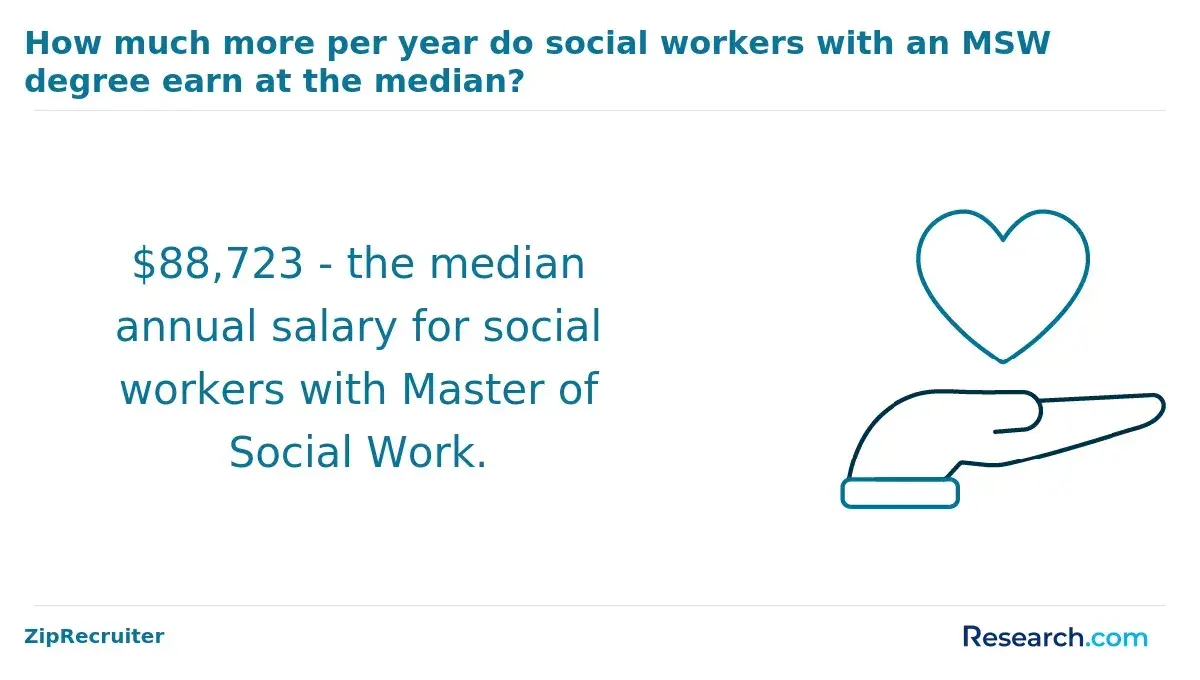
Salary benchmarks reflect the value of experience and credentials in this area, with average earnings around $54,337 annually and the top 10% exceeding $73,891. Actual pay can vary by state, district size, funding structure, union agreements, and whether the job is school-based or district-wide.
Prospective students comparing flexible options can review online masters social work programs, but they should confirm that any program they choose is CSWE-accredited and supports field placements aligned with school social work or education leadership goals.
How does an MSW prepare you for school district leadership?
An MSW prepares future school district leaders by combining clinical insight, systems thinking, policy knowledge, and field-based practice. This combination is important because district leaders must understand individual student needs while also improving the systems that shape those needs: school climate, discipline policies, community resources, family access, and crisis response procedures.
In an MSW program, students typically learn how to assess risk, intervene during crises, support families, interpret social welfare policy, evaluate programs, and advocate for vulnerable populations. Leadership-focused coursework and field placements can extend that training into supervision, organizational management, interagency collaboration, and data-informed decision-making.
MSW preparation is especially relevant for school districts because many student problems do not start in the classroom. Housing instability, grief, trauma, poverty, disability, food insecurity, family violence, substance use in the household, and untreated mental health concerns can all affect attendance, learning, and behavior. MSW-trained leaders are prepared to connect those realities to practical interventions.
Examples of MSW leadership skills for school districts include:
- Designing trauma-informed care initiatives for teachers, counselors, and support staff
- Leading multidisciplinary teams focused on attendance, dropout prevention, or behavioral support
- Using student behavior and referral data to evaluate whether programs are working
- Creating district crisis response protocols and training school teams to implement them
- Partnering with community health agencies to expand student and family access to services
- Supervising school social workers and aligning their work with district goals
Current workforce data shows 7.36% of social workers serve in K-12 or higher education settings, reflecting increasing demand for MSW-prepared leadership amid rising behavioral health needs. School social workers often coordinate resources for students facing emotional or family issues, train faculty in trauma-informed care, and help build crisis response strategies.
Compared with candidates who lack MSW training, MSW graduates typically bring deeper preparation in social systems theory, client advocacy, ethical practice, and evidence-informed intervention. Those skills are valuable in leadership roles where decisions affect entire schools or districts, not just individual caseloads.
Because compensation can vary significantly by location, prospective leaders may also want to compare regional earnings using resources on the highest paying states for social workers.
What are top accredited MSW programs for school leadership?
The strongest MSW programs for school leadership are CSWE-accredited, offer school-based or youth-focused field placements, and include coursework in policy, administration, supervision, program evaluation, and community collaboration. A recognizable university name can help, but accreditation and relevant field experience matter more for licensure and job readiness.
Several leading universities are commonly associated with advanced social work preparation for education-related leadership. The University of Michigan offers concentrations that can support educational leadership within the MSW curriculum, with attention to systemic change and school-based interventions. The University of Washington provides preparation connected to school social work leadership, community collaboration, and policy advocacy. Columbia University's School of Social Work offers a rigorous dual-degree option combining MSW with an MEd, which may appeal to students pursuing careers that bridge social work and educational leadership.
When comparing top accredited MSW programs for school leadership, prospective students should look beyond the catalog title and ask practical questions:
- Is the MSW program accredited by the Council on Social Work Education (CSWE)?
- Does the program offer field placements in schools, districts, youth-serving agencies, or education policy settings?
- Are there electives in school social work, child and adolescent mental health, educational policy, administration, or leadership?
- Do faculty members have experience in school systems, district administration, child welfare, special education, or public policy?
- Does the program prepare students for the relevant state credential, such as school social work licensure or certification?
- Can working professionals complete the program part time or online without sacrificing field placement quality?
Graduates commonly follow a leadership pipeline that starts with direct practice in school or youth-serving settings and then advances into coordination, supervision, and district-level program management. As of recent data, more than 57,700 child, family, and school social workers are employed in elementary and secondary schools, with a mean annual wage of $70,070 according to BLS OEWS May 2023 data updated 2025.
The best MSW degrees for educational leadership careers combine evidence-based policy instruction, leadership theory, and hands-on school experience. Students seeking flexible admissions pathways can also explore MSW programs with high acceptance rate, while still verifying accreditation, field placement support, and state credential alignment.
What are MSW program admission requirements?
MSW admission requirements usually start with a bachelor's degree from an accredited institution. Many programs prefer a minimum GPA of 3.0, although some may consider applicants with lower GPAs when they have strong professional experience, volunteer work, compelling recommendations, or a clear record of readiness for graduate study.
Most MSW applications include:
- Official transcripts from all colleges attended
- Two to three letters of recommendation
- A personal statement or statement of purpose
- A resume showing employment, service, internship, or volunteer experience
- Application forms and fees required by the university
- Background checks and immunization records for field placement eligibility, when required
For applicants interested in school district leadership, the personal statement should do more than express a general desire to help people. A stronger statement explains why schools are the intended setting, what student populations the applicant hopes to serve, and how the MSW will support long-term leadership goals. Experience in education, counseling, youth programs, community service, child welfare, behavioral health, or family support can strengthen the application.
The GRE is increasingly optional for MSW admission, but some competitive or research-focused programs may still require it. International applicants usually need TOEFL or IELTS scores to demonstrate English proficiency. Requirements vary, so applicants should check each program’s current admissions page before applying.
Applicants with an unrelated bachelor’s degree can still be competitive if they show academic readiness and relevant service experience. However, those who already hold a Bachelor of Social Work may qualify for advanced standing MSW pathways at some institutions, which can shorten the time to graduation.
California is a notable hub for school social work leadership roles, offering salaries above the national average because of a strong demand-supply gap. For that reason, students who plan to work in a specific state should choose MSW programs that align with state licensure rules and offer field placements in high-need districts whenever possible.
What does an MSW curriculum cover for leadership tracks?
An MSW curriculum for leadership tracks typically combines advanced social work practice with administration, policy, supervision, and program evaluation. For school district careers, the most useful curriculum helps students understand both individual student support and system-level decision-making.
Core areas often include:
- Human behavior and the social environment
- Social welfare policy and policy advocacy
- Research methods and program evaluation
- Ethical practice and professional standards
- Clinical assessment, crisis intervention, and trauma-informed care
- Family systems theory and child development
- Organizational behavior and leadership
- Fiscal management, grant awareness, and resource allocation
- Interdisciplinary collaboration with educators, healthcare providers, and community agencies
Leadership tracks may also emphasize educational policy, school-based mental health, equity, special populations, and legal issues that affect student services. Students learn how to design programs, analyze outcomes, advocate for resources, and coordinate care across school and community systems.
Field education is a central part of MSW preparation. For school district leadership goals, the strongest placements are in K-12 schools, district offices, youth mental health agencies, family service organizations, community health settings, or education-related nonprofits. These placements allow students to practice stakeholder engagement, documentation, team leadership, crisis planning, and referral coordination in real settings.
Data-driven decision-making is especially important for leadership roles. District leaders may need to evaluate whether an intervention reduces absenteeism, improves behavioral outcomes, increases access to mental health support, or narrows service gaps for vulnerable students. MSW coursework in research and evaluation gives students tools to answer those questions responsibly.
Growth in healthcare social worker roles that support school-family systems is projected at 8% from 2024 to 2034 (BLS & Teach.com, 2026). This points to rising demand for MSW graduates who can manage integrated care models and connect educational, healthcare, and family support systems.
By graduation, students in leadership-oriented MSW tracks should be prepared to advocate for vulnerable students, lead multidisciplinary teams, build inclusive policies, and manage programs under real-world constraints such as limited funding, staffing shortages, mental health crises, and complex family needs.
Are online MSW programs viable for school leadership careers?
Yes, online MSW programs can be viable for school leadership careers if they are accredited by the Council on Social Work Education (CSWE), provide strong field placement support, and offer coursework relevant to school social work, leadership, policy, and administration. The delivery format matters less than accreditation, practicum quality, licensure alignment, and the student’s ability to build relevant experience.
Online MSW programs are often a practical option for working professionals, career changers, parents, and students who cannot relocate. They may allow students to continue working while completing graduate coursework. However, online does not mean fully remote in every respect. MSW programs still require supervised field education, and those placements are usually completed in person.
Before enrolling in an online MSW for school district leadership, students should confirm:
- The program is CSWE-accredited
- The curriculum includes leadership, policy, administration, or school social work electives
- The school helps arrange field placements in or near the student’s community
- Placements can be completed in K-12, district, youth-serving, or education-related settings
- The program meets licensure or school social work credential requirements in the student’s intended state
- Class schedules, synchronous sessions, and field hours fit the student’s work obligations
Data from BLS OOH & Careers in Psychology highlight that MSW graduates in administrative roles frequently earn six-figure salaries, exceeding the median $61,330 social work wage, emphasizing the financial benefits that may come with leadership trajectories.
Online programs can be a strong fit when they offer:
- Flexibility for working students
- Leadership-focused coursework and electives
- Strong field placement in education settings
- Career advancement into management
The main risk is choosing a program for convenience alone. A low-friction online format is not enough if the program lacks accreditation, weakens field placement access, or does not align with state credentialing rules. For school leadership goals, students should prioritize a program that can connect online coursework to real school-based practice and eventual district-level advancement.
What is the typical cost and length of MSW programs?
Most traditional MSW programs take two years of full-time study. Students who already hold a Bachelor of Social Work may be eligible for accelerated or advanced standing tracks that can be completed in as little as one year. Part-time and online formats commonly take three or more years, which can be useful for students who need to keep working while earning the degree.
Cost varies widely by institution, residency status, delivery format, and program length. Public universities usually charge between $10,000 and $30,000 per year for in-state students, while private universities often exceed $40,000 annually. Students should also budget for fees, books, technology, travel to field sites, background checks, and possible lost work hours during practicum requirements.
Online MSW programs may reduce commuting or relocation costs, but they are not automatically cheaper. Some charge similar tuition to campus programs, and field placement obligations may still affect work schedules. The most accurate comparison is total cost to degree, not just tuition per credit.
Ways to manage MSW cost include:
- Choosing an in-state public university when available
- Comparing total tuition, fees, and field-related expenses
- Applying for scholarships, assistantships, and grants
- Asking employers about tuition reimbursement
- Considering part-time study if it helps maintain income
- Reviewing loan forgiveness options connected to public service employment when applicable
Students should weigh cost against licensure eligibility, field placement quality, program reputation, and long-term goals. A lower-cost program that lacks relevant school placements may be less useful for district leadership than a program with stronger education partnerships.
Strong demand exists for MSW graduates in school district leadership, with around 74,000 social worker job openings projected annually nationwide through 2034, including retiree replacements. This demand can support the value of the degree for qualified candidates, but it does not eliminate the need to manage debt carefully.
Program accreditation from the Council on Social Work Education (CSWE) is essential because it supports educational quality and is often tied to licensure and certification eligibility for school district roles.
What salaries can MSW school leaders expect?
MSW school leader salaries vary by district size, state funding, geographic location, union agreements, credential requirements, and level of responsibility. School-based roles generally pay less than senior district-wide leadership positions, while high-cost urban areas may offer higher salaries to reflect local labor markets.
Typical salary ranges include entry-level roles, such as school social work coordinators, at $55,000 to $75,000 annually. Mid-level positions, including assistant directors or program managers, usually make $75,000 to $95,000. Senior leaders, such as directors of student services or district-wide supervisors, often earn $95,000 to $120,000 or more, especially in urban or high-cost areas.
Major salary drivers include:
- State and local education funding
- Union contracts and negotiated salary schedules
- Whether the role is school-based, regional, or district-wide
- Supervisory authority and budget responsibility
- Specialized expertise in trauma-informed care, special education law, crisis response, or community partnerships
- Licensure or certification, including Licensed Clinical Social Worker (LCSW) or school administrative credentials where relevant
Leadership roles that include policy implementation, staff supervision, grant coordination, crisis planning, or district-wide program oversight often carry stronger earning potential than positions focused primarily on an individual caseload. Candidates who can show measurable program outcomes may also be more competitive for advancement.
Beyond salary, mission alignment matters to many workers entering education and social impact careers. The Lever report in the Raincross Gazette notes 42% of Gen Z prioritize employers whose values align with their own over higher pay. Districts that emphasize equity, student mental health, and culturally responsive support may therefore attract MSW-trained leaders who value both purpose and advancement.
To improve earning potential, professionals should build experience in high-need areas such as trauma-informed systems, special education collaboration, behavioral health integration, attendance improvement, and community partnership development. Advanced credentials can help, but they should be chosen based on state requirements and target job descriptions.
What is the job outlook for MSW school district leaders?
The job outlook for MSW school district leaders is supported by growing attention to student mental health, school safety, equity, attendance, family engagement, and community-based support. Districts increasingly need professionals who can connect clinical knowledge with administration, policy, grant awareness, and program management.
According to the Bureau of Labor Statistics Occupational Employment and Wage Statistics data from 2023, local government social work roles, including school district leaders, have a mean annual wage of $68,500. This is about 25% higher than the $50,780 average for social workers in individual or family services, reflecting a notable market premium for leadership and administrative competencies.
MSW school district leaders may manage budgets, oversee student support teams, coordinate grant-funded programs, develop crisis protocols, supervise staff, evaluate outcomes, and work with community partners. These responsibilities require skills that go beyond direct practice, including strategic planning, personnel management, public communication, and policy implementation.
Career prospects are strongest for candidates who can demonstrate both school-based experience and leadership readiness. A typical path may begin with direct service as a school social worker or youth-focused clinician, followed by coordination of a program area, then supervision or district-level administration.
Examples of advancement roles include director of student services, district mental health coordinator, school social work supervisor, attendance and family engagement director, behavioral support program manager, or equity-focused student support leader. Directors of student services responsible for district-wide programs generally earn more than school-based clinical social workers because their roles carry broader operational and policy responsibility.
To improve long-term prospects, MSW graduates should build administrative experience, learn fiscal management, participate in district committees, understand education law, and develop relationships with school administrators. Certifications in educational leadership or nonprofit management and networking within education administration can further strengthen advancement opportunities.
Other Things You Should Know About Social Work
Social workers in school district leadership need strong communication, problem-solving, and conflict resolution skills. They must be adept at advocacy, collaboration with educators and families, and understanding diverse student needs. Leadership qualities such as empathy and cultural competence are also essential.
Social workers often lead or support mental health programs within schools, helping to assess, refer, and provide direct counseling services. They design initiatives aimed at prevention, crisis intervention, and promoting social-emotional learning. Their presence helps create safer and more supportive school environments for students.
Yes, social workers frequently contribute to the development and implementation of school policies, particularly those affecting student welfare and inclusivity. They provide insights based on student needs, systemic barriers, and community resources. Their input helps ensure policies promote equity and support all students' well-being.
References
- Job Board https://longwood.recruitfront.com/JobBoard
- Best Affordable Master's Degree In Social Work https://www.psychology.org/social-work/best-affordable-masters-programs/
- 2023 Head of School Salary Research https://www.cois.org/about-cis/news/post/~board/news/post/2023-head-of-school-salary-research
- Social Work Masters Prerequisites: Discover 7 Critical Pieces - Prereqcourses https://www.prereqcourses.com/social-work-masters-prerequisites/
- How Online MSW Students Are Driving Policy Change Through Remote Degrees https://elearningindustry.com/how-online-msw-students-are-driving-policy-change-through-remote-degrees
- School Social Worker https://socialworklicensemap.com/social-work-careers/school-social-worker/
- MSW Career Outlook https://www.kysu.edu/academics/college-as/school-of-social-work/careers/msw-career-outlook.php
- Working While Earning Your MSW: Balancing School and Career | Sponsored | oswegocountynewsnow.com https://www.oswegocountynewsnow.com/sponsored/working-while-earning-your-msw-balancing-school-and-career/article_f9799162-b985-4e06-b8c3-c5878ee843ea.html
- Online Master’s Programs in Educational Leadership: Compare Schools https://www.onlinemastersdegrees.org/best-programs/education/educational-leadership/
- Unions call for business leaders' pay alignment https://schoolsweek.co.uk/unions-call-for-business-leaders-pay-alignment/