2027 MSW Careers in Program Evaluation and Research

Co-Founder and Chief Data Scientist
Choosing an MSW with a research or program evaluation focus is a different decision from choosing a clinically focused social work degree. The goal is not only to prepare for direct service, but to learn how to measure whether programs work, explain results to funders, improve services, and support policy decisions with credible evidence.
This path is especially relevant for social workers who want to work in nonprofits, healthcare systems, government agencies, universities, foundations, consulting firms, or policy organizations. As funders ask for clearer outcomes and agencies rely more heavily on data, MSW graduates who can combine social work values with evaluation methods are positioned for roles that influence program design, funding, and service quality.
This guide explains what MSW careers in program evaluation and research involve, what education and skills matter most, how to choose a program, what curriculum to expect, and how salary and job outlook vary by employer, experience, and advanced training.
Key Things You Should Know
- MSW graduates with skills in program evaluation and research are increasingly sought after, with a 12% job growth projected through 2030 according to the U.S. Bureau of Labor Statistics.
- Expertise in data analysis, outcome measurement, and evidence-based practices is critical for advancing social programs and securing funding in nonprofit and government sectors.
- Networking through professional organizations and ongoing training in research methodologies significantly enhances career opportunities and salary potential in this specialized MSW field.
What are MSW careers in program evaluation and research?
MSW careers in program evaluation and research focus on answering a practical question: are social programs achieving the outcomes they promise? Professionals in these roles study services, policies, and interventions to determine whether they are effective, equitable, efficient, and worth continued investment.
Instead of spending most of their time in direct practice, MSW research and evaluation professionals often design studies, collect data, analyze outcomes, interview participants, prepare reports, and help leaders make evidence-based decisions. Their work may shape funding proposals, policy recommendations, service redesign, and quality improvement efforts.
Common roles for MSW graduates
- Program evaluator: Measures whether a program is meeting its goals, such as reducing homelessness, improving treatment engagement, or increasing access to services.
- Research analyst: Collects and analyzes data for social service agencies, healthcare organizations, universities, or policy groups.
- Policy analyst: Studies how policies affect populations, agencies, and service delivery systems.
- Evaluation coordinator: Manages surveys, data systems, outcome tracking, and reporting requirements for grants or contracts.
- Research social worker: Supports studies involving clients, communities, interventions, or systems of care.
These roles appear in government agencies, healthcare organizations, nonprofit organizations, academic institutions, foundations, and consulting groups. For example, an MSW evaluator may track outcomes for a homelessness intervention program, while a research social worker may study the effects of mental health policy on underserved groups.
What makes the MSW useful in evaluation work?
The MSW is valuable because it combines applied research skills with a deep understanding of human behavior, systems, inequality, ethics, and service delivery. A strong evaluator does not only calculate outcomes; they also understand why a program may work for one community but fail in another.
Key competencies include:
- Quantitative and qualitative research methods
- Survey design and interview techniques
- Program logic models and outcome measurement
- Statistical analysis and data interpretation
- Ethical protection of participants and confidential information
- Clear communication with funders, agency leaders, practitioners, and policymakers
Technical skills also matter. Familiarity with tools such as SPSS and R can strengthen a candidate’s profile, especially for roles that require data cleaning, statistical analysis, or reporting. Grant writing is also useful because many evaluation positions are tied to funded projects.
The demand for evidence-based social services continues to grow. According to the CSWE 2023-2024 Annual Survey, 225 MSW programs reported 55,935 enrolled students, reflecting a strong pipeline of social work professionals who may enter research-oriented and evaluation-related roles.
Students who want advanced research leadership, university teaching, or high-level policy work may later consider accredited doctorate in social work programs to deepen their expertise.
What education is required for MSW program evaluation roles?
Most MSW program evaluation roles require a Master of Social Work from a program accredited by the Council on Social Work Education (CSWE). The MSW provides the professional foundation employers expect, while evaluation-focused coursework and field experience help graduates compete for research, data, and policy roles.
A generalist MSW may be enough for some entry-level evaluation coordinator or research assistant roles, but stronger candidates usually show focused preparation in research design, statistics, data analysis, program planning, and social policy.
Core education requirements
| Requirement | Why it matters for evaluation roles |
| CSWE-accredited MSW | Shows that the degree meets professional social work education standards. |
| Research methods coursework | Prepares students to design studies, assess evidence, and evaluate interventions. |
| Statistics or data analysis | Supports outcome measurement, reporting, and interpretation of program results. |
| Program evaluation coursework | Builds skill in logic models, performance measures, implementation review, and impact assessment. |
| Field placement or internship in evaluation | Provides applied experience that can become a portfolio item for employers. |
Additional preparation that helps
- Certificate programs or electives focused on evaluation methods and data analysis within MSW curricula.
- Hands-on training with statistical software such as SPSS, SAS, or R, which are widely used in evaluation and applied research.
- Internships, assistantships, or field placements involving outcomes measurement, quality improvement, grant reporting, or policy analysis.
- Writing samples, capstone projects, or evaluation reports that demonstrate the ability to turn findings into practical recommendations.
Employers frequently prefer candidates with at least two years of post-master's experience in program evaluations or applied research within social services. Some positions, especially in federal agencies, universities, and research institutions, may require or favor a doctoral degree such as a PhD or DSW with an emphasis on research and evaluation.
Because demand for social work professionals is projected to grow 7% from 2023 to 2033 due to healthcare and mental health needs, students who combine an MSW with strong evaluation skills may be better positioned for specialized roles beyond traditional direct practice.
Prospective students comparing cost and flexibility can explore affordable accredited online MSW programs while checking whether each program offers evaluation coursework, research field placements, and faculty mentorship.
How do you become a program evaluator with an MSW?
To become a program evaluator with an MSW, choose a degree path that builds both social work expertise and applied research ability. Employers want candidates who understand communities and services, but they also need evaluators who can define outcomes, collect reliable data, analyze results, and explain what the findings mean.
Step-by-step path
- Choose an MSW with research, policy, macro practice, community practice, or program evaluation options. A clinical concentration can still lead to evaluation work, but it may require additional electives or experience in research methods.
- Take courses in statistics, research design, survey methods, data management, and outcome measurement. These courses provide the technical base for evaluation roles.
- Use field education strategically. Look for placements in agencies that track outcomes, manage grants, run quality improvement projects, or partner with research institutions.
- Build software proficiency. Learn tools such as SPSS, SAS, or R, and become comfortable with spreadsheets, dashboards, and data visualization.
- Create a portfolio. Save de-identified examples of evaluation plans, logic models, survey instruments, literature reviews, reports, and presentations when permitted by your program and placement site.
- Network with researchers and community organizations. Evaluation work is often project-based, and professional relationships can lead to assistantships, consulting assignments, or full-time roles.
- Consider certifications or additional training. Short courses in program evaluation, public health, implementation science, or policy analysis can strengthen your profile.
The ASWB Social Work Workforce Study Series Report 2 shows that 13% of MSW graduates pursue research concentrations, highlighting that research-focused preparation is a recognized pathway within social work education.
Does licensure matter?
Licensure requirements vary by state and by job function. Many program evaluation roles do not require clinical licensure if the work does not involve diagnosis, therapy, or independent clinical practice. However, obtaining a clinical license can improve credibility in settings where evaluation involves behavioral health, healthcare, or clinical service programs. Candidates should review state rules and employer requirements before assuming licensure is or is not necessary.
Common challenges to prepare for
- Technical learning curve: Evaluation roles may require stronger statistical and software skills than many MSW students expect.
- Messy real-world data: Agency data may be incomplete, inconsistent, or collected for billing rather than research.
- Stakeholder pressure: Funders, administrators, and staff may have different expectations for what results should show.
- Communication demands: A strong evaluator must translate data into clear recommendations that non-research audiences can use.
Students comparing this path with direct practice can also review the social worker salary guide to understand how compensation varies across roles and states.
What does an MSW program evaluation curriculum cover?
An MSW program evaluation curriculum teaches students how to assess whether a social program is being implemented as intended, reaching the right population, producing measurable outcomes, and using resources responsibly. The best curricula combine research methods with applied social work judgment, ethics, and communication skills.
Typical curriculum areas
| Curriculum area | What students learn |
| Research design | How to frame evaluation questions, choose appropriate methods, and assess evidence quality. |
| Quantitative methods | How to use numerical data, descriptive statistics, outcome measures, and statistical analysis. |
| Qualitative methods | How to conduct interviews, focus groups, observations, and case studies. |
| Program theory and logic models | How to connect inputs, activities, outputs, outcomes, and long-term impact. |
| Formative evaluation | How to improve a program while it is being developed or implemented. |
| Summative evaluation | How to judge whether a program achieved its intended outcomes after implementation. |
| Ethics and cultural competence | How to protect participants, use informed consent, respect communities, and avoid harmful interpretations. |
| Data communication | How to present findings through reports, briefs, dashboards, and stakeholder presentations. |
Students may also learn survey design, sampling, data management, grant reporting, needs assessment, implementation evaluation, and mixed-methods approaches. Software training may include statistical tools and data visualization platforms, depending on the program.
How coursework connects to real social work settings
Program evaluation assignments often use examples from child welfare, mental health services, substance use programs, aging services, schools, housing programs, community development, and healthcare. A student might evaluate whether trauma-informed care improves client engagement, whether outreach efforts reach underserved populations, or whether a new case management model reduces service gaps.
Although clinical or direct practice remains a primary MSW concentration, program evaluation and research methods are increasingly integrated into training to support evidence-based interventions. This integration prepares graduates to address service quality, resource allocation, client outcomes, and accountability, as highlighted in the ASWB Social Work Workforce Study Series Report 2.
Students considering flexible study options can compare MSW online programs and review whether they include meaningful evaluation coursework rather than only general research requirements.
What are top accredited MSW programs for research careers?
Top accredited MSW programs for research careers are not defined only by name recognition. The strongest options combine CSWE accreditation, rigorous methods training, faculty research activity, applied field opportunities, and connections to agencies where students can evaluate real programs.
Leading universities such as Boston University, University of Michigan, and Washington University in St. Louis provide specialized research tracks focused on program evaluation, data analysis, and social policy impacts. These programs can prepare students for roles in healthcare, public agencies, nonprofit organizations, foundations, and academic research settings.
What to look for in a research-focused MSW
- CSWE accreditation: This should be the first screen for professional social work education quality.
- Research or evaluation concentration: Look for concentrations, certificates, or electives in program evaluation, policy research, macro practice, community practice, or evidence-based practice.
- Faculty with active research portfolios: Faculty research can lead to assistantships, mentorship, conference presentations, and applied projects.
- Applied research requirements: Programs that require a thesis, capstone, or evaluation project may help students graduate with stronger work samples.
- Partnerships with agencies and research centers: Field placements in healthcare systems, public agencies, universities, or nonprofits can be more valuable than classroom training alone.
- Data analysis resources: Strong programs provide training or support for quantitative, qualitative, and mixed-methods tools.
The University of Michigan's MSW program, for example, integrates multidisciplinary approaches and partnerships with research institutions, giving students valuable hands-on data and evaluation experience. Many programs also require applied research projects or theses, which can help students demonstrate skills employers want.
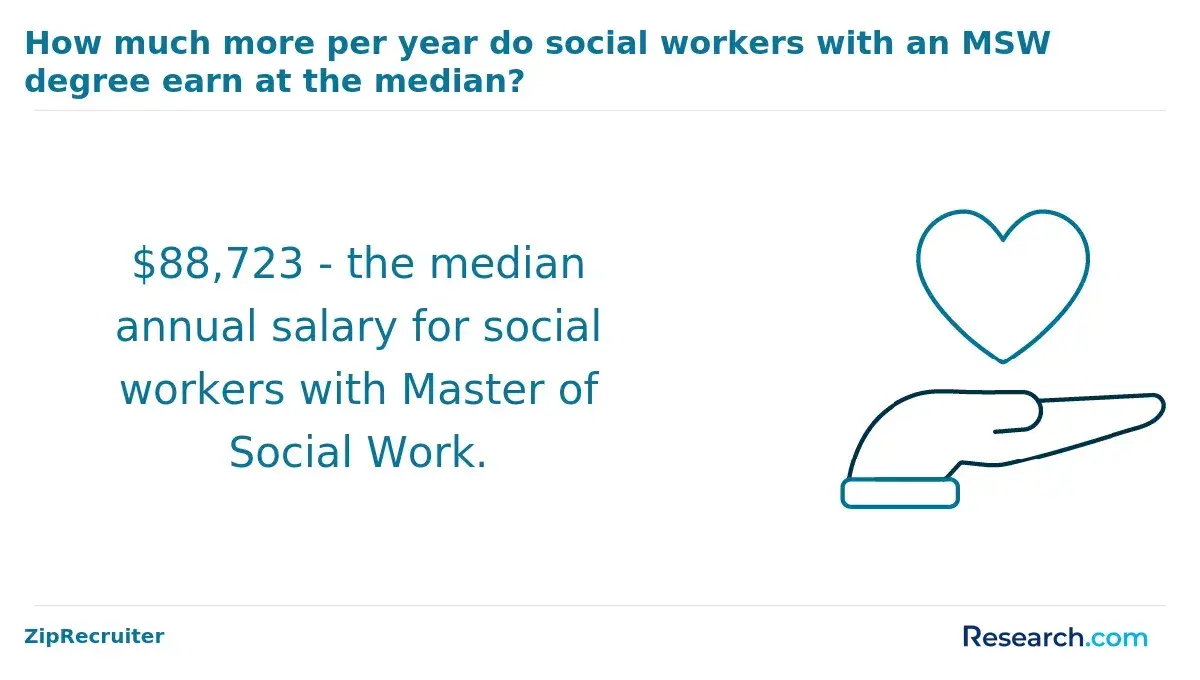
Salary data supports the value of graduate-level preparation. According to Baylor University School of Social Work Career Outcomes, MSW graduates focusing on research earn over $30,000 more annually than BSW holders, with median salaries exceeding $60,000 in sectors like healthcare. This reflects the market value of analytical, research, and program evaluation expertise, although individual salaries vary by employer, geography, experience, and role.
Working professionals should also consider format. Part-time and online options may make an MSW more accessible, but students should confirm that remote formats still include strong research mentorship, field placement support, and access to evaluation projects.
What are admission requirements for MSW evaluation tracks?
Admission requirements for MSW evaluation tracks are usually similar to general MSW admissions, with added attention to the applicant’s readiness for research, statistics, policy analysis, and evidence-based practice. Programs want to see that applicants can handle graduate writing, understand social issues, and explain why evaluation or research fits their career goals.
Common admission requirements
- Completed bachelor's degree from an accredited institution
- Official transcripts
- Minimum GPA, often 3.0+
- Two or three recommendation letters
- Statement of purpose focused on evaluation and research
- Resume with relevant professional, volunteer, research, or community experience
- Prerequisite coursework in statistics or research methods, if required
- TOEFL/IELTS for international applicants, when applicable
A bachelor's degree in social work, psychology, sociology, public health, political science, or another related field can be helpful, but applicants from unrelated majors may still be competitive if they show strong writing ability, social service experience, analytical preparation, and a clear reason for pursuing evaluation work.
How to strengthen an application
- Use the statement of purpose strategically. Explain the types of programs or populations you want to evaluate and why evidence-based practice matters to your goals.
- Highlight data-related experience. Include research assistant work, grant reporting, survey administration, needs assessments, quality improvement projects, or program coordination.
- Address gaps directly. If you lack statistics or research coursework, explain how you plan to build those skills before or during the MSW.
- Choose recommenders carefully. Strong letters should speak to your analytical ability, reliability, writing, ethics, and readiness for graduate study.
Many MSW programs offer part-time or online options, but these may have separate deadlines, field placement requirements, or technology expectations. Applicants should also check whether the evaluation track has additional prerequisites or a separate internal application after enrollment.
Over 55 MSW programs include concentrations in organizations and communities, such as policy practice, enrolling thousands in evaluation-related tracks aligned with nonprofit roles (CSWE 2023-2024 Annual Survey). This means applicants interested in evaluation should compare not only admission requirements, but also whether a program’s concentration structure truly supports research and program assessment careers.
How long do MSW programs take and what do they cost?
MSW programs generally take two years of full-time study. Part-time formats often take three to four years, while accelerated options may take 12 to 18 months and require a heavier course load. The right timeline depends on whether the student can study full time, continue working, complete field placement hours, and manage the academic demands of research-focused coursework.
Online and hybrid programs are increasingly common. About 30% of master's-level social workers use online and hybrid programs, offering flexible pathways, particularly for fields like healthcare program evaluation, as highlighted in the ASWB Social Work Workforce Study Series Report 2.
Typical time-to-completion options
| Program format | Typical length | Best fit |
| Full-time MSW | Two years | Students who can prioritize graduate study and field placement. |
| Part-time MSW | Three to four years | Working professionals who need a slower pace. |
| Accelerated MSW | 12 to 18 months | Students prepared for intensive coursework and limited scheduling flexibility. |
| Online or hybrid MSW | Varies by program | Students who need location flexibility but can still meet field placement requirements. |
Cost considerations
Tuition varies widely. Public universities typically charge between $15,000 and $30,000 annually for in-state students, while private institutions range from $30,000 to $50,000. Online programs may reduce relocation and commuting costs, but students should still review tuition, fees, technology costs, books, and field placement expenses.
Additional costs may include books, university fees, background checks, transportation to field placements, software, and professional conference or training expenses. These can add several thousand dollars each year, depending on the program and placement site.
How to evaluate affordability
- Compare total program cost, not only per-credit tuition.
- Ask whether online students pay different fees than campus students.
- Review scholarship, assistantship, fellowship, and stipend options.
- Check eligibility for federal loans and work-study.
- Ask employers about tuition reimbursement if you plan to keep working.
- Consider whether the program offers paid research assistantships or evaluation-related field placements.
Choosing the best format requires balancing cost, speed, flexibility, and career preparation. A lower-cost program may be a strong choice if it provides evaluation coursework and field experience; a more expensive program may be harder to justify if it lacks research mentorship or practical evaluation opportunities.
What is the salary outlook for MSW program evaluators?
The annual salary for MSW program evaluators generally ranges from $60,000 to $90,000. Actual pay depends on experience, location, employer type, technical skill level, and whether the role involves grant management, advanced analysis, consulting, or leadership responsibilities.
Factors that affect pay
| Factor | How it can influence salary |
| Employer type | Nonprofit and local agency roles may pay less than university, healthcare, federal, or consulting roles. |
| Experience | Entry-level roles often focus on coordination and data collection, while senior roles involve design, analysis, supervision, and strategy. |
| Technical skills | Quantitative research methods, statistical software, and data visualization can improve competitiveness. |
| Grant and reporting experience | Employers value professionals who can connect evaluation findings to funding requirements and program improvement. |
| Advanced education | Doctoral training may support leadership, university, federal research, or high-level consulting roles. |
Entry-level positions in nonprofit organizations or government agencies often start around $60,000. Experienced professionals working in academic settings, healthcare systems, federal research environments, or private consulting can earn up to $90,000 or more. Skills in quantitative research methods and data analysis tools can raise earning potential because they allow evaluators to handle more complex projects.
Advancing in this field may require further education for certain roles. Nearly 63 PhD programs reported 1,811 enrollments with an acceptance rate of 47.8% in recent years, highlighting the competitive nature of doctoral pathways that can lead to senior research and evaluation positions. Graduates holding research doctorates often achieve salaries above six figures, particularly in universities and federal research positions.
MSW graduates who want stronger salary growth should build evidence of impact. Employers are more likely to reward evaluators who can show that their work improved program outcomes, strengthened funding proposals, clarified service gaps, or supported better policy decisions. Grant writing, program design, advanced statistics, implementation science, and mixed-methods expertise can also support progression into higher-paying roles.
What is the job outlook for MSW research professionals?
The job outlook for MSW research professionals is supported by the continued need for evidence-based social services, accountability in public funding, and measurable outcomes in healthcare, behavioral health, child welfare, housing, education, and community programs.
The demand for MSW research professionals continues to grow, bolstered by a 23.7% increase in MSW graduates over the past decade, with 32,801 finishing in 2021-22 according to the CSWE 2022-2023 Annual Survey. This trend reflects a larger pool of MSW-trained professionals entering roles that may include program evaluation, policy research, and community impact analysis.
Where MSW research professionals work
- Government agencies evaluating publicly funded services
- Nonprofit organizations tracking grant outcomes and program effectiveness
- Healthcare systems studying access, quality, and patient or client outcomes
- Universities and research centers supporting applied social research
- Foundations and consulting firms assessing social impact
- Policy organizations analyzing laws, regulations, and service systems
Common tasks include evaluating mental health initiatives, child welfare programs, homelessness services, healthcare access projects, community interventions, and policy impacts on vulnerable groups. These roles often require both technical ability and social work judgment, especially when data involves communities affected by poverty, discrimination, trauma, disability, or limited access to care.
Skills that improve employability
- Quantitative and qualitative research methodologies
- Grant writing
- Data visualization
- Outcome measurement and logic model development
- Report writing for funders and agency leaders
- Stakeholder engagement and community-informed evaluation
Career paths can lead to project leadership, consulting, quality improvement management, policy analysis, or academic research. Competition can be stronger for university-based and federal research roles, but candidates with applied experience, technical tools, and a portfolio of evaluation work are better positioned.
Employers highly value professionals who can convert complex data into practical insights. In program evaluation, the most employable candidates are not simply those who can run analyses, but those who can explain what the results mean for clients, staff, budgets, equity, and policy.
How to choose the best MSW for evaluation careers?
To choose the best MSW for evaluation careers, focus on fit with your intended role. A program designed mainly for clinical practice may still be valuable, but it may not offer enough preparation in research design, statistics, policy, and applied evaluation. The right program should help you graduate with both the credential and the work samples needed for evaluation jobs.
Program selection checklist
- Accreditation: Confirm that the MSW is accredited by the Council on Social Work Education.
- Evaluation-relevant curriculum: Look for coursework in research methods, statistics, program evaluation, policy analysis, grant writing, and data visualization.
- Faculty expertise: Review whether faculty conduct research in social policy, community interventions, health services, child welfare, behavioral health, or other areas that match your goals.
- Field placement options: Ask whether students can complete placements involving evaluation, quality improvement, grant reporting, or applied research.
- Research assistantships: Programs with assistantships can provide hands-on experience and stronger mentorship.
- Capstone or thesis opportunities: A substantial evaluation project can become a portfolio piece for employers.
- Employer connections: Review partnerships with nonprofits, healthcare systems, public agencies, research centers, and policy organizations.
- Format and cost: Compare online, hybrid, part-time, and full-time options in relation to your work schedule and budget.
- Alumni outcomes: Look for graduates working as program evaluators, policy analysts, research coordinators, or quality improvement specialists.
Questions to ask before enrolling
- Can students specialize in program evaluation, research, policy, macro practice, or community practice?
- Which statistical or qualitative analysis tools are taught?
- Are evaluation-focused field placements available, and who helps secure them?
- Do students complete a thesis, capstone, or applied research project?
- Are faculty currently conducting funded research or evaluation studies?
- What kinds of jobs do graduates obtain after completing the program?
Accreditation and alignment with competency frameworks, such as those from the Council on Social Work Education, help ensure that students receive training in ethics, evidence-informed practice, assessment, and dissemination. The decline in practice doctorate (DSW) enrollment by over 14%, averaging 109 fewer students per program (CSWE 2022-2023 Annual Survey), also underscores the importance of choosing an MSW that provides strong preparation for evaluation roles at the master’s level.
Students should review alumni outcomes and employer connections carefully. Programs with demonstrated placements in research, nonprofit evaluation, healthcare quality improvement, or policy analysis are more likely to support this career path. Continuing education and certification-like Certified Evaluator credentials may also enhance professional credibility after graduation.
Other Things You Should Know About Social Work
Social workers in program evaluation and research need strong analytical and critical thinking skills to interpret data accurately. Communication skills are essential for presenting findings to diverse audiences and collaborating with stakeholders. Additionally, proficiency in research methodologies and statistical software enhances their ability to conduct rigorous evaluations.
Yes, social workers leverage program evaluation findings to inform and advocate for policy changes. By providing evidence-based recommendations, they help shape programs that better address community needs. This role strengthens social work's contribution to systemic improvements and social justice.
Common challenges include limited funding, which can restrict the scope of studies and data collection. Navigating complex community dynamics and respecting participant confidentiality can complicate data gathering. Balancing rigorous methodology with practical constraints often requires adaptable and creative problem-solving.
References
- Social Worker Salary and Jobs in Social Work https://teach.com/online-ed/social-work-degrees/online-masters-social-work/salary-and-career-outlook/
- Online MSW Degree - Social Work Standard | IWU https://www.indwes.edu/program/master-social-work/standard/
- Social Work Masters Prerequisites: Discover 7 Critical Pieces - Prereqcourses https://www.prereqcourses.com/social-work-masters-prerequisites/
- MSW Programs that Teach Methods of Evaluation in Social Work | edX https://www.edx.org/masters/online-msw-programs/evaluation-social-work
- High-demand social work roles in 2026: trends and opportunities https://socialwork.pacific.edu/blog/high-demand-social-work-roles-2026-trends-and-opportunities
- Which Social Work Job is Right For You? https://online.aurora.edu/social-work-jobs/
- MSW Career Outlook https://www.kysu.edu/academics/college-as/school-of-social-work/careers/msw-career-outlook.php
- What Can I Do With a Master's in Social Work? | UNR https://onlinedegrees.unr.edu/online-master-of-social-work/what-can-i-do-with-a-masters-in-social-work
- What Type of Social Worker Will You Be? https://www.socialworkers.org/Careers/NASW-Career-Center/Explore-Social-Work/What-Type-of-Social-Worker-Will-You-Be
- What Is Social Work Program Design and Evaluation? https://socialwork.tulane.edu/blog/what-is-social-work-program-design-and-evaluation/