2027 Social Work License Reciprocity by State: What Graduates Should Know

Co-Founder and Chief Data Scientist
Moving, taking a telehealth role, or accepting a job near a state border can turn social work licensure into a career-planning issue. A license issued in one state does not automatically authorize practice everywhere, and the rules can differ by license level, education, exam history, supervision record, and disciplinary status.
This guide explains how social work license reciprocity works by state, what the Social Work Licensure Compact may change, which credentials are more likely to transfer smoothly, and what applicants should verify before relocating or applying for jobs in another jurisdiction. It is designed for MSW students, recent graduates, LMSWs, LCSWs, clinical supervisors, and licensed social workers considering interstate practice.
Key Things You Should Know
- Reciprocity for social work licenses varies widely by state, with approximately 40 states participating in the ASWB's standardized exam process to facilitate cross-state practice.
- Graduates should verify state-specific requirements, as some states demand additional credentials, supervision hours, or state jurisprudence exams despite reciprocity agreements.
- Recent 2024-2025 data show a rising trend in states adopting the Association of Social Work Boards' (ASWB) endorsement model, simplifying license transfers for nearly 65% of licensed social workers nationwide.
What is social work license reciprocity by state?
Social work license reciprocity by state refers to the process of using an existing social work license to qualify for licensure or practice authority in another state. It does not always mean an automatic transfer. In many states, the more accurate term is licensure by endorsement, which means the receiving board reviews your current license, education, exam results, supervised experience, background, and professional standing before deciding whether to issue a new license.
State rules vary because social work licensing is controlled by individual state boards. A credential that meets one state’s requirements may need additional documentation, continuing education, supervision records, or a jurisprudence exam in another state. This is especially important for clinical licenses, where scope of practice, diagnosis authority, and independent practice rules can differ.
The interstate social work license transfer process is also being reshaped by the Social Work Licensure Compact, which currently includes 30 states and is fully expected to roll out between 2026 and 2027. The compact is intended to let eligible license holders practice across member states without applying for separate licenses in each state, improving mobility for in-person and telehealth practice.
- Direct reciprocity: A state recognizes an out-of-state license because the original requirements are considered substantially equivalent.
- Licensure by endorsement: The applicant submits proof of an active license and must satisfy the receiving state’s documentation, background check, exam, supervision, or jurisprudence requirements.
- Licensure compact: Participating states use a shared framework that can reduce duplicate applications and make multistate practice easier for eligible licensees.
Before planning a move, confirm whether your target state participates in the compact, uses endorsement, or requires a full application. Also compare license levels carefully: an LMSW, LCSW, independent clinical license, or bachelor-level license may not transfer under the same rules.
If your long-term goal includes advanced clinical leadership, policy work, or teaching, reviewing DSW programs in social work can help you understand how doctoral education may support career mobility beyond initial licensure.
Which states offer social work license reciprocity?
States that offer easier social work license portability are generally those that participate in the Social Work Licensure Compact or maintain endorsement pathways for out-of-state licensees. The Social Work Licensure Compact became effective in 2025. Initially adopted by seven states, the compact has expanded rapidly, with 30 states participating by mid-2025.
For social workers in compact states, the main advantage is the potential to hold a multistate license rather than applying separately in every jurisdiction. Professionals licensed in compact states can obtain a multistate license within 12 to 24 months of activation, which can support relocation, cross-border employment, and telehealth practice. Social workers licensed in member states like Texas may have easier portability to states such as Utah or Montana without repeating the full licensing process.
States outside the compact, including California and New York, still require separate licenses issued through their individual boards. These states may ask for additional documentation, state-specific exams, supervised experience verification, or coursework review. As a result, applicants should not assume that a license from a compact state will automatically satisfy requirements in a non-compact state.
How to check whether a state is practical for reciprocity
- Review the destination state board’s endorsement or reciprocity page before applying for jobs.
- Confirm whether your exact license level is eligible, not just whether social work licenses are accepted generally.
- Ask whether the state requires a jurisprudence exam, fingerprinting, background check, or continuing education before approval.
- Verify whether telehealth practice into the state requires a full in-state license, compact privilege, or separate authorization.
Students who expect to move after graduation should choose their education pathway with licensure portability in mind. Comparing the cheapest accredited online MSW programs can help identify programs that support licensure preparation while keeping total education costs manageable.
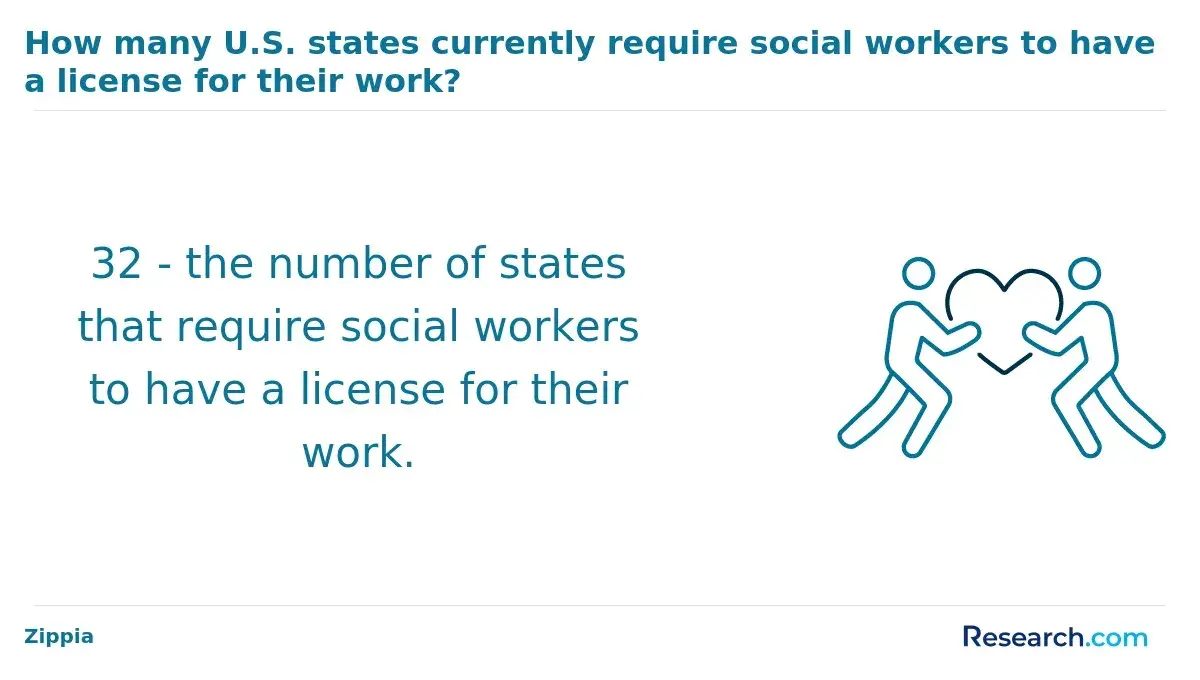
The key point is that “reciprocity” is not the same in every state. Compact participation may simplify practice, but non-compact states can still require a traditional board-by-board application.
How does social work license reciprocity work across states?
Social work license reciprocity across states usually works through a board review. The receiving state verifies that your current license is active and in good standing, compares your education and exam history with its own rules, reviews your supervised practice record, and checks for disciplinary or criminal background issues. If the board decides your qualifications are substantially equivalent, it may issue a license by endorsement.
There is no single national standard for social work license transfer. States such as Alabama and Missouri have formal reciprocity agreements that simplify the interstate social work licensure transfer process. Missouri, for instance, processed over 1,200 social work licensure by reciprocity applications in one year, accounting for 25% of all new licenses issued, reflecting high workforce mobility (Source: Missouri Division of Professional Registration Annual Report, 2025).
What boards usually review
- License status: Most states require verification directly from the original licensing board, including whether the license is active, expired, suspended, or disciplined.
- Education: Boards often require official transcripts and may check whether the degree came from an accredited social work program.
- Exam history: Applicants may need proof of passing the appropriate Association of Social Work Boards exam for the license level requested.
- Supervised experience: Clinical applicants may need supervisor forms, hour totals, dates, practice settings, and descriptions of clinical duties.
- State-specific rules: Some boards require a jurisprudence, ethics, or state law exam even when they accept the core license.
License titles also matter. An LCSW, LMSW, LISW, LICSW, or other state-specific title may not map perfectly onto the destination state’s categories. Clinical licenses are often reviewed more closely than nonclinical licenses because they can authorize diagnosis, psychotherapy, private practice, or independent billing.
To avoid delays, contact the destination board before submitting payment. Ask whether your current license qualifies for endorsement, whether any supervised hours will be rejected, and how long the average review takes. If compensation is part of your relocation decision, use an lcsw salary by state resource to compare likely earnings with licensure requirements and cost of living.
What are the requirements for social work license reciprocity?
The requirements for social work license reciprocity by state typically include an active license in good standing, official education records, proof of exam passage, supervised experience documentation, identity verification, and a background check. The exact requirements depend on the destination state, the license level requested, and whether the applicant is using endorsement, a compact pathway, or a standard application.
Common reciprocity requirements
- Current license verification: Most boards require verification sent directly from each state where you have held a social work license.
- Official transcripts: Applicants generally must submit transcripts showing completion of a qualifying social work degree.
- ASWB exam results: Some states accept prior exam results, while others require evidence that the exam level matches the requested license.
- Supervised experience records: Clinical applicants may need detailed supervision forms, hour totals, and supervisor credentials.
- Criminal background check: Fingerprinting or state and federal background checks are common.
- Continuing education: Some states require specific courses, such as ethics, mandated reporting, cultural competence, or state law.
- Jurisprudence exam: Many boards require an exam on state statutes, regulations, and professional responsibilities.
Some states use licensure by endorsement, where one state recognizes another state’s license if the applicant meets comparable standards. Arizona and Louisiana offer such endorsements; notably, Arizona's out-of-state LCSW endorsements increased by 18% recently, reflecting practitioners relocating for telehealth amid delays in the Social Work Licensure Compact implementation (Source: Arizona Board of Behavioral Health Examiners Statistics, 2025).
Applicants in non-compact states should prepare for a more document-heavy process. Missing supervision forms, outdated transcripts, name changes, incomplete employment histories, and unresolved disciplinary questions are common reasons applications slow down.
Students who are still choosing a graduate program should consider how their school will support licensure preparation. Reviewing the easiest MSW online program options can be useful, but admission accessibility should be weighed alongside accreditation, field placement quality, exam preparation, and compatibility with target-state licensing rules.
Do all social work licenses qualify for reciprocity?
No. Not all social work licenses qualify for reciprocity, and not all licenses transfer at the same level. Eligibility depends on the license type, the state where it was issued, the state where you want to practice, and whether your education, exam, and supervision history match the receiving state’s rules.
Licensed Master Social Worker (LMSW) credentials are often evaluated differently from Licensed Clinical Social Worker (LCSW) credentials. A nonclinical master’s license may be easier to endorse in some states because it does not authorize independent clinical practice. By contrast, an LCSW or equivalent clinical license may require detailed proof of supervised clinical hours, diagnosis and treatment experience, and passage of the correct clinical exam.
Only 12% of social workers successfully transferred their licenses without extra requirements, according to the 2024 ASWB survey. Many applicants must complete state-specific clinical exams, continuing education, jurisprudence testing, or additional supervised practice before receiving a comparable license.
Questions to ask before assuming your license will transfer
- Does the destination state recognize my exact license level or only a similar category?
- Was my degree from a program accepted by the receiving board?
- Did I pass the ASWB exam level required for the target license?
- Do my supervised hours meet the state’s minimum number, timing, setting, and supervisor requirements?
- Does the state require a jurisprudence exam or special continuing education before approval?
- Will my license allow independent practice, clinical diagnosis, supervision, or private practice in the new state?
The safest approach is to compare the written requirements from both boards and request clarification before you move, sign an employment contract, or begin telehealth services. Practicing before authorization can create disciplinary and legal risk, even when you already hold a valid license elsewhere.
What education is needed for social work reciprocity?
For most advanced social work reciprocity pathways, applicants need a social work degree that the receiving state recognizes for the license level requested. For clinical reciprocity, a master's degree in social work (MSW) from a Council on Social Work Education (CSWE)-accredited program is generally the key educational requirement. Some states may also review specific coursework, field placement, and post-degree supervision.
A CSWE-accredited MSW is usually the most portable educational credential for master’s and clinical licensure. Common coursework areas include ethics, human behavior, research, social welfare policy, assessment, and clinical practice. If the receiving state finds gaps in coursework or field education, it may require additional classes or documentation before approving reciprocity.
Applicants with only a bachelor’s degree, a non-social-work graduate degree, or a degree from a program without CSWE accreditation may face more limits. They may qualify only for certain license categories, need additional education, or be ineligible for clinical reciprocity until they complete a qualifying MSW and supervised clinical requirements.
The Social Work Licensure Compact facilitates multistate practice for licensed clinical social workers who have a CSWE-accredited master's and have passed the Clinical Level ASWB exam. Demand for social workers with multistate licenses is growing, especially in telebehavioral health within compact states, showing a 22% increase in related job postings from 2023 to 2024. Meeting education requirements for reciprocity is essential to access these expanding job opportunities (Source: NASW Interstate Licensure Compact Update, 2025).
Education checks before applying
- Confirm that your degree type matches the target license level.
- Verify that your program’s accreditation is accepted by the destination board.
- Request official transcripts early, especially if your school has merged, closed, or changed systems.
- Keep course descriptions and syllabi if you may need to prove content areas.
- Ask whether online, hybrid, or out-of-state field placements create any additional review issues.
How to apply for social work license reciprocity?
To apply for social work license reciprocity, start with the licensing board in the state where you want to practice. Do not rely only on employer guidance or general reciprocity language; the board’s application instructions determine what you must submit and when you may legally begin work.
Step-by-step application process
- Identify the correct license category. Match your current license to the closest license level in the destination state, such as LMSW, LCSW, LICSW, or another state-specific title.
- Review endorsement or compact eligibility. Determine whether you qualify for licensure by endorsement, a multistate compact privilege, or a standard license application.
- Request license verification. Many boards require official verification sent directly from every state where you have held a license.
- Order official transcripts. Send transcripts from your social work program according to the board’s instructions.
- Submit exam documentation. Provide ASWB exam results if the state does not already receive them through a designated reporting process.
- Document supervised experience. Clinical applicants should gather supervisor forms, hour logs, employment dates, and practice setting details.
- Complete background checks. Follow fingerprinting and criminal background check instructions exactly, including state-specific vendor requirements.
- Take required state exams or courses. Complete jurisprudence, ethics, or mandated training if required.
- Track the application. Monitor the portal or board communications and respond quickly to deficiency notices.
Check whether the destination state participates in the Association of Social Work Boards' (ASWB) Reciprocity Agreement. States in this agreement streamline the transfer process, especially for Licensed Clinical Social Workers (LCSWs). Otherwise, you may need to complete extra supervised hours or retake the licensing exam.
Processing times vary from weeks to months. In high-demand states, the career upside can be meaningful, but the application must be handled carefully. Transferring an LCSW license to high-demand states like California can increase your salary by an average of $15,000 annually, with median wages around $98,500, according to the Bureau of Labor Statistics Occupational Employment and Wage Statistics May 2024 data.
Before resigning from a current position or relocating, ask the new board whether you may work under temporary authorization, supervision, a provisional license, or not at all until full approval. This protects you from unlicensed practice and helps employers set realistic start dates.
What are social work salaries after reciprocity?
Social work salaries after reciprocity depend on the state where you become licensed, your license level, employer type, specialty, experience, and whether you can practice independently. Reciprocity can open access to a new labor market, but it does not guarantee a raise by itself.
Licensed Clinical Social Workers transferring their credentials are usually paid according to the target state’s market, not the state where they were first licensed. For example, an LCSW relocating to California might earn about $85,000 annually, while one moving to Texas may see closer to $70,000. These differences reflect cost of living, local demand, payer mix, public funding, and the concentration of healthcare and behavioral health employers.
Reciprocity can also affect timing. Some employers may wait until your license is fully issued before placing you in a clinical role, approving independent duties, or moving you to a higher pay band. According to the ASWB Licensure Compact Progress Report (2025), 68% of reciprocal LCSW applicants completed an average of 15 supplemental CE hours, which can delay achieving full licensure and corresponding salary.
Salary factors to compare before moving
- License level: Clinical licenses generally create more options for therapy, supervision, private practice, and healthcare roles.
- Employer type: Hospitals, integrated care systems, government agencies, schools, nonprofits, and private practices may pay differently.
- Location: Metropolitan areas may offer higher salaries but also higher housing, transportation, and tax costs.
- Specialty: Behavioral health, substance use treatment, child welfare, aging services, medical social work, and crisis response can have different pay ranges.
- Start-date restrictions: Delays caused by continuing education, background checks, or board review can temporarily reduce income.
Plan financially for the transition. Budget for application fees, transcripts, license verification, background checks, continuing education, exam fees if applicable, and possible gaps between job offer and approval.
What job outlook exists for reciprocal social work licenses?
The job outlook for social workers with reciprocal or portable licenses is strong because employers increasingly need clinicians who can serve clients across locations, especially in behavioral health, telehealth, rural practice, healthcare, and public agencies. Reciprocity can make a social worker more flexible, but eligibility still depends on state rules and the license level held.
According to projections from the 2024 ASWB workforce study, interstate social worker mobility could rise by 35% by 2028 once the Social Work licensure compact is fully activated. This expansion may help address shortages in rural and underserved areas by allowing qualified professionals to practice across state lines with fewer duplicative licensing steps.
Graduates and licensed professionals may benefit from broader job searches. A social worker licensed in Illinois, for example, may be able to pursue work in other compact states without completing the entire licensure process again, depending on compact activation and eligibility. This can be valuable for workers who relocate for family reasons, military transfers, partner employment, or access to higher-demand markets.
Career advantages of portable licensure
- Access to more employers across healthcare, government, schools, nonprofits, community agencies, and private practice.
- Faster entry into rural or hard-to-staff roles where qualified social workers are limited.
- More flexibility for telehealth and hybrid service models when allowed by state law.
- Greater ability to compare compensation, benefits, supervision quality, and caseload expectations across states.
- Reduced risk of career interruption when moving from one state to another.
Reciprocal licensing can reduce administrative friction, but it does not eliminate the need for compliance. Professionals should track compact participation, renewal rules, continuing education, mandated reporting requirements, and scope-of-practice differences in every state where they serve clients.
How to choose accredited social work programs for reciprocity?
To improve future reciprocity options, choose a social work program that is properly accredited, prepares students for licensing exams, and provides field education that aligns with state licensure expectations. For most MSW-level and clinical pathways, CSWE accreditation is the most important program-level factor to verify.
Accredited social work programs that support licensure reciprocity should align with Association of Social Work Boards (ASWB) exam expectations and Council on Social Work Education (CSWE) standards. Students should also review the rules in the states where they may want to practice, because accreditation alone does not guarantee licensure in every jurisdiction.
States participating in the Social Work Licensure Compact generally offer faster licensure processing-around three months-compared to an average 14-month delay in non-compact states. This delay can negatively impact early career earnings by an estimated $12,000, according to the NASW Graduate Licensure Survey, 2025.
What to verify before enrolling
- Confirm CSWE accreditation for the exact program and degree format you plan to complete.
- Ask how the curriculum prepares students for the appropriate ASWB licensing exam.
- Review field placement requirements and whether placements meet target-state expectations.
- Check whether the program offers licensure advising for multiple states, not only the school’s home state.
- Ask for graduate licensure support, including transcript processing, supervision guidance, and exam preparation resources.
- For online programs, confirm that distance learning and out-of-state placements are acceptable for the states where you may seek licensure.
The best program for reciprocity is not simply the cheapest, fastest, or easiest to enter. It is the program that gives you a recognized degree, strong field experience, clear licensure preparation, and documentation support for the states where you are most likely to build your career.
Other Things You Should Know About Social Work
Currently, states like California, Oregon, and Colorado have comprehensive social work license reciprocity agreements. These agreements streamline the process for out-of-state social workers to practice, recognizing the license issued by another state, subject to some additional state-specific requirements and verifications.
The timeline for obtaining a social work license in a new state varies widely depending on the state's regulatory board and your preparedness. It may take anywhere from a few weeks to several months, especially if additional documentation, supervised experience verification, or exams are required. Planning ahead can reduce delays.
Continuing education requirements differ from state to state in 2027. Each state's social work board determines specific hours, content, and approved providers for continuing education. Social workers should review the requirements in their new state to ensure compliance and maintain their license after relocation.
References
- Social Work Licensure By State https://therapistdevelopmentcenter.com/social-work-licensure
- Social Work Careers https://socialworklicensemap.com/social-work-careers/
- Social Work Jobs That Don’t Require A License | Pacific Oaks https://www.pacificoaks.edu/voices/social-work/social-work-degree-careers-dont-require-license/
- License Reciprocity for Social Workers Licensed in California https://www.californiasocialworkedu.org/how-to-become-a-social-worker-in-california/license-reciprocity/
- Accreditation and/or licensing requirements | SWTP https://socialworktestprep.com/blog/2024/october/25/accreditation-and-or-licensing-requirements/
- How to Travel as a Social Worker: A New Licensure Compact https://shccares.com/blog/allied-health/how-to-travel-as-a-social-worker-a-new-licensure-compact/
- What Are the Licensed Social Worker Requirements? https://www.tuw.edu/school-news/licensed-social-worker-requirements/
- What can you do as a licensed clinical social worker in California? https://socialwork.pacific.edu/blog/what-can-you-do-licensed-clinical-social-worker-california
- Online Master’s in Social Work Programs https://onlinecounselingprograms.com/online-counseling-degrees/cswe-accredited-online-msw-programs/
- Illinois Social Work License Reciprocity Guide https://www.illinoissocialworkedu.org/how-to-become-a-social-worker-in-illinois/license-reciprocity/