2027 Is Social Work School Hard? What Future MSW Students Should Expect

Co-Founder and Chief Data Scientist
Choosing an MSW program is not just a question of whether you can handle graduate school. It is a decision about time, money, emotional stamina, fieldwork obligations, and the kind of social work career you want after graduation. For many students, the hardest part is not one class or one assignment but the combined pressure of coursework, supervised practice, employment, family responsibilities, and exposure to difficult human problems.
This guide explains what makes social work school demanding, what admissions committees usually expect, how long an MSW takes, what students study, how much programs can cost, and how to evaluate online and accredited options. It also covers career paths, salary expectations, job outlook, and practical criteria for choosing a program that fits your goals, schedule, and licensure plans.
Key Things You Should Know
- Social work school demands rigorous academic coursework and field practicum, often requiring 18-24 months full-time, with attrition rates near 20% nationally.
- Students must balance diverse responsibilities: intensive research, client engagement, and ethical decision-making, reflecting the profession's high emotional and cognitive demands.
- Far-reaching career preparation includes evidence-based practice and trauma-informed care, with 90% of graduates employed in human services within one year of graduation.
Is Social Work School Hard?
Yes, social work school is hard for many students, but the difficulty is usually manageable with realistic planning. An MSW combines graduate-level reading and writing with field placements, professional ethics, client-facing practice, and emotionally complex topics such as trauma, poverty, discrimination, mental health, family conflict, and crisis intervention.
The academic work typically covers human behavior, social policy, ethics, research methods, assessment, intervention, and practice with individuals, families, groups, organizations, and communities. Students are often expected to analyze case studies, write policy or research papers, complete group projects, participate in simulations, and submit reflective journals that connect field experience to theory.
The field education requirement is often the biggest adjustment. MSW students complete about 900 to 1,200 hours of supervised practice in real-world settings, depending on the program and pathway. That means students are not only attending class; they are also learning to document services, work with supervisors, interact with clients, and navigate agency expectations.
The emotional side of the degree should not be underestimated. Students may encounter child welfare cases, homelessness, substance use disorders, grief, intimate partner violence, school crises, serious mental illness, or barriers to healthcare. Even when students are not responsible for independent practice, they must learn how to stay professional, ask for supervision, and protect their own well-being.
No state meets the recommended ratio of one school social worker per 250 PK-12 students, which shows why social work settings can involve heavy caseloads and high need. MSW programs prepare students for this reality, but they can also expose students to stress before they have fully developed professional coping skills.
What makes MSW programs challenging?
- Time pressure: Classes, assignments, commuting, field hours, employment, and family obligations can compete for the same limited schedule.
- Field placement demands: Placements may require daytime availability, travel, background checks, documentation, and supervision meetings.
- Emotional labor: Students learn to engage with vulnerable populations while maintaining boundaries and using supervision appropriately.
- Professional writing: Programs often require case notes, assessments, literature reviews, policy analysis, and research-based assignments.
- Ethical decision-making: Students must learn how to apply confidentiality, mandated reporting, informed consent, cultural humility, and professional boundaries.
How to make social work school more manageable
- Ask programs early how field placements are scheduled and whether evening or weekend options exist.
- Build a weekly calendar before the semester starts, including study time, commute time, field hours, and rest.
- Use supervision actively instead of waiting until a placement problem becomes urgent.
- Keep a simple system for tracking deadlines, field documents, readings, and practicum hours.
- Practice self-care as a professional skill, not as an optional reward after burnout has already started.
Students considering long-term academic, research, or leadership work may eventually compare MSW options with an online PhD social work pathway. For most direct practice roles, however, the MSW and the appropriate state license are the central credentials.
What Are MSW Program Admission Requirements?
MSW admission requirements vary by school, but most programs look for evidence that applicants can handle graduate coursework, understand the mission of social work, and work responsibly with diverse communities. A bachelor's degree from an accredited institution is typically required. The degree does not always need to be in social work, but applicants with a Bachelor of Social Work may qualify for advanced standing at some schools.
Applicants from psychology, sociology, human services, public health, education, criminal justice, or related fields often have relevant preparation. Those with unrelated majors may still be admitted, but some programs may require prerequisite coursework or evidence of social service experience.
Common MSW admission requirements
- Bachelor's degree: Usually from an accredited institution. A social work major may help, but it is not always required.
- Minimum GPA: Many programs expect an undergraduate GPA around 3.0, though requirements differ by institution and pathway.
- Letters of recommendation: Most schools ask for two or three letters from academic, professional, or volunteer supervisors who can speak to readiness for graduate study and social work values.
- Personal statement: This is often one of the most important parts of the application. Strong essays connect motivation, lived or professional experience, ethical awareness, career goals, and commitment to social justice.
- Resume or CV: Programs often want to see work, volunteer, internship, advocacy, or community service experience.
- GRE scores: The GRE is becoming optional at many schools, but certain schools still require it.
- Interview: Some programs use virtual or in-person interviews to evaluate communication skills, maturity, and fit.
Applicants with one to two years of work or volunteer experience in social services may be more competitive, especially if their experience shows reliability, cultural awareness, and direct exposure to community needs. Experience does not need to be glamorous. Work in shelters, schools, hospitals, crisis lines, youth programs, elder services, disability services, case management offices, or advocacy organizations can all help demonstrate readiness.
The Council on Social Work Education reported 56,709 students enrolled in Bachelor of Social Work programs across 479 institutions, which reflects the size of the undergraduate pipeline feeding many MSW programs. Applicants should not assume that meeting the minimum requirements guarantees admission, especially at selective schools or programs with limited field placement capacity.
How to strengthen an MSW application
- Explain clearly why social work, not only why you want to help people.
- Show that you understand the difference between personal compassion and professional practice.
- Connect your goals to the program's concentrations, field placements, or faculty expertise.
- Use recommenders who can provide specific examples, not generic praise.
- Address academic weaknesses directly if your GPA is below the program's preferred range.
Students comparing flexible admissions options may also review affordable online MSW programs no gre, especially if they want to reduce testing barriers while still evaluating accreditation, cost, field placement support, and licensure alignment.
How Long Does It Take to Complete an MSW Degree?
An MSW usually takes between one and three years to complete, depending on the student's prior education, enrollment status, and program structure. Full-time traditional MSW students often finish in two years. Students with a Bachelor of Social Work may qualify for accelerated or advanced standing options that can take about one year. Part-time students commonly take around three years or more.
The timeline is shaped by both coursework and field education. Even if classes are online or asynchronous, the field placement requirement still requires substantial scheduled time in an approved agency or practice setting. Programs may require 900 to 1,200 supervised hours, and students taking lighter course loads may need more semesters to complete those hours.
Typical MSW completion timelines
| Program pathway | Typical completion time | Best fit |
| Advanced standing | About one year | Students with a Bachelor of Social Work who meet program eligibility rules |
| Full-time traditional MSW | Often two years | Students who can manage a heavier course and fieldwork schedule |
| Part-time MSW | Around three years or more | Working adults, caregivers, and students who need a slower pace |
Part-time students frequently take six to nine credit hours per semester. This can make the workload more sustainable, but it may also extend tuition payments, fees, and the time before licensure or career advancement. Many schools also set a maximum timeframe of five to six years for degree completion, so students should confirm the program's policy before enrolling.
Program format matters, but it does not eliminate the time commitment. Online and hybrid MSW programs can reduce commuting for classes, yet students still need to complete fieldwork, attend supervision, and meet assignment deadlines. Some placements operate during standard business hours, which can be difficult for students with full-time jobs.
Demographics reveal that roughly 81.7% of master's social work students are female, highlighting gender trends in the field. Prospective students should consider not only how long the degree takes, but also whether the schedule is realistic for their employment, caregiving responsibilities, finances, and career goals.
Students planning the return on investment of an MSW should also compare career outcomes and regional pay patterns, including the MSW therapist salary across states.
What Does the MSW Curriculum Typically Cover?
The MSW curriculum is designed to build both conceptual knowledge and practice competence. Students study people within social systems, not only individual behavior. That means courses often examine families, organizations, communities, policy, culture, power, inequality, trauma, and evidence-based intervention.
Most programs begin with foundation content and then move into advanced practice or specialization coursework. Foundation courses typically introduce human behavior, social welfare policy, ethics, research methods, diversity, assessment, and generalist practice. Advanced courses may focus on clinical social work, community practice, administration, school social work, healthcare, child welfare, substance abuse, aging, or policy advocacy.
Common MSW course areas
- Human behavior and the social environment: How development, family systems, culture, institutions, and social conditions shape well-being.
- Social welfare policy: How laws, benefits, public programs, and institutional systems affect clients and communities.
- Ethics and professional practice: Confidentiality, boundaries, informed consent, mandated reporting, conflicts of interest, and professional responsibility.
- Research methods: How to evaluate evidence, understand data, assess programs, and use research in practice.
- Clinical practice: Assessment, diagnosis, treatment planning, therapeutic approaches, crisis intervention, and documentation.
- Macro practice: Community organizing, program development, policy advocacy, leadership, and organizational change.
- Cultural competence and humility: Practice with diverse populations, including attention to race, ethnicity, gender, disability, immigration status, religion, class, and sexual orientation.
- Trauma-informed care: Understanding how trauma affects behavior, relationships, service engagement, and recovery.
Field placement is not an add-on; it is a central part of the degree. Students generally spend 16-24 hours weekly in field placements, while also completing agency responsibilities, supervision, process recordings, learning contracts, evaluations, and related coursework. This is where many students discover which populations and work settings fit them best.
Electives and concentrations can strongly affect career preparation. A student aiming for clinical licensure should look closely at coursework in diagnosis, psychotherapy, assessment, and clinical supervision. A student interested in policy or nonprofit leadership should examine offerings in budgeting, program evaluation, grant writing, advocacy, and administration.
Questions to ask about the curriculum
- Does the program offer the concentration or specialization you need for your intended career?
- How are field placements assigned, and how much choice do students have?
- Are placements available in your geographic area if the program is online?
- Who supervises students in the field, and how are placement problems handled?
- Does the coursework align with the licensure requirements in the state where you plan to practice?
Because programs vary in elective options, field placement sites, supervision quality, and agency partnerships, students should compare more than course titles. Those seeking flexible admissions pathways can review online MSW programs with low gpa requirements, while still confirming accreditation, fieldwork support, and state licensure fit.
What Are the Costs of MSW Programs?
MSW program costs vary widely by institution type, residency status, delivery format, program length, and fees. Public universities may charge $10,000 to $30,000 annually for in-state students, while out-of-state fees can reach up to $40,000. Private schools can exceed $50,000 per year. These figures generally refer to tuition and do not include the full cost of attendance.
Students should calculate the total cost before enrolling, not just the advertised per-credit tuition. Fees, books, technology requirements, transportation, background checks, immunizations, liability insurance, parking, relocation, and lost work hours can materially affect affordability.
Costs students often overlook
- Field placement expenses: Commuting, parking, professional clothing, relocation, or reduced work hours may add costs even when the placement is unpaid.
- Program fees: Online learning fees, student service fees, graduation fees, and practicum-related fees can increase the bill.
- Summer enrollment: Some accelerated or intensive programs require summer courses, which can affect both tuition timing and work availability.
- Licensure preparation: Exam fees, application fees, supervision costs, and continuing education may come after graduation.
- Opportunity cost: A full-time schedule may limit earnings while enrolled.
Financial aid can reduce the immediate burden, but loans still need to be repaid unless the graduate qualifies for a forgiveness or repayment program. Students should review federal loans, grants, assistantships, employer tuition assistance, scholarships, and school-specific awards. The National Association of Social Workers offers scholarships aimed at diverse students and specializations.
Program length also affects total cost. A full-time program may allow a student to graduate sooner and enter the workforce faster, but it may reduce the ability to work while enrolled. A part-time program may be easier to manage financially month to month, but it can extend fees, living costs, and the timeline to licensure.
How to evaluate MSW affordability
- Compare total cost of attendance, not only tuition.
- Ask whether field placements are paid, unpaid, or eligible for current-employer placement.
- Estimate likely debt against realistic local salaries for your intended role.
- Check whether the school offers scholarships for your concentration or population of interest.
- Consider whether a lower-cost accredited program can meet the same licensure goal.
Are There Accredited Online MSW Programs?
Yes. There are accredited online MSW programs, and many are designed for working adults, career changers, rural students, military-connected students, and caregivers who cannot relocate or attend campus full time. The key is accreditation: students should confirm that the program is accredited by the Council on Social Work Education (CSWE).
CSWE accreditation matters because it signals that the program meets recognized standards for social work education. It is also commonly tied to licensure eligibility. Graduates from CSWE-accredited programs are generally positioned to pursue social work licensure, but requirements vary by state, so students should verify rules in the state where they plan to practice.
Online does not mean easier. Accredited online MSW programs usually require the same core academic content and field education expectations as campus-based programs. Students may complete lectures, discussions, papers, and group work online, but they still need supervised field placements.
What to check before choosing an online MSW
- CSWE accreditation: Confirm the program's current accreditation status directly through official sources.
- State licensure alignment: Ask whether the curriculum meets educational requirements for the state where you intend to become licensed.
- Field placement support: Determine whether the school finds placements, assists with placement searches, or expects students to secure agencies themselves.
- Residency requirements: Some online programs may require campus visits, intensives, synchronous sessions, or orientation events.
- Schedule format: Compare asynchronous coursework with live class requirements, especially if you work irregular hours.
- Specializations: Review options such as clinical practice, administration, community development, school social work, or healthcare.
Field placements are typically arranged near a student's home, but the level of support varies. Some schools have strong agency networks; others provide guidance while expecting students to identify possible sites. This difference can matter greatly if you live in a rural area, work full time, or need a placement with evening or weekend availability.
The emotional and psychological demands in social work can be significant. Research shows school social work services reduce truant behavior effectively, which illustrates how social workers can affect educational and behavioral outcomes when properly trained and supported.
For many students, an online MSW is the most practical route to a graduate degree. The safest choice is not simply the most convenient program, but the accredited program that offers clear field placement support, transparent costs, appropriate supervision, and a curriculum that fits your licensure and career plans.
What Career Paths Are Available After MSW?
An MSW can lead to clinical, school-based, healthcare, nonprofit, government, policy, and community practice roles. The right path depends on your preferred population, tolerance for crisis work, interest in therapy or systems change, desired work setting, and willingness to complete licensure requirements.
Clinical social workers often provide therapy, assessment, diagnosis-related services, treatment planning, and crisis intervention in community agencies, hospitals, behavioral health clinics, schools, correctional settings, or private practice. Independent clinical practice generally requires licensure, supervised post-graduate experience, and state-specific exams or applications.
Child welfare social workers support child safety, family preservation, foster care, adoption, court-involved services, and reunification planning. These roles can be meaningful but demanding, often requiring strong documentation skills, legal awareness, risk assessment, and emotional resilience.
School social workers support students facing social, emotional, behavioral, family, attendance, housing, or mental health challenges. They may provide counseling, crisis intervention, family outreach, special education support, and coordination with teachers, administrators, and community agencies.
Healthcare social workers help patients and families navigate illness, discharge planning, insurance barriers, long-term care, grief, care coordination, and access to community resources. These roles often require collaboration with physicians, nurses, therapists, case managers, and insurers.
MSW graduates can also work in policy advocacy, community organizing, nonprofit leadership, program evaluation, aging services, substance abuse treatment, domestic violence services, disability advocacy, homelessness services, veterans services, and corporate social responsibility.
Common MSW career directions
| Career area | Typical focus | Key considerations |
| Clinical social work | Therapy, assessment, treatment planning, crisis intervention | Usually requires licensure for independent practice |
| Child welfare | Child safety, foster care, family support, court coordination | Can involve high caseloads and urgent decision-making |
| School social work | Student support, counseling, attendance, family engagement | May require school-specific credentials depending on the state |
| Healthcare social work | Discharge planning, care coordination, patient advocacy | Often involves interdisciplinary teamwork and fast-paced settings |
| Policy and administration | Program leadership, advocacy, community systems, evaluation | May favor students with macro practice, policy, or management training |
Graduates should compare career paths against licensing requirements, work environment, advancement options, salary potential, and debt. Financially, 34.6% of social work graduates hold an average loan debt of $38,500, according to the CSWE State of Social Work Education 2022-23 Summary. Entry-level salaries vary widely but generally range from $40,000 to $60,000.
Because debt and earnings can vary by location and specialization, students should research employer loan repayment programs, federal options, unionized positions, government roles, and agencies with strong supervision benefits before committing to a path.
What Is the Average MSW Salary?
Salaries for people with a master of social work (MSW) degree typically range from $60,000 to $75,000 annually, but pay depends heavily on location, license level, employer type, specialization, and years of experience. Entry-level graduates often start near $50,000, while experienced clinicians or specialists in healthcare and clinical mental health may earn $80,000 or more.
Work setting is one of the biggest salary factors. Hospitals, government agencies, and some healthcare systems may pay more than small community nonprofits. Clinical roles may also offer higher earning potential once the social worker becomes independently licensed and can provide psychotherapy or supervision, depending on state rules and employer policies.
Geography also matters. Urban states like New York and California often present median salaries above many rural areas, but higher wages may come with higher living costs, commuting costs, and stronger competition for certain roles. Students should compare local salary data with local cost of living, not national averages alone.
Licensed clinical social workers (LCSWs) tend to earn 10-20% more than non-licensed peers because independent licensure can expand the types of services they may provide and the positions for which they qualify. However, licensure requires time, supervision, fees, exams, and continuing education, so students should plan for the full pathway rather than treating the MSW as the final step.
Factors that can raise or lower MSW earnings
- Licensure: Independent clinical licensure can improve access to therapy, supervisory, and higher-responsibility roles.
- Specialization: Healthcare, clinical mental health, substance abuse treatment, and leadership roles may offer different pay levels.
- Employer type: Government, hospital, school, nonprofit, and private practice settings can vary significantly.
- Location: State, metro area, rural access, and cost of living affect real earnings.
- Experience: Post-graduate supervised experience, certifications, and leadership responsibilities can increase compensation.
Graduates with substantial debt should look closely at loan forgiveness programs and high-demand roles such as child welfare or substance abuse treatment, which sometimes offer enhanced compensation or benefits. The best salary planning starts before enrollment: compare tuition, likely debt, local wages, and the license level required for the work you actually want to do.
What Is the Job Outlook for Social Workers?
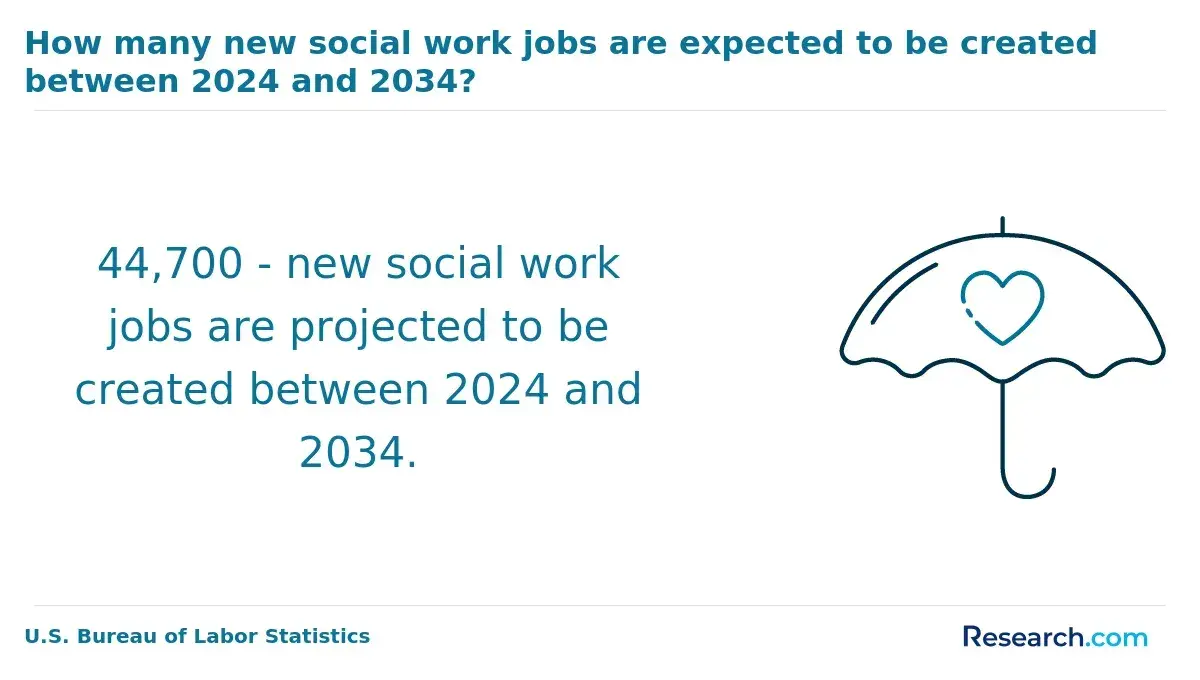
The job outlook for social workers between 2024 and 2034 is strong, with a projected growth rate of 12%, much faster than average across all fields. Demand is especially notable in healthcare, mental health, and substance abuse roles, where social workers help address behavioral health needs, care coordination, access barriers, and community-based support.
Child, family, and school social workers are also expected to see steady opportunities because schools, child welfare agencies, and family service organizations continue to need professionals who can support children, caregivers, and vulnerable households. The work may be demanding, but the need is persistent.
An MSW can improve access to clinical roles, which are often among the faster-growing and better-compensated areas of the profession. Advanced roles in healthcare social work and clinical therapy often require licensure, and licensure can improve employability by qualifying graduates for positions involving assessment, treatment planning, psychotherapy, or independent practice.
Administrative roles in nonprofits, public agencies, and community organizations may grow more slowly, but they can offer stability and opportunities for program leadership. Students interested in leadership should look for programs with coursework or field placements in management, policy, budgeting, grant writing, and program evaluation.
Prospective students should also weigh financial factors. Practice doctorate (DSW) graduates had an average loan debt of $48,402 in 2022-23, according to the CSWE Annual Survey of Social Work Programs. Salaries vary widely with specialization and location, typically ranging from $50,000 to $75,000 annually.
Where demand may be strongest
- Healthcare systems and hospitals
- Mental health clinics and behavioral health programs
- Substance abuse treatment settings
- Schools and youth-serving organizations
- Child welfare and family service agencies
- Aging services and long-term care coordination
Additional certifications or doctoral degrees can help those targeting leadership, teaching, advanced clinical, or research-oriented roles, but they should be pursued with a clear return on investment. Geographic location affects both job availability and wages; urban areas may offer more positions, while rural areas may have fewer providers and stronger demand in specific services.
Practical experience remains critical. Field placements, internships, volunteer work, and post-graduate supervision often shape employability as much as the degree title itself.
How to Choose an Accredited MSW Program?
Choosing an accredited MSW program starts with one non-negotiable requirement: confirm CSWE accreditation. Accreditation by the Council on Social Work Education indicates that the program meets national standards for social work education and is commonly required for licensure eligibility and many professional roles.
After accreditation, the best program is the one that fits your intended license, career path, budget, schedule, and fieldwork needs. A prestigious program is not automatically the best choice if it is unaffordable, lacks placements in your area, or does not align with your state's licensure requirements.
Key factors to compare
- Accreditation: Verify CSWE accreditation before applying or enrolling.
- Licensure alignment: Confirm that the curriculum supports the educational requirements in the state where you plan to practice.
- Program format: Compare full-time, part-time, online, hybrid, and campus-based options.
- Field placement quality: Ask how placements are selected, how supervision works, and what happens if a placement is not a good fit.
- Specializations: Look for concentrations that match your goals, such as clinical practice, school social work, healthcare, child welfare, policy, or administration.
- Faculty expertise: Review whether faculty interests align with your population, practice method, or research area.
- Cost and aid: Compare tuition, fees, scholarships, assistantships, employer benefits, and likely debt.
- Outcomes: Review state licensure pass rates where available, employment support, alumni pathways, and field agency partnerships.
Flexible delivery formats can be especially important for working adults and caregivers. Part-time, online, and hybrid programs can make graduate education more accessible, and this flexibility aligns with the growing trend in part-time social work education enrollment, which has risen by over 35% since 2009, according to CSWE data.
Field education deserves close scrutiny because it is often where program quality becomes most visible. Urban programs may offer more diverse practicum opportunities, while online programs may expand access for students who cannot relocate. However, students should not assume that an online program has strong local placement connections in every region.
Questions to ask before enrolling
- Is the program currently CSWE-accredited?
- Does the program meet educational requirements for licensure in my state?
- Who is responsible for finding my field placement?
- Can I complete field hours while working full time?
- What are the total tuition, fees, and estimated living or commuting costs?
- What support exists for students who struggle academically or in field placement?
- What career services, alumni networks, or licensure preparation resources are available?
A strong MSW program should be transparent about costs, realistic about fieldwork demands, clear about licensure alignment, and able to explain how its curriculum prepares students for specific roles. Choose the program that supports the career you want, not just the one that is easiest to enter.
Other Things You Should Know About Social Work
Most social work programs require students to complete supervised field internships in real-world settings such as hospitals, schools, or community organizations. These placements typically span several hundred hours and offer practical experience in applying social work theories and methods. Fieldwork is essential for developing hands-on skills and professional competence before graduation.
Yes, many social work programs allow students to specialize in areas like clinical social work, child and family services, gerontology, or community development. Specializations help students tailor their education to specific career goals and often include focused coursework and field experiences relevant to the chosen area.
In 2027, social work programs support students' mental health through counseling services, peer support groups, and wellness workshops. Many programs incorporate mindfulness sessions and offer access to mental health professionals, emphasizing a holistic approach to stress management and emotional resilience during the demanding MSW curriculum.
Cultural competence is a critical component of social work education, as practitioners must be able to work effectively with diverse populations. Programs incorporate training to enhance understanding of different cultural backgrounds, values, and social contexts, preparing students to provide respectful and appropriate services across varied communities.
References
- Online MSW Programs https://socialworklicensemap.com/social-work-degrees/online-msw-programs/
- How Much Can a Social Worker Make? https://www.herzing.edu/salary/social-worker
- How Long is a Master of Social Work Program? Length of MSW Programs https://www.masterofsocialwork.com/faqs/length-of-msw-programs
- Master of Social Work - Wikipedia https://en.wikipedia.org/wiki/Master_of_Social_Work
- High-demand social work roles in 2026: trends and opportunities https://socialwork.pacific.edu/blog/high-demand-social-work-roles-2026-trends-and-opportunities
- Noodle https://noodle.com
- The Future is Bright: LCSW Career Outlook and Opportunities in 2024 | PracticeMatch https://www.practicematch.com/healthcare/articles/the-future-is-bright-lcsw-career-outlook-and-opportunities-in-2024.cfm
- The Most Affordable MSW Programs: Public, Private and Online Schools Ranked https://www.studentloanplanner.com/cheapest-msw-programs/
- How hard is a social work degree? - Save The Social Worker https://www.savethesocialworker.com/blog/how-hard-is-a-social-work-degree/
- How to Choose MSW Programs to Apply to https://www.mswhelper.com/blog/how-to-choose-what-msw-programs-to-apply-to