2027 Is Social Work a Good Career for Empaths and Helpers?

Co-Founder and Chief Data Scientist
Choosing social work is not just a question of whether you care about people. It is a question of whether you can turn compassion into skilled, ethical, sustainable practice. For empaths, highly sensitive people, career changers, and students drawn to advocacy or counseling, social work can offer meaningful work in schools, hospitals, mental health settings, nonprofits, child welfare agencies, community organizations, and policy environments. It can also bring heavy caseloads, emotional exposure, documentation demands, and complex licensing rules.
This guide explains how to evaluate social work as a career path in 2026 without romanticizing the profession or dismissing its impact. You will learn what education is required, how online and campus programs compare, what accredited programs usually teach, how admissions and costs work, what licensed social workers may earn, and how to choose a reputable program. The goal is to help you decide whether social work fits your strengths, boundaries, financial goals, and long-term wellbeing.
Key Things You Should Know
- Social work careers uniquely suit empaths and helpers by leveraging strong interpersonal skills to support vulnerable populations, enhancing personal fulfillment and job effectiveness.
- Employment in social work is projected to grow by 12% from 2024 to 2034, reflecting increasing demand for mental health and community services.
- Challenges like burnout affect 40% of social workers, making self-care and professional boundaries critical for sustainable, long-term careers.
Is social work a good career fit for empaths and highly sensitive people?
Social work can be a strong fit for empaths and highly sensitive people when empathy is paired with training, supervision, and firm professional boundaries. Empathy helps social workers listen carefully, notice unspoken needs, build trust, and respond to clients without judgment. In roles such as counseling, case management, crisis intervention, school social work, and healthcare social work, those skills are central to effective practice.
Research also suggests that empathy can support job satisfaction. A 2025 study by SAS Publishers found a strong positive correlation (0.72, p < 0.01) between empathy levels and job satisfaction among 150 social workers. That does not mean every empath will enjoy the field, but it does indicate that empathic strengths can translate into professional satisfaction when the work environment is healthy.
Where empaths often thrive
- Clinical and counseling settings: Empaths who can maintain boundaries may do well in therapy-oriented roles that require careful listening and emotional attunement.
- Schools: School-based roles can provide a structured calendar, team collaboration, and opportunities to support children and families over time.
- Healthcare settings: Hospitals, clinics, and hospice programs often involve multidisciplinary teams, which can reduce isolation and improve decision-making.
- Program coordination or administrative roles: Highly sensitive professionals who want impact with less constant crisis exposure may prefer planning, outreach, quality improvement, or supervision roles.
Risks to consider before entering the field
The same sensitivity that helps a social worker connect with clients can also increase vulnerability to emotional burnout, compassion fatigue, secondary traumatic stress, and difficulty disconnecting after work. These risks are not personal failures. They are predictable occupational hazards in a profession that deals with poverty, trauma, illness, family conflict, discrimination, housing instability, and mental health crises.
Empaths considering social work should look for programs and employers that treat self-care as a professional competency, not as a personal afterthought. Strong supervision, manageable caseloads, peer consultation, trauma-informed practice, and clear role expectations matter as much as personal motivation.
Practical strategies for long-term sustainability
- Seek mentorship programs that explicitly address emotional resilience, ethical boundaries, and professional identity.
- Pursue continuing education in trauma-informed care, crisis response, documentation, and stress management.
- Choose workplaces with regular supervision, team-based decision-making, and peer support systems.
- Ask about caseload expectations before accepting a job, including documentation time and after-hours responsibilities.
- Build a personal decompression routine that does not depend on willpower alone, such as scheduled exercise, therapy, consultation, or protected time away from work communication.
For professionals who want to move into advanced leadership, teaching, or practice roles, researching the cheapest online DSW programs can help identify lower-cost doctoral pathways. The key is to choose a social work path that uses compassion effectively while protecting your mental health and financial stability.
What are the core educational requirements to become a licensed social worker?
The core educational path to licensed social work in the United States usually begins with a Bachelor of Social Work (BSW) or a Master of Social Work (MSW), depending on the license level and state rules. Because licensing is state-regulated, students should verify requirements with their state board before enrolling. In most cases, the safest choice is a program accredited by the Council on Social Work Education (CSWE), because CSWE accreditation is commonly tied to licensure eligibility.
Bachelor-level preparation
A BSW accredited by the Council on Social Work Education (CSWE) introduces students to social work ethics, human behavior, social welfare policy, research, diversity, advocacy, and generalist practice. It also includes supervised fieldwork or internships, where students learn how agencies operate and how social workers document, assess, refer, and support clients.
A BSW may qualify graduates for entry-level social service roles and, in some states, bachelor-level licensure. It can also create a faster route into graduate study through advanced standing MSW programs, when available.
Master-level preparation
An MSW is the standard graduate degree for advanced social work practice and is typically required for clinical licensure. MSW programs build on generalist training with coursework in clinical assessment, counseling methods, evidence-based interventions, policy, leadership, research, and advanced field education.
Many states demand an MSW and 2,000 to 4,000 hours of supervised post-master's clinical work before granting licensure as a Licensed Clinical Social Worker (LCSW). Requirements may also include a state-approved supervisor, specific documentation, background checks, and limits on how quickly supervised hours can be completed.
Exams and continuing education
Social work licensing educational requirements in the US also include passing the relevant Association of Social Work Boards (ASWB) exam and completing ongoing continuing education credits to maintain licensure. Continuing education may cover ethics, cultural competence, mandated reporting, suicide prevention, trauma, telehealth, or other topics required by the state.
Some states offer advanced licenses that may require doctoral degrees, though these are less common. Students interested in clinical practice should focus first on the MSW, supervised practice requirements, and the specific LCSW rules in the state where they plan to work.
Fit matters as much as eligibility
Prospective students should also consider the emotional realities of the profession. Social workers report an average rating of 2.9 out of 5 stars for job happiness, placing them in the bottom 23% of careers surveyed by CareerExplorer. This does not mean social work is a poor choice; it means applicants should evaluate workload, supervision, compensation, and stress tolerance before committing to the path.
Students who need flexibility while meeting educational standards can compare masters of social work online programs, especially if they are working, caregiving, or planning a career change.
What degree programs and specializations are available in social work?
Social work degree options range from undergraduate preparation for generalist roles to doctoral education for leadership, research, policy, teaching, or advanced practice. The right degree depends on the type of work you want to do, whether you need licensure, and how much time and money you can invest.
Common social work degree levels
- Bachelor of Social Work (BSW): A foundational degree covering human behavior, social welfare policy, ethics, research basics, diversity, and generalist practice. It can lead to entry-level roles and may shorten an MSW through advanced standing options.
- Master of Social Work (MSW): The main credential for clinical social work, advanced case management, leadership, and many specialized roles. MSW programs often allow students to concentrate in clinical practice, children and families, mental health, healthcare, school social work, gerontology, or community practice.
- Doctor of Social Work (DSW): A practice-focused doctorate often designed for experienced professionals interested in leadership, teaching, program development, advanced clinical expertise, or applied practice innovation.
- PhD in Social Work: A research-focused doctorate for those interested in academic careers, policy research, advanced scholarship, or large-scale evaluation of social programs.
Popular specialization areas
- Clinical social work: Focuses on assessment, diagnosis where permitted by state law, psychotherapy, treatment planning, and mental health support.
- Child and family welfare: Prepares students to work with families, foster care systems, child protection agencies, adoption services, and prevention programs.
- School social work: Centers on student wellbeing, attendance, family engagement, crisis response, special education teams, and school-community coordination.
- Healthcare social work: Involves discharge planning, care coordination, patient advocacy, family support, chronic illness, and interdisciplinary collaboration.
- Gerontology: Focuses on older adults, caregivers, long-term care, aging policy, hospice, and services that support independence and dignity.
- Community organization and macro practice: Emphasizes advocacy, program design, policy analysis, nonprofit leadership, community development, and systems change.
Dual degrees and interdisciplinary options
Some schools offer dual degree options that combine an MSW with public health, law, business, public policy, theology, or criminal justice. These programs can be useful for students who want to address complex social problems through both direct service and systems-level work. They also usually require more planning, more credits, and careful review of cost and career payoff.
Emotional intelligence is especially relevant across specializations. Research from the University of Texas at Austin shows higher emotional intelligence strongly correlates with increased compassion satisfaction in licensed social workers. For students who identify as empathic, a specialization should be chosen not only for passion but also for fit with workload, crisis exposure, supervision, and preferred client population.
Students comparing flexible graduate pathways can review MSW programs online to see which options support their preferred specialization, field placement needs, and career timeline.
How do online social work programs compare to campus-based options?
Online and campus-based social work programs can both prepare students for licensure and employment when they are properly accredited and include approved field education. The better choice depends on your schedule, learning style, location, support needs, and ability to complete supervised practicum placements.
Online programs
Online programs are often best for working adults, parents, rural students, military-connected students, and career changers who cannot relocate or attend classes at fixed times. Many offer asynchronous coursework, which lets students complete lectures and assignments around work or family responsibilities. Some also include synchronous sessions for discussion, skills practice, or advising.
The trade-off is that online students must be proactive. They may need to communicate more deliberately with faculty, seek peer connection intentionally, and confirm early how local field placements are arranged. A flexible class schedule does not make field education optional; social work still requires in-person or supervised practice experiences approved by the program.
Campus-based programs
Campus programs provide face-to-face access to faculty, classmates, student services, and local agency networks. Students who learn best through direct discussion, structured schedules, and in-person relationship building may prefer this format. Campus programs may also have longstanding field placement relationships in the surrounding region.
The drawbacks are less flexibility, commuting time, relocation costs for some students, and fewer options for those who must maintain full-time employment. Students should look beyond format and compare actual advising quality, placement support, faculty availability, and licensure outcomes.
Key comparison points
- Accreditation: Both online and campus programs should meet the accreditation expectations needed for licensure in your state.
- Fieldwork: Online students often complete placements locally, while campus students may rely more heavily on regional agency partnerships.
- Cost: Online study may reduce commuting, relocation, parking, or housing expenses, but tuition may be similar across formats.
- Support: Ask how the program handles advising, crisis support during field placements, technology help, disability accommodations, and licensure preparation.
- Networking: Campus networking can happen more naturally, while online networking requires more intentional participation in cohorts, alumni groups, and professional associations.
The growing demand for social workers-with employment projected to increase by 7%, adding about 60,800 jobs annually-makes program choice important. Students should choose the format that helps them complete the degree, succeed in fieldwork, and qualify for the roles they want, not simply the format that appears easiest at first glance.
Applicants seeking accessible graduate options can compare MSW online programs, while still verifying accreditation, field placement support, admissions standards, and state licensure alignment.
What is the typical curriculum and coursework in accredited social work programs?
Accredited social work programs are designed to prepare students for ethical, evidence-informed practice with individuals, families, groups, organizations, and communities. While course titles vary, most programs combine theory, policy, research, practice methods, diversity training, and supervised field education.
Core curriculum areas
- Human behavior and the social environment: Students examine psychological, biological, social, cultural, and environmental factors that shape development and wellbeing across the lifespan.
- Social welfare policy: Courses explain how laws, public programs, funding systems, eligibility rules, and advocacy shape client access to services.
- Social work practice methods: Students learn engagement, assessment, intervention planning, documentation, case management, counseling basics, crisis response, and group facilitation.
- Research and evaluation: Coursework teaches students how to read evidence, evaluate programs, understand data, and apply findings responsibly in practice settings.
- Ethics and professional responsibility: Programs emphasize confidentiality, informed consent, boundaries, mandated reporting, dual relationships, documentation, and ethical decision-making.
- Cultural competence and anti-oppressive practice: Students study how race, class, gender, disability, immigration status, religion, sexuality, age, and other identities affect access, risk, resilience, and trust.
Field education
Field education is a defining part of social work training. Students complete supervised practicum hours in settings such as hospitals, schools, behavioral health agencies, child welfare organizations, shelters, courts, veteran services, community nonprofits, or government agencies. Field placements help students translate classroom learning into professional judgment, documentation habits, client engagement, and interprofessional collaboration.
Students should ask how placements are assigned, whether evening or weekend placements are realistic, how conflicts with supervisors are handled, and what support is available if a placement becomes unsafe or unsuitable. Fieldwork can be rewarding, but it is also where many students first encounter the pace and pressure of the profession.
Specialized coursework
Many programs offer electives or concentrations in healthcare, child welfare, mental health, substance use, gerontology, school social work, community practice, policy, military social work, or trauma-informed care. These choices can shape field placements, licensure preparation, and early career opportunities.
Programs often offer specializations like healthcare, child welfare, or mental health, which correspond to wage variations within the profession. For example, social workers in healthcare report median wages higher than the overall average, illustrating the potential benefit of specialized training. Students should still evaluate the full picture: salary, emotional intensity, schedule, supervision, and advancement opportunities.
A strong curriculum should not only teach compassion. It should teach students how to assess risk, document clearly, understand systems, practice ethically, use evidence, collaborate across disciplines, and protect their own sustainability in demanding roles.
What are admission requirements for accredited bachelor's and master's social work programs?
Admission requirements vary by school, but accredited social work programs generally look for academic readiness, communication skills, ethical maturity, relevant experience, and a realistic understanding of the profession. Applicants should treat the admissions process as a chance to show both motivation and preparedness.
Bachelor's social work admission requirements
Admission to accredited bachelor's social work programs generally requires a high school diploma or GED and official transcripts showing completion of core subjects such as English, math, and social sciences. Minimum GPA expectations typically range from 2.5 to 3.0, though more competitive programs may require higher.
Many schools also ask for letters of recommendation, a personal statement, or essays explaining why the applicant wants to enter social work. Volunteer or work experience in social services is highly valued because it shows exposure to helping roles and a clearer understanding of client needs, agency systems, and professional boundaries.
Master's social work admission requirements
Master's social work programs require a bachelor's degree from an accredited institution. The degree does not always need to be in social work, but programs may expect prerequisite coursework in areas such as human behavior, social policy, psychology, sociology, statistics, or research methods. A minimum GPA around 3.0 is common, with some top programs requiring more.
GRE scores are often requested unless waived. Applicants usually submit multiple recommendation letters, a detailed personal statement, and a resume highlighting employment, internships, volunteer service, advocacy, research, or human services experience. Strong applications explain not only the applicant's passion for helping but also their readiness for difficult conversations, ethical complexity, writing-intensive work, and supervised practice.
Advanced standing options
Some MSW programs offer advanced standing for BSW graduates. This can shorten degree completion time because students have already completed accredited undergraduate social work preparation. Applicants should confirm eligibility rules, minimum GPA requirements, fieldwork expectations, and whether advanced standing limits or supports their desired specialization.
How to strengthen an application
- Gain direct exposure through volunteering, case aide work, crisis line service, community outreach, residential programs, shelters, schools, or healthcare settings.
- Choose recommenders who can speak to reliability, judgment, communication, cultural humility, and readiness for professional training.
- Use the personal statement to connect lived experience, service experience, and career goals without oversharing or presenting personal hardship as the sole qualification.
- Research each program's mission, concentrations, field placement model, and licensure alignment before applying.
- Be honest about your limits and support systems, especially if you are drawn to high-trauma roles.
A University of Texas at Austin study linked work-life imbalance with lower compassion satisfaction among social workers, emphasizing the importance of preparing well before entering the field. Admissions preparation should therefore include academic planning, emotional readiness, and a clear strategy for sustaining yourself through training and practice.
How long does it take to complete a social work degree and what are typical costs?
Completing a social work degree in the United States typically takes between two and six years, depending on the credential, enrollment status, transfer credits, and whether the student qualifies for advanced standing. Cost varies widely, so students should compare total program price rather than tuition alone.
Typical completion timelines
- BSW: A Bachelor of Social Work usually requires about four years of full-time study. Transfer students may finish faster, while part-time students may need longer.
- MSW: A Master of Social Work generally takes two years after the bachelor's degree for full-time students. Accelerated one-year options exist for those with a BSW, typically through advanced standing programs.
- Part-time study: Part-time BSW or MSW students may extend the timeline to balance work, caregiving, field placements, and financial obligations.
- Doctoral study: Doctoral timelines vary by program type, dissertation or capstone requirements, and whether the student enrolls full time or part time.
Typical costs
Tuition costs vary widely by institution type, residency, and program format. Public universities often charge between $7,000 and $15,000 annually for in-state students, while private institutions typically range from $20,000 to $40,000 per year. Online programs may reduce some expenses, such as commuting, relocation, or campus housing, but they often maintain similar tuition rates as campus-based options.
Students should also budget for fees, textbooks, technology, transportation to field placements, background checks, immunizations, liability insurance, parking, exam preparation, and licensure application costs. Field placements can also affect earnings if they require daytime availability that limits paid work hours.
Financial aid and cost control
- Complete financial aid forms early and compare grants, scholarships, loans, and work-study options.
- Ask whether the school offers social work-specific scholarships, public service scholarships, graduate assistantships, or tuition discounts.
- Check whether your employer offers tuition reimbursement or schedule flexibility for field education.
- Compare in-state public options, accredited online programs, and advanced standing pathways if eligible.
- Calculate debt against realistic salary expectations in your intended specialty and location.
Financial aid, scholarships, and employer tuition reimbursement can help reduce these costs, especially for working professionals pursuing part-time study. MSW applicants should review program accreditation and licensure preparation carefully because a lower-cost program that does not support licensing goals can become expensive later.
CareerExplorer reports social workers rate their work meaningfulness at 3.4 out of 5, reflecting the rewarding nature of these roles beyond happiness. That sense of meaning is important, but it should be weighed alongside debt, earning potential, working conditions, and personal sustainability.
What are the average salaries and job prospects for licensed social workers?
Licensed social worker salaries vary by license level, specialization, employer, geographic region, years of experience, and whether the role is clinical, school-based, healthcare-based, government-funded, nonprofit, or private practice. Job prospects are generally favorable, but opportunities are not distributed evenly across every specialization.
Salary expectations
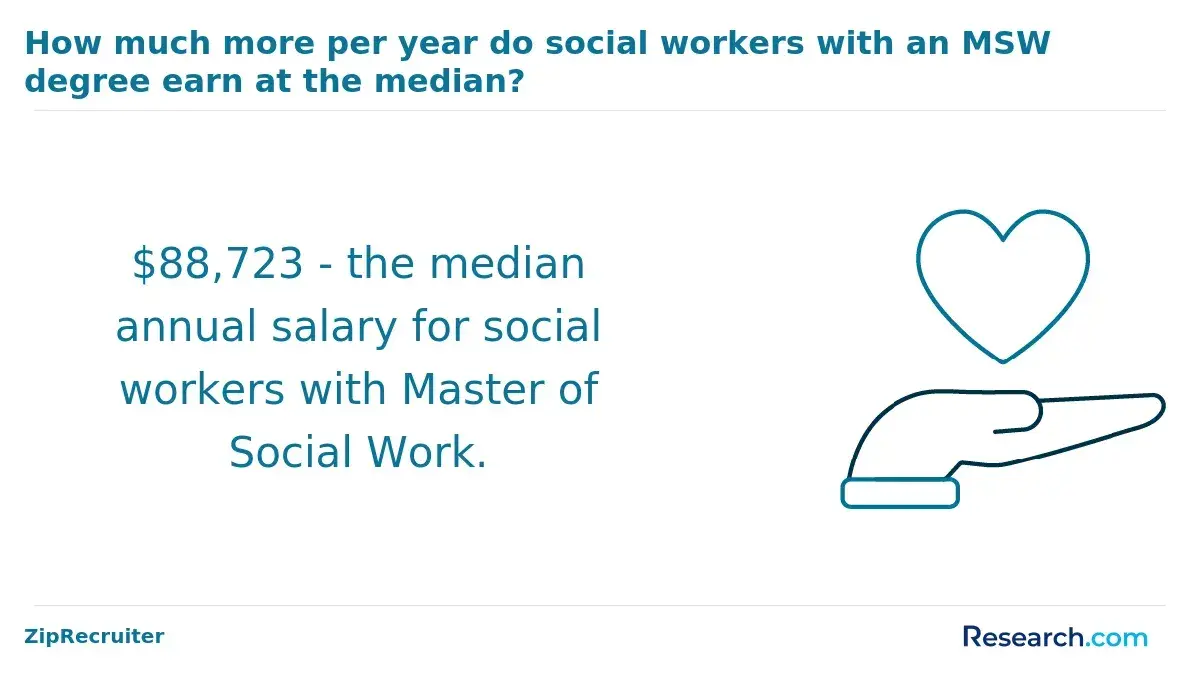
Licensed social workers in the United States earn an average annual salary around $60,000, with entry-level clinical social workers making roughly $50,000 to $55,000. Experienced licensed clinical social workers (LCSWs), particularly in healthcare or private practice, can earn over $75,000. Child, family, and school social workers typically have median salaries between $50,000 and $60,000.
These figures should be treated as broad benchmarks rather than guaranteed outcomes. Social workers in high-cost metropolitan areas may see higher posted salaries but also higher living expenses. Rural areas may offer fewer employers but sometimes provide loan repayment opportunities, broader roles, or stronger community relationships. Private practice can offer income potential, but it also involves business risk, insurance billing, client acquisition, and unpaid administrative time.
Job outlook
The job outlook for licensed social workers is strong, with an estimated growth rate of about 12% through the late 2020s, exceeding the average for most occupations. This growth is fueled by greater mental health awareness, aging populations, and expanded healthcare access. Demand is especially visible in behavioral health, healthcare coordination, aging services, schools, crisis response, and substance use treatment.
However, not every pathway has the same labor market. Macro social work roles-those involved in policy and community infrastructure planning-face a 15% hiring gap, revealing fewer job openings compared to qualified candidates. Students interested in macro practice should build strong policy, data, grant writing, program evaluation, coalition-building, and leadership skills to compete for fewer specialized roles.
Ways to improve earning potential and job stability
- Obtain an LCSW license if your goal is clinical practice, therapy, supervision, or higher-paying behavioral health roles.
- Choose geographic locations carefully, since metropolitan areas tend to offer better salaries and more opportunities, though often with higher living costs.
- Specialize in sectors such as healthcare, mental health, or gerontology for greater job security.
- Build documentation, assessment, crisis response, and interdisciplinary collaboration skills, which employers often value highly.
- Be prepared for tougher competition in macro social work roles despite advanced training.
- Compare benefits, supervision, loan repayment, caseload expectations, and schedule demands rather than evaluating salary alone.
For many social workers, the best long-term career strategy is to combine licensure, specialization, and strong boundaries. Higher pay is helpful, but a sustainable position also requires manageable workload, ethical supervision, and a setting where social workers have enough authority to practice effectively.
What certifications and credentials can social workers pursue beyond licensure?
Beyond state licensure, social workers can pursue specialized certifications to demonstrate expertise in a practice area, strengthen credibility with employers, and support career advancement. These credentials do not replace licensure, and requirements vary by issuing organization, but they can help clarify a social worker's focus.
Examples of specialized credentials
- Certified Clinical Social Worker (CCSW): Recognizes advanced clinical skills in mental health practice.
- Certified School Social Work Specialist (C-SSWS): Supports professionals working in educational settings with students, families, teachers, and school systems.
- Licensed Certified Social Worker-Board Certified Diplomate (LCSW-BC): Identifies advanced recognition related to psychoanalysis.
- Certified Hospice and Palliative Social Worker (CHP-SW): Focuses on end-of-life care, family support, grief, and interdisciplinary hospice or palliative practice.
- Certified Addictions Specialist (CAS): Supports professionals assisting veterans with substance abuse.
- Medical Social Worker Certification (MSW-C): Provides specialization for healthcare roles and helps employers verify medical social work expertise.
Typical requirements
These credentials generally require a master's degree in social work, documented clinical experience, and passing certification exams. For example, CCSW candidates must submit supervised clinical hours and take a standardized exam. Some certifications may also require current licensure, continuing education, professional references, or practice hours in the specialty area.
How to choose the right certification
The best credential is the one that supports a specific career goal. A school social worker may gain more from an education-focused credential than a healthcare credential. A hospice social worker should prioritize palliative and end-of-life care training. A clinical practitioner should consider credentials that align with therapy, diagnosis, supervision, trauma, or addictions practice, depending on state scope-of-practice rules.
According to the Georgetown University Center on Education and the Workforce, MSW graduates see an average lifetime earnings premium of $1.2 million, reflecting a 180% return on investment compared to those without degrees. Certifications can add professional value, but they should be weighed against exam fees, renewal requirements, continuing education costs, and employer recognition.
Before pursuing any credential, confirm that it is recognized in your state, respected by employers in your specialty, and aligned with the clients or systems you want to serve. A credential should sharpen your practice identity, not simply add letters after your name.
How do you identify and choose an accredited, reputable social work program?
The most important first step is verifying accreditation by the Council on Social Work Education (CSWE). CSWE accreditation indicates that the program meets national standards for social work education and is commonly required for licensure eligibility. Do not rely only on marketing language; confirm accreditation directly through official sources and ask the program how it aligns with licensure requirements in your state.
What to evaluate before enrolling
- Accreditation and licensure alignment: Confirm that the program prepares graduates for the license level and state where they plan to practice.
- Field placement support: Ask how placements are secured, what agencies are available, whether students can propose sites, and how the school handles placement problems.
- Faculty expertise: Programs led by experienced practitioners or active researchers often provide stronger mentorship and more current knowledge.
- Specializations: Check whether the school offers coursework and placements in your intended area, such as clinical practice, child welfare, healthcare, school social work, gerontology, or macro practice.
- Outcomes: Review graduation rates, licensure exam pass rates, employment outcomes, alumni feedback, and advanced standing results where available.
- Student support: Look for advising, writing support, mental health resources, disability services, career services, and help with licensure paperwork.
- Flexibility: Compare online, hybrid, evening, weekend, full-time, and part-time formats based on your work and caregiving responsibilities.
- Total cost: Include tuition, fees, books, travel, technology, field placement expenses, and potential lost wages.
Questions to ask admissions staff
- Is the program currently CSWE-accredited, and where can I verify that status?
- Does the curriculum meet licensure requirements in the state where I plan to work?
- How are field placements assigned, supervised, and evaluated?
- What happens if a field placement is not a good fit?
- What are recent graduation rates and licensure exam pass rates?
- How accessible are faculty and advisors for online or part-time students?
- What support is available for students experiencing stress, burnout, or ethical concerns in fieldwork?
Studies from IDEA Training show social workers with high empathy levels achieve 25% higher client engagement but face an 18% increased burnout risk without proper autonomy support. That finding makes program culture important. A reputable school should teach resilience, supervision use, boundaries, self-reflection, and ethical autonomy, not only intervention techniques.
Practicum placements are especially important because they shape both skill development and professional networks. Verify that the program collaborates with reputable organizations that match your career goals, whether in healthcare, schools, community agencies, behavioral health, child welfare, or policy settings.
Finally, speak with current students and alumni when possible. Ask about responsiveness, workload realism, field placement quality, faculty support, and whether the program's promises match the student experience. The right social work program should be accredited, transparent, financially realistic, and strong enough to prepare you for both the meaning and the demands of the profession.
Other Things You Should Know About Social Work
In 2027, social workers face key challenges such as managing high caseloads, navigating evolving digital tools and regulations, and addressing diverse client needs in culturally sensitive ways. Additionally, the profession continues to tackle mental health and resource scarcity issues in underserved communities.
Social workers often experience high caseloads and emotional stress due to the complexity of clients' needs. They may face bureaucratic hurdles and limited resources, which can impact service delivery. Maintaining professional boundaries while providing empathetic care is another ongoing challenge in this field.
Yes, most states require licensed social workers to complete continuing education (CE) credits regularly to maintain their credentials. These courses help professionals stay updated on best practices, ethics, and new developments in social work. Continuing education also supports specialized certifications and career advancement.
Many social workers move into supervisory, management, or policy-making positions after gaining experience. Advanced degrees or additional training in administration can support transitions into leadership roles. These positions involve overseeing programs, managing teams, and contributing to organizational strategy and development.
References
- how - Wiktionary, the free dictionary https://en.wiktionary.org/wiki/how
- How to Become a Licensed Social Worker https://onlinecounselingprograms.com/mental-health-careers/how-to-become-licensed-social-worker/
- A Complete Guide to MSW Specializations for 2023 https://mastersinsocialworkonline.org/resources/msw-specializations/
- Medical Social Work Salary Overview | Psychology.org https://www.psychology.org/social-work/medical-social-work/
- Social Work Salaries https://www.socialworkers.org/careers/career-center/kickstart-your-job-hunt/social-work-salaries
- How to become a social worker https://basw.co.uk/careers/how-become-social-worker
- Certification FAQs https://www.abcsw.org/certification-faqs
- How Being an HSP Contributes to My Career as a Psychotherapist https://highlysensitiverefuge.com/how-being-an-hsp-contributes-to-my-career-as-a-psychotherapist/
- Empathy In Social Work: Improving Outcomes https://ideatraining.org/empathy-in-social-work/
- Master of Social Work Programs https://socialworklicensemap.com/social-work-degrees/master-of-social-work-programs/